It is not uncommon for FDI enterprises to face penalties due to payroll management errors during their first years of operation in Vietnam. Payroll often becomes one of the biggest challenges for foreign investors entering the market, given the differences in labor regulations, tax policies, and the local operating environment.
In this context, payroll outsourcing services are increasingly chosen by businesses to ensure compliance and optimize internal resources. So, what are payroll outsourcing services, which businesses should use them, and how can companies select a reliable service provider? The article below clarifies these issues.
1. Why is payroll management challenging for FDI enterprises in Vietnam?
Labor law and social insurance regulations are frequently updated
Regulations relating to salaries, social insurance, health insurance, and unemployment insurance in Vietnam are regularly revised to align with labor and social welfare policies. As a result, many FDI enterprises face difficulties in tracking and promptly applying new rules when managing payroll.
The legal framework for salary and personal income tax is relatively complex
Vietnam’s salary-related regulations go beyond base salary and also involve personal income tax (PIT), allowances, employee benefits, and mandatory insurance obligations. Accurately calculating and declaring these items requires businesses to have a solid understanding of the law and the relevant reporting procedures.
Language barriers and differences in the legal environment
In addition to legal factors, language barriers and differences in working culture can make HR and payroll management even more complicated for FDI enterprises. In many cases, an incomplete understanding of local regulations or the application of unsuitable HR processes may result in errors in payroll management, employee benefits, and compliance obligations.
Because of these challenges, many FDI enterprises choose payroll outsourcing services to ensure legal compliance and optimize internal resources.
2. What are payroll outsourcing services? How is the service implemented?
2.1. What is payroll outsourcing?
Payroll outsourcing services refer to the arrangement in which a company hires a professional third-party provider to handle all or part of the activities related to payroll administration and labor compliance obligations. Instead of building an internal team to manage complex issues related to salaries, taxes, and insurance, businesses can transfer these functions to a specialized service provider.
In practice, payroll outsourcing services usually include activities such as:
- Preparing and calculating monthly payroll
- Declaring personal income tax for employees
- Registering and managing mandatory insurance contributions (social insurance, health insurance, and unemployment insurance)
- Preparing and submitting labor reports as required by law
- Supporting the company in complying with labor and tax regulations
By using payroll outsourcing services, businesses can reduce administrative workload, minimize payroll errors, and improve compliance, especially in a legal environment like Vietnam where labor and tax regulations contain many detailed requirements.
2.2. Payroll outsourcing service implementation process
In practice, payroll management goes far beyond simply calculating employee salaries. It also includes multiple steps related to HR data, tax and insurance obligations, and reporting to competent authorities.
Typically, payroll outsourcing services are implemented through the following process:
Step 1: Collecting and verifying payroll data
At the initial stage of payroll outsourcing services, the service provider will coordinate with the enterprise to collect the information necessary for payroll calculation, including:
- Employment contract information
- Salary levels and allowances
- Attendance records or working hour data
- Employee movement information (new hires/resignations)
- Relevant deductions or employee benefits
After collection, the data is reviewed and verified to ensure accuracy before payroll calculation begins.
Step 2: Preparing and calculating payroll
Based on the verified data, the payroll provider will:
- Calculate the monthly payroll for employees
- Determine the amount of personal income tax (PIT) to be withheld
- Calculate mandatory insurance contributions such as social insurance, health insurance, and unemployment insurance
Once completed, the payroll statement is sent to the company for review and approval before proceeding to the next stage.
Step 3: Issuing payslips and supporting salary payment
After the payroll is approved, the payroll provider will prepare and issue payslips for each employee. Payslip distribution must be handled confidentially and sent to the correct recipients.
Step 4: Handling tax and insurance obligations
An important part of payroll outsourcing services is ensuring that the company fulfills its obligations to state authorities. These tasks commonly include:
- Declaring and paying personal income tax
- Registering and paying mandatory insurance contributions for employees
- Registering dependents for tax deductions, where applicable
- Supporting the processing of insurance benefits such as maternity leave, sick leave, or occupational accident benefits
You may also be interested in: Personal Income Tax 2026: Key Changes Directly Affecting Employees
Step 5: Labor reporting and legal compliance
In addition to payroll processing, payroll outsourcing services also help enterprises fulfill their legal reporting obligations, such as:
- Reporting labor usage status (increase/decrease in headcount)
- Updating employee information with the social insurance authority
- Preparing periodic labor- and salary-related reports
Following these steps helps enterprises maintain a transparent, accurate, and compliant payroll system while minimizing HR administration errors.
3. Why do FDI enterprises in Vietnam prefer payroll outsourcing services?
For foreign-invested enterprises, managing payroll in a new market like Vietnam often creates many challenges related to labor law, taxation, and mandatory insurance systems. In addition, differences in legal frameworks and operating practices between countries can make it difficult to establish an effective internal payroll system.
In this context, many FDI enterprises choose payroll outsourcing services as a solution to improve operations, ensure legal compliance, and strengthen HR management efficiency.
3.1. Focusing on core business activities
When using payroll outsourcing services, enterprises do not need to allocate excessive resources to administrative tasks such as payroll calculation, tax filing, or insurance administration.
This allows management teams and HR departments to focus on strategic activities such as market expansion, business development, and workforce management.
3.2. Saving costs and improving operational efficiency
Building an in-house payroll system often requires investment in payroll software, IT systems, and personnel with expertise in tax and insurance matters.
For FDI enterprises, these costs can be considerable in the early stages of operation. Payroll outsourcing services help reduce initial investment costs while allowing businesses to leverage the expertise of professional service providers.
3.3. Strengthening compliance and minimizing legal risks
Payroll management is directly linked to a wide range of regulations, including labor law, personal income tax rules, and mandatory insurance obligations. These regulations are updated regularly and may differ significantly from the legal framework in the investor’s home country.
As a result, ensuring full compliance with local rules can become a major challenge for FDI enterprises. By using payroll outsourcing services, businesses can reduce the risk of errors in filings and reporting while ensuring that all legal obligations are handled properly.
3.4. Improving employee experience and retaining talent
A transparent and accurate payroll system plays an important role in building employee trust. When salaries, taxes, and insurance contributions are calculated clearly and paid on time, employees feel more secure about their entitlements.
For FDI enterprises competing for talent in Vietnam, maintaining a professional and transparent payroll process is also a key factor in improving employee experience and retaining high-quality staff.
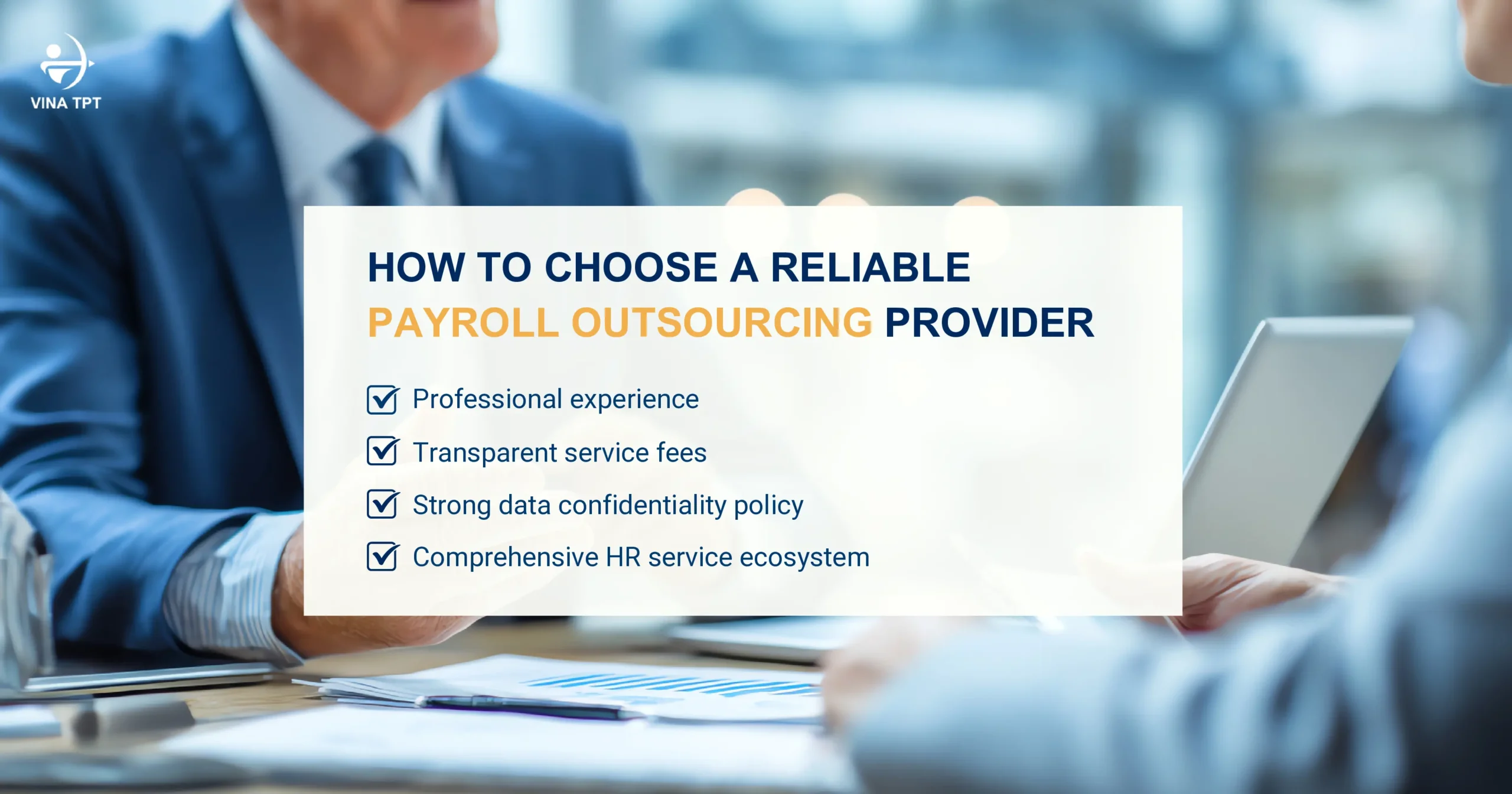
4. Four criteria for choosing a reliable payroll outsourcing services provider in Vietnam
Selecting the right payroll outsourcing services provider is especially important for FDI enterprises, as payroll is not only about paying employees but also closely tied to tax obligations, insurance contributions, and compliance with Vietnamese labor law.
Below are four key criteria businesses should consider when selecting a payroll service partner.
4.1. Experience and professional capability
A reliable provider of payroll outsourcing services is usually reflected through the following factors:
-
Proven track record and successful client base: Providers with many years of experience generally have a solid understanding of labor law, tax, and insurance regulations, and are better equipped to handle practical issues flexibly. Long operating history and a strong client portfolio are two important indicators when assessing a provider’s capability and reliability.
-
A clear payroll management system: Payroll statements should have a transparent structure, be easy to review, and be managed through a suitable payroll system. Components such as salaries, bonuses, allowances, and employee benefits should be clearly defined to ensure both accuracy and transparency.
-
An experienced team of specialists: A service provider should have specialists who understand labor law and taxation in depth. In particular, experience working with FDI enterprises is a significant advantage, because such specialists not only understand Vietnam’s legal environment but are also familiar with the working practices of international businesses. This helps ensure effective implementation and timely updates on legal changes.
4.2. Transparent and reasonable service fees
Service fees often reflect the professionalism of payroll outsourcing services. If the fees are too high, the enterprise may bear unnecessary operating costs. On the other hand, fees that are too low may indicate risks in service quality or a lack of transparency in the service agreement.
A professional provider typically offers a clear and transparent pricing structure that corresponds to the scope of services delivered. Therefore, businesses should prioritize providers that offer transparent quotations, clearly drafted service contracts, and specific commitments regarding the scope of work.
4.3. Data confidentiality policy
Payroll involves sensitive data relating to both the enterprise and its employees, including:
- Employees’ personal information
- Salary details and employee benefits
- Personal income tax and insurance data
For this reason, a payroll outsourcing services provider must have a clear confidentiality policy and a secure data management system to ensure that such information is protected throughout the cooperation period.
Businesses should also prioritize providers that maintain strict data control procedures and include confidentiality commitments in the service contract.
4.4. A comprehensive HR service ecosystem
In practice, FDI enterprises often have broader HR administration and labor compliance needs beyond payroll management alone. Therefore, choosing a payroll service provider with a comprehensive HR service ecosystem can bring substantial benefits.
Additional services commonly provided alongside payroll outsourcing services may include:
- Support for visas and work permits for foreign experts
- Consulting on HR policies and employee benefits
- Support for personal income tax finalization and periodic labor reporting
This allows businesses to simplify HR administration, optimize operating costs, and maintain better legal compliance.
5. Why is Vina TPT a leading payroll outsourcing services partner for FDI enterprises?
Based on the provider selection criteria outlined above, Vina TPT not only meets the required standards of expertise, experience, and data security, but also brings added value to businesses.
With more than 20 years of experience in business consulting, HR, and accounting services, Vina TPT has supported thousands of domestic and foreign enterprises in establishing and operating in Vietnam. Notably, more than 80% of Vina TPT’s clients are Japanese enterprises, a group of investors well known for their high standards in accuracy, process discipline, and compliance.
In addition, Vina TPT is currently supporting many international enterprises from Germany, Taiwan, the United States, the United Kingdom, Russia, Canada, Australia, Singapore, and many other countries, helping them build payroll systems that are transparent, accurate, and aligned with Vietnamese law.
Thanks to its practical experience and a team of specialists with strong knowledge of labor law and tax regulations, Vina TPT provides effective payroll services in Vietnam, helping enterprises optimize payroll administration, minimize compliance risks, and allocate more resources to core business operations.