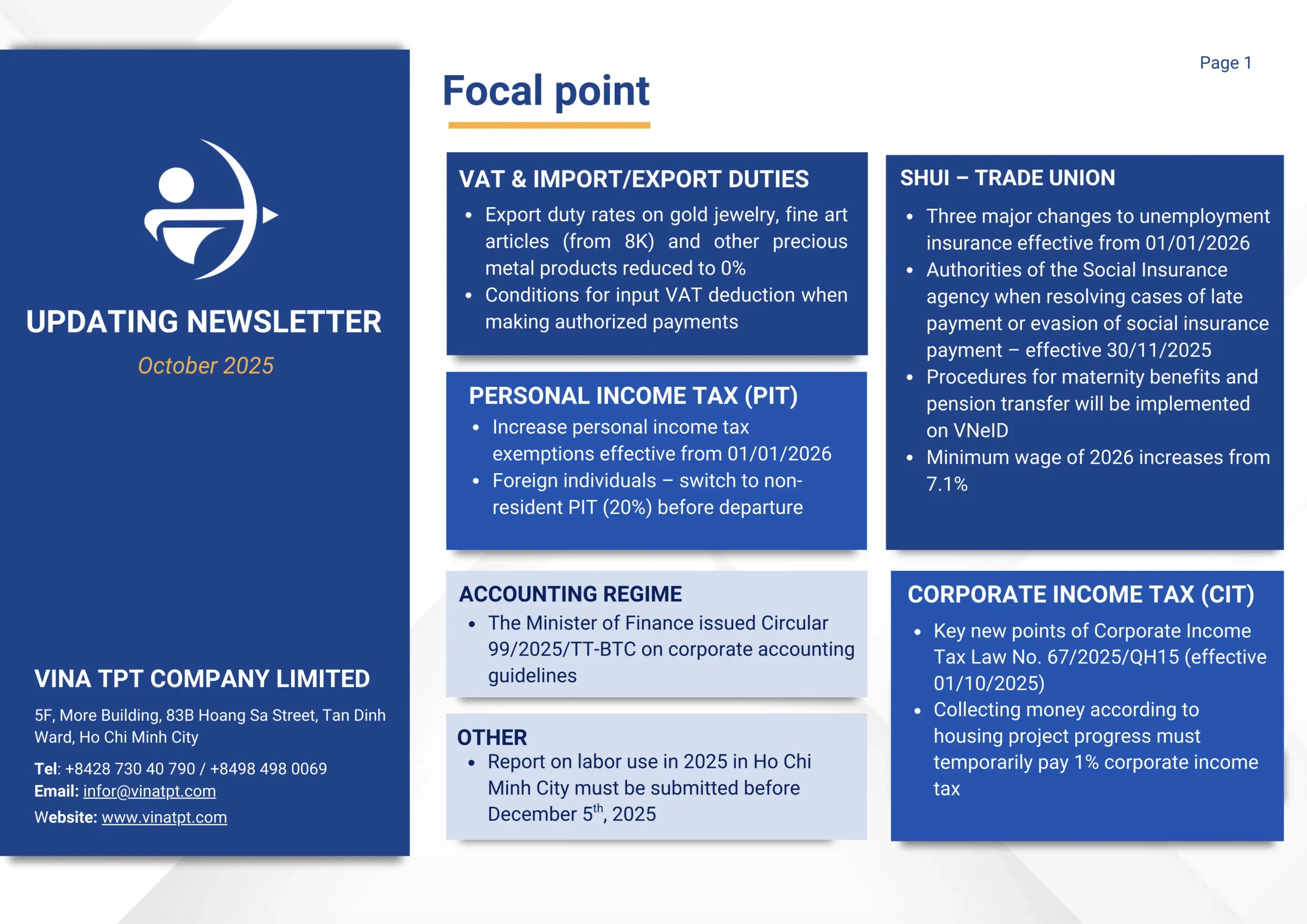
Vietnam is implementing a series of new tax, accounting, insurance, and labour regulations effective from October 2025. Notable updates include reduced export duty rates, clarified rules for input VAT deduction, higher PIT family circumstance deductions, a shift to non-resident taxation for certain foreign individuals, new CIT rates and deductible expense rules, and stricter sanctions on late or unpaid insurance contributions. These updates will reshape compliance requirements and influence core business operations, particularly in finance, payroll, and reporting functions.
This article outlines the essential policy changes businesses need to prepare for to ensure smooth compliance and operational continuity.
1. VAT & IMPORT/EXPORT DUTIES
1.a. Export duty on gold jewellery, fine art articles (from 8K) and other precious metal products reduced to 0%
Decree No. 260/2025/NĐ-CP dated 10/10/2025 of the Government amends the export duty rates for certain commodity lines under groups 71.13, 71.14 and 71.15 in the Export Tariff Schedule issued together with Decree No. 26/2023/NĐ-CP dated 31/05/2023.
The Decree reduces the export duty rate from 1% to 0% for the following items:
- Jewellery and parts thereof, of other precious metal, whether or not plated or clad with precious metal (HS codes 7113.19.10 and 7113.19.90);
- Articles of goldsmiths’ or silversmiths’ wares and parts thereof, of other precious metal, whether or not plated or clad with precious metal (HS code 7114.19.00);
- Other articles of gold or silver (HS code 7115.90.10).
Products that are currently subject to the 0% export duty rate will continue to enjoy the existing 0% rate.
1.b. Input VAT deduction when payment is made via third-party authorisation
Official Letter No. 4850/DON-QLDN1 dated 15/10/2025 of Đồng Nai Provincial Tax Department provides guidance on the deduction of input VAT in cases where non-cash payment is made through authorisation to a third party.
According to the regulations, for the enterprise to be eligible for input VAT deduction, it must fully satisfy the general conditions prescribed in Clause 2, Article 14 of Law No. 48/2024/QH15:
- Possession of a VAT invoice for the purchase of goods and services or VAT payment document.
- Availability of non-cash payment evidence.
- For exported goods and services, additional documents are required: contract, invoice, non-cash payment evidence, customs declaration, and other related documents.
In addition, when making payment through authorisation to a third party, the enterprise must comply with the further conditions stipulated in Decree No. 181/2025/NĐ-CP:
- The authorisation for payment to the third party must be specifically stipulated in a written contract.
- The third party must be an organisation or individual lawfully operating.
If the company fully satisfies all the above conditions and other relevant legal provisions, it will be entitled to deduct the input VAT.
2. PERSONAL INCOME TAX (PIT)
2.a. Increase in family circumstance deductions effective from 01/01/2026
On 17 October 2025, the Standing Committee of the National Assembly issued Resolution No. 110/2025/UBTVQH15 adjusting the family circumstance deductions for personal income tax. This Resolution takes effect from 01 January 2026 and applies to the 2026 tax period.
- The deduction for the taxpayer himself/herself is increased from VND 11 million to VND 15.5 million per month (VND 186 million per year) (Article 1, point a). This means the taxpayer may deduct this amount when calculating taxable income, thereby reducing the tax payable.
- The deduction for each dependant is increased from VND 4.4 million to VND 6.2 million per month (Article 1, point b). Accordingly, taxpayers with dependants will enjoy an additional deduction corresponding to the number of dependants, further easing the tax burden.
2.b. Foreign individuals – switch to non-resident PIT (20%) before departure
On 03 October 2025, the Tax Department issued Official Letter No. 4221/CT-CS providing guidance on PIT for foreign individuals working in Vietnam for less than 183 days and required to finalise their tax obligations before leaving the country. Specifically, where a foreign individual has previously been subject to resident PIT withholding and has self-declared PIT on overseas-paid income arising from work performed in Vietnam, but the actual number of days present in Vietnam is less than 183 days, such individual must re-determine their PIT obligations under the non-resident regime.
- PIT is calculated at 20% on total Vietnam-sourced income, irrespective of where the income is paid or received.
- Tax finalisation must be completed prior to departure from Vietnam.
3. CORPORATE INCOME TAX (CIT)
3.a. Key new points of Corporate Income Tax Law No. 67/2025/QH15 (effective 01/10/2025)
Official Letter No. 2244/QNG-NVDTPC dated 13 October 2025 of Quảng Ngãi Provincial Tax Department introduces the key new points of the Corporate Income Tax Law No. 67/2025/QH15 (effective from 01 October 2025). The main changes are as follows:
- Expanded scope of taxpayers:
Addition of foreign enterprises that do not have a permanent establishment in Vietnam (including those engaged in e-commerce and digital platforms).
2. Taxable income:
Additional provision stipulating that taxable income arising in Vietnam for foreign enterprises is income derived from Vietnam, regardless of where the business activities are conducted.
3.New CIT rates based on revenue:
- Standard rate: 20%
- Enterprises with total annual revenue not exceeding VND 3 billion: 15%
- Enterprises with total annual revenue exceeding VND 3 billion but not exceeding VND 50 billion: 17%
- Oil and gas exploration and production activities: 25% – 50% depending on the project.
4.Determination of taxable income:
- Taxable income from business activities is the total income from all business activities.
- Loss carry-forward is allowed between activities, except for real estate transfer activities, investment projects, and participation rights in investment projects when the entity is enjoying tax incentives.
- Income from the transfer of mineral exploration, extraction, and processing projects must be accounted for separately and may not be offset against other activities.
5.Tax exemption and reduction:
- Public-service entities providing public services in socio-economically disadvantaged areas are entitled to a 50% reduction of CIT payable.
- Enterprises converted from household businesses are exempt from CIT for two consecutive years from the year taxable income first arises.
6.Science and technology development fund:
Maximum contribution rate increased to 20%.
7.New tax calculation method:
Application of CIT as a percentage of revenue for enterprises with annual revenue ≤ VND 3 billion when revenue can be determined but costs and income cannot be determined.
8.Additional deductible expenses:
- Expenses related to seconded personnel participating in management, administration, and control at credit institutions under special control or commercial banks subject to mandatory transfer.
- Certain expenses incurred for business and production purposes but not yet generating corresponding revenue in the period, as stipulated by the Government.
- Expenses for supporting the construction of public infrastructure that simultaneously serves business and production activities.
- Expenses related to greenhouse gas emission reduction, carbon neutrality, net-zero initiatives, and environmental pollution reduction linked to business and production activities.
- Certain contributions to funds established by decision of the Prime Minister or the Government.
3.b. Temporary CIT payment of 1% on progress payments received for housing projects
Official Letter No. 5129/CT-CS dated 12 November 2025 of the Tax Department on tax policies:
- For housing investment projects intended for transfer/sale: If the investor collects advance payments according to progress, it must make provisional quarterly Corporate Income Tax (CIT) payments equal to 1% of the amounts collected, pursuant to Point b, Clause 6, Article 8 of Decree No. 126/2020/NĐ-CP.
- Regarding interest expense for enterprises with related-party transactions: Deductible interest expense is subject to the cap under Clause 3, Article 16 of Decree No. 132/2020/NĐ-CP and applies to all enterprises with related-party transactions, irrespective of whether they are domestic or foreign-invested enterprises.
4. SOCIAL, HEALTH & UNEMPLOYMENT INSURANCE – TRADE UNION
4.a. Three major changes to unemployment insurance effective from 01/01/2026 (Law on Employment 2025)
On 16 June 2025, the National Assembly passed the Law on Employment 2025, which officially takes effect from 01 January 2026. Accordingly, unemployment insurance policies will undergo significant changes, with the following three key updates to unemployment insurance effective from 01/01/2026:
(1) No entitlement to unemployment benefits upon eligibility for pension
From 01/01/2026, under point a, clause 1, Article 39 of the Law on Employment 2025, employees who terminate employment or end their labour contract upon reaching eligibility for pension benefits will not be entitled to unemployment benefits. Thus, effective from 01/01/2026, unemployment benefits will not be payable to individuals who meet pension eligibility criteria, regardless of whether pension procedures have been initiated.
(2) Faster receipt of unemployment benefits with reduced waiting period to 10 days
From 2025, pursuant to clause 3, Article 39 of the Law on Employment 2025, the commencement date for unemployment benefits effective from 01/01/2026 will be the 11th working day following the submission of a complete application dossier for unemployment benefits. This represents a reduction of 5 days from the current regulation, under which benefits commence from the 16th day after dossier submission.
(3) Maximum level of unemployment benefits
Pursuant to clause 1, Article 39 of the Law on Employment 2025, the maximum monthly unemployment benefit for all employees shall not exceed 5 times the regional minimum wage at the time of contract termination.
4.b. Penalties for late or evaded compulsory social/health/unemployment insurance contributions – effective 30/11/2025
On 16 October 2025, the Government issued Decree No. 274/2025/NĐ-CP detailing certain provisions of the Social Insurance Law regarding late payment, evasion of compulsory social insurance and unemployment insurance contributions; complaints and denunciations related to social insurance. This Decree takes effect from 30 November 2025.
- Late payment interest rate: 0.03% per day calculated on the amount and number of days of late or evaded payment (Article 3, Clause 1, Point d; Article 7, Clause 2).
- Conversion period to evasion: An act of late payment shall be converted to an act of evasion after 60 days from the expiry of the latest payment deadline, provided that the Social Insurance Agency has issued a written reminder (Article 6, Clause 1, Point c).
- Evasion by understating salary: The act of registering a salary base for social insurance contributions lower than prescribed under the Social Insurance Law shall be deemed evasion (Article 6, Clause 1, Point b).
- Exemption from evasion classification (force majeure): Specific enumeration of 4 force majeure cases not to be considered as evasion (such as storms, floods, dangerous epidemics, emergency situations) as announced by competent authorities (Article 4).
5. ACCOUNTING REGIME
5.a. Circular 99/2025/TT-BTC guiding the accounting regime for enterprises
On 27 October 2025, the Ministry of Finance issued Circular No. 99/2025/TT-BTC regulating the accounting regime for enterprises, replacing Circular No. 200/2014/TT-BTC dated 22 December 2014. Circular No. 99/2025/TT-BTC takes effect from 01 January 2026 and applies to financial years beginning on or after 01 January 2026. Pursuant to the regulations, Circular No. 99/2025/TT-BTC simultaneously repeals and replaces the following documents:
- Circular No. 200/2014/TT-BTC guiding the accounting regime for enterprises;
- Circular No. 75/2015/TT-BTC (amending Article 128 of Circular 200);
- Circular No. 53/2016/TT-BTC (amending and supplementing certain provisions of Circular 200);
- Circular No. 195/2012/TT-BTC dated 15 November 2012 guiding accounting for main investors.
However, certain provisions related to the accounting for the equitisation of State-owned enterprises under Circular 200 shall continue to apply until the Ministry of Finance issues a new replacement document.
Below are some key differences between Circular No. 99/2025/TT-BTC and Circular No. 200/2014/TT-BTC regarding the accounting regime for enterprises:
Method of converting financial statements prepared in foreign currency to Vietnamese Dong:
- Assets and liabilities shall be converted to Vietnamese Dong at the average transfer buying/selling exchange rate of the commercial bank where the enterprise regularly conducts transactions as at the end of the accounting period;
- Owner’s equity (owner’s contributed capital, capital surplus, other capital, convertible bond options) shall be converted to Vietnamese Dong at the actual transaction exchange rate on the date of capital contribution;
- Revaluation differences of assets shall be converted to Vietnamese Dong at the actual transaction exchange rate on the revaluation date; …..
Chart of accounts: Reduced to 71 level-1 accounts, abolishing 6 accounts, including 4 accounts related to non-business funding sources, capital construction investments, and 2 accounts (611 and 631).
Addition of accounts: Renaming of accounts and addition of new accounts (e.g., Account 215 – Biological assets, etc.). Abolition of certain accounts: 621 – Purchase costs, 631 – Production costs, etc.
Accounting forms and financial statement templates: Enterprises may also design additional or amend and supplement accounting forms and financial statement templates compared to those guided under this Circular to suit the characteristics of production and business activities and management requirements. Renaming of the “Balance Sheet” template to “Statement of Financial Position”.
6. OTHER
6.a. 2025 Labour Utilisation Report for Ho Chi Minh City – Must be submitted before 05 December 2025
Official Letter No. 9002/SNV-VLATLĐ dated 13 November 2025 of the Ho Chi Minh City Department of Home Affairs on the implementation of Article 4 of Decree No. 145/2020/NĐ-CP regarding labour utilisation reporting.
The Ho Chi Minh City Department of Home Affairs provides the following guidance on the submission of the 2025 labour utilisation report by establishments within the territory of Ho Chi Minh City:
- Entities required to submit the report:
- Agencies, organisations, enterprises, cooperatives, households, and individuals that hire, employ, or utilise labour.
- Those with headquarters or places of operation within the territory of Ho Chi Minh City.
2. Content of the report:
- To be completed in accordance with Form No. 01/PLI in Appendix I issued together with Decree No. 145/2020/NĐ-CP.
3. Method of submission (select one of the two options):
- Submission via the National Public Service Portal: Perform the “Integrated procedure for registering adjustments to compulsory social insurance, health insurance, unemployment insurance contributions and labour utilisation reporting”: https://dichvucong.gov.vn/.
- Submission to the Department of Home Affairs: Send the report online via Google Form: https://forms.gle/CiLKksGKq5McCyDP7.
4. Submission deadline: To be completed before 05 December 2025.
5. Important notes:
- After the prescribed deadline, the Department of Home Affairs will not accept any reports.
- The Department of Home Affairs will compile the implementation status as a basis for confirming compliance with legal regulations upon request from relevant agencies.
- Failure to submit the report on time may result in administrative violations under Clause 2, Article 8 of Decree No. 12/2022/NĐ-CP.