Vietnam is transitioning from a stage of rapid growth to a stage of high-quality growth, meaning growth based more on technology, productivity, and added value instead of relying only on labor scale and investment capital. FDI attraction data for the first half of 2026 shows this trend quite clearly: foreign capital is gradually shifting toward high-tech industries, green manufacturing, and high value-added services. These industries are likely to continue being the driving force leading the economy in the 2026–2030 period. In other words, the competition for investment attraction no longer revolves around low costs, but has shifted to project quality, technological capability, and the level of preparation of investors.
The policy context also follows that direction. The GDP growth targets for the upcoming period, together with the orientation in Resolution 10-NQ/TW and the strategy for attracting quality FDI, all place emphasis on projects that have technology, added value, and legal compliance. For foreign investors, this means that opportunities are still broad, but it is necessary to determine the right direction and carefully prepare the legal part right from the beginning. For enterprises considering expansion into Vietnam, the important question is not only which industry has potential, but also what needs to be prepared to bring the project into operation in compliance with regulations. This article analyzes the industries with great potential in the next 5 years, the practical challenges when starting a business, and how to prepare to seize vietnam business opportunities in a systematic manner.
1. Why Vietnam Remains Attractive for Business Opportunities
There are three main reasons why Vietnam continues to be a destination worth considering for foreign investors seeking vietnam business opportunities:
- Growth foundation from 2026: Registered FDI capital increased strongly, in which the processing and manufacturing industry still accounts for a large proportion but is gradually shifting toward high-tech and green technology segments. Investors therefore have both an existing manufacturing ecosystem to connect with and room for new projects in higher value-added segments.
- Long-term advantages: A young population, a wide network of free trade agreements (FTA), the continued promotion of institutional reform process, together with incentive policies for high technology and clean energy. These factors help the business environment become more predictable in the medium and long term.
- Change in the way of attracting investment: Vietnam is shifting from “attracting capital” to “attracting trust and added value,” meaning that investors are not only evaluated on capital scale but also on the level of compliance, long-term commitment, and contribution to the economy.
Overall, business opportunities in Vietnam in the 2026–2030 period no longer lie only in production costs. Projects with clear plans, complete legal dossiers, and orientations consistent with high-tech, green, and high value-added service trends are usually easier to implement smoothly.
For foreign investors, this trend carries two practical meanings. First, projects associated with technology, green manufacturing, and high value-added services have many points consistent with the overall orientation of the State. Second, preparing dossiers, enterprise structure, and compliance plans right from the beginning becomes part of the competitive advantage.
2. Top Business Opportunities by Sector
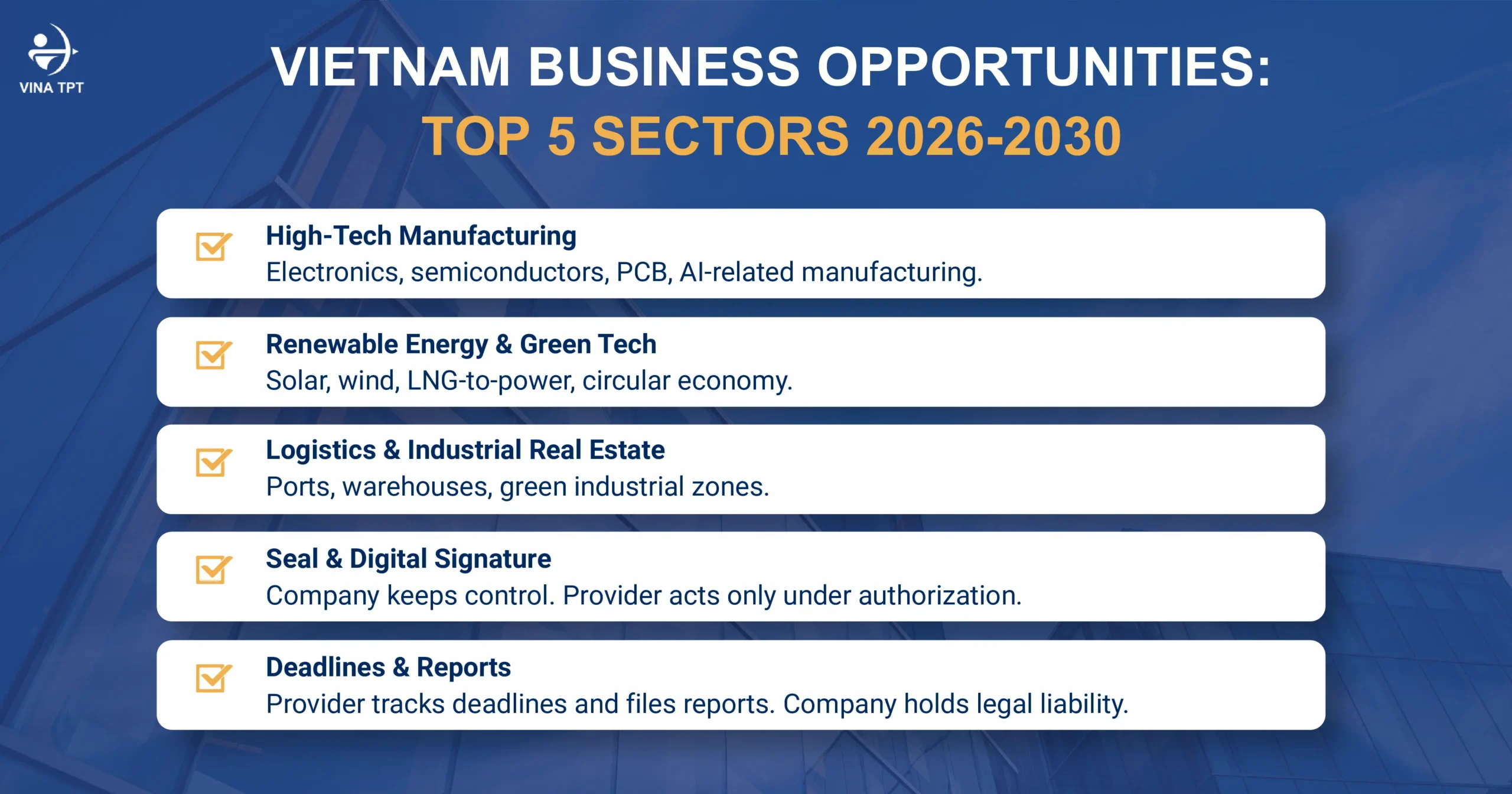
The following five sectors offer some of the most promising Vietnam business opportunities for foreign investors from 2026 to 2030. Each sector is examined in terms of its growth potential, key investment opportunities, and important considerations for foreign investors.
2.1. High-tech Manufacturing & Semiconductors
The main opportunity lies in electronics manufacturing, semiconductor chips, printed circuit boards (PCB), and manufacturing activities related to artificial intelligence (AI), a group of industries currently belonging to the group attracting large FDI. Investors can participate in assembly, testing, component manufacturing, and supporting equipment stages. This industry is expected to continue developing until 2030 thanks to the trend of diversifying global supply chains, the continued increase in demand for electronic devices and AI infrastructure, together with policies encouraging high technology. When participating, foreign investors need to check market access conditions and incentives applicable to high-tech projects, and at the same time determine early the production location and specialized licenses needed. In practice, projects in this group are usually associated with the supply chains of large corporations, so investors need to consider early their position in the chain in order to plan for factories, technical personnel, and investment dossiers.
2.2. Renewable Energy & Green Tech
The main opportunity concentrates on solar energy, wind power, LNG gas power, and solutions serving the circular economy. This industry has much room for development until 2030 thanks to the increasing demand for clean electricity from the manufacturing enterprise sector and the green transition trend in supply chains. The note for foreign investors is that energy projects are tightly regulated in terms of planning, specialized licenses, and pricing mechanisms, so these contents need to be reviewed from the early stage before deciding to implement. Due to the long-term investment characteristic, investors should also clarify the ownership structure, investment form, and conditions applicable to foreign investors before signing agreements with domestic partners.
2.3. Logistics & Industrial Real Estate
The main opportunity includes port systems, warehouses, green industrial zones, and supporting services for supply chains. This industry develops together with the expansion of manufacturing activities, because each new factory brings demand for warehousing, factories, and infrastructure connection. Foreign investors need to note issues regarding land allocation, land lease, environmental impact assessment, and the possibility of connecting technical infrastructure around the project. In addition, investors should consider the linkage between warehouses, transportation, and industrial zones, because the effectiveness of the project depends largely on the ability to connect between stages in the supply chain.
2.4. Digital Economy, AI & Fintech
The main opportunity concentrates on e-commerce, AI application solutions, financial technology (fintech), and data centers. This industry continues to be promoted by the digital transformation process of enterprises and the digital consumption habits of the people. Foreign investors need to pay special attention to regulations on cybersecurity, personal data protection, and business conditions applicable to conditional business lines, especially in the financial sector. This industry group usually changes quickly in terms of technology and management regulations, so investors need to monitor legal updates regularly instead of reviewing only once when applying for permits.
2.5. Healthcare & Supporting Industries
The main opportunity lies in digital health, medical equipment, and supporting industries for manufacturing. The increasing demand for quality healthcare is the driving force for this industry to develop until 2030. FDI enterprises need to consult carefully on procedures for licensing the circulation of equipment, mandatory technical standards, and investment conditions applicable to foreign investors in the healthcare sector. Investors should also clarify the source of material supply, technical capacity, and professional personnel plan, because this is an industry with high requirements on quality and safety.
In addition to the above five industries, the Vietnamese market still has many other potential fields so that investors can easily identify the industry of interest, including: Education & Training, Food Processing & Agro-processing, Tourism & Hospitality, E-commerce & Retail, Supporting Industries such as components and packaging, Professional Services, Commercial & Industrial Real Estate, Logistics Technology, Green Building Materials, and Data Centers. While these sectors expand the range of Vietnam business opportunities, each comes with its own market access requirements and legal conditions. Foreign investors should review these requirements carefully before choosing an industry and investment structure.
VIEW COMPANY FORMATION SERVICE
3. Key Challenges and Practical Tips for Foreign Investors
Although Vietnam business opportunities continue to expand, entering the market still requires careful preparation. In practice, foreign investors commonly face three main challenges:
- Administrative procedures and sub-licenses: Depending on the industry, the enterprise may have to complete many steps such as investment registration, enterprise registration, and applying for sub-licenses before being allowed to operate. Each industry has its own requirements on business conditions, so the time for preparing dossiers may differ.
- Tax and accounting compliance: The enterprise needs to grasp regulations on invoices, tax declaration, accounting books, and periodic reports right from the start of operations. Errors at the early stage easily lead to having to adjust dossiers, supplementary declarations, and incurring processing costs.
- Competition for high-quality personnel: Recruiting and retaining skilled labor, especially in technology industries, usually requires a systematic personnel plan. Salary levels and remuneration policies also need to be calculated into the financial plan right from the beginning.
Regarding practical advice, investors should prepare reasonable capital sources for the initial stage and cooperate with local advisory firms that understand the regulations. Discussing with the advisory firm in advance is not aimed at choosing the industry on behalf of the investor, but helps the enterprise prepare the necessary procedures before starting the business, from legal dossiers, working location to accounting, tax, and personnel. Early preparation helps limit arising issues and avoid delays when the enterprise enters operations. The contents that should be prepared in advance include the legal dossier of the investor, capital plan, working location, accounting – tax plan, and personnel needs (vietnam business opportunities)
For more details on the specific requirements when registering an LLC, investors can refer to the article Vietnam LLC Registration Requirements: A Complete Guide for Investor 2026.
4. How Vina TPT Helps You Seize Vietnam Business Opportunities
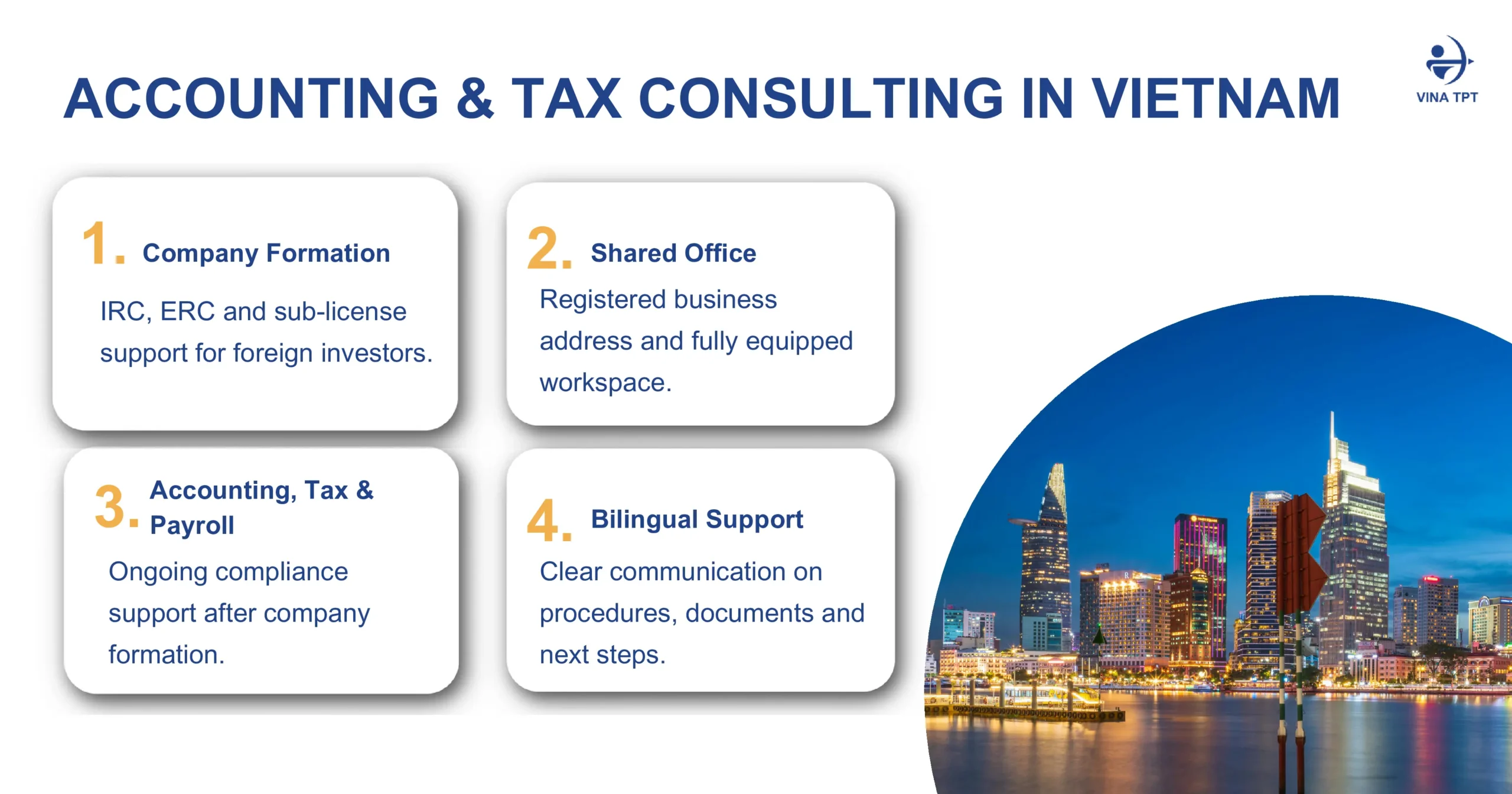
With more than 20 years of experience supporting FDI enterprises, Vina TPT helps foreign investors turn Vietnam business opportunities into practical investment plans. From company formation to ongoing operations, the team provides legal, accounting, tax, and administrative support. The main services include:
- Support for company formation (IRC/ERC) and applying for sub-licenses according to industry, helping investors complete legal procedures to start the business. The team reviews industries, business conditions, and necessary procedures so that dossiers are prepared correctly right from the beginning.
- Provide Shared Office with full facilities and affordable prices, helping clients have a working location and business registration address. This is a convenient choice for newly established enterprises that need a working location right when starting operations (vietnam business opportunities)
- Provide full-package Tax, Accounting & Payroll services after the enterprise is established, so that the enterprise maintains compliance right from the first months of operations. The service helps the enterprise monitor tax, accounting, and salary obligations in accordance with regulations.
- A bilingual working team, convenient for foreign investors when discussing procedures and dossiers. Thanks to that, investors can communicate in a familiar language and clearly understand each step in the implementation process (vietnam business opportunities)
If considering a specific field or not yet sure which procedure to start from, investors can discuss in advance with Vina TPT in order to clearly understand the steps that need to be prepared, the expected progress, and the related legal conditions before deciding to implement.
Conclusion
Vietnam is opening up many high-quality opportunities for foreign investors, especially in high-tech industries, green energy, logistics, digital economy, and healthcare. However, opportunities only become results when investors choose the right direction and prepare carefully regarding legal, tax, accounting, and personnel matters before starting. The three groups of matters to note are understanding industry trends, grasping the applicable legal conditions, and fully preparing dossiers, accounting, and tax before operations. Good preparation helps investors reduce arising risks and shorten the time from investment decision to actual operations.
If your enterprise is seeking vietnam business opportunities, please contact Vina TPT to receive free company formation advisory and comprehensive support, from initial legal procedures to accounting, tax, and payroll services after formation. Just send basic information about the expected project, Vina TPT will respond with guidance on the next steps.
BOOK A FREE CONSULTATION