Many foreign investors, when beginning to research the market, often believe that establishing an FDI company in Vietnam through an advisory firm only requires paying a single full-package service fee to complete the entire operating apparatus. This is a fairly common notion but is not truly complete in the actual implementation of the investment project.
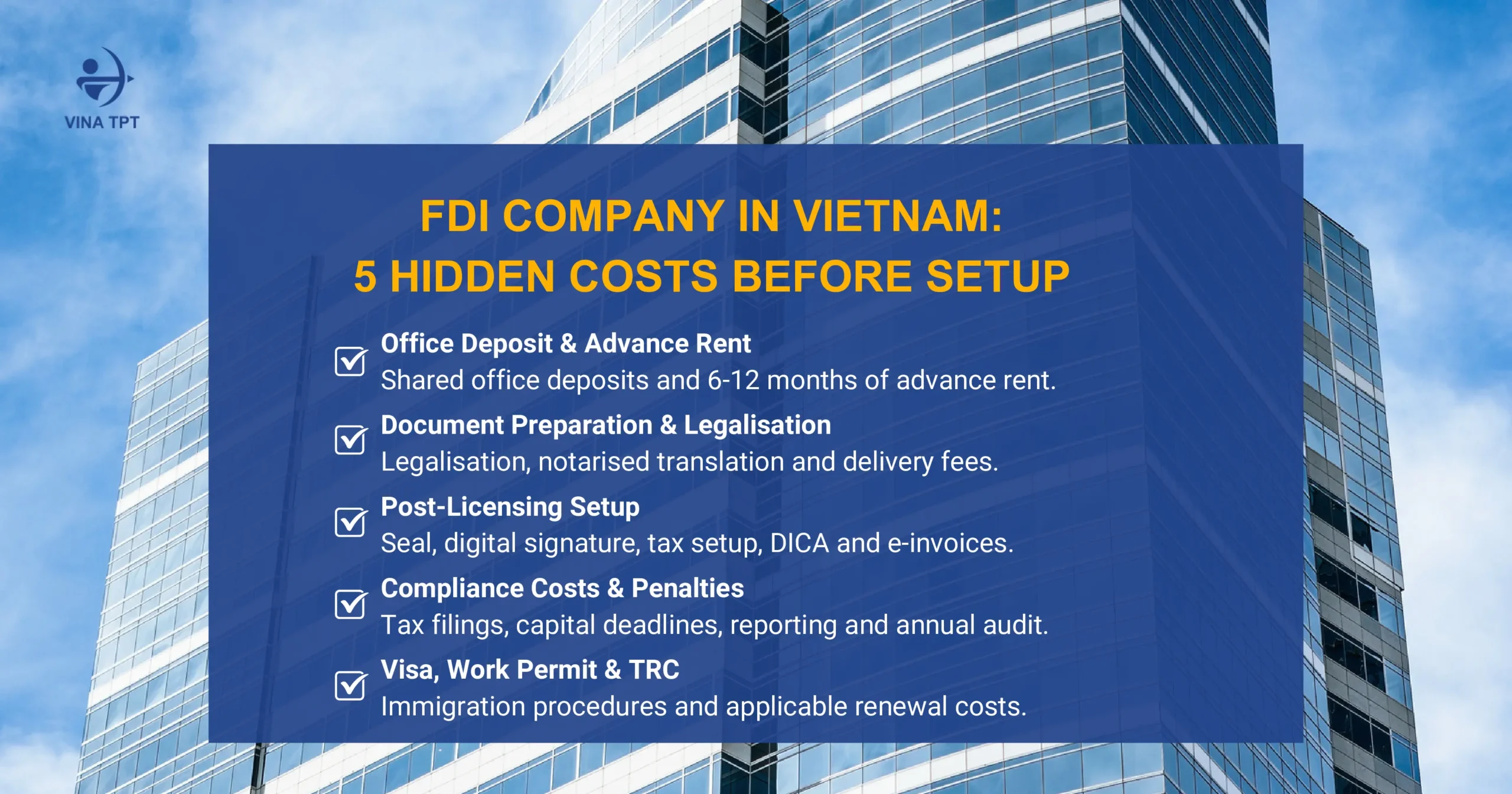
In practice, there are many arising costs lying outside the scope of the initial company formation quotation. This article summarizes and analyzes 5 key hidden costs that investors need to discuss and clarify directly with the advisory firm right from the planning stage, helping to proactively reserve the budget and ensure operational progress.
1. Registered Office: Deposit and Advance Rent
In the stage of newly entering the market, choosing the shared office model (Shared Office) is the optimal option prioritized by the majority of enterprises. This solution helps maximize savings on the initial operating budget, provides standard working space, and provides a full set of documents proving the legal right to use the location in order to perform the business registration procedure.
However, a noteworthy hidden cost is that office lessors often put forward the requirement of placing a rent deposit and the requirement of paying rent in advance for a term of 6 to 12 months.
Enterprises need to note that this is a cost for the head office location that must be budgeted right from the beginning. Vina TPT is currently providing the Shared Office service as a business registration address for clients choosing the company formation solution.
2. Document Preparation and Legalisation
The process of preparing legal dossiers requires original documents from the investor’s country to undergo legalization procedures in order to have validity for use in Vietnam:
- For corporate investors (Parent Company): The entire set of enterprise documents must be certified as legal. From 11/09/2026, countries that are members of the Apostille Convention perform certification under the regulations in Decree 293/2026/ND-CP; however, for countries such as Germany, Austria, and the Czech Republic that have submitted objection documents, the dossiers are still required to perform the consular legalization procedure at the Vietnamese Consulate in the home country.
- For individual investors: The dossier is simpler when the passport only needs to be notarized. Proof of financial capacity is confirmed through the individual’s bank account balance confirmation.
- Arising hidden costs: Fees for obtaining original documents in the home country, Apostille certification or consular legalization fees, notarized translation fees into Vietnamese, and ordinary delivery costs are usually not within the scope of the company formation service quotation of advisory firms.
- Mistakes that increase costs: Preparing documents too early leading to the dossier expiring at the time of submission (it is recommended to perform the legalization procedure within 30 days before the official filing date), or information on the enterprise name, capital amount, and registered address not matching correctly among the documents.
3. Post-Licensing Setup: Tax Registration, Seal, Digital Signature and Bank Account
Most firms providing company formation services have already included state fees in the initial quotation; however, the chain of actual operational tasks after receiving the Enterprise Registration Certificate (ERC) plays an extremely important role in the legal operation of the company.
The sequence of mandatory steps that must be completed after receiving the ERC includes:
- Performing engraving of the enterprise’s legal entity seal.
- Registering to purchase and activate the digital signature (Digital Certificate / USB Token).
- Submitting the initial tax registration dossier and initializing the electronic identification account (VNeID) for the enterprise.
- Opening the foreign investment capital account in accordance with the regulations in Circular 38/2026/TT-NHNN. In this step, the Legal Representative of the enterprise must be present in person at the bank to sign the account opening dossier.
- Performing full contribution of the registered charter capital as prescribed.
- Registering to use the electronic invoice system under the regulations in Decree 254/2026/ND-CP.
What to Confirm in an FDI Company in Vietnam Setup Package
In the case where the company formation service package chosen by the investor does not include the above post-licensing tasks, the enterprise must calculate and prepare additional budget to recruit internal personnel or hire an external professional service firm to implement them.
4. Compliance Costs Caused by Mistakes
Right at the time of receiving the ERC, the enterprise has officially acquired legal entity status in Vietnam and immediately incurs legal compliance obligations under the provisions of law:
- Periodically submitting Value-Added Tax (VAT) returns on time.
- Performing full contribution of 100% of the charter capital within 90 days from the date of issuance of the ERC (while ensuring the progress of contributing investment project capital according to the commitment recorded on the IRC).
- Submitting periodic quarterly and annual reports on the implementation status of the investment project on the national information system.
- Appointing personnel to hold the position of Chief Accountant or Person in charge of accounting.
- Performing mandatory annual financial statement audit by an independent audit firm.
Due to newly entering operations, the management apparatus is very prone to missing administrative obligation milestones, leading to unnecessary penalty amounts. For example, the act of not registering capital adjustment when contributing insufficient capital will be subject to administrative penalties from 30 to 50 million dong (under Article 46 of Decree 122/2021/ND-CP, this penalty level is retained in Decree 288/2026/ND-CP); late tax payment is subject to late payment interest at the rate of 0.03%/day. The optimal advice for investors is to seek and cooperate with a professional accounting – tax service provider right after receiving the ERC (The enterprise may refer further to the article Tax Checklist After Company Setup in Vietnam and the article FDI Accounting in Vietnam).
EXPLORE VINA TPT FDI COMPANY SETUP SERVICES
5. Visa, Work Permit and Temporary Residence Card
Management personnel who are the Legal Representative of the enterprise need to be granted a valid Vietnamese visa from the beginning in order to perform direct transactions and open a bank account:
- In the case where the Legal Representative or foreign expert resides in Vietnam exceeding the 3-month period, the enterprise is required to perform the procedure of applying for a Work Permit or the procedure of confirming that it does not fall under the case of requiring a work permit (applicable to owners or capital-contributing members with a value of 3 billion dong or more under Decree 219/2025/ND-CP), and then proceed to apply for a Temporary Residence Card (TRC).
- Classification of Temporary Residence Cards for investors is determined according to the scale of contributed capital: DT3 Card (capital from 3 billion to under 50 billion dong) has a maximum term of 3 years; for the case of DT4 Card (capital under 3 billion dong), the investor is only granted a visa with a maximum term of 12 months and does not fall under the case of being granted a Temporary Residence Card.
- Being granted only a short-term visa for capital under 3 billion dong will incur annual visa extension costs for the investor.
6. How Vina TPT Helps You Plan an FDI Company Setup
Standing firm on a foundation of more than 20 years of experience accompanying more than 500 corporate clients, Vina TPT brings a transparent and comprehensive company formation advisory solution:
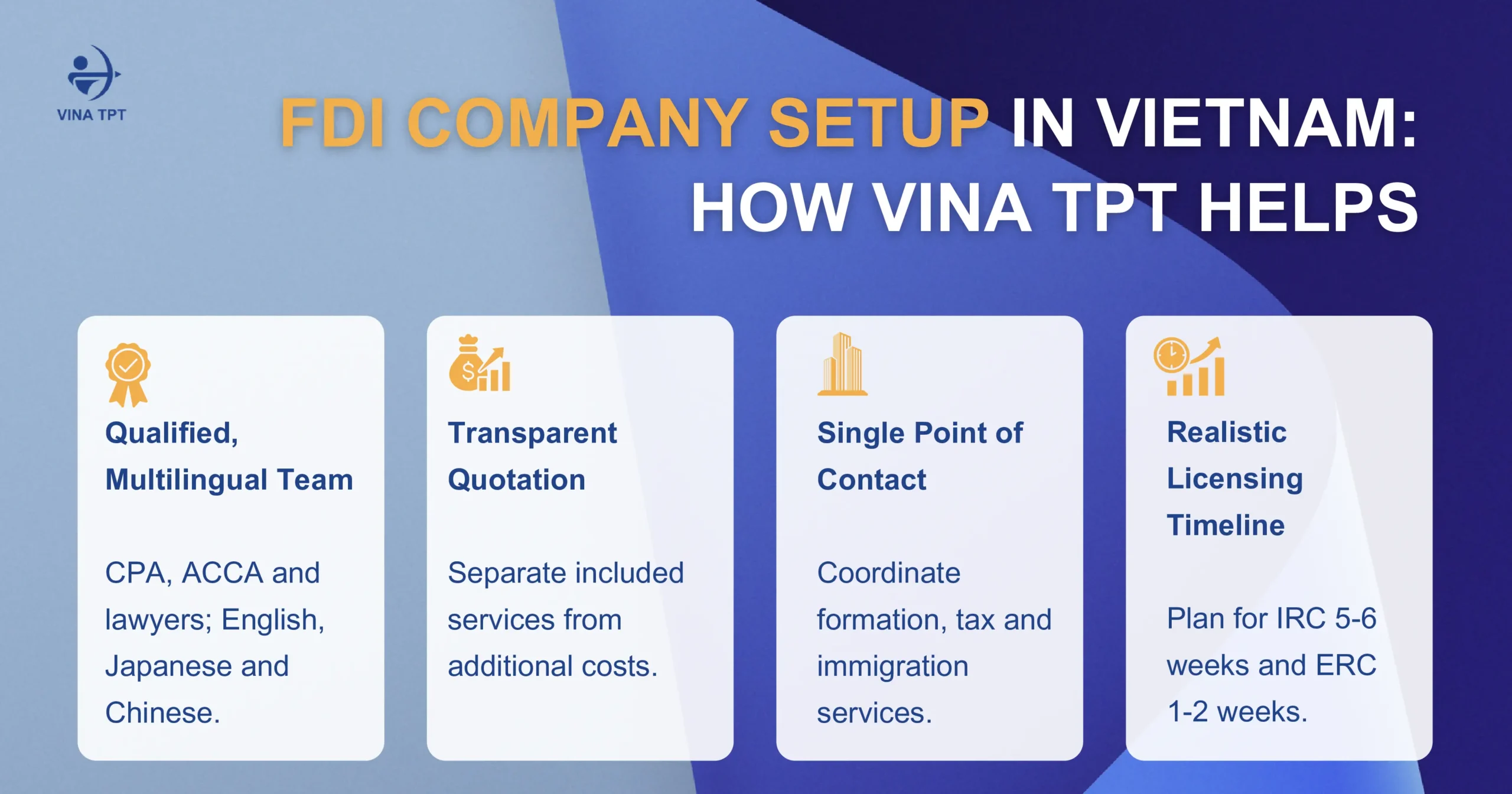
- The service quotation is prepared in detail, clearly dividing full-package items and actual arising costs, helping investors proactively budget and not be surprised by the 5 hidden costs mentioned above.
- Serving as a single point of contact handling the full package from Company Formation, providing Shared Office address, Accounting – Tax Services, to Visa, Work Permit, and Temporary Residence Card procedures.
- Providing actual implementation timelines: IRC application procedure from 5 to 6 weeks, ERC issuance procedure from 1 to 2 weeks (not including the time for obtaining explanation opinions from inter-agency authorities).
- Owning an experienced specialist team including CPA, ACCA certificates and specialized lawyers, supporting clients fluently in English, Japanese, and Chinese.
Conclusion
Firmly grasping and proactively confirming clearly the 5 hidden costs mentioned above will help investors build an accurate financial plan when beginning to establish an FDI company in Vietnam.
Please send information on the expected business field, the nationality of the investor, and the scale of investment capital in order to receive the full-package service quotation together with the detailed summary table of estimated arising costs.