“The FDI company also keeps its books under VAS just like a domestic company, so where does the accounting actually differ?” In essence, the daily bookkeeping entries for incurred transactions such as receipts, payments, and purchases and sales of goods are completely the same. However, the presence of foreign capital brings with it specialized management regulations that the accounting department of an FDI company is required to monitor separately and comply with strictly.
This article analyzes the 04 core specific requirements of FDI accounting: managing capital contribution and investment reports, preparing for the mandatory financial statement audit, controlling related-party transactions – Transfer Pricing, and accurately accounting for foreign employee expenses.
1. Track Capital Contribution and File Investment Reports
All cash flows, from the initial contributed capital and foreign loans to the profit remittance activities of an FDI company, must be carried out through the Direct Investment Capital Account (DICA) opened at an authorized commercial bank, in compliance with Circular 06/2019/TT-NHNN.
The investor is obliged to contribute 100% of the registered charter capital within 90 days from the date the Enterprise Registration Certificate (ERC) is issued. The amount of capital actually contributed must match exactly the information recorded on the Investment Registration Certificate (IRC) and the ERC. The accounting department needs to proactively monitor the progress of money transfers, record capital contributed in foreign currency at the actual transaction exchange rate at the time the money arrives in the DICA account, and carefully store all international money-transfer documents and the bank’s confirmation advice. Delayed capital contribution not only affects the project schedule but also leads to serious administrative penalties.
For medium- and long-term foreign loans, the company is obliged to carry out the loan registration procedure with the State Bank of Vietnam before disbursement.
Investment Reports in FDI Accounting
Besides the ordinary accounting books, accounting for foreign-invested companies also requires the performance of periodic investment reporting obligations. The company is responsible for preparing and submitting the Report on the Implementation of the Investment Project on a quarterly and annual basis on the National Investment Information System (in compliance with the 2025 Law on Investment, effective from 01/03/2026), together with statistical reports sent to the local management authorities.
The accountant needs to ensure absolute consistency between the figures on implemented capital, revenue, profit and labor scale presented in the investment reports and the data in the official accounting books.
2. Prepare for the Mandatory Financial Statement Audit
Under Article 37 of the 2011 Law on Independent Audit and Article 15 of Decree 17/2012/NĐ-CP, all FDI companies in Vietnam are required to have their annual Financial Statements audited by an independent audit firm, regardless of revenue scale or profit/loss status.
From the 2026 financial year, the company’s financial statement set is prepared under the standard system of Circular 99/2025/TT-BTC, consisting of 04 mandatory reports, in which Form B01-DN is officially renamed the “Statement of Financial Position”. The deadline for submitting audited financial statements to the tax authority, the statistics authority and the business registration authority is no later than 90 days from the end of the financial year. Where the company has registered to use a foreign currency as its accounting currency, the financial statements submitted to state authorities must be converted into Vietnamese Dong (VND) at the prescribed exchange rate.
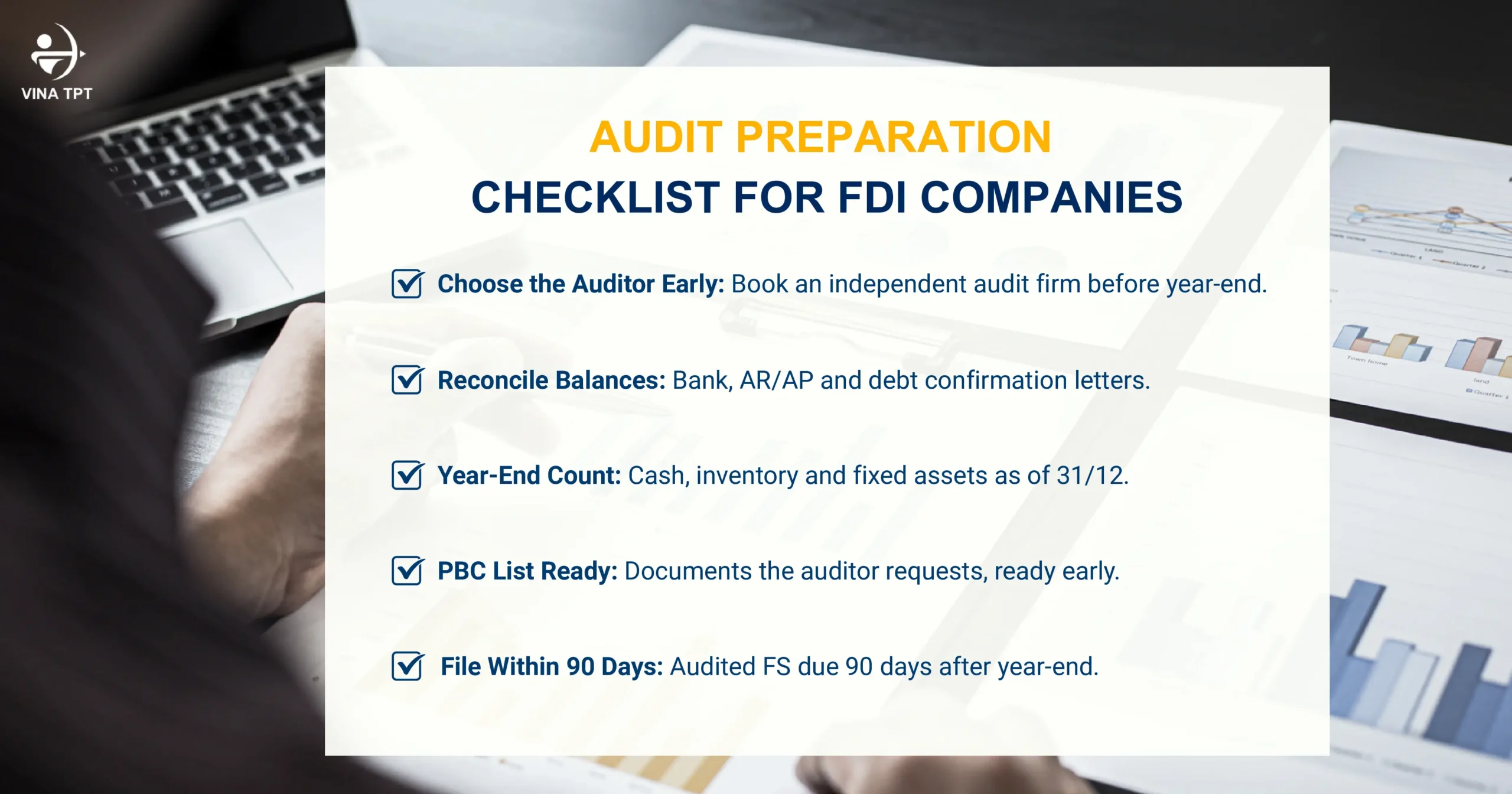
The entire audit preparation process should be planned by the accountant early in order to optimize the time of working with the auditors:
- Select the independent audit firm early.
- Reconcile all account balances and issue debt confirmation letters (AR/AP) to customers and suppliers.
- Carry out a physical count of cash, inventory and fixed assets as of 31/12.
- Prepare in advance the list of documents requested by the auditor (PBC List) for handover to the audit team.
Operational note: Financial statements audited by an independent auditor are a mandatory legal condition for the company to finalize annual Corporate Income Tax and to prepare the file for lawfully remitting profits to the Parent Company abroad.
Explore Vina TPT’s Accounting Services
3. Related-Party Transactions and Transfer Pricing
Transactions arising between an FDI company and its Parent Company or affiliated companies within the same group (such as purchases and sales of raw materials and goods, management fees, brand royalty fees, or loan agreements) must be fully reflected in the accounting books, ensuring that complete economic contracts, valid invoices and documents, and a transparent pricing calculation are in place.
The company is obliged to prepare and submit the Appendices on related-party transaction information attached to the Corporate Income Tax finalization return in accordance with Decree 132/2020/NĐ-CP (as amended and supplemented by Decree 20/2025/NĐ-CP). Under Article 16 of Decree 132/2020/NĐ-CP, the total interest expense incurred in the period by a company with related-party transactions is deductible when determining taxable expenses for Corporate Income Tax up to a maximum of 30% of total net profit from business activities plus interest expense and depreciation expense (EBITDA).
For payments made abroad to the Parent Company or third parties (such as consulting service fees, royalties and loan interest), the accounting department is responsible for declaring and paying Foreign Contractor Tax (FCT) within the prescribed deadline.
Transfer Pricing Documentation for FDI Companies
Besides declaring the appendices, an FDI company subject to the regulation is required to prepare and retain a Transfer Pricing Documentation set, including: the Local File, the Master File and the Country-by-Country Report where applicable.
In some cases, a company may be exempt from the obligation to prepare Transfer Pricing Documentation if it meets the thresholds on revenue and value of related-party transactions as prescribed. The accountant needs to ensure that the related-party transaction figures declared to the Vietnamese tax authority match exactly 100% with the data reported to the Group.
4. Foreign Employee Compliance
Work related to foreign personnel basically falls under the responsibility of the HR department. However, in many small-scale FDI companies or representative offices, the accounting department often concurrently handles salary calculation, Personal Income Tax declaration, Social Insurance contributions, and permit file storage. Therefore, accountants need to clearly understand the following regulations in order to support or perform them when assigned:
- Personal Income Tax (PIT): Resident individuals (present in Vietnam for 183 days or more in a year or having a regular place of residence) perform Personal Income Tax finalization according to the progressive tax schedule on total global income; non-resident individuals are subject to a fixed tax rate of 20% on the portion of income arising in Vietnam (the new Personal Income Tax Law needs to be verified).
- Income arising overseas: In cases where foreign experts receive part of their salary or allowances paid by the Parent Company overseas for the working period in Vietnam, this income must still be converted and fully declared for Personal Income Tax in Vietnam.
- Allowance expenses: Allowances such as housing paid by the company, tuition fees for children studying in Vietnam, and periodic return airfare need to be accurately classified as to which amounts are included in taxable Personal Income Tax income and which amounts are exempt (current legal documents need to be verified).
- Mandatory Social Insurance: Applies to employees who are foreign citizens working in Vietnam with a definite-term labor contract of 12 months or more, except for cases of intra-company transfer or those who have reached retirement age (under Clause 2, Article 2 of the Law on Social Insurance 2024, effective from 01/07/2025).
- Conditions for valid deductible expenses: For salary and bonus expenses of foreign personnel to be counted as deductible expenses when determining Corporate Income Tax, the company must retain a valid Work Permit and Temporary Residence Card (TRC) together with a legal labor contract (needs to be verified).
- Tax finalization upon returning home: When foreign personnel complete their assignment term and exit Vietnam, the Personal Income Tax finalization procedure for that individual needs to be performed before returning home. (See additional procedural guidance in the article Vietnam Visa, Work Permit and TRC: A Guide for Foreign Investors.)
5. FDI Accounting Services at Vina TPT
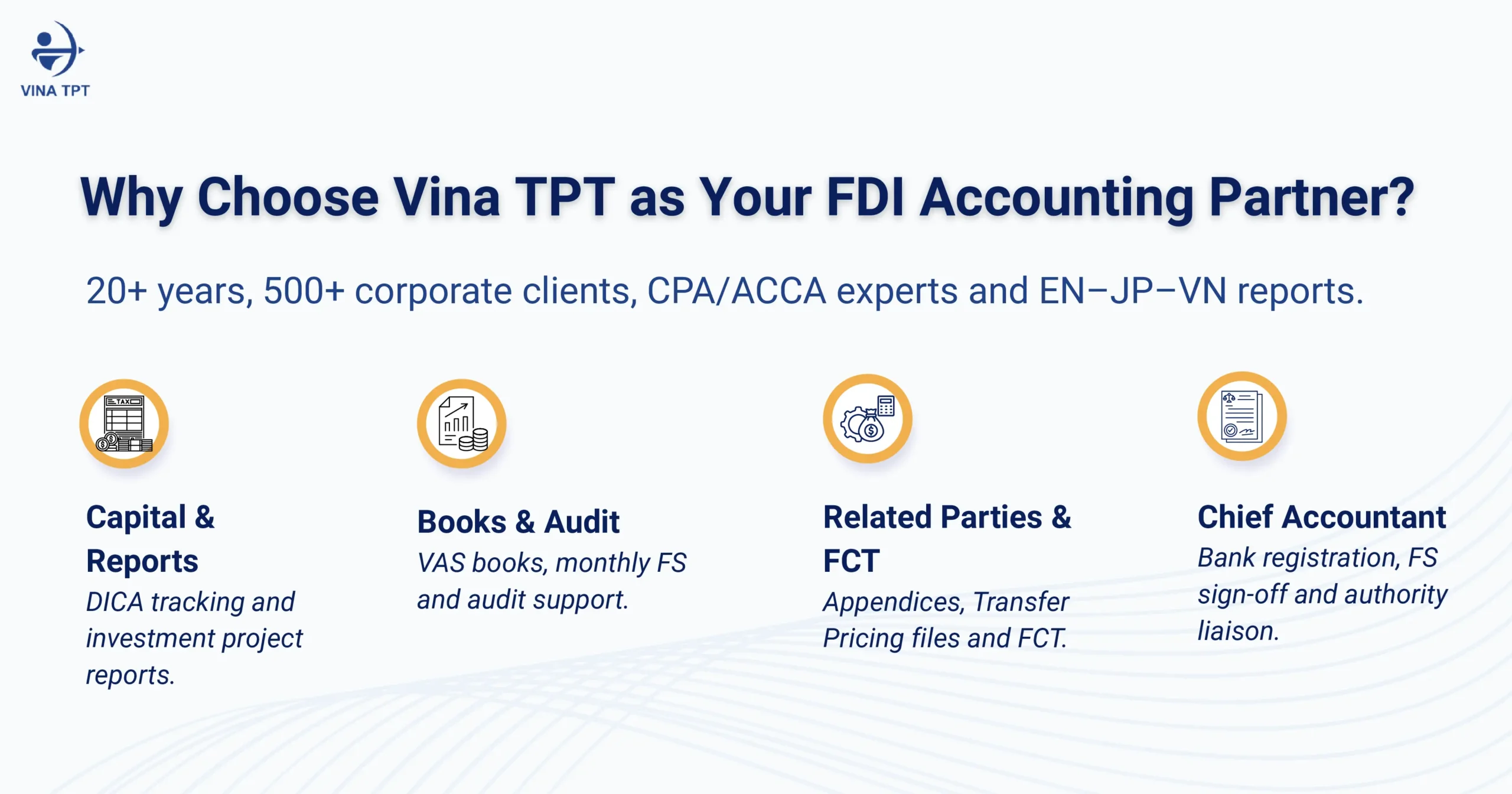
Vina TPT is a finance and accounting advisory firm that accompanies FDI companies, providing a full-package FDI accounting Vietnam solution. With more than 20 years of experience supporting more than 500 corporate clients, a specialist team holding CPA and ACCA certificates together with a bilingual English – Japanese – Vietnamese financial reporting system, we help companies fully meet the specific accounting requirements of FDI.
- Capital & investment reporting management: Monitor the DICA account and the progress of capital contribution; prepare and submit the Report on the Implementation of the Investment Project and statistical reports.
- Accounting & tax finalization: Keep the books under VAS and send monthly financial statements to the client for review; prepare annual financial statements, finalize Corporate Income Tax and work with the audit firm.
- Related-party transactions: Prepare related-party transaction appendices and Transfer Pricing documentation, and declare Foreign Contractor Tax.
- Payroll & foreign employees: Payroll, Social Insurance and PIT finalization; support with visa, Work Permit and Temporary Residence Card (TRC).
- Chief Accountant service: Register with banks, sign the financial statements and work with state authorities.