

Opening a company in Vietnam raises three separate questions: how can you enter the country, can you legally work for your business, and how long can you stay?
Understanding visa, work permit and TRC requirements in Vietnam helps foreign investors plan their business activities and relocation together. Your nationality, investment structure, personal capital contribution and actual working role all matter.
Quick answer: A visa establishes your immigration purpose, a work permit or applicable exemption addresses your right to work, and a Temporary Residence Card (TRC) provides residence under an eligible category. Registering a company does not automatically satisfy all three requirements.
Vietnam Visa vs Work Permit vs TRC: What Is the Difference?
Visa Establishes Your Entry and Stay Purpose
A Vietnamese visa supports entry and temporary stay for a specified purpose, such as business activities, investment or employment. The visa category should reflect your circumstances.
Visa validity and permission to remain during a particular visit are related but distinct. Always check your authorized temporary stay rather than relying only on the visa’s expiry date.
Work Permit Addresses Your Right to Work
A work permit authorizes a foreign national to work under the approved employment arrangement. Certain individuals qualify for an exemption, subject to the relevant conditions and procedures.
Neither owning a business nor holding an investor visa automatically resolves the work authorization question.
TRC Supports Longer-Term Residence
A TRC allows an eligible foreign national to reside in Vietnam for the card’s validity period and has visa-substitute value. It does not independently establish permission to work and is different from permanent residence.
| Document | Main purpose | What it does not establish by itself |
| Visa | Entry and stay for an approved purpose | A universal right to work |
| Work permit | Authorization for the approved work arrangement | Immigration permission to enter or remain |
| TRC | Residence under an eligible category | Work authorization or permanent residence |
These documents operate under separate immigration and employment requirements.
Which Visa Categories Matter to Foreign Investors?
1. Business Visa Vietnam (DN1 and DN2)
- DN1 applies to foreigners working with enterprises and other organizations having legal personality under Vietnamese law.
- DN2 applies to activities such as offering services, establishing a commercial presence and other activities under treaties to which Vietnam is a party.
Meeting a distributor and taking an operational role in a Vietnamese company are different activities. A DN visa does not itself provide a work permit exemption.
| Scenario | Visa Category to Consider |
| A Singaporean investor visits Vietnam to meet advisers, explore the market and discuss opportunities with potential partners before making an investment decision. | DN1, with sponsorship from an eligible enterprise or organization. |
| A representative of a Korean company visits Vietnam to negotiate a contract with a local distributor. | DN1, for business dealings with a Vietnamese enterprise. |
| A representative of a foreign enterprise enters Vietnam to offer services or establish a commercial presence under applicable international commitments. | DN2, subject to the relevant eligibility requirements. |
2. DT1, DT2, DT3 and DT4 Investor Visas
Investor visas cover qualifying foreign investors and representatives of foreign organizations investing in Vietnam. Classification depends on the relevant capital contribution or statutory investment criteria.
| Visa | Main classification criteria | Maximum visa validity |
| DT1 | Capital contribution of at least VND 100 billion, or qualifying investment-incentive sectors or locations | 5 years |
| DT2 | From VND 50 billion to below VND 100 billion, or qualifying government-designated encouraged sectors | 5 years |
| DT3 | From VND 3 billion to below VND 50 billion | 3 years |
| DT4 | Below VND 3 billion | 1 year |
| DN1 / DN2 | Qualifying business activities | 1 year |
| LD1 / LD2 | Qualifying employment circumstances | 2 years |
These are statutory ceilings, not guaranteed periods. Investor classification also requires appropriate supporting records.
3. LD1 and LD2 Work Visa Vietnam
- LD1 concerns foreign workers qualifying under the work-permit-exempt framework, with the applicable supporting basis.
- LD2 concerns foreign workers who require a work permit.
LD visas generally apply to foreign experts and employees coming to Vietnam to work for a company or organization. LD1 applies to those eligible for a work permit exemption, while LD2 applies to those required to hold a work permit.
Do Foreign Investors and Business Owners Need a Work Permit?
Investing in a Company and Working for It Are Different Activities
Holding an investment and actively working for the business require different assessments. Managing employees, directing operations or providing technical services may bring you within the foreign-worker framework.
The assessment should consider your actual activities, not simply whether your title says “investor” or whether you receive a local salary.
Work Permit Exemptions for Qualifying Capital Contributors
Under Article 7 of Decree 219/2025/ND-CP, the following capital contributors qualify for specified exemptions:
| Company type | Qualifying position | Required personal capital contribution |
| Limited liability company | Owner or capital-contributing member | At least VND 3 billion |
| Joint stock company | Chairperson or member of the Board of Directors | At least VND 3 billion |
For a joint stock company, merely being a shareholder does not establish the exemption described above; the qualifying board position also matters.
Representatives of Corporate Investors Need a Separate Assessment
Suppose an overseas company invests in a Vietnamese subsidiary and appoints a foreign director. The subsidiary’s investment capital is not automatically the director’s personal contribution.
The representative must therefore assess the applicable work permit requirement or another exemption based on their own circumstances. An investor visa issued in a representative capacity is not sufficient evidence of the personal-contribution exemption.
Exemption Does Not Always Mean No Paperwork
For the qualifying capital contributors listed above, Article 9(4) provides a notification procedure rather than an application for an exemption certificate. Notification must be made to the competent authority at least three working days before the expected start of work.
Other exemption categories may require different procedures. The employer should identify the correct exemption and retain evidence supporting it.
Which Investors Can Obtain a Vietnam Temporary Residence Card?
Investor TRCs Under DT1, DT2 and DT3
Eligible investors and representatives may apply for investor TRCs under DT1, DT2 or DT3. Immigration authorities assess the applicant’s status and supporting investment records.
| Category | TRC available under this category? | Maximum TRC validity |
| DT1 | Yes, subject to eligibility | 10 years |
| DT2 | Yes, subject to eligibility | 5 years |
| DT3 | Yes, subject to eligibility | 3 years |
| DT4 | No DT4 TRC category | Not applicable |
| LD1 / LD2 | Yes, subject to employment-related conditions | 2 years |
| DN1 / DN2 | No DN1 or DN2 TRC category | Not applicable |
A TRC must expire at least 30 days before the passport expires. Consequently, a short remaining passport validity can reduce the residence period granted.
Why DT4 Does Not Qualify for an Investor TRC
DT4 holders cannot obtain a TRC under the DT4 category. However, this does not permanently exclude them from residence cards.
A person who independently meets another category’s requirements may apply under that category. For example, an eligible working business owner may assess an employment-based route.
Work-Based TRCs Under LD1 and LD2
Employment-based TRCs require the appropriate work-related basis and sponsorship. Their statutory maximum is two years; the actual period depends on the supporting documents and applicable conditions.
A work permit holder should coordinate the residence application with the permit’s remaining validity rather than assume a full two-year card will be issued.
Is a TRC Mandatory for Staying in Vietnam?
A TRC is not mandatory simply because you own a company or intend to stay for an extended period. You may remain under another valid immigration basis within your authorized stay.
However, preparing a TRC application does not automatically extend an expiring stay.
How Does Investment Capital Affect Your Visa, Work Permit and TRC?
Personal Capital Contribution vs Total Company Capital
Start with three questions: who is the registered investor, how much capital belongs to that person or entity, and which documents prove the investment?
For the capital-contributor work permit exemption, your personal qualifying contribution matters. The company’s total capital cannot automatically be attributed to each shareholder, member or representative.
DT3 vs DT4: What Changes Around the VND 3 Billion Threshold?
The threshold affects investor visa classification and residence options, but employment exemptions must still be assessed separately.
The following examples assume the investment and working arrangements are properly documented:
| Illustrative situation | Work authorization assessment | Residence route to assess |
| Individual contributes VND 1 billion and actively manages the company | Work permit generally required unless another exemption applies | DT4 visa; employment-based residence if eligible |
| Individual contributes VND 5 billion as a member of an LLC | Assess the qualifying capital-contributor exemption and notification | DT3 investor TRC |
| Overseas company invests and sends a director | Assess the director’s own work arrangement; no automatic personal-contribution exemption | Representative investor or employment route, depending on eligibility |
Why Company Registration Alone Does Not Guarantee Residence
An Enterprise Registration Certificate (ERC) or Investment Registration Certificate (IRC) documents business or investment matters. Neither replaces the separate immigration and employment assessment.
Evaluate residence objectives before finalizing the investment structure, especially where the business will be owned by an overseas company rather than directly by the relocating individual.
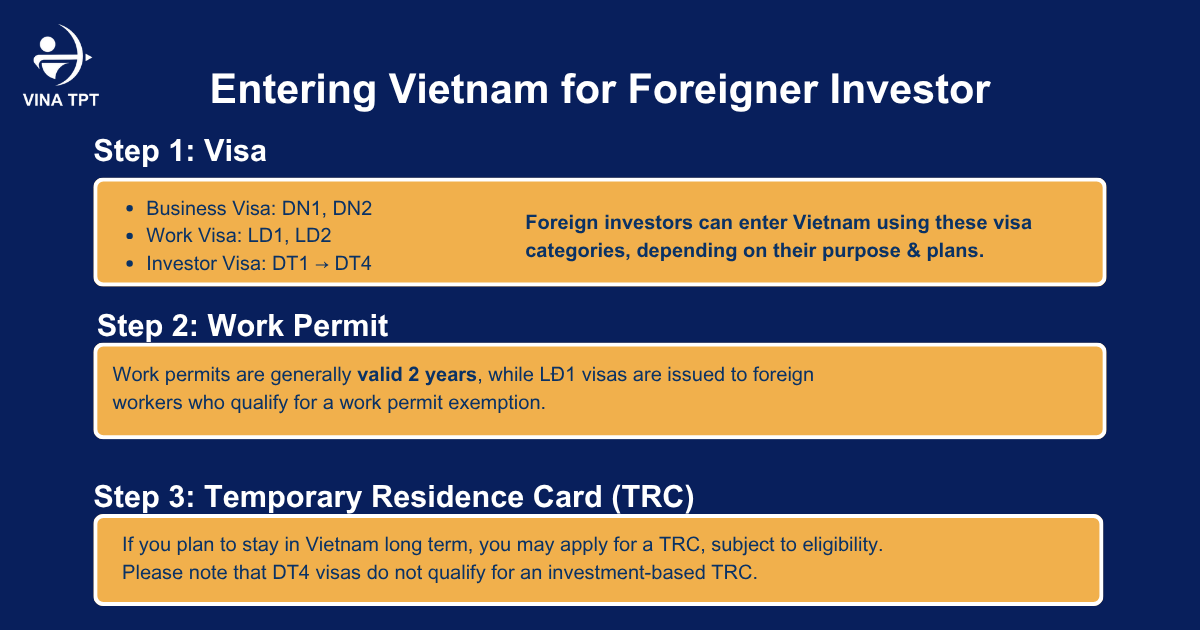
What Is the Application Process for Foreign Investors?
Step 1 — Assess Your Investment, Role and Intended Stay
Prepare details of your nationality, investment structure, contribution, working responsibilities, current immigration status and intended stay. Include accompanying family members when planning relocation.
Step 2 — Identify the Appropriate Visa and Sponsor
Match the visa to your actual purpose and identify the appropriate sponsoring entity. Check that personal, company and investment records consistently describe the proposed arrangement.
Step 3 — Complete Work Permit or Exemption Requirements Where Applicable
If you will work in Vietnam, establish whether a work permit, exemption certificate or notification procedure applies. Prepare the relevant evidence and complete the required steps before commencing work.
Step 4 — Apply for the Appropriate Residence Status
Assess the appropriate visa or TRC route. Vietnamese law permits visa-purpose changes in specified circumstances, including qualifying investment and employment cases; approval is not automatic.
Confirm the current filing requirements before assuming you must leave Vietnam or can complete everything domestically.
Step 5 — Maintain Temporary Residence Registration and Track Expiry Dates
Ensure temporary residence registration is completed and monitor passport, visa, work authorization and TRC dates. Reassess the documents when your employer, sponsor, passport, investment or working role changes.
An investor route and an employee route do not necessarily follow an identical application sequence.
Plan Your Visa, Work Permit and TRC With Vina TPT
Vina TPT helps foreign investors assess visa, work permit, exemption and TRC requirements alongside their business establishment and HR compliance needs.
Our team can review your investment structure, contribution, proposed role and intended stay, then discuss the relevant procedures and supporting documents. Share your nationality, ownership details, current immigration status and relocation plans to identify practical next steps.
Discuss Your Vietnam Visa and Residence Requirements