


In the Vietnamese market, B2B tax advisory firms rarely apply a single packaged model to every company. In actual operations, the service system is divided into two distinct work groups:
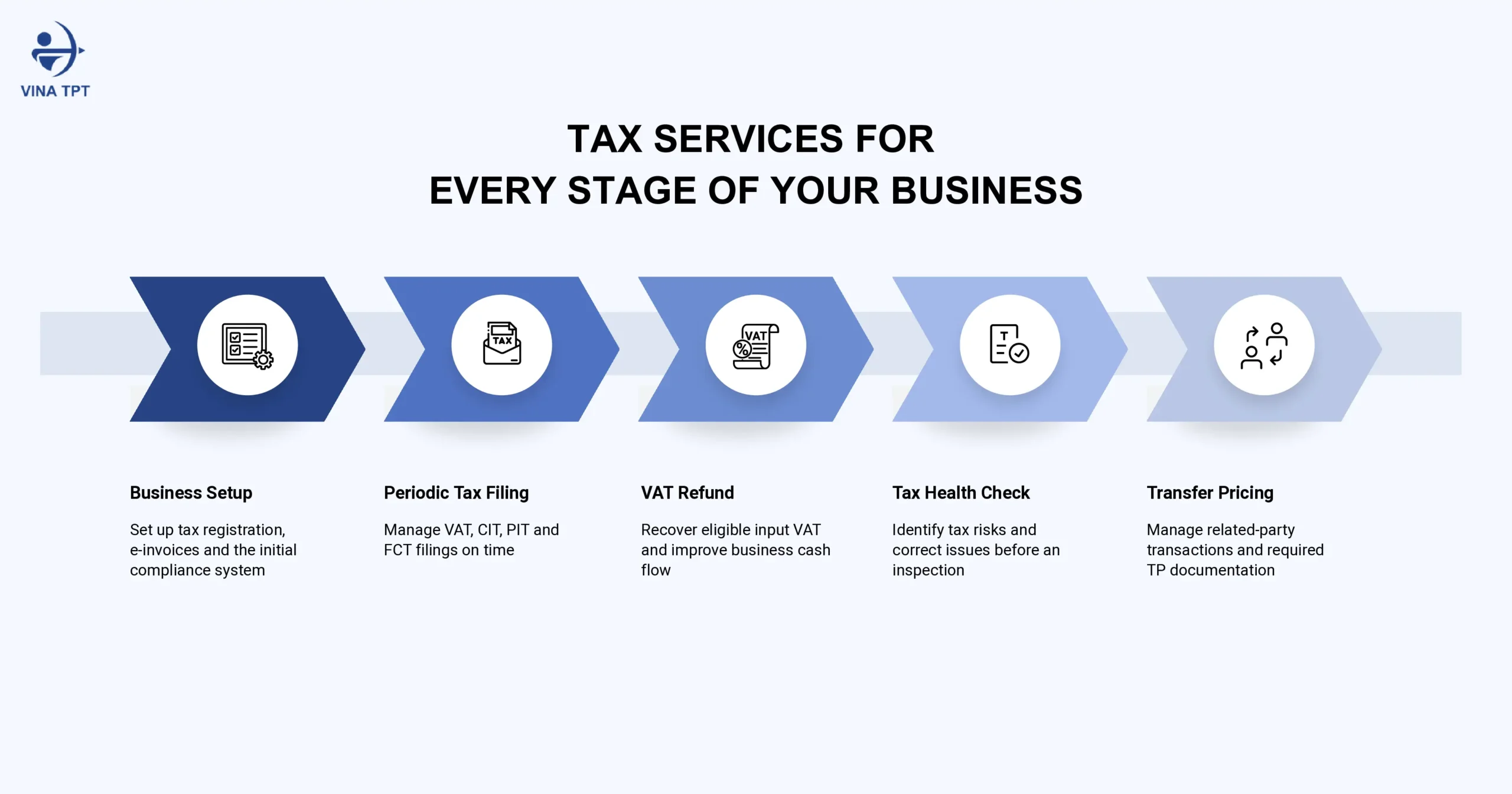
- Periodic compliance (Tax Compliance) is the workstream a company must maintain throughout its operating life. The typical scope covers initial tax registration, determination of the filing method and filing period, and then the preparation and submission of periodic returns: VAT on a monthly or quarterly basis; withholding PIT on a monthly or quarterly basis plus the annual finalization; quarterly provisional CIT followed by the annual finalization; Foreign Contractor Tax (FCT) whenever an outbound payment is made; and the business license fee together with any industry-specific taxes. This workstream is tightly linked to the accounting books. A return is only correct when the VAT (tax services in vietnam), payroll, FCT, and CIT figures match the source documents already recorded.
- In-depth advisory (Tax Advisory) comes into play when the company needs more than on-time filing and has to resolve a specific situation. Common services include VAT refunds to recover cash locked in uncredited input VAT; a Tax Health Check to surface risk before an inspection or a fundraising round; and related-party / Transfer Pricing compliance when there are dealings with a parent or group company. Choosing the right tax services in Vietnam therefore depends not only on company size, but also on its operating stage, transaction structure, and current tax risks.. Many FDI companies also need expatriate PIT finalization – because residency status, the Work Permit, and the tax calculation method for expats differ from those for local staff — as well as Global Minimum Tax advisory when the group falls within the scope of application. This is not ordinary monthly filing work.
Many FDI companies and SMEs fall into an “operating trap” by choosing the wrong service package at the wrong time. The result is wasted cost on one side and a serious risk of tax reassessment and administrative penalties on the other.
The article below examines the most common tax services in Vietnam, explains which businesses need each service, and identifies the right time to use them.
1. Common Tax Services in Vietnam
As an FDI company grows, the scope of tax services in Vietnam it requires also becomes more complex, moving from initial registration and periodic filing to specialized advisory work.
Understanding this structure helps the Board of Directors and the finance team choose the right service package at the right time, and keep figures consistent across accounting, tax, and investment reporting.
1.1. Initial Tax Registration
This service layer is the first legal stepping stone immediately after company incorporation and establishes the foundation for tax compliance Vietnam requirements throughout the company’s operating life.
- Scope of work: Registering the company’s Tax Identification Number (TIN), purchasing and activating a digital signature (CA token), registering e-invoices with the tax authority, determining the VAT calculation method (credit/deduction method or direct method), opening a bank account and notifying the tax authority of the account, and completing Level-2 VNeID identity for the Legal Representative.
- Suitable for: Newly established FDI companies looking for tax services in Vietnam immediately after receiving an Enterprise Registration Certificate (ERC), particularly those preparing to commence operations without an in-house tax team.
- When to implement: Immediately after the ERC is issued and before the first invoice is issued or any payment or capital contribution is received.
Vina TPT’s professional view: Configuring the wrong filing frequency (monthly versus quarterly, or vice versa) or choosing the wrong VAT method at this stage will create a chain of problems and force the company into complex explanation procedures with the managing tax authority.
1.2. Periodic Tax Filing (VAT, CIT, PIT, FCT, License Tax)
Periodic filing is one of the core tax services in Vietnam, covering recurring monthly, quarterly, and annual tax obligations for operating companies.
- Scope of work:
- Value-Added Tax (VAT): Preparing monthly or quarterly VAT returns and reconciling incoming and outgoing invoices on the General Department of Taxation’s e-invoice system.
- Personal Income Tax (PIT): Filing monthly or quarterly withholding PIT returns and completing the annual PIT finalization for Vietnamese employees and expatriates.
- Corporate Income Tax (CIT): Calculating and paying quarterly provisional CIT (ensuring that the four quarterly payments are not lower than 80% of the annual amount payable) and preparing the annual CIT finalization return.
- Foreign Contractor Tax (FCT): Declaring and paying FCT on each occurrence or on a monthly basis whenever payments are made to foreign suppliers.
- Suitable for: Every company operating in Vietnam. It is especially relevant for FDI companies with a complex cost structure, expatriate payroll, or outbound payments for royalties, loan interest, and international consulting services.
- When to implement: From the first filing period after the Tax Identification Number (TIN) is issued – even if no revenue or expense has arisen yet – and on a continuous basis in line with statutory deadlines.
EXPLORE ACCOUNTING & TAX SERVICES
1.3. VAT Refund
Among specialized tax services in Vietnam, VAT refund support goes beyond standard periodic filing (tax services in vietnam). It is a specialized advisory and dossier-handling process designed to recover eligible input VAT that has not yet been fully credited.
- Scope of work: A VAT refund is not an extension of the monthly return. It is a specialized service: reviewing the legality of every incoming invoice, checking non-cash bank payment evidence, reconciling customs declarations and export contracts where goods are exported, preparing the refund dossier, filing it, and explaining it directly to the tax authority during the pre-refund or post-refund inspection.
The person handling the file must have processed real cases, because any document group can delay or reject the application. Invoices that do not qualify for credit, cash payments on transactions of VND 5 million or more, discrepancies between the VAT return and the export file, or explanations that do not match the books are the first points the tax authority will raise. Advice that stays theoretical – and has never followed a dossier through to a refund decision – will struggle to anticipate supplementary requests and the timeline for receiving the funds.
- Suitable for: Companies whose accumulated uncredited input VAT is VND 300 million or more and that also meet all current refund conditions. For the detailed conditions and eligible cases, refer to VAT Refund in Vietnam 2025: Updated Conditions and Eligible Cases Explained.
- When to implement: When the refundable VAT amount is material and the company needs to release frozen cash for reinvestment.
1.4. Tax Health Check and Risk Review
A Tax Health Check is one of the preventive tax services in Vietnam designed to identify compliance risks before they develop into larger issues during a tax inspection.
- Scope of work rewritten: A Tax Health Check is an independent third-party review of the full set of accounting books, the tax compliance position, and the alignment between those two sources. The work covers examining source documents, VAS bookkeeping, a review of VAT, CIT, PIT, and FCT, identifying items at risk of being disallowed as deductible expenses, and then preparing a risk report with a plan to file supplementary returns if needed.
When the books and the tax returns are placed side by side, the company can see the gaps in control or in cash flow: invoices that do not qualify for credit, expenses lacking supporting documents, omitted FCT, off-track provisional CIT, or payroll figures that do not match PIT. From those discrepancies, the advisor proposes a suitable course of action: tightening the document process, amending returns, strengthening internal controls, or preparing an explanation file ahead of an inspection.
- Suitable for: A Tax Health Check is suitable for companies that have operated for two to three years or more but have not yet gone through a tax inspection; companies preparing for an M&A transaction, a restructuring, or a fundraising round; companies that are about to change their accounting and tax service provider; or companies that want to review internal processes and put in place tighter controls over documents, filings, and figure reconciliation before risk is discovered from the outside.
1.5. Transfer Pricing and Related – Party Transactions
Transfer Pricing is the way a company prices transactions with related parties so that the price of goods, interest, royalties, or management fees has a comparable basis and is not treated as a tool for shifting profit between companies in the same group. Related-party transactions are those dealings: buying and selling goods, lending, receiving services, paying group management fees, or paying royalties to a parent, a subsidiary, a commonly owned company, or another party treated as related under Vietnamese tax law.
These transactions usually arise when an FDI company in Vietnam is not fully standalone. The company may import raw materials from a group plant, pay a management fee to an overseas headquarters, take an intra-group loan, or pay a royalty to use the parent’s brand and technology. Not every outbound payment is a related-party transaction – hiring an independent contractor, for example, may give rise only to FCT – but most companies that belong to a multinational group need to identify the correct counterparties before CIT finalization.
This is a specialized tax advisory Vietnam workstream. The tax authority does not only ask whether the return was filed; it asks whether the price and the profit margin are reasonable compared with independent dealings. Missing documentation, or internal pricing that is too high or too low, can lead to a deemed assessment and a tax reassessment. The company should therefore understand the nature of the transaction first, and only then move on to the appendices and the Transfer Pricing documentation.
Within specialized tax services in Vietnam, Transfer Pricing requires a more structured execution process once the nature of the related-party transactions has been correctly identified. The work does not stop at a year-end appendix; it runs across four layers.
- Diagnostic review is the step of reading back every transaction with the parent and related companies: purchases and sales of goods, intra-group loans, group management fees, royalties, cost sharing, or the provision of services. The advisor identifies which transactions fall within the related-party scope, where current pricing sits, what is missing from the existing file, and which points the tax authority is likely to raise when the figures are compared with independent profit margins.
- Compliance filings are the statutory reporting layer. The company must prepare Appendices I, II, III, and IV on related-party transactions and submit them with the annual CIT finalization return, usually within 90 days after the end of the financial year. A missing appendix or an incorrect line item is not only a formal error; it is a signal for the tax authority to look more closely at internal pricing.
- Transfer Pricing documentation goes beyond the return. The company prepares and retains the Local File, the Master File (Global File), and the Country-by-Country Report (CbCR) if it is in scope, under Decree 132/2020/ND-CP and the current implementing guidance. This file set explains why the chosen price, royalty, or management fee was selected and which comparability method is being used.
- Defense during inspection is the final layer. When the tax authority inspects Transfer Pricing, the advisor represents the company in explaining the pricing method, the profit margins, and the link between the documentation, the books, and the CIT return. Completing the first three layers early reduces the pressure at this stage.
This service is suitable for FDI companies that are members of a multinational group and buy or sell goods, provide services, lend, or franchise with related parties. Implementation should start as soon as related-party transactions arise – not wait until the finalization deadline is close. The file must be complete before the annual CIT finalization deadline so the company is not filing the return while still lacking documents when questions are asked.
2. How Vina TPT Provides Tax Services in Vietnam
Vina TPT provides tax services in Vietnam for most types of companies operating in the country: newly established companies that need setup and periodic filing, SMEs with a stable transaction flow, and FDI companies that belong to a group and have a more complex cost structure. The foundation layer covers tax registration, e-invoices, VAT, CIT, PIT, and FCT filings, and the monthly, quarterly, and annual obligations that follow.
In parallel, the team includes CPA-qualified specialists and Chief Accountants who can support the deeper issues that a monthly return cannot resolve: VAT refunds, Tax Health Checks, expatriate PIT finalization, related-party / Transfer Pricing documentation, and advisory work when the company falls within the scope of the Global Minimum Tax.
- Foundation compliance layer: Core tax services in Vietnam covering initial tax setup and timely VAT, CIT, PIT, and FCT filings aligned with the accounting books.
- In-depth advisory layer: VAT refund dossiers, independent Tax Health Checks, and the review and preparation of Transfer Pricing documentation.
- Integrated operating ecosystem: Connecting tax data with the VAS books, payroll and social insurance, financial statements, and FDI investment monitoring reports.
If your company is reviewing its current tax services in Vietnam – from periodic filing to VAT refunds, Tax Health Checks, or Transfer Pricing – contact Vina TPT for a tax roadmap that matches your operating stage and compliance needs.