The picture of doing business in Vietnam in 2026-2027 is shifting in a strategic way. The investment environment is no longer built only on low labor cost or early-stage land incentives. For foreign investors, small and medium-sized enterprises (SMEs), and FDI groups preparing to enter or expand, the business case now turns on the ability to use the new-generation Free Trade Agreement (FTA) network, adapt to the Law on Investment 2025, and stay inside a Tax-Accounting-Labor framework that is tightening discipline year by year.
Many international investors who start researching the market struggle to shape an overall compliance path. Focusing only on the initial incorporation license, and overlooking new legal updates, market-access conditions, or post-licensing FDI reporting, easily leads to project delays, administrative penalties, or a blocked profit-repatriation flow.
To give companies a complete and accurate view, this Vietnam business guide from Vina TPT examines doing business in Vietnam through six structured layers: assessing market attractiveness, covering the core legal changes of 2025-2026, choosing the form of presence, controlling operating obligations, and setting an optimized launch path for 2026-2027.
1. Why Vietnam Still Matters for Foreign Investors in 2026-2027
Vietnam continues to hold its place as one of the most dynamic and attractive investment destinations in Southeast Asia for 2026–2027. That appeal is shaped by a domestic market of nearly 100 million people, a golden-age population structure, a rapidly growing middle class, and a geo-economic position that connects directly with China, ASEAN, and the world’s main export shipping lanes.
Vietnam’s position is also reinforced by a deep network of new-generation Free Trade Agreements (FTAs), including the Comprehensive and Progressive Agreement for Trans-Pacific Partnership (CPTPP), the EU–Vietnam Free Trade Agreement (EVFTA), and the Regional Comprehensive Economic Partnership (RCEP). This treaty framework gives products made in Vietnam a clear tariff advantage when they are exported to major markets – provided the company meets the rules of origin and the relevant industry standards exactly.
FDI inflows into Vietnam are also going through a quality restructuring. The state now prioritizes high-tech projects, higher-value manufacturing, professional services, renewable energy, and the green economy over labor-intensive raw processing. For investors entering the market in 2026–2027, reading the sector direction and the incentive policy that applies to each field – from export manufacturing and retail trade to F&B and digital services – is the first step toward an efficient investment.
2. Legal Barriers and Key Regulatory Updates in 2025-2026
The 2025-2026 period marks a turning point in Vietnam’s business law, with a cluster of key statutes coming into force. Mastering these changes lets investors adjust their legal strategy early and cut compliance risk when doing business in Vietnam.
2.1. Updates under the Law on Investment 2025 (No. 143/2025/QH15) and Decree 96/2026/ND-CP
The Law on Investment 2025 (effective 1 March 2026; the list of conditional business lines applies from 1 July 2026) and guiding Decree 96/2026/ND-CP change the state’s management approach at the root:
- A more flexible licensing sequence (ERC before IRC in some cases): Where the investor fully meets market-access conditions, the law allows the company to obtain the Enterprise Registration Certificate (ERC) first to establish legal personality, and complete the Investment Registration Certificate (IRC) afterward. This is more flexible than the IRC-before-ERC path required under the 2020 Law.
- From ex-ante to ex-post control: The state has cut the list of conditional business lines and expanded the “green lane” (special investment procedures) in industrial parks, export-processing zones, high-tech parks, and digital technology parks.
- Deeper decentralization: More project approvals sit with local authorities, and fewer small changes trigger a mandatory investment-project amendment.
2.2.Updates to the tax and financial-management framework (2025-2026)
- Corporate Income Tax (Law No. 67/2025/QH15 and Decree 320/2025/ND-CP): The standard rate remains 20%. Preferential rates of 15% or 17% still exist for SMEs based on a revenue threshold, but the new rules tighten the eligibility tests so that subsidiaries of large groups cannot use those incentives.
- Personal Income Tax (Law No. 109/2025/QH15 and Decree 253/2026/ND-CP): Applies from 1 July 2026 (with some salary-tax-bracket rules covering the full 2026 tax year) and revises the tax brackets and key family-circumstance deductions.
- Tax administration and e-invoices (Law No. 108/2025/QH15): Effective 1 July 2026, this strengthens automated data matching and tightens control of e-invoices and cross-border transactions.
- Abolition of the business license fee: From 1 January 2026, the business license fee is abolished. Companies no longer need to include this item in the operating budget.
Practical barriers that still matter: Even with simpler procedures, investors still face technical barriers: foreign-ownership limits, industry-specific sub-licenses, a lawful head-office address, digital identity requirements for the Legal Representative, the 90-day charter-capital contribution deadline, and periodic investment-monitoring reports.
3. How Foreign Investors Can Enter the Market: Forms and Entry Paths
To start doing business in Vietnam, a foreign investor needs a legal form of presence and an entry path that matches the project’s scale and commercial goal.
Common legal forms of presence
- Limited liability company (LLC – one member or two or more members): The most practical and widely used model for small and mid-sized investors. Liability is limited to the committed capital, and the governance structure is lean and easier to run.
- Joint-stock company (JSC): Suited to larger projects that involve at least three shareholders or that aim to raise capital and list on the stock market.
Two market-entry sequences under the new rules
Under the new legal framework, the investor has two procedural options:
- Traditional path (IRC → ERC): The investor files for the IRC so the project is appraised first, then incorporates the company to obtain the ERC. This path is safer for projects with complex conditions.
- Flexible path (ERC → IRC): Available where the project fully meets the published market-access conditions. The company obtains legal personality (ERC) first so it can prepare the operating setup, but actual project activity may start only after the IRC is completed within the committed deadline.
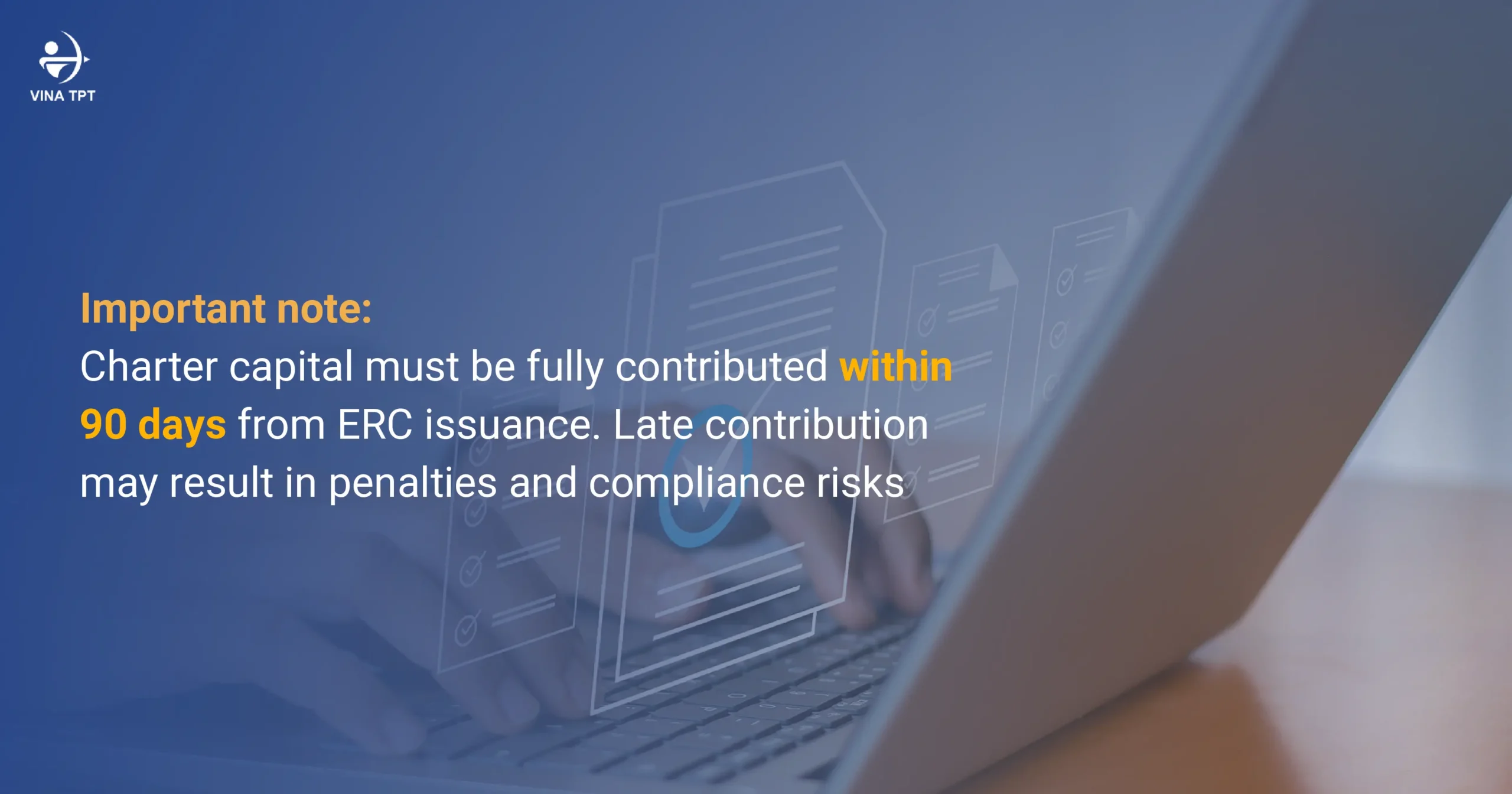
Vina TPT’s professional advice: Review the business-line conditions you intend to register in Vietnam. When setting up a company, you can look up the business-line codes and corresponding scope of activity on the official business-line lookup page to reduce the risk of having to amend or add lines during appraisal. Furthermore, registered capital must also match the actual project scale and must be paid in full into the Direct Investment Capital Account (DICA) within 90 days from the date the ERC is issued.
4. Tax, Accounting and Labor Rules After You Start Operations
Once licensing is complete, operating obligations begin in earnest. To keep the company safe and avoid administrative fines, the investor needs tight control of four core groups.
Tax and accounting (VAS)
- Taxes that arise: Value-Added Tax (VAT), Corporate Income Tax (CIT), Personal Income Tax (PIT) for employees, and Foreign Contractor Tax (FCT) if the company pays for services or royalties to counterparties outside Vietnam.
- Accounting standards: FDI companies must apply Vietnamese Accounting Standards (VAS), keep a proper set of books, appoint a legally qualified Chief Accountant, and prepare annual financial statements that are audited by an independent audit firm in Vietnam.
Labor and personnel
- The company must sign labor contracts, register personal tax codes, and contribute compulsory social insurance, health insurance, and unemployment insurance for Vietnamese and foreign staff.
- For foreign employees, the company must obtain a Work Permit or a Work Permit exemption, together with a Temporary Residence Card (TRC), so that residence is lawful.
- It must also file periodic reports on labor use with the Department of Labor, Invalids and Social Affairs (DOLISA) or the industrial-park management board.
FDI investment reporting: Foreign-invested companies have a separate duty to update project-implementation reports and periodic investment monitoring and evaluation reports on the National Investment Information System (fdi.gov.vn). Missing these FDI reports will later block license amendments, capital increases, or lawful profit repatriation.
5. A Simple Roadmap to Start Doing Business in Vietnam
To help investors see the full execution path without being overwhelmed by technical detail, Vina TPT summarizes the standardized launch process in six decision points:
| No. | Decision point |
What to complete |
|
1 |
Review the industry and conditions | Identify the business-line codes, check the foreign-ownership ratio, and confirm any sub-license requirements |
|
2 |
Choose the structure and head office | Select the company type (LLC/JSC) and sign a lease for a lawful registered address (Shared Office or a traditional office) |
|
3 |
Prepare the dossier and legalize documents | Collect investor documents, complete consular legalization, and obtain notarized Vietnamese translations |
|
4 |
License and contribute capital | Complete the IRC/ERC procedures on the path that fits the project, open the DICA, and contribute 100% of charter capital within 90 days |
|
5 |
Activate initial compliance | Register for tax, obtain a CA Token, set up e-invoices, establish the filing system, and complete the initial labor file |
|
6 |
Operate on a sustainable basis | Run VAS accounting, file periodic tax returns, submit FDI investment reports, and keep sub-license conditions in force |
6. How Vina TPT Supports Foreign Investors
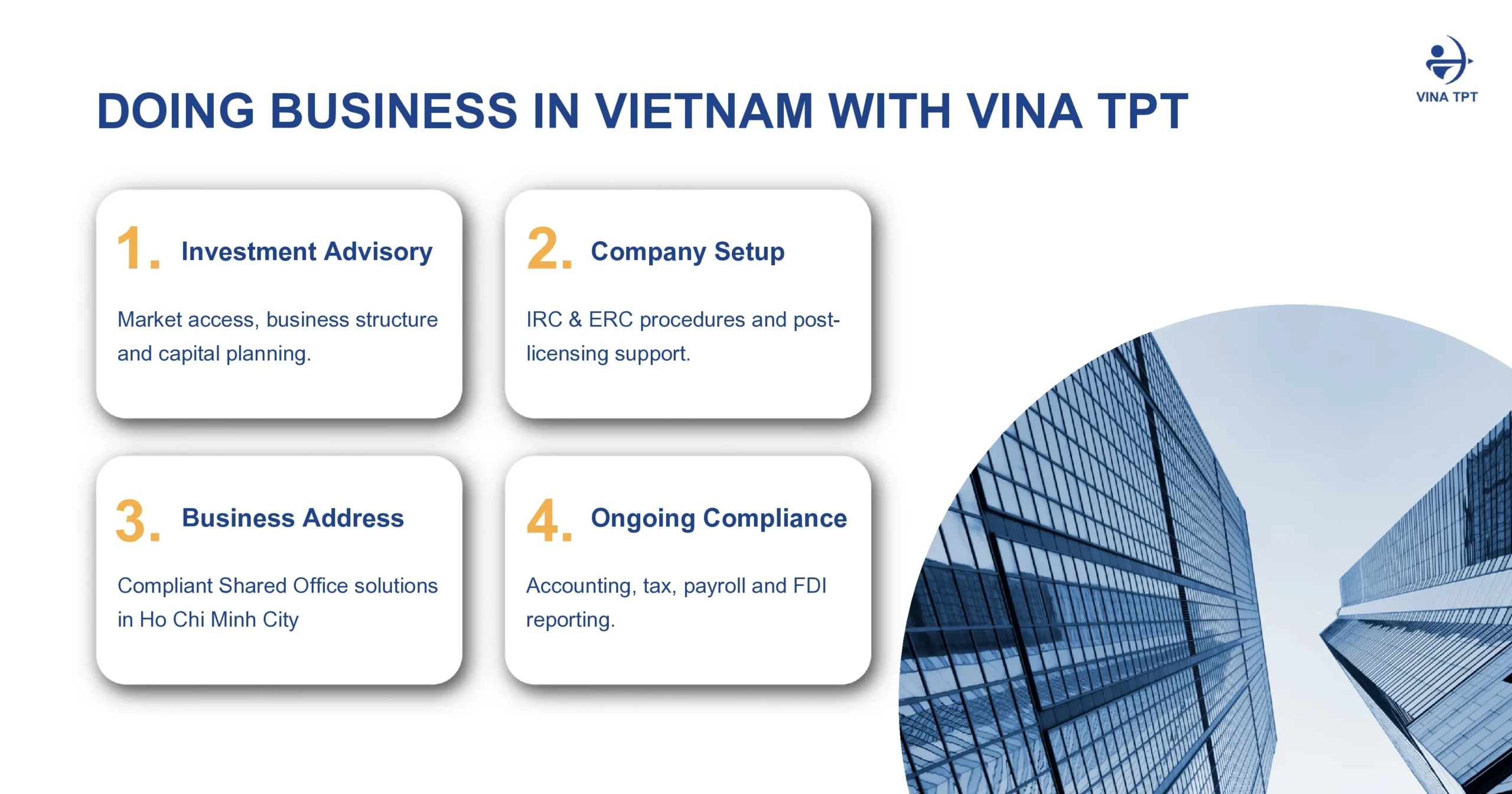
Entering and operating successfully in a fast-growing market like Vietnam requires a consulting partner that thinks clearly and understands how the system works in practice. Vina TPT provides end-to-end support through lawyers, legal specialists, CPAs, and Chief Accountants with 10-20 years of experience. We deliver a full service package and peace of mind for clients doing business in Vietnam:
- Investment and industry strategy: Assessing market-access conditions under the Law on Investment 2025, advising on the capital structure, and designing an efficient company model.
- Full-package company setup: Representing the investor to standardize the dossier, complete IRC and ERC procedures, engrave the seal, and finish post-licensing formalities.
- Head-office solution (Shared Office): A lawful business-registration address in central Ho Chi Minh City that meets the tax authority’s inspection standards.
- Post-establishment operating ecosystem: Full management of VAS tax accountant, bookkeeping service, payroll, social insurance, periodic FDI investment reporting, and industry-specific sub-licenses.
- Continues to support in-depth services: VAT refunds, preparation and accompaniment during tax inspections, transfer pricing documentation, and advisory on mergers and acquisitions.
If you are preparing to start doing business in Vietnam in 2026-2027 and need a safe, accurate execution path, contact Vina TPT for in-depth advice from our specialist team.