


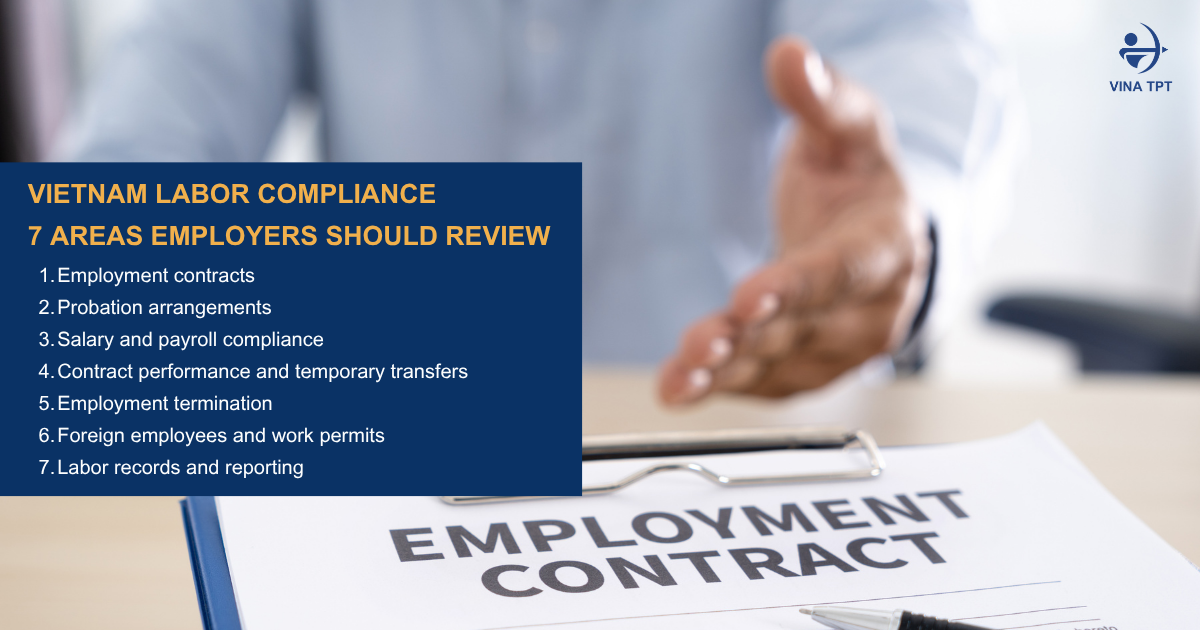
Vietnam labor compliance: Employment contracts, payroll records and work permits are part of a company’s day-to-day operations. Errors in these areas can also lead to administrative fines and obligations to pay employees amounts owed. Based on the information provided on Decree 283/2026/ND-CP, effective from September 10, 2026, sets out administrative penalties for violations in the fields of labor and social insurance.
For businesses in Vietnam, this makes it important to review everyday HR practices, from employment contracts and payroll to work permits and labor records. Below are seven areas employers should pay particular attention to.
1. Employment contracts
Employers may face penalties for failing to sign a written employment contract when required, using the wrong type of contract, or omitting essential terms. Retaining an employee’s original identity documents, diplomas or certificates, and requiring a deposit or other asset as security for the contract, are also identified as violations.
The supplied material states that fines for violations concerning the form, type or contents of an employment contract range from VND 2 million to VND 25 million, depending on the number of affected employees. Retaining original documents or requiring a deposit may result in a fine of VND 20 million to VND 25 million.
Legal reference: Article 15 of Decree 283/2026/ND-CP.
2. Probation arrangements
A business should check how often it applies probation to a position, how long probation lasts and what salary the employee receives. The material specifies that probation should not be applied more than once for the same job, should not exceed the statutory period, and should be paid at no less than 85% of the salary for that job.
Employers must also communicate the probation result and enter into an employment contract when the employee meets the requirements in cases prescribed by law. Some violations carry fines of VND 500,000 to VND 1 million. Applying probation more than once, exceeding the permitted period or paying probation salary incorrectly may result in fines of VND 2 million to VND 5 million. An employer may also be required to pay the outstanding salary or enter into an employment contract.
Legal reference: Article 16 of Decree 283/2026/ND-CP.
3. Salary and payroll compliance
Payroll compliance extends beyond calculating monthly salaries. According to the supplied material, businesses may be fined VND 5 million to VND 10 million for certain failures involving salary scales, payroll tables, labor norms or bonus policies. These include failing to establish or disclose them, failing to consult the workplace employee representative organization when required, providing a noncompliant payslip, or failing to ensure equal pay for work of equal value.
Other salary violations include late or insufficient payment of contractual wages, overtime pay, night-work pay or work-stoppage pay. Improper deductions, failure to pay for unused annual leave when employment ends, and failures concerning salary during a temporary transfer or work suspension are also listed. The stated fine ranges depend on the number of affected employees:
| Affected employees | Fine range |
| 1–10 | VND 5–10 million |
| 11–50 | VND 10–20 million |
| 51–100 | VND 20–30 million |
| 101–300 | VND 30–40 million |
| 301 or more | VND 40–50 million |
Paying below the government-prescribed minimum wage carries separate stated ranges: VND 20–30 million for 1–10 affected employees, VND 30–50 million for 11–50, and VND 50–75 million for 51 or more.
The material also addresses employees who are not subject to compulsory social, health and unemployment insurance. Their employer must pay an additional amount alongside salary equivalent to the employer’s contribution obligations. Failure to pay all or part of this amount may result in fines ranging from VND 3 million to VND 20 million, depending on the number of affected employees.
Depending on the violation, the business may be required to pay outstanding or late salary plus interest, or the unpaid insurance-equivalent amount plus interest.
Legal reference: Article 23 of Decree 283/2026/ND-CP.
4. Contract performance and temporary transfers
When assigning an employee to different work, businesses should review the notice given, the reason and duration of the transfer, and whether the employee’s consent is required. The supplied material also identifies risks in assigning a workplace different from that stated in the contract or failing to take an employee back after a period of contract suspension.
Fines for certain violations may range from VND 1 million to VND 7 million. The material lists higher ranges for workplace sexual harassment that does not reach the level of a criminal offence (VND 15–30 million) and coercion or mistreatment of employees (VND 50–75 million).
Legal reference: Article 17 of Decree 283/2026/ND-CP.
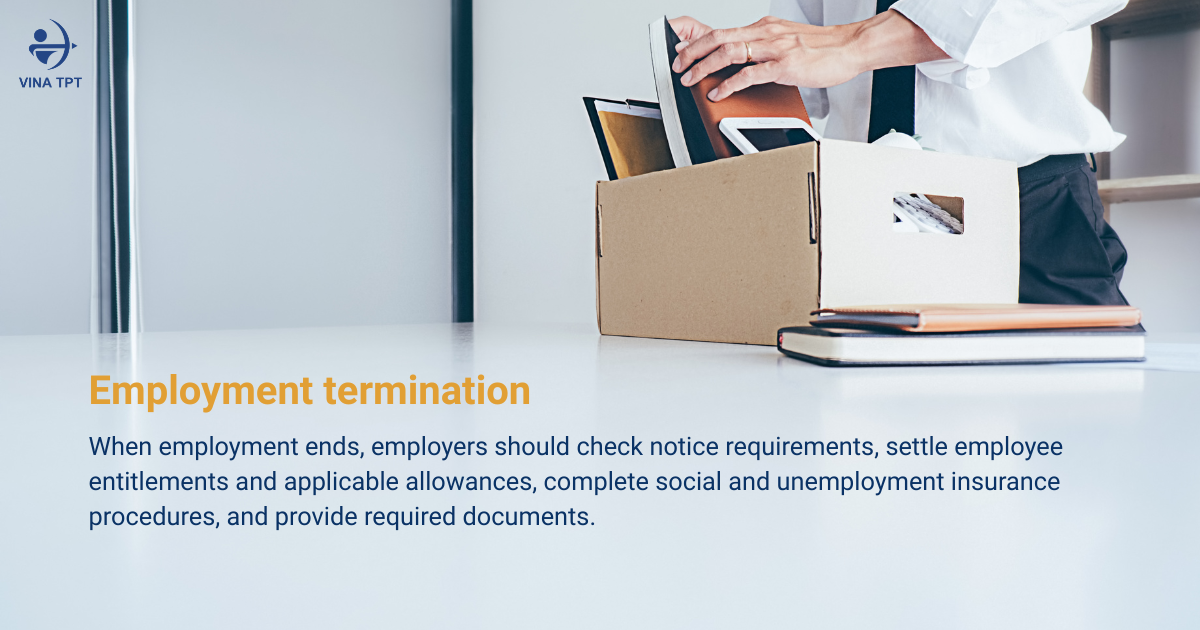
5. Employment termination
At the end of an employment relationship, employers should check whether written notice is required and whether all payments and documents have been completed. This includes employee entitlements, applicable severance or job-loss allowances, social and unemployment insurance procedures, and the return of documents or provision of relevant records when requested.
The stated fine for failing to give required written notice is VND 1 million to VND 3 million. Violations involving payments, allowances or post-termination documents may carry fines of VND 1 million to VND 20 million, depending on the number of affected employees.
Legal reference: Article 18 of Decree 283/2026/ND-CP.
6. Foreign employees and work permits
Businesses employing foreign nationals should review whether each employee holds a valid work permit or confirmation of exemption, and whether their actual work matches the permit. They should also check notification obligations when an employee works in multiple provinces or cities, as well as procedures for returning a permit or exemption confirmation when required.
According to the supplied material, a foreign employee working without a valid work permit or exemption confirmation may face a fine of VND 15 million to VND 25 million. For an employer using foreign employees without valid permits, the stated fines are VND 30–45 million for 1–10 employees, VND 45–60 million for 11–20, and VND 60–75 million for 21 or more. In some cases, a foreign employee may also be expelled from Vietnam.
Legal reference: Article 13 of Decree 283/2026/ND-CP.
7. Labor records and reporting
Workforce administration includes declarations of labor use, a labor management register, reports on changes in employment, and registration or updates to labor registration information.
The supplied material indicates fines of approximately VND 1 million to VND 10 million for violations involving declarations or the labor management register. Failure to register or update labor registration information may result in fines of VND 5–10 million for 1–50 employees, VND 10–15 million for 51–100, and VND 15–20 million for 101 or more.
Legal references: Articles 11 and 12 of Decree 283/2026/ND-CP.
Download Vina TPT’s checklist to review your company’s compliance with the seven employment areas covered in this article.
Download the Compliance Checklist for Labor & SHUI
Vina TPT – Review HR & Payroll Records Regularly
Administrative fines are only one possivinable consequence of a compliance gap. Depending on the violation, a business may also need to pay outstanding wages or benefits, pay interest, complete missing documents or fulfil other outstanding obligations. Regular reviews of employment contracts, payroll records, social insurance documents, work permits and labor reports can help businesses identify issues that need attention.
Vina TPT provides businesses in Vietnam with support across company incorporation, accounting, tax, HR and payroll, and business compliance. For the matters covered in this article, our HR and payroll services support salary calculation, social insurance record management, personal income tax calculation and filing, and related workforce administration.
Contact Vina TPT to discuss your company’s HR and payroll needs and the wider support required to manage your operations in Vietnam.