You already hold the Enterprise Registration Certificate (ERC), so why can you still not issue invoices, open a bank account, or record the first transaction? The legal entity exists, but the tax and payment systems have not been switched on. Without a Chief Accountant, a registered digital signature, a configured e-tax account, or valid e-invoices, the company is not yet legally ready to operate in practice.
Once the business setup Vietnam process is complete, foreign investors must address a series of post-establishment obligations to prepare their companies for operations. This article from Vina TPT walks through the next execution steps in priority order: appointing key positions, completing initial tax registration Vietnam, opening bank accounts and contributing capital, filing the first periodic tax returns, registering e-invoice Vietnam before the first invoice is issued, and registering a social-insurance unit code if you are about to hire staff.
1. Appoint Key Positions, Seal and Digital Signature
One of the first compliance priorities after business setup Vietnam is configuring the company’s tax registration and accounting systems correctly. This establishes the foundation for subsequent tax filings and financial reporting.
The Enterprise Registration Certificate (ERC) already records the Legal Representative. Immediately after that milestone, the investor’s first urgent task is to appoint a Chief Accountant (or the person in charge of accounting) – either an in-house hire or a professional outsourced accounting service. Under Vietnam’s Law on Accounting, this title is mandatory for every FDI company.
In practice, commercial banks require the Chief Accountant appointment decision when the company opens its capital account. Opening that account is the step that lets the investor transfer charter capital within the 90-day deadline after the ERC, or within the longer schedule stated on the IRC. Without the account, the contribution cannot be recorded on time.
The next step is to engrave the company seal so the initial accounting and tax registration dossiers can be completed and legally valid. The company then purchases a digital signature (CA Token). The token is the electronic identity used to log in to the General Department of Taxation portal, register e-invoices and sign periodic tax returns. These tools support the company’s initial tax registration Vietnam procedures and enable electronic submissions through the relevant government portals.
2. Initial Tax Registration
Although the company’s tax code is issued automatically with the ERC, completing the initial tax registration Vietnam requirements remains an important step before the business begins regular tax reporting. The core configuration items include:
- Accounting regime and financial year: Register the enterprise accounting regime (Circular 200/2014/TT-BTC or Circular 133/2016/TT-BTC) and confirm the financial year (usually the calendar year from 1 January to 31 December).
- Fixed-asset depreciation method: Declare the depreciation method applied under Ministry of Finance rules.
- E-tax account and VAT method: Declare the Value-Added Tax calculation method (credit method or direct method) as the basis for setting up VAS books.
- Digital identity and corporate VNeID: Activate the company’s electronic identity account and link the Legal Representative’s VNeID for two-factor authentication on the National Public Service Portal and the Tax Portal.
Declaring the wrong VAT method or choosing the wrong filing period at this step leads to complex amendment procedures and interrupts the company’s input and output invoice flow.
3. Open the Bank Account and Contribute Capital
After completing business setup Vietnam, foreign investors should arrange the appropriate corporate bank accounts, including a Direct Investment Capital Account (DICA) where required, to facilitate timely capital contributions. The statutory deadline is 90 days from the date the ERC is issued (unless the Investment Registration Certificate (IRC) records a longer, staged contribution schedule).
The bank file for an FDI company typically requires the following documents:
- Notarized copies of the ERC, IRC, and company charter.
- A valid visa, Temporary Residence Card (TRC), or passport of the Legal Representative.
- The decision appointing the Chief Accountant or the person in charge of accounting, plus personal identification.
- Specimen-signature and seal registration for the account holder and the Chief Accountant.
Besides the DICA, the company also needs a VND current account for day-to-day commercial receipts and payments.
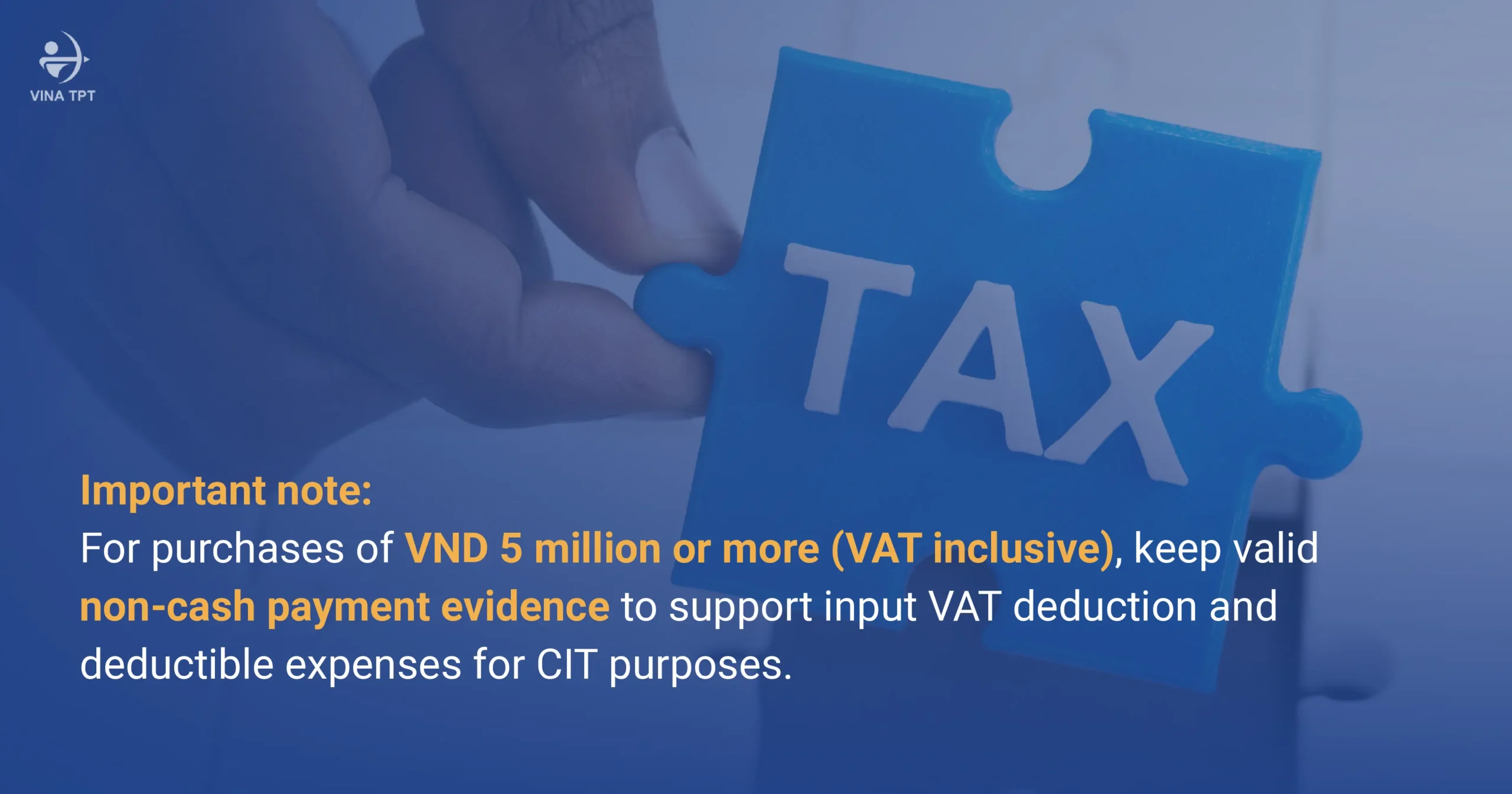
Important note on deductible costs: Under tax-administration rules, every purchase of goods or services of VND 5 million or more (VAT inclusive) must have a non-cash payment voucher (a transfer from the company’s bank account) to qualify for input VAT credit and for a reasonable expense when Corporate Income Tax is determined. Late charter-capital contribution through the DICA triggers administrative fines and can lock the company’s international banking functions.
4. File the First Periodic Tax Returns
As soon as the ERC is issued and the tax code is activated, the company has periodic tax-compliance duties under the law — even if it is newly formed and has no revenue, no costs, and no staff.
Initial periodic filing obligations include:
- VAT return: File monthly or quarterly (newly formed companies are usually quarterly VAT filers). If there are no transactions, the company must still file a nil return (select the “no arising” indicator).
- PIT return: File quarterly if income was paid to employees in the period.
- Self-assessed provisional CIT: The company determines quarterly provisional Corporate Income Tax if it has profit. No quarterly CIT return is filed; only the annual finalization is required.
- Foreign Contractor Tax (FCT): File and pay on each arising payment if the company pays costs to overseas counterparties or service providers (Google, Meta, international software services, and similar).
>>> You may also be interested in: Tax Tips for Small Businesses in Vietnam to Avoid Mistakes
Updated legal note: From 1 January 2026, the business license fee is abolished under the new Government rules. Companies completing business setup Vietnam from 2026 no longer file a business-license-fee return or pay the annual fee.
5. Register E-Invoices Before You Issue the First Invoice
Registering e-invoice Vietnam (tax-authority-coded electronic invoices under Circular 78/2021/TT-BTC) is mandatory before the company records any sale of goods or supply of services. Until e-invoice registration is complete, the company must not issue commercial invoices. Issuing unofficial invoices or recording revenue outside the e-invoice system is a tax-law violation.
The e-invoice registration steps are:
- Choose a certified e-invoice solution provider.
- File the e-invoice registration form (Form 01/ĐKTĐ-HĐĐT) with the managing tax office, signed with the digital signature.
- Wait for the tax office’s approval (usually within one working day).
Every detail on the e-invoice template, company name, tax code, and head-office address, must match the ERC 100%. Even a small character or administrative-place-name discrepancy can lead the tax office to reject the invoice or the buyer to refuse the VAT credit. The company may issue invoices only after the digital signature and the e-invoice template have been confirmed as active on the General Department of Taxation portal.
6. Register Social Insurance If You Will Hire Staff
If the company plans to hire local or foreign staff to work formally right after incorporation, registering a social-insurance unit code is mandatory. Even if the company has only one or two employees on labor contracts, first-time registration for social insurance, health insurance, and unemployment insurance must be completed before the first official payday.
The social-insurance unit code is linked directly to the company’s quarterly Personal Income Tax (PIT) finalization data.
Note for expatriates: If a founder or foreign specialist works in Vietnam, the company must at the same time obtain a Work Permit or a confirmation that the person is exempt from a Work Permit, then register compulsory social insurance under the rules for foreign workers. Without a valid Work Permit, the foreign employee’s salary can be disallowed as a reasonable expense when Corporate Income Tax is calculated.
7. 30-Day Sequence After Business Setup in Vietnam
To help investors see the exact execution path, here is the mandatory 30-day sequence to follow as soon as the Enterprise Registration Certificate (ERC) is in hand:
7.1. Days 1-7 (initial legal setup)
- Issue the decision appointing the Chief Accountant or the person in charge of accounting.
- Engrave the company seal (if used) and purchase a company digital signature (CA Token).
- File initial tax registration with the managing tax office.
- Activate the Legal Representative’s VNeID digital identity so it connects to the public-service system.
7.2. Days 7-15 (finance and banking)
- Open the Direct Investment Capital Account (DICA) and the VND current account at a commercial bank.
- Notify the tax office of the bank accounts (via the digital signature).
- Prepare funds and transfer charter capital from abroad into the DICA (complete within the 90-day deadline).
7.3. Days 15-30 (activation and periodic compliance)
-
Select an electronic invoicing provider and complete the e-invoice Vietnam registration process before issuing the company’s first invoice.
-
Set up the accounting books under VAS.
-
Register the social-insurance unit code if hiring has started.
-
Get ready for the first VAT and PIT filing period.
Reminder for FDI companies: Besides tax duties, foreign-invested companies must also meet the quarterly project-implementation reporting deadline on the National Foreign Investment Information System – even while the project is still in preparation and has no revenue.
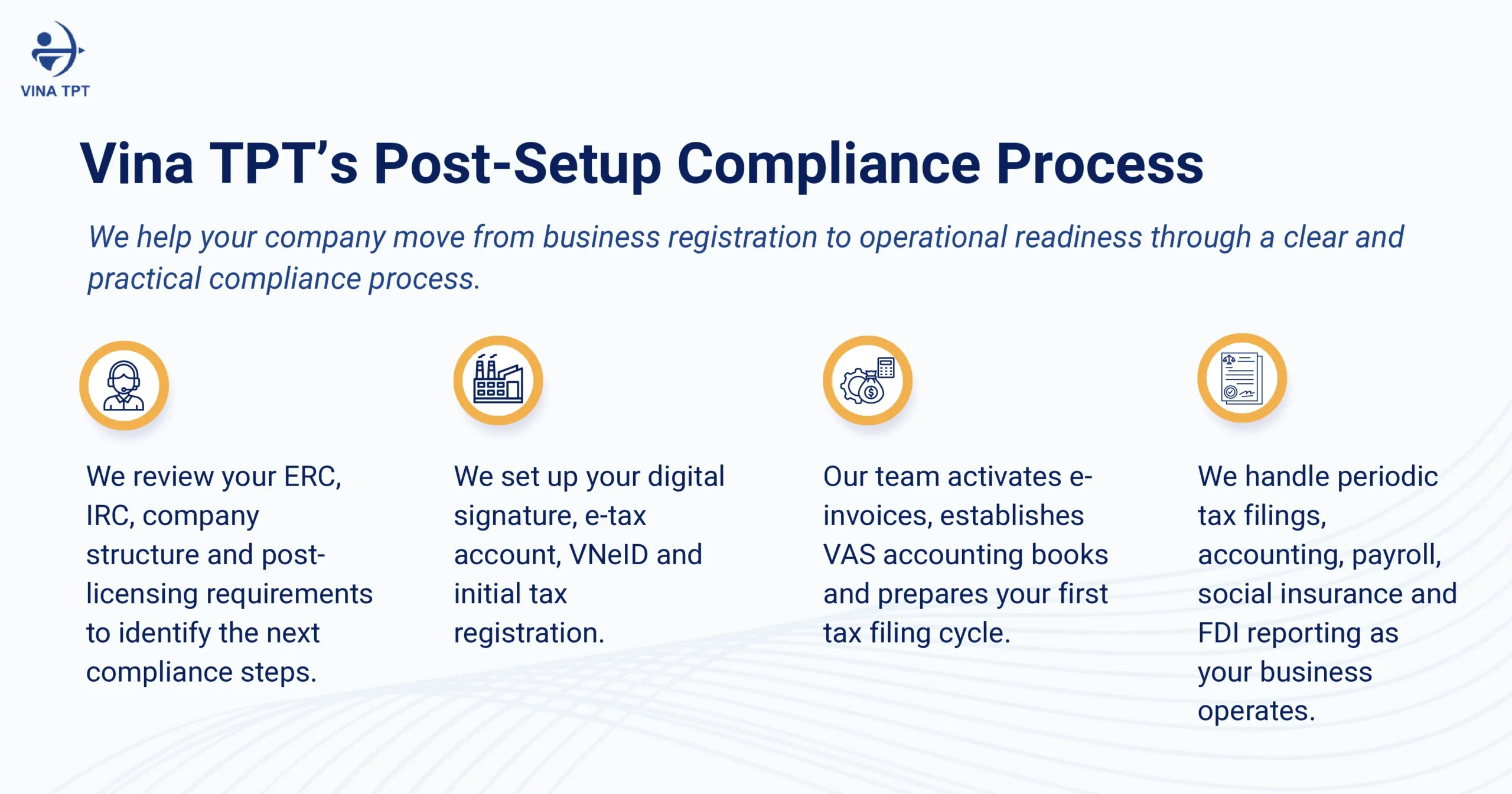
8. How Vina TPT Handles Post-Setup Tax Registration
Handling the full tax registration Vietnam chain after incorporation often takes time and creates legal errors for foreign investors who are not yet familiar with Vietnam’s administrative system. Vina TPT provides an end-to-end advisory and implementation package that standardizes the entire post-establishment tax-compliance system:
- Chief Accountant appointment and initial tax filing: Supplying a practicing-qualified Chief Accountant, registering the digital signature, activating corporate VNeID, and completing the initial tax-registration file accurately.
- E-invoice configuration and VAS books: Supporting template registration and activation of e-invoice Vietnam, and setting up VAS books that match the industry.
- Tax and social-insurance filing on the company’s behalf: Full handling of periodic returns (VAT, CIT, PIT, FCT), registration of the social-insurance unit code, and payroll for staff.
- FDI legal support: Tracking the 90-day charter-capital deadline, filing periodic FDI investment reports, and supporting Work Permit and TRC applications for foreign staff.
Have you just completed business setup Vietnam and are preparing for the first invoice? Contact Vina TPT so our specialists and CPAs with 10-20 years of experience can review and activate the full initial tax checklist for your company.