In our practical experience providing FDI investment advisory services, we have seen company formation in Vietnam files approved and completed in as little as 2-3 weeks. Conversely, quite a few cases drag on for more than two months because business lines must be added repeatedly, the registered office address must be changed, or all foreign legal documents must be retranslated. This large difference in processing time usually does not come from the state authorities, but from the order and method in which the investor prepares the file before submission.
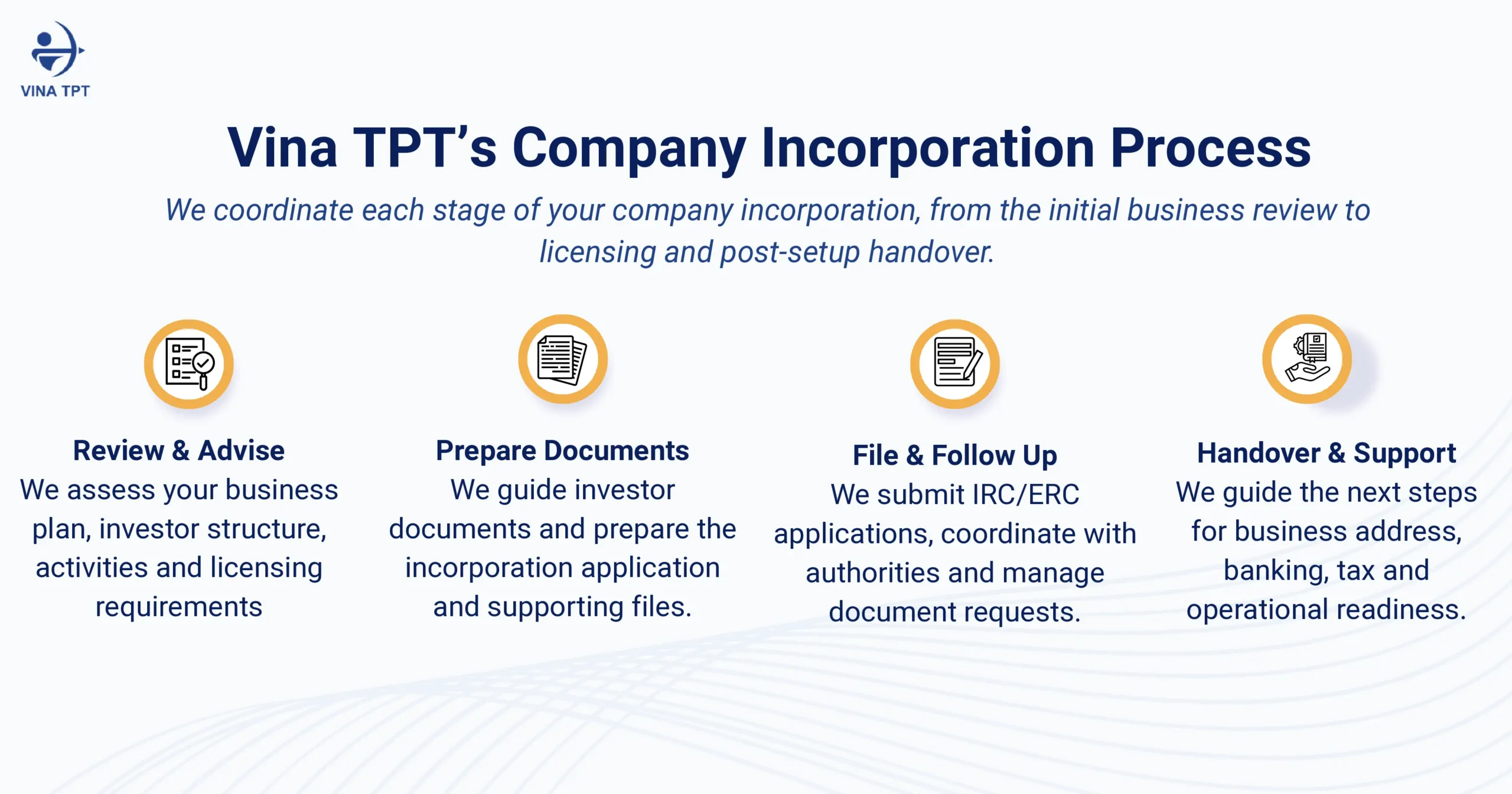
Drawing on our experience accompanying hundreds of FDI companies that have successfully entered the market, Vina TPT has compiled the following 7 practical tips. The first five points will help your licensing file follow the correct path from the first submission. The next part clarifies the mandatory legal obligations that must be activated immediately upon receiving the ERC, and the final part explains how Vina TPT accompanies you from business model design through to sustainable compliant operations.
1. Check the Business Activities Before Preparing Any Documents
The decisive first step in the FDI company formation process is to identify and accurately describe the actual business model the company will operate in Vietnam, before proceeding with the legalization of foreign documents or drafting the registration file.
It is necessary to clearly distinguish between the “business activity you want to do” and the “business lines that can be registered.” An actual business model may include wholesale, direct retail to end consumers, consulting services, import-export, or F&B operations that serve alcoholic beverages. Each way of describing the activity and its scope will determine completely different market-access conditions, foreign ownership limits, conditional sectors, and sub-licenses.
Investors should provide a detailed description of the business model to the advisory firm before proceeding with the translation or legalization of any document. This description needs to clarify:
- Products & Services: The specific goods to be traded, or the solutions/services to be provided (for example: software, management consulting, logistics services, industrial equipment).
- Commercial structure and distribution channels: Whether operations follow a wholesale (B2B) model, direct retail to end consumers (B2C), e-commerce, pure import-export, or cross-border service provision.
- Operational specifics: The location where services are provided, warehouse scale, or special factors such as serving alcoholic beverages in an F&B model, trading conditional goods, or requirements for specialized premises.
Based on this detailed information, the specialist team will review the VSIC industry codes and accurately determine the market-access conditions, foreign ownership ratio, and list of accompanying sub-licenses. This review helps establish an accurate document list from the outset and completely eliminates the risk of having to adjust documents, retranslate, or provide additional explanations midway.
2. Choose a Capital Level That Matches the Actual Business Plan
The question “What is the minimum capital required to set up a company in Vietnam?” usually does not produce a useful answer. Except for certain financial, banking, or real-estate fields that require statutory capital, most service and trading sectors in Vietnam do not prescribe a fixed minimum charter capital. Nevertheless, the registered capital must be commensurate with the project scale, headcount, office rental costs, and the plan to sustain operations for the first 6-12 months. Registered capital that is too low relative to premises and inventory costs will cause the investment registration authority to request transparent explanations.
In addition, investors must tightly manage the capital contribution timeline: the mandatory legal deadline is within 90 days from the date the ERC is issued (or according to the disbursement schedule clearly stated on the IRC). If capital contribution is delayed beyond the prescribed 90-day period, the company will face serious administrative fines, late-payment interest, and a high risk that the business registration authority will revoke the Enterprise Registration Certificate.
Preparing a detailed operating budget for the first 6-12 months before finalizing the charter capital and investment capital is a necessary step. The capital contribution cash flow transferred from a personal account or the parent company’s overseas account into the Direct Investment Capital Account (DICA) in Vietnam needs to be planned in advance, to avoid the situation where the company waits until the bank account is opened before starting to arrange the funds.
3. Secure the Business Address Before Filing the Application
A location that is “available to rent” in practice is not necessarily a legally eligible address for company registration. The building used as the registered office must have the correct commercial/office function, the lease contract must fully meet the conditions for filing, and the legal documents of the premises must match exactly in name, administrative address, and area with the project description. Residential apartments or collective housing are strictly prohibited from being used as company headquarters.
For newly established FDI companies, using a shared office is a more optimal solution than leasing a traditional office: it provides a legal lease contract, a central business registration address, reception services, cost savings in the first year, and the flexibility to upgrade to a private office when headcount increases.
Investors should request the landlord to provide complete legal documents of the premises (construction permit, land/building use right certificate, sublease contract) so that the advisory firm can review them before a long-term deposit is placed. Changing the registered office address midway is one of the main reasons why a Vietnam company formation file is rejected or returned.
Explore Vina TPT’s Shared Office Services
4. Prepare Foreign Documents Correctly the First Time
The requirements for original documents issued abroad differ clearly between two groups of investors:
- Individual investors: A valid passport and a bank balance confirmation (proof of financial capacity) showing a balance equivalent to the committed capital contribution.
- Corporate investors (parent company): Certificate of Incorporation, company charter, most recent audited financial statements, decision appointing the representative, and the representative’s passport.
All documents issued abroad must go through the following process: Consular legalization at the Vietnamese Embassy/Consulate in the home country → notarized translation into Vietnamese in Vietnam → consistency check of the data.
These legal documents should be issued and consularized close to the filing date (ideally within 30 days) to avoid the investment registration authority requesting explanations or rejecting them as outdated. Most importantly: the full name, passport number, permanent address, parent company name, and registered capital must be 100% consistent on every page of the documents. A small character discrepancy between the passport and the bank balance confirmation is enough to interrupt the entire foreign company setup Vietnam process.
Explore Vina TPT’s Company Formation Services
5. Name the Chief Accountant When You File, Not After
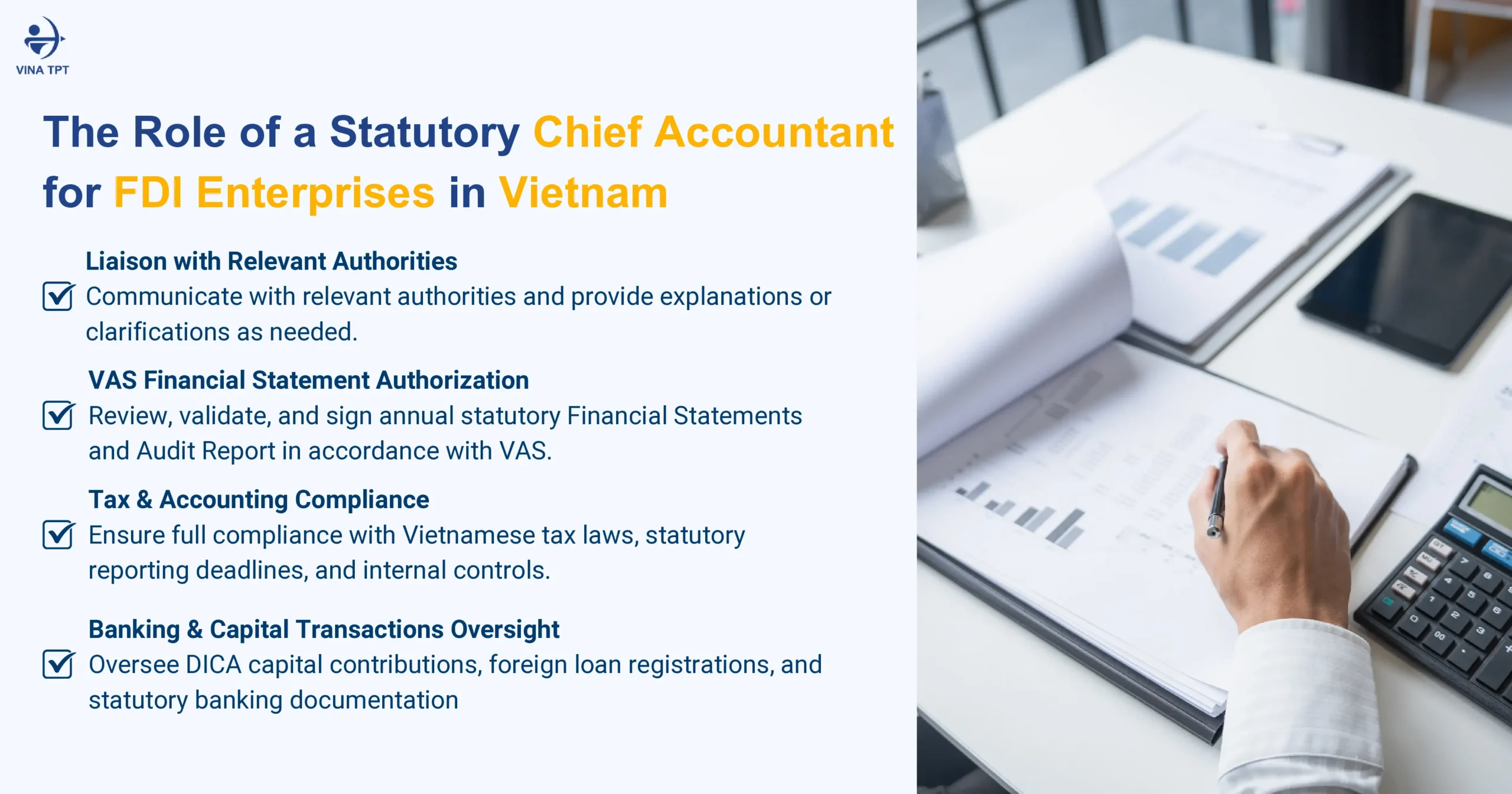
Many investors mistakenly believe that they only need to look for accounting staff once the company is officially operating. In reality, at the time of filing the FDI company registration application (ERC), the information of the Chief Accountant (or the person in charge of accounting) already needs to be declared in the legal file. Immediately afterward, commercial banks in Vietnam will also mandatorily require the presentation of the Chief Accountant appointment decision before agreeing to open the Direct Investment Capital Account (DICA) and the current account.
Proactively confirming a professional accounting service provider right from the pre-formation stage helps the company complete the initial registration file smoothly. Using an outsourced Chief Accountant service together with a tax compliance package is the option chosen by the majority of FDI companies, ensuring legal continuity and data responsibility from the first day of licensing.
6. What to Line Up After the Company Is Formed
Receiving the Enterprise Registration Certificate (ERC) is only the starting point of putting the company into operation. Here is the list of mandatory post-formation procedures that investors need to budget for and implement immediately:
- Open bank accounts and contribute capital: Open the Direct Investment Capital Account (DICA) and the VND current account. The bank will require the Legal Representative’s visa/TRC and the Chief Accountant appointment decision. Transfer 100% of the charter capital within the 90-day deadline.
- Activate initial legal and tax formalities: Engrave the company seal, purchase a digital signature (CA Token), register the company’s VNeID electronic identity account, and complete the initial tax registration file with the directly managing tax office.
- Register e-invoices: Complete registration to use tax-authority-coded electronic invoices before issuing the first sales or service invoice.
- VAS accounting books and personnel: Set up the accounting book system under VAS standards; register a social insurance unit code if hiring employees; apply for Work Permits and Temporary Residence Cards (TRC) for the founder/foreign specialists.
- Mandatory FDI investment reporting: File periodic project implementation reports as required by the Law on Investment.
7. Why You Should Partner with a Trusted Advisory Firm
The process of establishing and operating an FDI company in Vietnam requires a deep understanding of the investment legal system and local administrative practice. Partnering with a reputable advisory firm such as Vina TPT helps international investors optimize licensing time, proactively eliminate risks, and establish a solid compliance system from the outset, based on more than 20 years of practical experience:
- Market and industry-code review (Pre-Filing Stage): Analyze the actual business model, assess market-access conditions, advise on company type (LLC/JSC), optimal capital structure, and accurately map VSIC industry codes.
- Document guidance and consular legalization: Provide an accurate list of original documents and check 100% information consistency of foreign documents before proceeding with consular legalization and judicial notarized translation.
- Registered office address solution (Shared Office): Provide a legal business registration address at central locations in Ho Chi Minh City, with a full lease contract and building legal documents to attach to the state filing.
- End-to-end company formation representation (Licensing Stage): Represent the client in filing the application, providing explanations, and working directly with state authorities to hand over the original IRC and ERC on schedule.
- Post-licensing operational and compliance ecosystem (Post-Setup Ecosystem): Vina TPT provides a comprehensive operating solution so investors can focus entirely on business development with peace of mind: Accounting & Tax (VAS), Account opening & cash flow, Personnel & labor legal matters, FDI compliance reporting.
Do not let language barriers and administrative procedures delay your market-entry plan. You only need to provide the intended business model and operating plan. Vina TPT’s team of specialists will analyze and prepare a complete execution roadmap completely free of charge.