Most foreign-invested companies (FDI) in Vietnam prepare financial statements under Vietnamese Accounting Standards – VAS (currently applied under Circular 99/2025/TT-BTC) to meet tax finalization obligations and submission requirements to state management authorities. However, the Group or Parent Company overseas is required to use financial statements prepared under International Financial Reporting Standards (IFRS) for global consolidation. Due to differences in accounting substance, figures between these two systems cannot automatically match.
The group of FDI companies that frequently generate the need to convert financial statements from VAS to IFRS includes:
- 100% FDI subsidiaries: Required to send a periodic Reporting Package prepared under IFRS standards to the Parent Company for full group consolidation.
- Companies with international investors / banks: Capital providers or foreign banks require IFRS-standard financial statements to assess financial health.
- Companies on an M&A / capital-raising roadmap: Companies preparing for merger transactions, restructuring, or share issuance to international investment funds.
- Members of International Financial Centers: Organizations eligible under Circular 118/2026/TT-BTC (effective from 01 January 2027) that may elect to apply full IFRS.
This article analyzes in depth the key line items that commonly show differences when performing VAS to IFRS conversion and the list of documents companies need to prepare to complete the adjustment bridge (Bridge/Reconciliation Pack).
1. Why VAS to IFRS Numbers Differ
The core reason for the difference in figures between the two systems stems from the purpose for which the standards were established:
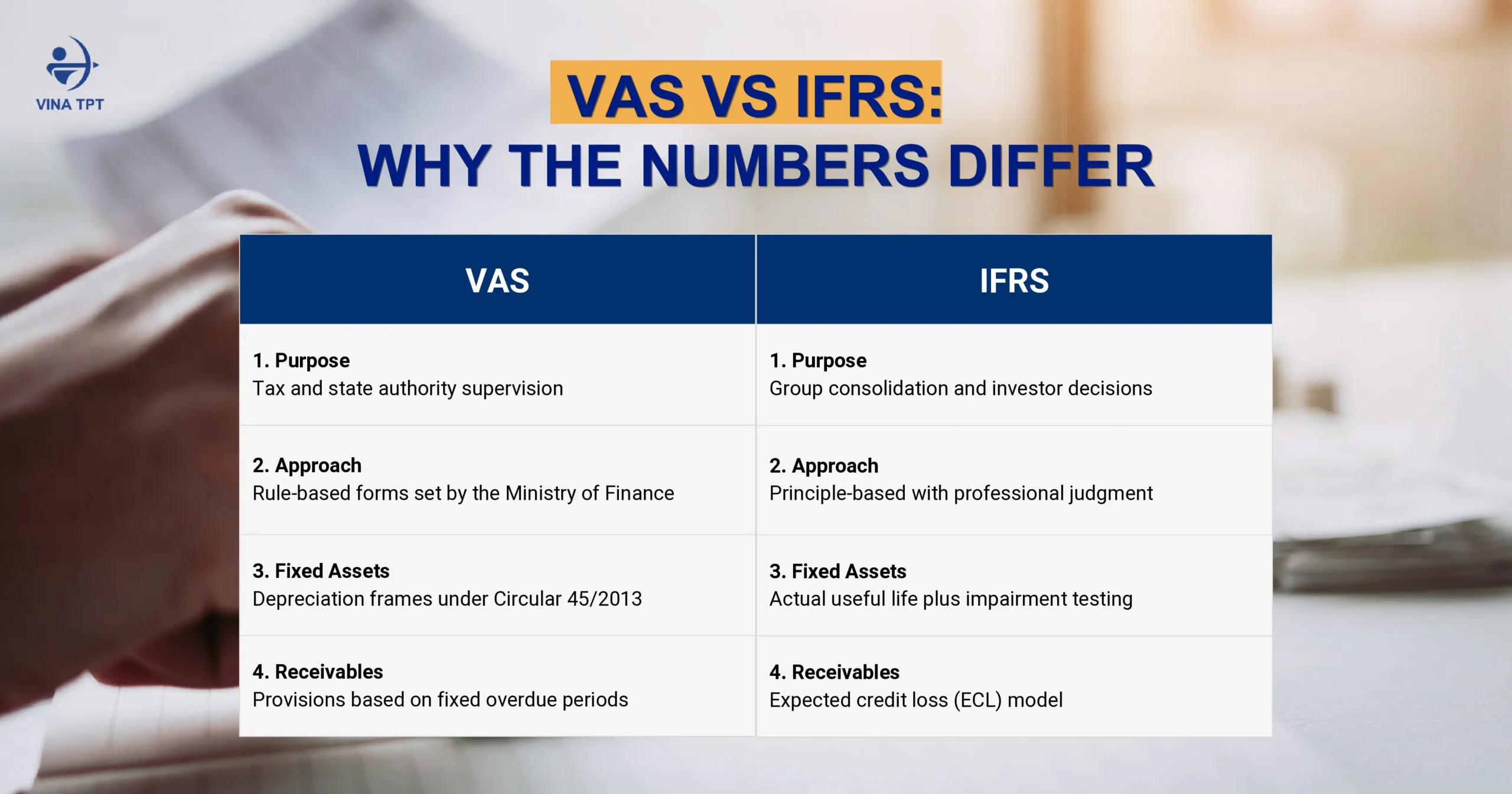
- VAS system: Established primarily to serve tax administration and state authority supervision, with a high degree of compliance, based on pre-determined forms and rigid timelines prescribed by the Ministry of Finance.
- IFRS system: Established to serve investors and management purposes, operating on a principle-based approach and requiring professional judgment regarding the economic substance of transactions.
For the same transaction, VAS and IFRS may prescribe completely different recognition timing or recognition values. Therefore, companies need to prepare a transparent Reconciliation Statement between the two sets of books.
Legal note: Preparing IFRS reports for the Group does not replace the obligation to submit audited VAS financial statements in Vietnam. All Corporate Income Tax and VAT obligations of the company continue to be determined based on Vietnamese tax law.
IFRS Adoption in Vietnam in 2026
Under Decision 345/QĐ-BTC dated 16 March 2020 of the Ministry of Finance, the 2022–2025 period is the voluntary IFRS adoption phase. For the period after 2025, the Ministry of Finance will assess actual conditions to prescribe mandatory subjects; as of now, the regulatory authority has not issued a broad mandatory list. Therefore, 100% FDI companies that are subsidiaries may voluntarily elect to apply IFRS for their separate financial statements.
In particular, Circular 118/2026/TT-BTC (effective from 01 January 2027) officially allows companies that are members of International Financial Centers to elect to apply for full IFRS. The first-time conversion will strictly follow the guidance of IFRS 1 (First-time Adoption of IFRS).
2. Balance-Sheet Items to Review First
When performing VAS to IFRS, the following Balance Sheet line items are where the most technical adjustments arise:
VAS to IFRS Adjustments for Fixed Assets
- Fixed assets (IAS 16): VAS calculates depreciation based on the timeline framework prescribed in Circular 45/2013/TT-BTC. IFRS, by contrast, requires companies to assess and estimate the actual useful life of the asset.
- Impairment of assets (IAS 36): VAS does not yet have an equivalent standard for impairment testing. When converting to IFRS, companies must assess indicators of impairment and recognize an impairment loss if the recoverable amount is lower than the carrying amount.
- Leases (IFRS 16): Under VAS 06, operating lease costs for offices/factories are charged directly to production and business expenses in the period. IFRS 16, by contrast, requires recognition of a Right-of-Use Asset (ROU) and a Lease Liability on the Balance Sheet (except for short-term leases or low-value assets).
- Inventories (IAS 2): Review the cost formula and adjust inventory write-downs to net realizable value (NRV).
- Receivables (IFRS 9): VAS recognizes provision for doubtful receivables based on fixed overdue periods (Circular 48/2019/TT-BTC). IFRS 9 applies the Expected Credit Loss (ECL) model based on historical data and forward-looking risk forecasts.
- Financial instruments (IFRS 9): VAS currently only provides guidance on presentation and disclosure (Circular 210/2009/TT-BTC). IFRS 9 requires classification of financial instruments by substance (AC, FVOCI, FVTPL) and measurement at fair value or the effective interest method.
3. Profit-and-Loss Items That Usually Move
Adjustments on the balance sheet do not only change asset and liability balances but also directly affect the income statement. Many items that are recognized at a different timing or at a different value between VAS and IFRS will change revenue, expenses, and profit for the period. Therefore, when sending the reporting package to the parent company, the company needs to clearly understand which items on the P&L will differ and the reasons for the differences in order to avoid having to provide explanations multiple times.
The line items on the income statement that commonly change when converting from VAS to IFRS include:
- Revenue (IFRS 15): VAS 14 recognizes revenue primarily based on the point at which the majority of risks and rewards attached to the asset are transferred. IFRS 15 applies the 5-step model and only recognizes revenue when the company satisfies a performance obligation and transfers control to the customer.
- Depreciation expense: Corresponding movement after adjusting the useful life and depreciable amount of fixed assets.
- Lease expense (IFRS 16): Monthly operating lease expense under VAS is fully replaced by depreciation of the ROU asset and interest expense arising from the Lease Liability.
- Provisions (IAS 37): Recognize provision expenses for product warranty obligations, restructuring costs, litigation costs, or onerous contracts.
- Deferred tax (IAS 12): Deferred tax liabilities or deferred tax assets arise from temporary differences created by all of the above adjusting entries.
4. Documents You Need for the Conversion
To ensure the IFRS conversion Vietnam work achieves high accuracy and stays on schedule, companies need to prepare the following source documents:
- The VAS financial statement set that has been officially closed and completed independent audit.
- Detailed fixed asset register, depreciation schedule, and all asset/office lease contracts.
- List of major sales / service provision contracts arising during the period.
- Detailed aging analysis and debt recovery history for at least the most recent 3–5 years (used for ECL modeling).
- Detailed list of transactions and economic contracts with related parties.
- Group Accounting Policies manual and the standard Reporting Package template from the Parent Company.
5. How Vina TPT Supports the VAS to IFRS Bridge
With more than 20 years of experience in investment and finance-accounting advisory for the FDI sector, Vina TPT is a professional bridge that helps companies completely eliminate barriers arising from differences in accounting standards. Bringing together a team of specialists holding reputable international certificates such as CPA and ACCA, we combine a foundation of deep understanding of local law with mastery of International Financial Reporting Standards (IFRS) to deliver optimal compliance solutions:
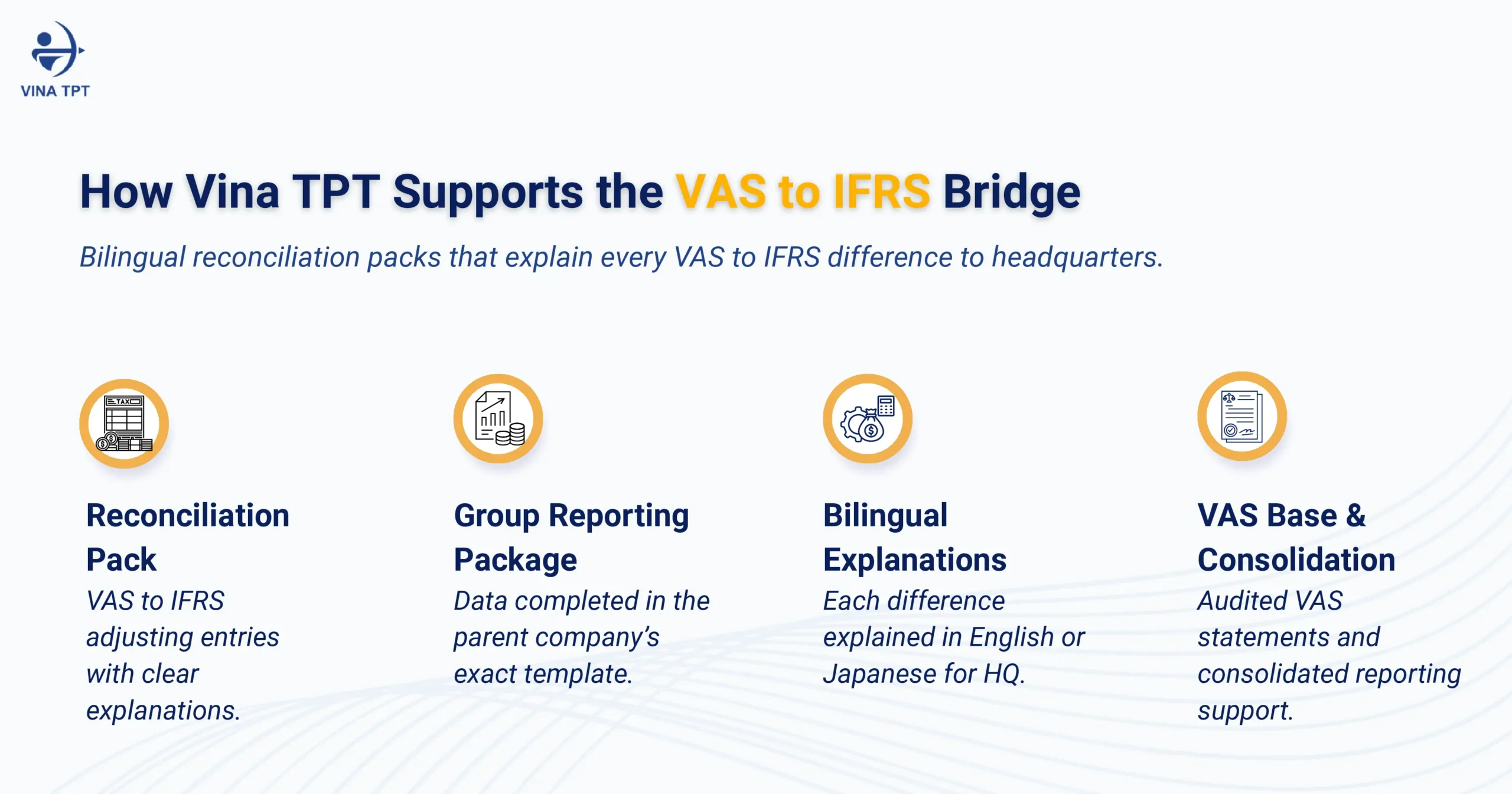
- Preparation of the Bridge/Reconciliation Pack: Analyze all differences, prepare adjusting entries from VAS to IFRS, and explain the economic substance in detail to the Group Finance Department through bilingual reports.
- Standardization of the Reporting Package: Complete financial data in exact accordance with the template prescribed by the Parent Company.
- Platform system advisory: Where the company needs to standardize a proper VAS financial statement set as the base or needs to prepare internal consolidated financial statements, Vina TPT provides a full package within the corporate financial reporting ecosystem.
(Investors can learn more about the foundational financial statement service in the article Financial Statements Reporting Vietnam and the tax finalization process in the article Annual Tax Finalization in Vietnam 2026.)
The VAS to IFRS conversion process requires in-depth understanding of the economic substance of each transaction, with primary focus on adjusting Fixed Assets, Leases (IFRS 16), Receivables (IFRS 9), Revenue recognition (IFRS 15), and Deferred tax (IAS 12).
Send Vina TPT your latest VAS financial statements together with the Parent Company’s Accounting Policies manual. Our CPA/ACCA specialist team will analyze and send you the list of line items requiring adjustment completely free of charge!