
How to Open Business Bank Account in Vietnam for FDI: Step-by-Step Guide
Are you a foreign investor setting up an FDI company in Vietnam? Opening a business bank account is not just the first essential step—it’s a legal requirement to manage investment capital and daily operations. This comprehensive 2025 guide walks you through every stage, from document prep to account activation, based on the Investment Law 2020 and Enterprise Law 2020. Let’s get your open best business bank account for LLC or corporation up and running—fast and compliant.
1. Why Foreign Investors Need to Open Business Bank Account in Vietnam
Opening business bank account in Vietnam is critical for FDI compliance and financial transparency. The State Bank of Vietnam (SBV) mandates that all FDI entities maintain dedicated accounts to contribute charter capital and conduct international transactions. This protects assets and enables legal profit repatriation. Here’s why it matters.
Strategic Importance
- Efficient foreign exchange management: Seamlessly transfer funds globally and access offshore loans.
- Financial transparency: Track expenses, taxes, and annual audits with ease.
- Build credibility: A dedicated account boosts trust with partners and Vietnamese authorities.
- Flexible profit repatriation: Move earnings abroad after tax obligations—via the right account.
The Two Essential Accounts
FDI companies must open two core accounts:
- Direct Investment Capital Account (DICA) – for capital contributions.
- Current Account – for daily operations.
DICA is opened first and is non-negotiable for receiving registered capital.
2. Step-by-Step Guide to Open Business Bank Account
The process typically takes 1 week, depending on the bank and document readiness. We break it into four logical phases: Preparation, Bank Selection, Submission, and Activation—all aligned with the Banking Law 2010 and 2025 forex rules.
Phase 1: Pre-Registration Requirements
Complete business registration before approaching any bank.
Legal Entity Establishment
- Register with the Department of Planning and Investment (DPI) to obtain:
- Investment Registration Certificate (IRC) – for the investment project.
- Enterprise Registration Certificate (ERC) – for company setup.
- Secure a tax code and enterprise code.
- Prepare valid passport and visa for the legal representative.
Capital Commitment
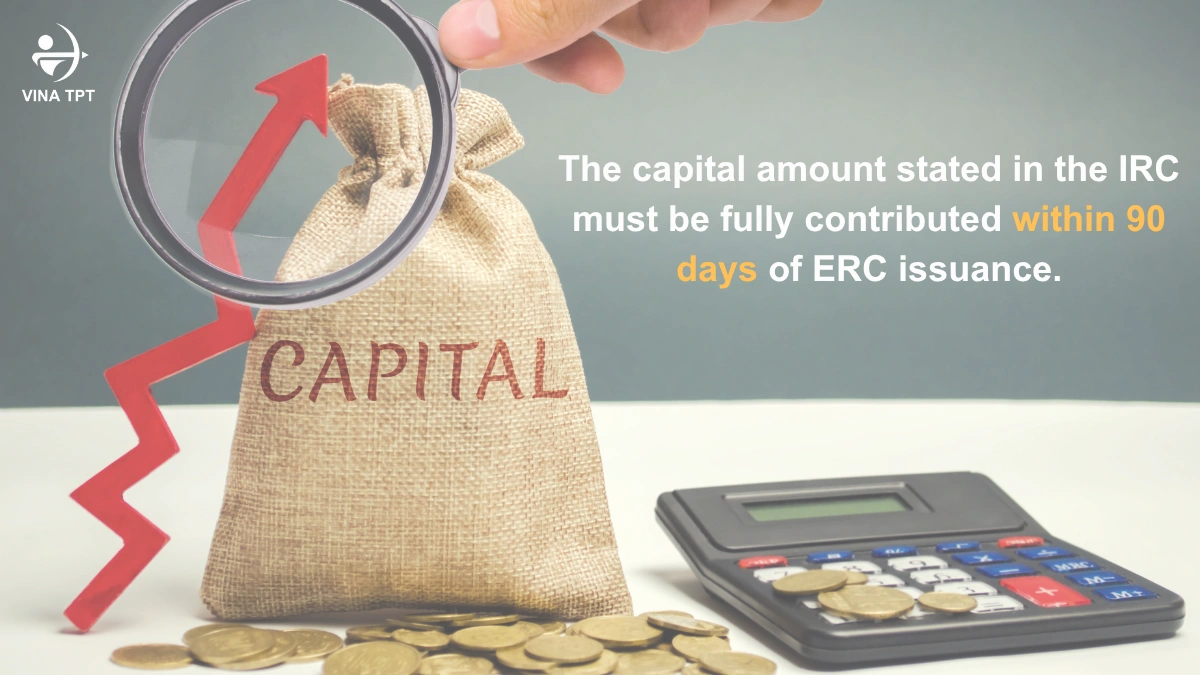
The capital amount stated in the IRC must be fully contributed within 90 days of ERC issuance. The bank opens a DICA to monitor inflows—ensuring SBV compliance.
Example: If registered capital is $100,000, the full amount must enter the DICA before the deadline.
Phase 2: Choosing Your Bank Wisely
Choosing the best business bank account impacts fees, speed, and English support. Prioritize institutions with proven FDI experience.
Key Selection Criteria
- FDI expertise: Banks that have processed thousands of DICA openings.
- Low forex fees: Competitive VND/USD conversion rates and free large transfers.
- English digital banking: 24/7 mobile apps for international wires.
- Branch network: Presence in Ho Chi Minh City, Hanoi, and Da Nang.
Top Recommendations (2025)
- HSBC & Standard Chartered: Best for global FDI—fast forex, full English support.
- Vietcombank & BIDV: State-owned, low fees, strong local DICA experience.
Tip: Consider ACB, UOB, or VietinBank for additional best business bank account options.
Phase 3: Documentation and Submission
This is the core phase. All documents must be notarized or translated into Vietnamese if required.
Mandatory Document Checklist
| Document | Requirement |
| Investment Registration Certificate (IRC) | Notarized copy |
| Enterprise Registration Certificate (ERC) | Notarized copy |
| Account Opening Resolution (Board-approved) | Original, signed by legal rep |
| Passport & visa of legal representative | Notarized copy |
| Proof of company address (lease agreement) | Notarized copy |
| Chief Accountant / Finance Manager details | Original (if applicable) |
| Specimen signature & company seal | Original |
Note: Requirements follow SBV guidelines and may vary slightly by bank.
Power of Attorney (POA)
If the legal representative cannot sign in person, a notarized POA (at a Vietnamese notary or consulate) is required. It must explicitly authorize account opening and management.
Phase 4: Account Activation and Initial Deposit
Banks review applications in 3–7 days. Once approved:
- Transfer capital from abroad into the DICA.
- Activate online banking and access rights.
- Set up transaction alerts for forex monitoring.
Capital Contribution Deadline
Per the Investment Law, full capital must arrive within 90 days of ERC issuance. Late contributions risk VND 10–50 million fines or license revocation. Banks report violations to the SBV.
3. Understanding the Two Mandatory Account Types for FDI
FDI firms must maintain separate accounts under SBV forex rules. This ensures transparency and prevents misuse of investment capital.
3.1 Direct Investment Capital Account (DICA)
A dedicated account for direct investment, opened in the currency registered in the IRC (usually USD or VND).
Purpose and Permitted Transactions
- Receive capital contributions from foreign investors.
- Accept international loans.
- Repatriate profits and dividends (post-tax).
- Repay foreign debt.
Strict Compliance Rules
Every DICA transaction requires supporting documents (invoices, loan agreements). Violations may trigger account freezes under Decree 88/2019/ND-CP.
3.2 Current Account (Operating Account)
Opened after DICA and linked to it—for daily business spending.
Purpose and Permitted Transactions
- Pay salaries and VAT.
- Purchase local goods and services.
- Receive payments from Vietnamese clients.
- Make VND domestic transfers.
Interplay Between Accounts
Funds flow one-way only: DICA → Current Account. Reverse transfers are prohibited to protect investment capital.
Bonus: You may open additional accounts (e.g., payroll, project, escrow, or multi-currency) based on operational needs.
4. Common Challenges and Expert Solutions
Based on 2025 FDI consulting experience, here are frequent hurdles—and how to solve them.
Challenge 1: Foreign Currency Management
Risk: VND/USD rate fluctuations erode profits.
Solution: Open a parallel foreign currency account with DICA. Use HSBC’s hedging tools to lock rates. Monitor daily SBV conversion limits.
Challenge 2: KYC/AML Delays
Risk: Incomplete Ultimate Beneficial Owner (UBO) data extends review by 2–4 weeks.
Solution: Submit UBO passports and financial history early.
Challenge 3: Legal Representative Changes
Risk: Delays in updating DPI and bank records.
Solution: File updated resolution + new POA. Takes 5–10 days.
Challenge 4: Profit Repatriation
Risk: Complex documentation delays transfers.
Solution: Prepare audited financials, tax clearance from the Tax Department, and route via DICA. Processing: 15–30 days (Circular 19/2014/TT-NHNN).
5. Value-Added: Comparison of Top Banks for FDI (2025)
| Bank | DICA Opening Fee | English Support | Processing Time | FDI Experience |
| HSBC | Free | High | 3–5 days | Excellent (Global) |
| Standard Chartered | Low | High | 4–7 days | Strong |
| Vietcombank | Free | Moderate | 5–10 days | High (Local) |
| BIDV | Low | Moderate | 7–14 days | Good |
6. Simplify the Process with Vina TPT Accounting Services
As a leading provider of accounting, tax, and FDI consulting in Vietnam, Vina TPT Accounting Services has supported over 200 foreign companies in compliant financial setup—including opening business bank accounts, VAT/PIT/CIT reporting, and multinational HR.
Our all-in-one support includes:
- Bank selection advisory: Match HSBC, Standard Chartered, or Vietcombank to your capital and forex needs.
- Full document preparation & verification: IRC, ERC, POA, signatures—100% notarized and compliant.
- Proxy submission & KYC follow-up: Reduce approval time to 3–5 business days.
- Capital contribution guidance: Ensure 90-day compliance and avoid penalties.
Special: Open DICA + Current Account simultaneously with instant English online banking.
Contact Vina TPT now for consultation on opening a business bank account