The FDI picture in Vietnam is expanding at pace. Disbursed capital reached a record USD 27.62 billion in 2025, and in the first six months of 2026 registered capital jumped to USD 34.65 billion, up 61% year on year. A consumer market of VND 7,093 trillion is driving global brands such as OH!SOME, Saizeriya, Pin Wei, Shake Shack… to keep expanding their legal entities and on-the-ground retail networks.
With a rapidly growing middle class, improving logistics infrastructure, and a new generation of FTAs, Vietnam offers significant opportunities for investors looking to establish an international business in Vietnam.
Working alongside FDI companies, this article from Vina TPT maps the full market-entry roadmap: choosing the form of legal presence, reviewing conditional business lines, obtaining the IRC and ERC, and building a tax, accounting, and labor system that is complete and correct from day one.
1. Choose the Right Form of Presence First
The first step in establishing an international business in Vietnam is not choosing a brand name. It is selecting the form of legal presence that accurately matches the investor’s business objectives.
- Limited Liability Company (LLC): This is the most common and optimal model, accounting for more than 90% of FDI projects in Vietnam. It applies limited liability within the scope of contributed capital, has a relatively flexible governance structure, and allows 100% foreign ownership in most business lines. It is the most suitable choice for trading, services, manufacturing, and technology activities.
- Representative Office (RO): An RO only serves as a liaison, market-research, and trade-promotion unit. Vietnamese law strictly prohibits an RO from conducting direct profit-making activities. It may not sign commercial contracts (except under a valid power of attorney), issue invoices, or collect payment from customers. Many foreign investors set up an RO because they assume the procedures are simpler, then later have to dissolve it and incorporate a company because the RO cannot carry out business operations.
- Joint Stock Company (JSC): This form is suitable for large-scale projects that plan to raise capital from multiple shareholders or aim for a stock-exchange listing. However, the governance structure and internal regulations of a JSC are significantly more complex than those of an LLC.
2. Check Market Access and Conditional Business Lines
Before establishing an international business in Vietnam, foreign investors must carefully review the market-access conditions for their intended business lines under the Law on Investment, the WTO Commitments Schedule, and relevant Free Trade Agreements.
- Fully open sectors: Foreign investors are permitted to hold 100% of charter capital (for example: management consulting, manufacturing, software, and wholesale trading).
- Conditional market-access sectors: These may impose a cap on foreign ownership (foreign room), a required form of investment (such as a joint venture with a domestic partner), or experience and capability requirements.
- Sub-license / Business License requirements: Sensitive sectors or those that directly affect consumers – such as retail (import-export and retail distribution), F&B, education, logistics, pharmaceuticals, and e-commerce – require a specialized license after the company has been established.
- Investment capital requirements: General law does not prescribe a minimum charter capital for every sector, but the registered capital must be commensurate with the project scale and the feasibility of the business plan. Capital that is too low will lead the licensing authority to refuse project approval or to request repeated additional explanations.
3. Step-by-Step: Set Up International Business in Vietnam
The standardized process answering the question of how to register a company in Vietnam for foreign investors consists of the following 5 core stages:
Step 1: Industry Survey and Preparation of the Investment Dossier
Before commencing the company establishment procedures, the investor needs to accurately determine the business industry codes according to the Vietnam Standard Industrial Classification (VSIC) and cross-check them against the WTO Commitments Schedule and the Law on Investment to verify market access conditions. Certain sectors classified as conditional business lines will require additional specialized licenses or compliance with standards related to capital, personnel, and facilities. At this stage, the investor is advised to contact a local consulting firm for support in reviewing the industry codes and assessing the project’s feasibility.
After identifying the suitable industry, the investor proceeds to prepare the investment dossier under the guidance of the service provider. Documents of the investor (whether an individual or an organization) must be consular-legalized abroad before being brought to Vietnam for use. The consular legalization process usually takes 14 to 30 days, depending on the procedures of each embassy/consulate and the respective country.
Estimated time for the entire step: approximately 5-7 working days (excluding consular legalization time).
Step 2: Submission of the Application for the Investment Registration Certificate (IRC)
The investment dossier is submitted to the Department of Finance. The competent authority will appraise the market conditions, project location, and the investor’s financial capacity before officially issuing the IRC.
Estimated time: 30 – 45 working days.
Step 3: Submission of the Application for the Enterprise Registration Certificate (ERC)
After obtaining the IRC, the enterprise submits the legal entity establishment dossier to apply for the ERC. The business registration authority will appraise the company name, head office address, and governance structure. Once the ERC is completed, the enterprise code is simultaneously created on the National Business Registration Information System.
Estimated time: 14 – 20 working days.
Step 4: Opening a Bank Account, Engraving the Company Seal, and Making Capital Contribution
The enterprise proceeds to engrave the legal seal, publish the seal specimen, and open a Direct Investment Capital Account (DICA) at a commercial bank licensed to operate in Vietnam. Under the law, the investor must complete the transfer of the entire committed charter capital into the DICA within a maximum of 90 days from the date the ERC is issued.
Implementation time: Within 90 days as prescribed by law.
Step 5: Completion of Tax Registration and Post-Establishment Compliance
The enterprise purchases a digital signature (USB Token), installs the company signboard at the head office, carries out initial tax registration, submits the business license fee declaration, and registers the electronic invoice system. At the same time, the company completes labor registration and social insurance procedures if employees are officially hired, and registers the enterprise electronic identity account (VNeID for enterprises) to facilitate electronic administrative procedures and transactions with state authorities.
Estimated time: 14 – 30 working days.

4. Tax, Accounting and Labor Obligations After Setup
Once an international business in Vietnam is legally established, ongoing tax, accounting, labor, and investment reporting obligations arise immediately, regardless of whether the company has recorded any revenue.
- Tax obligations: The company must declare and pay on time Value-Added Tax (VAT), Corporate Income Tax (CIT), Personal Income Tax (PIT) for employees, and Foreign Contractor Tax (FCT) whenever payments are made to international counterparties.
- Accounting standards and audit: Accounting books must be maintained under the Vietnamese Accounting Standards (VAS). An FDI company is required to appoint a legally qualified Chief Accountant and must have its annual financial statements audited by an independent audit firm in Vietnam before submitting them to the tax and statistics authorities.
- Labor law and expatriate compliance: The company must enter into labor contracts and make mandatory social insurance contributions. When employing foreign nationals, it must complete the Work Permit or Work Permit exemption procedures and obtain a Temporary Residence Card (TRC) to ensure lawful residence.
- Investment Activity Report (IAR): This is a mandatory quarterly and annual reporting obligation on the National Foreign Investment Information System. Discrepancies between investment report figures and the audited financial statements can result in significant administrative penalties.
5. Practical Challenges Foreign Founders Often Underestimate
During implementation, many international investors run into bottlenecks because they underestimate Vietnam’s administrative barriers:
- Registered office address barrier: Vietnamese regulations require a business to have a lawful registered office address that is suitable for business registration and can be verified by the relevant authorities. For foreign investors, setting up a traditional office from the beginning can be time-consuming and costly, as it may involve finding a suitable premises, negotiating and signing a lease, arranging the office, and preparing the necessary supporting documents. To save time and reduce initial setup costs, many investors therefore consider a Shared Office during the early stage of establishing their business. A suitable Shared Office can provide a lawful business address together with the necessary legal documents and support for an on-site inspection by the tax authority when required.
- Requirements for the Legal Representative: The company must have at least one Legal Representative who resides regularly in Vietnam. This person must complete Personal Tax Identification Number registration, obtain a Work Permit, and activate Level-2 VNeID identity so that they can use a digital signature on public service systems.
- Timeline slippage versus the original plan: Actual dossier review often takes longer than the theoretical timeline if overseas legal documents have consular-legalization defects, translations are inaccurate, or the explanation of the investment capital source does not meet the competent authority’s requirements.
- Timeline slippage versus the original plan: Actual dossier review often takes longer than the theoretical timeline if overseas documents have consular-legalization defects, translations are inaccurate, or the explanation of the investment capital source does not meet the competent authority’s requirements.
For that reason, investors should appoint a partner for company setup, Chief Accountant support, and tax compliance from the dossier-preparation stage – rather than splitting the work into two phases of “get the license first, find an accountant later.”
6. How Vina TPT Supports International Business Setup in Vietnam
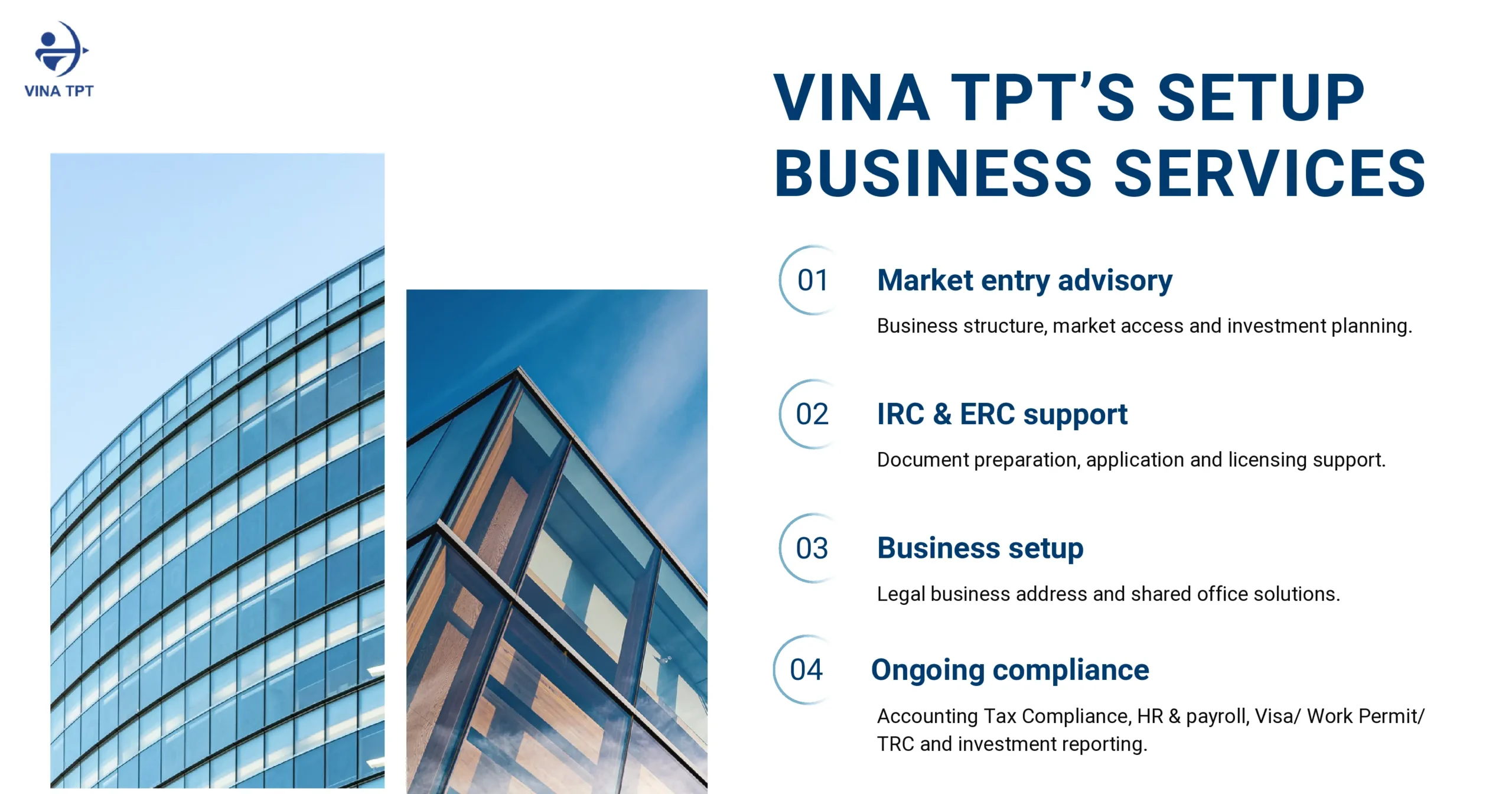
As a leading B2B advisory firm in accounting, tax, and corporate law for FDI companies in Vietnam, Vina TPT provides an end-to-end solution from market entry through to stable operations:
- Legal structure and business-line advisory: We assess market-access conditions and recommend a capital structure and form of presence that is tax-efficient.
- Full-package licensing: We prepare a compliant dossier and represent the investor before state authorities to obtain the IRC, ERC, and all required specialized business licenses.
- Lawful registered office: Vina TPT provides a business registration address and a Shared Office solution that is legally qualified and meets the tax authority’s on-site inspection requirements. Refer to Shared Office Vietnam: A Smart Workspace Solution for Startups and FDI Companies to choose the right office model before you file the IRC/ERC dossier.
- Post-establishment management system: We deliver a full package covering VAS accounting and bookkeeping, financial statement, tax filing, HR & payroll, Work Permits, and periodic Investment Activity Reports (IAR).
Are you preparing a plan to start business in Vietnam? Contact Vina TPT’s specialist team today for an in-depth advisory roadmap and a complete company setup solution that is legally sound and operationally efficient.