

In corporate governance and financial compliance activities in Vietnam, accurately determining the VAT rate is not only a mandatory legal requirement but also a factor that directly influences pricing strategy, tax declaration efficiency, and cash flow circulation. Especially for foreign direct investment (FDI) enterprises, this tax requires the highest level of caution to minimize the risk of tax recovery or administrative penalties during operations.
Value Added Tax (VAT), or value added tax, is an important indirect tax that makes a major contribution to the state budget. It is calculated on the added value of goods and services arising throughout the entire process from production and distribution to consumption. To help enterprises gain a comprehensive understanding, this article compiles the latest regulations on the VAT rate Vietnam, provides a detailed analysis of the applicable tax rates in 2026, policy exemption and reduction cases, as well as core notes to help foreign investors ensure absolute legal compliance.
1. What is Value Added Tax (VAT) in Vietnam?
According to the Law on Value Added Tax of Vietnam, value added tax Vietnam is a tax applied to most types of goods and services used for production, business, and consumption purposes within the territory of Vietnam. The taxable objects cover a wide range, from domestic consumer goods to commercial services, excluding those items listed as non-taxable under specific provisions of the law.
Taxable subjects are defined as all organizations and individuals engaged in the production or trading of goods and services subject to VAT, or entities that import goods from abroad into Vietnam. From an economic management perspective, VAT not only ensures a stable and sustainable source of revenue for the national budget but also creates a transparent financial management mechanism through the invoice and supporting document system. A clear understanding of the nature of VAT will help foreign managers become more proactive in optimizing input costs and establishing standard compliance processes.
2. Current VAT Rates in Vietnam
The legal framework on the VAT rate Vietnam in 2026 categorizes goods and services into specialized tax rate groups in order to regulate the economy and support social welfare. The current system consists of three main tax rates along with a non-taxable group.
2.1. Standard Tax Rate of 10% and the Temporary Reduction Policy to 8% until the End of 2026
The 10% tax rate applies to most ordinary goods and services that fall outside preferential or export categories. However, to continue stimulating domestic consumption and supporting enterprises in production recovery, the Government has approved a temporary reduction of the VAT rate from 10% to 8%, which remains effective until 31 December 2026.
Enterprises should note that this 8% reduction policy does not apply universally across all sectors. Certain groups of goods and services are still required to apply the standard 10% rate, including:
- Telecommunications services, financial activities, banking, securities, and insurance.
- Real estate business and products from metals or mining products (excluding coal).
- Goods subject to Special Consumption Tax (SCT) such as alcohol, beer, tobacco, and automobiles with fewer than 24 seats.
|
VAT Rate |
Main Scope of Application |
Practical Examples |
| 8% (Until 31/12/2026) | Ordinary consumer goods and services normally subject to 10% that are eligible for reduction. | Consumer goods, food & beverage services, domestic logistics, processing manufacturing. |
| 10% (Standard) | Specific sectors not eligible for the VAT reduction. | Telecommunications, banking, real estate, goods subject to Special Consumption Tax. |
| 5% | Essential goods and services, agriculture, healthcare, and education. | Clean water, medical equipment, medicines, fertilizers, social housing. |
| 0% | Goods and services exported abroad or to non-tariff zones. | Exported goods, international transportation, services provided to foreign partners. |
2.2. Goods and Services Subject to 5% VAT Rate
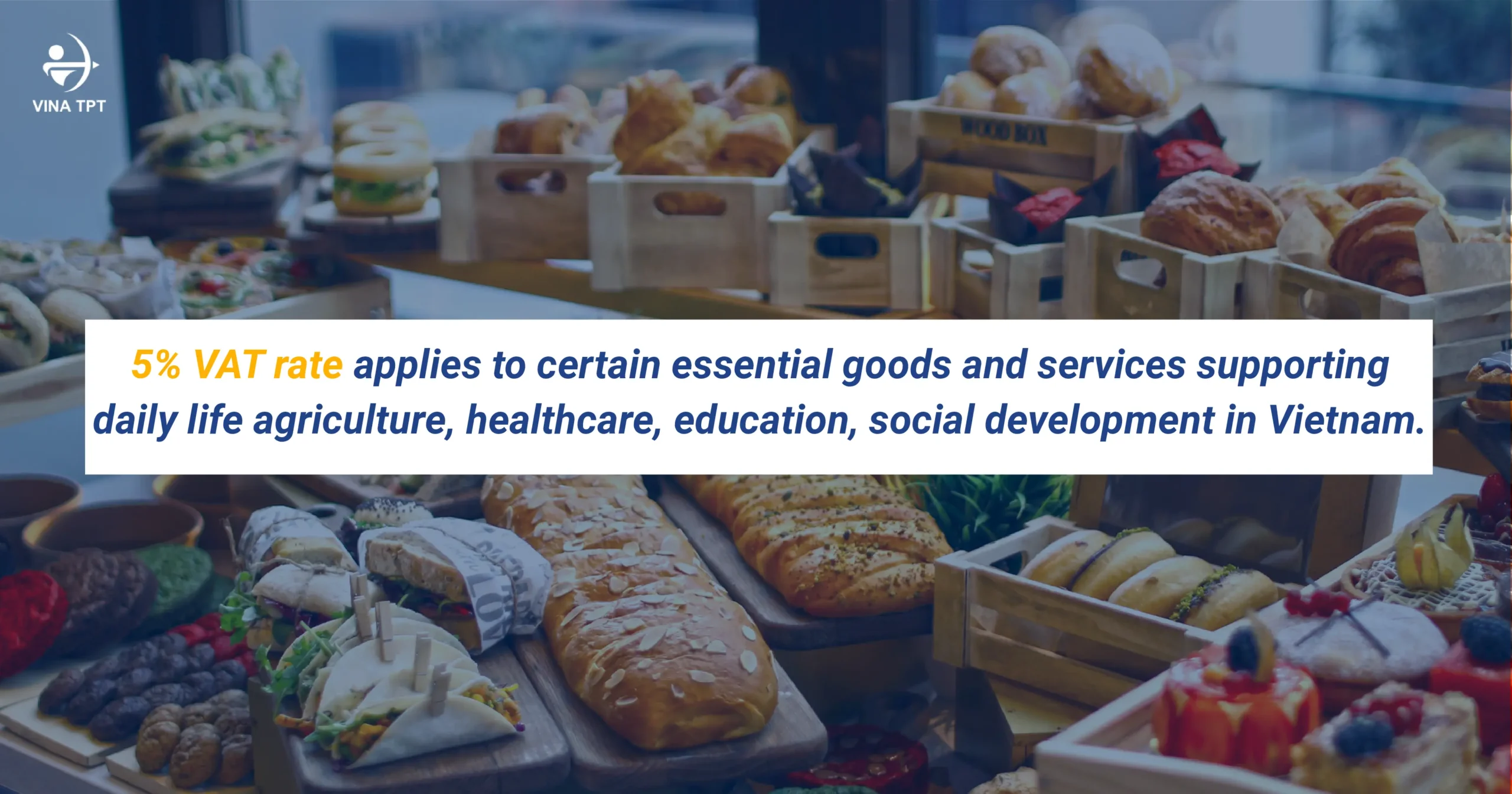
The 5% tax rate is a preferential policy of the State applicable to groups of essential goods and services that serve people’s livelihoods, agricultural development, and social infrastructure. Common groups include:
Clean water used for production and daily living purposes (excluding bottled or containerized drinking water). Fertilizers, plant protection products, plant and animal growth stimulants. Medicines, vaccines, medical biological products, and specialized medical equipment and instruments. Teaching aids, educational materials, and specialized books. Certain agricultural, forestry, and aquatic products that have not been processed or have only undergone ordinary preliminary processing at the commercial trading stage, as well as social housing sale and lease projects as prescribed.
2.3. 0% VAT Rate and Exempt Cases
The 0% tax rate is designed to encourage export activities and enhance the competitiveness of Vietnamese products in the international market. The scope of application of the 0% rate includes goods exported abroad, goods sold into non-tariff zones for export production, international transportation services, and services provided directly to organizations and individuals overseas.
In addition, the law also specifies a list of VAT-exempt objects, such as self-produced agricultural products sold by the producers themselves, transfer of land use rights, credit services, securities, life insurance, and public healthcare and education services.
Core distinction between “0% Tax Rate” and “VAT-Exempt”:
- 0% Tax Rate: The enterprise remains within the scope of VAT, and is therefore entitled to deduct and fully refund all input VAT paid on related production and business costs.
- VAT-Exempt: The enterprise does not charge output VAT, but at the same time is not entitled to deduct or refund input VAT. This input tax must be included in production and business costs or the original cost of assets.
3. Key Compliance Requirements Related to VAT Rate
To maintain legal compliance and optimize the amount of deductible tax, enterprises must strictly comply with the current tax administration regulations:
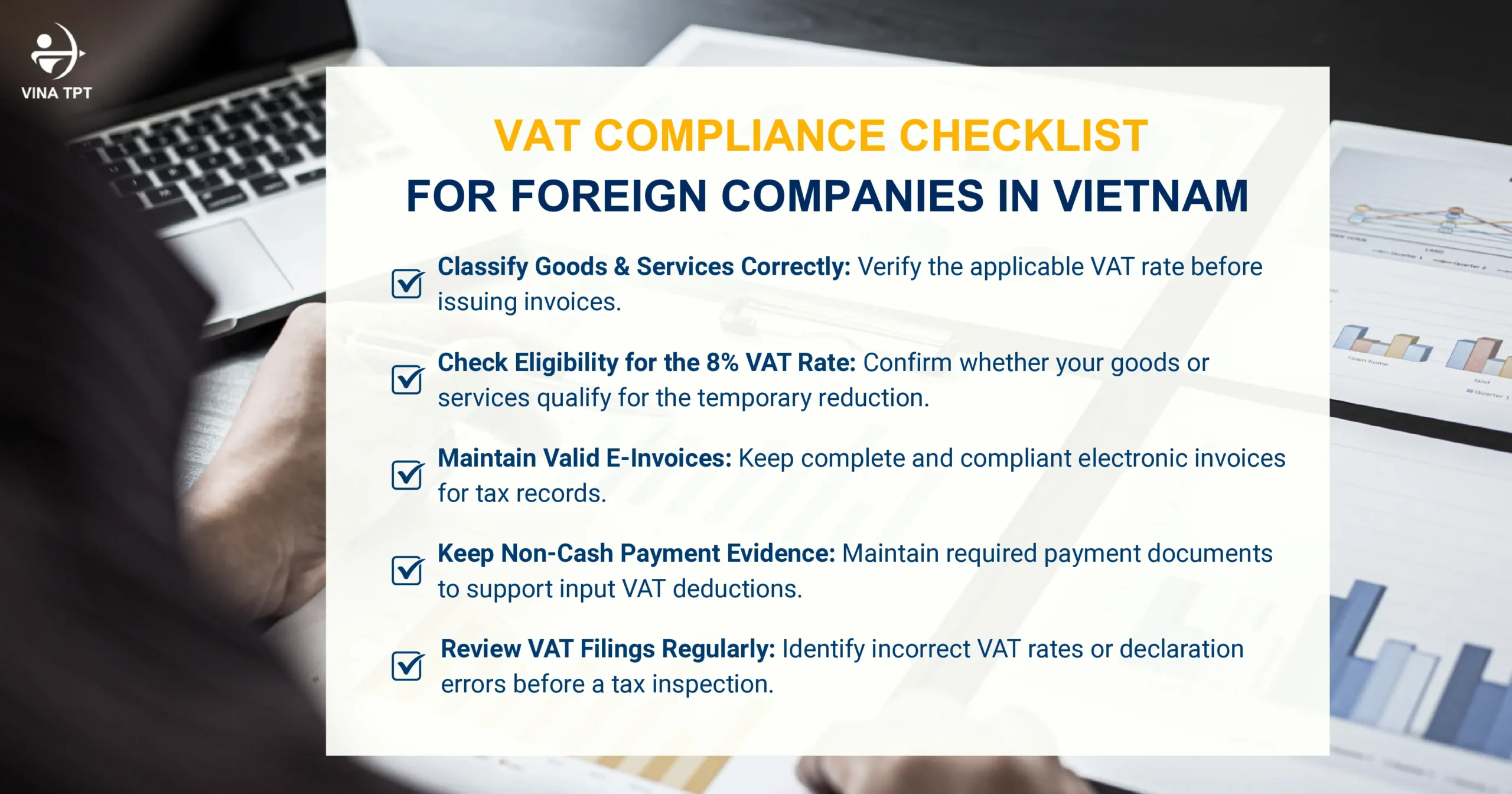
Enterprises must fulfill their VAT declaration and payment obligations on a monthly or quarterly basis, depending on the total revenue of the immediately preceding year (enterprises with annual revenue of VND 50 billion or more are required to declare monthly). To be eligible for input VAT deduction, the enterprise must fully meet three mandatory conditions: possession of a valid VAT invoice; non-cash payment documents for invoices valued at VND 5 million or more (including tax); and the purchased goods or services must be used directly for the production or trading of goods and services subject to VAT.
In addition, the use of electronic invoices (with or without the tax authority’s code) is 100% mandatory. If an enterprise applies an incorrect VAT rate (for example, issuing an invoice at 8% for goods subject to the 10% rate), the enterprise will not only have to pay the underpaid tax and late payment interest but will also face serious administrative tax penalties.
4. Practical Tips for Foreign Companies
To minimize financial errors when operating a business in Vietnam, foreign managers should keep the following practical experiences in mind:
Establish a process to accurately check and classify the enterprise’s goods and service categories right from the input stage. Because the 8% tax reduction policy contains many complex exceptions, the accounting department must carefully cross-check the economic industry codes and HS codes of the products to apply the correct tax rate.
Systematically store and organize all electronic invoices together with bank payment documents. This is the only legal basis that enables the enterprise to protect its rights to input VAT deduction and refund when the competent authorities conduct tax inspections or audits.
Proactively carry out periodic internal tax reviews (tax audits) of the tax declaration process to detect and correct errors in a timely manner before the Tax Authorities issue an inspection decision. In cases where the internal team does not have a deep understanding of the local tax legal system, the enterprise should consider cooperating with professional tax agency firms to ensure operational safety.
5. How Vina TPT Supports VAT Compliance
As a reputable firm specializing in financial consulting and tax compliance for FDI enterprises, Vina TPT provides comprehensive support solutions that help businesses optimize their VAT processes:
- Tax Rate Consulting & Classification: Accurate assessment of product categories and advice on applying the correct VAT rate (clearly distinguishing between the 8%, 10%, 5%, and 0% groups).
- Periodic Tax Declaration & Reporting: Preparation and submission of accurate monthly/quarterly VAT declarations in full compliance with statutory deadlines.
- Input Deduction Review & Tax Refund Services: Appraisal of input invoice dossiers and representation of the enterprise in carrying out VAT refund procedures for investment projects and export activities.
- Support During Tax Inspections: Direct explanation, protection of data, and safeguarding of the enterprise’s legitimate rights before the tax management authorities.
Conclusion
In summary, mastering the regulations on the VAT rate and accurately complying with the VAT declaration process is the golden key that enables FDI enterprises to operate safely, transparently, and sustainably in Vietnam.
Is your enterprise facing difficulties in determining the correct VAT rate or in need of professional tax declaration support? Contact Vina TPT today for a free consultation and experience our standard full-package accounting and tax services.