Small-scale investors who want to establish a business in Vietnam often do not know whether to start with the legal structure, the capital level, or the dossier. Many confuse a Representative Office with a company that can issue invoices, choose a registered address that does not meet registration requirements, or submit overseas documents that have not been consular-legalized. The result is that the IRC/ERC file is returned and the timeline for opening a store or signing the first contract is stretched.
This article breaks the process into steps for a small business in Vietnam: choosing the entity type, checking ownership conditions, working through the IRC and ERC, selecting an address when you have just arrived, preparing personal documents, and then looking at both setup cost and ongoing cost. The aim is to see the full operating cycle – not stop on the day the license is issued.
1. Choose the Right Legal Structure for a Small Business in Vietnam
Choosing the right legal structure from the outset is a foundational decision. It directly affects the company’s governance model, financial liability, and ability to raise capital later. The three legal-entity models that foreign investors in Vietnam most often consider today are the single-member limited liability company, the limited liability company with two or more members, and the joint-stock company.
For small and mid-sized foreign investors, the limited liability company (LLC) remains the most practical and widely used option. This structure limits the investor’s financial liability to the committed charter capital and keeps personal or parent-company assets separate from operating risk in Vietnam. The LLC’s governance is also relatively lean: it is not required to form a Board of Directors or a complex General Meeting of Shareholders of the kind a joint-stock company must maintain, so business decisions can be made faster and with more flexibility. The investor may hold 100% foreign ownership or form a joint venture with a local partner.
A joint-stock company (JSC), by contrast, requires at least three founding shareholders and is bound by stricter rules on meetings, voting, and reporting. This model is a genuine fit only if the investor plans a stock-exchange listing or intends to raise capital from venture funds in the near term.
Vina TPT’s professional recommendation: If your goal is to bring a product or service to market quickly, sign commercial contracts, and issue lawful invoices, start by establishing an LLC. When the business scale grows and you need to bring in more shareholders, the company can legally convert to another enterprise type.
For dossier requirements and LLC registration conditions, refer to Vietnam LLC Registration Requirements: A Complete Guide for Investor.
2. Ownership Rules and Investment Conditions for Small Business in Vietnam
Vietnam’s investment environment is now relatively open: foreign investors may hold 100% ownership in most ordinary business lines such as management consulting, information technology, software services, and manufacturing. The legal framework still maintains, however, a list of conditional business lines for foreign investors.
The sectors that a small business in Vietnam often targets – direct-to-consumer trading and retail, food and beverage (F&B), and some logistics services – all sit in the conditional market-access group. For these lines, the law may cap the foreign capital ratio, require a Vietnamese joint-venture partner, or require the company to obtain a Retail License or another industry-specific sub-license after incorporation.
As a rule, Vietnam’s Law on Investment does not impose a single minimum charter-capital figure across all sectors (except certain finance, banking, and real-estate lines that require statutory capital). The registered capital must still correspond to the project scale, the business line, and the costs set out in the investment proposal.
Vina TPT’s management view: The investment registration authority will assess the project’s feasibility against the capital you commit. If a company registers a retail or F&B line but declares a charter capital that is too low (for example under USD 5,000-10,000), the file is easily refused or sent back for an explanation of financial capacity, because that amount cannot cover rent, equipment, and initial operating costs. In addition, the investor must contribute 100% of the registered charter capital within 90 days from the date the Enterprise Registration Certificate (ERC) is issued.
3. Step-by-Step Process to Establish a Small Business in Vietnam
Setting up a foreign-invested company in Vietnam is more complex than forming a domestic company because it runs through two separate licensing stages: investment project approval and legal-entity formation. Completing the steps out of order, or leaving gaps in the early dossier, can stall the entire timeline.
The standardized process follows these sequential steps:
Step 1: Industry Survey and Preparation of the Investment Dossier
Before commencing the company establishment procedures, the investor needs to accurately determine the business industry codes according to the Vietnam Standard Industrial Classification (VSIC) and cross-check them against the WTO Commitments Schedule and the Law on Investment to verify market access conditions. Certain sectors classified as conditional business lines will require additional specialized licenses or compliance with standards related to capital, personnel, and facilities. At this stage, the investor is advised to contact a local consulting firm for support in reviewing the industry codes and assessing the project’s feasibility.
Explore Business Setup Services
After identifying the suitable industry, the investor proceeds to prepare the investment dossier under the guidance of the service provider. Documents of the investor (whether an individual or an organization) must be consular-legalized abroad before being brought to Vietnam for use. The consular legalization process usually takes 14 to 30 days, depending on the procedures of each embassy/consulate and the respective country.
Estimated time for the entire step: approximately 5-7 working days (excluding consular legalization time).
Step 2: Submission of the Application for the Investment Registration Certificate (IRC)
The investment dossier is submitted to the Department of Finance. The competent authority will appraise the market conditions, project location, and the investor’s financial capacity before officially issuing the IRC.
Estimated time: 30 – 45 working days.
Step 3: Submission of the Application for the Enterprise Registration Certificate (ERC)
After obtaining the IRC, the enterprise submits the legal entity establishment dossier to apply for the ERC. The business registration authority will appraise the company name, head office address, and governance structure. Once the ERC is completed, the enterprise code is simultaneously created on the National Business Registration Information System.
Estimated time: 14 – 20 working days.
Step 4: Opening a Bank Account, Engraving the Company Seal, and Making Capital Contribution
The enterprise proceeds to engrave the legal seal, publish the seal specimen, and open a Direct Investment Capital Account (DICA) at a commercial bank licensed to operate in Vietnam. Under the law, the investor must complete the transfer of the entire committed charter capital into the DICA within a maximum of 90 days from the date the ERC is issued.
Implementation time: Within 90 days as prescribed by law.
Step 5: Completion of Tax Registration and Post-Establishment Compliance
The enterprise purchases a digital signature (USB Token), installs the company signboard at the head office, carries out initial tax registration, submits the business license fee declaration, and registers the electronic invoice system. At the same time, the company completes labor registration and social insurance procedures if employees are officially hired, and registers the enterprise electronic identity account (VNeID for enterprises) to facilitate electronic administrative procedures and transactions with state authorities.
Estimated time: 14 – 30 working days.
4. Selecting a Compliant Address for Your Small Business in Vietnam
The head-office address is one of the most important legal elements in a company-setup dossier. Under Vietnam’s Law on Enterprises and Law on Housing, the registered address must be a real location, with a clear cadastral identity and a lawful right of use. It must not be placed in a residential apartment or a collective housing block.
For a small business in Vietnam that has just entered the market, a long-term traditional office lease often creates a heavy financial burden. A deposit of three to six months, fit-out costs, and high monthly rent consume a large share of the budget before the company has generated any revenue.
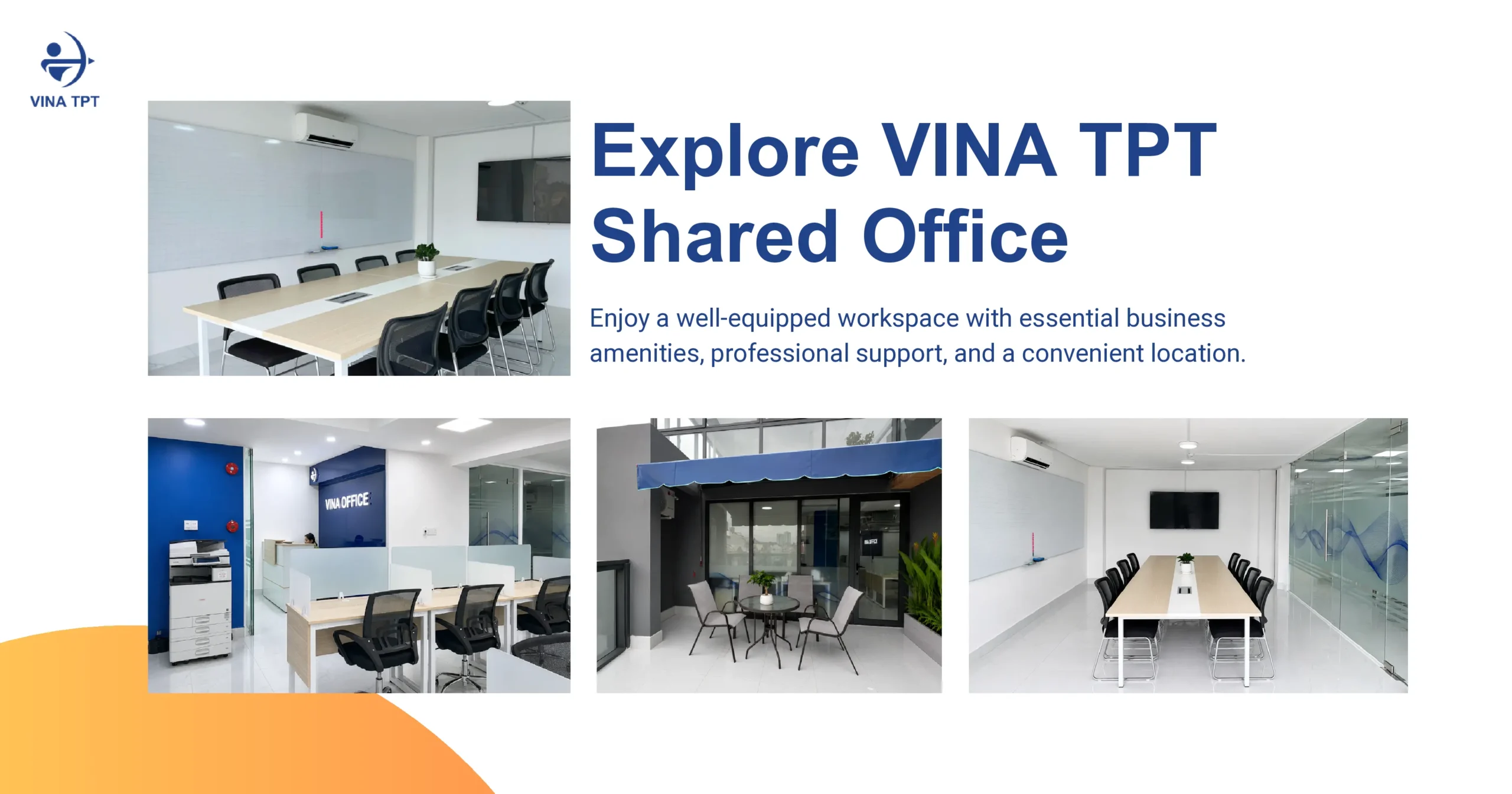
To solve that cost problem, a Shared Office or Serviced Office is the most practical option at the launch stage. A standard Shared Office address does more than supply a lawful business-registration address for the IRC/ERC file. It also meets the tax authority’s on-site inspection criteria: a company signboard, a reception desk, staff answering the phone, and a meeting room when an inspection team visits.
Vina TPT provides a Shared Office package on Hoang Sa Street in District 1, Ho Chi Minh City. The package includes a lawful business-registration address, a proper company nameplate, professional reception, and a modern meeting-room system. This solution can reduce initial fixed costs by up to 80% and makes it straightforward to upgrade to a Private Office when headcount grows.
5. Required Documents and Legalization for Small Business Foreign Investors
Preparing the legal documents is the bottleneck that costs investors the most time. Every document issued by a foreign authority must go through consular legalization and a notarized Vietnamese translation before it can be filed with the competent authorities in Vietnam.
For an individual foreign investor, the standard dossier includes these core documents:
- Personal passport: A copy of the investor’s valid passport, consular-legalized and accompanied by a notarized translation.
- Proof of financial capacity: The investor’s most recent bank statement, showing a balance equal to or greater than the charter capital committed to the company. This document must also be consular-legalized.
- Head-office premises file: An office lease or deposit agreement in Vietnam, together with the land-use rights certificate or other legal papers proving the landlord’s right to lease.
- Application forms and investment proposal: The investment-registration and enterprise-registration forms prepared to the templates of the Ministry of Planning and Investment.
Note: Personal details (full name, passport number, permanent address) and project particulars (company name, head-office address, charter capital) must match 100% across every document – from the foreign-language original and the notarized translation through to the forms filed with the state authorities. Even a small discrepancy in a character or in the transliteration of a name can send the file back so that consular legalization has to be redone from the start.
6. Realistic Setup Costs and Operating Budget for Small Business in Vietnam
To manage cash flow effectively, the investor needs to separate one-time setup cost from the operating budget for the first 12 months. Preparing funds only for the licensing stage and overlooking post-establishment compliance is the main reason many companies end up in a financially passive position.
The basic cost groups are structured as follows:
One-time setup costs
- State fees for the IRC, the ERC, enterprise information publication, and seal engraving.
- Notarization, consular legalization, and translation of foreign documents.
- Legal advisory and representation fees for filing the IRC/ERC dossier.
- First-year rent for the registered address or a Shared Office.
- Purchase of a digital signature (CA Token for 1–3 years) and e-invoice software.
Ongoing compliance and operating costs
- Accounting and tax: Monthly or quarterly bookkeeping and tax filing, plus annual financial statements under VAS.
- Labor and payroll: Salary calculation, personal tax-code registration, and social insurance contributions for staff.
- Investment reporting: Periodic investment monitoring reports on the fdi.gov.vn system.
- Sub-licenses: Maintenance or renewal of a retail business license or other industry-specific licenses, where applicable.
7. The Full Journey to Establish a Small Business in Vietnam at a Glance
To give investors a complete picture of the path from idea to the company actually starting operations, Vina TPT summarizes the execution cycle in the step-by-step table below:
| No. | Main step |
Step details |
| 1 | Survey and structuring | Choose the entity type (LLC) and review industry conditions |
| 2 | Legal preparation | Consular-legalize personal documents and lease a Shared Office |
| 3 | Investment licensing | File the dossier and obtain the Investment Registration Certificate (IRC) |
| 4 | Enterprise licensing | File the dossier and obtain the Enterprise Registration Certificate (ERC) |
| 5 | Post-licensing | Engrave the seal, open the DICA/VND accounts, and contribute full capital typically within 90 days |
| 6 | Operational activation | Tax registration, CA Token, e-invoices, and sub-licenses where required |
| 7 | Ongoing compliance | VAS accounting, tax, payroll, and investment reporting |
8. How Vina TPT Helps You Establish a Small Business in Vietnam
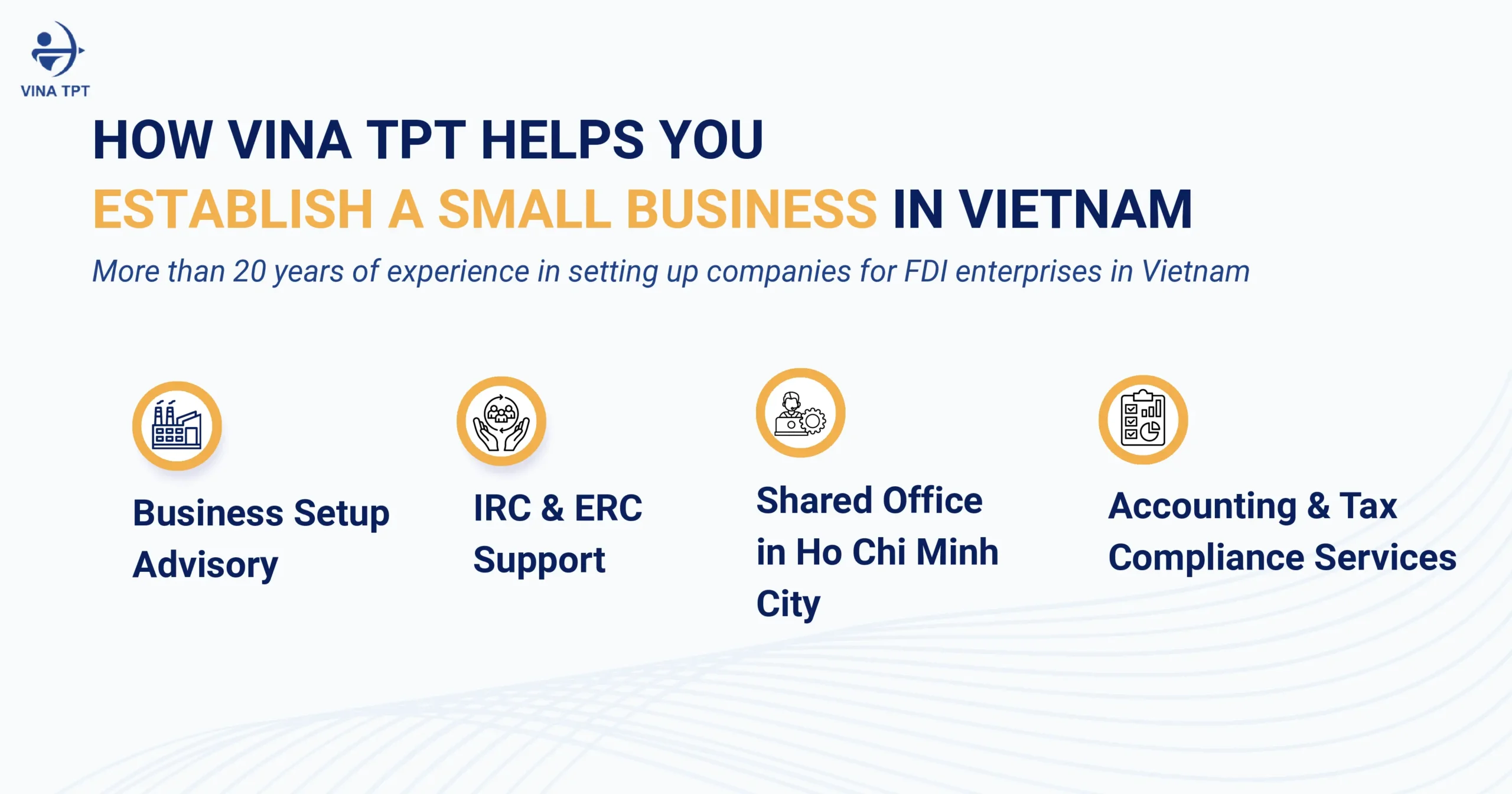
Establishing a small business in Vietnam does not end on the day you hold the ERC. It is an ongoing process of keeping legal compliance aligned throughout the company’s life. Vina TPT is a B2B advisory firm that provides an end-to-end solution ecosystem so foreign investors can grow the business with confidence:
- Legal structure and industry advisory: Assessing market-access conditions, advising on the capital model, and building a business-line list that is tax-efficient.
- Full-package licensing: Standardizing the dossier, supporting translation and consular legalization, and representing the investor in filings for the IRC, ERC, and sub-licenses.
- Registered head-office address: A compliant Shared Office in District 1, Ho Chi Minh City, that meets the tax authority’s inspection standards.
- Post-establishment operating ecosystem: Full management of VAS accounting and bookkeeping, tax filing, payroll, social insurance, and periodic investment monitoring reports.
Are you planning to establish a business in Vietnam and need a safe, cost-efficient execution path? Contact Vina TPT’s specialist team for in-depth support today.