Many entrepreneurs and foreign investors are planning to start their own business in Vietnam – a fast-growing market with competitive costs and a strategic location in Southeast Asia. With the Law on Investment 2025 officially taking effect from March 1, 2026, Vietnam continues to implement strong reforms to attract foreign direct investment (FDI).
However, establishing an FDI company brings both significant opportunities and real challenges. This article provides a balanced analysis of the advantages and disadvantages of starting your own business in Vietnam, helping you gain a comprehensive view before making an informed decision before making a decision about the advantages and disadvantages of starting your own business in Vietnam.
1. Why consider setting up an FDI Company in Vietnam?
Vietnam has become one of the most attractive investment destinations in Southeast Asia. The main reasons many investors choose to set up a business in Vietnam under the FDI model include:
- Stable economic growth with consistently high GDP growth rates over many years
- A young, abundant, and cost-competitive workforce
- Strategic logistics position as a gateway connecting ASEAN, China, and global markets
- Extensive network of free trade agreements that create export and expansion opportunities, including:
- Comprehensive and Progressive Agreement for Trans-Pacific Partnership (CPTPP)
- EU-Vietnam Free Trade Agreement (EVFTA)
- UK-Vietnam Free Trade Agreement (UKVFTA)
- Increasingly favorable FDI policies, especially following the Law on Investment 2025
This is a crucial and strategic step when you decide to start your own business in Vietnam through through foreign direct investment, especially when evaluating the advantages and disadvantages of starting your own business.
2. Key Advantages of setting up an FDI Company in Vietnam
When evaluating the advantages and disadvantages of starting your own business, Vietnam offers several compelling benefits for foreign investors.
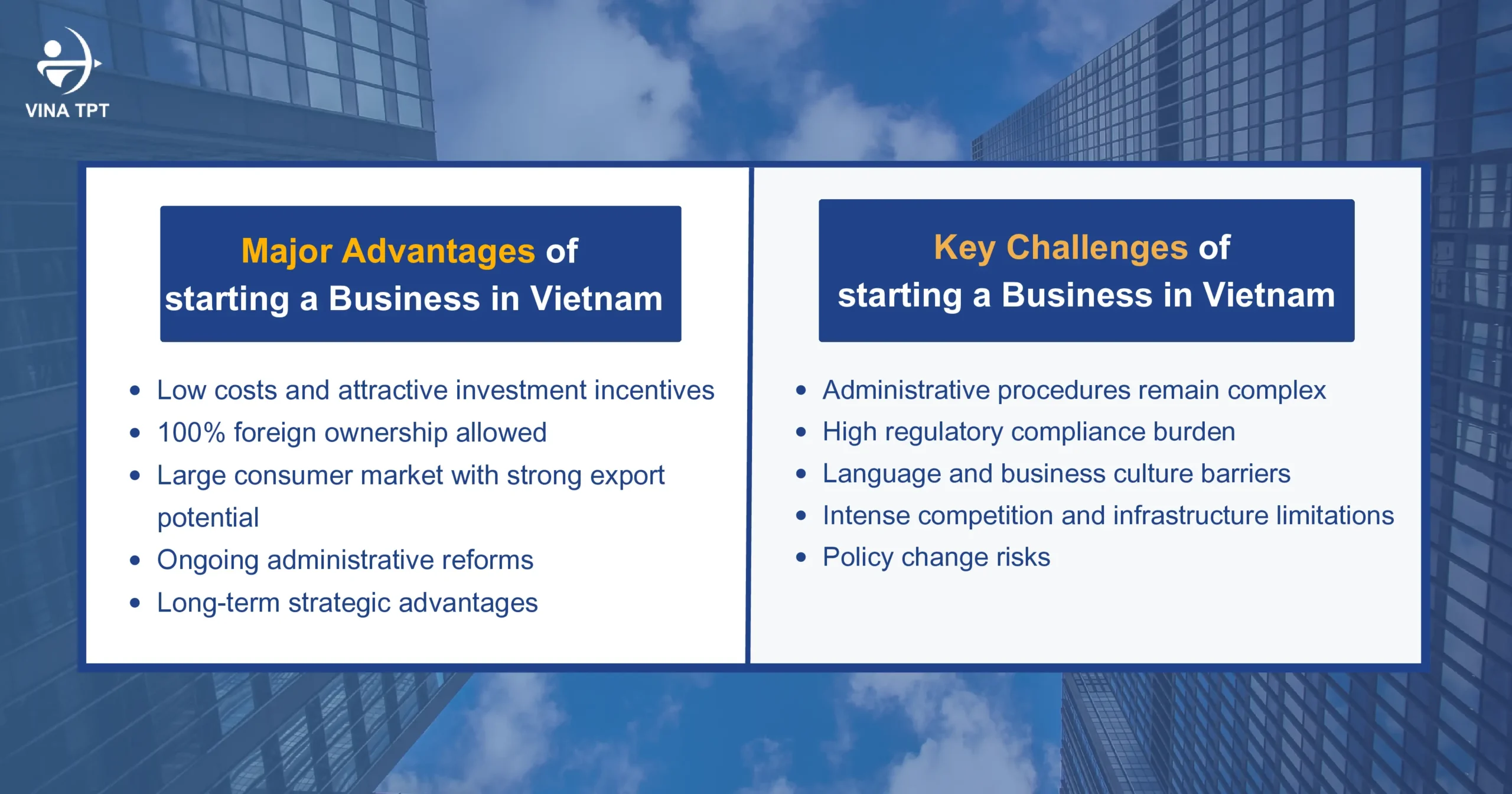
One of the biggest advantages is low operating costs. Labor, office rental, and general business expenses in Vietnam are significantly lower than in many developed markets. Additionally, companies can enjoy attractive tax incentives, especially in industrial zones or priority sectors.
Another major advantage is capital ownership flexibility. Under the Law on Investment 2025, foreign investors can own up to 100% of the capital in most sectors, allowing full control over management and operations.
Vietnam also boasts strong market potential, with a rapidly expanding middle class. Furthermore, the country serves as an excellent manufacturing hub, enabling businesses to integrate deeply into global supply chains.
Recent reforms have also shortened the company establishment timeline. In many cases, investors can now obtain the Enterprise Registration Certificate (ERC) before the Investment Registration Certificate (IRC), making the setup process faster and more flexible.
Overall, these advantages create favorable conditions for successfully starting your own business in Vietnam in an efficient and sustainable manner.
Explore Vina TPT’s End-to-End Business Setup Services
3. What challenges should investors be aware of?
Alongside the benefits, it is important to understand the disadvantages of starting your own business when choosing the FDI route in Vietnam.
Despite many reforms, administrative procedures can still be complex, especially for investors unfamiliar with the Vietnamese legal system. Preparing documents and working with government authorities sometimes takes longer than expected.
Compliance pressure is another notable challenge. Companies must strictly follow Vietnamese Accounting Standards (VAS), tax regulations, electronic invoicing requirements, and periodic reports such as the Investment Activity Report (IAR). Without proper expertise or professional support, the risk of errors is relatively high.
Additionally, language and cultural barriers can affect communication and daily operations. Understanding how to navigate the local business culture is essential for building strong relationships and achieving long-term success.
Increasing competition in many sectors and occasional limitations in infrastructure or high-quality talent are also factors to consider.
Understanding these risks is essential when analyzing the advantages and disadvantages of starting your own business in Vietnam.
4. How to maximize advantages and minimize risks?
To make the most of the advantages and disadvantages of starting your own business in Vietnam, investors should develop a clear strategy from the beginning:
- Choose the right type of company structure: Carefully consider between 100% foreign-owned companies and joint ventures, as each model has different implications for control and risk.
- Prepare thorough and accurate documentation while fully utilizing the new provisions of the Law on Investment 2025.
- Partnering with a professional consulting firm helps minimize legal and operational risks. Beyond supporting company formation, these firms typically provide comprehensive solutions covering legal, accounting, and tax services – three core areas that are closely monitored by regulatory authorities in Vietnam.
- Build a strong local team and establish a robust compliance system from day one.
- Develop a detailed financial and cash flow plan to handle potential delays in administrative procedures.
5. Why Vina TPT is the right partner for your FDI Company
When considering the advantages and disadvantages of starting your own business, choosing the right partner is critical for long-term success.
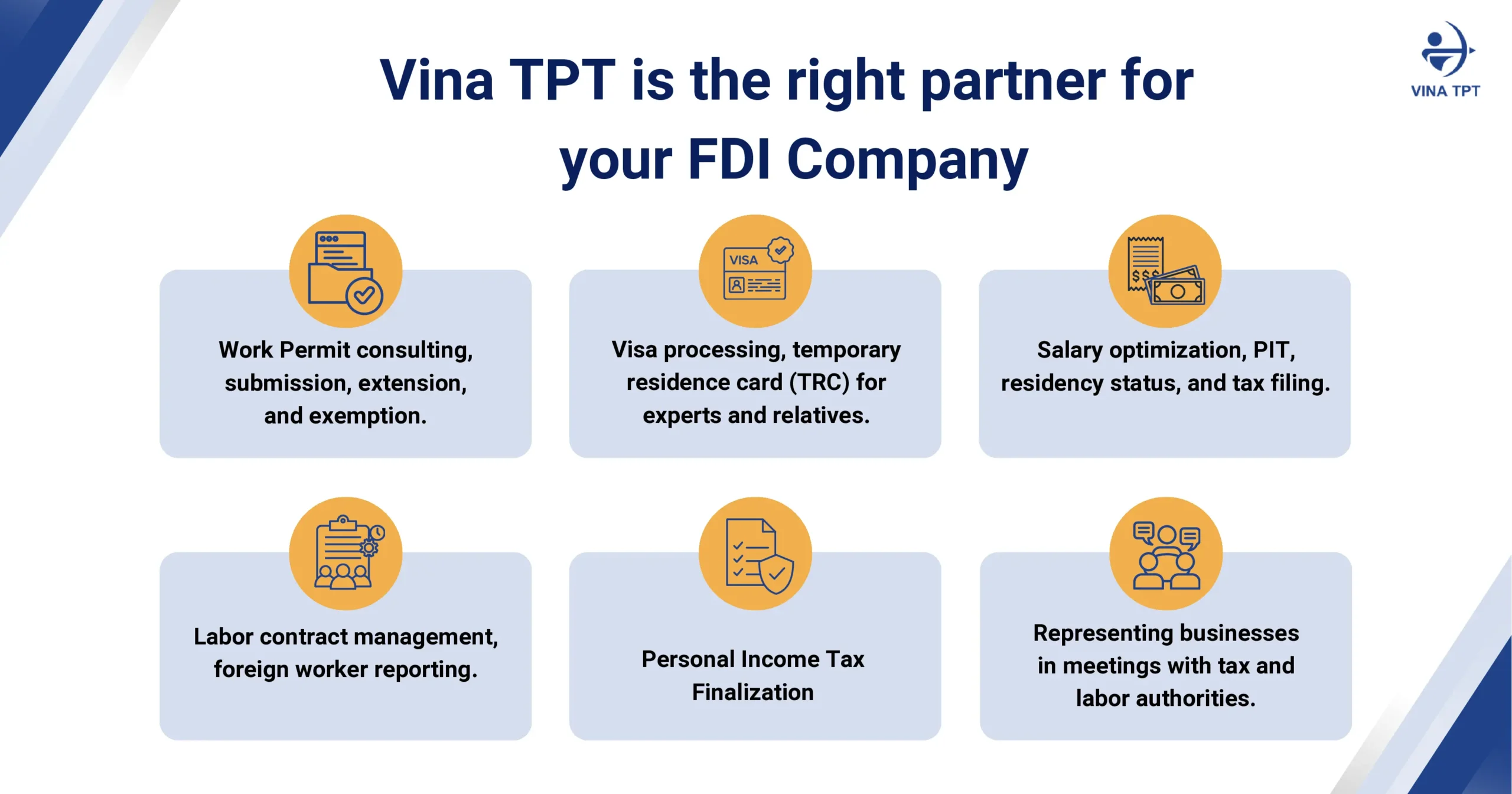
With over 20 years of experience supporting FDI enterprises, Vina TPT deeply understands the real challenges foreign investors face when starting their own business in Vietnam.
We provide comprehensive services, including:
- Investment consulting and company establishment (IRC/ERC)
- Support for Temporary Residence Cards (TRC) for foreign employees
- Qualified Chief Accountant and outsourced finance & accounting services
In addition, we have a team of legal experts with hands-on experience working directly with competent authorities throughout the company establishment and operational process. With a deep understanding of procedures, requirements, and common challenges, Vina TPT can support businesses in implementing processes efficiently while ensuring full compliance with Vietnam Accounting Standards (VAS), tax regulations, and reporting obligations. At the same time, we provide timely financial insights to support informed decision-making.
With multilingual capabilities and extensive practical experience, Vina TPT helps businesses not only “comply with the law” but also operate efficiently and successfully.
Conclusion
Understanding the advantages and disadvantages of starting your own business through the FDI model in Vietnam is a critical step before making your investment decision.
With the strong reforms introduced by the Law on Investment 2025, opportunities in Vietnam are more open than ever. However, success requires careful preparation and a well-thought-out strategy.
Contact Vina TPT today for a free consultation. Let our expert team help you build the most suitable FDI company establishment plan tailored to your business model in Vietnam.