As a startup founder, most of your time is spent developing your product and acquiring customers. However, if your accounting system is not set up and managed properly, it can quickly become a major bottleneck – leading to tax errors, lack of financial transparency, and insufficient data when approaching investors.
In reality, many startups in Vietnam struggle due to limited budgets, constantly changing tax regulations, and the need for fast, accurate reporting to support fundraising. Building a competent in-house accounting team from day one is often difficult and expensive.
This article will help you understand the 7 essential bookkeeping tasks every startup in Vietnam should prioritize, along with important considerations when choosing the right bookkeeping services for startups in Vietnam. This is why many founders start looking for bookkeeping services for startups early to build a solid financial foundation.
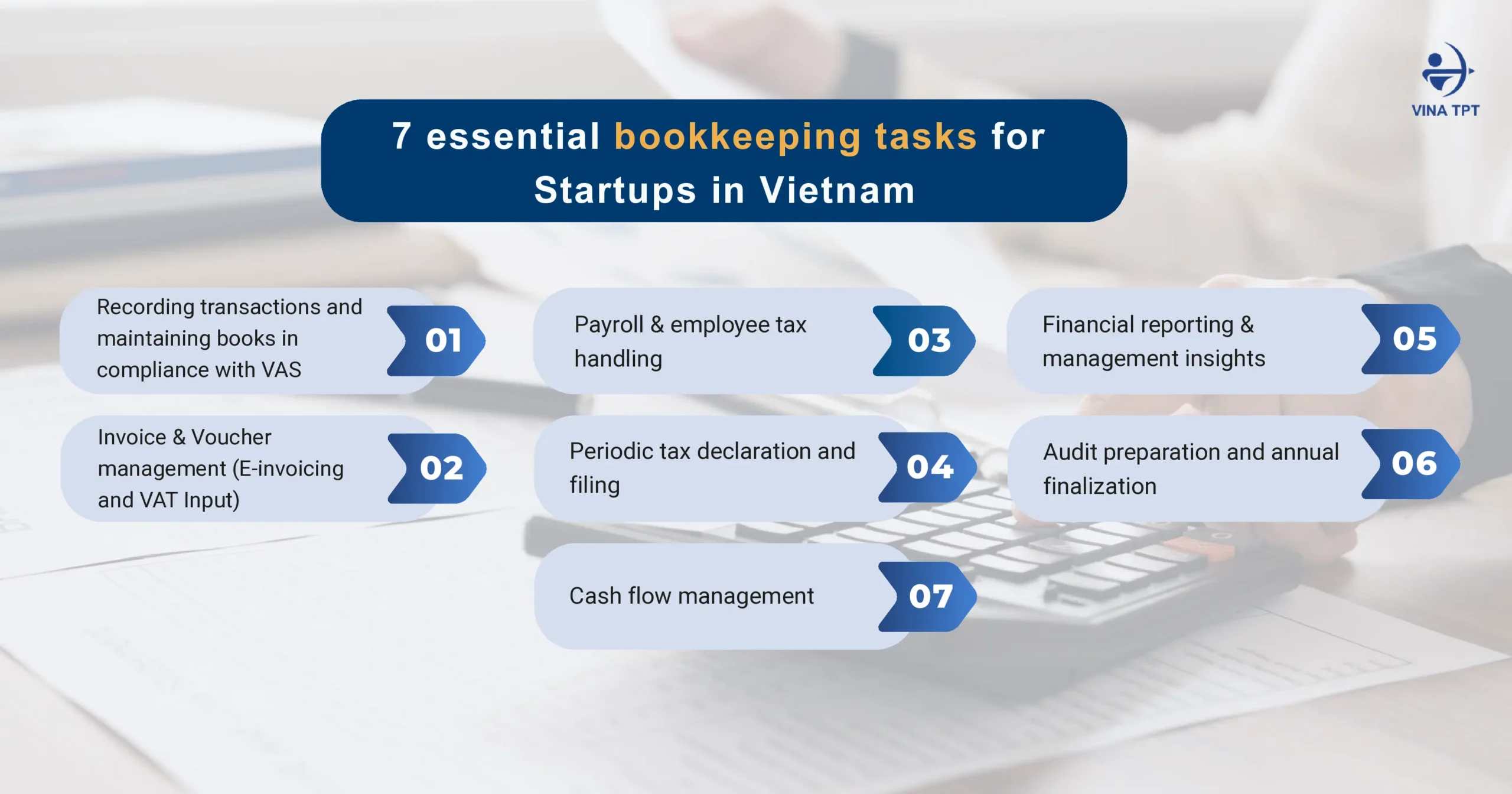
Essential bookkeeping tasks for Startups in Vietnam
Understanding these tasks also helps you evaluate the quality of bookkeeping services for startups before outsourcing. Here are the 7 core tasks that every startup should focus on when implementing bookkeeping for startups in Vietnam:
1.1. Recording transactions and maintaining books in compliance with VAS
VAS (Vietnamese Accounting Standards) is the foundation of any reliable accounting system. Every transaction – revenue, expenses, and payments – must be recorded accurately and in full compliance with current Vietnamese Accounting Standards.
For startups, incorrect or incomplete recording from the beginning can distort all future reports. This not only affects decision-making but also creates serious tax risks during finalization.
Using professional startup accounting services in Vietnam ensures your data is recorded correctly from day one and remains audit-ready.
1.2. Invoice & Voucher management (E-invoicing and VAT Input)
Electronic invoicing and proper voucher management are mandatory in Vietnam. Startups must closely track input VAT invoices to ensure accurate tax claims and deductions.
Missing valid invoices or improper storage can result in non-deductible expenses and higher tax liabilities
This function can generally be handled by an in-house accountant. However, to ensure that invoices are issued and processed in full compliance with regulations, many businesses still choose bookkeeping services for startups to minimize errors and reduce tax risks.
1.3. Cash flow management
For startups, profitability is often secondary – cash flow is everything.
Many startups fail not because their product is bad, but because they run out of money before reaching product-market fit. Therefore, closely monitoring burn rate (monthly cash consumption) and runway (months of operation left before running out of cash) is critical.
This task includes:
- Weekly and monthly tracking of cash inflows and outflows
- Comparing actual cash flow against forecasts
- Early warning when burn rate increases unexpectedly
- Regular runway updates to help founders plan fundraising on time
Investors usually require clear, updated cash flow reports at the beginning or end of each month. Without them, securing funding becomes significantly harder. Many bookkeeping services for startups include cash flow monitoring as a core feature to support fundraising readiness.
1.4. Periodic tax declaration and filing
Tax compliance is mandatory. This includes monthly or quarterly VAT declarations, provisional Corporate Income Tax (CIT) filings, annual finalization, and PIT withholding from employee salaries.
With frequent tax law changes in 2026, staying updated is essential. Late or incorrect filings can result in daily penalties (0.03% per day) and, more seriously, suspension of electronic invoicing – which can immediately disrupt sales and cash flow.
1.5. Financial reporting & management insights
Financial reports are not only for tax authorities but also serve as vital tools for founders to understand their business performance.
For startups, management reports on cash flow, operating costs, and profitability help leaders make faster and more accurate decisions.
1.6. Audit preparation and annual finalization
When a startup grows and prepares for subsequent funding rounds, financial audits often become a requirement from investors. In particular, for FDI enterprises in Vietnam, annual financial statement audits are mandatory under local regulations.
If the accounting system is not properly structured from the beginning, the audit process can be prolonged, lead to additional adjustment costs, and even impact fundraising timelines.
A professionally managed accounting system ensures that financial data is always clear, transparent, and well-documented. As a result, both the audit process and annual tax finalization can be completed more efficiently, reducing costs and enhancing credibility with investors.
In practice, accounting service providers typically work directly with auditors to finalize audited financial statements. This means businesses not only have audit-ready data but also receive end-to-end support throughout the process—significantly reducing internal workload and minimizing potential risks.
This is exactly why many founders choose outsourced bookkeeping services early – so they are always prepared when audit time comes.
1.7. Payroll & employee tax handling
Payroll management involves more than just paying salaries. It includes social insurance (BHXH), health insurance (BHYT), unemployment insurance, and Personal Income Tax (PIT) deductions.
This is also a service commonly bundled with bookkeeping services for startups, helping businesses ensure accurate calculations, timely filings, and full compliance with labor and tax regulations.
Important considerations when choosing bookkeeping services for Startups in Vietnam
Not all bookkeeping services for startups are the same, which is why careful evaluation is necessary. Choosing the right bookkeeping services for startups in Vietnam can determine whether you can focus on growth with peace of mind. Here are the key questions every founder should ask:
- Does the provider have real experience with startups? Startups typically operate with limited budgets and relatively low transaction volumes, yet they still require monthly reporting to effectively monitor cash flow and financial performance.
- How strong is their cloud system and real-time reporting? You need an easy-to-use dashboard to monitor your financial health anytime.
- What is their commitment on deadlines and error handling? A good provider must have a clear Service Level Agreement (SLA) and fast response mechanisms.
- Do they offer tax advisory and management reporting? Beyond basic bookkeeping, you need strategic advice for tax optimization and fundraising preparation.
- Is the pricing transparent with no hidden fees? Choose a clear, predictable package to avoid unexpected costs later.
Selecting the wrong provider can be not only expensive but also create legal risks and slow down your startup’s development.
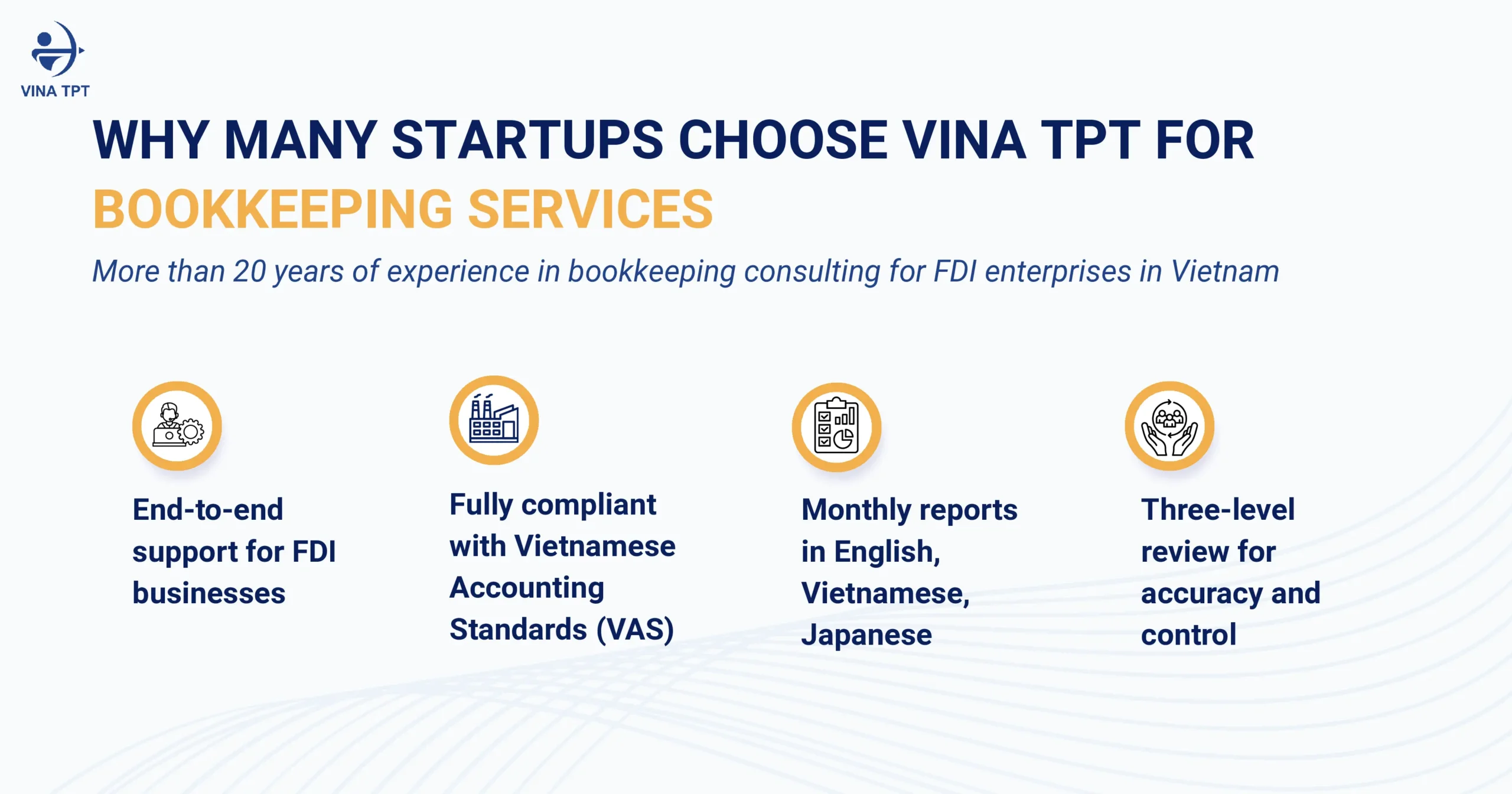
Why many startups choose Vina TPT for bookkeeping services
With over 20 years of experience, Vina TPT has supported hundreds of FDI companies and startups in Vietnam in building efficient accounting systems.
We offer comprehensive solutions including VAS compliant bookkeeping, tax declaration, payroll processing, management reporting, and Qualified Chief Accountant services. Every package is designed to be flexible according to each startup’s growth stage.
What makes Vina TPT different is not only our expertise but also our multilingual support and modern cloud-based system, allowing founders to track their financial situation anytime, anywhere. This enables you to focus fully on growth instead of being distracted by accounting issues.
Choosing the right bookkeeping services for startups can significantly impact your long-term growth and compliance. Contact Vina TPT today for a free consultation and to build the most suitable bookkeeping services for startups package for your current stage of development. Our team is ready to support your startup from day one.