1. Key Indicators Bookkeeping Service Should Improve
Businesses should consider improving their accounting services when they notice the following signs:
- Inaccurate or opaque reporting, making it difficult to assess the financial situation.
- Delays in preparing monthly/quarterly/annual reports, affecting business decisions and legal compliance.
- Service costs are too high compared to the quality and scope of service.
- Lack of financial strategy consulting support, preventing businesses from optimizing cash flow or budget.
- Expanding business but current services are not meeting the increased volume of books and reports.
These signs are signals to consider finding a more reliable accounting partner.
2. Assessing Your Business Requirements
To decide whether to switch to a new bookkeeping or accounting service, businesses need to conduct a comprehensive assessment of their current needs. A correct assessment will help you choose the right type of service, the right level of support and optimize costs.
2.1 Assess the volume of documents and the complexity of transactions
Businesses need to answer the following questions:
- Is the number of input and output invoices increasing each month?
- Are there complex transactions such as: import, export, transfer pricing, authorization, cross-border service contracts?
- Do the transactions require cost allocation, depreciation, asset capitalization, and exchange rate difference handling?
- If the volume of documents is increasing or the transactions are complicated, businesses need an accounting unit with in-depth expertise, instead of just simple bookkeeping.
2.2 Assessing Tax Compliance
Vietnam has many taxes with constantly updated regulations: VAT, CIT, PIT, FCT, electronic invoices…
Enterprises need to consider:
- Are tax reports submitted on time?
- Have you ever been fined for incorrect declaration or late submission?
- Does the current unit warn the business of new regulations or tax risks?
- Does it ensure complete documentation when the tax authority inspects?
If the answer to any question is “No”, the business should consider changing to a unit with stronger tax consulting capacity.
2.3 Reporting frequency and transparency level
Each business has different reporting needs:
- Internal management reports by month/quarter
- Reports as required by the parent company (e.g., for Japanese, Korean, Singaporean businesses)
- Reports analyzing costs, cash flow, and profits by segment
Businesses need to evaluate whether the current unit:
- Does it provide reports on time and in the required format?
- Does it explain the data clearly, or does it just send files without consulting?
- Does it support customizing reports according to management needs?
- If it does not meet these requirements, the business needs a more professional partner.

2.4 Ability to accompany the business when it expands
You need to consider:
- Does the business plan to open branches, increase capital, or increase staff size in the coming year?
- Can the current accounting unit meet the increased workload?
- Do they have experience in handling FDI or large-scale enterprise records?
A small or unsystematic unit often has difficulty keeping up with the growth rate of the enterprise.
2.5 Evaluate the appropriate bookkeeping service model
When assessing the needs, you also need to determine the ideal model:
- Fully outsource?
- Specialized service?
- A combination of internal + outsourced bookkeeping?
Part 3 below will have a comparison table to help you decide exactly which model is most suitable.
3. Comparing Bookkeeping and Accounting Options
Below is a comparison table of popular options: full outsourcing, hiring specialized services, and building an internal accounting team.
| Evaluation Criteria | Outsourced Bookkeeping / Full Accounting Outsourcing | Specialized Accounting Services (Tax, Review, Financial Reporting) | Internal Accounting Team |
| Operating cost | Low, fixed monthly fee | Medium, depends on the specialized service scope | High, includes salary, social insurance, training, and management cost |
| Professional expertise | High, especially with reputable firms such as Vina TPT | Very high, suitable for complex financial and tax matters | Varies by individual capability, risk of dependency |
| Tax advisory capability | Good, with regular regulation updates | Excellent, strong in tax planning and risk management | Limited, as internal staff have less exposure to diverse industries |
| Staff stability | Stable due to dedicated service teams | Very stable | Unstable, employees may resign and require rehiring and retraining |
| Best suited for | SMEs, FDI companies, fast growing businesses | Companies needing deep tax expertise, reviews, or complex reporting | Large enterprises that require strong internal control |
| Speed of implementation | Fast, can start immediately | Depends on scope or project complexity | Slow, requires recruitment and training |
| Data control | Good when handover processes are well managed | Very strong and detailed | Good but depends heavily on internal personnel |
| Legal compliance risk | Low due to expert handling | Very low due to constant regulatory updates | Higher if the internal team is not updated on tax regulations |
| Scalability | Flexible based on business growth | Flexible based on project needs | Limited, scaling requires hiring additional staff |
| Best case to choose this option | When businesses want cost savings and on time reports | When advanced tax, audit support, or financial management expertise is required | When the company is large and needs deep internal control |
4. Key Benefits of Switching to a Reliable Bookkeeping Service Partner
When switching to a better service provider, businesses will receive:
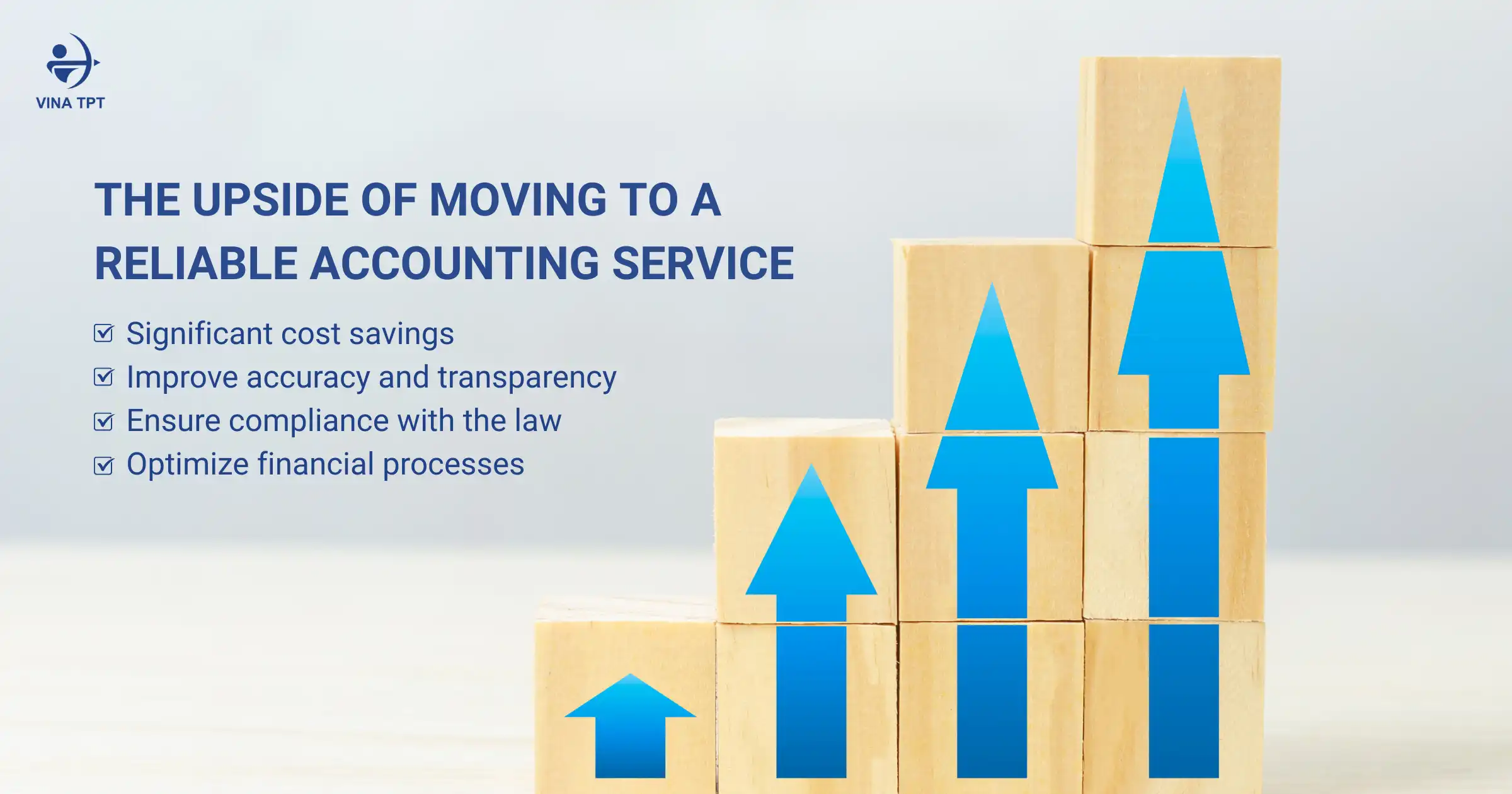
- Significant cost savings: No need to recruit, train, or maintain an internal accounting team.
- Improve accuracy and transparency: Bookkeeping is standardized, consistent, and in compliance with regulations.
- Ensure compliance with the law: Tax reporting and financial reporting are done on time and in compliance with regulations, avoiding the risk of being fined.
- Optimize financial processes: A scientifically organized accounting system supports better decision making for the board of directors.
5. Steps to Seamlessly Transition Bookkeeping Service
Transitioning to a new accounting unit will go smoothly if the business prepares properly. Here are simple but effective steps to reduce risks and avoid reporting disruptions:
Step 1: Assess the current state of bookkeeping services
Businesses need to review the quality of reports, progress of declaration submission, accuracy and coordination ability of the current accounting unit. From there, accurately determine the reason for the transition and specific requirements for the new unit.
Step 2: Prepare documents & data for handover
Including financial reports, books, tax declarations, labor contracts, software accounting data, and related documents. Arranging complete documents will help the new unit to receive quickly and not miss tax obligations.
Step 3: Make a detailed transition plan
Agree with the new accounting unit on the scope of work, start time, responsibilities of each party and method of receiving data. In this step, the business also determines the closing time to avoid duplication.
Step 4: Handover of books & check for completeness
All data is handed over according to the agreed list. The new unit will check for completeness, compare data and detect problems (if any) before official operation.
Step 5: Trial operation & adjustment
In the first 1-2 cycles (month or quarter), the new accounting unit will re-check the accounting, ensuring that tax reports and management reports are prepared correctly. If there are any discrepancies from the old unit, the two parties will immediately adjust to avoid tax risks.
Step 6: Officially switch to stable operation
After testing and comparison, the business can operate stably with the new accounting provider, ensuring a smooth, transparent process and in accordance with management requirements.
6. Why Vina TPT Is the Preferred Choice for Businesses
Vina TPT is considered the best bookkeeping services in Vietnam with many outstanding advantages:
Comprehensive and specialized services: From bookkeeping services, accounting services to complex tax consulting for FDI enterprises.
Ability to receive books at any time: Whether the enterprise transfers accounting services at the beginning, middle or end of the year, Vina TPT still ensures:
- Review old data
- Adjust errors
- Complete unfinished records
- Continue to record books for the next phase
All are done quickly – transparently – in compliance with the law.
Smooth transition process: Vina TPT has experience in handling interrupted records, incomplete books, or delayed tax reports.
Highly specialized team: Accounting – tax experts with many years of experience, knowledgeable about FDI enterprises and domestic enterprises.