Many foreign companies, when establishing a Representative Office (RO) in Vietnam, often view it as a relatively simple step for market exploration. However, in reality, an RO requires a fairly strict level of legal compliance, even though it is not permitted to conduct direct business activities. Many foreign investors initially face difficulties because they are not fully aware of the regulations regarding labor, personal income tax, social insurance, and administrative reporting.
A Representative Office is a legal form of presence for a foreign parent company in Vietnam. It primarily serves the purpose of trade promotion, market research, and supporting coordination with local partners. Although it is not allowed to sign sales contracts or collect payments, an RO must still fully comply with all regulations on personnel and finance. A small compliance mistake can lead to administrative fines, prolonged inspections, and damage to the parent company’s reputation.
This article provides detailed and practical guidance on the accounting obligations, documentation, payroll, PIT, social insurance, and mandatory labor reports for Representative Offices in 2026, helping investors operate their RO smoothly and in full compliance with the law.
1. The Legal Nature of a Representative Office in Vietnam
Under current Vietnamese law, a Representative Office (RO) does not have independent legal entity status, has no charter capital, and is strictly prohibited from directly engaging in profit-generating economic activities in Vietnam. It functions purely as a liaison office, representing the rights and legitimate interests of the parent company abroad.
The legal scope of activities for a Representative Office in Vietnam is strictly limited to the following:
- Performing liaison functions and conducting local market research.
- Promoting market research activities and collecting economic, commercial, and technical data.
- Facilitating cooperation opportunities and promoting the parent company’s products, services, and brand.
- Monitoring and supervising the implementation of contracts signed between the parent company and Vietnamese partners.
The most critical legal risk is that a Representative Office is absolutely prohibited from conducting direct business activities, such as signing commercial contracts (except in cases with specific written authorization from the parent company’s legal representative for each instance), importing or exporting goods, providing services, or directly collecting payments.
When compared to a full FDI company (a foreign-invested enterprise with full legal entity status), a Representative Office has a simpler establishment process and significantly lower maintenance costs. However, the compliance pressure regarding human resources management, Personal Income Tax (PIT) obligations, and administrative reporting is just as strict as that of a full legal entity. Any violation beyond the permitted scope of activities may result in the permanent revocation of the Representative Office’s license.
2. Does a Representative Office Need to Set up an Accounting Bookkeeping System?
This is a classic question that almost every foreign manager asks when setting up a Representative Office in Vietnam. From a purely legal perspective, the answer is No. Under current regulations, a Representative Office is not required to maintain a full accounting system or submit complete financial statements in accordance with Vietnamese Accounting Standards (VAS), as is mandatory for full FDI companies.
However, this is a common “subjective trap” that causes many foreign Representative Office managers to face serious problems during tax finalization. Although RO is not required to submit financial statements, all supporting documents and vouchers related to its operating expenses – such as office lease contracts, VAT invoices, salary payment records, business trip decisions, and equipment purchase documents – must be systematically collected, stored, and readily available for explanation.
The tax authorities have the right to inspect the RO’s expenses at any time to verify the legitimacy of funds transferred from the parent company.
Practical Recommendation from Vina TPT Experts:
You should appoint a dedicated Admin staff member or an internal accounting coordinator to strictly manage these administrative tasks, including:
- Systematically collecting, verifying, and storing all valid and legal supporting documents for operating expenses.
- Preparing and managing bank payment requests.
- Drafting and archiving business trip decisions along with complete supporting evidence.
- Coordinating and approving reimbursement records.
All supporting documents should be organized scientifically and stored securely. This creates a solid foundation for explanations and helps protect the legitimacy of expenses in case of any tax inspection.
3. Does a Representative Office Need to Comply with Payroll, PIT, and Social Insurance Requirements?
The answer is Yes. As soon as a Representative Office recruits and employs any personnel, whether Vietnamese staff or expatriates, it is fully obligated to comply with the Labor Code, Personal Income Tax (PIT) regulations, and social insurance laws.
Companies must establish a strict human resources management process that includes the following:
- Payroll Calculation and PIT Withholding: Every month, the Representative Office must prepare a payroll report, calculate taxable income, and withhold Personal Income Tax (PIT) before paying salaries to employees. Since an RO does not generate revenue, all salary payments must be legally transferred from the parent company’s bank account to the RO’s operating account. The office is required to declare PIT on a quarterly basis and perform full annual PIT finalization for its employees.
- Mandatory Social Insurance Contributions: For Vietnamese employees working at the office, the Representative Office must fulfill all obligations to contribute to Social Insurance (BHXH), Health Insurance (BHYT), and Unemployment Insurance (BHTN) at the rates stipulated by law, based on the insurable salary.
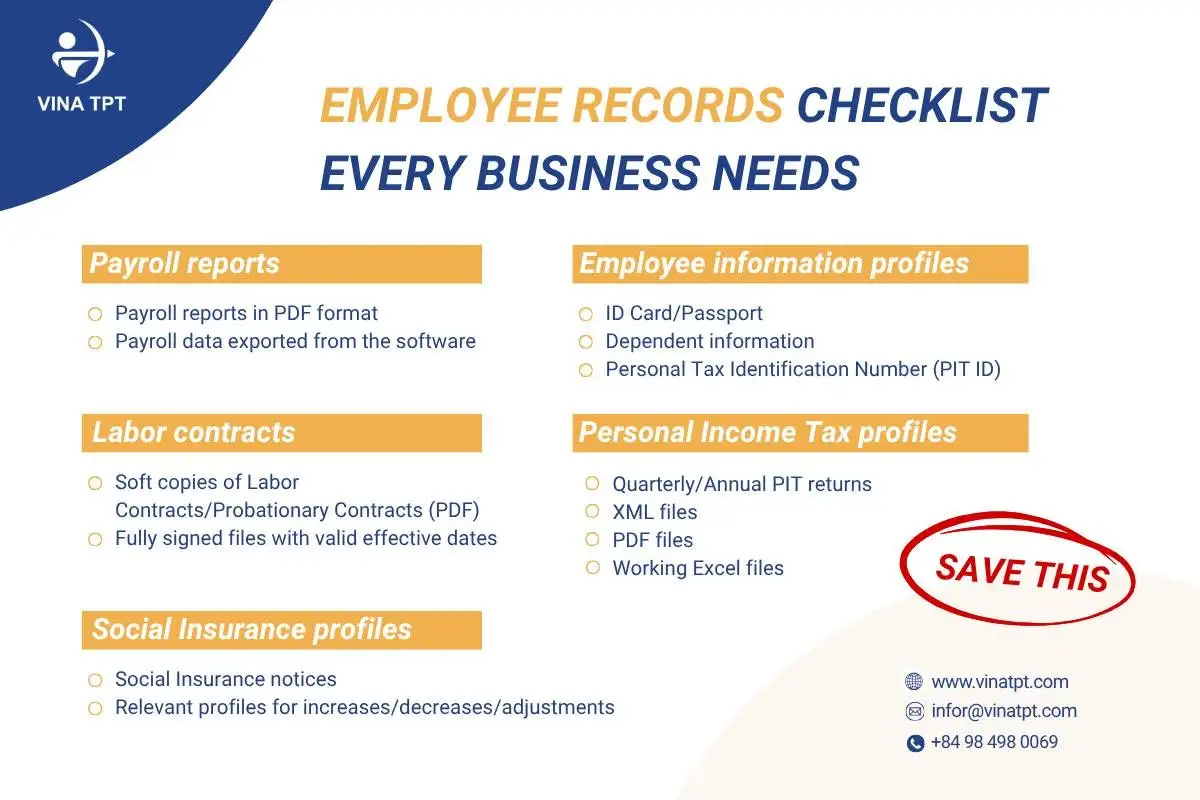
- Mandatory Employee Record Keeping: To prepare for potential sudden labor inspections, a Representative Office must maintain a complete set of personnel files, including: valid employment contracts, employee personal information records, monthly payroll sheets, bank payment proofs for salaries, PIT declarations, and receipts of tax payments to the state budget.
4. Mandatory Labor Reports for a Representative Office
Although a Representative Office does not directly generate business revenue, its human resources management is still subject to supervision by the Ministry of Labor, Ministry of Home Affairs (MOHA). Many Representative Office managers often overlook these requirements, resulting in unnecessary administrative fines.
Below is the list of 5 mandatory labor reports that an FDI Representative Office must submit on a regular basis each year:
|
No. |
Report Name | Frequency per Year |
Submission Deadline |
| 1 | Report on Changes and Use of Labor |
2 times/year |
Before June 5 and December 5 each year |
| 2 | Report on Occupational Safety and Health |
1 time/year |
Before January 10 of the following year |
| 3 | Periodic Report on Occupational Accidents |
2 times/year |
Before July 5 and January 5 of the following year |
| 4 | Report on Occupational Health and Medical Care |
2 times/year |
Before July 5 and January 5 of the following year |
| 5 | Report on Unemployment Insurance Participation |
1 time/year |
Annually as guided by the Social Insurance Agency |
To help foreign managers easily track deadlines and maintain strict compliance, Vina TPT has compiled a detailed practical handbook specifically for Representative Offices. You can download this technical guidance document directly via the link below:
Representative Office Compliance Handbook
5. Standard Reimbursement Process and Operating Document Management
Due to the unique nature of a Representative Office in Vietnam, where all operating expenses are funded by the parent company, establishing a transparent reimbursement process and proper management of original supporting documents is a prerequisite to ensuring the legitimacy of expenses before the tax authorities.
A standard reimbursement process for employee-incurred expenses at a Representative Office should be strictly followed through the following 6 steps:
- Expense Proposal: The employee completes an expense request form (clearly stating the business purpose and estimated amount) and submits it to the Head of the Representative Office for approval.
- Pre-Approval: The Head of the Office reviews the reasonableness of the request and approves the expense based on the budget limit authorized by the parent company.
- Payment and Collection of Original Documents: The employee makes the actual payment and is responsible for collecting all valid original supporting documents, including electronic invoices (e-invoices), receipts, and ticket stubs (if applicable).
- Preparation of Reimbursement File: The employee attaches the original documents to a detailed claim form, signs for confirmation, and submits it to the admin coordinator.
- Verification of Document Legality: The admin or internal accounting staff cross-checks the documents against tax regulations (verifying the RO’s tax code on invoices and the validity of electronic invoices).
- Final Approval and Disbursement: The Head of the Office gives final approval. Accounting then processes the bank transfer to reimburse the employee and records the transaction in the expense tracking ledger.
Document Classification and Storage System: All supporting documents must be scanned and securely stored in the electronic (Cloud) system, while physical copies should be organized chronologically and by expense category. The minimum mandatory retention period is 5 to 10 years, depending on the nature of the documents.
6. How Vina TPT Provides Comprehensive Support for Representative Offices
Managing a complex administrative compliance system, while all procedures and documentation are in Vietnamese, is often a major headache for senior management at overseas headquarters. Understanding this challenge, Vina TPT offers a specialized, all-in-one service package designed to completely remove the compliance burden for FDI Representative Offices.
Our comprehensive support includes:
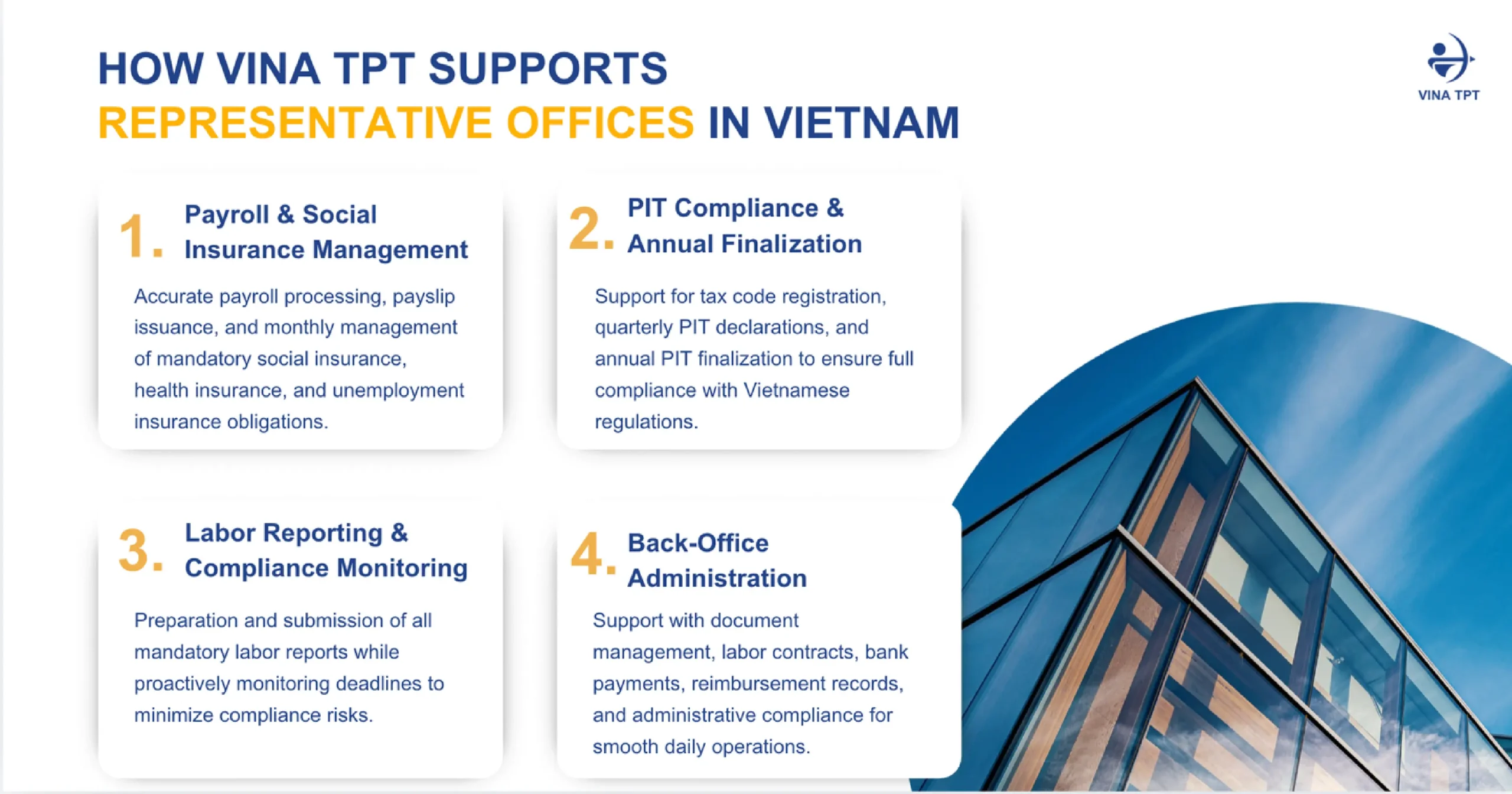
- Full Payroll and Social Insurance Management: We establish accurate salary structures, issue secure payslips, and handle all mandatory social insurance (BHXH, BHYT, BHTN) registration and monthly contributions.
- Professional PIT Declaration and Filing: We manage individual tax codes, prepare quarterly PIT declarations, and file annual PIT finalization on behalf of employees in full compliance with regulations.
- Mandatory Labor Reporting: We take full responsibility for preparing and submitting the five required periodic labor reports to MOHA on time, eliminating the risk of administrative fines due to late submissions.
- Remote Operation and Multilingual Support: All document submission processes are fully digitized. We provide professional support and reporting in both English and Japanese, enabling headquarters to easily monitor operations from anywhere.
- Proven Practical Expertise: Vina TPT’s team consists of highly qualified professionals holding CPA, ACCA, Tax agent and legal licenses. We have deep, hands-on knowledge of the specific operational requirements for foreign Representative Offices in Vietnam.
Are you responsible for operating or planning to establish a Representative Office in Vietnam? Contact Vina TPT today to receive a free, in-depth consultation. Our experts will help ensure your Representative Office maintains strong compliance and operates at optimal efficiency.