


1. From July 1, 2026, a series of important legal changes in the fields of accounting and tax officially take effect. The key focuses of this reform package include Decree 253/2026/ND-CP (guiding personal income tax), Circular 58/2026/TT-BTC (the new accounting regime), and the Tax Administration Law 2025 (Law on Tax Administration No. 108/2025/QH15).
For FDI enterprises, Accounting Departments, and Human Resources (HR) teams, these adjustments are not merely changes in administrative procedures. They directly impact payroll calculation processes, social insurance contributions, tax withholding, and the preparation of financial statements. Delays or inaccurate application of the new regulations can lead to declaration errors, administrative penalties, and strict inspections from the tax authorities.
This article summarizes the core new points together with practical notes to help businesses ensure tax compliance, proactively eliminate legal risks, and operate cash flow safely from the July 1, 2026 milestone.
5 Important Changes to Personal Income Tax under Decree 253/2026/ND-CP
Decree 253/2026/ND-CP introduces fundamental adjustments that directly affect personal income tax (PIT) obligations, which Accounting and Payroll departments must implement immediately:
1. Mid-shift / lunch meal allowance – tax-exempt up to VND 1.2 million per person per month
Pursuant to Point g, Clause 2, Article 8 of Decree 253/2026/ND-CP, from July 1, 2026, the tax exemption for mid-shift meal allowances is tightened under a fixed limit:
- Cash payment: The mid-shift or lunch meal allowance paid in cash by the enterprise to employees is exempt from PIT up to a maximum of VND 1.2 million per person per month. Any amount exceeding this limit must be included in taxable income subject to PIT.
- In-kind payment / meal vouchers: If the enterprise directly organizes a canteen, purchases industrial meal portions, or issues meal vouchers, the entire value of the meals is exempt from PIT, regardless of the form of payment.
Important note: The new regulation abolishes the previous principle that “whatever amount the enterprise stipulates in its internal regulations is exempt.” Accountants must review the company’s Financial Regulations and Labor Contracts to adjust payment norms to ensure compliance.
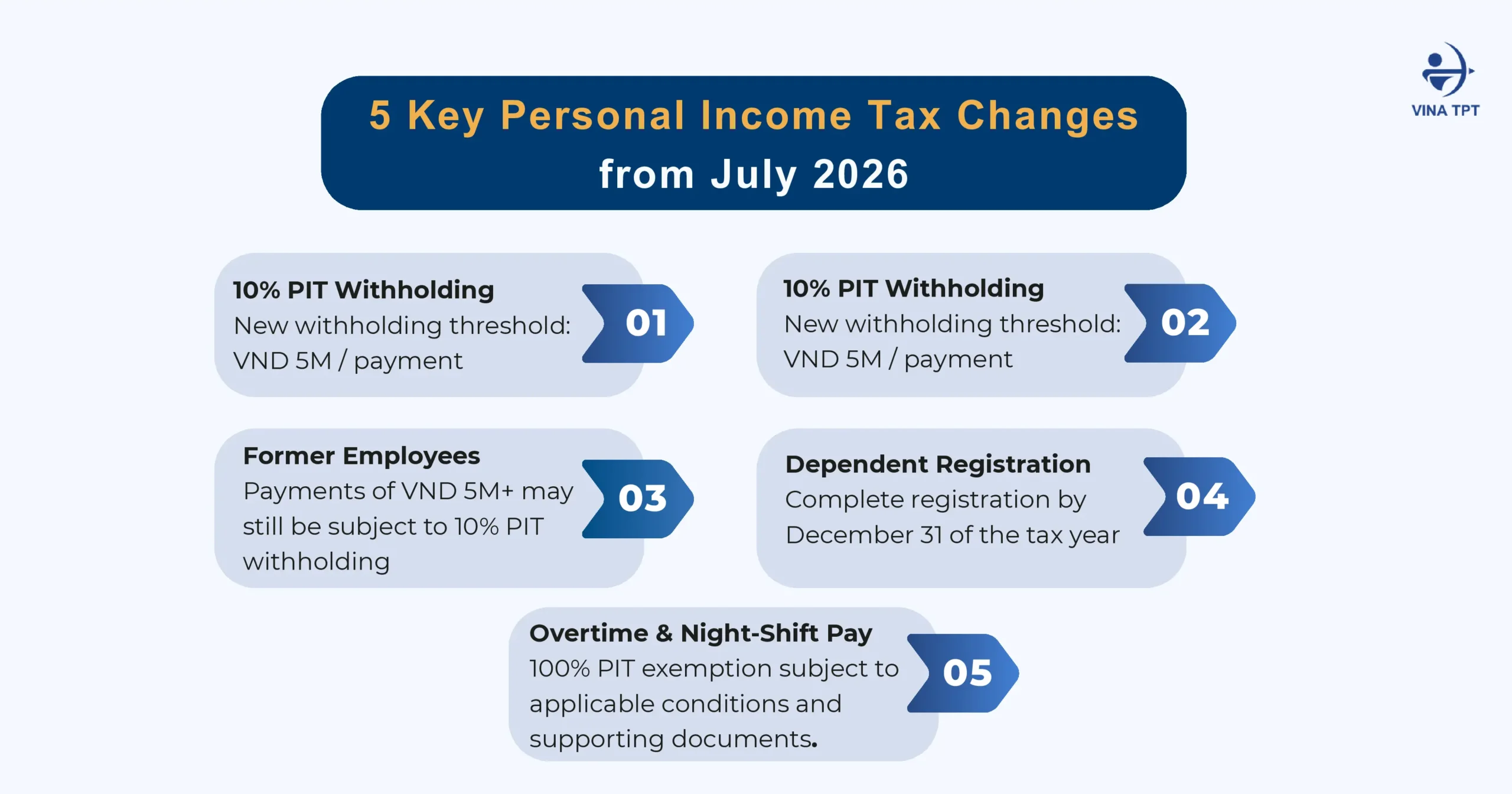
2. Increase in the 10% PIT withholding threshold to VND 5 million per payment
According to Clause 2, Article 50 of Decree 253/2026/ND-CP:
- Organizations paying income are required to withhold 10% personal income tax (PIT) only when the payment reaches VND 5 million or more per time for individuals who have not signed a labor contract or have signed a labor contract of less than 3 months (replacing the previous threshold of VND 2 million per payment).
- For payments below VND 5 million per time, the enterprise is not required to withhold the 10% tax, unless the individual specifically requests it.
- Individuals who estimate that their total income after family deductions has not yet reached the taxable threshold may still submit a Commitment Letter to the enterprise to temporarily avoid the 10% withholding.
3. Salary and bonus payments to former employees still require 10% withholding
Decree 253/2026/ND-CP clarifies the withholding obligation for payments arising after the termination of the employment relationship. When an enterprise pays salary, bonuses, commissions, or other support amounts of VND 5 million or more per payment to former employees, the enterprise is required to withhold personal income tax (PIT) at the rate of 10%. Omitting this obligation will result in the enterprise being subject to additional tax assessments and late-payment penalties during the annual tax finalization.
4. Stricter deadline for registering dependents – before 31 December
Pursuant to Clause 2, Article 48 of Decree 253/2026/ND-CP, registration for family circumstance deductions for dependents must be completed before 31 December of the tax year. If the registration dossier is submitted after this deadline, the employee will not be entitled to the family circumstance deduction for that tax year, directly affecting the individual’s tax finalization benefits.
5. 100% tax exemption on overtime and night-shift pay
According to Article 26 of Decree 253/2026/ND-CP:
- Enterprises are exempt from personal income tax (PIT) on the entire amount of overtime pay and night-shift pay, provided the conditions under the Labor Code are fully met (replacing the previous rule that only exempted the differential portion compared with normal working-day pay).
- Conditions for application: The enterprise must maintain complete supporting documentation (night-shift/overtime timesheets, payroll calculations, and overtime assignment documents).
- Effective date: Applicable from 1 January 2026 for resident individuals and from 1 July 2026 for non-resident individuals.
Circular 58/2026/TT-BTC: New Accounting Regime for Micro-Enterprises
In addition to tax regulations, the accounting and tax regime from July 1, 2026, marks an important change with the Ministry of Finance’s issuance of Circular 58/2026/TT-BTC (completely replacing Circular 132/2018/TT-BTC).
Circular 58/2026/TT-BTC provides detailed guidance on accounting documents, accounting books, and the preparation and presentation of financial statements for micro-enterprises, helping to simplify the accounting apparatus while still ensuring legal transparency.
Criteria for identifying a Micro-Enterprise (under Decree 80/2021/ND-CP):
- Agriculture – Forestry – Fishery, Industry & Construction sectors: Average number of employees participating in social insurance per year does not exceed 10 people AND total annual revenue does not exceed VND 3 billion (or total capital does not exceed VND 3 billion).
- Trade & Services sectors: Average number of employees participating in social insurance per year does not exceed 10 people AND total annual revenue does not exceed VND 10 billion (or total capital does not exceed VND 3 billion).
- Flexible choice of accounting regime:
Micro-enterprises have the right to choose to apply the Accounting Regime for Small and Medium-sized Enterprises (Circular 133/2016/TT-BTC) if it better suits their management needs. However, the chosen accounting regime must be applied consistently throughout an entire financial year; any change of regime may only be made at the beginning of the following accounting year.
- Financial Statement System for Micro-Enterprises:
Micro-enterprises that pay corporate income tax using the method based on taxable income must prepare annual financial statements in accordance with the guidance in Circular 58/2026/TT-BTC, including:
- Statement of Financial Position (Form B01 – DNSN).
- Income Statement (Form B02 – DNSN).
Key Points to Note under the Tax Administration Law 2025
The Tax Administration Law 2025 (Law on Tax Administration No. 108/2025/QH15, promulgated on 10 December 2025) takes effect from 1 July 2026. It introduces stricter sanctions to strengthen declaration discipline and enhance the transparency of electronic invoice data.
Shortening of the time limit for supplementary tax declaration dossiers to 5 years
One of the core changes that Accounting teams must particularly note under Clause 5, Article 12 of the Tax Administration Law 2025 is: The time limit allowing taxpayers to self-detect errors and submit supplementary declaration dossiers has been shortened from 10 years to 5 years, counted from the deadline for submitting the tax declaration dossier of the tax period containing the error.
Taxpayers may perform supplementary declarations within the 5-year period in the following cases:
- The supplementary declaration is made before the tax authority or competent authority issues a Decision on tax inspection or examination at the taxpayer’s premises.
- The supplementary tax declaration dossier does not fall within the scope and period of the inspection stated in the Inspection Decision.
- The dossier is not related to a case in which the investigating authority has requested that the status quo be maintained to serve a criminal investigation.
Risk warning: Shortening the adjustment period to 5 years requires enterprises to strengthen annual internal audits of accounting books, rather than allowing errors to accumulate over a longer period as in the past.

Immediate Actions FDI Enterprises Need to Take for Compliance
To maintain absolute tax compliance and optimize operating costs under the new regulations effective from 1 July 2026, FDI enterprises should immediately implement the following actions:
- Review Salary & Benefit Policies: Adjust the mid-shift meal allowance (cap at VND 1.2 million per month if paid in cash) and the regulations on overtime and night-shift pay within the payroll software system.
- Update the 10% Tax Withholding Process: Configure the accounting system to apply the new 10% withholding threshold for payments of VND 5 million or more per time to casual workers and former employees.
- Accelerate Standardization of Dependents: Urge employees to complete supporting documents and submit family circumstance deduction registrations before 31 December.
- Check the Synchronization of Accounting & Tax Data: Review the consistency between sales software, the electronic invoice system, and VAT/CIT tax declarations.
- Update Enterprise Information: Review the head office address, lease agreements, and legal representative information on the enterprise registration portal to avoid being classified by the tax authorities as a “high-risk taxpayer.”
Conclusion
The legal changes in accounting and tax effective from 1 July 2026 present a challenge of rapid adaptation for Accounting and HR teams. Proactively reviewing accounting processes, updating new tax policies, and controlling electronic invoice data are the keys that help FDI enterprises operate safely, transparently, and sustainably in Vietnam.
The entire adjustment process must be carried out rigorously to maximize benefits for employees and protect the enterprise against tax inspections.
Follow the News & Insight & News section of Vina TPT for continuous updates on the latest in-depth analyses of Accounting and Tax policies in Vietnam.