


When operating in Vietnam, foreign-invested enterprises (FDI companies) often prioritize tax filings, financial statements, and regular accounting requirements, but may overlook FDI reporting obligations. Unlike standard tax and accounting reports, FDI reports have specific requirements regarding both the information to be declared and the applicable deadlines. Failure to submit these reports on time or providing inaccurate investment information may lead to administrative penalties, complicate procedures involving the Investment Registration Certificate (IRC), and expose the company to compliance risks. In this article, Vina TPT summarizes the key mandatory FDI reports and their submission deadlines throughout the year, helping accounting, HR, and legal teams stay organized and comply with Vietnam’s investment regulations.
1. What Is an FDI Report and Which Businesses Are Required to Submit It?
1.1. What Is an FDI Report? What Types of FDI Reports Are Required?
FDI reports are reports that foreign investors and foreign-invested economic organizations (FDI enterprises) implementing investment projects in Vietnam are required to prepare and submit to the competent authorities on a periodic basis or upon the occurrence of certain events. These reports provide information on the implementation and operation of investment projects, including capital disbursement, business performance, employment, state budget obligations, research and development activities, environmental matters, and other sector-specific indicators.
Depending on the type of report, businesses may be required to submit FDI reports on a quarterly, semi-annual, or annual basis, or before making certain adjustments to their investment projects. Therefore, “FDI reports” do not refer to a single reporting form, but rather to a group of reporting obligations related to the investment activities of foreign-invested enterprises in Vietnam.
1.2. Which Businesses Are Required to Submit FDI Reports?
Under Vietnam’s current Investment Law, the following entities are required to fulfill FDI reporting obligation
- Newly Established Foreign-Invested Enterprises: Enterprises in which foreign investors hold between 1% and 100% of the charter capital.
- Businesses Implementing Investment Projects: Enterprises that take over investment projects or receive capital contributions from, or acquire shares or ownership interests from, foreign investors.
- Enterprises Operating Under an Investment Registration Certificate (IRC): Any investment project issued with an IRC is subject to investment monitoring and reporting obligations.
Special Cases: Newly established enterprises that have not yet generated revenue, projects still in the basic construction stage, or businesses undergoing procedures for temporary suspension of operations are still required to submit FDI reports. The report should reflect the actual figures available at the time of filing, with zero reported for items that have not yet arisen. This reporting obligation only ends when an official decision is issued to terminate the investment project.
2. What Types of FDI Reports Must Businesses Submit and When?
2.1. Report on the Implementation of the Investment Project
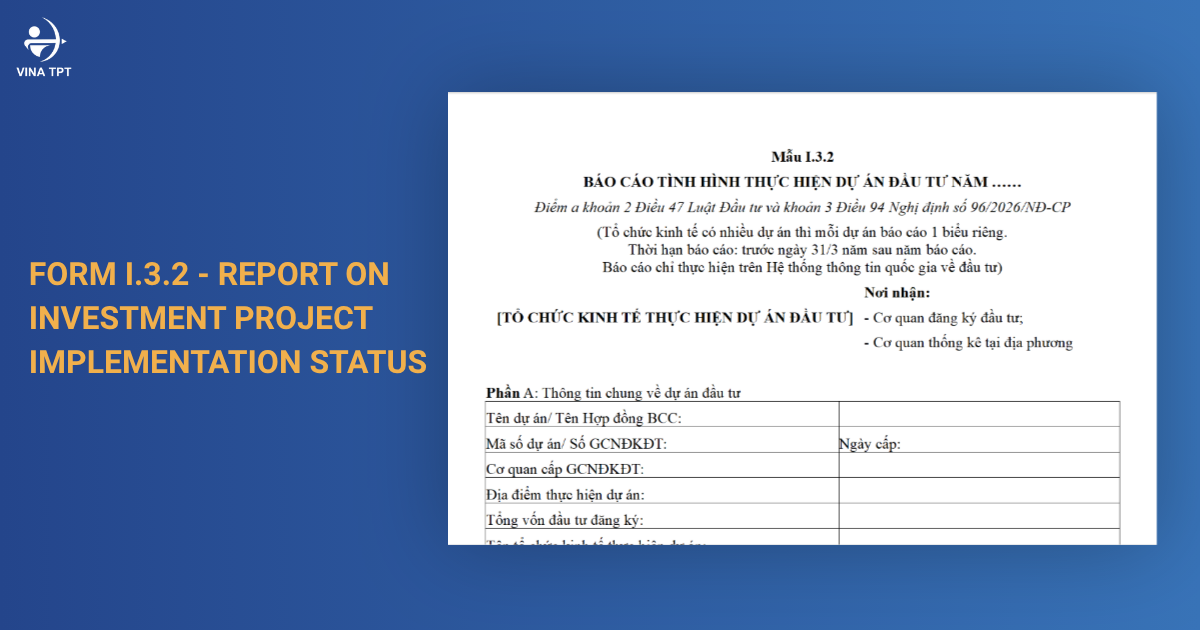
In addition to financial reporting obligations, enterprises and investors are subject to investment project implementation reporting requirements pursuant to Decree No. 96/2026/ND-CP dated March 31, 2026, of the Government.
Submission Method: Reports must be submitted online through the National Investment Information System at fdi.gov.vn. Enterprises should use their assigned account to log in and fulfill their reporting obligations in accordance with applicable regulations. If an account has not yet been issued, the enterprise must submit an account registration form to the email address provided by the relevant Management Board to obtain login credentials and submit the required reports.
Enterprises are subject to two primary reporting periods:
Quarterly Report: The report must be submitted by the 10th day of the first month of the quarter following the reporting quarter. The report covers the following information:
- Investment Capital Actually Contributed
- Net Revenue
- Export and Import Activities
- Employment Situation
- Taxes and Other Amounts Payable to the State Budget
- Status of Land and Water Surface Use
Annual Report: The report must be submitted by March 31 of the year following the reporting year. The annual report includes:
- Investment Performance
- Investment Performance
- Employee Income
- Expenses
- Investment in Scientific Research and Technology Development
- Environmental Protection and Treatment Activities
- Origin of the Technology Used
2.3. Investment Monitoring and Evaluation Report
In addition, businesses must fulfill investment monitoring and evaluation reporting obligations in accordance with Decree No. 19/2026/ND-CP, Decree No. 96/2026/ND-CP, and Circular No. 44/2026/TT-BTC dated April 22, 2026, issued by the Ministry of Finance.
According to Official Letter No. 113, businesses are required to use Form No. 13 – Report on Investment Project Implementation Monitoring and Evaluation (Quarterly and Annual), issued together with Circular No. 44/2026/TT-BTC.
Submission Method: The report must be submitted online through the Ministry of Finance’s Investment Monitoring and Evaluation Information System. In cases specified under Clauses 1 and 2, Article 95 of Decree No. 19/2026/ND-CP, the electronic submission through the system may be replaced by a written report and an electronic version.
Businesses are required to submit reports during the following reporting periods:
- Quarterly Report: The report must be submitted by the 10th day of the first month of the quarter following the reporting quarter.
- Semi-Annual Report: The report must be submitted by July 10 of the reporting year. The reported data covers the period from January 1 through June 30 of the reporting year.
- Annual Report: The report must be submitted by February 10 of the following year. The reported data covers the period from January 1 through December 31 of the reporting year.
A key point businesses should keep in mind is not to confuse investment activity reports in Vietnam with tax returns or financial statements. Although many reporting indicators may be based on data from the company’s accounting system, the primary purpose of investment reporting is to reflect the implementation status of the investment project and the company’s investment activities.
FDI reporting is an important group of compliance obligations that businesses with investment projects in Vietnam need to proactively manage alongside tax and financial reporting. Businesses should pay close attention not only to reporting deadlines, but also to identifying the correct type of report, receiving authority, required form, and consistency of the reported data.
Rather than waiting until the deadline approaches to compile the necessary data, businesses should establish a dedicated FDI reporting schedule for each investment project, assign responsible personnel, and regularly reconcile data across accounting, tax, HR, and investment records. This simple but effective approach can help minimize the risk of missed reporting obligations and maintain compliance throughout the company’s operations in Vietnam.
3. Accounting, Tax, and FDI Reporting Services for Businesses at VINA TPT
Managing an FDI enterprise involves more than maintaining accounting records and submitting tax reports on time. Businesses must also monitor their investment project obligations, FDI reporting requirements, and legal documentation throughout their operations in Vietnam.
Vina TPT offers integrated accounting, tax, and FDI reporting support for foreign-invested businesses in Vietnam, helping them manage recurring compliance requirements more efficiently and avoid the risks associated with missed filing deadlines.
How Can Vina TPT Support Your Business?
- Accounting Services: Recording day-to-day business transactions, managing accounting documents and records, reconciling financial data, and keeping the accounting system complete and accurate in compliance with applicable requirements.
- Periodic Tax Filing: Preparing and submitting tax returns on a monthly or quarterly basis, including Value Added Tax (VAT), Personal Income Tax (PIT), and other applicable tax obligations depending on the nature of the business.
- Financial Statements and Tax Finalization: Preparing annual financial statements, handling Corporate Income Tax (CIT) and Personal Income Tax (PIT) finalization, and reconciling data before submission.
- Payroll and SHUI: Calculating salaries, deductions, and social insurance (SI) obligations; supporting the preparation of required documents and handling insurance procedures in accordance with applicable regulations.
- Preparation of Periodic FDI Reports: Monitoring statutory reporting deadlines, compiling and reconciling relevant data, preparing and supporting the submission of periodic FDI reports as prescribed by law, thereby reducing the risk of late filings and inconsistencies in reported information.
Labor Compliance Reporting: Assisting with required employment reports and other labor-related filings requested by the relevant authorities, helping businesses stay compliant and meet deadline
The value of professional support goes beyond simply preparing reports. It also helps businesses keep information consistent across accounting, tax, HR, and investment-related records. This is especially useful for FDI businesses that have multiple reporting requirements and frequently experience changes in their investment activities.
Not sure which FDI reports your business is required to submit? Contact Vina TPT to review the reporting obligations applicable to your investment project and receive support with preparing and submitting reports on time.