Managing salaries and employee benefits in Vietnam has become one of the most challenging aspects for foreign businesses. Unlike many other countries, payroll here is not simply about distributing monthly income. Employers bear full legal responsibility for accurate salary calculations, timely contributions to mandatory social insurance, health insurance, and unemployment insurance, as well as correct withholding and declaration of Personal Income Tax (PIT) for both local staff and expatriates. As demand for Vietnam payroll services continues to grow, more foreign companies are choosing outsourcing over maintaining internal payroll teams.
With the frequent updates to legal circulars and the pressure to deliver bilingual reports to headquarters, many FDI companies experience compliance crises within their first 1–2 years of operation. This reality has driven the strong growth of payroll service in Vietnam in 2026. By outsourcing this administrative workload to professional providers, international investors can eliminate legal risks and focus 100% of their resources on core business growth.
1. Understanding Payroll and HR Obligations Before Using a Payroll Service in Vietnam
For foreign-invested enterprises entering the Vietnamese market, understanding local requirements is essential before engaging a payroll service in Vietnam. To maintain smooth operations, businesses must pay special attention to the following core requirements:
- Personal Income Tax (PIT): Companies are required to withhold PIT directly from employees’ salaries and declare and remit it to the state budget on a monthly or quarterly basis. The tax system clearly distinguishes between tax residents (progressive rates from 5% to 35%) and non-residents (flat 20% rate), requiring absolute accuracy when applied to both Vietnamese and foreign employees.
- Social, Health, and Unemployment Insurance (Social Insurance, Health Insurance, Unemployment Insurance): Vietnam maintains a very strict framework for mandatory insurance. Employers must contribute 21.5% and employees 10.5% of the insurable salary (capped at 20 times the regional minimum wage). This requires accurate reconciliation and timely monthly contributions.
- Compliance with Current Labor Law: The entire payroll process must strictly comply with the Labor Code 2019, including issuing detailed payslips, correctly calculating overtime pay (at rates from 150% to 300%), managing annual leave, and handling severance or redundancy payments.
- Mandatory Reporting: In addition to monthly financial transactions, companies must complete annual PIT finalization and submit periodic labor reports to the competent state authorities.
Failure to comply with these obligations can expose the company to heavy administrative fines, complex tax audits, and operational disruptions.
2. Core Components of Payroll Service in Vietnam
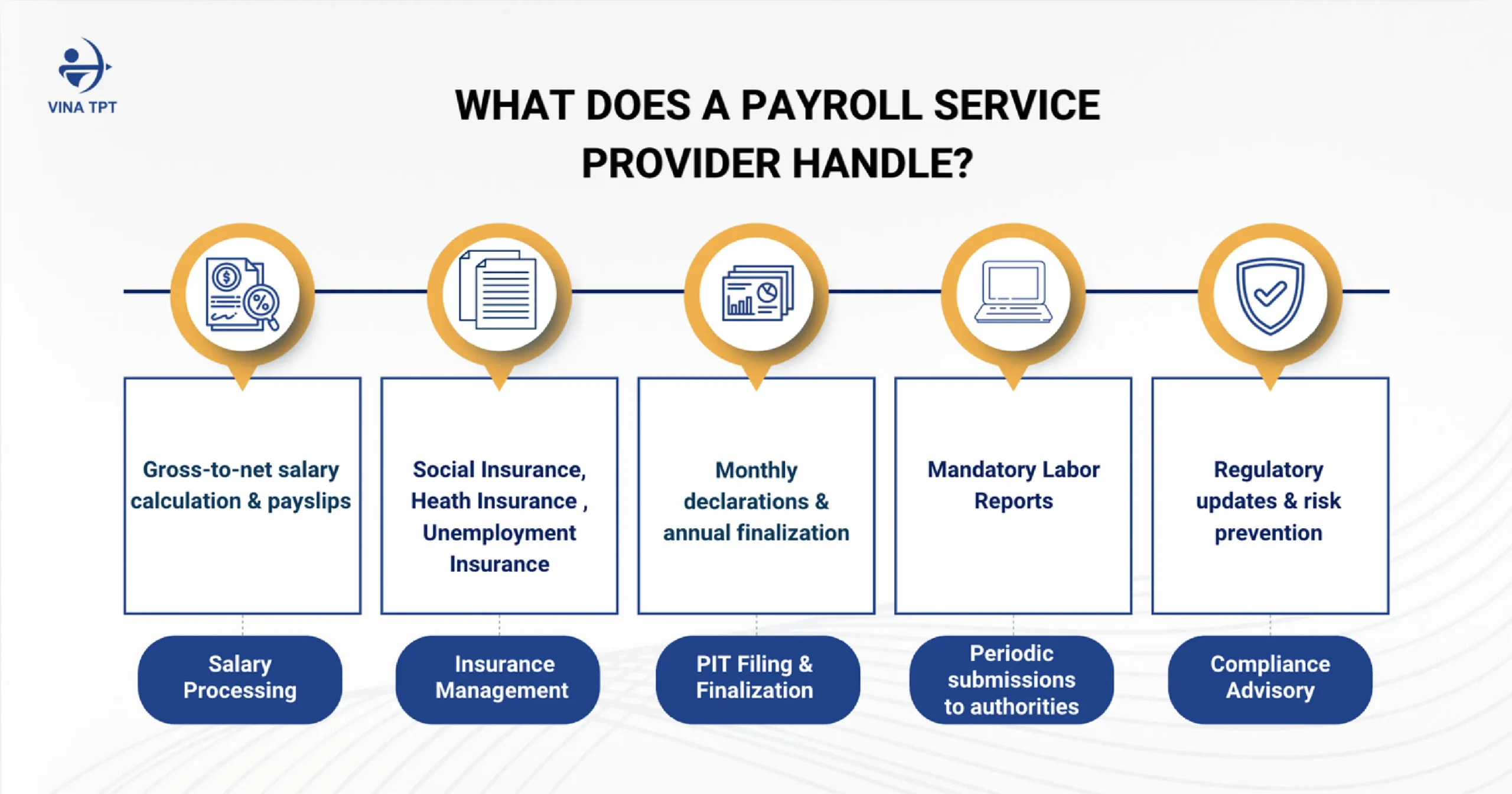
A comprehensive payroll service in Vietnam from a professional provider covers the full lifecycle of employee income and compliance management, including the following key services:
- Salary Calculation and Secure Payslips: Accurate computation from gross to net salary, detailed allocation of allowances (housing, transportation, phone, meals), performance bonuses, overtime, and deductions. Employees receive secure digital payslips every month.
- Mandatory Insurance Management: Handling all monthly increases/decreases in employee records, closing social insurance books for departing staff, processing claims for sickness, maternity, work-related accidents, and submitting electronic reports to the Social Insurance Agency.
- Personal Income Tax (PIT) Declaration and Finalization: Accurate withholding of PIT, monthly/quarterly tax declarations, registration of new employees’ tax codes, claiming dependent deductions, and handling year-end PIT finalization on behalf of employees.
- Mandatory Labor Reports: Preparing and submitting the five required periodic labor reports to the Ministry/Department of Labor, Invalids and Social Affairs (DOLISA).
- Strategic Advisory and Compliance Updates: Proactively alerting businesses to changes in minimum wage levels, social insurance caps, or new tax regulations, ensuring the company remains fully compliant at all times.
3. Common Difficulties Foreign Companies Face When Managing Payroll In-House
When foreign companies attempt to handle payroll internally or through remote overseas teams, they often encounter major systemic barriers:
- Rapidly changing legal framework: Labor laws, tax policies, and insurance contribution rates in Vietnam are updated frequently. Without a dedicated local expert team, international HR managers struggle to stay current with the latest circulars and decisions.
- Complexity of expatriate payroll: Managing income for foreign specialists requires highly specialized knowledge – from determining tax residency status and applying double tax treaties to correctly taxing or exempting benefits such as relocation costs, international school fees, and home leave flights.
- Language and administrative barriers: Most electronic portals of the Tax Department, Social Insurance Agency, and official legal documents are in Vietnamese, creating significant obstacles for foreign HR teams when verifying data or responding to audits.
- High risk of errors and administrative overload: Even a small calculation mistake or a delay of a few days in filing can result in accumulating penalties. The sheer volume of monthly paperwork drains valuable time, preventing companies from focusing on strategic HR initiatives.
This is one of the main reasons why payroll services for foreign companies Vietnam have become increasingly popular.
4. Key Benefits of Outsourcing Payroll Service in Vietnam
Outsourcing payroll delivers significant strategic and economic advantages for foreign companies and FDI businesses operating in Vietnam. Instead of managing a complex, ever-changing system internally, companies can leverage professional expertise to reduce risks, lower costs, and focus on core business growth.
Elimination of compliance risks
One of the biggest benefits is the substantial reduction in compliance risks. Vietnam’s labor laws, social insurance regulations, and tax requirements (especially PIT for both local and expatriate staff) change frequently. A dedicated payroll service provider has a team of specialists who constantly monitor updates and ensure all calculations, declarations, contributions, and reporting are accurate and submitted on time. This helps companies avoid heavy fines, back payments, tax audits, and potential operational disruptions that often occur when handled in-house.
Major cost optimization
Outsourcing payroll can reduce administrative expenses by 30% to 40% compared to maintaining an in-house team. Companies no longer need to bear high fixed costs such as salaries, social insurance contributions, training, software licenses, and office space for payroll staff. Instead, they pay a predictable monthly fee that scales with their actual needs, freeing up capital for more strategic investments.
Access to local expert networks
By outsourcing, foreign companies immediately gain access to a professional team with deep knowledge of Vietnamese labor practices, strong relationships with government authorities (tax offices and social insurance agencies), and experience handling expatriate payroll complexities. This local expertise is invaluable for navigating double tax treaties, work permit-related tax issues, and optimal contribution strategies.
Flexible scalability
As the company grows, an outsourced payroll service can easily scale up or down without the need for recruitment, training, or internal restructuring. Whether your headcount increases from 10 to 100 employees or you open a new branch, the provider can quickly adjust the service scope while maintaining the same quality and compliance standards.
Additional benefits
Beyond the above, outsourcing also brings peace of mind for foreign investors and HR teams. Professional providers deliver timely, accurate bilingual reports for headquarters, secure digital payslips for employees, and proactive advisory support whenever regulations change. This allows management to focus on business development rather than administrative burdens.
5. How to Choose the Right Payroll Service Provider
To ensure a safe and long-term partnership, foreign companies should carefully evaluate payroll service providers based on several strict and practical criteria. Choosing the right payroll service in Vietnam can significantly impact compliance, cost efficiency, and operational smoothness.
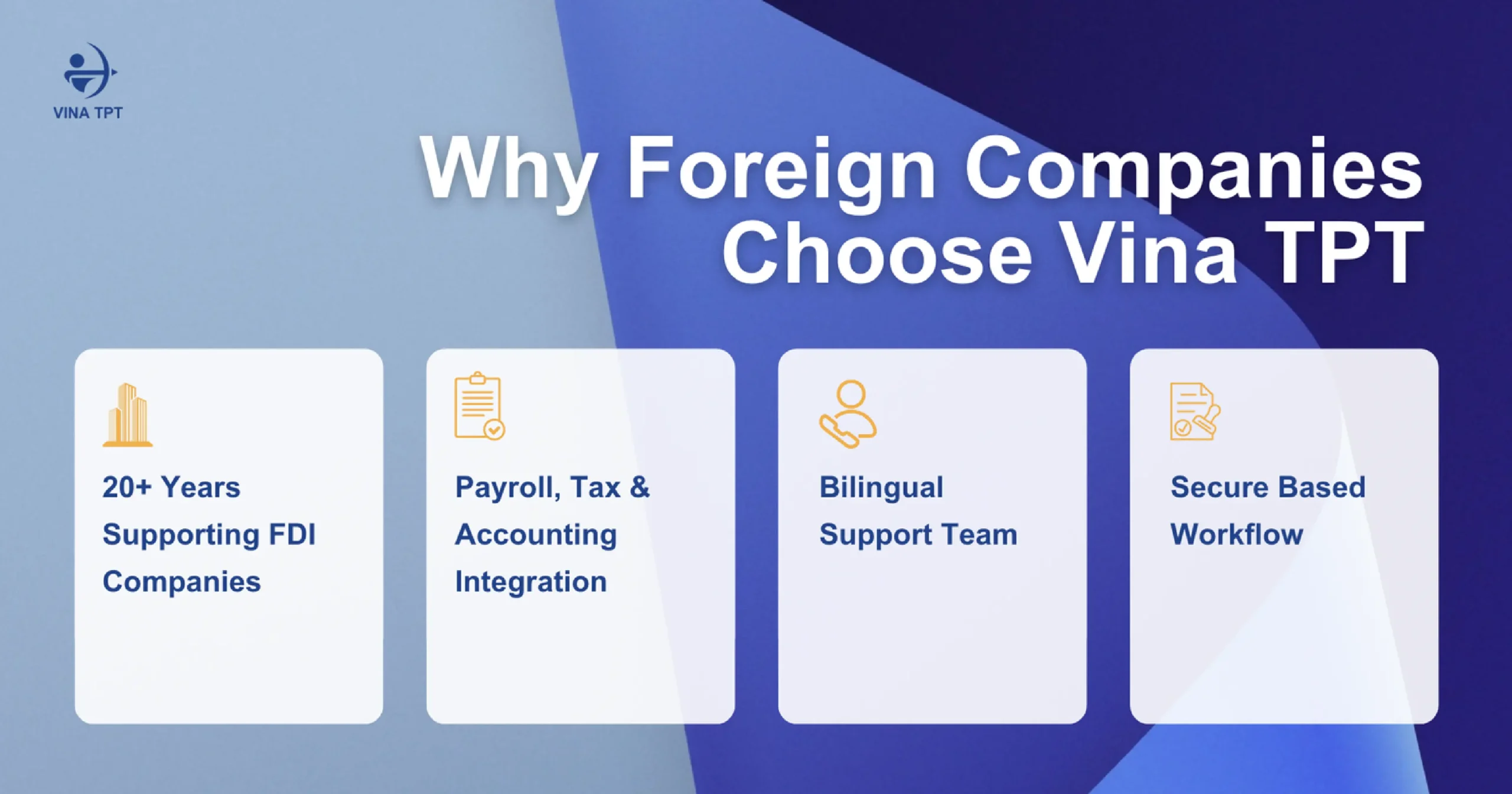
- Proven experience with foreign capital: The provider must have extensive experience working with FDI companies and international clients. They should understand not only Vietnamese labor and tax regulations but also international reporting standards (IFRS), cross-border salary payments, and the specific needs of expatriate employees. A provider with a strong track record in handling FDI clients can help you avoid common compliance pitfalls that new companies often encounter.
- Modern Cloud technology and data security: In today’s digital environment, the payroll system must be built on a secure, modern cloud platform. It should offer real-time dashboards, encrypted data storage, role-based access control, and full compliance with Vietnam’s Personal Data Protection Law. This ensures employee information is safe and accessible anytime, anywhere – especially important for remote management teams.
- Transparent Service Level Agreement (SLA): A high-quality provider will offer a clear and detailed SLA that defines payroll processing deadlines, response times for urgent issues, accuracy guarantees, and clear liability for any errors. This protects your company and sets realistic expectations from the beginning of the partnership.
- Multilingual support: The support team should be fluent in English (and preferably other languages such as Japanese, Korean, or Chinese) to communicate effectively with headquarters and expatriate staff. They must be able to explain complex local regulations in simple, understandable terms and provide bilingual reports when needed.
Beyond these core criteria, you should also consider the provider’s ability to integrate payroll with accounting and tax services, their reputation among other FDI clients, and their willingness to offer a trial period or detailed demo.
Contact Vina TPT today to receive expert advice on the most suitable payroll service in Vietnam for your business.