The accounting review service delivers practical value to companies through a comprehensive reconciliation of the accounting books system, source documents, and account balances with VAS standard regulations as well as the tax returns already filed. It needs to be clarified that accounting review is not a mandatory procedure under the law, but a voluntary and proactive cross-check solution. This service helps companies identify errors in accounting records and weaknesses in the accounting department’s operations, enabling them to implement appropriate corrective measures and mitigate tax compliance risks before a tax inspection by the authorities.
Performing an accounting review early is the key that helps companies proactively adjust figures while there is still time, eliminate the risk of administrative tax penalties, and at the same time avoid prolonging the audit progress of the annual financial statements. The article below presents in detail the warning signs that books need review, the standard implementation process, the method of assessing the level of tax inspection, and clearly distinguishes the difference between review and audit.
1. What Is an Accounting Review or Accounting Health Check?
In substance, accounting review is the process of in-depth examination of the entire General Ledger, detailed account ledgers, recording documents, and financial balances against the Vietnamese Accounting Standards (VAS) system, as well as consistency with the tax returns already filed. The output product of this process is a detailed findings report, accompanied by a list of proposed adjusting entries and a summary table of tax risk areas that the company needs to remediate.
Companies should proactively implement accounting review Vietnam at the following important milestones:
- The stage of preparing to close the accounting books at the end of the financial year.
- The time before an inspection by the relevant authorities, such as tax or social insurance agencies.
- When the company changes the accounting service provider (Refer to details in the article Accounting Handover Checklist).
- Before preparing the dossier to remit lawful profits to the Parent Company overseas.
- The stage of preparing for M&A transactions, restructuring, or investment exit.
2. Key Differences Between Accounting Review and Independent Audit
Clearly distinguishing between internal accounting review and independent audit helps companies use the correct service according to needs:
|
Comparison Criteria |
Accountin Review/ Health Check |
Financial Audit |
| Performed by | Independent accounting / tax advisory firm | Licensed independent audit firm |
| Core objective | Detect errors and accounting, tax risks, and adjust figures | Express an opinion on whether the financial statements are presented truly and fairly |
| Output | Findings report & list of adjusting entries | Official independent audit report |
| Can it replace the audit report? | No, it cannot replace the audit report | A mandatory legal report as prescribed |
Accounting Review Is Not a Review Engagement
It needs to be clarified that the “Review of financial statements” procedure (Review Engagement) under Vietnamese Standard on Review Engagements VSRE 2400 (issued together with Circular 65/2015/TT-BTC) is a limited assurance service performed by practicing auditors. Meanwhile, the accounting review service mentioned in this article is in substance an internal review and cross-check activity aimed at detecting technical errors and optimizing figures.
These two tasks are complementary in nature: performing an internal accounting review beforehand will help the subsequent independent audit process proceed quickly, smoothly, and minimize exception opinions from the auditor to the greatest extent.
3. Signs Your Books Need an Accounting Review
During operations, when the following abnormal signs appear, companies should immediately proceed to review the accounting books system (books review before audit):
- Cash/bank deposit differences: The bank deposit account balance on the accounting books does not match exactly with the Bank Statement from the bank at the period-end closing date.
- Revenue figure inconsistency: Revenue recorded on the accounting books has differences compared with the total revenue declared on the periodic VAT tax returns without an explanatory table of the causes.
- Unreasonable receivable, payable, and inventory balances: Receivable, payable, and internal advance balances have been outstanding for a long time without reconciliation; negative inventory balances appear on the books.
- Missing expense documents: Many expense items lack valid invoices, are recorded in the wrong accounting period, or the balances of foreign-currency monetary items have not been revalued at the period-end date.
- Group report differences: Financial statement figures under VAS have large differences compared with management report figures sent to the Parent Company but lack a Reconciliation Package.
- 2026 circular transition risk: The company performs the transition of the accounting regime from Circular 200/2014/TT-BTC to Circular 99/2025/TT-BTC in 2026 but has not reviewed and accurately converted the opening balances of the accounting accounts.
Beyond the warning signs above, companies are still advised to carry out a periodic independent accounting review even when none of these symptoms are present. A proactive review uncovers hidden or potential errors that rarely surface in day-to-day operations, keeping the books accurate and audit-ready before the financial year closes.
4. The Accounting Review Process Step by Step
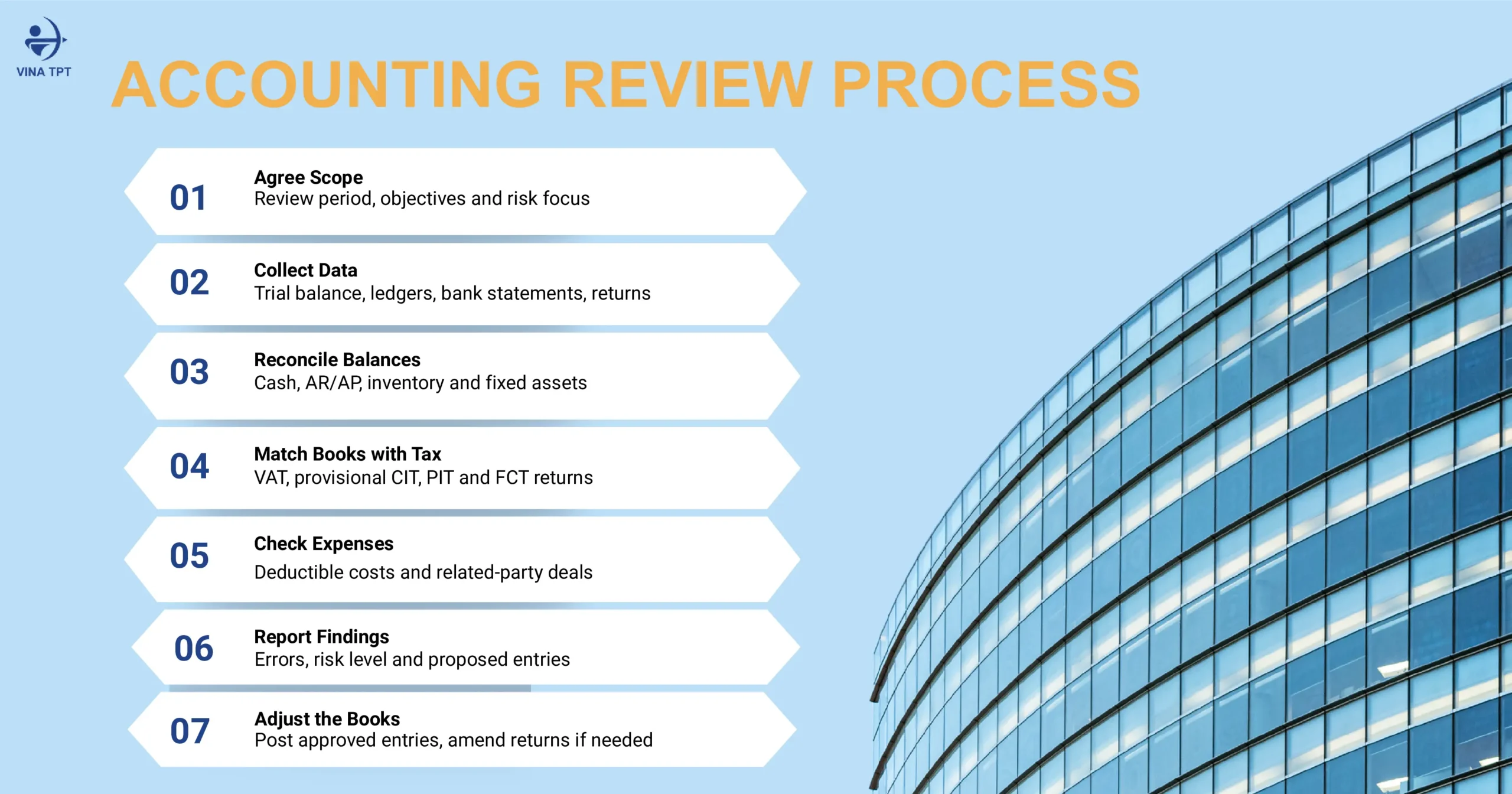
A standard accounting review process is performed systematically through 7 clear steps:
- Agree on scope & objectives: The two parties hold a meeting to accurately finalize the work scope, the accounting period to be reviewed, and the risk focuses that need attention.
- Collect data: The review department receives the Trial Balance, detailed account ledgers, bank statements, and all tax returns filed during the period.
- Reconcile asset & liability balances: Proceed to check and reconcile cash balances, bank deposits, receivables/payables (through debt confirmation letters), physical inventory counts, fixed assets, and depreciation/allocation schedules.
- Reconcile book figures with Tax: Review the consistency between general ledger data and VAT tax returns, provisional Corporate Income Tax returns, Personal Income Tax returns, and Foreign Contractor Tax (FCT) returns.
- Examine expenses & Related-party transactions: Review the conditions for deductible expenses when calculating Corporate Income Tax, the legality of documents, and check transactions arising with related parties.
- Prepare the report & Propose adjustments: Issue a detailed findings report, clearly analyze the causes of errors, the level of risk, and prepare the list of proposed adjusting entries.
- Perform figure adjustments: After the Board of Directors approves, the accounting department proceeds to record the additional adjusting entries and file supplementary tax returns (if adjusted tax obligations arise).
4. How Ready Are Your Books for Audit?
To assess the level of readiness of the books before the independent audit period, companies can use the Checklist below:
- Accounting books have been completed and officially closed.
- All receivable/payable and bank deposit balances have been reconciled and debt confirmation letters have been issued.
- Full cash count, inventory, and fixed asset count minutes are available as of 31/12.
- Fixed asset depreciation schedule and prepaid expense allocation schedule are prepared accurately.
- The Transfer Pricing Documentation set and declaration appendices have been completed.
- The audit document request list (PBC List – Provided by Client List) is prepared and ready.
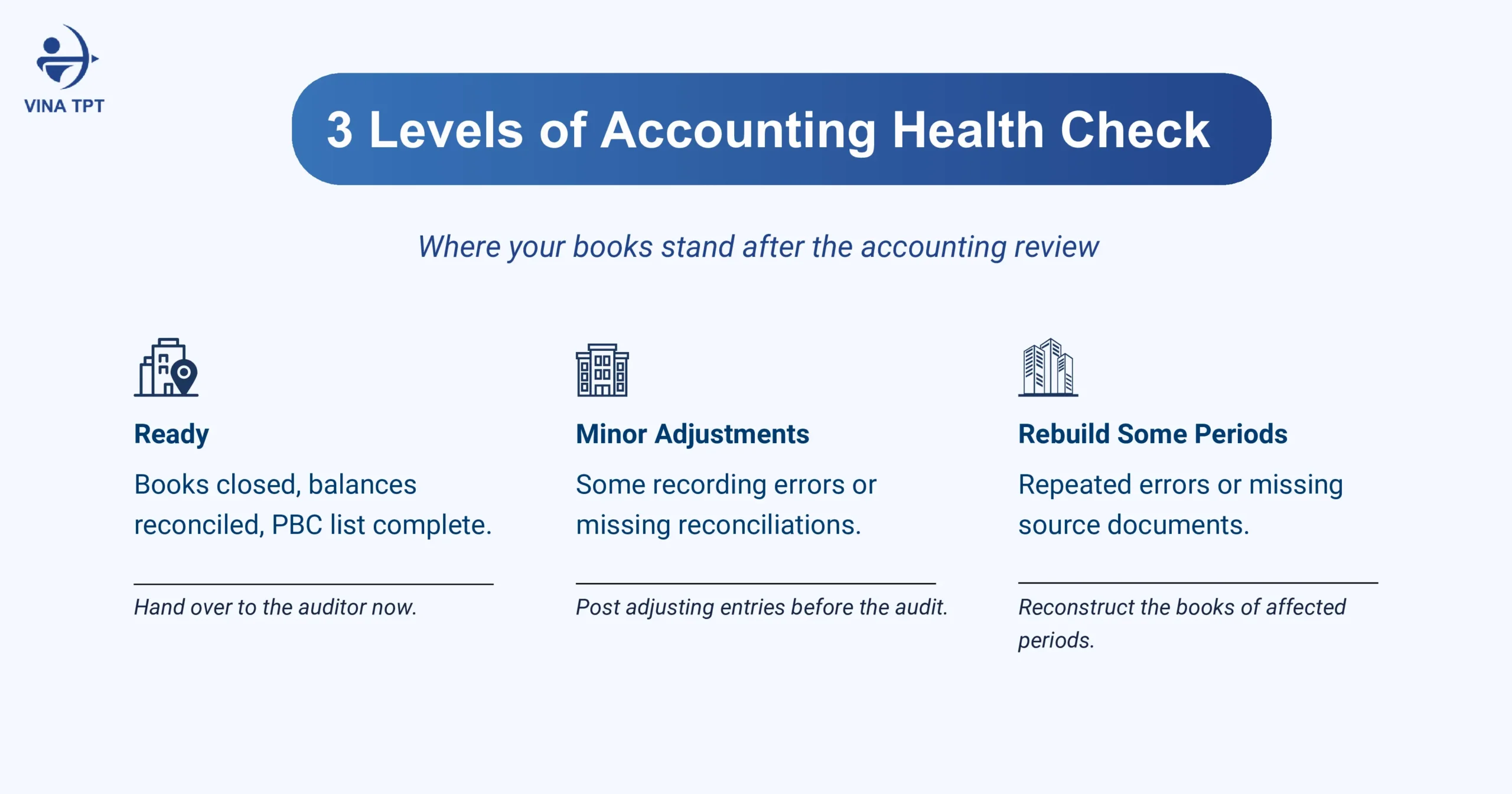
Based on the reconciliation results, the books usually fall into one of three levels:
- Ready: books have been closed, balances have been reconciled, and the PBC list is sufficient; can be handed over immediately to the auditor.
- Needs minor adjustments: some recording errors or missing reconciliations remain; adjusting entries are needed before the auditor enters.
- Needs reconstruction of books for certain periods: errors are repeated across multiple periods or source documents are missing; the books of the affected periods must be reconstructed.
Note for FDI companies: According to regulations, foreign-invested companies are required to have their annual financial statements audited and to submit the audited reports within 90 days from the end of the financial year. Therefore, companies should perform the accounting review 1 to 2 months before the audit firm enters work in order to ensure progress.
EXPLORE VINA TPT TAX REVIEW AND AUDIT SUPPORT SERVICE
6. Accounting Review Services at Vina TPT
The Accounting Review (Accounting Health Check )service at Vina TPT is specifically designed to bring absolute peace of mind to the company’s management before audit periods and tax inspections:
- Perform the review according to the standard 7-step process, issue a detailed findings report accompanied by bilingual technical explanations (English – Vietnamese / Japanese).
- Directly support the company in performing the book-closing adjusting entries after approval; support preparation of the PBC document set and work directly with the independent audit team.
- Integrate the Tax Health Check package to comprehensively screen risks arising from VAT, Corporate Income Tax, Personal Income Tax, and Foreign Contractor Tax obligations.
Performing accounting review is the optimal method that helps companies proactively detect errors and control tax risks through reconciliation of books, documents, and returns, while at the same time raising the level of readiness for the annual financial statement audit period.
Please send the most recent Trial Balance so that we can provide a proposed review scope and detailed implementation roadmap before the audit period!