


Vietnam is becoming an attractive destination for investors in the Southeast Asia region thanks to stable economic development, an abundant labor force, and open policies attracting international capital flows. Before officially starting business in Vietnam activities, foreign investors need to equip themselves with an overall picture of the legal environment, market structure, and practical operational management regulations.
This article summarizes and analyzes the most foundational factors for foreign individuals and organizations, including identifying potential industries, regulations on capital ownership ratios and formation dossiers, options for choosing a business registration address, periodic tax – accounting compliance obligations, as well as the long-term stay mechanism for founders. Each content section is accompanied by reference links to specialized professional guidance.
1. Promising Business Sectors in Vietnam for Foreigners
Foreign investors exploring opportunities to start a business in Vietnam can consider a wide range of industries, including manufacturing, trade, technology, and professional services. Foreign investors often choose to enter the market through the following key industry groups:
- Manufacturing – processing: Suitable for international enterprises that want to optimize operating costs and take advantage of Vietnam’s strategic position in the global supply chain.
- Trade, import-export, and distribution: Taking advantage of the rapidly growing domestic market scale and the system of multilateral Free Trade Agreements (FTA).
- E-commerce and retail: Serving the purchasing power and modern consumption needs that are increasingly growing among the young population.
- F&B business (Food & Beverage): Suitable to meet the diverse and rich culinary tastes of local residents and the international tourist community.
- Information technology, software development, and outsourcing services: Exploiting the outstanding strength of a highly qualified technology personnel force together with competitive cost levels.
- Consulting and professional services: Providing technical and management support solutions for the wave of FDI enterprises that are expanding operations.
- Education and training: Meeting the increasingly large demand for language learning, professional skills, and international-standard programs.
- Tourism and accommodation services: Developing sustainably in line with the recovery and growth momentum of domestic and international tourist flows.
Each of the above industry groups has its own distinct market access conditions. Investors should consult directly with local advisory firms before finalizing the business plan. Readers may learn in more detail in the article Vietnam Business Opportunities 2026-2030: Top Sectors for Foreign Investor
2. Can Foreigners Own 100% of a Company in Vietnam?
Vietnamese law allows foreign investors to own 100% of the charter capital for the majority of ordinary business lines. However, for some conditional business fields or restricted access services, the capital ownership ratio of the foreign party or the investment form will be subject to specific adjustments under the regulations in the Law on Investment 2025 and Decree 96/2026/ND-CP. Current law does not prescribe a general minimum capital level applicable to all projects, but the registered capital scale must ensure feasibility and suitability with the project scale. Investors have the obligation to fully contribute 100% of the registered charter capital within 90 days from the date of issuance of the Enterprise Registration Certificate (ERC). Regarding organizational models, the Limited Liability Company is a popular choice suitable for medium and small investors, while the Joint Stock Company model is optimal for projects with multiple shareholders or plans to raise capital.
2.1. Basic Documents to Start a Business in Vietnam
To register a business in Vietnam, foreign investors generally need to prepare the following documents according to whether they are investing as individuals or corporate entities:
- For individual investors: A copy of a still-valid Passport that has been validly notarized in Vietnam.
- For corporate investors (Parent Company): The set of legal documents of the parent company that has undergone Apostille certification or consular legalization at a Vietnamese diplomatic representative office, then proceeding with notarized translation into Vietnamese.
- Financial documents: A bank account balance confirmation document proving the investor’s financial capacity.
- Location & Project dossier: The head office premises lease contract together with the lessor’s legal documents, along with the Investment Project Proposal prepared by the advisory firm.
The usual sequence of performing the formation procedure starts with applying for the Investment Registration Certificate (IRC) in approximately 5–6 weeks, then applying for the Enterprise Registration Certificate (ERC) in approximately 1–2 weeks. In cases where market access conditions are fully met, investors may choose the option of establishing the ERC first and completing the supplementary IRC procedure within a 12-month period. Readers may refer further to the article How to Get a Business License in Vietnam: Step-by-Step FDI Guide.
3. Choosing a Location and Registered Address
The choice of province or city to locate the investment project depends largely on the industry characteristics and target customer objects of the enterprise (Refer to details in the article Best City for Business Setup in Vietnam). The enterprise’s head office address must have a legal premises lease contract and have a usage function suitable for office activities.
Under the regulations in the Law on Housing 2023, residential apartments or collective housing intended for living purposes are absolutely not allowed to be used as the business registration head office. In the initial stage when there is not yet a need to lease an independent office, investors may use the Shared Office solution to optimize costs. In the case where the enterprise performs a change of the head office address after the ERC has been issued, the procedure of registering the ERC adjustment is mandatory (Refer further to the article ERC Amendment in Vietnam).
The head office address of an FDI enterprise must be located on the territory of Vietnam, clearly identified according to administrative boundaries and with contact information. Under the Law on Housing 2023, residential apartments or collective housing intended for living purposes are not allowed to be used as the business registration head office. The registered address must have a valid lease contract, clearly stating the purpose of use as an office, and be accompanied by documents proving the lessor’s legal right to lease. In addition, the location needs to meet fire prevention and fighting (PCCC) requirements under current regulations, especially for multi-story office spaces or large-area premises, and at the same time must not be shared with purely residential areas.
To optimize initial costs and help the enterprise fully comply with regulations on business premises, Vina TPT provides the Shared Office service as a business registration address for clients using the company formation service. You may contact us to receive advisory and arrange a suitable location.
EXPLORE COMPANY SETUP SERVICES
4. Compliance Rules for Doing Business in Vietnam
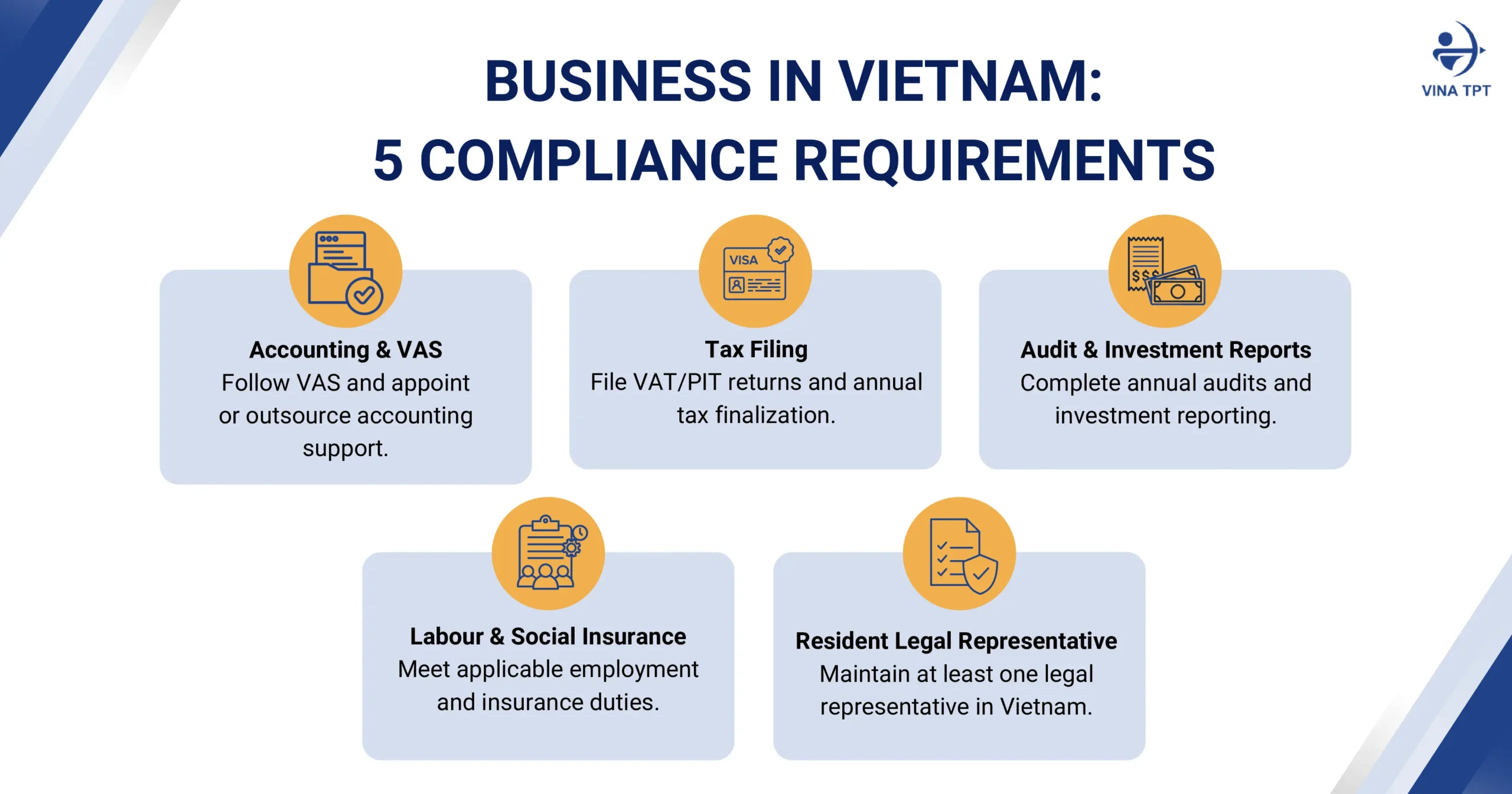
After establishing a business in Vietnam, foreign-invested companies must maintain ongoing compliance with accounting, tax, financial reporting, labor, and corporate governance requirements.
- Accounting system: Applying Vietnamese Accounting Standards (VAS) and the accounting regime issued under Circular 99/2025/TT-BTC applicable for the 2026 fiscal year. The enterprise is required to appoint a Chief Accountant or hire a professional accounting service firm.
- Tax Declaration and Finalization: Performing periodic VAT and PIT declarations monthly or quarterly; submitting the annual CIT and PIT tax finalization dossiers within 90 days from the end date of the fiscal year.
- Audit and Investment Reports: FDI enterprises fall under the subjects required to have the annual financial statements audited by an independent audit firm, and at the same time submit periodic quarterly and annual reports on the implementation status of the investment project.
- Labor & Governance Obligations: Complying with regulations on labor registration and social insurance (BHXH) contributions when personnel arise; always ensuring the maintenance of at least 01 Legal Representative who resides regularly in Vietnam.

5. Long-Term Stay for Foreign Founders
If investors want to stay in Vietnam long-term, they need to have a TRC (Temporary Residence Card). There are many ways to apply for a TRC such as through investment visa form or work permit. Foreign founders and investors may choose a suitable form of stay based on the actual scale of contributed capital into the enterprise in Vietnam:
|
Registered contributed capital level |
Visa / Card type |
Maximum stay term |
| From 100 billion dong or more | Temporary Residence Card DT1 | Maximum 10 years |
| From 50 billion to under 100 billion dong | Temporary Residence Card DT2 | Maximum 5 years |
| From 3 billion to under 50 billion dong | Temporary Residence Card DT3 | Maximum 3 years |
| Under 3 billion dong | DT4 Visa | Maximum 12 months (No Temporary Residence Card issued) |
Under the regulations in Decree 219/2025/ND-CP, individual investors or representatives of capital contribution portions with a value of 3 billion dong or more fall under the case of Work Permit exemption. In the case of contributed capital under 3 billion dong, investors are only granted short-term DT4 visas and must proceed with periodic annual extensions.
TRC applied for through Work Permit has a term of 2 years, after which it can be extended for an additional 2 years. This is also the option prioritized by many investors because in practice the possibility of successfully obtaining the TRC is higher.
Readers may read further detailed guidance on visas, work permits, and temporary residence cards in the article Vietnam Visa, Work Permit and TRC: A Guide for Foreign Investors.
6. How Vina TPT Supports Your Business in Vietnam
Vina TPT supports foreign investors throughout the process of setting up and operating a business in Vietnam, providing coordinated company formation, accounting, tax, payroll, Work Permit, visa, and TRC services.
- Reviewing business industry codes, appraising market access conditions, advising on legal structure, and representing the full-package implementation of IRC and ERC application procedures.
- Providing a legal business registration address solution through the standard Shared Office service for clients using the company formation service.
- Accompanying full-package post-licensing management including Accounting – Tax services, Payroll management, Work Permit, Visa, and Temporary Residence Card advisory.
- Standing firm on a foundation of more than 20 years of practical experience, accompanying 500+ corporate clients, with a specialist team supporting fluently in English, Japanese, and Chinese.
Conclusion
In summary, launching business in Vietnam activities requires foreign investors to proactively grasp the legal system, choose suitable industries, prepare a registration address, and build a standardized tax – accounting compliance plan. Cooperating with an experienced local advisory firm will help optimize time and prevent legal risks.
Please send a detailed description of the expected activities together with the nationality in order to receive guidance on building the most suitable business model.