From 11/09/2026, investors from member countries of the Apostille Convention who carry out investment procedures in Vietnam can significantly simplify the document authentication process. Instead of going through multiple complex certification and consular legalisation steps at diplomatic authorities as before, companies only need to use a single Apostille stamp under Decree 293/2026/ND-CP.
This article clarifies what an Apostille is, points out the core differences from the traditional consular legalisation procedure, updates the important changes under Decree 293/2026/ND-CP, and shares practical notes that help investors prepare an accurate dossier from the start.
1. What Is an Apostille?
An Apostille is a form of certificate (in the form of a stamp placed directly on the document or an attached page) issued by the competent authority of the country where the document was issued, in order to confirm the authenticity of the origin of a public document, including the signature, the title of the signatory and the seal on that document.
The legal basis of this mechanism is the 1961 Hague Convention Abolishing the Requirement of Legalisation for Foreign Public Documents. Accordingly, a public document that has been granted a valid Apostille certificate will be recognized and used directly in other member countries of the Convention without any additional diplomatic confirmation procedure.
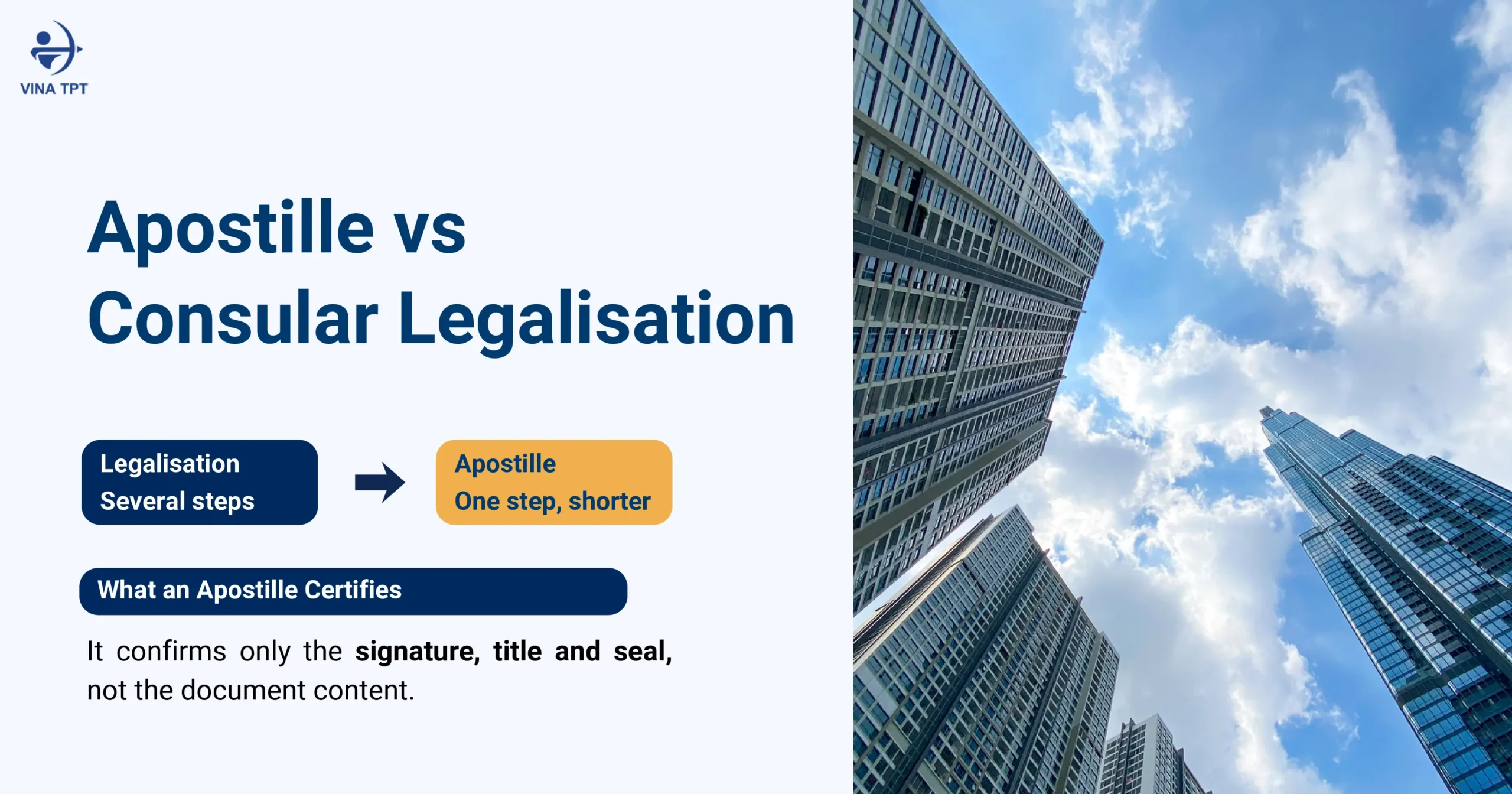
- Scope of confirmation: An Apostille certificate only authenticates the origin of issuance (the signature and seal); it does not confirm or take responsibility for the accuracy of the content of the document.
- Scope of application: This procedure only applies to public documents circulated between member countries.
- Examples of common documents: When preparing company formation dossiers in Vietnam, foreign investors usually need certification of the business registration certificate, the parent company’s charter, a notarized power of attorney, passport, and bank account balance confirmation.
2. Apostille vs Consular Legalisation
The shift from the traditional consular legalisation procedure to the Apostille mechanism brings clear changes in terms of procedures and dossier preparation time for investors:
|
Criteria |
Consular legalisation (Before) |
Apostille (From 11/09/2026) |
| Number of steps | Multiple steps: certification at the diplomatic authority of the host country, followed by legalisation at a Vietnamese diplomatic mission | A single step at the competent authority of the country that issued the document |
| Processing time | Usually 14–30 days
Sửa: Usually lasts 14-30 days, depending on the competent authority of each country. |
Significantly shorter, depending on the regulations of each country |
| Authority in charge | The Ministry of Foreign Affairs of the host country and the Vietnamese Embassy or Consulate | Only the competent Apostille-issuing authority of the host country |
| Country scope | Applies to all countries | Only applies between member countries for which the Convention is in force with Vietnam |
3. Key Updates Under Decree 293/2026
Decree 293/2026/ND-CP officially takes effect from 11/09/2026, the same date the Apostille Convention enters into force for Vietnam. The important legal updates that investors need to understand include:
- Exemption from consular legalisation for foreign documents: Public documents issued abroad that carry a valid Apostille certificate are exempt from consular legalisation when submitted and used at Vietnamese state authorities.
- Apostille for Vietnamese public documents: Public documents issued by competent Vietnamese authorities will be granted an Apostille certificate by the Ministry of Foreign Affairs for lawful use in other member countries.
- Important exceptions: Since Germany, Austria and the Czech Republic have formally objected to Vietnam’s accession to the Convention, all public documents originating from these 3 countries must still go through consular legalisation as before. In addition, the Convention will only apply between Vietnam and Thailand from 28/02/2027. Countries that are not members of the Convention continue to apply the usual consular legalisation procedure.
From 11/9/2026, official documents from member countries of the Convention with a valid Apostille are exempt from consular legalization when used in Vietnam. Investors from typical member countries such as the United States, the United Kingdom, France, the Netherlands, Italy, Spain, Switzerland, Japan, South Korea, Singapore, China, Australia, India, and Canada only need to obtain an Apostille instead of many previous legalization steps. Dossiers from Germany, Austria, and the Czech Republic still must undergo consular legalization because these three countries have objected. Thailand applies from 28/2/2027. Non-member countries still perform consular legalization as before. These are only examples of typical member countries, not a complete list.
EXPLORE COMPANY SETUP SERVICES
4. What Foreign Investors Should Note When Preparing Documents
To ensure that the legal dossier is accepted smoothly at the first submission, investors should note the following practical principles:
4.1. Which Documents Need an Apostille
Before proceeding with authentication, investors need to check carefully whether the document is a public document of a member country of the Convention. Basically, the legal documents of the parent company (corporate investor) must have an Apostille certificate, while the passport copy of an individual investor only needs a valid certified copy.
4.2. Translation, Timing and Where the Documents Are Used
- Notarized translation requirement: Even with an Apostille stamp, all documents in a foreign language must still be translated into Vietnamese with notarization before being submitted to the competent authorities in Vietnam.
- Validity of documents: Investors should complete the Apostille procedure within 30 days before the planned submission date to avoid the risk of documents expiring or information becoming outdated.
- Common purposes of use: The certified documents are used directly in the application dossier for the Investment Registration Certificate and Enterprise Registration Certificate, as well as in the work permit application for intra-company transferees.
5. How Vina TPT Supports Your Company Setup Documents
Experience and support capability: Accompanying enterprises with more than 20 years of experience, serving more than 500 corporate clients together with a support team communicating fluently in English, Japanese, and Chinese.
Clear coordination scope: The Apostille stamp issuance procedure is performed by the competent authority in the country issuing the documents; Vina TPT plays the role of in-depth advisory and supports the completion of the entire company formation dossier in Vietnam.
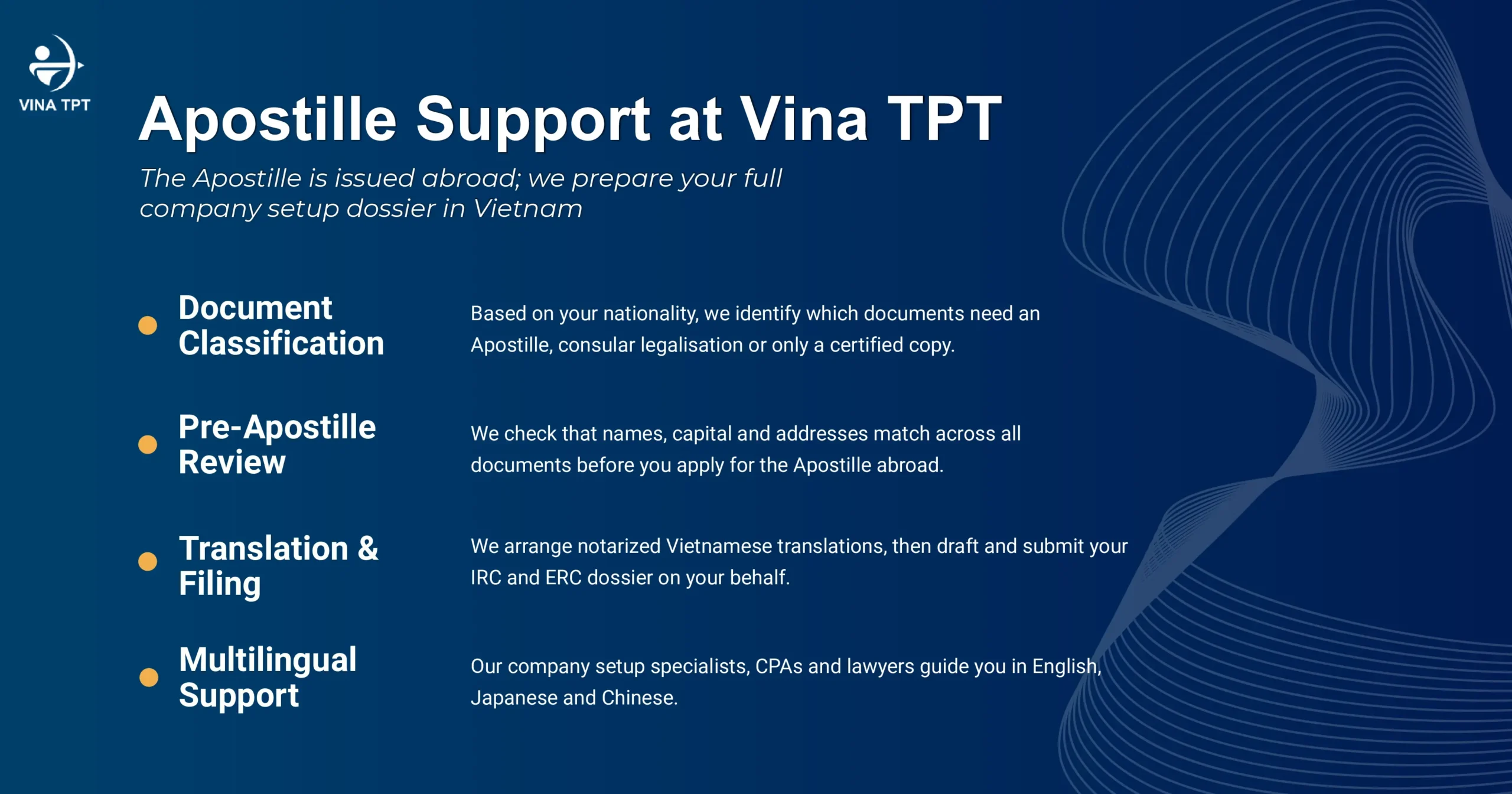
Classification of documents by nationality: Detailed advisory based on the nationality of each investor to accurately determine which documents need Apostille certification, which documents must undergo consular legalization, and which documents only need notarized copies.
Full-package review and submission of dossiers: Comprehensive review of the consistency of information among documents before the investor proceeds to apply for Apostille abroad; directly performing notarized translation into Vietnamese, drafting, and representing the full-package submission of IRC and ERC application dossiers.
Conclusion
The Apostille mechanism under the new regulations has significantly shortened the time and simplified the legal document authentication process for investors from member countries of the Convention entering the Vietnamese market. Correctly classifying the authentication requirements from the first step helps companies save costs and keep the project licensing on schedule.
Please send us information on your nationality together with the list of documents you currently have to receive detailed guidance on whether your dossier needs an Apostille or consular legalisation.