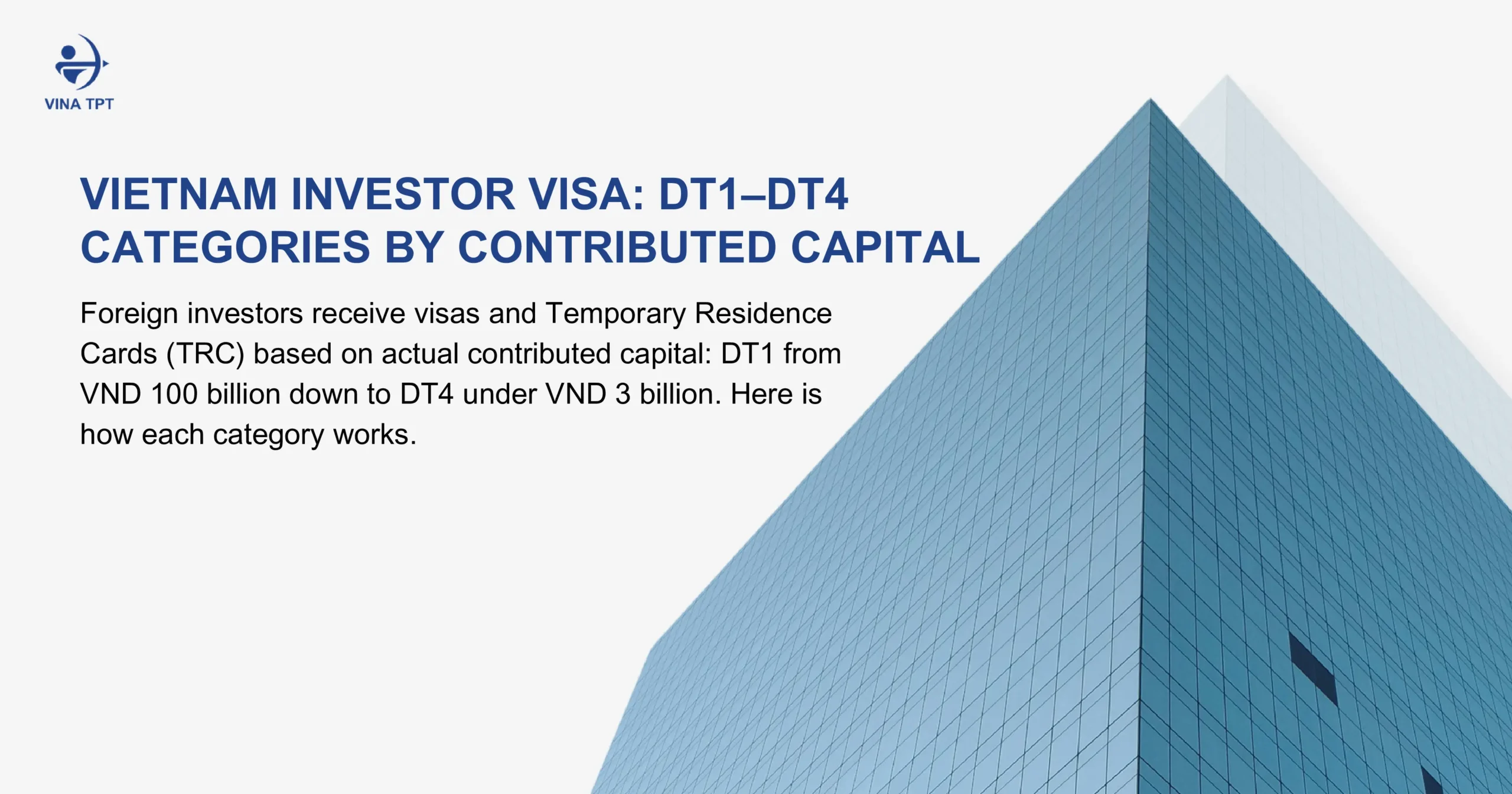
What determines the validity of an investor TRC? The validity period of visas and Temporary Residence Cards for foreign investors mainly depends on the actual scale of contributed capital into the enterprise, divided into groups DT1–DT4. Specifically, DT1 (from 100 billion dong) has a TRC of maximum 10 years, DT2 (from 50 to under 100 billion dong) maximum 5 years, DT3 (from 3 to under 50 billion dong) maximum 3 years, while DT4 (under 3 billion dong) is only granted a visa of maximum 12 months and has no TRC. The general conditions for applying for a TRC and alternative paths when not yet meeting the investment category conditions will be stated in the subsequent sections of the article on Vietnam investor visa.
This article summarizes in detail the classification criteria of each Vietnam investor visa category by contributed capital, lists the basic conditions for being granted a lawful Temporary Residence Card, and introduces an effective alternative for obtaining a Temporary Residence Card when the investor does not yet meet the minimum capital level under the usual investor category.
1. Overview of Investor Categories by Capital
Under the Law on Entry, Exit, Transit and Residence of Foreigners in Vietnam (Law No. 47/2014/QH13, as amended and supplemented in 2019 and 2023), the Vietnam investor visa categories and corresponding residence durations are regulated as follows:
|
Symbol |
Actual contributed capital |
Visa validity |
| DT1 | VND 100 billion or more | Temporary Residence Card (TRC) valid for up to 10 years |
| DT2 | From VND 50 billion to under VND 100 billion | Temporary Residence Card (TRC) valid for up to 5 years |
| DT3 | From VND 3 billion to under VND 50 billion | Temporary Residence Card (TRC) valid for up to 3 years |
| DT4 | Under VND 3 billion | Visa only, valid for up to 12 months, no TRC issued |
1.1. DT1 Vietnam Investor Visa (from VND 100 billion)
Applies to foreign investors in Vietnam and representatives of foreign organizations investing in Vietnam with contributed capital of VND 100 billion or more, or investing in sectors and business lines eligible for investment incentives, or in areas eligible for investment incentives as decided by the Government. This category may be granted a Temporary Residence Card valid for up to 10 years, suitable for large-scale and long-term projects.
1.2. DT2 (VND 50 to under 100 billion)
The DT2 Vietnam investor visa applies to foreign investors and representatives of foreign organizations with contributed capital from VND 50 billion to under VND 100 billion, or those investing in sectors and business lines encouraged by the Government. The Temporary Residence Card is granted for up to 5 years.
1.3. DT3 (VND 3 to under 50 billion)
Applies to investors with contributed capital from VND 3 billion to under VND 50 billion, allowing them to apply for a Temporary Residence Card valid for up to 3 years. The DT3 category of the Vietnam investor visa is particularly common among investors establishing small and medium-sized FDI companies. Notably, under Decree 219/2025/ND-CP, the owner or capital-contributing member of a limited liability company, or the Chairman or a member of the Board of Directors of a joint stock company, with contributed capital of VND 3 billion or more is not required to apply for a work permit.
1.4. DT4 (under VND 3 billion)
Foreign investors with contributed capital of less than VND 3 billion fall under the DT4 Vietnam investor visa category. This group is only granted a visa valid for up to 12 months, is not eligible for a Temporary Residence Card at all, and must renew the visa periodically every year. If they need a stable long-term stay, DT4 investors should refer to the alternative solution described in section 3 below.
For example, if the company is initially registered with capital of 3.5 billion dong, the investor receives a DT3 visa and can apply for a TRC. If after the second year the capital is increased to 52 billion dong, the investor can switch to a DT2 visa. Conversely, if only capital of 2 billion dong is registered, only a DT4 visa is granted and there is no TRC; at this point another method needs to be applied as presented in the section below.
2. Common Conditions for a TRC
Investors applying for a Temporary Residence Card under an eligible Vietnam investor visa category need to meet the following basic legal and documentation requirements:
- The company in Vietnam is operating lawfully and holds a valid Investment Registration Certificate (IRC) and Enterprise Registration Certificate (ERC).
- For the investor category, the investor must prove that the actual capital contribution has been completed through statements of the foreign investment capital account opened under Circular 38/2026/TT-NHNN, or a valid capital contribution confirmation.
- The foreigner’s original passport is still valid (usually required to have more than 1 year of remaining validity), and temporary residence has been declared online or in person at the local police of the place of residence.
- The actual processing time usually takes 5–7 working days from the date the immigration authority receives a complete and valid dossier.
- The detailed document list for each case is described in the article Vietnam Visa, Work Permit and TRC: A Guide for Foreign Investors.
3. Another Way to Get a TRC: Work Visa, Work Permit and TRC
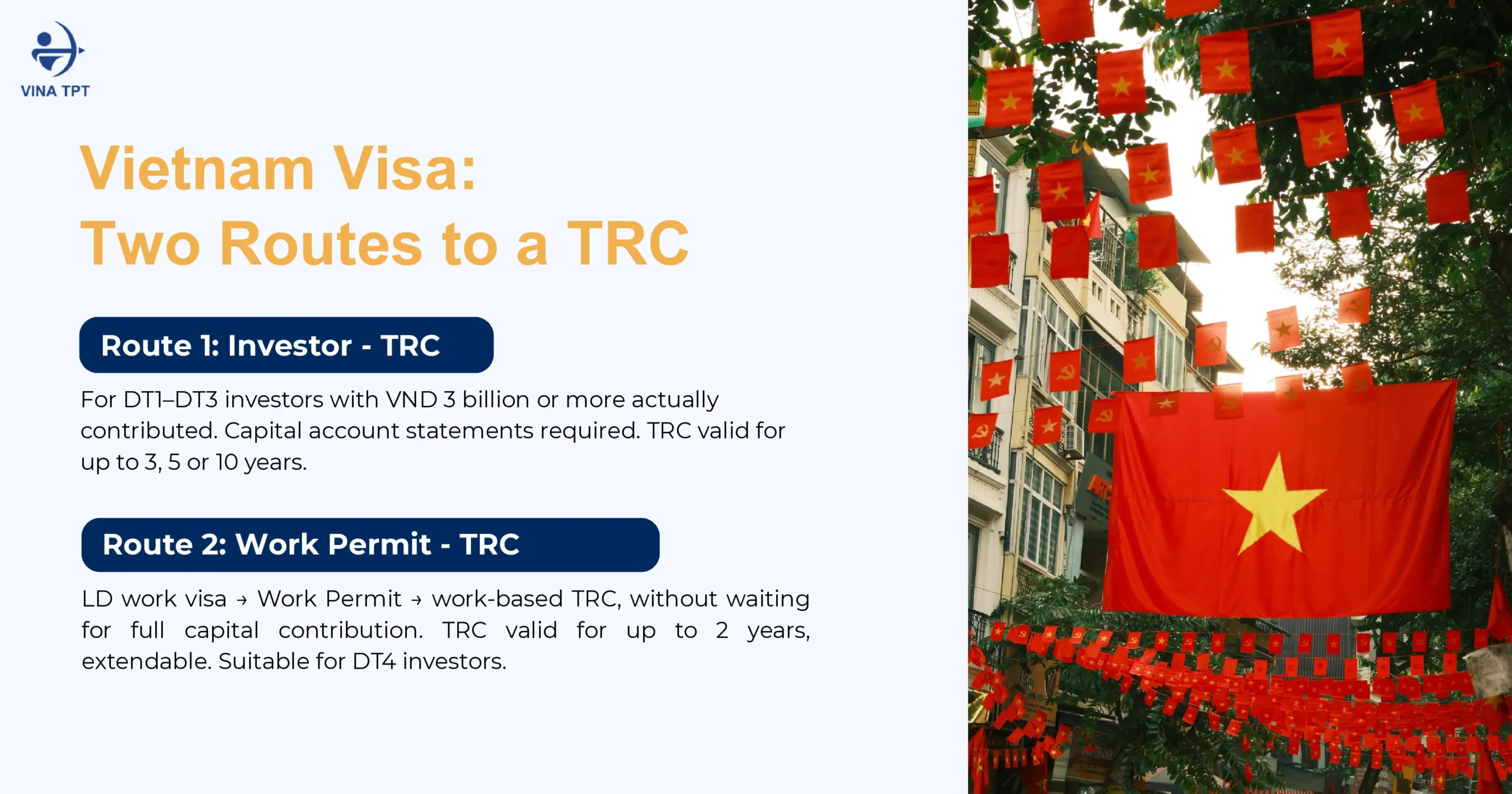
When the capital level is under 3 billion dong or the enterprise has not yet fully contributed the capital, investors should choose this alternative method to apply for a Temporary Residence Card. Besides the option of applying for residence directly under the investment category, foreign investors can apply for a Temporary Residence Card under the labor category. The process includes the steps: apply for a labor visa (code LD) → apply for a Work Permit → apply for a labor Temporary Residence Card.
- Card duration: A Temporary Residence Card granted on the basis of a Work Permit is valid for up to 2 years and, after it expires, can be extended for a further 2 years.
- Suitable cases: This option is especially useful when the investor contributes less than VND 3 billion (the DT4 category, which is not eligible for a TRC), or when the investor needs a Temporary Residence Card right away to settle their life and transactions before completing the capital contribution, because this route does not require the charter capital to be fully contributed.
- Feasibility in practice: In practice, the approval rate for Temporary Residence Cards via the Work Permit route is usually higher and more stable, so it is preferred by many foreign investors.
- For more details: The implementation roadmap and expected timeline of each option are analyzed.
4. Practical Notes for Smaller Investors
For investors with small and medium capital, the process of preparing and maintaining lawful residence status requires attention to the following practical points:
- Visa or Temporary Residence Card applications in the DT3 and DT4 groups are usually reviewed carefully by the authorities and are often asked to supplement documents proving the company’s actual business operations in Vietnam (such as the office lease agreement, invoices and tax returns).
- If wanting to apply for a Temporary Residence Card directly under the investment category, the investor only needs to fully contribute the capital before the time of submitting the dossier for applying for an investor category visa or card.
- Closely track the validity dates on the Temporary Residence Card or visa so that the renewal procedure can be carried out early before expiry, avoiding administrative violations related to residence.
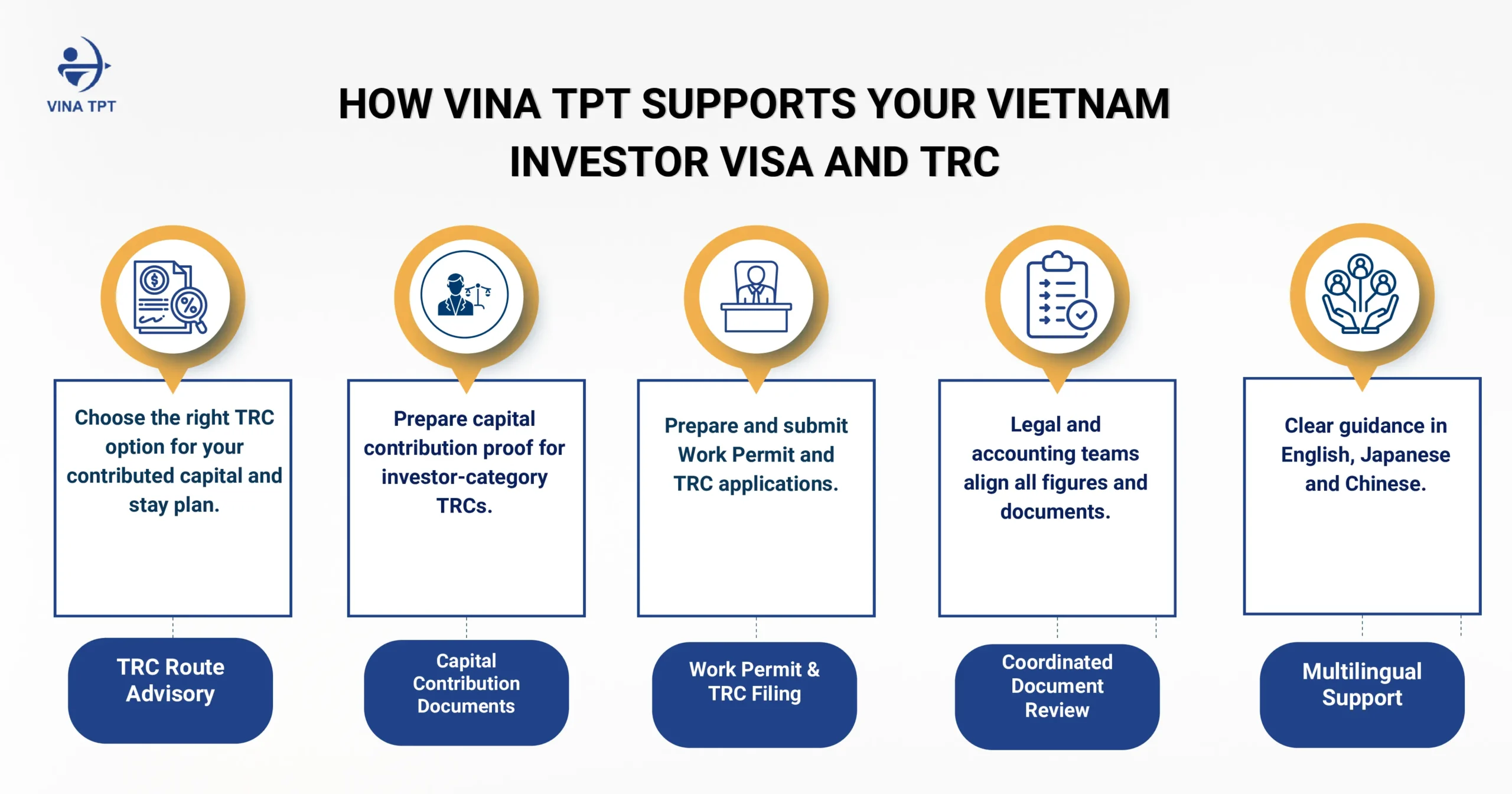
5. How Vina TPT Supports Your Vietnam Investor Visa and TRC
Vina TPT with more than 20 years of experience, serving more than 500 FDI corporate clients, with a team that supports clients fluently in English, Japanese and Chinese. For investors planning their stay, we support:
- Advising on, analyzing and selecting the most suitable Temporary Residence Card option for the investor’s actual contributed capital and long-term stay plan in Vietnam.
- Directly preparing the full set of capital contribution documents, Work Permit and Temporary Residence Card applications; at the same time coordinating between the company setup legal team and the accounting team so that all figures and documents match exactly.
Conclusion
Understanding the DT1 to DT4 categories together with the two routes to a Temporary Residence Card (the investor route and the employment route) helps investors proactively plan a lawful stay and save time when applying for a Vietnam investor visa. Choosing the right option for the scale of contributed capital helps minimize additional procedures.
Please send us information on your expected investment capital and how long you plan to stay in Vietnam to receive advice on the most suitable roadmap and visa category.