

In practice, compliance for an intra-company transfer rests on three pillars: (1) a work permit or a valid work permit exemption confirmation, (2) a Temporary Residence Card matching that status, and (3) a correctly structured employment contract with the right social insurance treatment. This article works through each pillar – what an intra-company transfer is, the conditions for qualifying, the work permit or exemption rules, the TRC procedure, and the social insurance and Personal Income Tax (PIT) obligations. The content is general reference information and does not replace separate legal advice for each specific case.
1. What Is an Intra-Company Transfer?
Under Decree 219/2025/ND-CP, an intra-company transfer is when a manager, executive, expert or technical worker who is working for a foreign company is assigned to work at that foreign company’s commercial presence (such as a subsidiary or branch) in Vietnam.
For example, a Japanese engineer who has worked for the parent company in Osaka for 2 years is then assigned by management to the subsidiary in Binh Duong to directly operate a production line for 2 years. The core difference between this form and direct recruitment is that the employee does not sign a new employment contract with an independent Vietnamese legal entity, but is transferred within the same group.
2. Conditions to Qualify as an Intra-Company Transfer
For a foreign employee to be considered under the intra-company transfer category, the dossier needs to fully meet the following prerequisites:
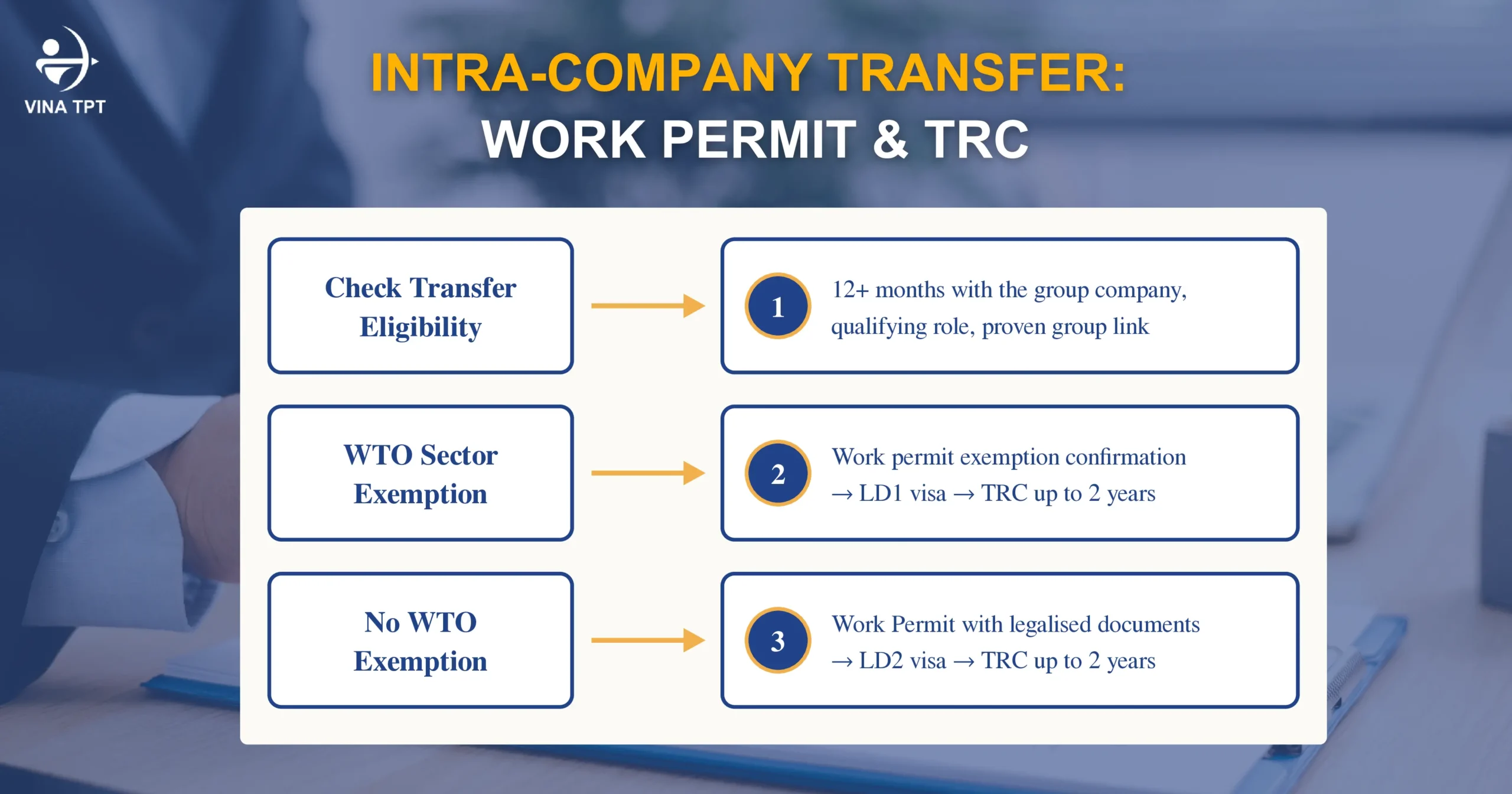
- The employee has been working continuously for the parent company or another member company of the same group abroad for a minimum period before the assignment – commonly cited as at least 12 months – subject to the exact wording of point b, clause 13, Article 7 of Decree 219/2025/ND-CP.
- The position in Vietnam falls into one of the four prescribed job groups: manager, executive, expert or technical worker.
- There is an official document from the foreign company assigning the employee to work for a fixed term at the commercial presence in Vietnam.
- There are full legal documents proving the ownership or group relationship between the foreign company and the commercial presence in Vietnam.
3. Work Permit, Exemption and TRC for an Intra-Company Transfer
The mandatory principle under Vietnamese labor law is that a foreign employee must have a Work Permit (WP) or a confirmation of work permit exemption before officially starting work.
3.1. Intra-Company Transfer Exemption in WTO Service Sectors
- Intra-company transferees operating within the service sectors covered by Vietnam’s Schedule of Specific Commitments in Services with the WTO may not be required to obtain a Work Permit. Because the scope of these committed sectors is specific, the company should compare the business line codes on its Enterprise Registration Certificate against the WTO commitments, and confirm the current list with the licensing authority, before relying on this exemption.
- However, the company must still submit an application asking the competent authority to issue a confirmation that the employee is exempt from a Work Permit under Decree 219/2025/ND-CP. Therefore, the company needs to carefully compare the business line codes on its license with the WTO commitments before applying this exemption.
- In practice, Official Letter 7873/BCT-KHTC (30/09/2026) advises local authorities to review technical-worker transferees carefully, so companies should confirm the exemption with the local licensing authority before the employee starts work.
3.2. Work Permit for Transfers Outside the Exemption
If the employee does not fall into an exempt sector, the company must apply for a Work Permit through the usual procedure. Foreign-issued documents such as degrees, experience confirmations and criminal record certificates must carry Apostille certification or consular legalization and a notarized Vietnamese translation, while the passport only needs a certified copy (please also refer to the article Vietnam’s New Apostille Rules Under Decree 293/2026: Key Updates for Foreign Investors).
3.3. Temporary Residence Card and Visa
- After being granted a Work Permit or a work permit exemption confirmation, the foreign employee is eligible to apply for a work-based Temporary Residence Card (TRC) for a lawful long-term stay.
- The duration of the Temporary Residence Card follows the duration of the Work Permit or the exemption confirmation, but no longer than 2 years under the Law on Entry, Exit, Transit and Residence of Foreigners in Vietnam 2014 (as amended and supplemented in 2019 and 2023).
- Visa and Temporary Residence Card symbols are clearly classified: the LD1 symbol applies to foreign employees who are exempt from a Work Permit, and the LD2 symbol applies to foreign employees who are required to have a Work Permit.
- Investors who contribute capital in their own name and directly manage the company can refer to the investor visa (DT) categories or see the overall roadmap from company setup to the residence card.
EXPLORE VISA AND TRC SERVICES VINA TPT
4. Employment Contract and Social Insurance
The first important step in compliance management is to clarify whether the transferred employee’s employment contract is signed directly with the parent company abroad or with the subsidiary in Vietnam.
- Contract with the parent company abroad: If the employee keeps the contract with the parent company and receives all income into an account abroad, the company in Vietnam does not have to pay compulsory social insurance for this employee.
- Contract with the company in Vietnam: If the employee signs an employment contract directly with the Vietnamese legal entity, the company and the employee are in principle subject to compulsory social insurance under the prevailing Law on Social Insurance and its implementing guidelines. The specific contribution rates and the way these rules apply to foreign transferred employees should be confirmed against the guidance in force at the time of the assignment.
- Personal Income Tax (PIT) obligations: Tax residence status (resident or non-resident individual) is determined based on the total number of days actually present in Vietnam. All income arising from work performed in Vietnam must be declared and taxed under PIT regulations, regardless of whether it is paid from Vietnam or from abroad.
5. How Vina TPT Supports Intra-Company Transfer Compliance
Vina TPT is an advisory firm specializing in company setup, accounting, tax, HR – payroll and visa, Work Permit and TRC services for FDI companies. For intra-company transfers, we support:
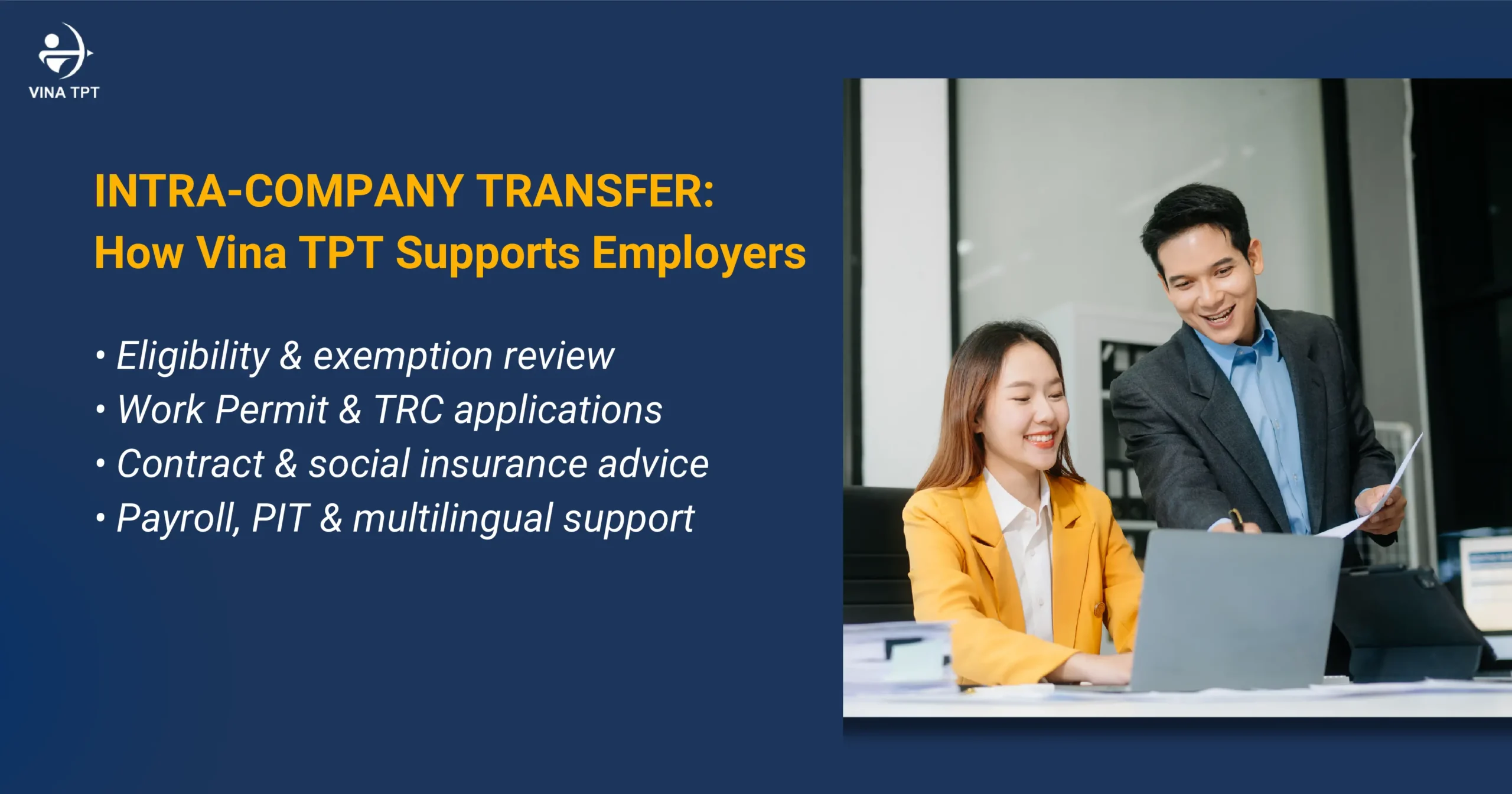
- Reviewing the job title and business line codes to determine exactly whether the employee needs a Work Permit or a work permit exemption confirmation; directly preparing the full Work Permit, exemption and Temporary Residence Card (TRC) applications.
- Advising on the employment contract structure and a compliant social insurance plan; synchronizing HR data with our payroll and PIT filing services to ensure all compliance reports match exactly.
- Accompanying companies with more than 20 years of experience, serving more than 500 FDI corporate clients, with a team that supports clients fluently in English, Japanese and Chinese.
Following the right legal process from the first step helps companies optimize the time needed to assign staff and avoid penalty risks when carrying out an intra-company transfer. Please send us information on the planned job title, business sector and transfer period to receive a detailed compliance checklist.