When establishing a trading company in Vietnam, many foreign investors often have an incomplete understanding, believing that obtaining the Enterprise Registration Certificate (ERC) is sufficient to legally commence all commercial activities. However, from a practical legal perspective in Vietnam, the ERC is only the first step in granting legal entity status. To actually circulate goods legally in the market, an FDI company must obtain additional sub-licenses or specialized Business Licenses, depending on the distribution method and target customer base.
Vietnam’s specialized management system clearly separates legal obligations based on the operating model: from retail, wholesale, import-export, to business on e-commerce platforms. Correctly identifying, preparing, and obtaining the necessary business licenses for a trading company in time not only completely eliminates the risk of administrative penalties and operational suspension but also protects the investment project from the risk of losing legal entity status.
This article from Vina TPT provides a detailed handbook on the licensing requirements for the four most common types of trading activities today.
1. Common Sub-Licenses for Trading Companies
In principle, immediately after receiving the Enterprise Registration Certificate (ERC), a trading company must carefully review the registered Vietnam Standard Industrial Classification (VSIC) codes to cross-check against the list of conditional business sectors. The need for sub-licenses depends entirely on the distribution channels and target customer groups the company will serve.
Some common sub-licenses, categorized by product type and infrastructure requirements, include:
- Certificate of Eligibility for Food Safety: Mandatory for trading companies dealing in food products, beverages, functional foods, or deeply processed raw materials.
- License for Restricted or Conditional Goods: Required when trading items under special state management, such as industrial chemicals, cosmetics, pharmaceuticals, alcohol, or tobacco.
- Environmental License and Fire Prevention & Fighting Approval: Mandatory for companies operating physical warehouses to ensure compliance with technical safety standards.
Note: Not every trading company requires sub-licenses. If your business only distributes ordinary consumer goods through wholesale channels, having accurate VSIC codes and complying with periodic reporting requirements is usually sufficient to operate legally.
2. Sub-Licenses for Retail Business
The retail model (retail stores or direct distribution channels) – legally defined as the activity of selling goods directly to individual end consumers – is the form of commerce subject to the strictest legal regulations for foreign investors.
According to Decree 09/2018/ND-CP, the core requirements include:
- Business License: This is a mandatory license issued by the Department of Industry and Trade for foreign-invested economic organizations to exercise retail rights to end consumers.
- Retail Outlet Establishment License: If an FDI company wishes to open additional retail outlets, the system will trigger the local Economic Needs Test (ENT) process, except for stores with an area of less than 500m² located in shopping centers.
- Location Infrastructure Standards: The retail establishment must fully comply with the urban planning of the province or city and meet strict standards for fire prevention and fighting as well as food safety and hygiene.
3. Sub-Licenses for Wholesale Business
Wholesale business – the activity of selling goods to merchants, economic organizations, or other enterprises for further production or distribution – has a much more open and less restrictive legal framework compared to retail.
The key legal characteristics include:
- Exemption from Sub-Licenses: According to the Law on Commerce and Decree 09/2018/ND-CP, FDI companies are permitted to engage in wholesale activities for ordinary goods (not in the list of lubricants, rice, sugar, industrial explosives, etc.) immediately after obtaining the Investment Registration Certificate (IRC) with the appropriate wholesale business codes and the Enterprise Registration Certificate (ERC). In this case, the company does not need to apply for an additional Business License from the Department of Industry and Trade.
- Warehouse System Management: In case the company establishes a large-scale goods storage warehouse system, it must complete environmental protection commitments and obtain fire prevention and fighting system approval for the warehouse.
- Tax Documentation Management: The company must strictly comply with the process of issuing synchronized electronic Value-Added Tax (VAT) invoices for each wholesale transaction.
Contact Vina TPT for a Free Consultation on Sub-Licenses
4. Sub-Licenses for Export Activities
Export activities are one of the sectors prioritized by the Vietnamese Government for simplified procedures to attract international capital and promote global trade balance.
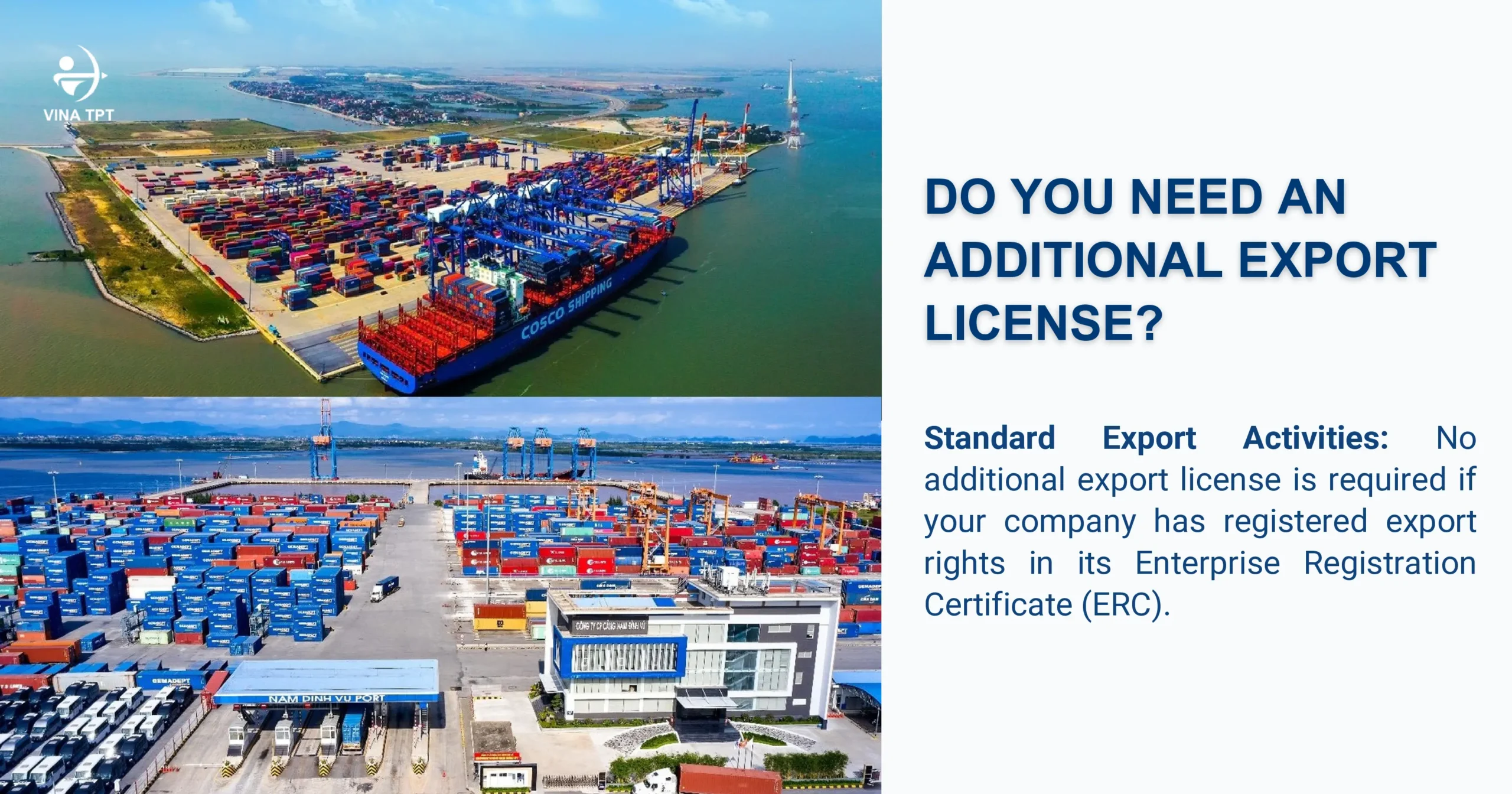
- Legal Basis: According to the Law on Foreign Trade Management and Decree 69/2018/ND-CP, foreign-invested enterprises that have registered export rights in their Enterprise Registration Certificate (ERC) have the full right to purchase goods in Vietnam for export without needing a separate Business License for this trading activity.
- Customs Clearance Procedures: The company only needs to register a customs tax code and prepare standard export documents, including: Commercial Invoice, Packing List, Bill of Lading, and Certificate of Origin (C/O) to enjoy preferential tax rates.
- Exceptions: For certain special goods under specialized management or subject to quotas (such as minerals, natural timber, rare agricultural products, or precursor chemicals), the company must still apply for an export license for each shipment or annually from the relevant specialized ministries (Ministry of Industry and Trade, Ministry of Agriculture and Rural Development).
5. Sub-Licenses for E-Commerce Business
The rapid growth of online business models and the establishment of official stores on major e-commerce platforms in Vietnam (such as Shopee, Lazada, Tiki, and TikTok Shop) has created specific legal compliance requirements for business licenses for online business.
The mandatory obligations include:
- Notification/Registration with the Ministry of Industry and Trade: Whether operating a proprietary e-commerce website or setting up large-scale trading platforms, businesses must complete the online notification/registration procedure on the Ministry of Industry and Trade’s portal as required by Decree 52/2013/ND-CP (as amended by Decree 85/2021/ND-CP).
- Legal Entity Verification on Platforms: In 2026, major e-commerce platforms in Vietnam apply strict control mechanisms, requiring businesses to provide their Enterprise Registration Certificate (ERC), tax code, and any necessary sub-licenses for goods before activating a business (Mall) storefront.
- Compliance with the Cybersecurity Law and Consumer Protection Law: Businesses must establish mechanisms to protect customer information, publicly disclose data privacy policies, return policies, and transparent complaint resolution mechanisms in the digital environment.
- Business License for selling to end consumers: If the e-commerce business model is considered retail (selling directly to end consumers), the company must obtain a Retail Business License from the Department of Industry and Trade as required by regulations.
6. How Vina TPT Supports Sub-Licenses for Trading Companies
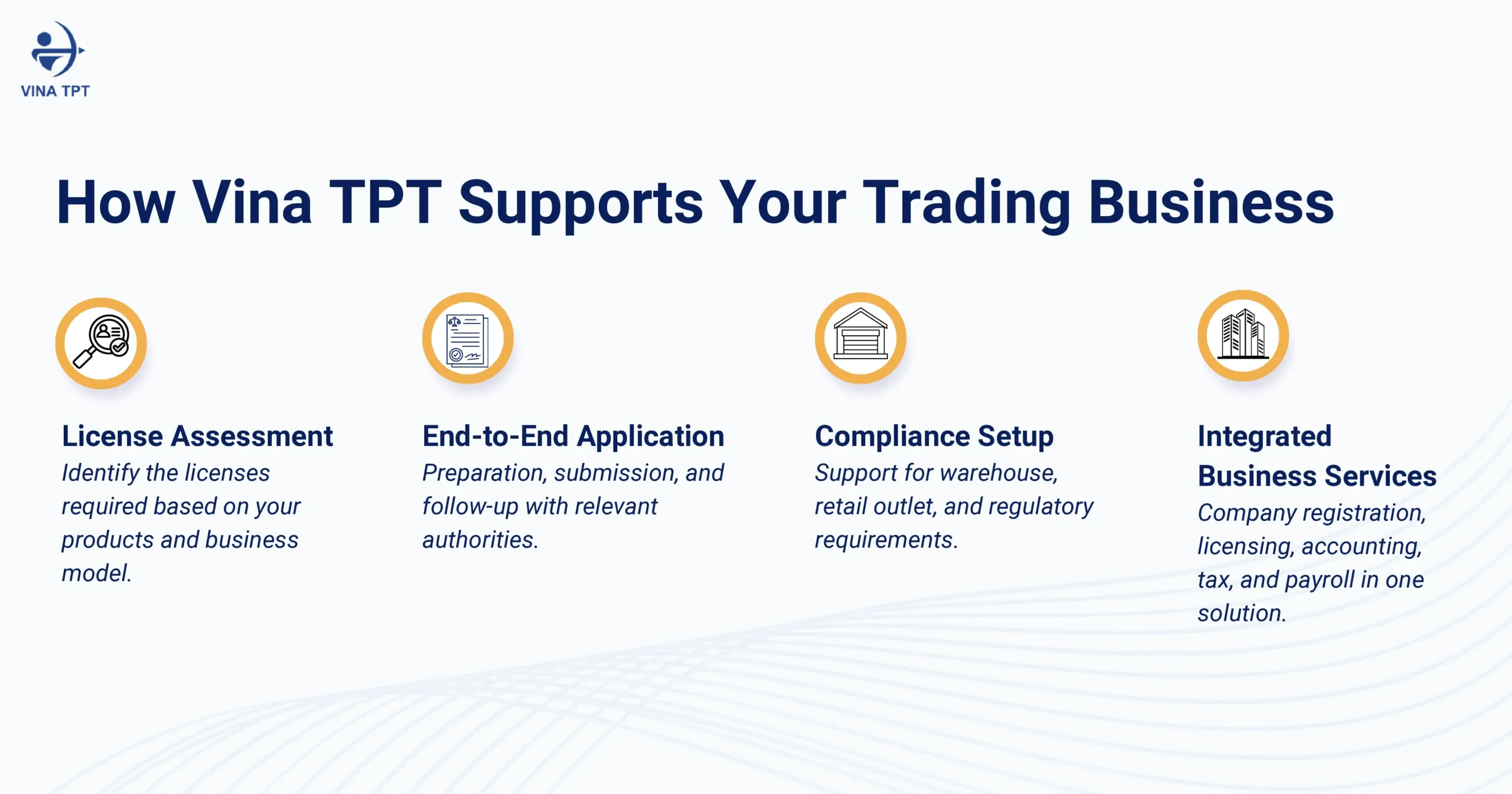
Handling sub-license applications independently in a developing market like Vietnam often presents many challenges for FDI executives due to language barriers, complex online filing procedures, and frequent changes in local Economic Needs Test (ENT) decisions. With over 20 years of specialized experience in FDI legal support, Vina TPT offers a comprehensive and professional sub-license support solution:
- License Mapping and Structuring: We analyze your actual business model to accurately identify the required sub-licenses, avoiding unnecessary applications or missing critical ones that could waste budget.
- Legal Document Preparation and Optimization: On behalf of the company, we draft business proposals, explain financial capacity, submit applications, and directly liaise with relevant authorities (Department of Industry and Trade, Ministry of Industry and Trade, Food Safety Authority) to obtain approvals.
- Compliance Infrastructure Setup: We support site surveys and preparation of retail outlets or warehouses to fully meet on-site inspection standards for fire prevention and food safety.
- End-to-End Service Ecosystem: Vina TPT provides integrated solutions from company establishment and sub-license applications to full accounting, tax, and payroll management services, helping your trading company commence commercial operations in the shortest possible time.
Are you planning to launch a trading company in Vietnam? Contact Vina TPT today for a free, in-depth consultation and receive a complete licensing roadmap tailored to your business model.