

Vietnam is an attractive destination for foreign investors thanks to stable economic growth, a young population, and its strategic position in the global supply chain. However, understanding how to open a business in Vietnam successfully depends not only on completing legal procedures but also on understanding the local market.
Many foreign investors initially focus only on paperwork and costs, but after some time they realize that understanding Vietnamese business culture and consumer behavior is the key factor for long-term sustainability. This article from Vina TPT shares practical insights into Vietnamese culture and market trends, while providing a detailed guide on how to open a business in Vietnam for foreign investors in 2026.
1. Understanding Vietnam’s Culture, People, and Market Trends
To successfully realize your plan to start a business in Vietnam for foreigners, reading macroeconomic reports is not enough. You need to deeply understand the cultural layers that influence consumer behavior and how local businesses operate.
1.1. Business Culture: The Importance of Relationship Networks
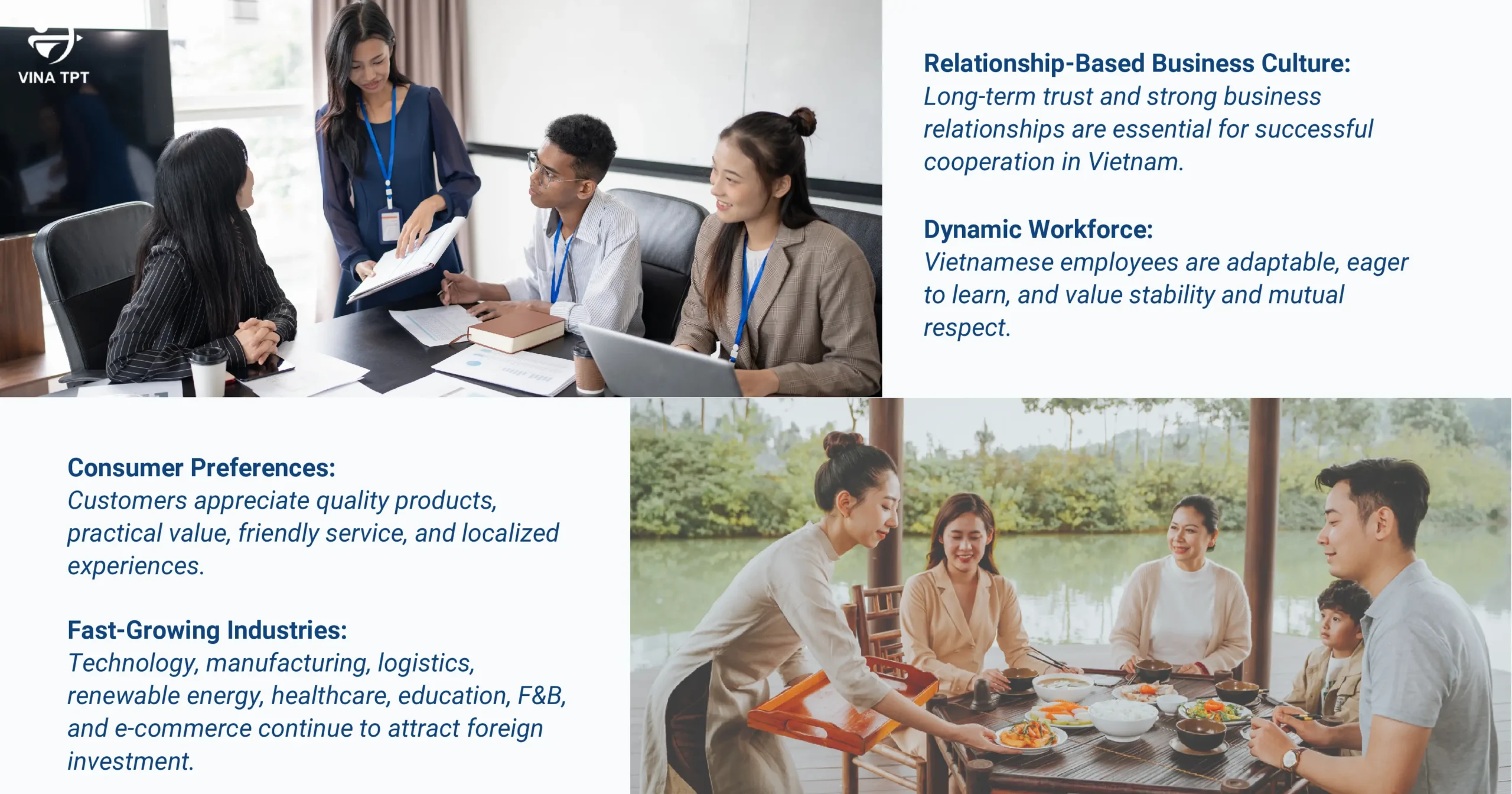
Vietnamese business culture highly values relationships, often referred to as “relationship” based on trust and long-term commitment.
Patience, personal credibility, and keeping promises are invaluable intangible assets. Face-to-face meetings, intimate dinner parties, or small gifts featuring specialties from the investor’s home country during holidays are not mere formalities – they are how Vietnamese people measure the sincerity and commitment of their partners. Once relationship or empathy and trust are established, future business bottlenecks are resolved much more flexibly and quickly.
1.2. Vietnamese People: Diligent, Flexible, and Value “Tín” (Trust)
Vietnamese people are known for their diligence, dynamism, and extremely fast ability to learn and adapt to new technologies. However, they also highly value stability, family, and long-term relationships.
In the workplace, Vietnamese employees appreciate foreign managers who are sincere, good listeners, respect personal dignity, and show long-term commitment to staff development. Flexibility is also a prominent trait – in Vietnamese business, the ability to “solve problems together” (problem-solving through consensus) in a win-win spirit is often valued more than imposing rigid legal terms from the start.
1.3. Consumer Preferences: Sophisticated, Practical, and Service-Oriented
Vietnamese consumer tastes (especially Gen Z and Millennials) are shifting rapidly. They increasingly seek real value: stable quality, smart design, optimal functionality, but at a reasonable price (value-for-money). Vietnamese people are not xenophobic, but they prioritize international brands that localize products to fit daily life and local customs.
In addition, friendly, enthusiastic service attitudes and fast response to online messages (via chat apps and social media) are major advantages that help businesses retain customers.
1.4. Fast-Growing Industry Trends in 2026
Based on the government’s strategic directions, Vietnam’s market is opening up to high-tech manufacturing, electronic components, renewable energy, green logistics, premium experiential tourism, F&B chains, e-commerce, digital healthcare, and quality education. Vietnam’s tropical monsoon climate provides abundant resources but also creates major challenges for fresh food supply chains (requiring advanced cold-chain infrastructure). Understanding these core characteristics will help a restaurant business in Vietnam foreign investors or any other industry investor easily integrate, build a strong local team, and make accurate business decisions.
2. Step-by-Step Guide: How to Open a Business in Vietnam
Doing business in Vietnam with foreign investment requires a clear, structured process to ensure full legal compliance and smooth operations. This guide to opening a company in Vietnam is designed specifically for foreign-invested commercial and service businesses.
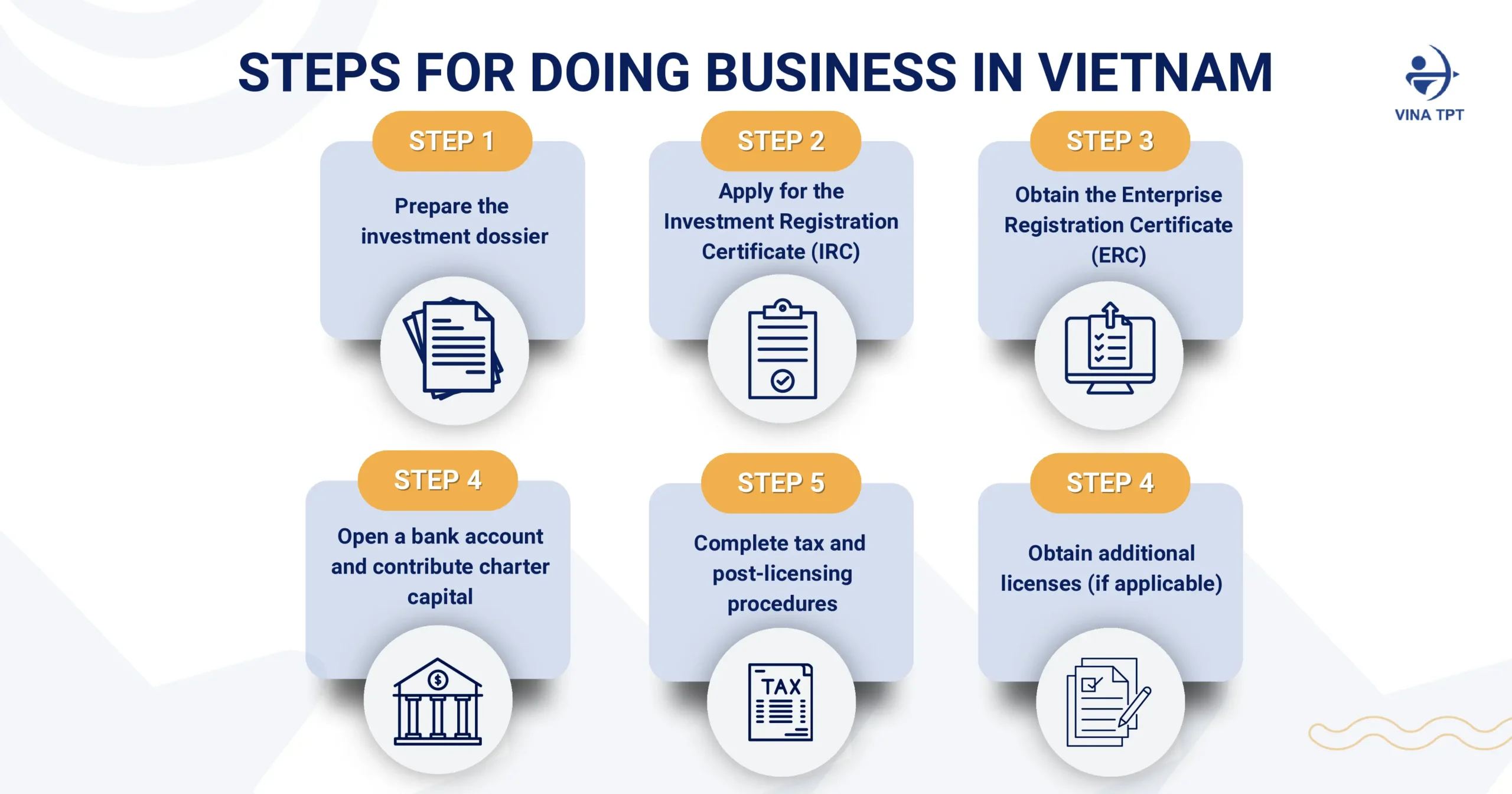
Step 1: Prepare the investment dossier
This is the critical first step in how to open a business in Vietnam. The dossier must be prepared in accordance with the Investment Law 2025.
- Written request for implementation of the investment project
- Documents proving the investor’s legal status:
- For individuals: Citizen ID/Passport (copy)
- For organizations: Certificate of incorporation or equivalent legal document (copy)
- Investment project proposal (including investor information, objectives, investment capital, scale, capital mobilization plan, location, schedule, and socio-economic efficiency assessment)
- Documents proving financial capacity:
- Individuals: savings book, bank balance confirmation
- Organizations: financial statements for the last two years, financial commitment from the parent company or a financial institution
- Head office lease agreement or documents proving the right to use the project location
- Technology explanation (for projects subject to technology appraisal)
- BCC business cooperation contract (if investing under this form)
The dossier is submitted to the Department of Finance in the province/city where the project’s head office is located.
Step 2: Submit the application for the Investment Registration Certificate (IRC)
The IRC is a prerequisite for open new company in Vietnam for foreign investors. The IRC approves the investor’s project and specifies charter capital, scale, location, and business scope. Without an IRC, investors cannot proceed with company registration.
Required documents include:
- Application form and a detailed project proposal (objectives, scale, investment capital, location, and timeline)
- Proof of financial capability (bank statements, audited financial reports, or credit agreements)
- Legal documents: notarized passport (individual) or business registration certificate (organization), both legalized
- Proof of location (lease agreement or land use rights)
- Power of attorney (if using a third-party service)
Foreign documents must be consular legalized and officially translated into Vietnamese. The processing time for an IRC application is typically 5-6 weeks , depending on the nature of the project and the review requirements of the investment registration authority. It is recommended to work with a professional service provider such as Vina TPT to avoid delays.
Step 3: Obtain the Enterprise Registration Certificate (ERC)
After obtaining the IRC, the next step in how to open a business in Vietnam is applying for the Enterprise Registration Certificate (ERC). Typically, the ERC is issued within 7-14 days from the submission date.
Step 4: Open a corporate bank account and inject charter capital
Foreign investors who open new company in Vietnam are required to:
- Open a dedicated investment capital (DICA) account at a licensed bank in Vietnam
- Contribute the full charter capital within 90 days from the ERC issuance date to avoid penalties and maintain credibility for future licenses
Step 5: Complete tax registration and post-licensing procedures
Before officially commencing operations, the enterprise must:
- Register for a tax code and purchase a digital signature
- Apply for e-invoice issuance/registration
- Register labor and enroll employees in social insurance
Tax and labor obligations are the final steps in doing business in Vietnam before official operations begin.
Step 6: Apply for sector-specific licenses (if applicable)
Conditional business sectors may require additional sub-licenses such as business licenses, import-export licenses, or environmental permits.
By following these steps and staying updated on regulations, foreign investors can successfully establish operations in Vietnam.
Explore End-to-End Company Formation Services
3. How Vina TPT Supports Your Business Setup in Vietnam
Entering a new market always comes with challenges such as language barriers and differences in legal systems. Vina TPT proudly serves as your reliable partner, offering comprehensive end-to-end support to make your how to open a business in Vietnam journey smooth, fast, and absolutely safe:
- Pre-Investment Strategic Advisory: Market surveys, industry analysis, optimal company structure selection, and support in finding and verifying legal locations for headquarters or restaurants.
- Full Legal Procedure Execution: On behalf of investors, preparing, translating, notarizing, and submitting applications for IRC, ERC, and all necessary sub-licenses.
- Flexible Office Solutions: Providing legally compliant virtual offices and shared offices to optimize initial registered address costs.
- Compliance Ecosystem: Integrated accounting, tax, payroll, and insurance services to ensure full legal operation from day one.
- Remote Support: A special solution for investors who cannot be physically present in the early stages, ensuring project progress remains on track.
With a team of FDI law specialists who deeply understand local culture and communicate fluently in English, Vina TPT helps you eliminate language gaps, save maximum time and costs, and reduce 100% of unnecessary administrative penalty risks.