Vietnam is becoming one of the most attractive startup and investment destinations in Southeast Asia thanks to its stable economic growth rate, increasingly open business environment and young, dynamic workforce. However, to successfully establish business in Vietnam, businesses and investors need to prepare a clear roadmap — from choosing the type of company and building the charter, to completing legal documents and applying for an operating license. Many founders turn to a professional company registration service or company formation services to streamline paperwork, ensure compliance and speed up market entry. Using a trusted business license service can simplify obtaining the necessary permits, including the startup business license Vietnam, which is critical for early-stage ventures and foreign-invested enterprises. Each stage requires accuracy and strict compliance with regulations. The following article will guide you step-by-step, helping you visualize the entire process from the idea stage to when the business officially starts operating legally in Vietnam.
1.Step 1: Planning Your Venture to Establish Business in Vietnam
Choosing the right type of business is the foundation for startups or investors to establish a business in Vietnam successfully and develop sustainably. In Vietnam, the three most popular models are:
- Limited Liability Company (LLC): suitable for small and medium enterprises, simple management structure, limited liability according to capital contribution.
- Joint Stock Company (JSC): suitable for large projects or enterprises with plans to raise capital, list shares.
- Representative Office: often used for foreign enterprises that want to survey the market but have not yet directly operated.
Each model carries different regulations on ownership structure, management rights, tax obligations and capital mobilization ability. To make the right decision, investors need to clarify the following factors:
- Business lines: Check whether the field of operation is on the list of conditional business lines or not. Some sectors such as education, finance, e-commerce or healthcare may require specialized licenses or limit the percentage of foreign investment.
- Charter capital: This is the company’s committed capital and is clearly stated in the business registration dossier. The minimum capital will vary depending on the industry, however, most fields in Vietnam do not require a minimum capital, except for some specific industries such as banking, insurance, securities investment or real estate. This also creates flexible opportunities for investors, especially startups or FDI who want to test the Vietnamese market without having to commit too much capital. The capital stated in the charter also affects the quota for granting work permits to foreigners and future tax obligations.
- Target investors: Legal procedures will be clearly different between domestic investors and FDI (foreign direct investment). FDI projects must go through the additional step of applying for an Investment Registration Certificate (IRC) before registering a business.
- Pre-investment approval: Some large-scale projects or projects in sensitive sectors (e.g. real estate, energy) may require pre-approval from the Provincial People’s Committee or the Ministry of Planning and Investment before submitting the dossier to the company registration service.
Carefully analyzing these factors from the beginning will help businesses choose the right model, prepare accurate documents and significantly shorten the time to obtain a license.
2. Step 2: Preparing Documents with a Reliable Company Registration Service
Preparing documents for the Investment Registration Certificate (IRC) and Enterprise Registration Certificate (ERC) is the most important step in the process of establishing a business in Vietnam, especially for projects with foreign investment capital.
2.1 Investment Registration Certificate (IRC)
If the project has FDI capital, IRC is the first license allowing the investor to implement the project in Vietnam.
The required documents usually include:
- Application for investment project implementation and Project proposal: stating the objectives, scale, location, investment capital, progress.
- Proof of the investor’s financial capacity: bank statement, credit contract or collateral.
- Legal documents of the investor:
- Individual: Notarized passport, consular legalization.
- Organization: Business registration certificate or equivalent document, consular legalization.
- Project location: lease contract or land/office use rights certificate.
2.2 Enterprise Registration Certificate (ERC)
After the IRC is granted (or for 100% domestic-owned enterprises), the investor applies for an ERC – an official license for the enterprise to operate, and also the tax code of the company.
The ERC dossier usually includes:
- Application for enterprise registration.
- Company Charter: stipulates the organizational structure, powers of members/shareholders, capital ratio and management method.
- List of members/shareholders and legal representatives: clearly state information, ownership ratio, voting rights.
- Appointment decision and authorization letter (if any).
- Capital contribution plan & financial evidence: bank statement or credit contract (especially important for large capital projects).
2.3 General Requirements and Important Notes
- Consular legalization & translation: All documents of foreign investors must be notarized, consular legalized and translated into Vietnamese before submission. This is a factor that often prolongs the preparation time.
- Valid head office address: Do not use apartment or collective house address.
- Unified information: Company name, address, capital, industry… must be consistent on all documents.
- Business line: Should choose a suitable industry and be qualified for investment to avoid being asked to make many changes.
2.4 Estimated time
Document preparation: 1-2 weeks, depending on the volume of documents and the level of complexity.
- IRC appraisal: 20-45 working days.
- ERC issuance: 10-20 working days after IRC (or similar if the enterprise is a domestic enterprise).
In fact, if the enterprise cooperates with a reputable company registration service, it will help the enterprise quickly handle the consular legalization, translation and submission of documents, shortening the time and increasing the possibility of being licensed the first time.
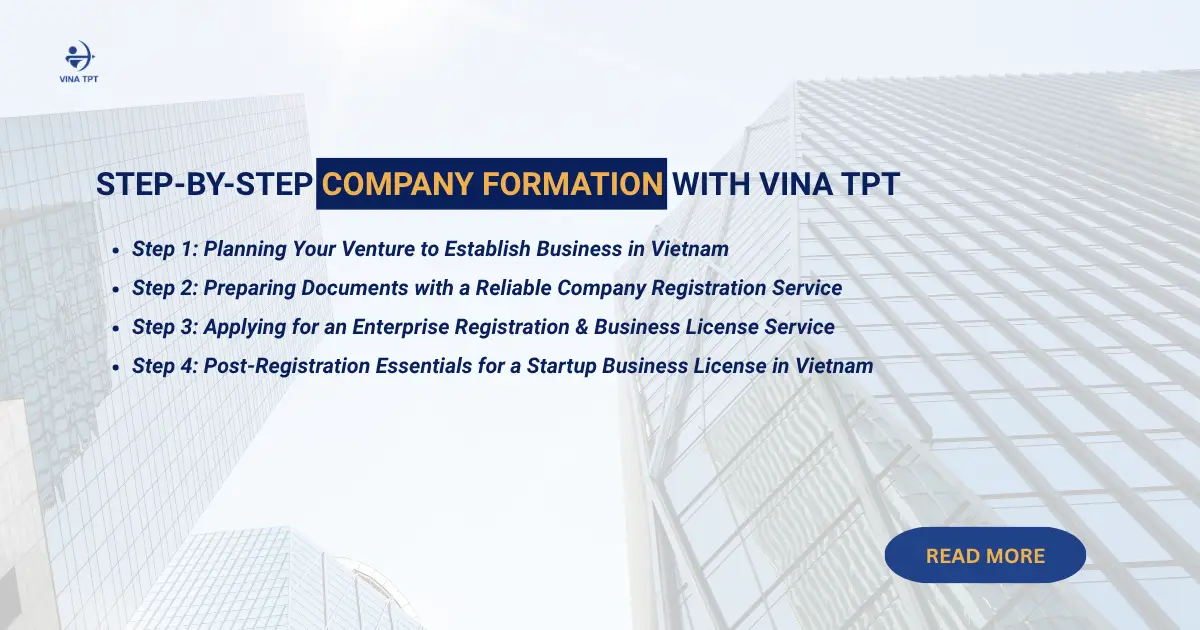
3. Step 3: Applying for an Enterprise Registration & Business License Service
For FDI projects, the licensing process usually consists of two main steps:
- Investment Registration Certificate (IRC): Required for projects with foreign investment capital. Processing time: about 15–30 working days depending on the industry and locality.
- Enterprise/Business Registration Certificate (ERC/BRC): Confirmation of business establishment. Processing time: about 10 working days after the application is approved.
The receiving agency is the local Department of Finance or through the National Business Registration Portal. From 2025, enterprises must register for corporate e-ID to submit documents and perform obligations online.
4. Step 4: Post-Registration Essentials for a Startup Business License in Vietnam
After receiving ERC/BRC, the enterprise needs to complete the following steps:
- Engrave the legal seal and register the seal sample (if using a physical seal).
- Open a bank account and complete capital contribution within the prescribed time limit.
- Register for tax and get an electronic tax code.
- Register for labor and social insurance.
- Register to use electronic invoices for commercial transactions.
If not completed on time, the enterprise may be fined or have its license revoked.
AVOID PENALTIES – LET VINA TPT HANDLE YOUR SETUP
5. Maintaining Compliance with Ongoing Business License Service Support
Depending on the field of operation, enterprises may need to apply for additional specialized licenses after being granted an Investment Registration Certificate (IRC) and Enterprise Registration Certificate (ERC).
For example:
- Food safety: Restaurants, cafes, food processing facilities must have a Food Safety Certificate.
- Education/Training: Foreign language centers, private schools need an Education Operation License.
- Fintech/Financial Services: Some activities such as payment intermediaries, peer-to-peer lending need a License from the State Bank.
- Environment/Production: Manufacturing plants or projects with environmental impacts must prepare and obtain an Environmental Impact Assessment (EIA) Report.
In addition to additional licenses, enterprises must also maintain periodic compliance obligations, including:
- Annual reporting: Submitting reports on operations and finances to the Department of Finance and tax authorities to ensure transparency.
- Maintaining statutory capital: Some conditional industries (e.g. banking, insurance, real estate, logistics) require businesses to maintain a minimum statutory charter capital. If the actual contributed capital falls below the prescribed level, the business may be fined or have its license revoked.
- Updating business information: Any changes related to capital structure, shareholders, legal representatives or head office address must be registered and notified to Department of Finance promptly. Delayed notification may result in administrative fines or invalidation of related transactions.
Applying for additional licenses or updating information usually has a specific time limit (usually 10–30 days depending on the type). Businesses should monitor closely to avoid being fined or having their business license revoked.
6. Why Choose Vina TPT Start-up Business License Service for End-to-End Setup
When establishing a business in Vietnam, especially for foreign investors or startups operating for the first time, handling the procedures to establish a business in Vietnam by yourself can be time-consuming, prone to legal errors and prolong the licensing time. This is when Vina TPT start-up business license service becomes the optimal solution, providing a full package of services from initial consultation to post-registration.
Outstanding advantages when cooperating with Vina TPT:
- Consulting on international standard business structure: Legal experts analyze investment objectives, business lines and charter capital to propose suitable types (LLC, JSC, Representative Office).
- Preparing documents & representing ERC/IRC submission professionally: Vina TPT prepares all documents in Vietnamese and English, ensuring compliance with regulations and increasing the rate of being licensed right the first time.
- Support for consular legalization & multilingual translation: A team fluent in English, Japanese and Vietnamese helps shorten the time for legalizing documents for FDI investors.
- Fast implementation – Cost savings: Shorten the time to apply for a business license service, limit errors leading to additional costs or administrative fines.
- Post-registration & long-term compliance: Support for seal engraving, opening bank accounts, tax registration, labor declaration and guidance on applying for specialized licenses (food safety, education, fintech …).
With Vina TPT company registration service, businesses not only save time and costs but are also guaranteed that the entire process from startup business license Vietnam to actual operation is legal, transparent and safe.