Is your foreign-invested enterprise (FDI) fully prepared for the upcoming payroll shifts? 2026 marks a year of major regulatory changes in Vietnam salary regulations, featuring two significant adjustments: the Regional Minimum Wage hike in January and the Base Salary increase in July. For foreign investors, HR professionals, and internal accounting teams, navigating these dual updates is critical to optimizing labor costs and avoiding severe compliance penalties. This ultimate guide will walk you through the essential 2026 salary policies, insurance caps, and overtime rules to ensure your business remains 100% compliant.
Core Principles of Salary Regulations in Vietnam
Before diving into the specific 2026 updates, it is vital to understand the foundational rules governing payroll under the Vietnam Labor Code 2019. Adhering to these legal baselines is the first step for any foreign-invested enterprise (FDI) to build a compliant and risk-free HR framework.
According to the Labor Code, all employment contracts and company policies must strictly observe the following core principles:
-
Equality and Non-Discrimination: Employers must pay equal salaries for equal work, regardless of gender, nationality, or social background. Vietnam strictly enforces this principle to ensure fairness in the workplace.
-
Currency of Payment: By default, salaries for Vietnamese employees must be paid in Vietnamese Dong (VND). However, FDI companies and foreign employers are legally permitted to pay expatriate employees in foreign currencies (e.g., USD).
-
Timely and Full Payment: Salaries must be paid fully and on time according to the agreed-upon labor contract. Late payments are strictly regulated by law and may incur mandatory interest penalty payments to the employee if delayed beyond permissible force majeure limits.
2026 Regional Minimum Wage Updates (Effective Jan 1, 2026)
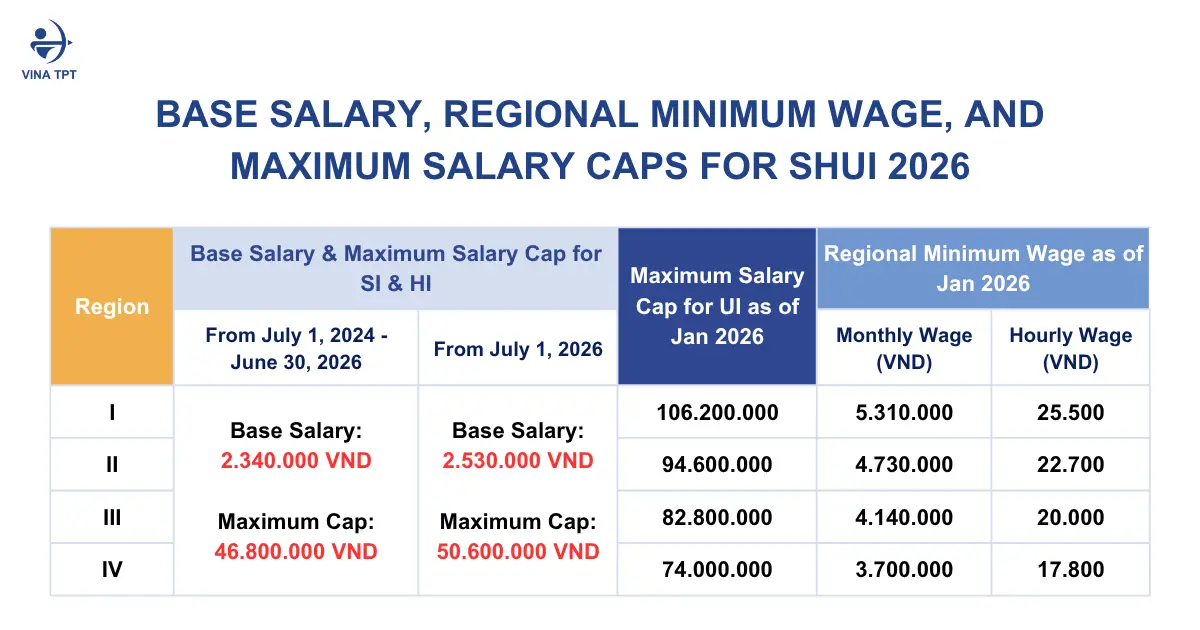
The first major milestone of 2026 is the implementation of Decree 293/2025/ND-CP, which officially increases the Regional Minimum Wage by an average of 7.2%. This minimum wage serves as the absolute floor for negotiating monthly salaries for full-time workers operating under normal conditions.
Minimum Wage Table by Region (I, II, III, IV)
FDI companies typically operate in major economic hubs, mostly falling under Region I and II. Here are the updated 2026 rates:
| Region | 2026 Monthly Minimum Wage (VND) | Key Applicable Areas |
| Region I | 5,310,000 VND | Ho Chi Minh City, Hanoi, Binh Duong, Dong Nai, Hai Phong… |
| Region II | 4,730,000 VND | Da Nang, Can Tho, specific provincial cities |
| Region III | 4,140,000 VND | Provincial towns and emerging industrial zones |
| Region IV | 3,690,000 VND | All other rural and remaining areas |
>>>>Read more: Regional Minimum Wage 2026 in Vietnam: Latest Updates and Key Changes
Impact on Unemployment Insurance (UI) Caps
Critical Compliance Note: The Regional Minimum Wage does not just dictate base pay; it also sets the ceiling for Unemployment Insurance (UI). By law, the maximum salary for calculating UI contributions is capped at 20 times the Regional Minimum Wage. For employees in Region I, the 2026 UI contribution cap is now 106,200,000 VND (20 x 5,310,000 VND).
The New Base Salary Increase (Effective July 1, 2026)
While the minimum wage targets the private sector, the Base Salary (Lương cơ sở) under Decree 161/2026/ND-CP primarily dictates public sector wages. However, FDI companies must pay close attention to this decree because the Base Salary directly controls the maximum caps for mandatory social and health insurances in the private sector.
How Base Salary Affects Social & Health Insurance Caps
Effective July 1, 2026, the Base Salary will increase to 2,530,000 VND. The legal formula for capping Social Insurance (SI) and Health Insurance (HI) contributions is 20 times the Base Salary.
- New SI & HI Cap Calculation: 20 x 2,530,000 VND = 50,600,000 VND.
- Impact: Any gross salary exceeding 50,600,000 VND will only be subject to SI and HI calculations up to this absolute ceiling. HR departments must update their payroll software before July 2026 to reflect this new cap and avoid overpaying or underpaying state insurances.
Overtime Pay and Night Shift Salary Regulations
Vietnamese labor law provides strict guidelines for overtime (OT) and night shift compensation to protect worker rights. FDI businesses must accurately calculate these multipliers:
- Regular Workdays: OT is paid at 150% of the standard hourly rate.
- Weekly Days Off: OT is paid at 200% of the standard hourly rate.
- Public Holidays and Paid Leave: OT is paid at 300% of the standard hourly rate (in addition to the regular holiday pay).
- Night Shifts: Working at night (from 22:00 to 06:00) entitles the employee to an additional 30% night shift allowance, plus further multipliers if the night shift falls on an overtime day.
The 13th-Month Salary and Bonus Regulations: Is It Mandatory?
A frequent question from foreign investors is whether the 13th-month salary is a legal requirement. According to Vietnam’s salary regulations, a 13th-month bonus is not strictly mandatory by law. It is legally considered a “bonus” based on company performance and employee productivity.
However, it is a deeply ingrained market norm. More importantly, if the 13th-month salary is explicitly written into the Labor Contract or the Collective Labor Agreement (CLA), it becomes legally binding and must be paid regardless of the company’s financial status that year.
FDI Compliance: A 5-Step Payroll Audit Checklist
To ensure a smooth transition into the 2026 fiscal year, internal accounting and HR teams should execute the following 5-step checklist:
- Review Labor Contracts: Ensure no employee in Region I is being paid below the new 5,310,000 VND threshold.
- Update Payroll Software: Adjust system parameters to reflect the January Minimum Wage UI caps and the July Base Salary SHI caps.
- Adjust Insurance Contributions: Re-declare insurance levels with the local Social Insurance Authority based on the new ceilings.
- Recalculate HR Budgets: Factor the 7.2% wage increase and higher insurance caps into your H2 2026 operational budget.
- Consult a Tax Expert: Review your Personal Income Tax (PIT) and payroll structures to optimize tax efficiency for both local and expatriate staff.
Frequently Asked Questions (FAQs) on Salary Regulations
- Can salaries be paid in USD?
Yes, but only for expatriates (foreign workers). Under Vietnam’s foreign exchange controls, salaries for Vietnamese citizens must be denominated and paid in VND.
- What is the penalty for late salary payment?
If a salary payment is delayed by more than 15 days (due to force majeure), the employer must compensate the employee with an additional amount. This penalty is calculated based on the delayed amount multiplied by the State Bank of Vietnam’s 1-month deposit interest rate.
- Are probationary salaries subject to full insurance?
No. Probationary salaries must be at least 85% of the official job salary. Furthermore, mandatory social insurance contributions are generally not required during a standard probation period (which lasts up to 60 days).
Vietnam’s salary regulations in 2026 bring a layer of complexity that can easily trigger administrative penalties if mishandled. From navigating dual wage increases to calculating exact insurance caps and PIT deductions, the margin for error is slim.
Why Vina TPT is the Trusted Choice for Payroll Services in Vietnam
With over 20 years of experience supporting FDI companies and remote teams, Vina TPT offers a specialized, secure, and fully compliant remote payroll service tailored to Vietnam’s latest legal frameworks.
We handle complex salary calculations, social and health insurance management, unemployment insurance caps, PIT withholding, and digital payslips—entirely online with real-time dashboards. Our team provides excellent English support, utilizes a highly secure cloud system, and operates under a clear Service Level Agreement (SLA). This gives foreign investors complete confidence and 100% compliance, even when you are not physically present in Vietnam.
Contact Vina TPT today for a free consultation and to experience professional remote payroll services. Let our experts handle your payroll and labor compliance so you can focus seamlessly on growing your core business.