Decree 283/2026/NĐ-CP governs administrative penalties in the fields of labor, social insurance, and Vietnamese workers working abroad under contracts. Issued on July 15, 2026, it took effect on September 10, 2026, replacing Decree No. 12/2022/NĐ-CP.
Compared with the previous regulations, Decree 283/2026/NĐ-CP introduces several notable provisions concerning late payment and evasion of compulsory social insurance and unemployment insurance contributions, employee data management, handling violations electronically, and labor discipline.
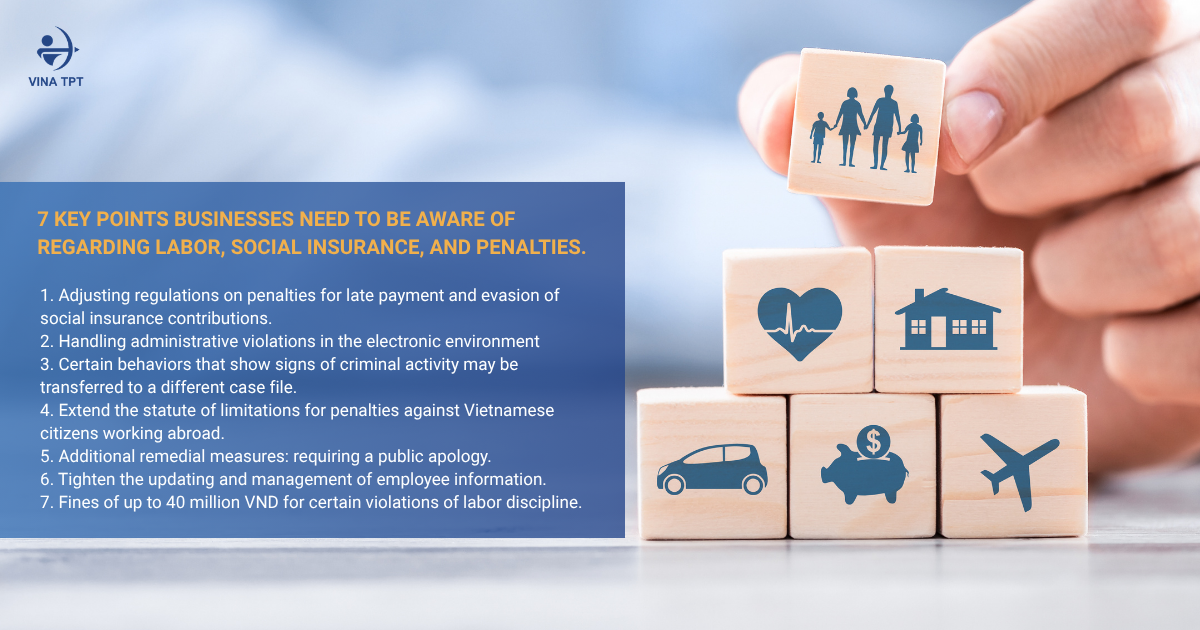
Below are seven points businesses should review to comply with the new regulations.
1. Revised penalties for late payment and evasion of social insurance and unemployment insurance contributions
Businesses should pay particular attention to the new rules on late payment and evasion of compulsory social insurance and unemployment insurance contributions.
Late payment of compulsory social insurance contributions
Under Article 43 of Decree No. 283/2026/NĐ-CP, late payment of compulsory social insurance contributions may be penalized based on a percentage of the total overdue amount.
Specifically:
- A warning may be issued if the amount involved is less than VND 400,000 at the time the violation is officially recorded.
- A fine of 12% to 15% of the total overdue compulsory social insurance contributions may be imposed, subject to the prescribed maximum of VND 75 million.
- The business must also pay the outstanding contributions in full and an additional amount equal to 0.03% per day, calculated on the overdue amount and period in accordance with the regulations.
Evasion of compulsory social insurance contributions
Evasion of compulsory social insurance contributions is subject to a fine of 18% to 20% of the total amount evaded, subject to the prescribed maximum.
The Decree also sets out separate provisions for employers that fail to register, or fail to register all individuals required to participate in compulsory social insurance, after a period of 60 days.
The penalty is determined based on the number of affected employees.
Late payment and evasion of unemployment insurance contributions
Similarly, Articles 45 and 46 of Decree 283/2026/NĐ-CP separately address late payment and evasion of unemployment insurance contributions.
Late payment may be subject to a fine of 12% to 15% of the total overdue amount, up to the prescribed maximum of VND 75 million.
Evasion may be subject to a fine of 18% to 20% of the total amount evaded, up to the prescribed maximum of VND 75 million.
In addition to fines, businesses must implement the applicable remedial measures.
Businesses should note: When determining the fine applicable to an organization, they need to consult the provisions on fines for organizations in Decree No. 283/2026/NĐ-CP, rather than directly applying only the amount stated for each violation.
2. Handling administrative violations electronically
Decree No. 283/2026/NĐ-CP adds provisions for handling administrative violations electronically when the relevant infrastructure, technical, and information requirements are met.
Violation records, decisions, and related documents may be sent through prescribed electronic channels, including:
- The email address that the individual in violation or the representative of the organization in violation has provided to the competent authority;
- The national digital identification application or an electronic identification account that meets authentication requirements;
- Applications specified in sector-specific legal documents;
- SMS messages sent to a previously provided phone number; and
- The email addresses of the fine collection agency and other relevant agencies for enforcement purposes.
Businesses should therefore keep the contact details, email addresses, and electronic accounts used in dealings with state authorities up to date to avoid missing notices or documents relating to violations.
3. Cases showing signs of criminal activity may be referred to competent authorities
Under Decree 283/2026/NĐ-CP, if an act shows signs of a crime during the review or handling of a violation, the official handling the case must refer the relevant file to the competent criminal proceedings authority.
Notable acts include:
- Using forged papers or documents;
- Illegally accessing, sharing, using, buying, selling, or exchanging information or data in the employee database that has not been made public by a competent authority;
- Infringing an employee’s honor, reputation, or dignity during disciplinary proceedings;
- Exploiting activities involving Vietnamese workers working abroad to organize illegal departures, exploitation, or forced labor; and
- Repeatedly violating the rules by assigning workers aged 15 to under 18 to prohibited jobs or workplaces.
These provisions highlight the need for businesses to pay close attention to the accuracy of personnel records, data security, and procedures for handling employee matters.
4. Longer limitation period for violations involving Vietnamese workers working abroad
Decree No. 283/2026/NĐ-CP sets the following limitation periods for imposing administrative penalties:
- One year for administrative violations relating to labor and social insurance; and
- Two years for administrative violations involving Vietnamese workers working abroad under contracts.
The limitation period for violations in the field of sending Vietnamese workers abroad under contracts has therefore increased from one year to two years.
Businesses operating in this field should take the new period into account when reviewing records, contracts, and related compliance obligations.
5. Additional remedial measure: mandatory public apology
Alongside fines, Decree 283/2026/NĐ-CP adds or further specifies remedial measures, including a mandatory public apology in certain cases.
This measure may apply to specified acts, such as:
- Workplace sexual harassment that does not warrant criminal prosecution;
- Forced labor or mistreatment of employees that does not warrant criminal prosecution;
- Requiring an employee to perform a labor contract to repay a debt owed to the employer; and
- Certain violations relating to the organization and operation of trade unions.
Depending on the violation, a business may also be required to reinstate an employee, pay wages, or refund amounts it collected.
When reviewing compliance, businesses should therefore consider all applicable remedial measures as well as the potential fine.
6. Stricter requirements for updating and managing employee information
Decree No. 283/2026/NĐ-CP also addresses the provision, updating, and management of employee information.
For employees subject to compulsory social insurance, failure to provide information, or provision of incomplete or inaccurate information for labor registration, may be subject to penalties under the regulations.
Employment service businesses are required to:
- Create and update employee data;
- Manage employer data;
- Protect the safety and confidentiality of personal data; and
- Protect the safety and confidentiality of labor data and employment transaction data.
The Decree also prescribes penalties for illegally accessing, sharing, using, buying, selling, or appropriating employee data that has not been made public. In particular:
- Illegal access, sharing, or use of data may be subject to the prescribed fines; and
- Illegal buying, selling, exchanging, or appropriation of data may be subject to a fine of up to VND 70 million if the conduct does not warrant criminal prosecution.
Businesses should use these provisions to review how they manage personnel records, personal information, social insurance data, and internal data access rights.
7. Fines of up to VND 40 million for certain labor discipline violations
Article 25 of Decree 283/2026/NĐ-CP prescribes penalties for certain violations concerning labor discipline and material liability.
Businesses may be penalized for:
- Failing to inform employees of the internal labor regulations;
- Failing to display the main provisions of the internal labor regulations at the workplace;
- Failing to establish written internal labor regulations when required;
- Failing to register the internal labor regulations as required;
- Applying internal labor regulations that are not yet effective or are no longer effective;
- Taking disciplinary action without following the required procedures or limitation period; or
- Suspending an employee from work contrary to the regulations.
Notably, certain serious violations may be subject to fines of VND 20–40 million, including:
- Imposing a monetary fine or deducting wages instead of taking disciplinary action;
- Taking disciplinary action for conduct that is not specified in the applicable regulations;
- Imposing multiple forms of disciplinary action for a single violation; or
- Taking disciplinary action against an employee during a period when the law prohibits it.
Depending on the circumstances, a business may also be required to reinstate the employee, pay wages, refund amounts collected, or issue a public apology.
Conclusion
Decree 283/2026/NĐ-CP introduces several notable changes to administrative penalties relating to labor, social insurance, unemployment insurance, and Vietnamese workers working abroad under contracts.
For businesses, compliance extends beyond paying social insurance contributions on time. It also involves managing employment records, updating data, establishing and registering internal labor regulations, following proper disciplinary procedures, and protecting employee information.
Reviewing and updating internal procedures can help businesses reduce the risk of violations and manage their workforce in accordance with current regulations.
Need to review your employment records and social insurance compliance?
Vina TPT provides HR & Payroll services and labor compliance advice, supporting businesses with personnel management and their social insurance obligations under current regulations.