


Annual tax finalization is not simply a roll-up of the monthly or quarterly VAT and PIT returns. For the 2026 accounting period (ending on 31 December 2026 for companies that use a calendar financial year), the company must close its VAS books, prepare the annual financial statements, and finalize Corporate Income Tax (CIT) and Personal Income Tax (PIT). The usual statutory deadline is 31 March 2027.
In practice, foreign-invested (FDI) companies face a real risk of reassessment and late-payment interest in the annual tax-finalization period. The pressure points are usually the gap between provisional CIT paid over the four quarters and the tax due on finalization, errors in employee PIT finalization authorizations, and missing related-party transaction appendices.
This article sets out the full tax finalization Vietnam obligations for 2026 and the file the company should start preparing now.
1. What “Tax Finalization” Means in Vietnam
In Vietnam’s tax-administration system, annual tax finalization has a different legal character and a different scope of review from monthly or quarterly returns. Periodic filing only records provisional figures for the period. Tax finalization is the process of consolidating and reconciling all revenue, expenses, taxable income, and tax already paid across the full 12 months of the financial year, so that the tax the company and its employees actually owe, or are entitled to have refunded or offset, is fixed exactly.
The company’s annual tax-finalization file rests on two core obligations:
- Corporate Income Tax (CIT) finalization: Determine total revenue, deductible expenses, upward and downward adjustments to taxable income, loss carry-forward, and the company’s official CIT for the year.
- Personal Income Tax (PIT) finalization: Determine total salary and wage income the company paid during the year to all employees (local staff and foreign specialists), declare tax already withheld, and finalize on behalf of individuals who have authorized the company to do so.
- Mandatory supporting documents: Annual financial statements prepared under VAS (independently audited for FDI companies) and the related-party transaction return set, if related-party relationships arose.
Under Article 44 of the Law on Tax Administration 2019, the annual tax-finalization file must be filed no later than the last day of the third month after the financial year ends.
2. Corporate Income Tax Finalization for 2026
CIT finalization for the 2026 tax year requires an exact match between the financial statements and the CIT finalization return (Form 03/TNDN), together with the loss-carry-forward and tax-incentive appendices, if any.
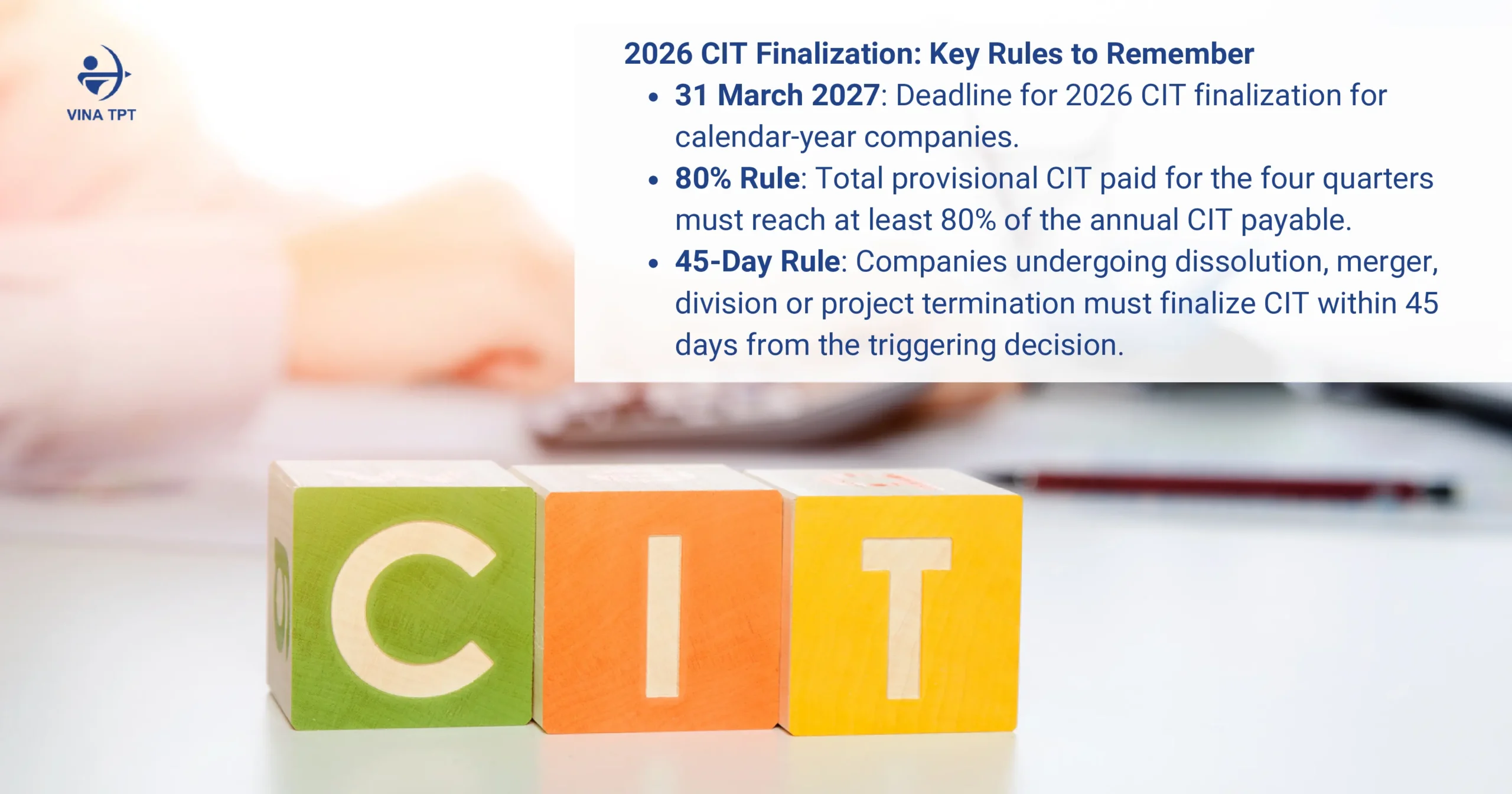
- Filing deadline: For companies whose financial year matches the calendar year (1 January 2026 to 31 December 2026), the deadline for the 2026 CIT finalization return and the annual financial statements is 31 March 2027. For companies whose financial year does not follow the calendar year, the deadline is 90 days from the end of that financial year.
- The 80% provisional-CIT rule: Under current rules, total provisional CIT paid over the four quarters of the tax year must not be less than 80% of the CIT due on the annual finalization return. If the four quarterly payments fall short of that 80% threshold, late-payment interest (0.03% per day) is charged on the shortfall from the day after the Quarter 4 payment deadline until the date the tax is actually paid.
- 2026 support-policy update: If provisional CIT is deferred under a 2026 Government support measure (such as Decree 245/2026/ND-CP), the deferral changes only the payment date of the quarterly provisional tax. It does not change the filing deadline for the 2026 CIT finalization return, which must still be filed by 31 March 2027.
- Event-based finalization: If a company is dissolved, bankrupt, divided, merged, converted in ownership, or ends a project in 2026, the CIT finalization file must be filed no later than the 45th day from the date of the decision that triggers the event. The company does not wait until the end of the financial year.
3. PIT Finalization the Company Must File
When carrying out CIT and PIT finalization for 2026, the company acts as the income-paying organization. It must prepare the PIT finalization return (Form 05/QTT-TNCN) for all salary and wage income paid in 2026.
Key deadlines and legal points:
- Deadline for the company (income-paying organization): The deadline to file the 2026 PIT finalization return for individuals who have authorized the company to finalize on their behalf is 31 March 2027.
- Deadline for individuals who finalize directly: Individuals who must finalize directly with the tax office, those with income from more than one source, or foreign specialists whose contracts have ended, must file by the last day of the fourth month after the calendar year ends, which is 30 April 2027.
- PIT rules updated from 2026: The 2026 finalization period applies the amended Personal Income Tax Law 2025 and Decree 253/2026/ND-CP (effective from 1 July 2026). The company must split income, family deductions, and tax-exempt items arising before and after 1 July 2026 exactly as the General Department of Taxation’s transitional guidance requires, so that tax withheld from staff is calculated correctly. The company finalizes only for individuals who have signed a labor contract of three months or more and who have submitted a valid tax-finalization authorization in the prescribed form.
4. Related-Party Forms Filed with CIT Finalization
For FDI companies, and for domestic companies that had related-party transactions in 2026, the related-party transaction return set is a mandatory part of the file and must be filed together with the CIT finalization return.
The related-party file submitted with finalization includes:
- Appendix I: Information on related-party relationships and related-party transactions.
- Appendices II and III: The list of information and documents to be provided in the Local File and the Master File.
- Appendix IV: The Country-by-Country Report of the ultimate parent company (CbCR), if the company is in scope.
A company that bought or sold goods or services, borrowed, transferred technology, or paid a management fee to its parent or to other group companies must prepare and keep Transfer Pricing Documentation at its head office before finalization, ready to produce if the tax office inspects or audits.
5. Documents to Prepare Before the Deadline
For the tax finalization Vietnam period to run smoothly and avoid last-minute blocks, the accounting team must lock the full legal file before 31 March 2027. Do not wait until the filing week to start the reconciliation. The most common risk at this stage is not a missing return form. There is a shortage of original vouchers to explain and defend the figures already recorded in the books.
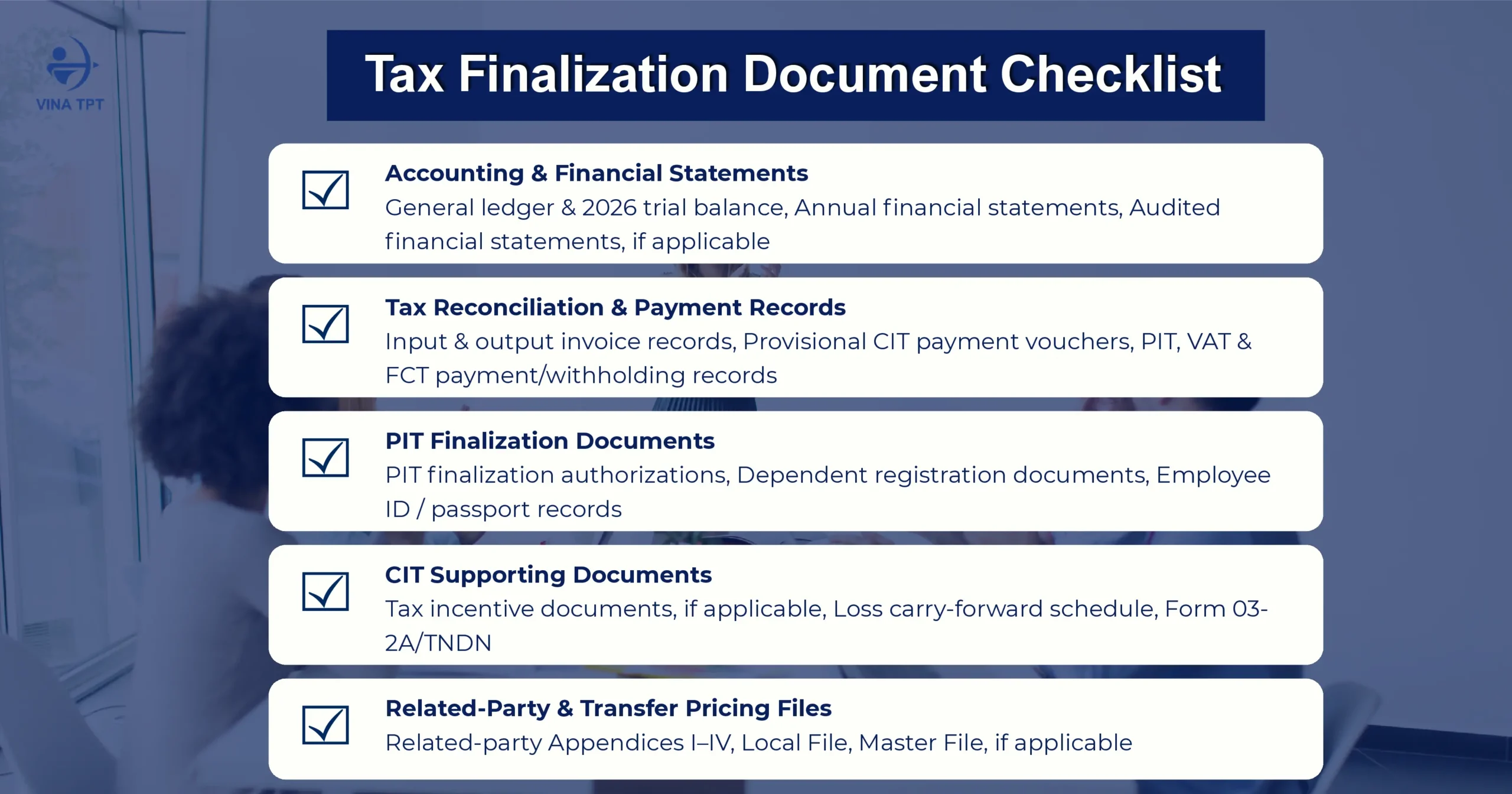
A legally complete annual tax-finalization file must cover these five core document groups:
- VAS books and financial statements: This is the foundation of the file. Accounting must close the general ledger for all revenue, expense, tax, and capital accounts, together with the 2026 trial balance. For FDI companies that must be audited, the independently audited annual financial statements are the only legal basis for reconciling the CIT finalization return. Any gap between the finalization figures and the audit report will be the first point the tax office questions in an inspection.
- Tax reconciliation and credit vouchers: This group covers the input and output invoice listings, VAT payment vouchers, the four quarterly provisional CIT payment vouchers, PIT withholding vouchers, and Foreign Contractor Tax (FCT) payment vouchers where payments were made abroad. A 100% match between the listings, the general ledger, and the periodic returns already filed during the year avoids complex supplementary filings before the year is closed.
- PIT finalization authorization and deduction file: This applies only when the company finalizes on behalf of employees. The file includes the dependent-registration form, the PIT finalization authorization, and copies of personal identification (citizen ID or passport). A missing authorization, or a dependent registration filed after the deadline, will cause the family deduction to be excluded from the annual finalization – even if the income was actually withheld.
- Tax-incentive file and loss-carry-forward schedule: This covers the legal documents confirming eligibility for CIT incentives, if any, and the schedule tracking losses carried from prior years into 2026 (Form 03-2A/TNDN). Without a valid loss-carry-forward schedule, prior-year losses will be disallowed as a deduction when CIT for this period is calculated.
- Related-party transaction file (transfer pricing): This covers Appendices I–IV filed with the CIT finalization return, plus the transfer-pricing documentation (Local File and Master File). Every figure in the appendices must match the books exactly for intercompany loans, management fees, royalties, and internal purchases and sales. Leaving this work until March often produces large errors, because data collection and price benchmarking take time.
Reviewing and standardizing all five groups before the deadline turns tax finalization from a high-pressure risk review into a fast, safe, and fully controlled periodic filing.
6. Common Finalization Mistakes in 2026
The 2026 finalization period often produces reassessments and late-payment interest not because the company forgot to file, but because of these four data gaps.
- Missing the 80% provisional CIT threshold: The company underestimates Quarter 4 revenue and expenses, so total provisional payments over the four quarters fall short of 80% of the CIT due on finalization. The tax system charges late-payment interest on the shortfall even if the annual return is filed on time. The way to limit this is to review Quarter 4 figures before locking the provisional payment, rather than scaling Quarter 3 revenue by an estimate.
- PIT finalization for the wrong authorized persons: The company accepts an authorization to finalize for an individual with income from two or more sources, or for a person who does not meet the conditions to authorize. When the tax office reconciles the file, that portion of the company finalization is rejected. The employee must still finalize personally, and the company must explain the authorizations it accepted.
- Missing related-party appendices: The company has loans, management fees, royalties, or purchases and sales with related parties, but does not file Appendices I–IV with the CIT finalization return. A missing appendix is a basis for the tax office to review interest expense and payments to related parties. Interest expense can be capped at 30% of EBITDA if the deduction conditions are not proven.
- A gap between the financial statements and the CIT return: Accounting profit before tax on the financial statements differs from taxable income on the finalization return, and the company has no reconciliation of the adjustments: non-deductible expenses, temporary differences, tax incentives, or loss carry-forward. This is the first point an inspection asks about, because the two sets of figures must lead to the same taxable result.
All four errors can be handled if provisional payments, PIT authorization eligibility, related-party appendices, and the profit-adjustment schedule are reconciled before 31 March 2027.
7. How Vina TPT Supports Annual Tax Finalization
Preparing the 2026 CIT and PIT finalization file requires deep knowledge of VAS accounting and Vietnam’s Law on Tax Administration. Vina TPT provides a full-package annual tax-finalization service so FDI companies can close the year with confidence:
- Data review and health check: Review the full 2026 books, flag non-deductible expense risks, and reconcile the 80% provisional CIT threshold before the filing deadline.
- CIT and PIT finalization file: VAS financial statements, the CIT finalization return, the PIT finalization return, and filing on the company’s behalf through the e-tax system.
- Related-party reporting (transfer pricing): Prepare Appendices I-IV and build a legally compliant transfer-pricing file (Local File and Master File).
- Representation before the tax office: Explain figure differences directly and defend reasonable expenses during tax inspections.
Are you ready for the 2026 tax finalization period? Contact Vina TPT so our CPAs and tax specialists with more than 10 years of experience can review and lock an accurate file before the deadline.