In multinational group structures, the parent company overseas frequently requires subsidiaries in Vietnam to provide a standardized financial data package (Reporting Package) in order to perform full-group financial statement consolidation. However, depending on the ownership structure and actual control rights, some companies located in Vietnam are also required to prepare their own consolidated financial statements under local law.
This article provides an overview to help FDI managers and founders clearly understand the nature of consolidated financial statements, accurately determine the cases in which consolidated reporting is mandatory in Vietnam, and master the key groups of data and intercompany transactions that need to be prepared for the Parent Company.
1. When a Company Must Prepare Consolidated Financial Statements
In accounting substance, consolidated financial statements are prepared when a company (Parent Company) holds control over one or more other companies (subsidiaries). Control is defined as the power to govern the financial and operating policies of the company in order to obtain economic benefits, usually associated with holding more than 50% of voting rights or having actual control rights under agreement.
Practical examples to avoid confusion:
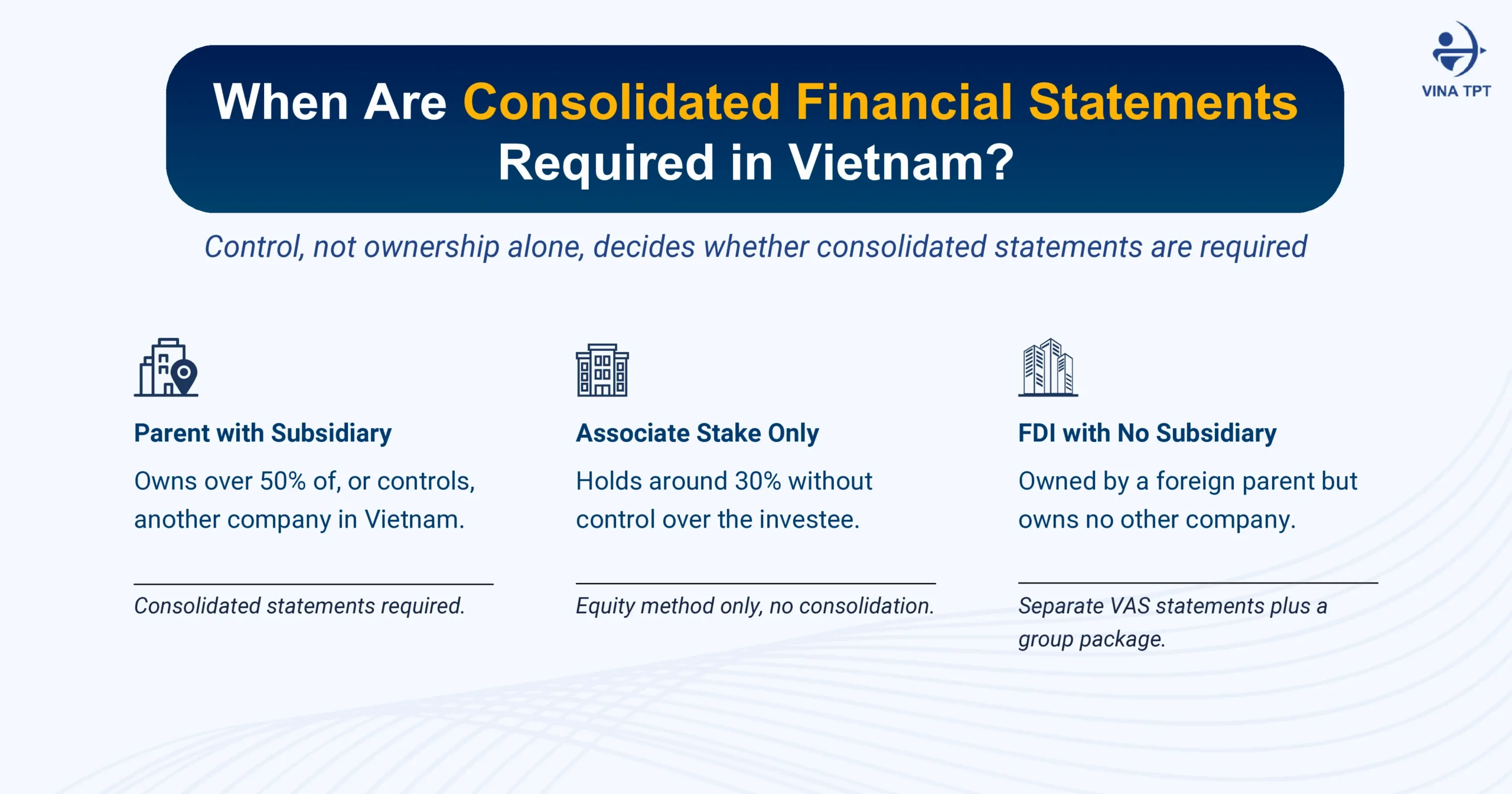
- Case where consolidated financial statements are mandatory in Vietnam: Company A in Vietnam owns 80% of the capital contribution/shares in Company B (manufacturing) in Vietnam. Company A is required to prepare consolidated financial statements for the A-B group.
- Cases that are NOT subject to consolidation:
- Only associate investment: A company in Vietnam contributes only 30% of capital to another company and does not have control. The company only accounts for the investment using the equity method on its separate financial statements and does not prepare consolidated financial statements.
- Two companies under the same individual owner: Two independent legal entities established under the same individual’s name (Sister companies) that do not have a direct parent-subsidiary ownership relationship. Both companies only prepare separate financial statements.
- FDI company in Vietnam with no subsidiaries: A 100% FDI company in Vietnam has a parent company overseas, but the company itself in Vietnam does not own any other subsidiaries. In this case, the company in Vietnam only prepares separate financial statements under domestic regulations and prepares a Reporting Package to send to the Group; it does not prepare consolidated financial statements in Vietnam.
2. What Consolidated Financial Statements Require from a Vietnam Subsidiary
Technically, preparing consolidated financial statements is the process of combining the separate financial statements of the Parent Company and the subsidiaries, while eliminating all intercompany transactions and balances in order to present the entire group as a single economic entity.
For a subsidiary in Vietnam that does not own any other subsidiaries, the company only needs to prepare separate financial statements under Vietnamese Accounting Standards — VAS (applied under Circular 99/2025/TT-BTC), complete independent audit, and convert the data into the Reporting/Consolidation Package required by the Parent Company.
When a Vietnamese Company Must Prepare Consolidated Financial Statements
In cases where a company in Vietnam acts as the Parent Company (owning subsidiaries), the preparation of consolidated financial statements must strictly comply with VAS 25 and Circular 202/2014/TT-BTC (as amended and supplemented by Circular 43/2026/TT-BTC, applicable to financial years beginning on or after 01 January 2026).
A parent company in Vietnam is exempt from preparing consolidated financial statements when it simultaneously meets all of the conditions prescribed in Clause 2, Article 5 of Circular 202/2014/TT-BTC:
- It is not a public-interest entity.
- It is not state-owned.
- It is a subsidiary of another company and has obtained written consent from all shareholders/capital-contributing members not to prepare consolidated financial statements.
- Its equity instruments or debt instruments are not publicly traded on the market.
- Its parent company has already issued publicly available consolidated financial statements under accounting standards.
Legal note: Consolidated financial statements of FDI companies must be independently audited. The deadline for submitting consolidated financial statements is no later than 90 days from the end of the financial year (as prescribed in Article 6 of Circular 202/2014/TT-BTC and current amending documents).
Explore Our Financial Statement Services
3. What the Parent Usually Asks For
When serving global consolidation work, the Parent Company overseas usually requires the Vietnam subsidiary to provide a financial data package that includes the following key components:
- Trial Balance: Mapped and standardized according to the Group’s Chart of Accounts.
- VAS financial statement set: The separate financial statement set that has been fully closed and independently audited in Vietnam.
- Reconciliation & Mapping schedule: A reconciliation of differences between VAS accounting policies and the accounting policies applied by the Group (usually IFRS or US GAAP standards).
- Related-party transaction schedule: A detailed list of all transactions arising with the Parent Company and sister companies within the same Group.
4. Intercompany Balances to Reconcile First
The review and reconciliation of intercompany balances (intercompany reconciliation) is a prerequisite condition that enables the Parent Company to perform elimination entries during consolidation. The Vietnam subsidiary needs to review and finalize figures with related parties for the following line items:
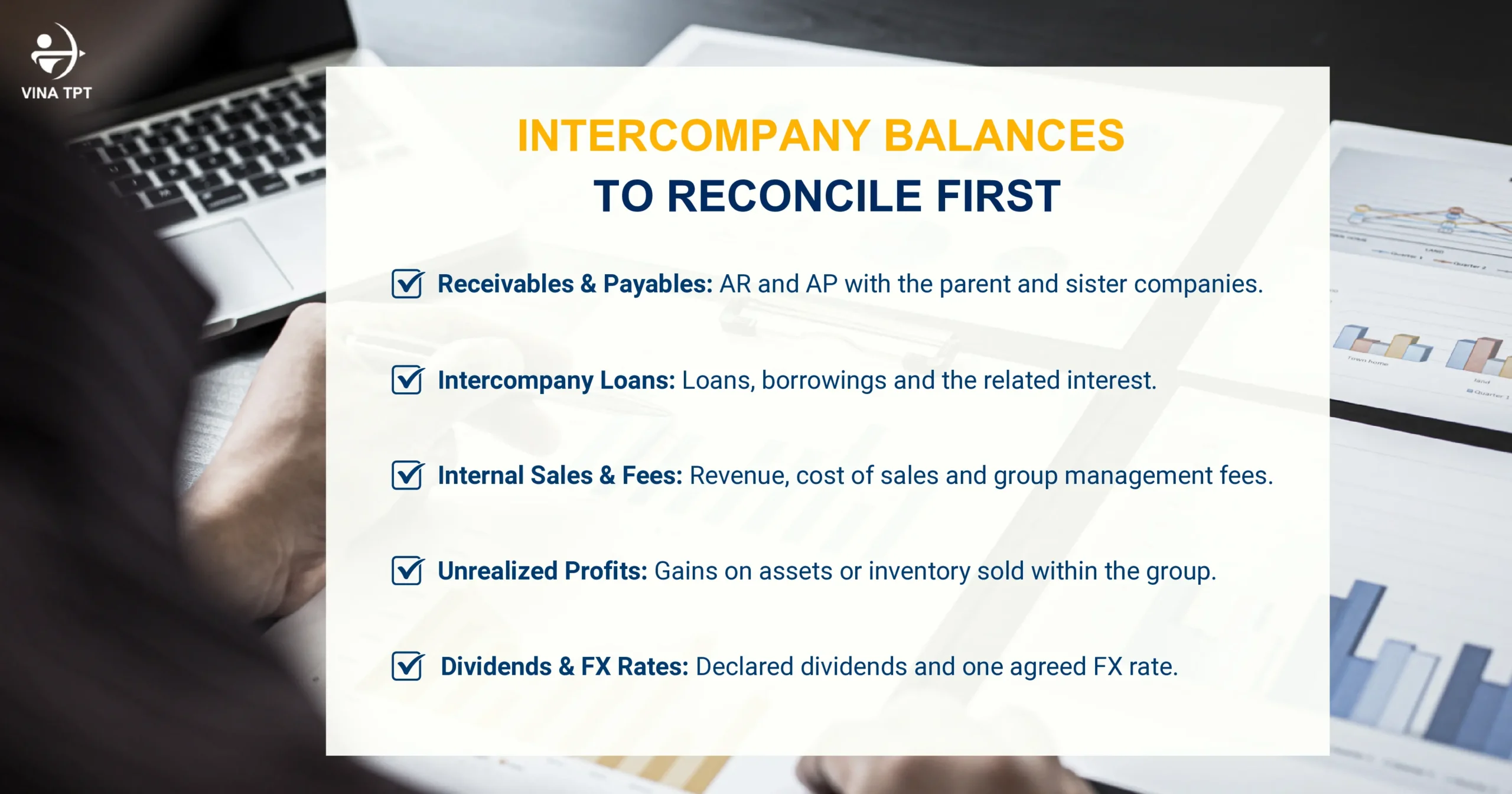
- Intercompany balances: Receivables (AR) and Payables (AP) with the Parent Company and companies within the same group.
- Capital and loan transactions: Intercompany loans, borrowings, and corresponding interest expense/income arising during the period.
- Revenue and cost of goods sold: Internal sales revenue, internal service revenue, and management fees paid to the Group.
- Unrealized gains/losses: Profits arising from internal sales of fixed assets or inventories that have not yet been sold to independent third parties.
- Dividends: Dividends declared payable or dividends received from subsidiaries/associates.
Technical requirement: The parties must agree on the foreign exchange conversion rate, issue Intercompany Confirmation letters, and ensure that corresponding balances match 100% so that they are fully eliminated to zero when elimination entries are made.
5. Other Data the Consolidation Pack Needs
In addition to basic accounting figures, the consolidation reporting package sent to the Parent Company also requires the following in-depth analytical data:
- Fixed assets: Detailed fixed asset register, depreciation method, and depreciation schedule for adjustment under group policies.
- Inventories: Detailed quantity and value of inventories purchased from internal companies that have not yet been sold to the market, together with calculation of Deferred Tax arising from the elimination of unrealized profits (under VAS 17 / IAS 12).
- Provisions: Detailed schedule of provisions for doubtful receivables, inventory write-downs, and warranty provisions already recognized.
- Key notes: Detailed explanation of the nature of line items with significant movements during the financial year.
6. When to Lock the Numbers
To ensure compliance with the Group’s global reporting timeline, the Vietnam subsidiary should follow a standardized four-step book-closing roadmap:
- Step 1: Complete the VAS accounting close and prepare the domestic Trial Balance.
- Step 2: Perform intercompany balance and transaction reconciliation with the Group’s accounting department.
- Step 3: Prepare and send the draft Reporting Package to the Parent Company’s Finance Department for review.
- Step 4: Only perform additional adjusting entries after receiving official confirmation from the Parent Company.
Note: The Group usually requires the Reporting Package to be submitted within 1 – 2 months after the end of the financial year, which is significantly earlier than the 90-day financial statement submission deadline in Vietnam.
7. How Vina TPT Prepares the Consolidation Pack
Vina TPT provides comprehensive advisory and support solutions for FDI companies in preparing consolidated reports and standardizing the Reporting Package:
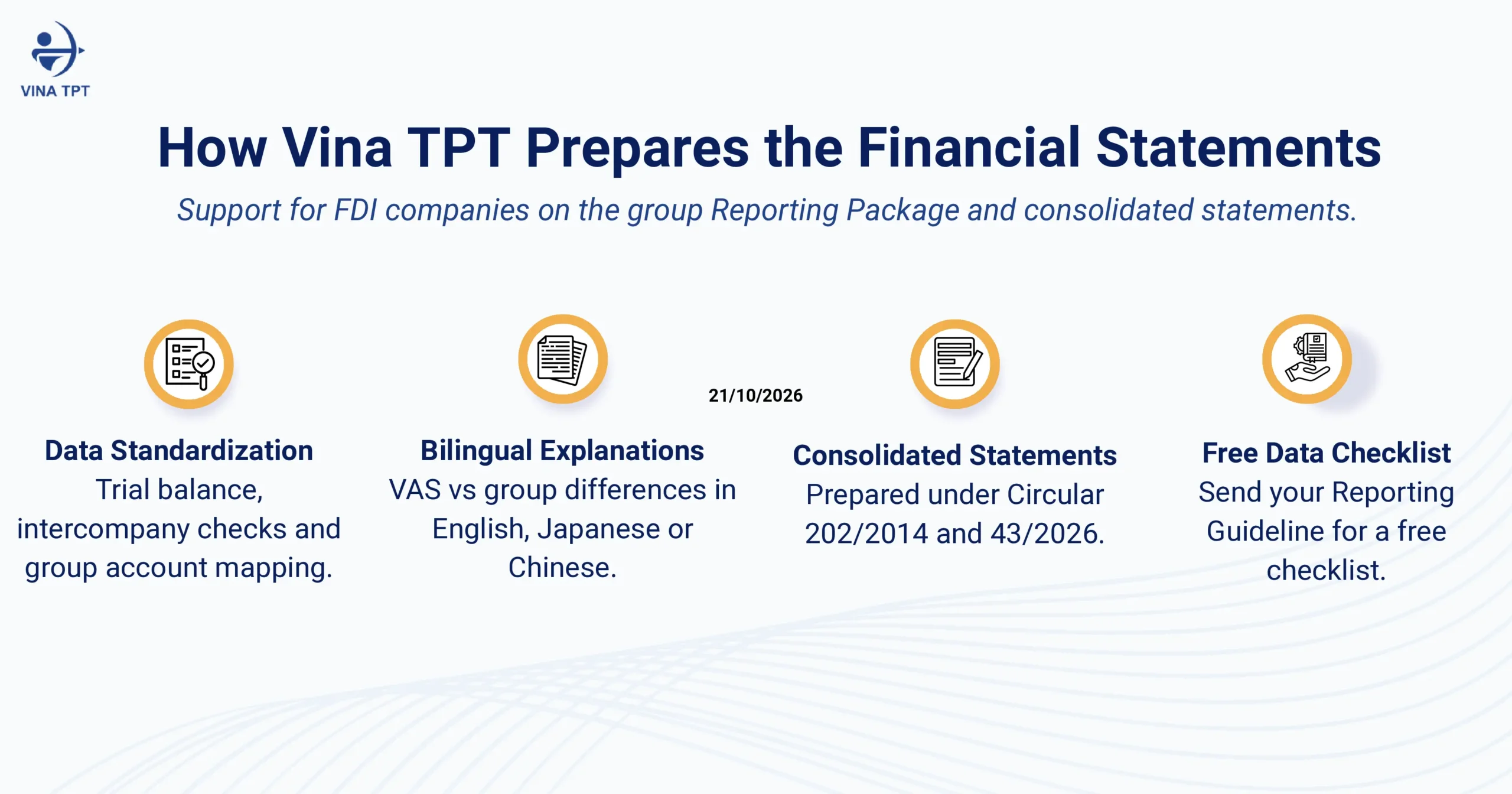
- Data standardization: Directly prepare the Trial Balance, perform intercompany reconciliation, and accurately map the VAS chart of accounts to the Group’s Chart of Accounts.
- Bilingual explanatory reports: Prepare analysis schedules and explain in detail the differences between VAS standards and Group regulations in English/Japanese/Chinese.
- In-depth consolidated financial statement preparation: For companies in Vietnam that act as the Parent Company, Vina TPT provides a full consolidated financial statements preparation service that fully complies with Circular 202/2014/TT-BTC and Circular 43/2026/TT-BTC.
Conclusion
The process of preparing consolidated financial statements requires the Vietnam subsidiary to proactively close the VAS books on time, accurately reconcile all intercompany transactions, and convert standardized data according to the Parent Company’s requirements.
Please send the Parent Company’s Reporting Guideline so that Vina TPT’s specialist team can analyze and send you the data preparation checklist completely free of charge.