Many businesses in Vietnam, especially export enterprises and FDI companies, have a large amount of capital stuck in unrefunded input Value-Added Tax (VAT). This amount can reach hundreds of millions or even billions of VND, directly affecting cash flow and operational capabilities.
Obtaining a VAT refund is not only a legitimate right but also an important financial tool that helps businesses optimize their cash flow. However, in practice, not every business clearly understands the conditions, procedures, and how to prepare documents to successfully receive a VAT refund.
This article provides a detailed guide on how to get VAT refund in Vietnam, including eligibility conditions, required documents, step-by-step procedures, processing timeline, and common mistakes to avoid in 2026. This entering Vietnam market guide is designed to give you a complete roadmap from preparation to operation.
1. Who is eligible for VAT Refund in Vietnam in 2026?
Not every business in Vietnam is eligible for a VAT refund. According to Article 15 of the Law on Value-Added Tax 2024, the most common cases that qualify for a VAT refund include:
- Enterprises exporting goods and services (subject to the 0% VAT rate)
- Businesses with new or expanded investment projects, particularly FDI projects that are still in the investment phase
- Enterprises with excess VAT paid after quarterly or annual input tax credit
- Companies undergoing dissolution, bankruptcy, or termination of operations
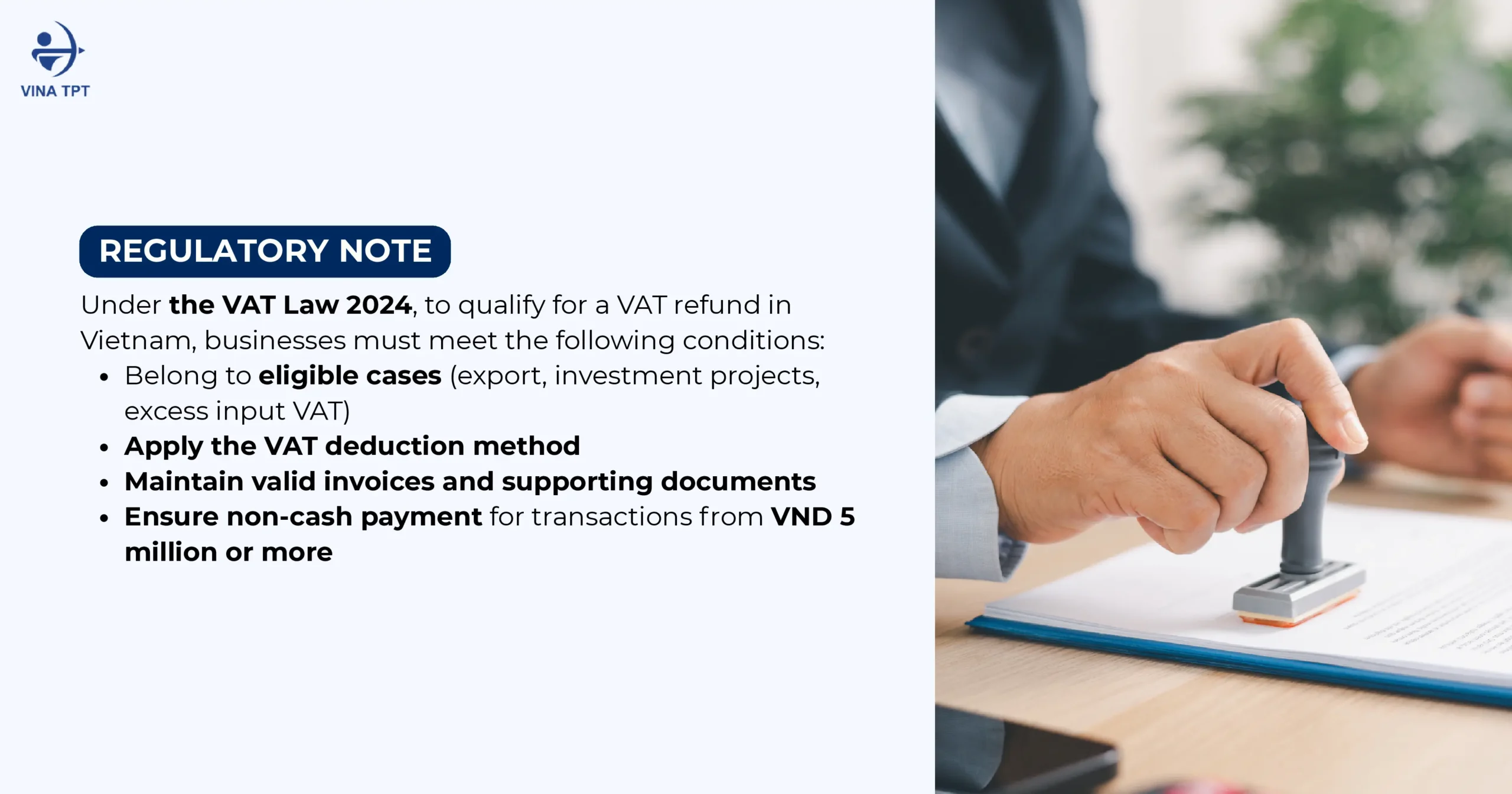
To be eligible for a VAT refund, businesses must also meet several general requirements:
- Declare and pay VAT using the deduction method
- Maintain complete and accurate accounting records with valid supporting documents
- Hold a bank account registered under the company’s tax code
- For any transaction of VND 5 million or more (VAT inclusive), payment must be made via bank transfer (cash payments are not accepted)
Businesses engaged in exports and FDI investment projects are often given priority under the “refund first, audit later” mechanism. This allows them to receive VAT refunds more quickly, helping improve cash flow during the critical early stages of investment.
2. Key conditions to qualify for VAT Refund in Vietnam (What You Must Meet)
To qualify for a VAT refund in Vietnam in 2026, businesses must simultaneously meet two main conditions:
2.1. Belong to the Eligible Categories under Clauses 1, 2, 3, and 4 of Article 15 of the Law on Value-Added Tax 2024
The most common eligible cases include:
- Enterprises exporting goods and services (subject to the 0% VAT rate)
- Businesses undertaking new or expanded investment projects (especially FDI projects)
- Enterprises with excess VAT paid after quarterly or annual input tax credits
- Companies undergoing dissolution, bankruptcy, or termination of operations
2.2. Declare and Pay VAT Using the Deduction Method and Comply with Input VAT Deduction Regulations under Clause 2 of Article 14 of the Law on Value-Added Tax 2024
Specifically, businesses must:
- Possess valid VAT invoices or equivalent supporting documents
- Make payment via bank transfer for any transaction of VND 5 million or more (VAT inclusive) – cash payments are not accepted
- For exported goods and services, in addition to the general conditions, the following documents are required: a contract with the foreign party (for sale, processing, or service provision), invoices, non-cash payment proof, customs declaration (for exported goods), and supporting documents such as packing list, bill of lading, and insurance certificate (if any). The Government also provides specific regulations on input VAT credit conditions for exports via overseas e-commerce platforms and other special cases.
Only when conditions are fully satisfied can a business submit a VAT refund application.
>>> You may find this article helpful: Cases Eligible for VAT Tax Refund in Vietnam in 2026
3. Step-by-Step guide: How to get VAT Refund in Vietnam
Understanding the required documents is one of the most important steps in learning how to get VAT refund in Vietnam successfully. To carry out a VAT refund, businesses need to go through the following steps:
Below is the detailed procedure for how to get VAT refund in Vietnam in 2026. The entire process is now mainly carried out electronically, helping to shorten the time compared to before.
Step 1: Check and prepare documents
Businesses need to carefully check the eligible input VAT amount and compile all related documents (electronic VAT invoices, customs declarations, export contracts…).
Step 2: Declare VAT
Carry out VAT declaration monthly or quarterly accurately and on time as prescribed.
Step 3: Submit VAT refund application
Submit the electronic VAT refund dossier through the eTax system of the General Department of Taxation. This is an important step that determines the subsequent processing speed.
Step 4: Tax authority review and decision
The tax authority will review the dossier. If it qualifies for “refund first – audit later”, you will receive the refund decision faster.
Step 5: Receive VAT refund
After receiving the refund decision, the money will be transferred directly to the business’s bank account within the prescribed time.
Step 6: Handle additional requests (if any)
In case the dossier needs clarification, businesses must quickly explain or supplement documents as requested by the tax authority to avoid prolonging the processing time.
4. What documents are required for VAT Refund in Vietnam?
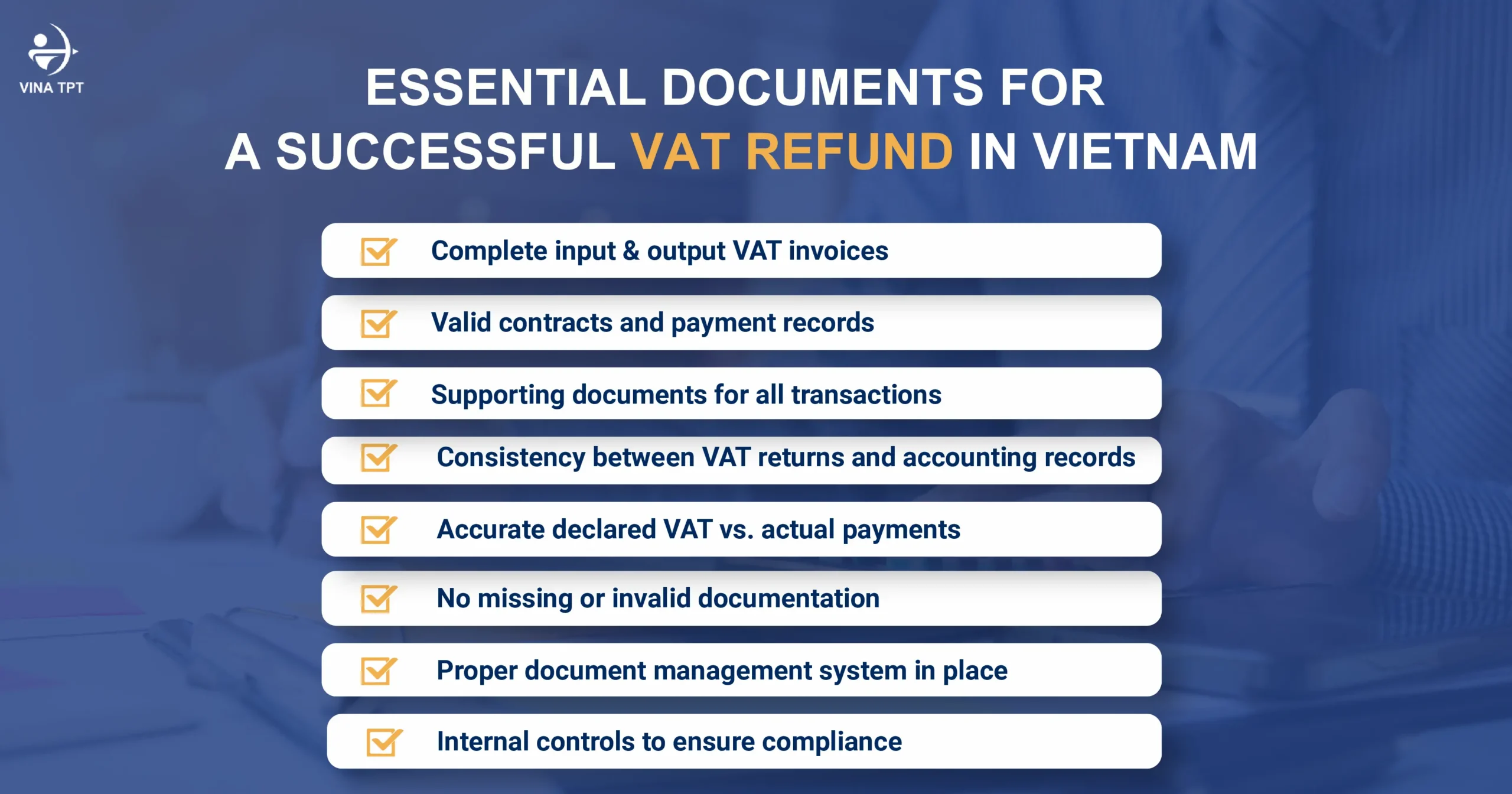
Whether the business uses the deduction method or the direct method, it is mandatory to properly store all input and output documents. These documents usually include electronic VAT invoices, contracts, payment vouchers, and related records to prove the legitimacy of declared revenue and expenses.
In addition, businesses must ensure consistency between the declared VAT data, paid tax amounts, and the accounting books. Any discrepancy or lack of valid documents may lead to tax reassessment, administrative penalties, or prolonged processing time with the tax authority.
In practice, establishing a document management and internal control system from the beginning will help minimize errors and significantly reduce pressure during periodic tax inspections or audits later.
Processing Time
- Refund first – audit later: approximately 15 days
- Audit first – refund later: approximately 40 days
However, in practice in 2026, the processing time may be longer if the dossier is incomplete or requires multiple explanations.
5. Common VAT Refund mistakes that delay or reject your application
Although the VAT refund process has been digitized, many businesses (especially FDI enterprises and export companies) still encounter situations where their dossiers are delayed, require multiple additional submissions, or are even rejected. One of the biggest challenges when learning how to get VAT refund in Vietnam is avoiding documentation and declaration mistakes that may delay approval.
- Invalid or mismatched invoices and documents This is the most common error. Many businesses submit VAT invoices that do not qualify for deduction, invoices with incorrect information, or fail to fully match them with customs declarations and contracts. As a result, the dossier is suspended or removed from the refund list.
- Late tax declaration or incorrect data Declaring incorrect input VAT data or being late by even one day can lead to penalties and delay the entire refund process.
- Not preparing sufficient explanation documents when requested When the tax authority requests explanations, many businesses respond slowly or lack supporting documents, causing the dossier to be delayed or rejected.
- Choosing the wrong refund method Some businesses choose the “audit first – refund later” method even though they qualify for “refund first – audit later”, significantly prolonging the time to receive the money.
- Not completing other tax obligations Businesses with outstanding PIT, CIT, or other taxes will not be eligible for VAT refund until those obligations are settled.
Practical Advice: Before submitting the VAT refund dossier, carefully check all documents and data. Cooperating with a professional consulting firm like Vina TPT will help you avoid most of the above mistakes, increase the success rate of the refund, and significantly shorten the time to receive the money.
6. How Vina TPT Helps You Get VAT Refund Faster and Safer
With more than 20 years of experience supporting FDI enterprises and export businesses, Vina TPT deeply understands the VAT refund process and the practical requirements of the tax authorities. We help clients get VAT refunds faster, safer, and with a higher success rate.
Specifically, Vina TPT provides comprehensive support as follows:
- Thorough checking and review of input VAT dossiers before submission
- Full preparation and optimization of documents to increase the refund success rate
- Representing clients in submitting electronic VAT refund applications and regularly monitoring progress
- Timely support for explanations and supplementary documents when requested by the tax authority
- Integration with outsourced finance & accounting services for overall tax management, avoiding arising errors
Thanks to our professional process, we help businesses significantly shorten the time to receive VAT refunds while minimizing the risk of additional requests or dossier rejection.
Most importantly, when cooperating with Vina TPT, you can focus on your core business activities instead of spending time dealing with complex administrative procedures.
If your business needs professional support on how to get VAT refund in Vietnam, Vina TPT is ready to assist from document preparation to tax authority procedures.