Vietnam’s business landscape has been expanding rapidly as the government places increasing emphasis on developing the private sector. Today, private enterprises account for around 50% of the country’s GDP and employ more than 80% of the national workforce, with over 940,000 registered businesses currently operating nationwide.
As this entrepreneurial ecosystem continues to grow, many companies face challenges in areas such as management, marketing strategy, business development, and digital transformation. As a result, professional consulting services are becoming increasingly important for businesses seeking to improve competitiveness and navigate Vietnam’s evolving market environment.
If you are considering establishing a consulting company in Vietnam, understanding the legal framework and business registration process is an essential first step
1. Is consulting a conditional business line?
Under the Investment Law 2025 (effective from January 3, 2026), most common consulting services, such as management consulting, business consulting, marketing consulting, human resources consulting, and strategy consulting are not classified as conditional business lines.
This allows foreign investors to establish a 100% foreign-owned enterprise without requiring a Vietnamese partner and without applying for additional sub-licenses after obtaining the IRC and ERC. This is a significant advantage compared to sectors included in the restricted market access list.
However, for certain specialized consulting sectors, how to start a business will be more complex because additional industry-specific conditions must be satisfied. In such cases, the enterprise must comply with requirements relating to professional practicing certificates, capacity conditions, or separate licenses in accordance with regulations of the relevant ministries.
Therefore, before initiating procedures, investors should review Decree 31/2021/ND-CP and Decree 239/2025/ND-CP to determine whether the intended business line falls under the conditional category, thereby ensuring that they start a consulting business in Vietnam in the right direction and minimize the risk of dossier amendments.
2. Key consulting services currently in demand in Vietnam
In Vietnam, several consulting sectors are attracting the attention of foreign investors who are determining how to start a business at an early stage, including:
- Management consulting: Including strategic planning, corporate restructuring, operational optimization, and performance management.
- Technology and software consulting: Associated with digital transformation, IT system advisory, software solutions, automation, and data management.
- Marketing consulting: Including brand building, market research, communications, and digital advertising. This group of business support services has been committed to market opening by Vietnam under WTO agreements and does not require a separate sub-license.
- Tourism and service development consulting: Consulting on product development strategies, destination management, and tourism service operations. For each service group, how to start a business may differ in terms of operational scope and personnel requirements.
- Healthcare management consulting: Primarily focusing on hospital management, service development strategies, and optimization of healthcare systems. If the enterprise provides medical examination and treatment services or specialized medical practice, it will be subject to conditions under the Law on Medical Examination and Treatment.
In general, strategic and business-support consulting services enjoy a high level of openness to foreign investors, while services directly related to technical expertise or specialized professional practice are subject to stricter conditions.
3. Conditions for establishing a consulting company in Vietnam for foreign investors
When establishing a foreign-invested consulting company in Vietnam, investors must meet several basic conditions relating to capital, office location, and management structure.
3.1 Capital and financial capacity requirements
Although the Enterprise Law 2025 does not set a minimum charter capital for consulting companies, the Department of Finance will review the registered capital to ensure it is appropriate for the company’s operational scale, business plan, and proposed services.
In practice:
- Charter capital of approximately USD 20,000-50,000 is generally considered appropriate for a professional consulting model with stable personnel and office operations.
- For smaller-scale models with a limited service scope, charter capital in the range of USD 10,000 may still be accepted if the business plan clearly demonstrates reasonable and low initial investment costs.
Determining an appropriate capital level not only serves dossier appraisal requirements but also creates a financial foundation for operations in the early stage, especially when the enterprise is exploring how to start a business and has not yet generated stable revenue.
3.2 Office location requirements
When a foreign enterprise determines how to start a business in Vietnam, the head office location is a mandatory and important requirement. The location must:
- Be permitted for use as an office or commercial premises;
- Not be a residential apartment used solely for housing or a property without business function;
- Have legal documentation proving the lawful right of use by the lessor.
Choosing an appropriate office location directly affects the validity of the dossier in the process of how to start a business.
If the enterprise has not yet secured a suitable location, Vina TPT provides consultation on virtual office solutions that satisfy enterprise registration conditions in accordance with legal regulations.
The use of a virtual office is a flexible solution in the early stage of how to start a business and is fully acceptable provided that:
- The address is not located in a residential apartment building or a prohibited business registration area;
- It is capable of receiving correspondence and official documents from state authorities;
- The lessor has sufficient documentation proving lawful leasing rights;
- The building is designated for “office” or “commercial – service” functions.
This solution helps enterprises optimize initial costs while still ensuring legal conditions for obtaining the Investment Registration Certificate (IRC) and the Enterprise Registration Certificate (ERC).
3.3 Legal representative requirements
Another important aspect in how to start a business is the appointment of a legal representative.
A foreign-invested consulting company must have at least one legal representative residing in Vietnam. The legal representative may be a foreign investor lawfully residing in Vietnam, or another individual (a Vietnamese citizen or a foreigner with valid residence documents) appointed by the enterprise.
This person is responsible for:
- Organizing and managing company operations;
- Fulfilling tax and financial reporting obligations;
- Registering labor and social insurance;
- Working with state authorities in administrative procedures.
Appointing a legal representative residing in Vietnam is a mandatory requirement and plays an important role in ensuring continuity in corporate governance and legal compliance. Lack of appropriate personnel preparation may cause difficulties in how to start a business, particularly when planning to start a consulting business in Vietnam with a foreign management team.

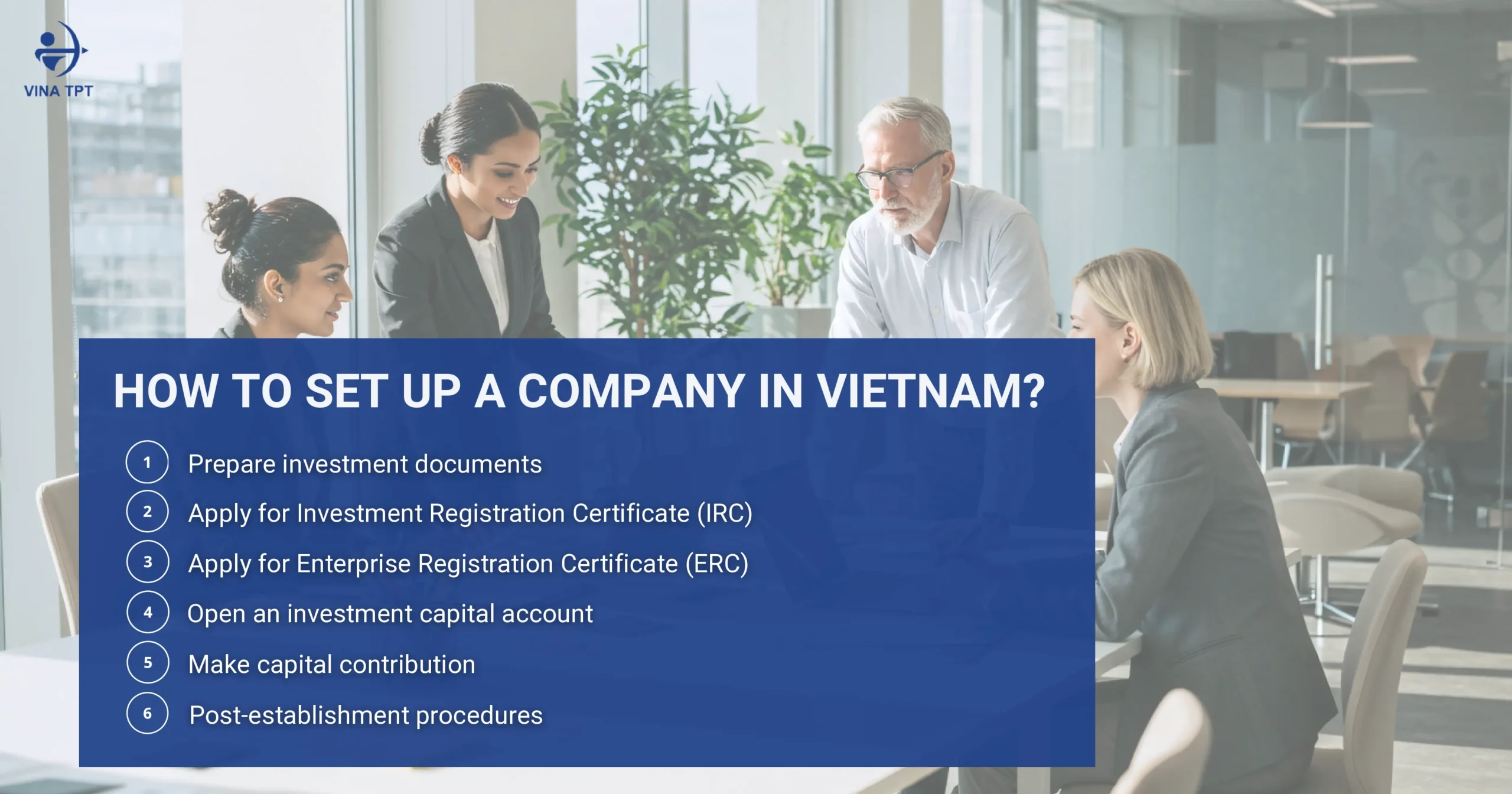
4. How to start a business in Vietnam for a consulting company – detailed step-by-step procedures
For the consulting sector, how to start a business generally includes the following steps:
Step 1: Prepare the application dossier for the Investment Registration Certificate (IRC)
Under the Investment Law 2025, investors are required to prepare:
- A written request for implementation of the investment project;
- Legal documents of the investor (passport for individuals; business registration certificate for organizations);
- Investment project proposal (objectives of providing consulting services, scale, capital, location, duration of operation);
- Documents proving financial capacity;
- Office lease agreement or documents proving the lawful right to use the project location;
- Technology explanation (if the project involves technology subject to appraisal).
The dossier is submitted to the competent investment registration authority in the province/city where the head office is located.
Note: Foreign documents must undergo consular legalization and be translated into Vietnamese.
Step 2: Obtain the Investment Registration Certificate (IRC)
The IRC records basic information of the consulting project, including:
- The investor;
- The registered consulting service business lines;
- Investment capital and charter capital;
- Location and duration of operation.
For standard consulting services (not classified as conditional business lines), this procedure mainly focuses on the validity of the dossier and financial capacity.
Step 3: Register the enterprise and obtain the Enterprise Registration Certificate (ERC)
After obtaining the IRC, the enterprise proceeds with company registration under the Enterprise Law 2025 to receive the Enterprise Registration Certificate (ERC).
The ERC establishes the company’s legal entity status and records:
- The name of the consulting company;
- Head office address;
- Legal representative;
- Charter capital;
- Business lines (corresponding consulting service codes).
Step 4: Open an investment capital account and contribute capital
Immediately after obtaining the ERC, the enterprise must open a dedicated investment capital account at a bank licensed to operate in Vietnam.
The full charter capital must be contributed within 90 days from the ERC issuance date to avoid administrative penalties and ensure compliance of the enterprise.
Step 5: Complete post-establishment procedures
Before commencing operations, the consulting company must:
- Complete initial tax registration and register for electronic invoices;
- Purchase a digital signature;
- Register labor and social insurance (if employees are hired).
After licensing, tax procedures and capital contribution complete the overall picture of how to start a business in Vietnam; from a practical perspective, this is the “final sprint” of the business registration process in Vietnam that many enterprises tend to underestimate.
Step 6: Obtain sector-specific licenses (if operating in conditional consulting sectors)
If the company provides consulting services in specialized sectors such as construction consulting, legal consulting, securities investment consulting, etc., the enterprise must satisfy additional requirements relating to practicing certificates or professional licenses under the corresponding specialized laws.
Complying with the correct sequence helps ensure that how to start a business proceeds smoothly and minimizes dossier amendments, especially when planning to start a consulting business in Vietnam in sectors requiring specialized expertise.
5. Common mistakes when opening a consulting company in Vietnam
Many investors fail not because the market is difficult, but because they do not properly understand how to start a business. Below are common mistakes foreign investors often make when establishing a consulting company in Vietnam:
Mistake 1: Choosing an inappropriate enterprise structure
Many investors choose an enterprise structure based on habits in their home country without evaluating governance needs and capital mobilization capacity in Vietnam. An unsuitable choice (single-member LLC, multi-member LLC, joint stock company) may misalign with how to start a business, creating limitations in ownership structure, capital transfer, or future fundraising, and may even require conversion procedures later.
To avoid costly adjustments, investors should clearly determine growth objectives, number of shareholders/members, and fundraising plans before submitting the dossier.
Mistake 2: Failing to carefully review business line conditions
Registering business lines that fall under restricted market access or conditional sectors without reviewing relevant regulations often results in IRC dossiers being requested for clarification, amendment, or extended processing time.
Failure to thoroughly review business lines poses legal risks in how to start a business with foreign investment.
Investors should review the list of restricted market access sectors, specialized licensing conditions, and operational scope before finalizing project objectives.
Mistake 3: Selecting the wrong CPC code when registering business lines
For foreign-invested enterprises determining how to start a business correctly, in addition to registering Vietnam Standard Industrial Classification (VSIC) codes, investors must also refer to Vietnam’s WTO service commitments schedule, where services are classified under CPC (Central Product Classification) codes.
Common CPC codes in consulting and business services include:
- Management consulting services – CPC 865
- Marketing consulting services (marketing management) – CPC 86503
- HR consulting services – CPC 86504 (management consulting); labor supply services – CPC 872
- Software consulting services – CPC 842
Incorrect identification of CPC codes may result in:
- Misapplication of market access conditions;
- Misunderstanding of foreign ownership limits;
- Unnecessary requirements for specialized licenses;
- IRC dossier amendments.
Therefore, properly reviewing CPC codes before submitting the investment dossier is crucial to ensure accurate appraisal and minimize future amendment risks.
Mistake 4: Confusing the IRC and ERC procedures
Foreign-invested enterprises must generally follow the sequence: obtain the IRC (project approval) first, then register the ERC (legal entity establishment).
Confusing these procedures or preparing dossiers in the wrong order may delay implementation plans and lead to amendments.
Investors should build a legal roadmap in stages and prepare documentation corresponding to each certificate type.
Mistake 5: Lack of post-establishment financial and tax planning
Many enterprises focus on licensing but fail to anticipate tax obligations, operating costs, and periodic filing schedules, leading to penalties and operational disruption.
Immediately after establishment, enterprises should set up an accounting system, register e-invoices and digital signatures, and establish monthly/quarterly compliance plans to ensure stable operations.
Mistake 6: Failure to prepare labor and work permit plans
For foreign managers or experts, work permits and lawful residence status are required for long-term employment in Vietnam.
Without prior planning, enterprises may face management time limitations or urgent administrative procedures affecting operations.
Labor planning, work permits, and temporary residence cards should be integrated immediately after completing establishment procedures.
Mistake 7: Lack of understanding of the local business environment and culture
Differences in working styles, administrative procedures, and communication standards may affect negotiations, HR management, and coordination with partners or authorities.
Understanding the local context and establishing appropriate internal processes helps reduce operational friction and improve implementation efficiency from the early stage.
In cases where investors wish to optimize how to start a business and minimize potential risks, engaging professional consulting services can help standardize the entire process.
With over 20 years of experience supporting FDI enterprises in company formation, tax – accounting, and HR services in Vietnam, Vina TPT provides comprehensive consulting and implementation solutions, ensuring compliance with regulations and alignment with long-term investment objectives.
Contact Vina TPT for detailed consultation on how to start a business in line with your business model and investment goals.