
How to Start an International Business in Vietnam?

how-to-start-an-international-business-in-vietnam

how-to-start-an-international-business-in-vietnam

The FDI picture in Vietnam is expanding at pace. Disbursed capital reached a record USD 27.62 billion in 2025, and in the first six months of 2026 registered capital jumped to USD 34.65 billion, up 61% year on year. A consumer market of VND 7,093 trillion is driving global brands such as OH!SOME, Saizeriya, Pin Wei, Shake Shack… to keep expanding their legal entities and on-the-ground retail networks.

With a rapidly growing middle class, improving logistics infrastructure, and a new generation of FTAs, Vietnam offers significant opportunities for investors looking to establish an international business in Vietnam.

Working alongside FDI companies, this article from Vina TPT maps the full market-entry roadmap: choosing the form of legal presence, reviewing conditional business lines, obtaining the IRC and ERC, and building a tax, accounting, and labor system that is complete and correct from day one.

1. Choose the Right Form of Presence First

The first step in establishing an international business in Vietnam is not choosing a brand name. It is selecting the form of legal presence that accurately matches the investor’s business objectives.

  • Limited Liability Company (LLC): This is the most common and optimal model, accounting for more than 90% of FDI projects in Vietnam. It applies limited liability within the scope of contributed capital, has a relatively flexible governance structure, and allows 100% foreign ownership in most business lines. It is the most suitable choice for trading, services, manufacturing, and technology activities.
  • Representative Office (RO): An RO only serves as a liaison, market-research, and trade-promotion unit. Vietnamese law strictly prohibits an RO from conducting direct profit-making activities. It may not sign commercial contracts (except under a valid power of attorney), issue invoices, or collect payment from customers. Many foreign investors set up an RO because they assume the procedures are simpler, then later have to dissolve it and incorporate a company because the RO cannot carry out business operations.
  • Joint Stock Company (JSC): This form is suitable for large-scale projects that plan to raise capital from multiple shareholders or aim for a stock-exchange listing. However, the governance structure and internal regulations of a JSC are significantly more complex than those of an LLC.

2. Check Market Access and Conditional Business Lines

Before establishing an international business in Vietnam, foreign investors must carefully review the market-access conditions for their intended business lines under the Law on Investment, the WTO Commitments Schedule, and relevant Free Trade Agreements.

  • Fully open sectors: Foreign investors are permitted to hold 100% of charter capital (for example: management consulting, manufacturing, software, and wholesale trading).
  • Conditional market-access sectors: These may impose a cap on foreign ownership (foreign room), a required form of investment (such as a joint venture with a domestic partner), or experience and capability requirements.
  • Sub-license / Business License requirements: Sensitive sectors or those that directly affect consumers – such as retail (import-export and retail distribution), F&B, education, logistics, pharmaceuticals, and e-commerce – require a specialized license after the company has been established.
  • Investment capital requirements: General law does not prescribe a minimum charter capital for every sector, but the registered capital must be commensurate with the project scale and the feasibility of the business plan. Capital that is too low will lead the licensing authority to refuse project approval or to request repeated additional explanations.

3. Step-by-Step: Set Up International Business in Vietnam

The standardized process answering the question of how to register a company in Vietnam for foreign investors consists of the following 5 core stages:

Step 1: Industry Survey and Preparation of the Investment Dossier

Before commencing the company establishment procedures, the investor needs to accurately determine the business industry codes according to the Vietnam Standard Industrial Classification (VSIC) and cross-check them against the WTO Commitments Schedule and the Law on Investment to verify market access conditions. Certain sectors classified as conditional business lines will require additional specialized licenses or compliance with standards related to capital, personnel, and facilities. At this stage, the investor is advised to contact a local consulting firm for support in reviewing the industry codes and assessing the project’s feasibility.

After identifying the suitable industry, the investor proceeds to prepare the investment dossier under the guidance of the service provider. Documents of the investor (whether an individual or an organization) must be consular-legalized abroad before being brought to Vietnam for use. The consular legalization process usually takes 14 to 30 days, depending on the procedures of each embassy/consulate and the respective country.

Estimated time for the entire step: approximately 5-7 working days (excluding consular legalization time).

Step 2: Submission of the Application for the Investment Registration Certificate (IRC)

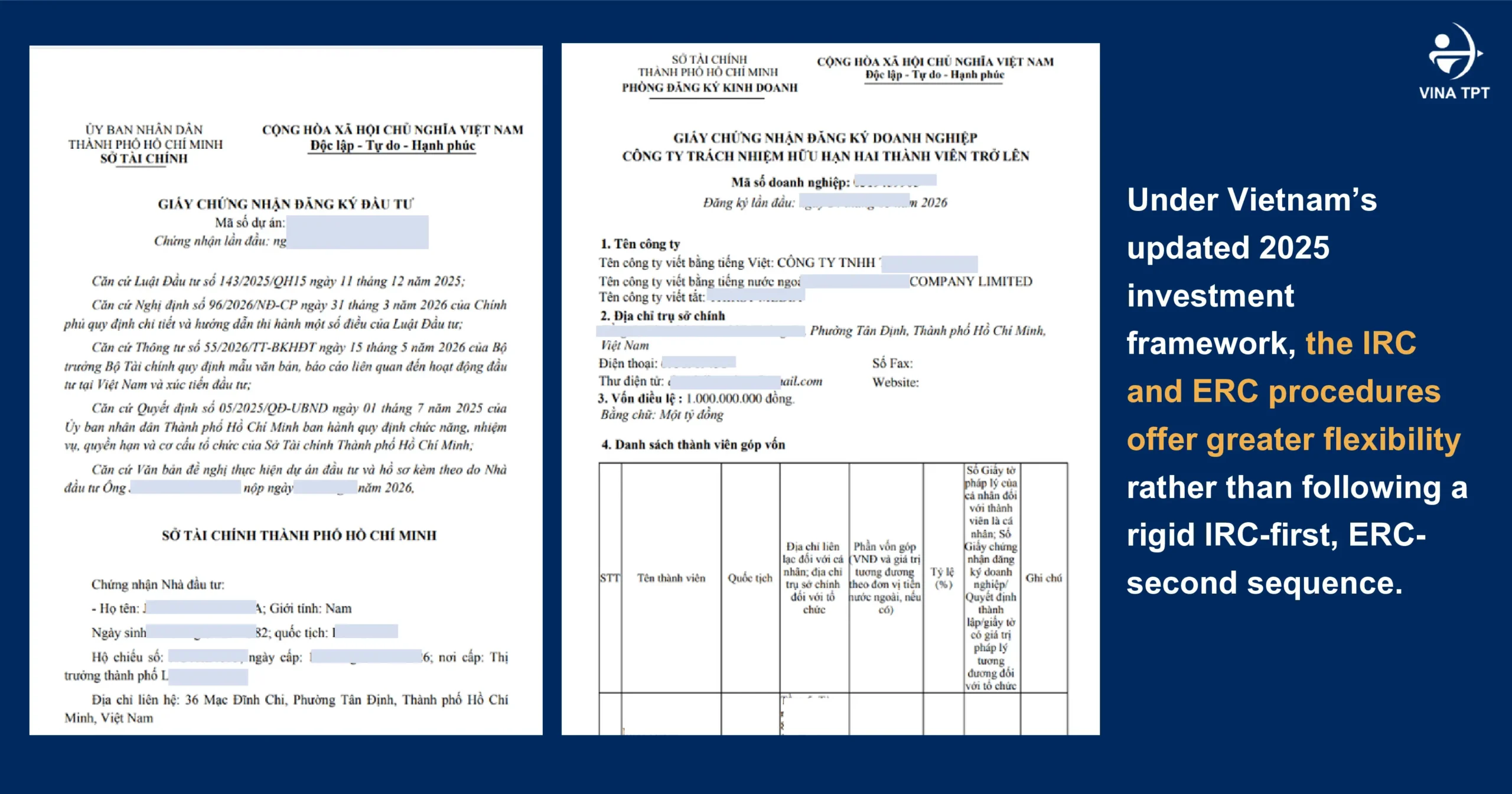
The investment dossier is submitted to the Department of Finance. The competent authority will appraise the market conditions, project location, and the investor’s financial capacity before officially issuing the IRC.

Estimated time: 30 – 45 working days.

Step 3: Submission of the Application for the Enterprise Registration Certificate (ERC)

After obtaining the IRC, the enterprise submits the legal entity establishment dossier to apply for the ERC. The business registration authority will appraise the company name, head office address, and governance structure. Once the ERC is completed, the enterprise code is simultaneously created on the National Business Registration Information System.

Estimated time: 14 – 20 working days.

Step 4: Opening a Bank Account, Engraving the Company Seal, and Making Capital Contribution

The enterprise proceeds to engrave the legal seal, publish the seal specimen, and open a Direct Investment Capital Account (DICA) at a commercial bank licensed to operate in Vietnam. Under the law, the investor must complete the transfer of the entire committed charter capital into the DICA within a maximum of 90 days from the date the ERC is issued.

Implementation time: Within 90 days as prescribed by law.

Step 5: Completion of Tax Registration and Post-Establishment Compliance

The enterprise purchases a digital signature (USB Token), installs the company signboard at the head office, carries out initial tax registration, submits the business license fee declaration, and registers the electronic invoice system. At the same time, the company completes labor registration and social insurance procedures if employees are officially hired, and registers the enterprise electronic identity account (VNeID for enterprises) to facilitate electronic administrative procedures and transactions with state authorities.

Estimated time: 14 – 30 working days. 

how-to-start-an-international-business-in-vietnam

4. Tax, Accounting and Labor Obligations After Setup

Once an international business in Vietnam is legally established, ongoing tax, accounting, labor, and investment reporting obligations arise immediately, regardless of whether the company has recorded any revenue.

  • Tax obligations: The company must declare and pay on time Value-Added Tax (VAT), Corporate Income Tax (CIT), Personal Income Tax (PIT) for employees, and Foreign Contractor Tax (FCT) whenever payments are made to international counterparties.
  • Accounting standards and audit: Accounting books must be maintained under the Vietnamese Accounting Standards (VAS). An FDI company is required to appoint a legally qualified Chief Accountant and must have its annual financial statements audited by an independent audit firm in Vietnam before submitting them to the tax and statistics authorities.
  • Labor law and expatriate compliance: The company must enter into labor contracts and make mandatory social insurance contributions. When employing foreign nationals, it must complete the Work Permit or Work Permit exemption procedures and obtain a Temporary Residence Card (TRC) to ensure lawful residence.
  • Investment Activity Report (IAR): This is a mandatory quarterly and annual reporting obligation on the National Foreign Investment Information System. Discrepancies between investment report figures and the audited financial statements can result in significant administrative penalties.

5. Practical Challenges Foreign Founders Often Underestimate

During implementation, many international investors run into bottlenecks because they underestimate Vietnam’s administrative barriers:

  • Registered office address barrier: Vietnamese regulations require a business to have a lawful registered office address that is suitable for business registration and can be verified by the relevant authorities. For foreign investors, setting up a traditional office from the beginning can be time-consuming and costly, as it may involve finding a suitable premises, negotiating and signing a lease, arranging the office, and preparing the necessary supporting documents. To save time and reduce initial setup costs, many investors therefore consider a Shared Office during the early stage of establishing their business. A suitable Shared Office can provide a lawful business address together with the necessary legal documents and support for an on-site inspection by the tax authority when required.
  • Requirements for the Legal Representative: The company must have at least one Legal Representative who resides regularly in Vietnam. This person must complete Personal Tax Identification Number registration, obtain a Work Permit, and activate Level-2 VNeID identity so that they can use a digital signature on public service systems.
  • Timeline slippage versus the original plan: Actual dossier review often takes longer than the theoretical timeline if overseas legal documents have consular-legalization defects, translations are inaccurate, or the explanation of the investment capital source does not meet the competent authority’s requirements.
  • Timeline slippage versus the original plan: Actual dossier review often takes longer than the theoretical timeline if overseas documents have consular-legalization defects, translations are inaccurate, or the explanation of the investment capital source does not meet the competent authority’s requirements.

For that reason, investors should appoint a partner for company setup, Chief Accountant support, and tax compliance from the dossier-preparation stage – rather than splitting the work into two phases of “get the license first, find an accountant later.”

6. How Vina TPT Supports International Business Setup in Vietnam

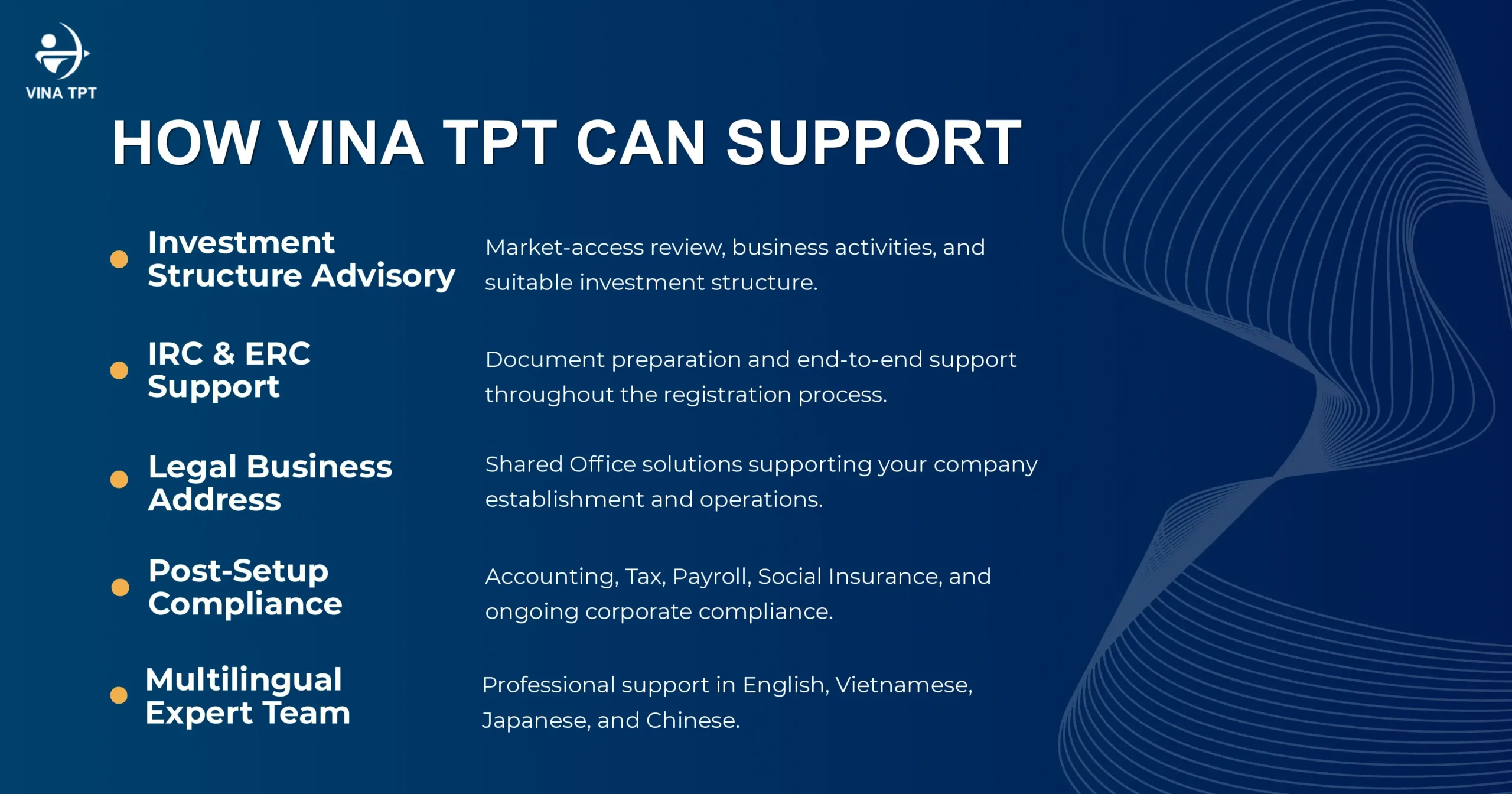
As a leading B2B advisory firm in accounting, tax, and corporate law for FDI companies in Vietnam, Vina TPT provides an end-to-end solution from market entry through to stable operations:

  • Legal structure and business-line advisory: We assess market-access conditions and recommend a capital structure and form of presence that is tax-efficient.
  • Full-package licensing: We prepare a compliant dossier and represent the investor before state authorities to obtain the IRC, ERC, and all required specialized business licenses.
  • Lawful registered office: Vina TPT provides a business registration address and a Shared Office solution that is legally qualified and meets the tax authority’s on-site inspection requirements. Refer to Shared Office Vietnam: A Smart Workspace Solution for Startups and FDI Companies to choose the right office model before you file the IRC/ERC dossier. 
  • Post-establishment management system: We deliver a full package covering VAS accounting and bookkeeping, financial statement, tax filing, HR & payroll, Work Permits, and periodic Investment Activity Reports (IAR).

Are you preparing a plan to start business in Vietnam? Contact Vina TPT’s specialist team today for an in-depth advisory roadmap and a complete company setup solution that is legally sound and operationally efficient.
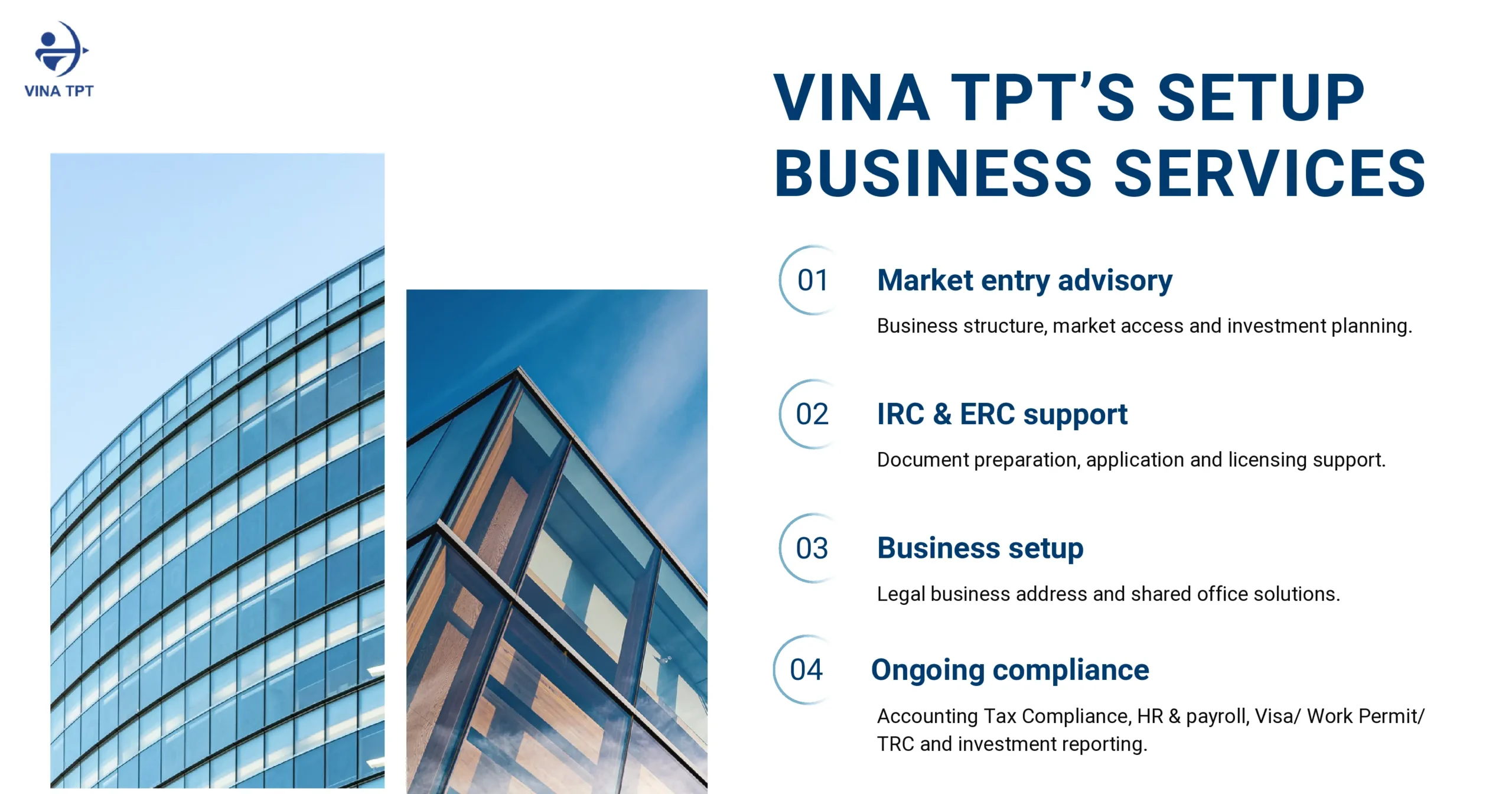
BOOK A FREE CONSULTATION

how-to-start-an-international-business-in-vietnam

What Does a Tax Consultant in Vietnam Actually Do?

what-does-a-tax-consultant-in-vietnam-actually-do

what-does-a-tax-consultant-in-vietnam-actually-do

If you are already doing business in Vietnam and looking for tax advisory support, the harder question is often not whether to hire someone, but which services a tax consultant Vietnam actually offers. Some firms only handle monthly filings. Others also cover VAT refunds, tax health checks, inspection support, and transfer pricing. The scope is not the same, and the right package depends on where your company is in its operating cycle.

This article maps the tax advisory Vietnam services most commonly provided in the market: the routine accounting – tax work that keeps filings on time, the specialized work that protects cash flow and inspection risk, and the point at which an FDI company should bring in a professional partner. The goal is to give you a clear picture of tax compliance Vietnam support before you choose a consultant.

1. What Accounting & Tax Consultant Services Cover Each Month

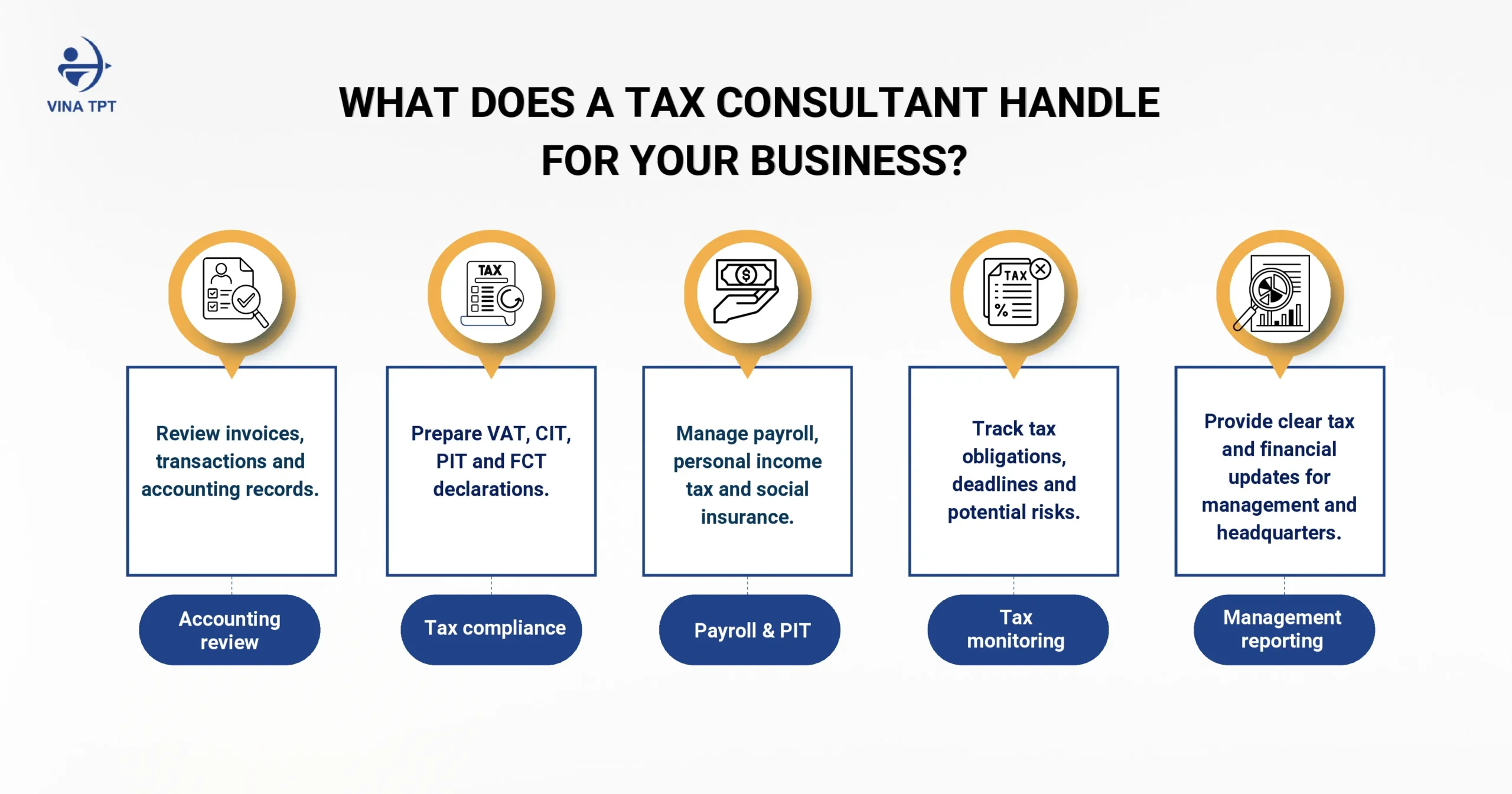
For FDI companies, the role of a tax consultant Vietnam never stands alone as “someone who just files returns.” It must be tied to the internal accounting system. Periodic tax compliance Vietnam requires absolute accuracy from incoming source documents through to the data submitted on the Tax Authority’s system.

Below are the monthly and quarterly tasks that a professional tax advisory firm performs for FDI companies:

  • Document recording and e-invoice review: Receive all incoming and outgoing invoices and bank documents; review the legality, validity, and reasonableness of e-invoices on the General Department of Taxation portal to prevent risks from invoices issued by absconding or inactive companies.
  • Full identification of tax obligations arising in the period: Accurately assess the taxes the company must pay, including Value-Added Tax (VAT), Corporate Income Tax (CIT), Personal Income Tax (PIT), Foreign Contractor Tax (FCT), and the business license fee.
  • Preparation and on-time filing of tax returns: Build tax computation worksheets, prepare VAT and PIT returns on a monthly or quarterly basis, and file them through the e-tax portal before the statutory deadlines (the 20th of the following month or the last day of the first month of the following quarter), completely eliminating the risk of late-filing penalties.
  • Review of VAT deduction conditions and non-cash payment rules: Strictly check input VAT deduction conditions, especially the mandatory bank-transfer requirement for invoices of VND 5 million or more, and verify valid bank payment evidence.
  • Monitoring and balancing CIT provisional payments: Provisionally calculate actual quarterly profit to determine the CIT amount payable in advance, ensuring that the total provisional CIT paid over four quarters is not lower than 80% of the CIT payable on the annual finalization, thereby avoiding late-payment interest.
  • Monitoring of Foreign Contractor Tax (FCT): Declare and pay FCT promptly whenever outbound payments arise to international suppliers (software royalties, consulting fees, commercial commissions, foreign loan interest, etc.), preventing reassessment risk from omitted transactions.
  • Consolidated reporting for the Board of Directors and Headquarters: Prepare tax-obligation summaries and management reports in English and Vietnamese so that management in Vietnam and the overseas parent company can easily track cash flow and compliance status.

Vina TPT’s professional view: A full-package tax compliance service must deliver three core elements: clean accounting books + accurate tax returns + figures that reconcile between accounting and tax. If any one of these is missing, the tax position will be off even if the company still “files on time.”

2. When You Need Deeper Tax Consultant Support

Monthly filing work only keeps the company on the correct administrative rhythm. The actual operations of FDI companies regularly give rise to complex matters that require in-depth tax advisory Vietnam capability:

  • VAT refund consulting and implementation: For FDI companies with new investment projects or export businesses, the amount of undeducted input VAT is often substantial. A tax consultant Vietnam will review the entire legal dossier, the validity of invoices, export contracts, and bank payment evidence, then file the application and explain it directly to the Tax Authority in order to recover the refund into the company’s account.
  • Tax Health Check: A full review of the accounting books, tax returns, and supporting documents of prior financial years. This work helps the company proactively detect errors, non-deductible expenses, or potential violations before a tax inspection, fundraising, M&A, or share transfer takes place.
  • Inspection dossier preparation and representation before the Tax Authority: When a tax inspection or audit decision is issued, the advisor helps collect documents and prepare detailed explanations of sensitive expense items (entertainment, expatriate costs, foreign-exchange differences, etc.) in order to protect reasonable expenses as far as possible and minimize reassessment risk.
  • Related-party transaction management and Transfer Pricing (TP) documentation: Most FDI companies have transactions with the parent company or other related parties. The tax advisor is responsible for identifying the scope of related-party transactions, preparing the related-party transaction appendix attached to the CIT finalization return, and building the Transfer Pricing documentation set (Local File and Master File) in strict compliance with Decree 132/2020/NĐ-CP.

what-does-a-tax-consultant-in-vietnam-actually-do

3. When Does an FDI Company Need a Tax Consultant?

An FDI company should proactively look for a professional tax advisory partner when it falls into one of the following situations:

  • Newly established FDI company: It does not yet have a dedicated accounting and tax team that fully understands the Vietnamese legal system and needs to set up the initial books and compliance processes correctly.
  • Need for a VAT refund: It wants to shorten the refund timeline and ensure that the input dossier meets the Tax Authority’s inspection standards so that cash can be released sooner.
  • Related-party transactions: It needs advice on preparing Transfer Pricing documentation to the required standard in order to avoid the risk of the Tax Authority imposing prices and assessing additional CIT.
  • Change in capital structure or business model: It needs advice on the tax obligations arising from a capital transfer, asset transfer, or corporate restructuring.
  • Several years of operation without a proper tax finalization review: It is not certain that prior periods were fully compliant and needs a Tax Health Check to address risks proactively before an inspection decision is issued.

Explore Vina TPT’s Tax Consultant Support Services

4. What to Look for When Choosing a Tax Consultant in Vietnam

When selecting a tax compliance Vietnam partner, the Board of Directors should assess the following practical capability criteria:

  • Hands-on experience with FDI clients: A deep understanding of the relationship between VAS and IFRS, a firm grasp of Vietnamese tax regulations, and familiarity with the reporting culture of multinational groups.
  • Valid practicing certificates: Both the firm and its staff must hold the Certificate of Practice in Tax Procedure Services and the Accountant / Chief Accountant certificate as required by law.
  • Multi-level quality control (QC): Accounting data and tax returns must pass through at least two to three review layers (Specialist → Team Leader → Chief Accountant / Tax Director) before official filing.
  • Multilingual communication and reporting: The ability to advise and prepare management reports clearly in English and Vietnamese, enabling Headquarters to monitor compliance with ease.
  • Transparent service contract: A clear scope among monthly filing work, in-depth advisory, inspection support, and Transfer Pricing documentation.
  • Integrated payroll and accounting: Seamless connection between payroll processing and tax filing so that financial data remains consistent and no discrepancies arise at year-end finalization.

5. How Vina TPT Works as a Tax Consultant for FDI Companies

As a specialist advisory firm in finance, accounting, and tax for foreign-invested enterprises in Vietnam, Vina TPT delivers a two-layer tax advisory solution that helps companies optimize costs and control risk comprehensively.

The service areas Vina TPT implements for FDI companies include:

  • Recurring work: Full-package filing of VAT, CIT, PIT, and FCT; review of the legality of incoming documents; bookkeeping under VAS; payroll administration; and provision of a Chief Accountant.
  • Specialized work: Preparation of VAT refund dossiers; Tax Health Checks of prior-year books; preparation of inspection files and direct liaison during a tax inspection; and related-party transaction advisory and documentation.

Is your FDI company looking to review its current tax obligations in full, or do you need a reputable tax advisory partner for the long term? Contact Vina TPT today for a consultation on the most suitable service package – accurate, optimized, and free of unnecessary extra costs.

what-does-a-tax-consultant-in-vietnam-actually-do

BOOK A FREE CONSULTATION

Documents Required (IRC-ERC) for Vietnam Company Registration

documents-required-for-vietnam-company-registration

documents-required-for-vietnam-company-registration

Incomplete dossiers or documents that have not been properly notarized, translated, or consular-legalized are a common reason why Vietnam company registration is delayed or has to be resubmitted. Many foreign investors prepare only part of the paperwork, submit the application, and then receive a request for supplementary documents because the passport, bank statements, or parent company charter do not yet meet Vietnam’s requirements.

To register a foreign-invested company, investors typically need two closely linked dossiers: the application for the Investment Registration Certificate (IRC) and the application for the Enterprise Registration Certificate (ERC). This article separates the checklist for individual investors and corporate investors, helping you prepare the correct documents from the outset.

1. Overview of Vietnam Company Registration Documents

In the Vietnam company registration process, the IRC dossier is used to substantiate the investment project: who the investor is, how much capital will be contributed, where the project will be implemented, and whether the business lines are permitted. The ERC dossier is used to establish the legal entity: the company name, charter capital, legal representative, and registered office address.

Several principles apply to both dossiers:

  • Copies generally need to be notarized.
  • Foreign-language documents require a notarized Vietnamese translation.
  • Many documents issued by a foreign organization must be consular-legalized before they can be used in Vietnam.
  • Information across the entire dossier must be consistent: investor name, passport number, registered capital, and registered office address.

2. Documents Required from Individual Foreign Investors

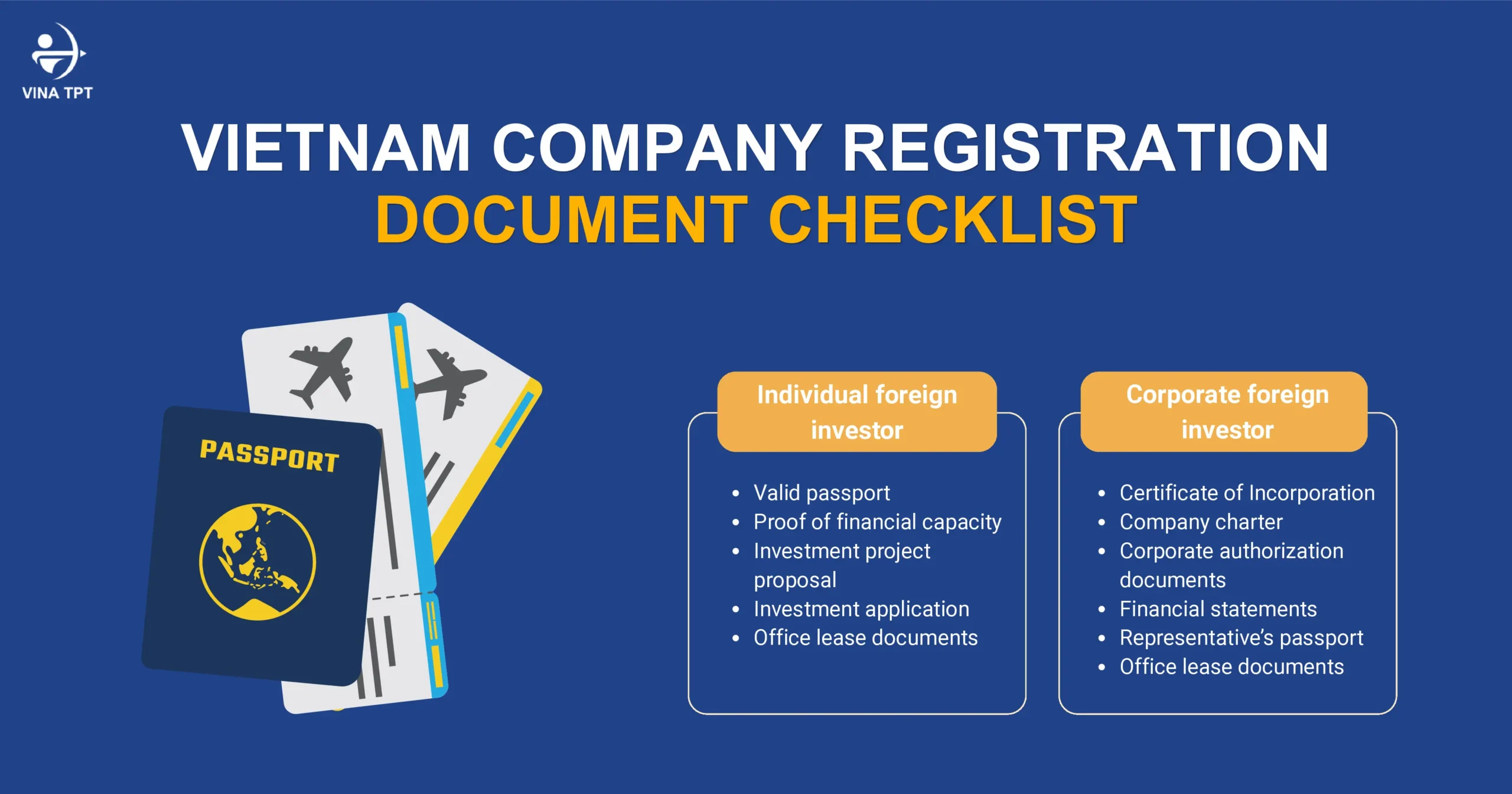
Individual investors usually have a slimmer dossier than a parent company, but financial capacity evidence and registered office documents still need to be prepared accurately for Vietnam company registration.

Common IRC ERC required documents for individual investors include:

  • A valid passport (notarized copy; consular legalization of an individual passport is not always mandatory and depends on the receiving authority’s requirements)
  • A bank balance confirmation or savings book in the investor’s name to prove financial capacity
  • An investment project proposal covering the objectives, capital, location, implementation schedule, and socio-economic benefits
  • A written request to implement the investment project
  • A lease agreement for the registered office or documents proving the right to use the premises

The bank balance should be commensurate with the registered scale and business lines. If the balance is too low relative to the intended sector, the receiving authority often requests additional explanations.

documents-required-for-vietnam-company-registration

3. Documents Required from Corporate Foreign Investors

When the investor is a foreign organization, the dossier is more extensive because Vietnamese authorities need to verify the legal status of the parent company.

Important note: the foreign investor must be a company. A private enterprise, household business, or any form that is not a corporate legal entity is generally not accepted as an organizational investor.

Typical documents include:

  • Certificate of Incorporation of the parent company
  • The charter or equivalent constitutional documents
  • A list of members/the Board of Directors and the person authorized to sign the dossier
  • Financial statements for the last two years, preferably audited
  • A financial commitment letter from the parent company or a credit institution (if required)
  • Passport of the person authorized to sign the dossier
  • A lease agreement for the premises in Vietnam

For Vietnam company registration, most documents issued abroad must be consular-legalized and accompanied by a notarized Vietnamese translation. Missing the legalization step is one of the most common reasons why corporate dossiers are delayed.

4. Additional Documents Often Requested During Vietnam Company Registration

Even when the main dossier is already fairly complete, the licensing authority may still request additional documents.

Documents commonly required as supplements include:

  • A technology explanation, if the project is subject to technology appraisal
  • Documents related to conditional business lines
  • A power of attorney authorizing a consulting firm to submit the dossier
  • Information on the person in charge of accounting or the Chief Accountant

The registration authority typically requests further explanations when the registered capital is low relative to the business lines, the registered office address is unclear, or the lease agreement does not yet qualify as a business registration address. Preparing these points in advance can make the Vietnam company registration process smoother and reduce the number of times the dossier has to be supplemented.

Explore Vina TPT’s FDI Company Registration Services

5. Common Document Mistakes That Delay Registration

In practice, the Vietnam company registration process often faces administrative obstacles that stem from avoidable mistakes in document preparation. Below is a detailed analysis of the most common errors that cause a dossier to be rejected or returned for repeated revisions:

  • Missing consular legalization or following the wrong process: Many investors only have documents notarized in their home country and overlook the certification stamp of the Vietnamese Embassy or Consulate. In some cases, legalization is completed by the wrong competent authority, rendering the documents legally invalid in Vietnam.
  • Notarized translations that do not match the original: Inconsistent translation of technical terms, company proper names, or omitted clauses in the parent company’s charter will be identified by the reviewing officer and result in the dossier being returned.
  • Expired bank statements or financial confirmations: Bank balance confirmations or savings books typically remain valid for only 30 to 90 days from the date of issue. Submitting an expired statement leads the registration authority to question the investor’s current financial capacity.
  • A leased registered office that does not qualify for business use: Renting a residential apartment, a condotel unit, or signing a lease for a building that has not been completed or does not have a commercial office function. Once the authority verifies the address, the dossier will be immediately suspended.
  • Inconsistent information across documents: Even a single-character discrepancy in the investor’s name, overseas registered address, passport number, or capital contribution ratio among the lease agreement, charter, investment project proposal, and financial confirmation documents.

6. How Vina TPT Helps Prepare Vietnam Company Registration Documents

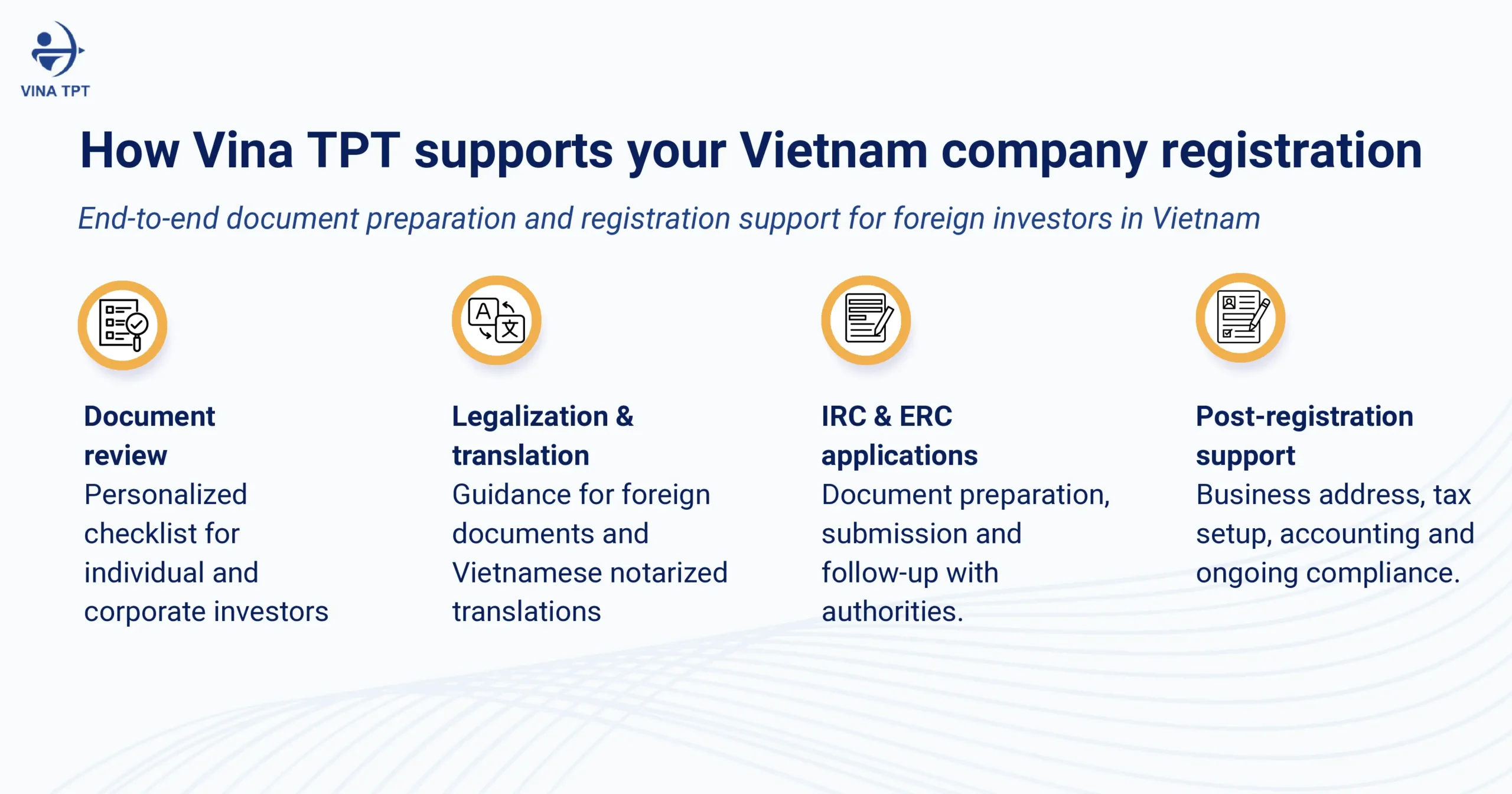
Preparing a foreign-invested company registration dossier on your own requires a deep understanding of the Law on Investment, the Law on Enterprises, and the consular legalization rules. Vina TPT provides a full-package consulting and dossier completion solution that helps investors save both time and cost:

  • Personalized review and checklist: We analyze the project scale and investor structure (individual or organization) to build a document list that is 100% accurate, avoiding both missing and unnecessary paperwork.
  • Consular legalization guidance and professional translation: We provide detailed guidance on the legalization process in each home country and prepare notarized Vietnamese translations that accurately reflect legal and economic terminology.
  • Drafting of the Investment Project Proposal and the IRC–ERC dossier: We prepare an optimized Investment Project Proposal on the investor’s behalf, with a clear justification of economic efficiency, labor utilization, and the capital disbursement schedule.
  • Dossier submission and liaison with state authorities: We submit the application to the Department of Finance or the Industrial Park Management Board, closely monitor the processing timeline, and proactively handle any issues that arise.
  • Legal registered office solution: We support the lease of a business registration address (Shared Office) with a complete set of legal documents that fully meets the authority’s premises inspection requirements.
  • Post-establishment compliance support: We assist with opening a Direct Investment Capital Account (DICA), completing initial tax registration, and preparing periodic investment reports so the company can operate smoothly immediately after licensing.

If you are preparing for Vietnam company registration and want to minimize the risk of a returned dossier or repeated resubmissions, contact Vina TPT today to receive a standardized document checklist and a free legal consultation before filing.

BOOK A FREE CONSULTATION

documents-required-for-vietnam-company-registration

Shared Office Ho Chi Minh City – Vina TPT Workspace for Foreign Companies

Shared-Office-Ho-Chi-Minh-City-Vina-TPT-Workspace-for-Foreign-Companies

Shared-Office-Ho-Chi-Minh-City-Vina-TPT-Workspace-for-Foreign-Companies

Are you looking for a shared office Ho Chi Minh City model that offers a strategic transportation location, integrates modern operational facilities, and fully meets 100% of the legal requirements for a business registration address?

Vina TPT Shared Office in the center of Ho Chi Minh City delivers a comprehensive and professional workspace solution, designed to the highest standards to precisely meet the stringent requirements of foreign-invested companies (FDI), international representative offices, and dynamic startups. We invite you to explore the actual working experience here and select the most suitable space model for your enterprise’s development roadmap.

1. Prime Location in the Heart of Ho Chi Minh City

An ideal workspace not only provides comfort for employees but also serves as an important catalyst that elevates the brand image in the eyes of business partners.

  • Prestigious Commercial Address: 5th Floor, Building 75/18-20-22 Hoang Sa Street, Saigon Ward, Ho Chi Minh City.
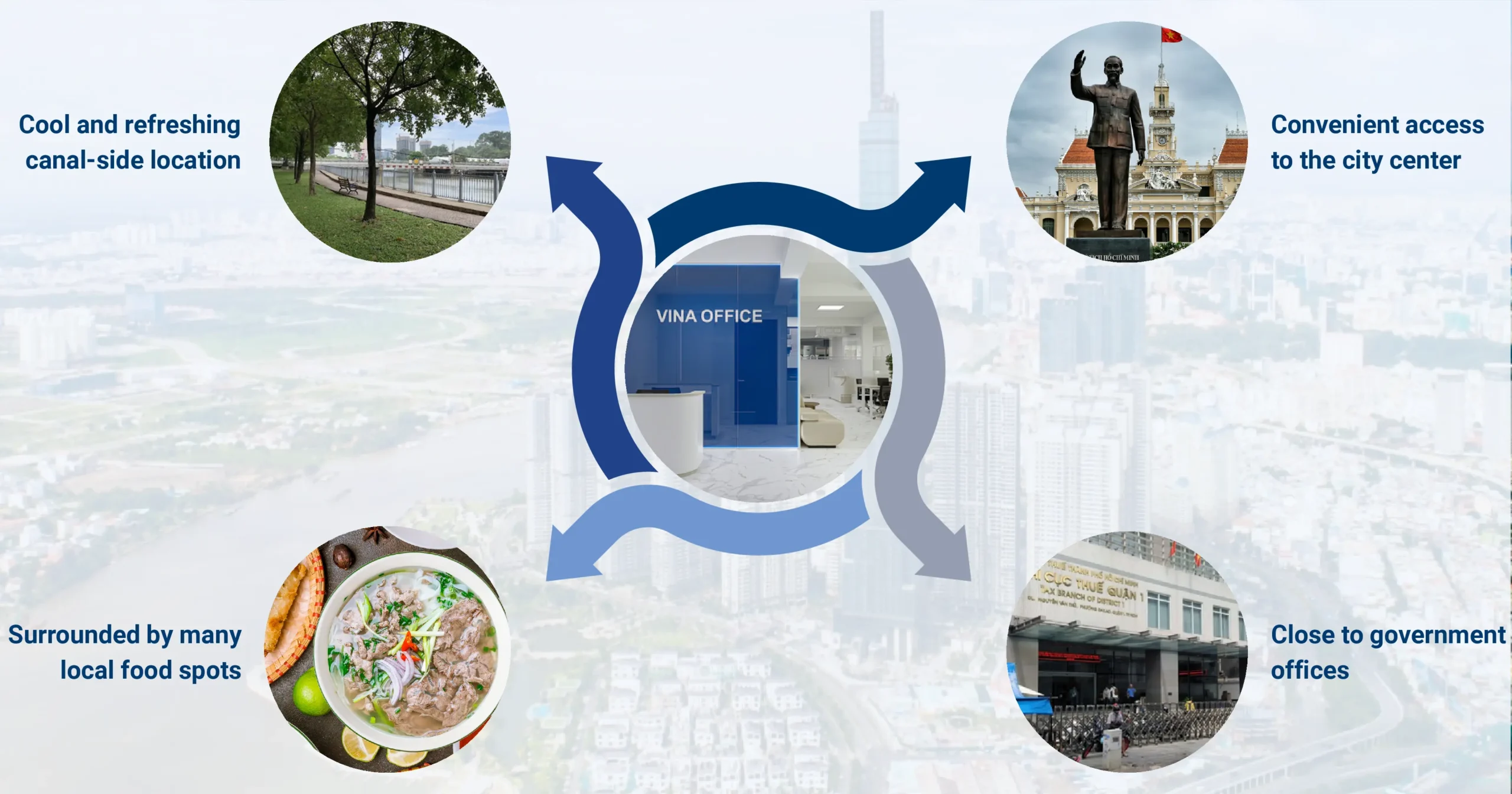
  • Flexible Connectivity: Located along the green Hoang Sa Canal, the space offers a quiet and airy atmosphere while still ensuring instant connectivity to key administrative and financial centers such as District 1, District 3, and Binh Thanh area.

This location enables the team to move easily, significantly reduces daily commuting time, and creates an extremely professional and polished first impression during meetings with clients and international partners.

Shared-Office-Ho-Chi-Minh-City-Vina-TPT-Workspace-for-Foreign-Companies

2. Flexible Workspace Options: Dedicated Desk & Private Office

Understanding the flexible nature of headcount among foreign enterprises when first entering the market, Vina TPT Shared Office provides two optimally designed space models:

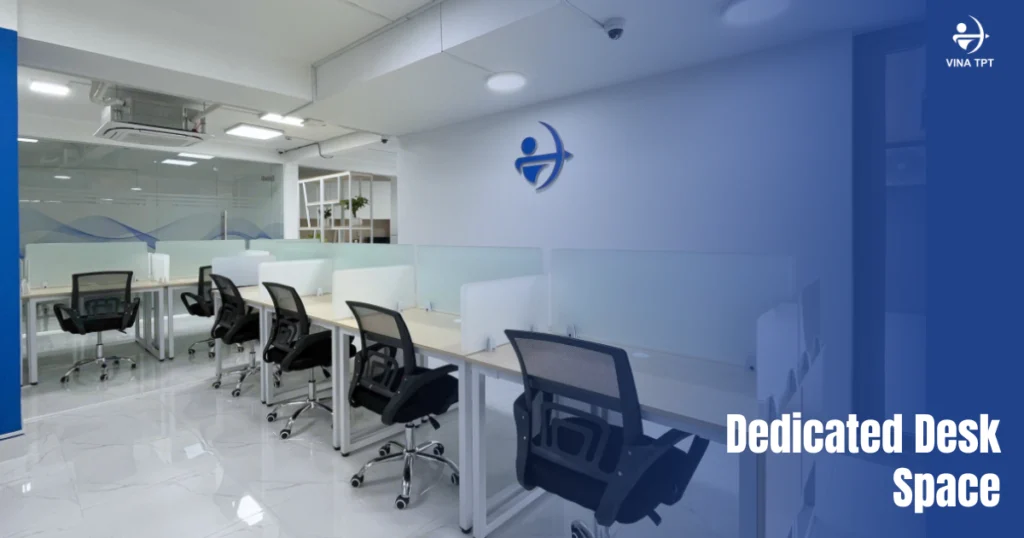
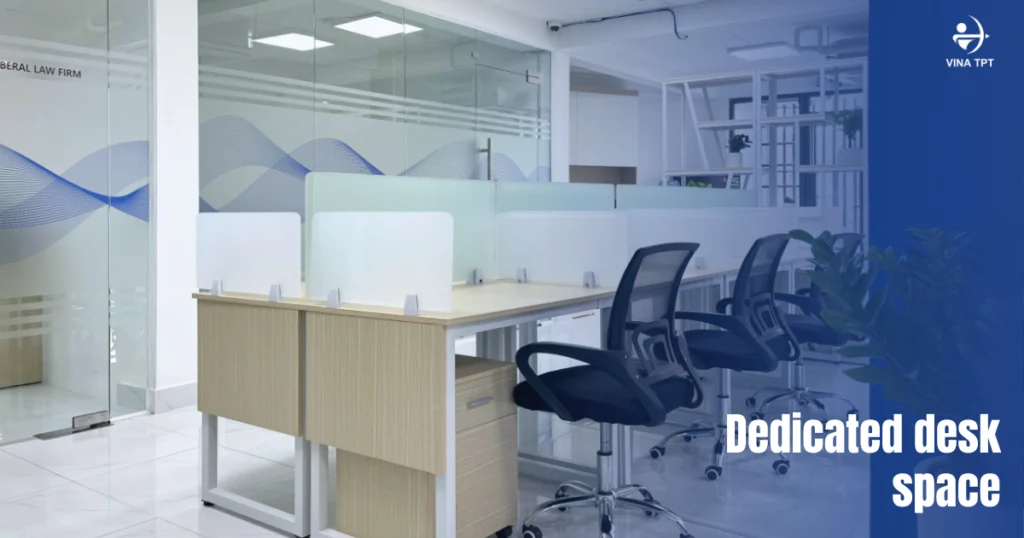
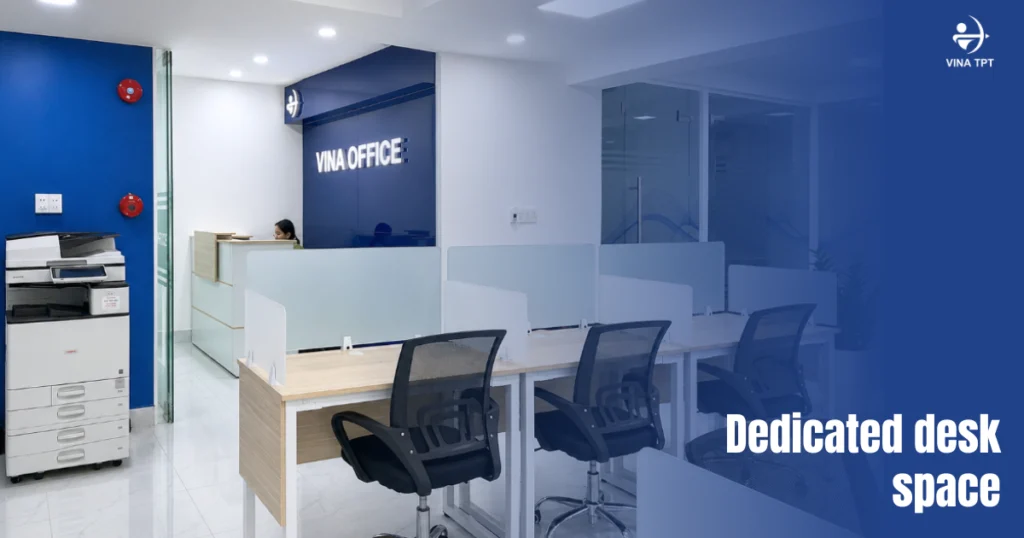
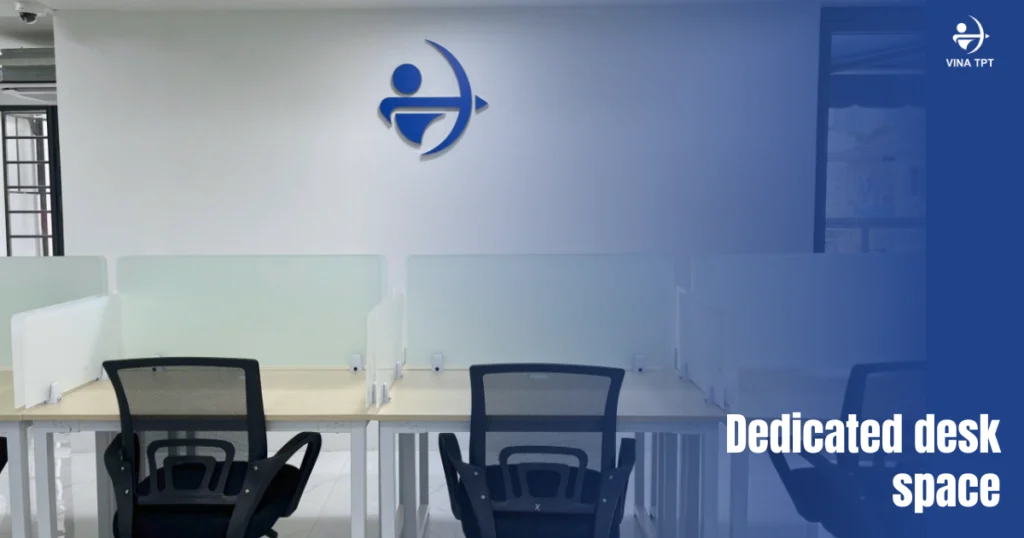
  • Dedicated Desk: A fixed individual workstation within a high-end shared space. This is the perfect choice for independent professionals, individual entrepreneurs, or lean teams of 1 to 3 people who need a focused, professional environment with full amenities.
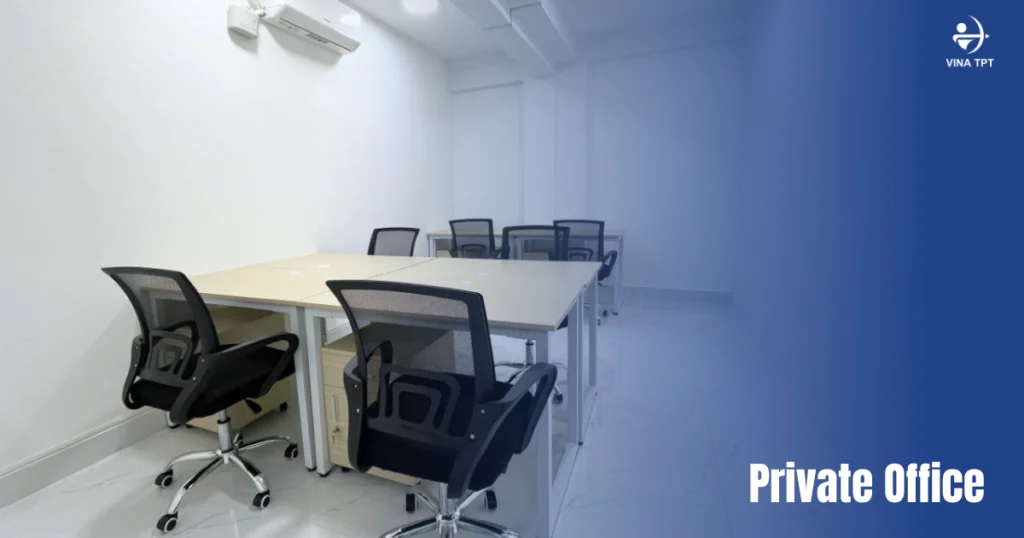
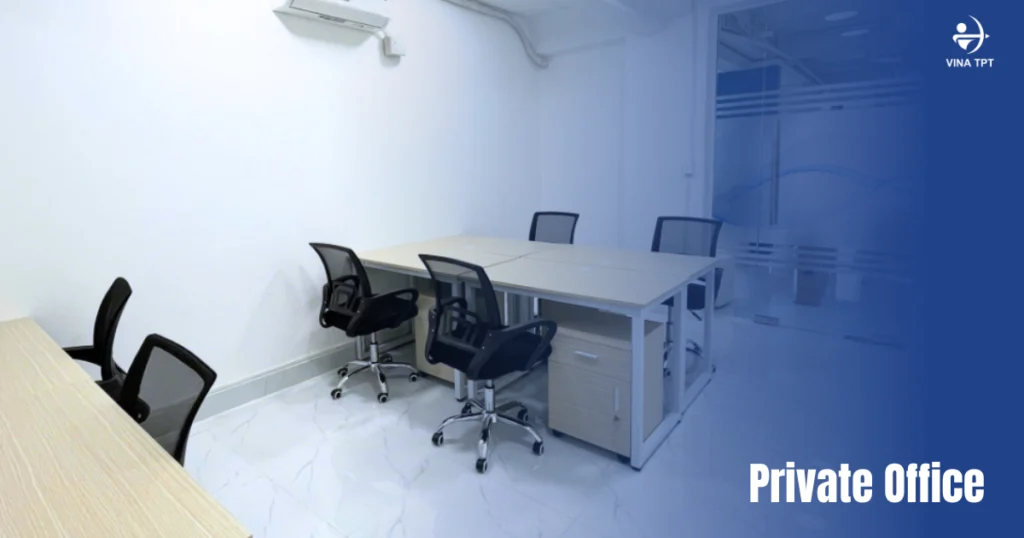
  • Private Office: Fully equipped private workspaces with 6 to 8 seats, featuring individual locking systems that ensure absolute information security. This model is specifically designed for FDI enterprises or branch offices that require a quiet internal discussion space and frequent client meetings.

The outstanding advantage of this model lies in its seamless scalability. Enterprises can start with a dedicated desk and easily upgrade to a private office within the same building as the team grows, ensuring continuity of operations without any disruption.

3. Fully Equipped Amenities for Daily Operations

All operational amenities at Vina TPT shared office Ho Chi Minh City are packaged into a transparent monthly fee, helping enterprises manage their budget clearly and completely eliminate hidden costs:

  • High-End Technical Infrastructure: Dedicated high-speed fiber optic internet, free lighting and air-conditioning systems.
  • Multilingual Reception Team: Professional receptionists who represent the enterprise in welcoming clients and handling daily correspondence and administrative parcels.
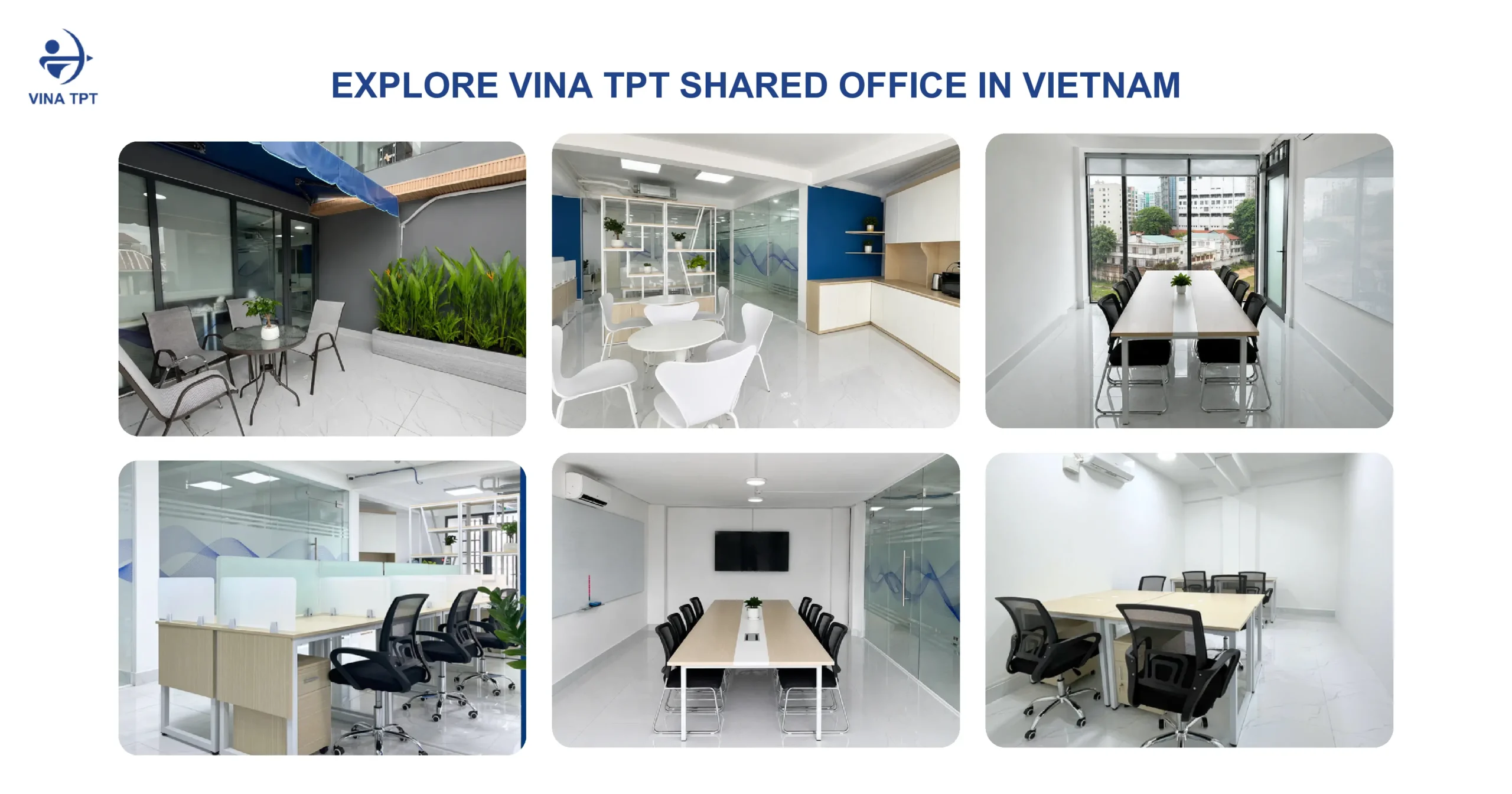
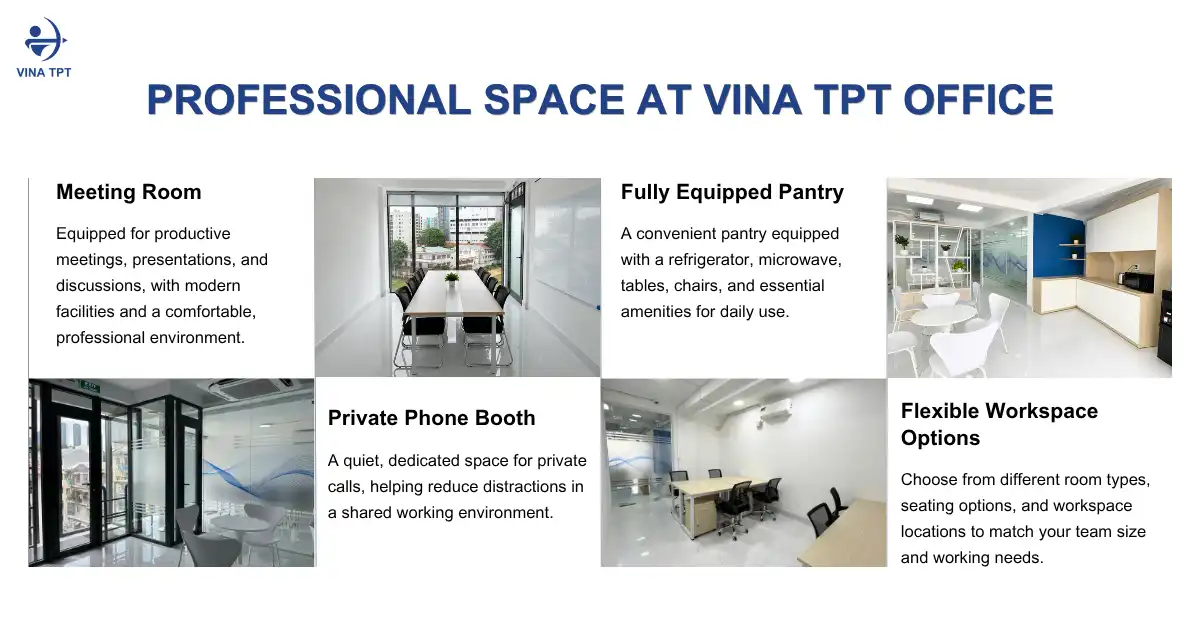
  • Integrated Meeting Room System: Elegant meeting rooms with a capacity of up to 15 people, fully equipped with presentation screens, whiteboards, and online conferencing devices.
  • Printing & Document Processing: High-capacity multifunction printers and scanners available in the shared area.
  • Pantry & Relaxation Zone: Complimentary high-quality tea and coffee, equipped with a refrigerator, microwave, and a refined lounge area for receiving guests.
  • Security & Parking: 24/7 security control system and convenient parking areas for motorcycles and cars for both employees and visitors.
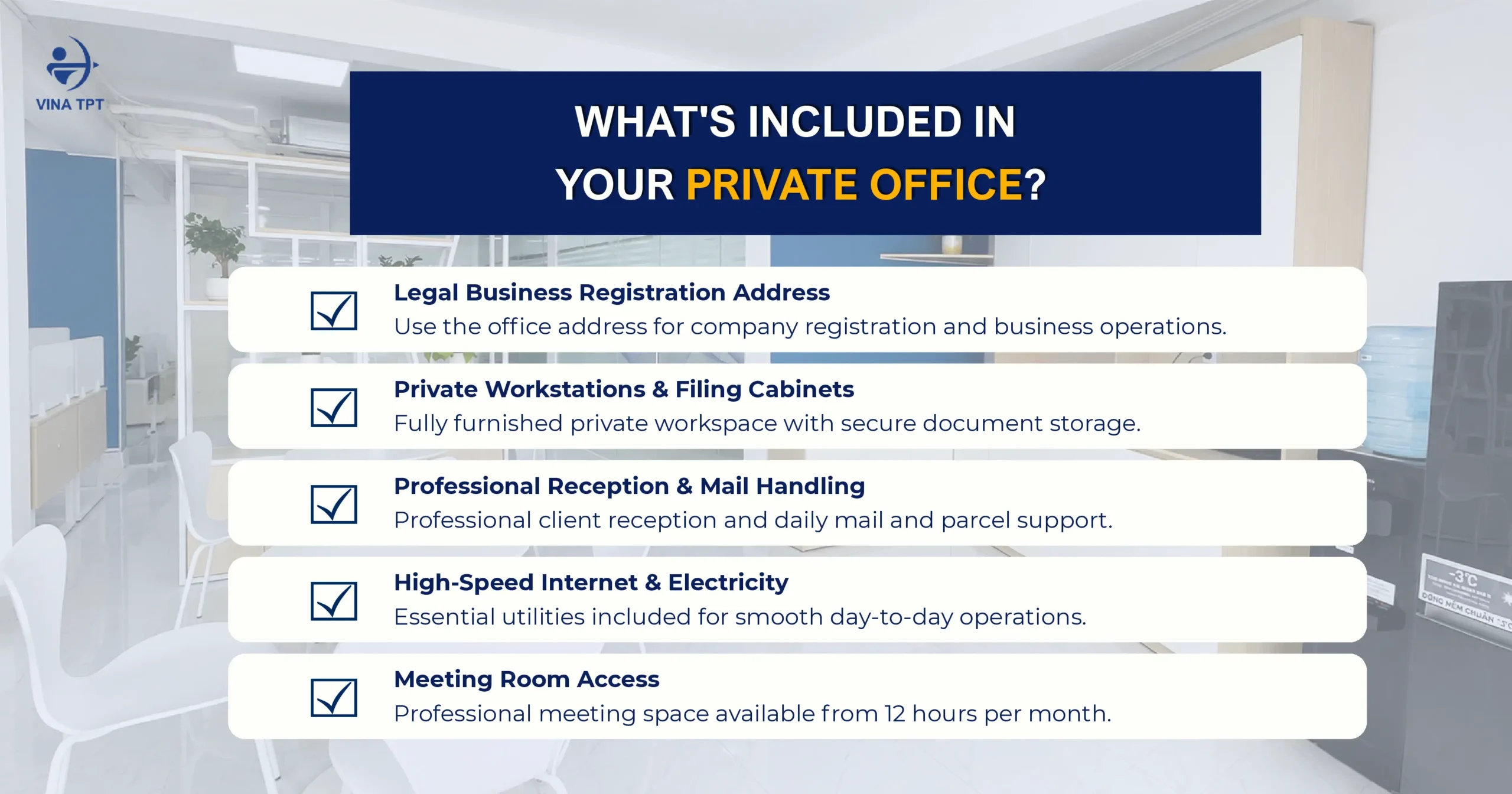
  • Legal Business Registration Address: Provision of a complete set of premises documents to support ERC, IRC licensing procedures and tax registration.


4. More Than Just a Shared Office – Complete Business Support

The greatest difference of Vina TPT Shared Office compared to pure office rental providers on the market is its deep integration within a full-package corporate service ecosystem.

When operating here, international investors not only secure an ideal workspace but also receive continuous legal and financial support:

  • Company Establishment Consulting: Full-package support for obtaining the Investment Registration Certificate (IRC) and the Enterprise Registration Certificate (ERC).
  • Accounting – Tax – Payroll Services: Expert teams directly handle tax declarations, prepare financial statements, manage payroll, and process social insurance for employees.
  • Ensuring Legal Compliance: Consulting and representation of the enterprise in dealings with state management authorities, including support for Work Permit and Temporary Residence Card (TRC) procedures for foreign personnel.

The strategic benefit for investors is the ability to work with a single partner for the entire office infrastructure and operational procedures, optimizing management costs and completely eliminating risks that arise from coordinating with multiple separate third parties.

5. Who Is Vina TPT Shared Office Suitable For?

The shared office Ho Chi Minh City model of Vina TPT is specifically tailored to optimally serve the following groups of enterprises:

  • Foreign direct investment (FDI) companies newly entering the Vietnamese market that need a legal headquarters to carry out IRC and ERC licensing procedures.
  • Startups and small-to-medium enterprises (SMEs) seeking a flexible space solution to minimize initial capital expenditure (CAPEX).
  • International corporations that need to establish a representative office or short-term project team in Ho Chi Minh City within a secure and professional private office space.
  • Organizations looking for a fully integrated service solution that perfectly combines shared office space with professional accounting–tax and human resource–payroll management systems.

Contact Vina TPT today for a free consultation, to schedule an on-site visit of the Private Office & Dedicated Desk spaces, and to receive the most preferential quotation.

BOOK A FREE CONSULTATION

VAT Rate in Vietnam: Complete Guide to Value Added Tax Regulations

VAT Rate in Vietnam: Complete Guide to Value Added Tax Regulations

VAT Rate in Vietnam: Complete Guide to Value Added Tax Regulations

In corporate governance and financial compliance activities in Vietnam, accurately determining the VAT rate is not only a mandatory legal requirement but also a factor that directly influences pricing strategy, tax declaration efficiency, and cash flow circulation. Especially for foreign direct investment (FDI) enterprises, this tax requires the highest level of caution to minimize the risk of tax recovery or administrative penalties during operations.

Value Added Tax (VAT), or value added tax, is an important indirect tax that makes a major contribution to the state budget. It is calculated on the added value of goods and services arising throughout the entire process from production and distribution to consumption. To help enterprises gain a comprehensive understanding, this article compiles the latest regulations on the VAT rate Vietnam, provides a detailed analysis of the applicable tax rates in 2026, policy exemption and reduction cases, as well as core notes to help foreign investors ensure absolute legal compliance.

1. What is Value Added Tax (VAT) in Vietnam?

According to the Law on Value Added Tax of Vietnam, value added tax Vietnam is a tax applied to most types of goods and services used for production, business, and consumption purposes within the territory of Vietnam. The taxable objects cover a wide range, from domestic consumer goods to commercial services, excluding those items listed as non-taxable under specific provisions of the law.

Taxable subjects are defined as all organizations and individuals engaged in the production or trading of goods and services subject to VAT, or entities that import goods from abroad into Vietnam. From an economic management perspective, VAT not only ensures a stable and sustainable source of revenue for the national budget but also creates a transparent financial management mechanism through the invoice and supporting document system. A clear understanding of the nature of VAT will help foreign managers become more proactive in optimizing input costs and establishing standard compliance processes.

2. Current VAT Rates in Vietnam

The legal framework on the VAT rate Vietnam in 2026 categorizes goods and services into specialized tax rate groups in order to regulate the economy and support social welfare. The current system consists of three main tax rates along with a non-taxable group.

2.1. Standard Tax Rate of 10% and the Temporary Reduction Policy to 8% until the End of 2026

The 10% tax rate applies to most ordinary goods and services that fall outside preferential or export categories. However, to continue stimulating domestic consumption and supporting enterprises in production recovery, the Government has approved a temporary reduction of the VAT rate from 10% to 8%, which remains effective until 31 December 2026.

Enterprises should note that this 8% reduction policy does not apply universally across all sectors. Certain groups of goods and services are still required to apply the standard 10% rate, including:

  • Telecommunications services, financial activities, banking, securities, and insurance.
  • Real estate business and products from metals or mining products (excluding coal).
  • Goods subject to Special Consumption Tax (SCT) such as alcohol, beer, tobacco, and automobiles with fewer than 24 seats.

VAT Rate

Main Scope of Application

Practical Examples

8% (Until 31/12/2026) Ordinary consumer goods and services normally subject to 10% that are eligible for reduction. Consumer goods, food & beverage services, domestic logistics, processing manufacturing.
10% (Standard) Specific sectors not eligible for the VAT reduction. Telecommunications, banking, real estate, goods subject to Special Consumption Tax.
5% Essential goods and services, agriculture, healthcare, and education. Clean water, medical equipment, medicines, fertilizers, social housing.
0% Goods and services exported abroad or to non-tariff zones. Exported goods, international transportation, services provided to foreign partners.

2.2. Goods and Services Subject to 5% VAT Rate

The 5% tax rate is a preferential policy of the State applicable to groups of essential goods and services that serve people’s livelihoods, agricultural development, and social infrastructure. Common groups include:

Clean water used for production and daily living purposes (excluding bottled or containerized drinking water). Fertilizers, plant protection products, plant and animal growth stimulants. Medicines, vaccines, medical biological products, and specialized medical equipment and instruments. Teaching aids, educational materials, and specialized books. Certain agricultural, forestry, and aquatic products that have not been processed or have only undergone ordinary preliminary processing at the commercial trading stage, as well as social housing sale and lease projects as prescribed.

VAT Rate in Vietnam: Complete Guide to Value Added Tax Regulations

2.3. 0% VAT Rate and Exempt Cases

The 0% tax rate is designed to encourage export activities and enhance the competitiveness of Vietnamese products in the international market. The scope of application of the 0% rate includes goods exported abroad, goods sold into non-tariff zones for export production, international transportation services, and services provided directly to organizations and individuals overseas.

In addition, the law also specifies a list of VAT-exempt objects, such as self-produced agricultural products sold by the producers themselves, transfer of land use rights, credit services, securities, life insurance, and public healthcare and education services.

Core distinction between “0% Tax Rate” and “VAT-Exempt”:

  • 0% Tax Rate: The enterprise remains within the scope of VAT, and is therefore entitled to deduct and fully refund all input VAT paid on related production and business costs.
  • VAT-Exempt: The enterprise does not charge output VAT, but at the same time is not entitled to deduct or refund input VAT. This input tax must be included in production and business costs or the original cost of assets.

3. Key Compliance Requirements Related to VAT Rate

To maintain legal compliance and optimize the amount of deductible tax, enterprises must strictly comply with the current tax administration regulations:

Enterprises must fulfill their VAT declaration and payment obligations on a monthly or quarterly basis, depending on the total revenue of the immediately preceding year (enterprises with annual revenue of VND 50 billion or more are required to declare monthly). To be eligible for input VAT deduction, the enterprise must fully meet three mandatory conditions: possession of a valid VAT invoice; non-cash payment documents for invoices valued at VND 5 million or more (including tax); and the purchased goods or services must be used directly for the production or trading of goods and services subject to VAT.

In addition, the use of electronic invoices (with or without the tax authority’s code) is 100% mandatory. If an enterprise applies an incorrect VAT rate (for example, issuing an invoice at 8% for goods subject to the 10% rate), the enterprise will not only have to pay the underpaid tax and late payment interest but will also face serious administrative tax penalties.

EXPLORE TAX FILLING SERVICES

4. Practical Tips for Foreign Companies

To minimize financial errors when operating a business in Vietnam, foreign managers should keep the following practical experiences in mind:

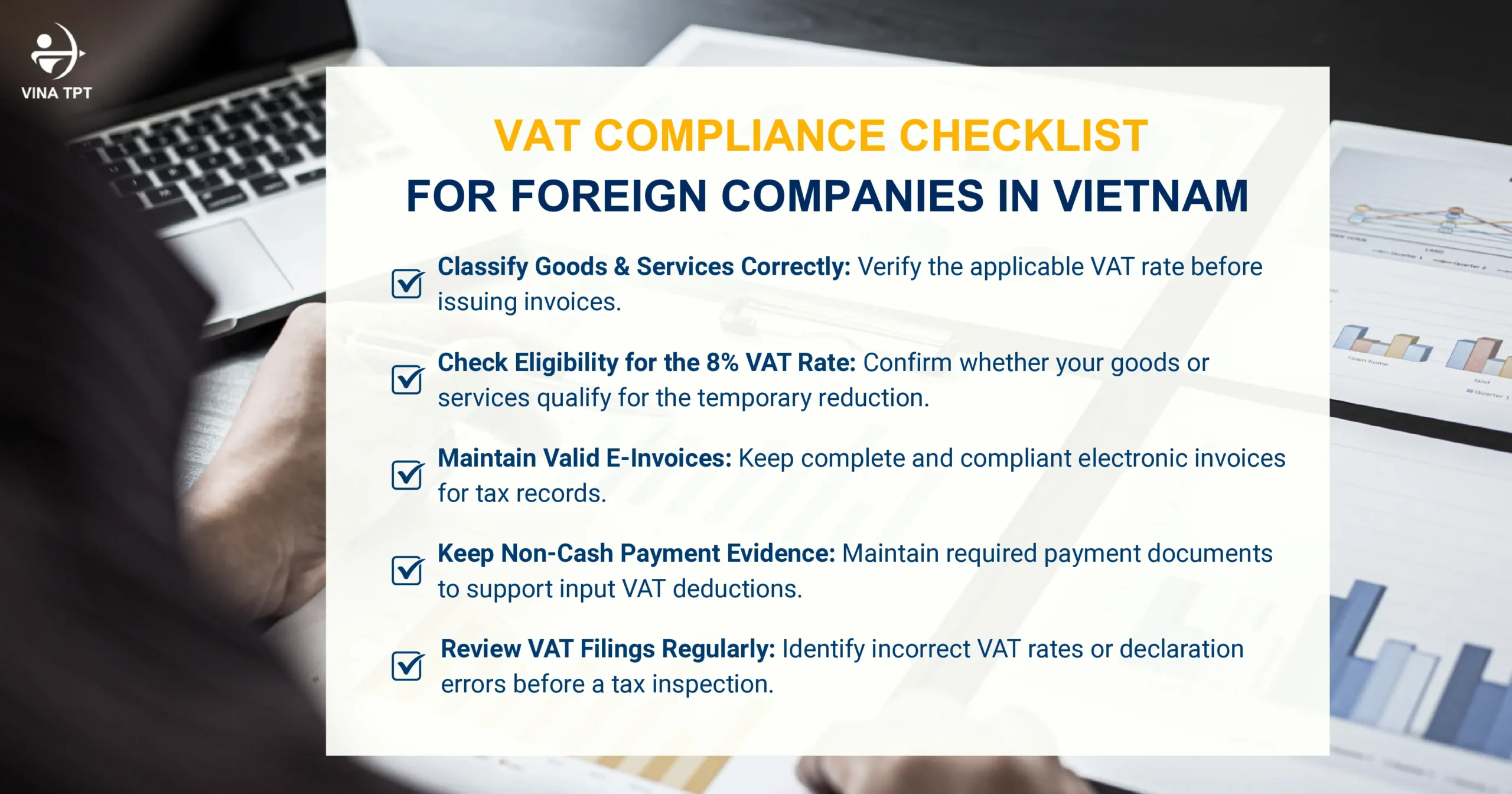
Establish a process to accurately check and classify the enterprise’s goods and service categories right from the input stage. Because the 8% tax reduction policy contains many complex exceptions, the accounting department must carefully cross-check the economic industry codes and HS codes of the products to apply the correct tax rate.

Systematically store and organize all electronic invoices together with bank payment documents. This is the only legal basis that enables the enterprise to protect its rights to input VAT deduction and refund when the competent authorities conduct tax inspections or audits.

Proactively carry out periodic internal tax reviews (tax audits) of the tax declaration process to detect and correct errors in a timely manner before the Tax Authorities issue an inspection decision. In cases where the internal team does not have a deep understanding of the local tax legal system, the enterprise should consider cooperating with professional tax agency firms to ensure operational safety.

VAT Rate in Vietnam: Complete Guide to Value Added Tax Regulations

5. How Vina TPT Supports VAT Compliance

As a reputable firm specializing in financial consulting and tax compliance for FDI enterprises, Vina TPT provides comprehensive support solutions that help businesses optimize their VAT processes:

  • Tax Rate Consulting & Classification: Accurate assessment of product categories and advice on applying the correct VAT rate (clearly distinguishing between the 8%, 10%, 5%, and 0% groups).
  • Periodic Tax Declaration & Reporting: Preparation and submission of accurate monthly/quarterly VAT declarations in full compliance with statutory deadlines.
  • Input Deduction Review & Tax Refund Services: Appraisal of input invoice dossiers and representation of the enterprise in carrying out VAT refund procedures for investment projects and export activities.
  • Support During Tax Inspections: Direct explanation, protection of data, and safeguarding of the enterprise’s legitimate rights before the tax management authorities.

Conclusion

In summary, mastering the regulations on the VAT rate and accurately complying with the VAT declaration process is the golden key that enables FDI enterprises to operate safely, transparently, and sustainably in Vietnam.

Is your enterprise facing difficulties in determining the correct VAT rate or in need of professional tax declaration support? Contact Vina TPT today for a free consultation and experience our standard full-package accounting and tax services.

BOOK A FREE CONSULTATION

How to Register a Company in Vietnam: Complete Guide to IRC and ERC for Foreign Investors

How-to-Register-a-Company-in-Vietnam-Complete-Guide-to-IRC-and-ERC-for-Foreign-Investors

How-to-Register-a-Company-in-Vietnam-Complete-Guide-to-IRC-and-ERC-for-Foreign-Investors

For international investors, the decision to register a company in Vietnam is a strategic step toward unlocking the dynamic growth potential of the Southeast Asian market. However, establishing a commercial presence here requires the enterprise to complete two foundational legal procedures: obtaining the Investment Registration Certificate (IRC) and the Enterprise Registration Certificate (ERC). These two documents constitute the highest legal basis confirming the foreign investor’s operational status and project ownership rights.

A thorough understanding of the legal nature of these certificates and accurate dossier preparation from the very first step will help investors minimize appraisal time, avoid administrative obstacles, and bring the project into official operation as quickly as possible. This article provides a comprehensive practical guide covering the process of how to register a company in Vietnam, the mandatory list of documents, implementation timelines, and the most effective cost-optimization solutions.

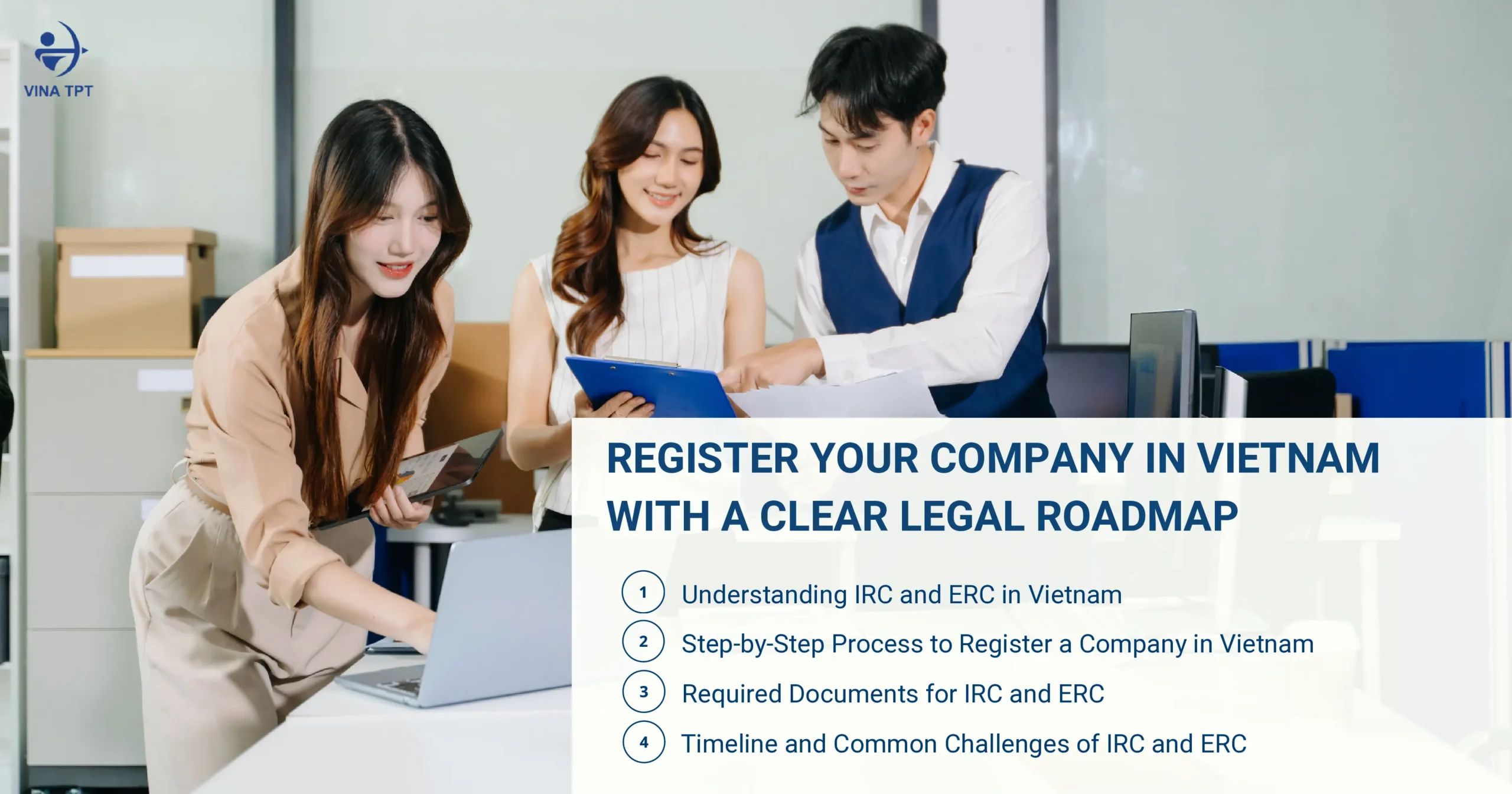
1. Understanding IRC and ERC to Register Company in Vietnam

Before commencing any legal procedures, investors need to clearly distinguish the specialized roles as well as the interconnected relationship between the two core certificates in Vietnam’s investment legal system.

  • Investment Registration Certificate (IRC) is the Investment Registration Certificate, a mandatory document for most foreign direct investment (FDI) projects. This certificate records detailed information about the investment project, including project objectives, investment capital scale, capital contribution schedule, project location, and related investment incentives. The IRC serves as the “passport” confirming that the foreign project fully meets the conditions for market entry into Vietnam.
  • Enterprise Registration Certificate (ERC) is the Enterprise Registration Certificate, the official document that records the establishment of the company’s legal entity. The ERC contains basic information including the company name, enterprise code (which also serves as the tax identification number), head office address, legal representative, and charter capital. Once the ERC is issued, the enterprise officially acquires independent legal entity status and full rights and obligations under the Law on Enterprises.

Regarding their legal relationship, the IRC ERC Vietnam procedures are closely linked. Normally, the IRC is a prerequisite for the competent authority to issue the ERC. However, under current investment law updates, the process has become more flexible for certain service sectors, allowing optimization of the licensing sequence to help investors shorten the time required to launch business operations.

How-to-Register-a-Company-in-Vietnam-Complete-Guide-to-IRC-and-ERC-for-Foreign-Investors

2. Step-by-Step Process to Register a Company in Vietnam

The standardized process answering the question of how to register a company in Vietnam for foreign investors consists of the following 5 core stages:

Step 1: Industry Survey and Preparation of the Investment Dossier

Before commencing the company establishment procedures, the investor needs to accurately determine the business industry codes according to the Vietnam Standard Industrial Classification (VSIC) and cross-check them against the WTO Commitments Schedule and the Law on Investment to verify market access conditions. Certain sectors classified as conditional business lines will require additional specialized licenses or compliance with standards related to capital, personnel, and facilities. At this stage, the investor is advised to contact a local consulting firm for support in reviewing the industry codes and assessing the project’s feasibility.

After identifying the suitable industry, the investor proceeds to prepare the investment dossier under the guidance of the service provider. Documents of the investor (whether an individual or an organization) must be consular-legalized abroad before being brought to Vietnam for use. The consular legalization process usually takes 14 to 30 days, depending on the procedures of each embassy/consulate and the respective country.

Step 2: Submission of the Application for the Investment Registration Certificate (IRC)

The investment dossier is submitted to the Department of Finance. The competent authority will appraise the market conditions, project location, and the investor’s financial capacity before officially issuing the IRC.

—> Estimated time: 30 – 45 working days.

Step 3: Submission of the Application for the Enterprise Registration Certificate (ERC)

After obtaining the IRC, the enterprise submits the legal entity establishment dossier to apply for the ERC. The business registration authority will appraise the company name, head office address, and governance structure. Once the ERC is completed, the enterprise code is simultaneously created on the National Business Registration Information System.

—> Estimated time: 14 – 20 working days.

Step 4: Opening a Bank Account, Engraving the Company Seal, and Making Capital Contribution

The enterprise proceeds to engrave the legal seal, publish the seal specimen, and open a Direct Investment Capital Account (DICA) at a commercial bank licensed to operate in Vietnam. Under the law, the investor must complete the transfer of the entire committed charter capital into the DICA within a maximum of 90 days from the date the ERC is issued.

—>Implementation time: Within 90 days as prescribed by law.

Step 5: Completion of Tax Registration and Post-Establishment Compliance

The enterprise purchases a digital signature (USB Token), installs the company signboard at the head office, carries out initial tax registration, submits the business license fee declaration, and registers the electronic invoice system. At the same time, the company completes labor registration and social insurance procedures if employees are officially hired, and registers the enterprise electronic identity account (VNeID for enterprises) to facilitate electronic administrative procedures and transactions with state authorities.

—> Estimated time: 7-10 working days.

3. Required Documents to Register Company in Vietnam

The list of documents prepared for the IRC ERC Vietnam process is specifically categorized based on the legal status of the investing entity:

For Individual Investors:

  • A copy of a valid passport (notarized as required).
  • Documents proving financial capacity: Bank account statement or bank balance confirmation letter showing an amount equivalent to or greater than the total expected investment capital.
  • Investment Project Proposal: Clearly stating the objectives, scale, investment capital, capital mobilization plan, and project location.
  • Headquarters location dossier: Office lease agreement and documents proving the lessor’s lawful right to use the premises (Land Use Rights Certificate, building construction permit).

For Organizational / Corporate Investors:

  • A copy of the Enterprise Registration Certificate, Business Extract, or parent company Charter (must be consular-legalized and notarized translation into Vietnamese).
  • Audited financial statements of the parent company for the two most recent years to prove financial capacity.
  • Power of attorney authorizing the representative to manage the capital contribution and a copy of the authorized representative’s passport.
  • Investment Project Proposal and the dossier proving the legality of the head office location in Vietnam.

EXPLORE OUR COMPANY SETUP SERVICE

4. Timeline and Common Challenges When Registering a Company in Vietnam

Although the statutory total time to complete both certificates is approximately 4 to 6 weeks, in practice the process may be faster or take longer depending on the completeness of the dossier and any administrative obstacles that arise:

  • Appraisal of Conditional Business Lines: Sectors such as real estate, education, healthcare, and wholesale/retail of goods often require inter-ministerial consultation, causing the IRC processing time to extend beyond the expected timeline.
  • Unconvincing Financial Dossier: Licensing authorities reject applications due to unclear proof of capital sources or bank balances that do not match the capital contribution schedule registered in the Investment Project Proposal.
  • Delays in Consular Legalization: Documents originating from the investor’s home country are prepared incorrectly, missing the authentication seals of the Ministry of Foreign Affairs or the Vietnamese Embassy/Consulate in the host country.
  • Headquarters Address Issues: The registered address does not meet legal standards, is located in a residential apartment building, or the lessor fails to provide sufficient documents proving the right to operate the premises.

5. Practical Tips to Register Company in Vietnam Smoothly

To ensure the process of registering a company in Vietnam proceeds smoothly while saving time and budget, investors should apply the following practical recommendations:

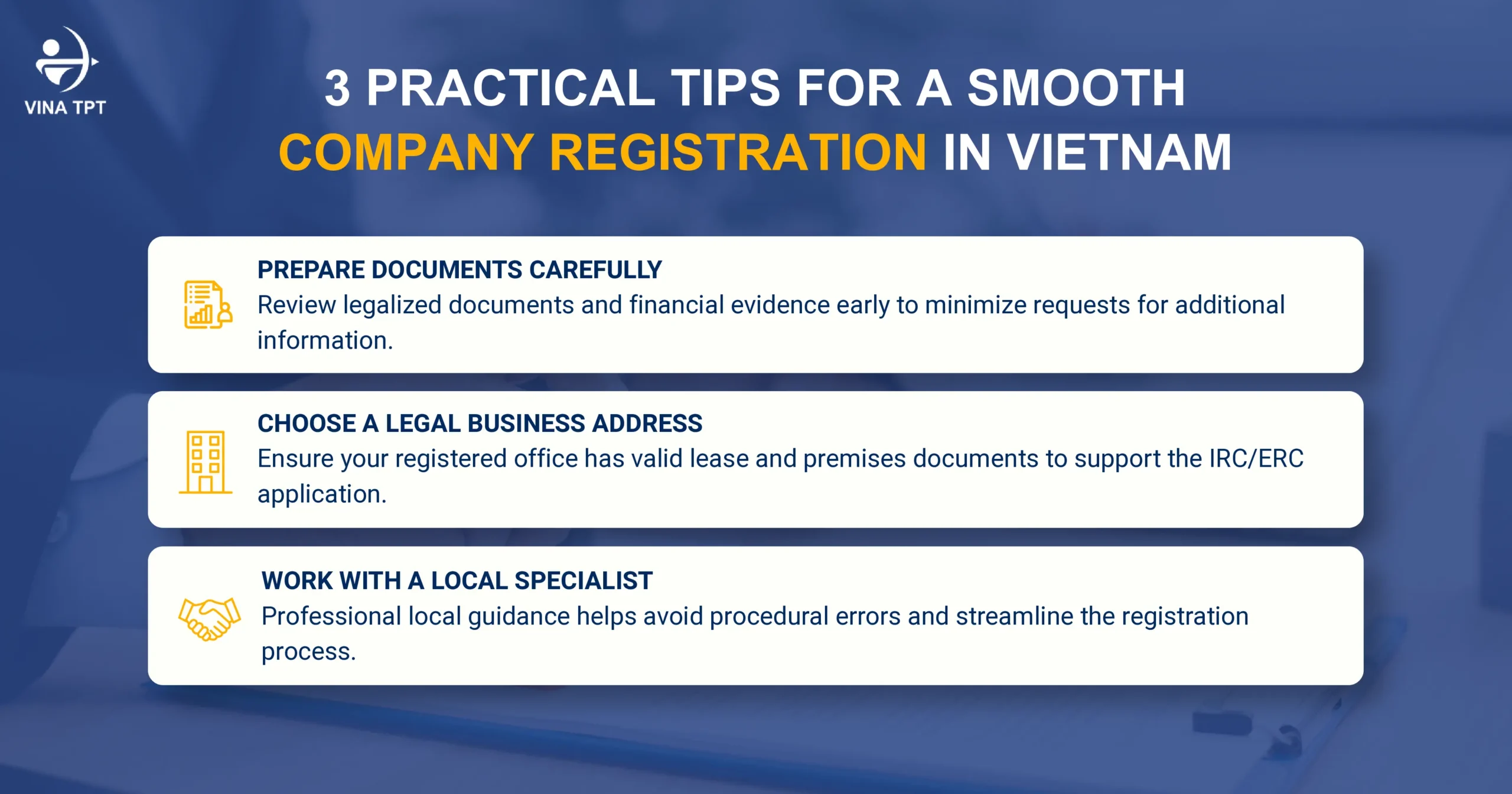
Optimize dossier preparation by thoroughly reviewing consular-legalized documents right from the home country. Preparing a detailed Investment Project Proposal with clear arguments demonstrating financial capacity will help minimize the risk of repeated requests for supplementary explanations from the competent authorities.

Utilize a legal business registration address solution from reputable shared office models, such as Vina TPT’s shared office. This approach helps the enterprise optimize fixed costs in the initial stage while ensuring a complete set of documents proving lawful use of the premises that meet the standards required for submission with the IRC/ERC dossier.

Partner with a consulting firm that has strong professional expertise in FDI investment advisory. The deep understanding of local procedures possessed by the expert team will help the enterprise shape an optimal legal structure and significantly shorten the dossier processing time.

How-to-Register-a-Company-in-Vietnam-Complete-Guide-to-IRC-and-ERC-for-Foreign-Investors

6. How Vina TPT Helps Foreign Investors Register Company (IRC ERC Vietnam)

With extensive experience supporting hundreds of international investment projects, Vina TPT delivers a full-package solution that helps foreign investors register a company in Vietnam in the safest and most professional manner:

  • Investment Structure & Industry Consulting: Assessment of market access conditions, advice on selecting suitable industry codes, and establishment of an optimal corporate governance model.
  • Full-Package IRC & ERC Dossier Service: Drafting of the entire document list and representation of the investor in direct dealings with the Department of Planning and Investment to obtain the certificates promptly.
  • Legal Business Registration Address Solution: Provision of a prestigious Shared Office service in central Ho Chi Minh City that fully meets 100% of the legal conditions for IRC and ERC licensing as well as bank account opening.
  • Integrated Post-Establishment Ecosystem: Continued support for the enterprise in fulfilling compliance obligations related to Tax, Accounting, Payroll Management, Social Insurance, and Legal Representative services.
  • Multilingual Expert Team: Transparent and direct consulting in English, Vietnamese, Japanese, and Chinese, completely eliminating language barriers for foreign investors.

Conclusion

The process of registering a company in Vietnam through the issuance of the IRC ERC Vietnam certificates is a critical starting milestone that lays a solid foundation for the enterprise’s growth in the Vietnamese market.

Are you looking for a reliable partner to turn your investment and business plans into reality? Contact Vina TPT today for a free consultation and experience comprehensive FDI company establishment services.

BOOK A FREE CONSULTATION

How-to-Register-a-Company-in-Vietnam-Complete-Guide-to-IRC-and-ERC-for-Foreign-Investors

Is a Shared Office a Valid Company Registration Address?

Is-a-Shared-Office-a-Valid-Company-Registration-Address

Is-a-Vina-tPT-Shared-Office-a-Valid-Company-Registration-Address

Many foreign investors preparing to establish a company in Vietnam often face a core question: “Is a shared office model accepted as a legal company registration address under current Vietnamese law?”

This is a particularly important legal issue, as the company registration address plays a decisive role in the appraisal of applications for the Investment Registration Certificate (IRC) and Enterprise Registration Certificate (ERC). It also directly affects all subsequent tax declaration procedures and bank account opening processes.

The article below will provide a detailed answer to this question, while offering a comprehensive perspective on the legal conditions, operational benefits, and key considerations for investors when choosing this model.

1. What is a Company Registration Address in Vietnam?

According to the provisions of the Law on Enterprises of Vietnam, the enterprise registration address (head office) is the actual contact location of the enterprise within the territory of Vietnam. The address must be clearly identified, including house number, alley, lane, street, road, or village, hamlet, commune, ward, town, district, urban district, town, provincial city, province, or centrally governed city.

A legally compliant headquarters address must meet the following basic requirements:

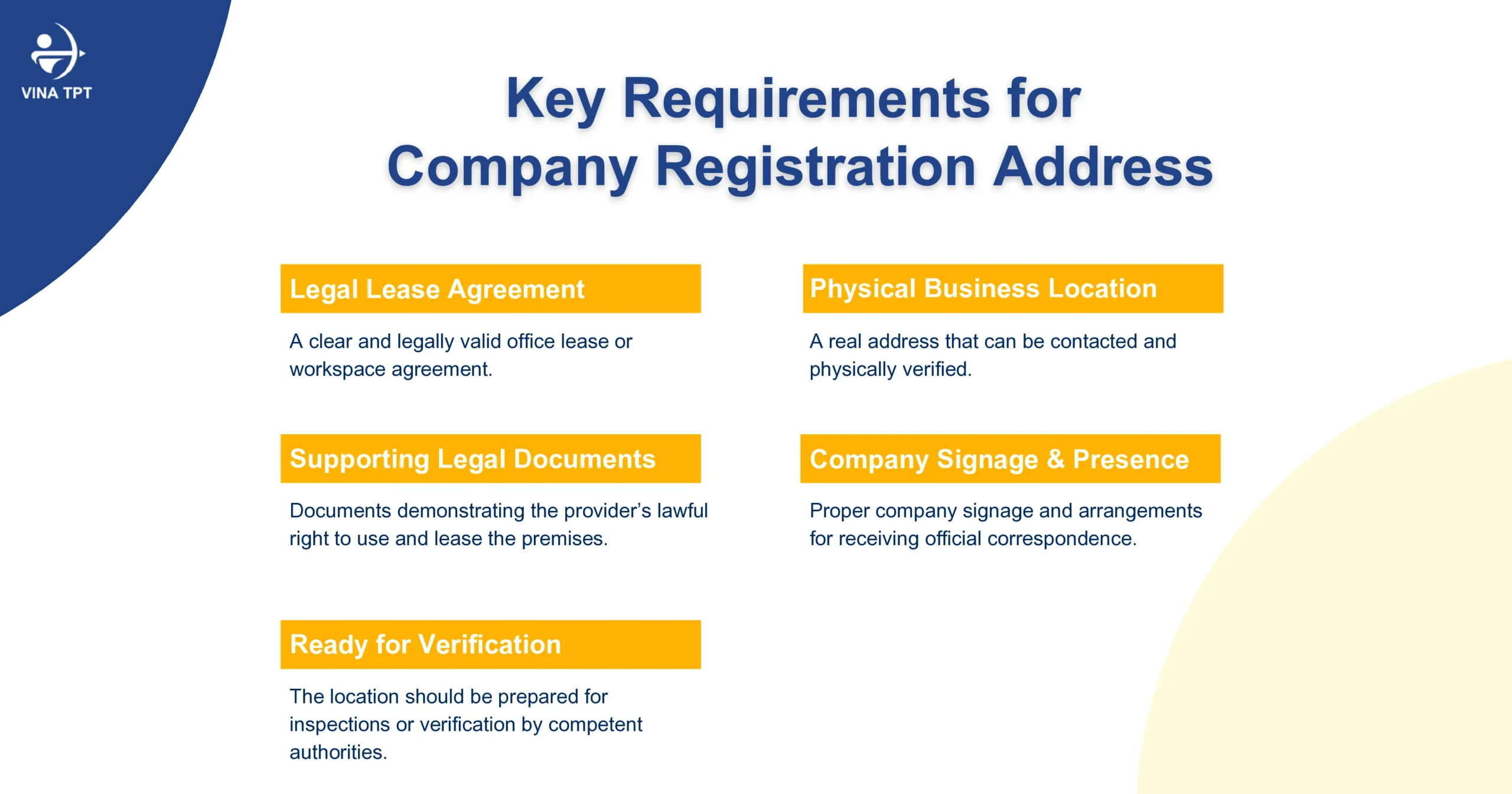
  • Actual Presence: It must be a real location that can be contacted and can easily receive administrative notices and correspondence.
  • Legal Right of Use: The enterprise must prove its lawful right of use through a lease agreement, borrowing agreement, or the lessor’s ownership certificate.
  • Safety & Fire Prevention: The headquarters building must fully comply with standards on structural safety, fire prevention and fighting (PCCC), and land-use planning under construction law.

The registration address is not only the basis for state management authorities to issue the operating license (ERC), but also the legal foundation for the tax authorities to exercise direct management, for banks to appraise corporate bank account opening dossiers, and a cornerstone of trust when establishing transactions with business partners.

2. Can a Shared Office Be Used as a Company Registration Address?

According to the Law on Enterprises, the enterprise registration address (head office) must be the actual contact address of the enterprise within the territory of Vietnam. This address must be clearly identified (house number, street, ward/commune, district, province/city) and meet the following basic conditions:

  • Actual Presence: It must be a real location that can be contacted and can receive administrative notices and correspondence.
  • Legal Right of Use: The enterprise must prove its lawful right of use through a lease agreement, borrowing agreement, or documents proving the lessor’s ownership rights.
  • Safety & Fire Prevention and Fighting: The building/headquarters must comply with standards on structural safety, fire prevention and fighting (PCCC), and planning under construction law.

Therefore, a shared office can fully be used as a company registration address if it meets all the conditions listed above.

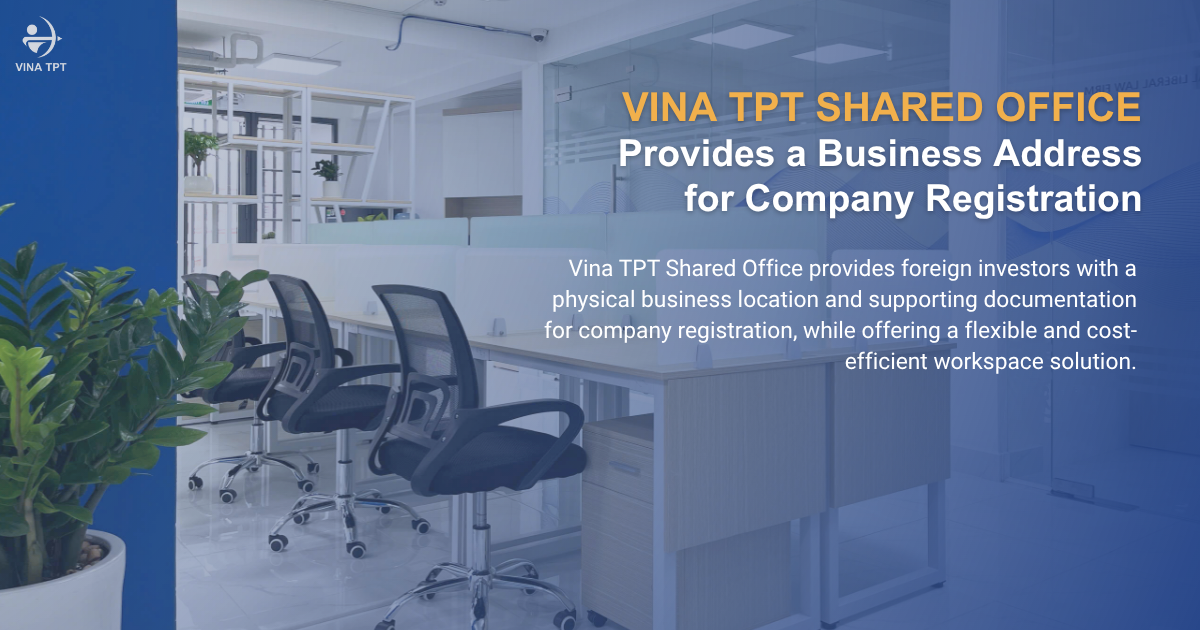
In practice, professional shared office providers supporting FDI enterprises can provide a company registration address that meets these requirements, subject to the legal status and documentation of the specific premises.

Is-a-Shared-Office-a-Valid-Company-Registration-Address

3. Benefits of Using a Shared Office as a Company Registration Address

Choosing a shared office as a company registration address can deliver significant financial and operational benefits for foreign investors entering the Vietnamese market. The most easily recognizable benefit is the ability to optimize operating budgets, enabling the enterprise to save up to 80% of costs compared to signing a long-term contract to lease and fit out a traditional office space solely for the purpose of obtaining a business registration location.

Beyond the cost equation, this solution also elevates brand positioning, as the enterprise naturally owns a transaction address located in prestigious high-rise buildings in the city center. This professional presence builds significant trust among partners, clients, and regulatory authorities alike. Furthermore, the flexibility of shared offices allows the enterprise to easily expand its workspace as headcount grows without disrupting the original legal structure. Most importantly, the use of a well-managed actual workspace helps the enterprise maintain continuous legal compliance and completely eliminates the risk of having its Tax Identification Number (MST) locked due to suspicions of non-operation at the registered headquarters.

4. Risks When Choosing a Company Registration Address

Although using shared space as a headquarters address is legal, investors still need to exercise caution regarding potential operational risks:

  • Lessor Lacking Legal Capacity: Some small-scale space providers do not have the legal function or permission from the building owner to sublease, resulting in the business registration dossier being rejected by the Department of Planning and Investment.
  • Address Listed on Tax Warning Lists: If a location has too many “shell” companies registered but not actually operating, the tax authorities may place that address under priority inspection, affecting the company’s ability to issue electronic invoices.
  • Lack of Support During On-Site Inspections: When state management authorities conduct unannounced inspections, if the lessor does not assist in verifying the enterprise’s presence, the company risks having its Tax Identification Number locked due to “non-operation at the registered address.”

Is a Shared Office a Valid Company Registration Address (2)

6. How Vina TPT Shared Office Supports Company Registration

Vina TPT provides a full-package solution that supports company registration in combination with shared office rental services for foreign investors in Vietnam.

When clients use Vina TPT’s company establishment service, we can simultaneously provide a shared office that serves as a legal company registration address, together with the supporting office documentation required for the registration process. This solution enables the enterprise to fully meet legal requirements right from the stage of applying for the IRC and ERC, while saving costs compared to leasing a traditional office.

After the company is established, Vina TPT continues to support key operational services, including:

  • Provision of a Legal Business Registration Address: Ensures a standard commercial address that fully meets legal conditions for ERC and IRC registration, bank account opening, and VAT invoice issuance.
  • Full-Package Office Dossier Support: Ready preparation of the lease agreement, copies of premises documents, and legal confirmations to support the appraisal process by state authorities.
  • All-in-One Integrated Solution: Perfectly combines workspace infrastructure with Company Establishment Consulting, Accounting – Tax Services, and Payroll Management.
  • Legal Compliance Support: The Vina TPT team directly assists with installing the company signboard, welcoming on-site inspection teams from the Tax Authorities, and professionally receiving administrative correspondence.

Thanks to this integrated model, investors only need to work with a single partner for both establishment procedures and workspace, making the process of starting a business in Vietnam faster, more convenient, and fully compliant with regulations.

Are you looking for a legally compliant and prestigious company registration address in Ho Chi Minh City? Contact Vina TPT today for a free consultation on the Shared Office solution and full-package company establishment procedures.

BOOK A FREE CONSULTATION

How to Reduce Office Costs with a Shared Office Space

How to Reduce Office Costs with a Shared Office Space

How to Reduce Office Costs with a Shared Office Space

In the current context of financial pressure and economic volatility, traditional office rental costs have become a significant fixed burden for many startups as well as foreign-invested companies (FDI) newly entering the Vietnamese market. Allocating an excessively large initial capital outlay for infrastructure can weaken the enterprise’s core operating cash flow.

For this reason, the shared office space model has become the leading optimal solution, enabling management teams to substantially reduce office costs while still maintaining a professional and polished brand image in the eyes of clients and partners.This article will provide a detailed analysis of the cost items that the shared office model helps optimize, along with the key criteria for enterprises to select the most suitable workspace solution.

1. Why Traditional Offices Are Costly for New and Growing Businesses

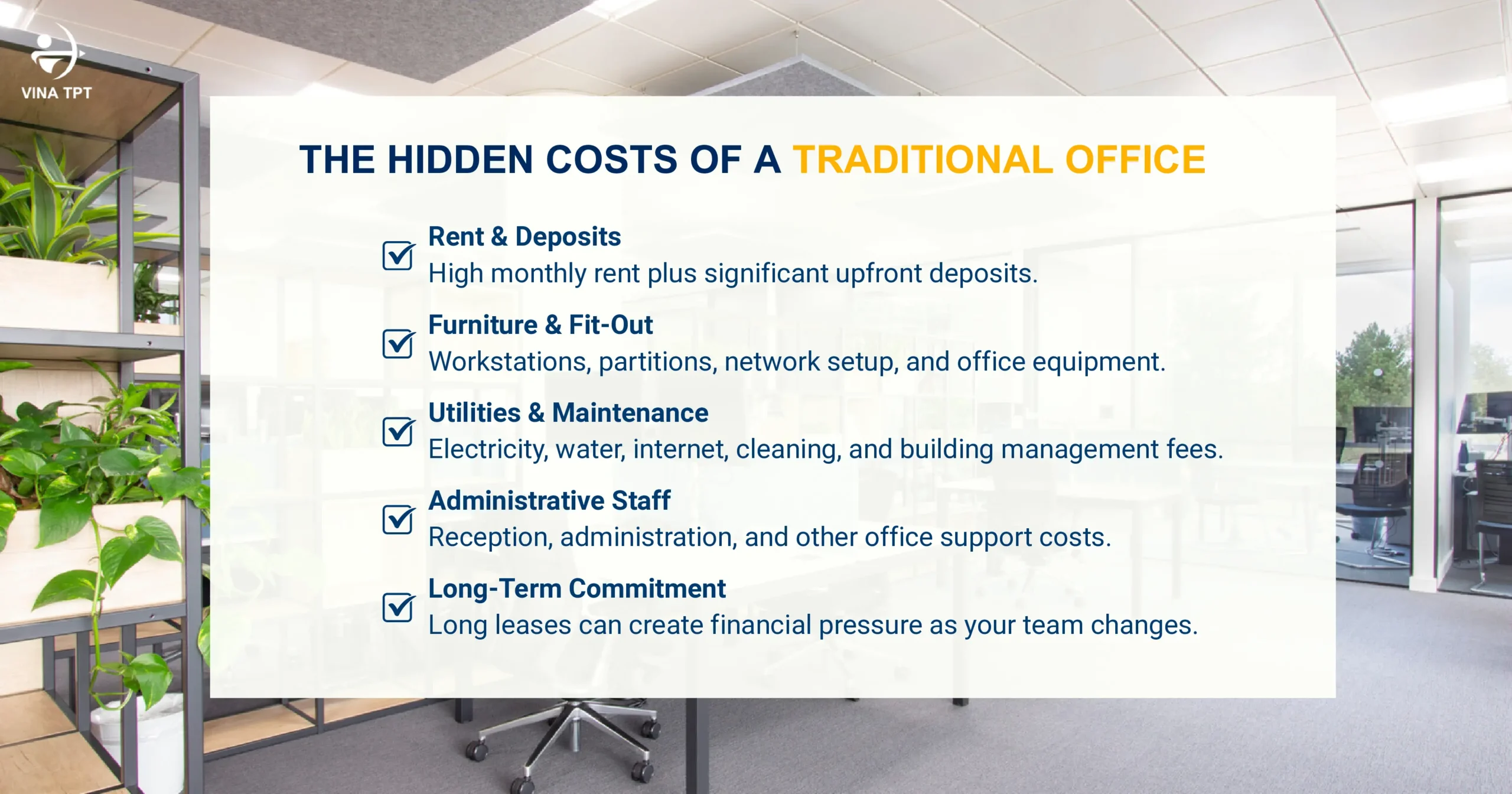
The traditional office model requires enterprises to commit significant financial resources even before the operational structure is officially put into operation. Fixed and variable costs when leasing a traditional office typically include:

  • Premises Rental & Large Deposit Amounts: Enterprises usually have to place a deposit of 3 to 6 months’ rent in advance, plus the obligation to make quarterly payments, placing significant pressure on cash flow.
  • Initial Investment Costs (CAPEX): Substantial budget is required for interior design, furniture procurement, partition construction, concealed electrical systems, and network infrastructure.
  • Monthly Utility & Maintenance Bills: Payment of recurring monthly expenses such as electricity, domestic water, corporate fiber-optic internet, cleaning services, and building management fees.
  • Administrative Personnel Costs: Recruitment, salary payment, and social insurance contributions for a dedicated receptionist, administrative staff, and security personnel.

For newly established companies or lean teams, these cost items create a heavy financial barrier, reduce flexibility, and divert resources away from profit-generating business activities.

How to Reduce Office Costs with a Shared Office Space

2. How a Shared Office Space Helps Reduce Office Costs

Choosing a shared office space enables enterprises to free up capital and transform the cost structure from high fixed costs into flexible variable costs through the following factors:

  • No Initial Interior Fit-Out Costs: The space is fully invested and equipped with premium workstations, document storage cabinets, and functional areas.
  • All-Inclusive Electricity, Water & Internet Bills: Costs for domestic electricity, air-conditioning systems, water, and high-speed Wi-Fi are completely bundled into the fixed monthly rental fee.
  • Reduced Receptionist Recruitment Costs: A professional multilingual receptionist team is already available at the lobby to represent the enterprise in welcoming clients and receiving mail and parcels.
  • Flexible Space – Avoid Waste: Enterprises only pay for the actual number of seats used and can easily expand when headcount increases without incurring costs for surplus unused space.
  • Shorter Commitment Terms: Flexible contract terms on a monthly or annual basis minimize legal and financial risks compared to the long-term 3–5 year commitments of traditional offices.
  • Integrated Business Registration Address: Allows the use of a prime commercial address for Enterprise Registration Certificate (ERC) and tax registration, completely eliminating the cost of leasing a separate premises solely for obtaining a legal address.

3. Additional Cost-Saving Benefits of Shared Office Space

In addition to cutting direct expenses, this model also delivers significant shared office benefits that are indirect yet carry substantial economic value:

  • Time Savings in Operational Management: The management team does not have to spend time handling technical issues, coordinating with internet service providers, or managing building administrative personnel.
  • Utilization of Integrated Meeting Rooms: Access to modern meeting rooms fully equipped with presentation devices under allocated usage quotas, without the need to invest in a private meeting room that is rarely used.
  • Free Office Amenities: Free access to the pantry area (tea, coffee, drinking water), client lounge area, and monthly printing/scanning quotas.
  • Accelerated Time-to-Market: Enterprises can start working immediately on the same day without spending 1 to 3 months on premises preparation.

4. What to Consider When Choosing a Shared Office Space to Maximize Savings

To maximize cost-saving efficiency when deciding to invest in a shared office space, management teams need to carefully and comprehensively analyze practical operational criteria. First and foremost, a transparent review of the pricing structure is a prerequisite; enterprises must thoroughly check the list of services already included in the fixed monthly fee and clarify potential additional charges such as after-hours fees, excess printing unit prices, or extra meeting room rental costs. Beyond the financial equation, the legal validity of the office address also requires strict verification to ensure the location fully meets the conditions for legal business registration and is not flagged as high-risk under tax management.

At the same time, enterprises should prioritize centers that can flexibly support scale-up plans, making it easy to transition from dedicated desks to private offices when the headcount grows without disrupting operations. Convenient transportation location should also be carefully considered to optimize both time and commuting costs for employees and partners. In particular, selecting a provider that owns an integrated ecosystem – including company establishment consulting, accounting, tax, and payroll management solutions – will help the enterprise significantly save management budgets, reduce coordination costs with third parties, and optimize the entire operational process.

How to Reduce Office Costs with a Shared Office Space5. Vina TPT Shared Office Space in Ho Chi Minh City – A Cost-Effective Solution

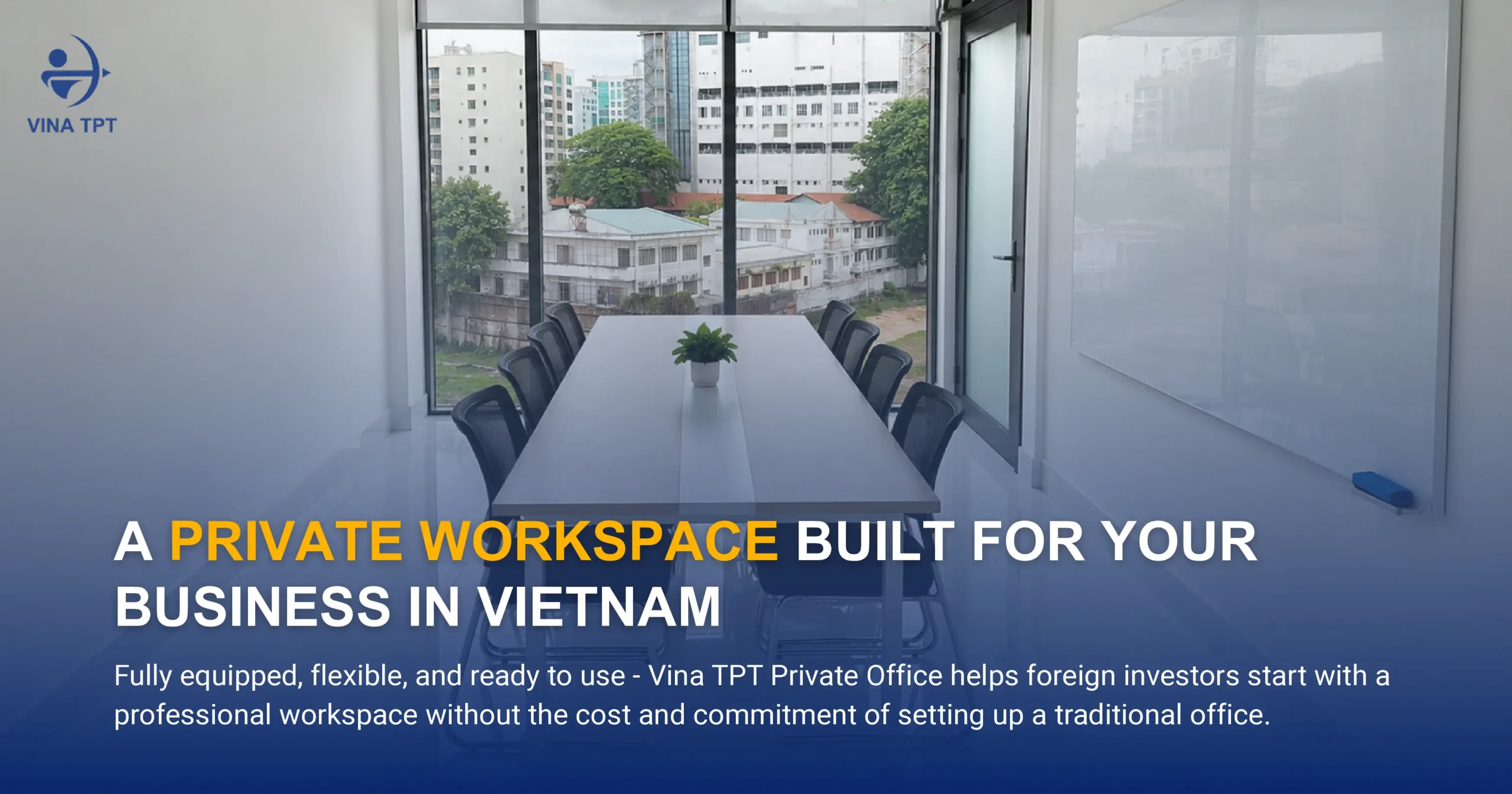
Vina TPT delivers a comprehensive shared office space in Ho Chi Minh City solution that helps FDI enterprises and startups optimize operating costs in a practical and transparent manner:

  • Transparent Pricing Structure: Commitment to a fixed monthly rental fee that already includes a full package of electricity, water, fiber-optic internet, receptionist services, and cleaning – absolutely no hidden costs.
  • Prime & Legal Commercial Address: Provides a prestigious business headquarters address in a central location of Ho Chi Minh City that fully meets the legal conditions for company establishment, bank account opening, and invoice issuance.
  • Modern Office Infrastructure: Fully equipped with standard workstations, elegant technology-integrated meeting rooms, free-service pantry area, and multi-function printers/scanners.
  • Integrated Business Ecosystem: Seamlessly connects the office service with Vina TPT’s core solutions such as Legal Consulting, Company Establishment, Accounting – Tax, and Payroll Management.
  • Flexible Conversion Capability: Allows flexible upgrades from shared space to private offices in line with the enterprise’s growth progress.

Optimizing office costs through the shared office space model is a smart strategy that enables enterprises to both reduce initial financial pressure and own a standard, flexible operating environment.

Are you looking for a shared office space in Ho Chi Minh City to optimize your enterprise’s operating budget? Contact Vina TPT today for a free consultation and to schedule a visit to the actual workspace.

BOOK A FREE CONSULTATION

Private Office in Ho Chi Minh City: Reduce Setup Costs and Start Your Business Faster

Private-Office-for-Foreign-Investors-in-Vietnam

Private-Office-for-Foreign-Investors-in-Vietnam

For many foreign investors in Vietnam, owning a professional Private Office is not merely about solving the need for a workspace. It is also a strategic factor closely linked to brand credibility, corporate image, and the ability to operate to standard from the very first days of market entry.

When first entering a new market like Vietnam, investing a large amount of capital to lease raw premises, design and construct, and purchase equipment for a traditional office always carries a very high level of financial risk. The private office model within a shared office system allows FDI enterprises to immediately have an independent, fully equipped, and professional working environment while still maintaining maximum flexibility in terms of costs.

The article below will provide a detailed analysis of the concept, outstanding benefits, and specialized integrated values dedicated to international investors who are seeking a private office in Ho Chi Minh City solution.

1. What is a Private Office and Why It Matters for Foreign Investors

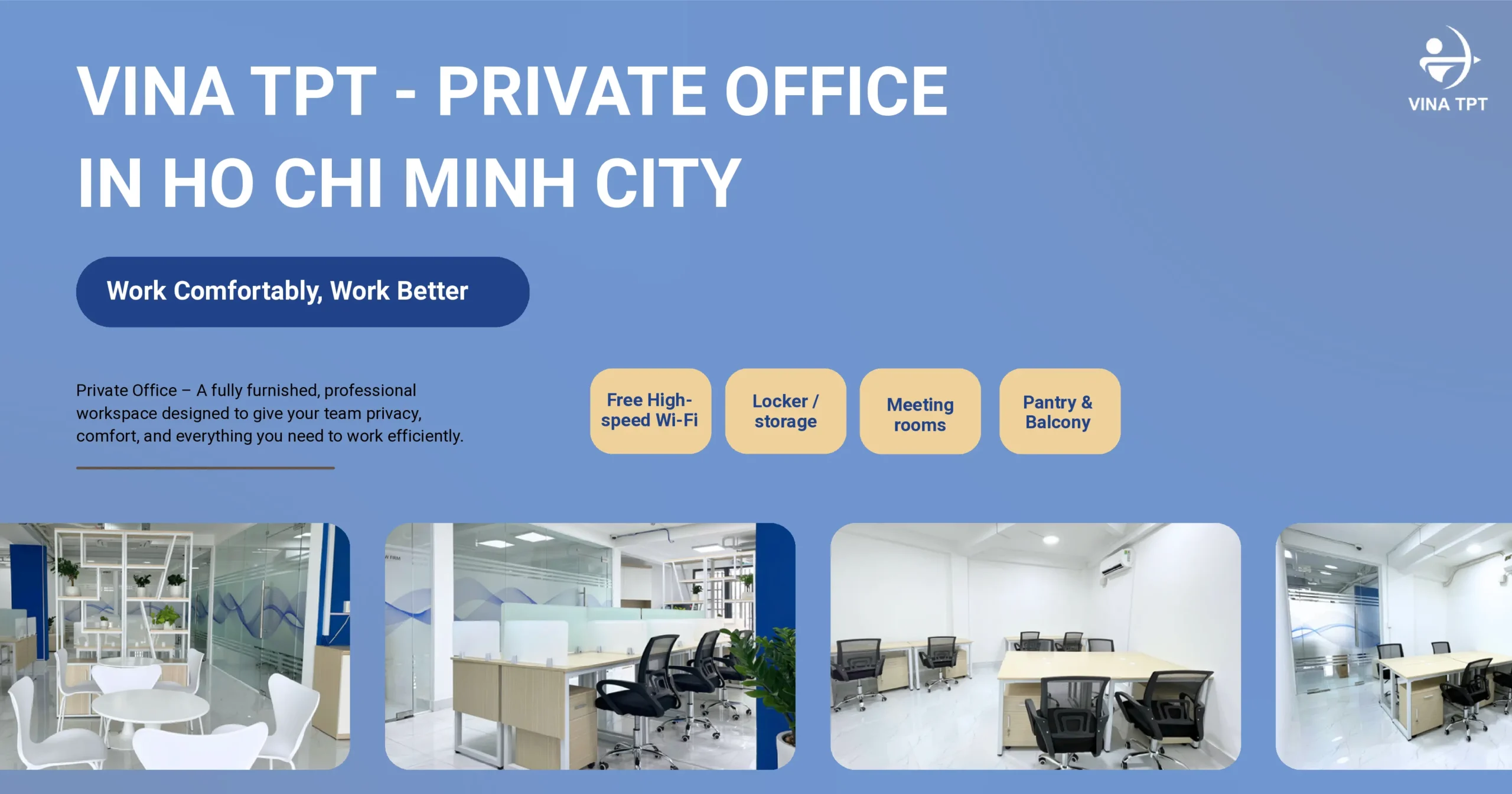
In essence, a Private Office is a separate workspace with a lockable door, flexibly arranged within an overall shared office or integrated co-working space. Unlike shared seating areas, a private office is fully equipped with premium furniture, secure document storage cabinets, and ensures absolute privacy for internal meetings as well as business transactions.

For international investors deciding to implement a private office Vietnam model, this option delivers the following core operational advantages:

  • Zero CAPEX Optimization: The enterprise incurs no initial investment costs for interior decoration, installation of fiber-optic network systems, air-conditioning, or recruitment of administrative/receptionist staff.
  • Flexible Adaptation for Small Teams: Perfectly suitable for lean personnel structures of 3 or more staff during the market entry and research phase.
  • Easy Scalability: Allows the enterprise to quickly adjust by increasing working area or switching to larger space packages when the company grows its headcount, without facing contractual barriers or operational disruptions.
  • Minimized Financial Risks: Eliminates the legal commitment risks associated with long-term traditional lease contracts (typically 3 to 5 years) when the business model in a new market requires a testing period.

2. Key Benefits of Choosing a Private Office at Vina TPT Shared Office

Private-Office-for-Foreign-Investors-in-Vietnam

When choosing a Private Office within the Vina TPT Shared Office system, FDI enterprises will benefit from a comprehensive package of infrastructure and operational services:

  • Legal Business Registration Address: Permission to use the prime commercial office address as the official headquarters address on the Enterprise Registration Certificate (ERC), for tax registration, and for opening bank accounts.
  • Enclosed Workspace & Private Filing Cabinets: Ownership of standard-designed workstations fully equipped with secure document storage cabinets with individual locks for each enterprise.
  • Multilingual Reception & Mail Handling: A professional receptionist team to welcome partners and represent the enterprise in receiving letters, parcels, and providing timely notifications.
  • Free Energy & Internet Infrastructure: 100% free of charge for domestic electricity, air-conditioning systems, and dedicated high-speed fiber-optic internet.
  • Standard Meeting Room Access: Support for modern meeting room usage time (minimum of 12 hours/month or more depending on the service package) equipped with high-definition screens.
  • Printing & Document Scanning Services: Integrated monthly printing and scanning quotas (from 200 pages/month) available right at the shared administrative area.
  • Modern Reception Lounge & Pantry: Free use of the elegant client lounge area and pantry serving complimentary tea, coffee, and drinking water.
  • Professional & Quiet Environment: Ensures good sound insulation, maintains maximum concentration for the personnel team, and preserves confidentiality for business activities.

Private-Office-for-Foreign-Investors-in-Vietnam

3. Private Office vs Dedicated Desk – Which One Should You Choose?

To help investors easily make a decision that matches their scale and budget, the comparison table below details the differences between the Private Office model and the Dedicated Desk model:

Evaluation Criteria

Private Office

Dedicated Desk

Privacy Level Absolute (Enclosed private room with lockable door) Medium (Dedicated desk in an open space)
Rental Cost Higher (Calculated by area/room) More optimized (Calculated by individual seat)
Integrated Amenities Package Comprehensive (Private filing cabinets, business registration address, spacious meeting rooms) Basic (Desk & chair, personal locker, Wi-Fi)
Client Reception Space Directly in the private room or shared Lounge Shared client Lounge area
Suitable for Teams of 3–8 people requiring confidentiality & frequent client meetings Individuals, freelancers, or teams of 1–2 people

Recommendation: The Private Office model is the optimal choice for FDI enterprises that have already established a legal entity, possess a team of 3 or more staff, and have a frequent need to receive clients and partners in a professional standard space.

4. Location and Facilities of Vina TPT – Private Office

Address: 5th Floor, 75/18-20-22 Hoang Sa, Saigon Ward, Ho Chi Minh City.

The location of Vina Office is situated right on the spacious canal-side Hoang Sa road, providing a quiet working environment filled with natural light while still offering highly convenient transportation connections to the financial center of District 1 and the bustling business areas of Ho Chi Minh City.

The synchronized on-site amenities include: dedicated high-speed fiber-optic Wi-Fi system, completely free operating electricity costs, standard meeting rooms with integrated technology, modern pantry area, secure parking zone, and multi-function printer/scanner systems.

Private-Office-for-Foreign-Investors-in-Vietnam

5. More Than Just a Private Office – A Complete Business Ecosystem

The core differentiator that makes the Private Office service at Vina Office the top choice for the international investor community is its direct connection with Vina TPT’s comprehensive business consulting ecosystem:

  • FDI Company Establishment Consulting: Full-package support for obtaining the Investment Registration Certificate (IRC) and Enterprise Registration Certificate (ERC).
  • Accounting & Financial Reporting Services: Establishment of standard accounting books under Vietnamese Accounting Standards (VAS) and preparation of periodic financial statements in accordance with legal regulations.
  • Tax Consulting & Compliance: Handling of VAT, CIT, and PIT declarations, tax refund services, and Tax Health Check.
  • Payroll & HR Management: Salary calculation and payment, social insurance registration, personal tax identification number registration, and professional labor dossier management.

Integrated Benefit: Foreign investors do not need to spend time searching for or coordinating with multiple separate service providers. All issues – from office infrastructure to legal, accounting, and tax compliance – are handled centrally by a single partner.

6. Who is a Private Office Most Suitable For?

The Private Office solution at Vina TPT is specially designed to perfectly meet the needs of the following target groups:

  • Newly established FDI enterprises that are in the process of completing their operational structure in Vietnam.
  • International companies with a core team of 4 to 8 personnel.
  • Representative offices or branches of foreign companies that require an official workspace and frequent partner receptions.
  • Investors who require a confidential, quiet, professional workspace with a ready legal business registration address from the very first day of operation.

The Private Office solution at Vina TPT Shared Office does not merely solve the need for a private working seat; it also provides FDI enterprises with a standard operational foundation that is cost-efficient and fully legally compliant right from the launch stage.

Are you looking for a suitable private office in Ho Chi Minh City for your enterprise’s development plan? Contact Vina TPT today for a free consultation and to schedule a real experience of the office space.

BOOK A FREE CONSULTATION

How to Choose the Right Serviced Office in Vietnam

how-to-choose-the-right-serviced-office-in-vietnam

how-to-choose-the-right-serviced-office-in-vietnam

An increasing number of foreign companies, FDI enterprises, and startups in Vietnam are choosing the full-package office model instead of traditional office leasing. This approach helps optimize initial investment budgets, increase management flexibility, and significantly shorten the preparation time required to bring the enterprise into official operation.

The shared office Vietnam trend is experiencing explosive growth in major economic centers such as Ho Chi Minh City and Hanoi. This model is particularly suitable for international investors who have newly established a legal entity, representative offices, or organizations that are in the market-exploration stage.

The article below provides a comprehensive analysis of the full-package office concept in the Vietnamese market, the core factors that need to be evaluated, and guidance on how to choose a serviced office that best matches the actual needs and scale of the enterprise.

What is a Serviced Office in Vietnam?

In the Vietnamese market, a serviced office in Vietnam (also known as a service office or full-package office) is a workspace model that is fully designed, furnished, and equipped with complete technical infrastructure. Enterprises only need to bring their computers and can start operating immediately without spending time or costs on design and construction.

A standard full-package office space typically includes the following integrated amenities:

  • Diverse working spaces: Private offices ensuring confidentiality, dedicated desks, or flexible hot desks.
  • Complete technical infrastructure: Fully equipped with high-quality desks and chairs, air-conditioning systems, dedicated high-speed internet, and stable power supply.
  • Professional operational services: Multilingual receptionist teams to welcome clients, shared reception areas, modern meeting rooms equipped with projectors/flat screens, and a pantry area serving tea and coffee.
  • Administrative office support: Mail receiving and courier services, printing, photocopying, document scanning, and 24/7 security.
  • Legal business registration address: Some reputable providers support enterprises in using the office address for Enterprise Registration Certificate (ERC) and tax registration.
  • Note: This is not a default amenity at every provider; enterprises need to carefully verify this before signing a contract.

In summary, the essence of a serviced office in Vietnam is a “turnkey” solution. Enterprises completely free themselves from the burdens of infrastructure management, equipment maintenance, or hiring administrative staff, allowing them to focus 100% of their resources on core business activities.

how-to-choose-the-right-serviced-office-in-vietnam

Key Factors to Consider When Choosing a Serviced Office in Vietnam

When evaluating and considering how to choose a serviced office, foreign investors need to carefully analyze the following operational and legal criteria:

  • Strategic Location: Prioritize spaces located in economic centers (such as District 1 and District 3 in Ho Chi Minh City), with convenient transportation and easy connectivity to the banking system, administrative authorities, and business partners.
  • Suitable Space Structure: Choose a private office if the team requires high privacy and information security; or select a dedicated desk for lean project teams.
  • Transparent Costs with No Hidden Fees: Request the provider to clearly break down what is included in the monthly rental fee (electricity, water, internet, cleaning fees, free meeting room hours, etc.) to avoid unexpected additional charges.
  • Flexible Contract Terms: Prefer providers that allow flexible contracts on a quarterly or annual basis, accompanied by easy terms for adjusting space when headcount changes.
  • Legal Validity of the Business Registration Address: When choosing a serviced office in Vietnam, FDI enterprises should verify that the office address meets the applicable legal conditions for business registration and can support the required registration documentation.
  • Amenities and Service Quality: Directly assess the quality of the network system, sound insulation of the workspace, the professionalism of the reception team, and the neatness of shared areas.
  • Scalability: The building must have available space so that the enterprise can easily upgrade from an individual desk to a larger private office as the company grows.

3 Practical Tips to Choose the Right Serviced Office in Vietnam

To make the search and decision-making process efficient, enterprises can apply the following three practical steps when researching how to choose a serviced office:

  • Shortlist 3-5 Options Based on Location and Budget

Clearly define the desired geographic radius and the maximum monthly cost limit. From there, create a shortlist of 3 to 5 shared office Vietnam providers that best meet these two foundational criteria for quantitative comparison.

  • Conduct On-Site Surveys and Experience the Service Directly

Do not make a decision based solely on online advertising images. Before selecting a serviced office in Vietnam, an on-site visit allows you to verify whether the actual workspace, facilities, and service quality match what the provider has advertised. Visit the location during standard working hours to experience the actual internet speed, check the air-conditioning system, the privacy of meeting rooms, and observe the real service attitude of the reception team.

  • Thoroughly Review the Contract and Legal Terms

Request the provider to clearly explain the regulations on deposit, conditions for early contract termination, price escalation policy upon renewal, and the process for supporting business registration / tax registration dossiers before proceeding with the deposit.

how-to-choose-the-right-serviced-office-in-vietnam

4. Vina TPT Serviced Office in Vietnam for FDI Companies in Ho Chi Minh City

Vina TPT provides specialized serviced office in Vietnam solutions that perfectly meet the strict operational standards of FDI enterprises in central Ho Chi Minh City:

  • Optimized Setup Costs: Completely eliminate initial investment costs for construction, equipment procurement, and maintaining an administrative team. Enterprises only pay a fixed monthly fee.
  • Legal & Prestigious Business Presence: Provide a prime commercial address in the center of Ho Chi Minh City that fully meets the legal conditions for enterprise registration, bank account opening, and electronic invoice issuance.
  • Premium Office Infrastructure: Fully equipped with private workstations, high-speed fiber-optic internet, elegant meeting rooms, modern pantry areas, and professional multilingual reception services.
  • All-in-One Integrated Ecosystem: Combine the workspace with Vina TPT’s core services such as Accounting – Tax, Payroll Management, and Corporate Legal Consulting – helping investors avoid spending time coordinating with multiple third parties.
  • Optimal Solution for International Investors: Particularly suitable for newly established companies, market research projects, or enterprises that want to quickly establish a presence in Vietnam.
  • Flexible Scale-Up: Shorten the time and procedures required when upgrading from a dedicated desk to larger workspaces without disrupting business operations.

Are you looking for a standard serviced office in Vietnam in the center of Ho Chi Minh City? Contact Vina TPT today for a free consultation and to schedule a visit to the actual workspace.

BOOK A FREE CONSULTATION

how-to-choose-the-right-serviced-office-in-vietnam