[Newsletter] September 2026 Tax Update: VAT Refund, PIT withholding, CIT & Invoice issuance 

Vietnam tax update september 2026

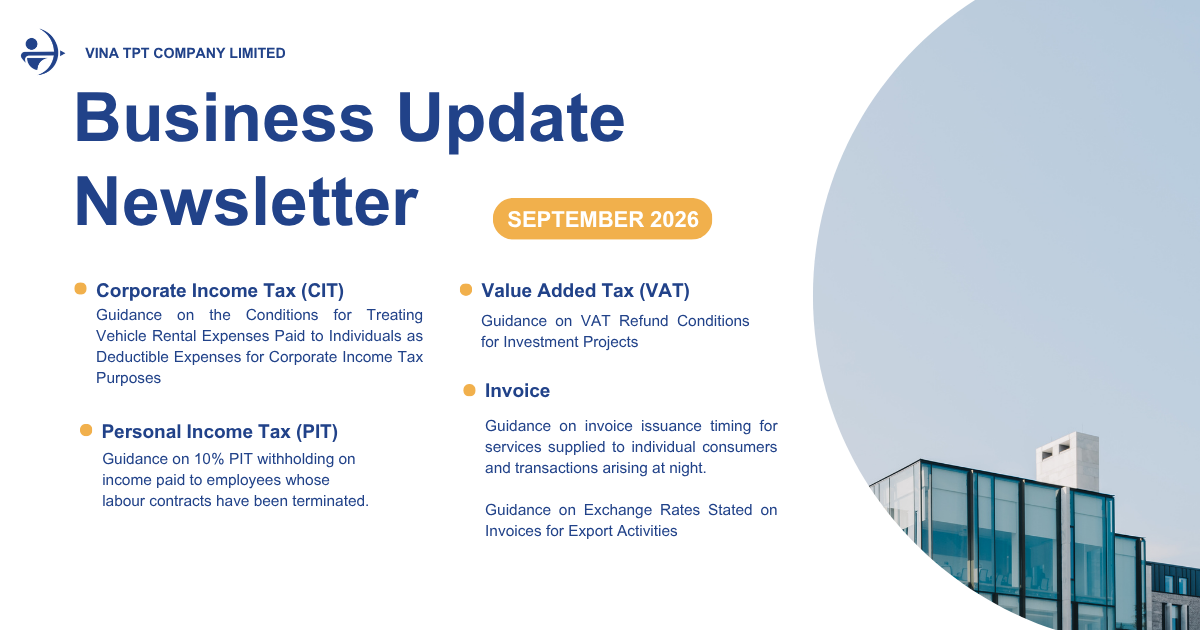
This September 2026 Vietnam tax update summarises recent guidance on VAT refunds for investment projects, deductible vehicle rental expenses, PIT withholding after employment termination, invoice issuance timing and exchange rates on export invoices. Each section highlights the relevant conditions and practical considerations to help businesses review their tax procedures and supporting documents. 

1. INVOICE

Guidance on invoice issuance timing for services supplied to individual consumers and transactions arising at night. 

Pursuant to Official Letter No. 6325/CT-QLNT dated August 26, 2026 of the Tax Department, guiding Article 9 of Decree No. 254/2026/NĐ-CP (effective July 1, 2026). 

Services supplied to individual consumers

For enterprises providing services to individual consumers, including banking; payment intermediary services; credit information services; securities business; crypto-asset transactions; support services for transactions on carbon exchanges; insurance business; money transfers via e-wallets; suspension and resumption of electricity supply; e-commerce; postal and transportation services supporting e-commerce; public passenger transport by metro and bus; passenger transport by taxi, contract vehicle, and two-wheeled motorcycle; parking services; cinema services; and other services, where such enterprises satisfy the conditions of having a software system capable of managing each transaction in detail and maintaining payment collection data in the system on a transaction-by-transaction basis: 

–  The seller shall prepare a Summary of E-Invoice Data for Sales of Goods and Provision of Services and a Detailed Statement of Transactions Arising During the Month or Quarter (covering the period from the first day to the last day of the relevant month or quarter), using the forms prescribed by the Minister of Finance, and submit them to the tax authority no later than the statutory deadline for submission of the Value Added Tax (“VAT”) return in accordance with the laws on tax administration. 

– Where a large volume of invoices is generated, the Summary of E-Invoice Data and the Detailed Statement of Transactions shall be divided into separate data files in accordance with the standard data format prescribed by the tax authority to ensure compliance with the technical requirements for data transmission and receipt. 

The seller is responsible for the accuracy of transaction information, must retain full detailed data for each transaction, and must ensure the data can be retrieved, reconciled and provided, together with related documents, on request of the tax authority or competent state agency. 

Transactions arising during night working hours

Where the seller has no automatic invoicing software and sells goods or supplies services during night working hours as defined by the Labor Code, the invoice must be issued no later than the next working day.ogether with the Appendix on VAT Refund Claim Information (Form No. 01-8/GTGT) as the basis for the tax authority to review and process the refund request. 

Guidance on Exchange Rates Stated on Invoices for Export Activities 

Pursuant to Official Letter No. 6810/CT-QLNT dated 14 September 2026 

In cases where economic or financial transactions are denominated in foreign currencies in accordance with foreign exchange regulations, the seller shall indicate on the invoice the exchange rate between the foreign currency and the Vietnamese Dong as prescribed in Point c.1, Clause 8 of the Appendix attached to Decree No. 254/2026/NĐ-CP. 

Pursuant to Clauses 1 and 5, Article 26 of the Law on Tax Administration No. 108/2025/QH15 and the accounting regulations, the exchange rate shown on the invoice shall be the actual transaction exchange rate determined in accordance with accounting laws and regulations.

2. PERSONAL INCOME TAX 

Guidance on 10% PIT withholding on income paid to employees whose labour contracts have been terminated. 

Pursuant to Official Letter No. 10049/NBI-QLDN1 dated August 3, 2026 of the Ninh Binh Provincial Tax Office, guiding Clauses 1 and 3, Article 26 and Clause 2, Article 50 of Decree No. 253/2026/NĐ-CP dated June 30, 2026 

– Where an employee is a resident individual whose labor contract was terminated on 30 June 2026, and the Company pays the employee’s salary for June 2026 on 10 July 2026, such payment shall be treated as a salary payment made to an individual whose labor contract has already been terminated. If the payment to each individual on each occasion is VND 5 million or more, the Company shall withhold personal income tax (“PIT”) at the rate of 10% before making the payment. If the payment is less than VND 5 million per payment, the Company shall withhold PIT at the rate of 10% only at the individual’s request. 

– The Company shall withhold PIT at the rate of 10% on taxable income from salaries and wages before making payment to the individual. Tax-exempt income prescribed by law, including remuneration for night work and overtime work, and salaries and wages paid for unused annual leave within the conditions, duration and limits prescribed by labor laws, shall not be included in the income subject to withholding. Any amount exceeding the statutory limits shall be included in taxable income. 

Compulsory insurance contributions, personal and dependent deductions, and other allowable deductions are taken into account in determining taxable income when applying the partially progressive tax tariff or upon annual PIT finalization, and shall not be deducted when applying the provisional 10% withholding rate prescribed in Clause 2, Article 50 of Decree No. 253/2026/ND-CP. 

3. VALUE ADDED TAX

Guidance on VAT Refund Conditions for Investment Projects 

Pursuant to Official Letter No. 7019/CT-QLNT dated 22 September 2026 issued by the Tax Department: 

Where, at the time of submitting the VAT refund application, a business establishment falls within the scope of cases eligible for a VAT refund in respect of an investment project, has input VAT that fully satisfies the conditions for VAT credit and refund in accordance with the VAT regulations, and has submitted a VAT refund application dossier in compliance with the tax administration regulations, the business establishment shall be considered for a VAT refund in respect of the investment project. 

Pursuant to Clause 4, Article 3 of Law on Investment No. 61/2020/QH14, Clause 2, Article 15 of Law on Value Added Tax No. 48/2024/QH15, and Article 30 of Decree No. 181/2025/ND-CP, there is no provision stipulating that the date of issuance of the Investment Registration Certificate (“IRC”) shall serve as the basis for determining the input VAT attributable to an investment project 

Where the Company has VAT invoices for purchased goods and services arising prior to the issuance of the IRC, if the Company is able to provide sufficient supporting documents and evidence demonstrating that such goods and services were actually purchased for the preparation and implementation of the investment project in accordance with the laws on investment, and the related input VAT satisfies the conditions for VAT credit and refund under the VAT regulations, such input VAT may be considered for credit and refund in respect of the investment project in accordance with the applicable regulations. 

4. CORPORATE INCOME TAX

Guidance on the Conditions for Treating Vehicle Rental Expenses Paid to Individuals as Deductible Expenses for Corporate Income Tax Purposes 

Pursuant to Official Letter No. 15944/DON-QLDN3 dated 18 August 2026 issued by the Dong Nai Tax Authority: 

  • Where an enterprise rents assets from an individual, the supporting documents required to substantiate the deductible expense include the asset lease agreement and documents evidencing payment of the rental fee. 
  • Where an enterprise rents assets from an individual and the lease agreement stipulates that the rental fee is exclusive of taxes (including value added tax and personal income tax), and the enterprise is required to declare and pay such taxes on behalf of the individual in accordance with the laws on tax administration, the taxes paid on behalf of the individual may also be treated as deductible expenses for corporate income tax purposes, provided that valid tax payment documents are available. 

5. Review Your Business’s Tax Compliance 

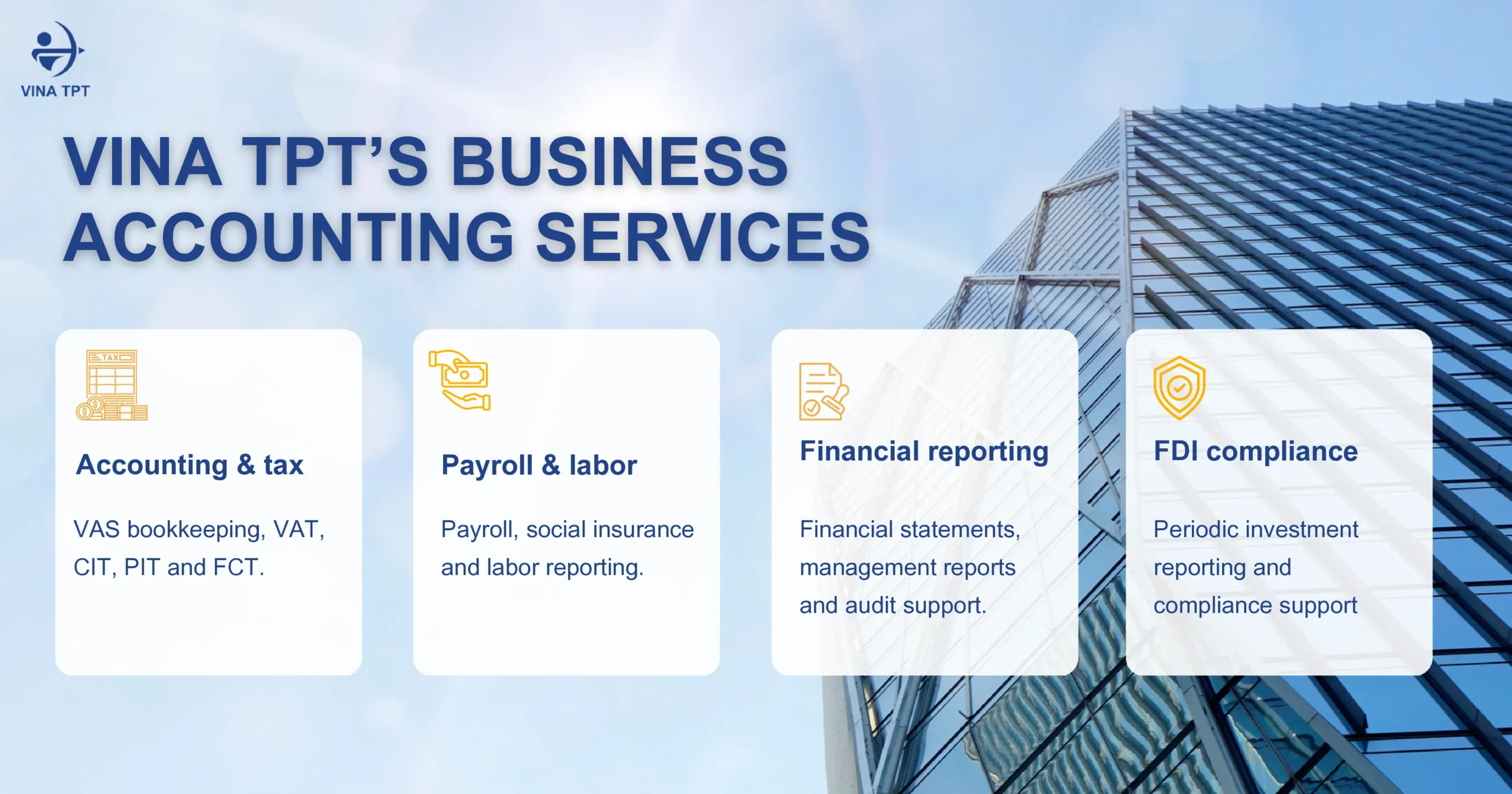
Vina TPT provides integrated accounting, tax, HR and payroll, legal and business advisory services for domestic and foreign-invested enterprises in Vietnam. From company establishment and post-licensing procedures to bookkeeping, financial reporting and ongoing compliance, we help businesses manage their obligations at each stage of their operations. 

Our tax services include tax filing and annual finalization, VAT refund assistance, tax health checks, transfer pricing and global minimum tax compliance. We also review supporting records, identify potential compliance gaps, and assist with documentation and explanations requested by tax authorities during tax reviews and inspections. 

If these updates affect your business, our team can help assess the implications, review your current procedures and recommend practical actions suited to your operations. 

Contact Vina TPT to Review Your Tax Compliance 
BOOK A FREE CONSULTATION

what-is-included-in-business-accounting-services-in-vietnam

VAT Rate in Vietnam: Complete Guide to Value Added Tax Regulations

VAT Rate in Vietnam: Complete Guide to Value Added Tax Regulations

VAT Rate in Vietnam: Complete Guide to Value Added Tax Regulations

In corporate governance and financial compliance activities in Vietnam, accurately determining the VAT rate is not only a mandatory legal requirement but also a factor that directly influences pricing strategy, tax declaration efficiency, and cash flow circulation. Especially for foreign direct investment (FDI) enterprises, this tax requires the highest level of caution to minimize the risk of tax recovery or administrative penalties during operations.

Value Added Tax (VAT), or value added tax, is an important indirect tax that makes a major contribution to the state budget. It is calculated on the added value of goods and services arising throughout the entire process from production and distribution to consumption. To help enterprises gain a comprehensive understanding, this article compiles the latest regulations on the VAT rate Vietnam, provides a detailed analysis of the applicable tax rates in 2026, policy exemption and reduction cases, as well as core notes to help foreign investors ensure absolute legal compliance.

1. What is Value Added Tax (VAT) in Vietnam?

According to the Law on Value Added Tax of Vietnam, value added tax Vietnam is a tax applied to most types of goods and services used for production, business, and consumption purposes within the territory of Vietnam. The taxable objects cover a wide range, from domestic consumer goods to commercial services, excluding those items listed as non-taxable under specific provisions of the law.

Taxable subjects are defined as all organizations and individuals engaged in the production or trading of goods and services subject to VAT, or entities that import goods from abroad into Vietnam. From an economic management perspective, VAT not only ensures a stable and sustainable source of revenue for the national budget but also creates a transparent financial management mechanism through the invoice and supporting document system. A clear understanding of the nature of VAT will help foreign managers become more proactive in optimizing input costs and establishing standard compliance processes.

2. Current VAT Rates in Vietnam

The legal framework on the VAT rate Vietnam in 2026 categorizes goods and services into specialized tax rate groups in order to regulate the economy and support social welfare. The current system consists of three main tax rates along with a non-taxable group.

2.1. Standard Tax Rate of 10% and the Temporary Reduction Policy to 8% until the End of 2026

The 10% tax rate applies to most ordinary goods and services that fall outside preferential or export categories. However, to continue stimulating domestic consumption and supporting enterprises in production recovery, the Government has approved a temporary reduction of the VAT rate from 10% to 8%, which remains effective until 31 December 2026.

Enterprises should note that this 8% reduction policy does not apply universally across all sectors. Certain groups of goods and services are still required to apply the standard 10% rate, including:

  • Telecommunications services, financial activities, banking, securities, and insurance.
  • Real estate business and products from metals or mining products (excluding coal).
  • Goods subject to Special Consumption Tax (SCT) such as alcohol, beer, tobacco, and automobiles with fewer than 24 seats.

VAT Rate

Main Scope of Application

Practical Examples

8% (Until 31/12/2026) Ordinary consumer goods and services normally subject to 10% that are eligible for reduction. Consumer goods, food & beverage services, domestic logistics, processing manufacturing.
10% (Standard) Specific sectors not eligible for the VAT reduction. Telecommunications, banking, real estate, goods subject to Special Consumption Tax.
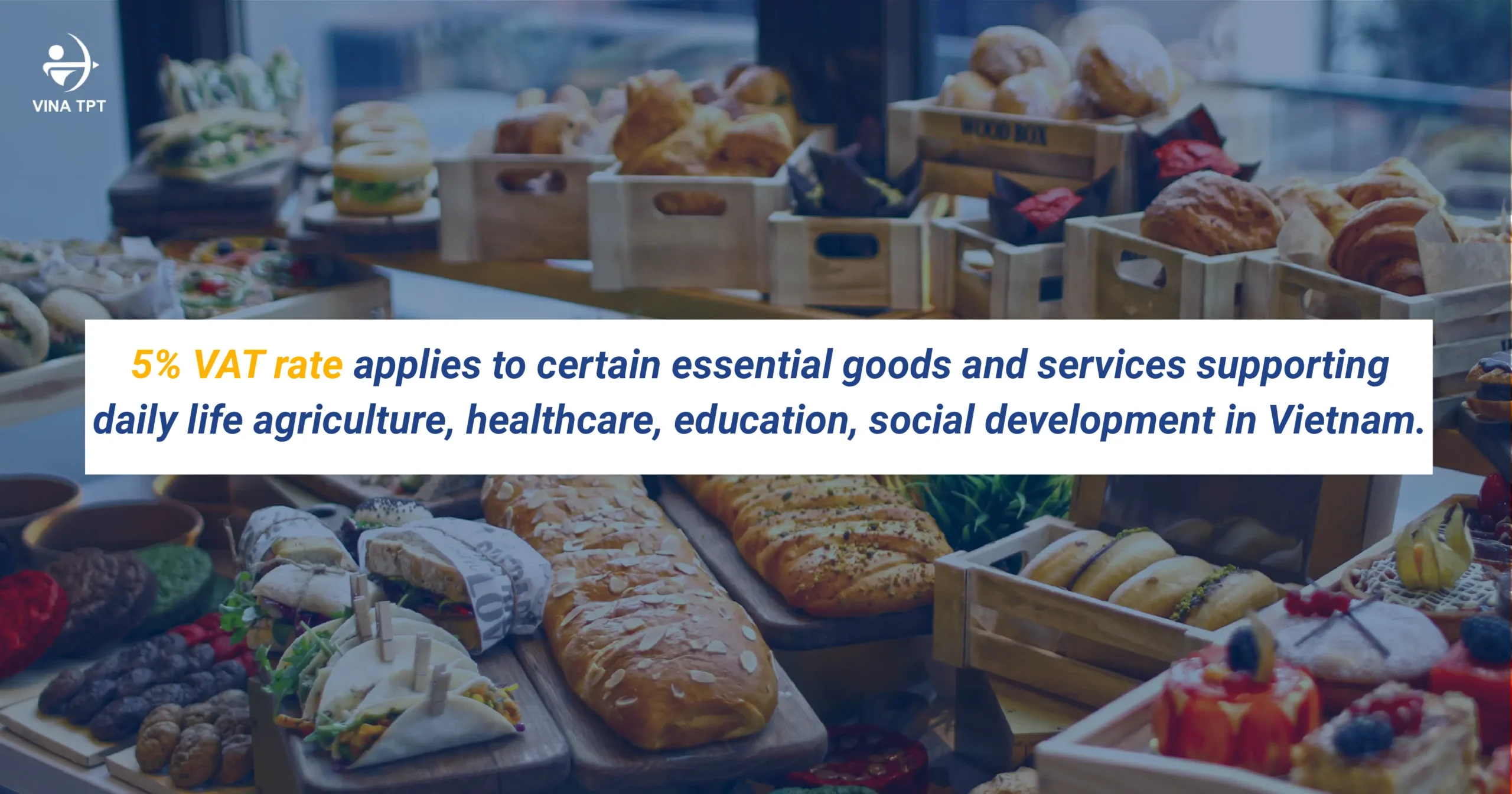
5% Essential goods and services, agriculture, healthcare, and education. Clean water, medical equipment, medicines, fertilizers, social housing.
0% Goods and services exported abroad or to non-tariff zones. Exported goods, international transportation, services provided to foreign partners.

2.2. Goods and Services Subject to 5% VAT Rate

The 5% tax rate is a preferential policy of the State applicable to groups of essential goods and services that serve people’s livelihoods, agricultural development, and social infrastructure. Common groups include:

Clean water used for production and daily living purposes (excluding bottled or containerized drinking water). Fertilizers, plant protection products, plant and animal growth stimulants. Medicines, vaccines, medical biological products, and specialized medical equipment and instruments. Teaching aids, educational materials, and specialized books. Certain agricultural, forestry, and aquatic products that have not been processed or have only undergone ordinary preliminary processing at the commercial trading stage, as well as social housing sale and lease projects as prescribed.

VAT Rate in Vietnam: Complete Guide to Value Added Tax Regulations

2.3. 0% VAT Rate and Exempt Cases

The 0% tax rate is designed to encourage export activities and enhance the competitiveness of Vietnamese products in the international market. The scope of application of the 0% rate includes goods exported abroad, goods sold into non-tariff zones for export production, international transportation services, and services provided directly to organizations and individuals overseas.

In addition, the law also specifies a list of VAT-exempt objects, such as self-produced agricultural products sold by the producers themselves, transfer of land use rights, credit services, securities, life insurance, and public healthcare and education services.

Core distinction between “0% Tax Rate” and “VAT-Exempt”:

  • 0% Tax Rate: The enterprise remains within the scope of VAT, and is therefore entitled to deduct and fully refund all input VAT paid on related production and business costs.
  • VAT-Exempt: The enterprise does not charge output VAT, but at the same time is not entitled to deduct or refund input VAT. This input tax must be included in production and business costs or the original cost of assets.

3. Key Compliance Requirements Related to VAT Rate

To maintain legal compliance and optimize the amount of deductible tax, enterprises must strictly comply with the current tax administration regulations:

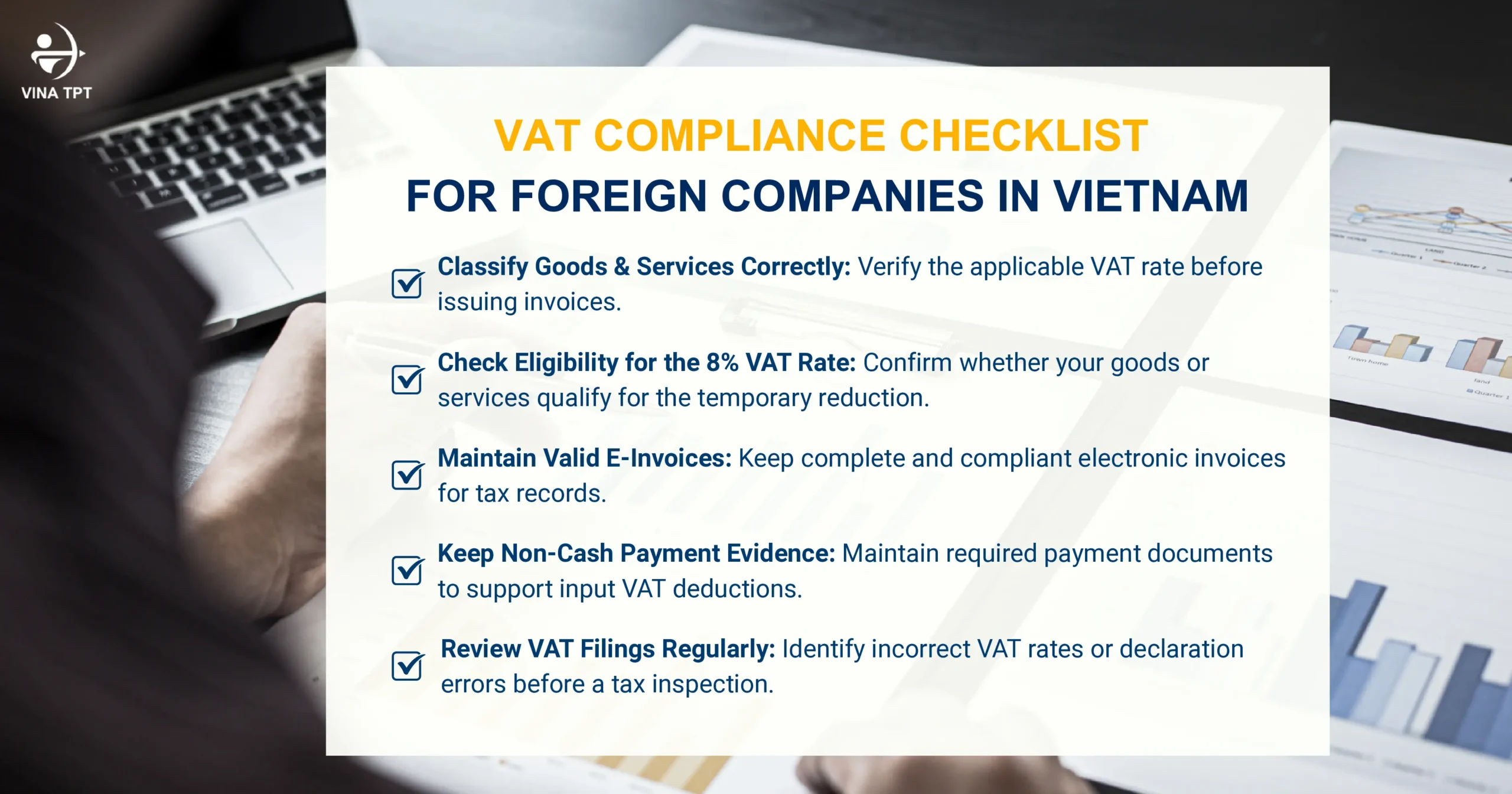
Enterprises must fulfill their VAT declaration and payment obligations on a monthly or quarterly basis, depending on the total revenue of the immediately preceding year (enterprises with annual revenue of VND 50 billion or more are required to declare monthly). To be eligible for input VAT deduction, the enterprise must fully meet three mandatory conditions: possession of a valid VAT invoice; non-cash payment documents for invoices valued at VND 5 million or more (including tax); and the purchased goods or services must be used directly for the production or trading of goods and services subject to VAT.

In addition, the use of electronic invoices (with or without the tax authority’s code) is 100% mandatory. If an enterprise applies an incorrect VAT rate (for example, issuing an invoice at 8% for goods subject to the 10% rate), the enterprise will not only have to pay the underpaid tax and late payment interest but will also face serious administrative tax penalties.

EXPLORE TAX FILLING SERVICES

4. Practical Tips for Foreign Companies

To minimize financial errors when operating a business in Vietnam, foreign managers should keep the following practical experiences in mind:

Establish a process to accurately check and classify the enterprise’s goods and service categories right from the input stage. Because the 8% tax reduction policy contains many complex exceptions, the accounting department must carefully cross-check the economic industry codes and HS codes of the products to apply the correct tax rate.

Systematically store and organize all electronic invoices together with bank payment documents. This is the only legal basis that enables the enterprise to protect its rights to input VAT deduction and refund when the competent authorities conduct tax inspections or audits.

Proactively carry out periodic internal tax reviews (tax audits) of the tax declaration process to detect and correct errors in a timely manner before the Tax Authorities issue an inspection decision. In cases where the internal team does not have a deep understanding of the local tax legal system, the enterprise should consider cooperating with professional tax agency firms to ensure operational safety.

VAT Rate in Vietnam: Complete Guide to Value Added Tax Regulations

5. How Vina TPT Supports VAT Compliance

As a reputable firm specializing in financial consulting and tax compliance for FDI enterprises, Vina TPT provides comprehensive support solutions that help businesses optimize their VAT processes:

  • Tax Rate Consulting & Classification: Accurate assessment of product categories and advice on applying the correct VAT rate (clearly distinguishing between the 8%, 10%, 5%, and 0% groups).
  • Periodic Tax Declaration & Reporting: Preparation and submission of accurate monthly/quarterly VAT declarations in full compliance with statutory deadlines.
  • Input Deduction Review & Tax Refund Services: Appraisal of input invoice dossiers and representation of the enterprise in carrying out VAT refund procedures for investment projects and export activities.
  • Support During Tax Inspections: Direct explanation, protection of data, and safeguarding of the enterprise’s legitimate rights before the tax management authorities.

Conclusion

In summary, mastering the regulations on the VAT rate and accurately complying with the VAT declaration process is the golden key that enables FDI enterprises to operate safely, transparently, and sustainably in Vietnam.

Is your enterprise facing difficulties in determining the correct VAT rate or in need of professional tax declaration support? Contact Vina TPT today for a free consultation and experience our standard full-package accounting and tax services.

BOOK A FREE CONSULTATION