Chief Accountant Services for FDI Companies in Vietnam: Regulations, Roles, and Practical Solutions

chief-accountant-services-for-fdi-companies-in-vietnam-regulations-roles-and-practical-solutions

chief-accountant-services-for-fdi-companies-in-vietnam-regulations-roles-and-practical-solutions

Many foreign investors, when establishing projects and legal entities in Vietnam, often raise a skeptical question: “We have already hired HR staff and internal accountants, so why does local law still require us to appoint a Chief Accountant?” This is one of the most common concerns that multinational corporations seek advice on from legal and financial firms when entering the Vietnamese market.

In reality, Vietnam’s legal framework is very clear: not every small-scale business model requires this position immediately, but for foreign-invested enterprises (FDI), appointing a Chief Accountant or using Chief Accountant services is a mandatory compliance obligation. Moreover, this is a regulated legal position – meaning not every accountant has the qualifications and certifications required for legal appointment. This article provides an in-depth legal analysis, clarifies the boundaries of responsibility, and offers practical solutions and Chief Accountant services that help foreign businesses protect their invested capital.

1. Understanding Chief Accountant Services for FDI Companies in Vietnam

According to the current Law on Accounting and Decree No. 174/2016/ND-CP, the Chief Accountant is the head of the accounting department of an organization. They are responsible for organizing and performing accounting work and assisting the Legal Representative in financial management. For an FDI company, this is not merely an internal job title but a mandatory legal position that must be registered with the state authorities, completely separate from regular operational accounting staff.

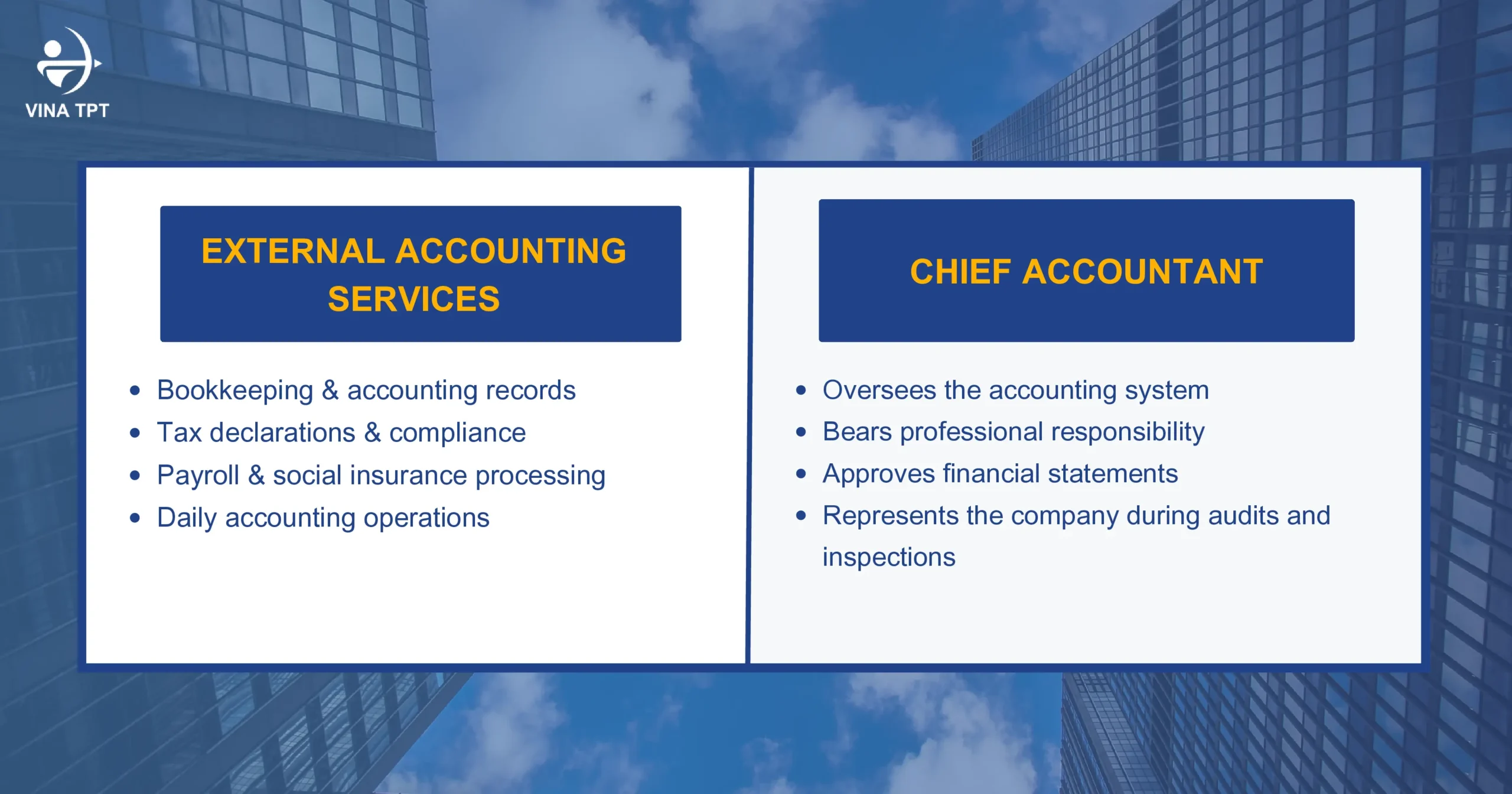
The core roles and responsibilities of a Chief Accountant in an FDI company include:

  • Bearing the highest professional responsibility before the tax authorities and financial institutions for the honesty and accuracy of the accounting system.
  • Directly activating and digitally signing approval on the company’s electronic invoicing system.
  • Being required to sign and approve the annual financial statements before submission to the tax authorities, statistics office, and investment licensing authorities.
  • Representing the company in providing professional explanations and defending data during periodic or sudden tax audits and finalizations.

For foreign businesses, this role becomes even more critical as the person must act as a bridge in both language and mindset – ensuring the entire system complies with Vietnamese Accounting Standards (VAS) while smoothly converting data to meet the IFRS requirements of the overseas headquarters.

2. Requirements Behind Professional Chief Accountant Services

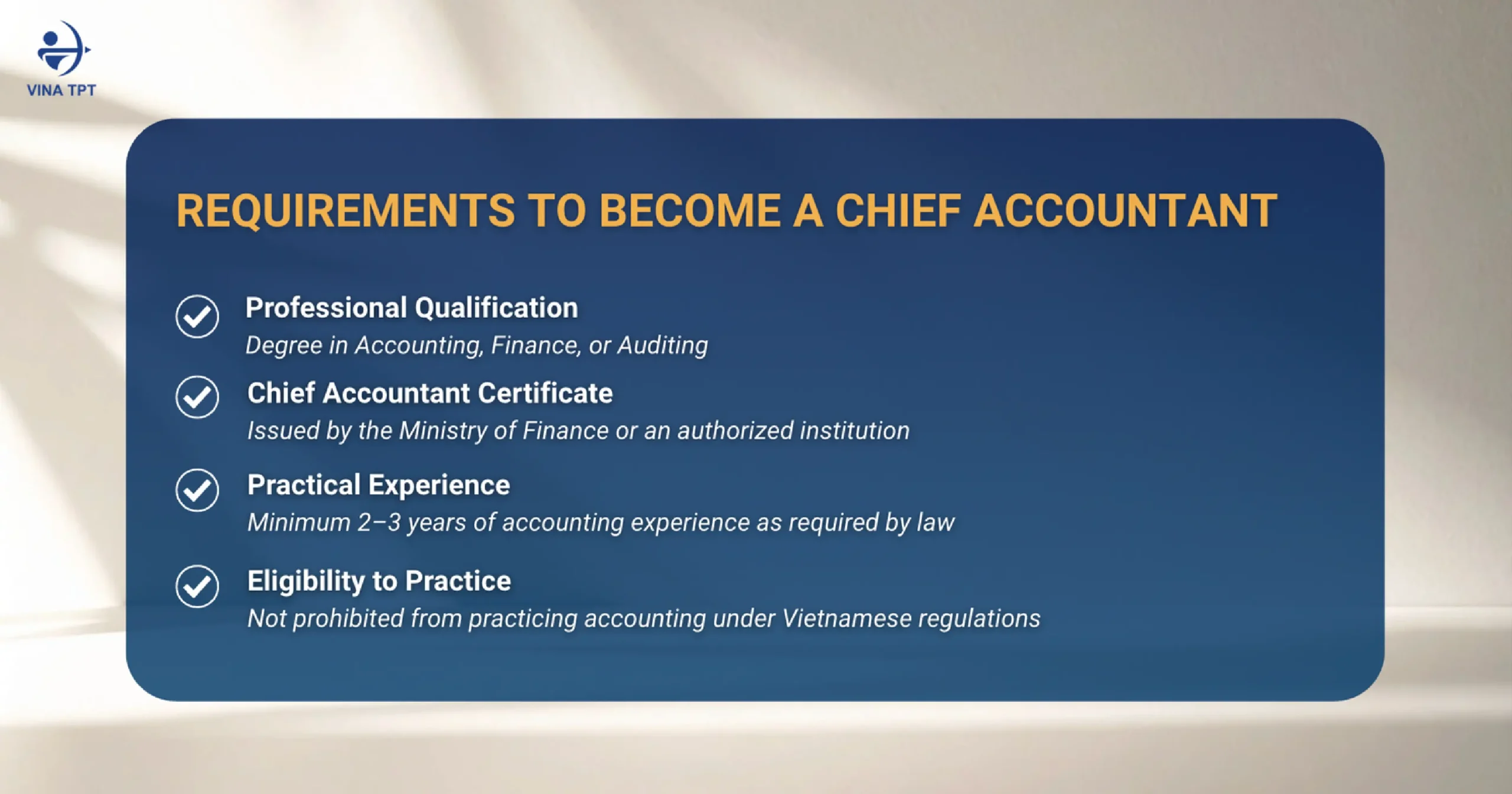
Due to the special nature and high level of legal responsibility, Vietnamese law applies extremely strict standards for anyone appointed to this position. To be legally appointed in an FDI company, the individual must simultaneously satisfy the following legal conditions:

  • Hold a professional degree in finance, accounting, or auditing at university level or higher (for companies with large charter capital).
  • Possess a valid Chief Accountant Training Certificate issued by the Ministry of Finance or authorized institutions.
  • Have at least 2 years of practical accounting experience (for university graduates) or 3 years (for college or intermediate level).
  • Not be subject to prohibitions on practicing accounting under the Law on Accounting, have no economic criminal record, and possess full civil capacity.

To solve this conditional personnel challenge, foreign businesses currently have two main options: recruit and appoint an internal staff member who fully meets the above qualifications, or flexibly use professional Chief Accountant services from licensed providers from licensed professional tax agencies.
chief-accountant-services-for-fdi-companies-in-vietnam-regulations-roles-and-practical-solutions

3. Why Many FDI Companies in Vietnam Choose Chief Accountant Services

Each approach to appointing a senior accountant position brings its own strategic value and cost considerations, requiring investors to carefully evaluate based on company scale and development stage:

Option 1: Build an internal team and appoint an in-house Chief Accountant

  • Advantages: Full 24/7 internal control and deep understanding of operational details.
  • Disadvantages: Extremely high operating costs. Recruiting and retaining a qualified Chief Accountant with the necessary legal certifications is very expensive. The company also bears 100% of the risk if the internal staff makes professional errors or suddenly resigns.

Option 2: Using Professional Chief Accountant Services Combined with Outsourced Accounting

This is the modern management trend chosen by most small and medium-sized FDI companies because it delivers superior benefits:

  • Guaranteed Legal Compliance: You immediately gain a “legal shield” from a team of experts who stay continuously updated on the latest Vietnamese tax circulars and decrees.
  • Clear Contractual Responsibility: Unlike internal staff, the service provider always commits to a specific Service Level Agreement (SLA) and bears material responsibility for professional errors within the scope of the service. When the service provider’s Chief Accountant signs documents, they also assume direct legal responsibility – providing additional assurance and safety for your company’s data.

For the majority of FDI companies, the solution of a professional Chief Accountant combined with Outsourced Accounting is currently the most optimal choice in terms of cost, risk, and efficiency.
chief-accountant-services-for-fdi-companies-in-vietnam-regulations-roles-and-practical-solutions

4. How Vina TPT Provides Chief Accountant Services

While the Chief Accountant position is mandatory by law, FDI companies can flexibly choose between an internal appointment or a smart outsourced solution. Vina TPT proudly offers a comprehensive Chief Accountant service package specially designed to support foreign capital:

  • Internationally qualified expert team: All senior staff responsible for signing approvals at Vina TPT not only hold Chief Accountant certificates issued by the Ministry of Finance but also possess prestigious professional certifications such as Vietnamese CPA, international ACCA, and lawyer licenses. This ensures a multidimensional logical approach to both finance and local law.
  • Legal Role Execution: The Chief Accountant from Vina TPT will sign and approve the Financial Statements (BCTC), audit reports, official reports submitted to state authorities, and directly handle explanations with the tax authorities when required. We assume full legal responsibility for all documents signed by our Chief Accountant.
  • Seamless integration and multilingual support: Our services integrate perfectly with tax representation and payroll packages, support 100% remote operation through digital platforms, and provide high-standard bilingual reports (English-Vietnamese, Japanese-Vietnamese), enabling headquarters to maintain real-time control.

Are you looking for a legally qualified Chief Accountant with extensive expertise for your FDI company in Vietnam? Contact Vina TPT today for a free in-depth consultation and tailored Chief Accountant services designed for your business that is both optimal and secure for your business.
BOOK A FREE CONSULTATION


Is payroll outsourcing in Vietnam worth it for small FDI companies with 5 employees?

is-payroll-outsourcing-in-vietnam-worth-it-for-small-fdi-companies-with-5-employees

is-payroll-outsourcing-in-vietnam-worth-it-for-small-fdi-companies-with-5-employees

Many foreign-invested companies, when first establishing operations in Vietnam with a very small team of just 3 to 5 employees, often adopt a management mindset: “With such a small number of staff, we can simply handle everything internally – why spend money on outsourcing?” Meanwhile, another group of executives worries that with such a tiny workforce, the minimum cost of using professional tax agency services will surely be too expensive and not worth the limited startup budget.

However, real-world management experience in Vietnam tells a completely different story. The local legal framework does not offer any preferential treatment or reduced compliance obligations based on company size. Whether your business has 5 employees or 500, the processes for declaring Personal Income Tax (PIT), making mandatory Social Insurance (SI) contributions, Health Insurance (HI) payments, and completing labor reports for the authorities must still be carried out accurately and on time. Even a small mistake in updating regulations can result in heavy administrative fines.

This article provides a detailed analysis of cost calculations, compliance risks, and delivers a clear answer to the question: Is payroll outsourcing in Vietnam truly a worthwhile investment for very small FDI companies?

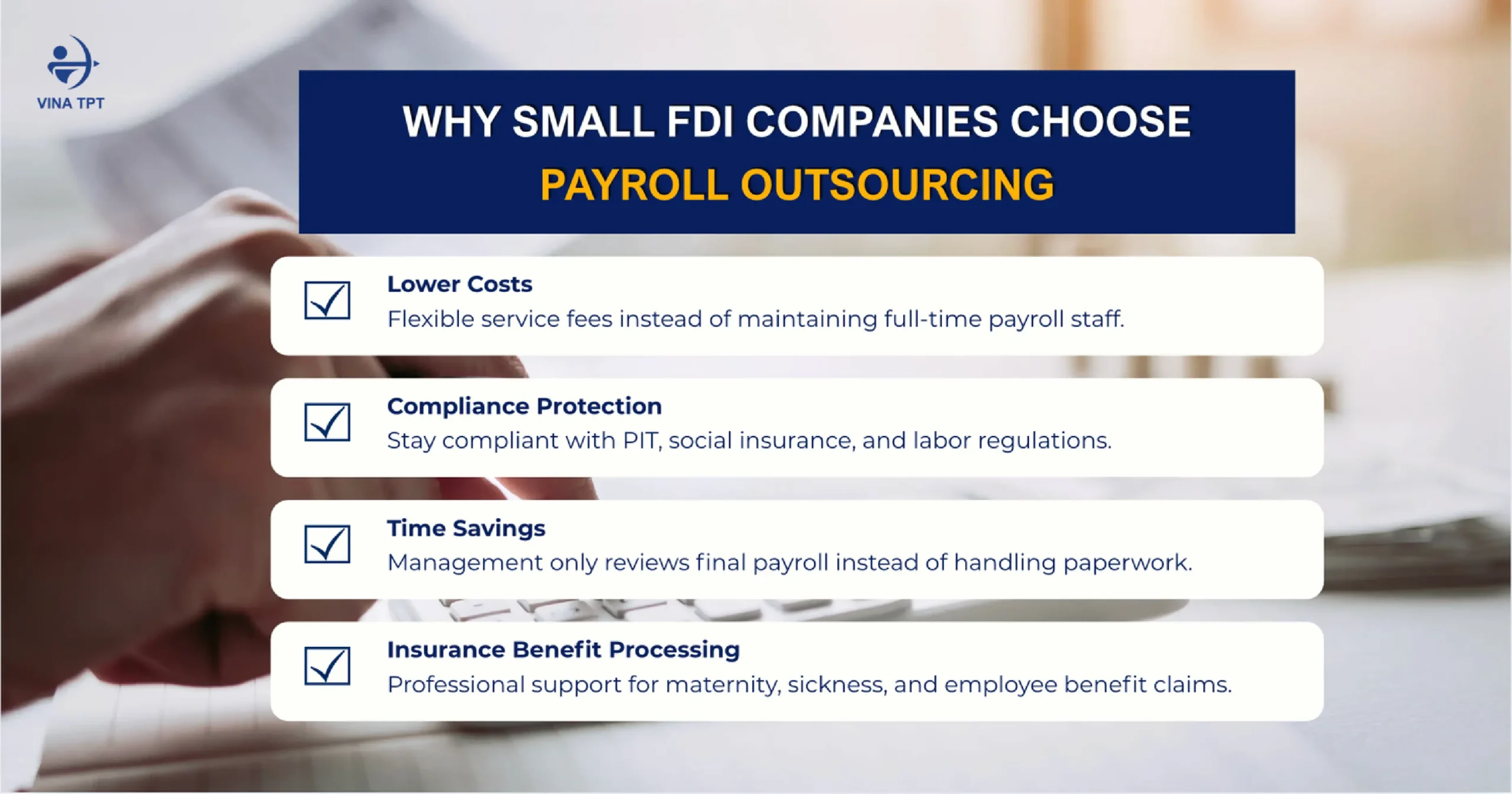
1. Why Small FDI Companies Choose Payroll Outsourcing Vietnam

When attempting to handle payroll internally or assigning the task to a non-specialist staff member who lacks deep knowledge of local regulations, small FDI companies often face four major systemic barriers:

  • Excessively high fixed costs for in-house staff: To hire a competent payroll accountant or HR professional who is also fluent in a foreign language for reporting to investor, companies must pay salaries ranging from VND 15 to 25 million per month – not including office space and social insurance costs. This is an unreasonably high expense for a team of only 3–5 people.
  • Rapidly changing legal framework: Circulars, decrees, and regulations on Personal Income Tax (PIT) for expatriates, social insurance contribution caps, and regional minimum wages in Vietnam are updated frequently. Small operational teams rarely have the time or resources to stay current with these changes.
  • High risk of administrative errors and tax penalties: Processing complex insurance benefits such as maternity leave, sick leave, and work-related accidents requires extremely strict electronic filing procedures. If internal staff lack practical experience, delays or incorrect application of progressive PIT rates for residents and non-residents can result in accumulating penalties from the tax authorities.
  • Waste of core management resources: Instead of devoting 100% of their focus to acquiring customers, conducting market research, and optimizing revenue, founders or branch directors often spend many days each month handling administrative paperwork and reconciling salary data.

2. Is Payroll Outsourcing Vietnam Worth It for Companies with Only 3-5 Employees?

To give business leaders the clearest answer, let’s compare the costs and operational efficiency of two models – In-house processing versus outsourced professional services (small business payroll) – for a company with 3 to 5 employees:

Cost and Operational Efficiency Comparison Table

Evaluation Criteria

In-House Processing Outsourced Service (Vina TPT)

Strategic Conclusion for FDI

Monthly Financial Cost 15,000,000 – 25,000,000 VND (fixed salary + tools) 4,000,000 – 15,000,000 VND (flexible per-head fee) Saves 30%-40% of fixed monthly budget
Management Time Investment 8–15 working days per month Only 4–5 days for final payroll approval Completely frees leadership from admin work
Accuracy & Compliance Depends on one multi-tasking person 100% accuracy thanks to cross-check system Standardized process optimizes legal labor costs
Expat & Remote Document Handling Major language and administrative barriers 100% online, bilingual reporting Perfectly suits parent company’s operational structure

Direct Answer from Financial Experts:

Using payroll outsourcing Vietnam is highly worthwhile and a vital solution for small FDI companies. One of the brightest advantages of outsourcing is its ability to thoroughly handle complex insurance cases such as maternity benefits, long-term sick leave, or severance payments. An inexperienced internal staff member may spend days struggling with the Social Insurance Agency’s electronic portal, while a professional provider can complete the process in just a few working hours. This is why payroll outsourcing for small FDI companies has become increasingly popular among foreign investors.

EXPLORE OUR PAYROLL SERVICES

is-payroll-outsourcing-in-vietnam-worth-it-for-small-fdi-companies-with-5-employees

3. What Does Payroll Outsourcing Vietnam Include?

A standard and comprehensive small business payroll package designed by Vina TPT covers the entire lifecycle of human resources and salary management for your company. It includes the following key components:

  • Accurate Salary Calculation and Secure Payslip Distribution: Precise calculation from gross to net salary, detailed allocation of tax-exempt allowances (meals, phone, uniforms), performance bonuses, and issuance of secure electronic payslips (Payslip) to each employee.
  • PIT Compliance and Representation: Direct withholding of Personal Income Tax (PIT) from source, preparation of quarterly tax declarations, registration of new individual tax codes, registration of dependents, and handling of year-end PIT finalization on behalf of the company and employees.
  • Full Management of Mandatory Insurance: Processing employee additions and terminations on the electronic social insurance system, closing social insurance books for departing staff, and directly handling benefit claims from the insurance fund (maternity, convalescence, sickness).
  • Completion of Periodic Labor Reports: Preparing, standardizing data, and submitting all required reports on labor changes and occupational safety & health to the Department of Labor, Invalids and Social Affairs (DOLISA) according to the legally mandated deadlines.

4. Common Concerns About Payroll Outsourcing Vietnam

Here are the most practical questions and concerns that foreign founders often raise when considering payroll outsourcing for small FDI companies:

4.1. Our company currently has only 2-3 employees. Will large service providers accept such a small client?

Absolutely. Vina TPT has specifically designed flexible service packages with no minimum headcount requirement. We support businesses from the very beginning, even when you only have 1 or 2 key staff members in Vietnam.

4.2. Will there be any hidden fees added to the monthly service cost?

For teams of 3 to 5 employees, our outsourced service package is priced very competitively and includes everything – from salary calculation, payslip issuance, PIT declaration, to social insurance finalization. All costs are fully transparent and clearly stated in the service contract.

4.3. How does the remote working process work?

The entire operation is fully digitized and 100% online. Each month, you only need to provide basic attendance data or confirm working days through our Cloud system. Vina TPT will handle all calculations and official filings. You can monitor progress in real time via our Dashboard.

4.4. Are salary data and employee personal information absolutely secure?

Data security is our top priority. Vina TPT’s storage system is built on a high-standard encrypted cloud platform that strictly complies with Vietnam’s Personal Data Protection Decree (PDPD). This ensures zero risk of information leakage.

5. Why Vina TPT is the Smart Choice for Payroll Outsourcing Vietnam

At Vina TPT, we understand that a micro-sized FDI enterprise does not need complex and burdensome processes – it needs a practical, streamlined, and legally compliant solution. Vina TPT goes beyond simply handling payroll calculations and data entry. We provide a fully integrated service ecosystem, covering small business payroll management, social insurance administration, Personal Income Tax (PIT) finalization, and professional Chief Accountant services.

Our end-to-end operating model enables management teams at overseas headquarters to monitor key financial and payroll data in real time through bilingual management reports. Combined with the expertise of our multilingual professionals (English and Japanese) and clearly defined service commitments under formal Service Level Agreements (SLAs), Vina TPT has become the trusted partner of hundreds of small-scale FDI offices and manufacturing facilities. By outsourcing payroll and compliance functions to us, businesses can focus entirely on growing their operations in Vietnam.

Are you looking for a smart, secure, and cost-optimized human resources management solution for your small FDI company in Vietnam? Contact Vina TPT today to receive a free in-depth consultation and a tailored payroll outsourcing package that best fits your company’s scale.

is-payroll-outsourcing-in-vietnam-worth-it-for-small-fdi-companies-with-5-employees

BOOK A FREE CONSULTATION

Legal Representative for FDI Company in Vietnam: Requirements & Rights

legal-representative-for-fdi-company-in-vietnam-requirements-rights

legal-representative-for-fdi-company-in-vietnam-requirements-rights

The position of Legal Representative is often regarded as the “legal face” of any foreign-invested company in Vietnam. This individual serves as the official legal representative for the entire organization when dealing with state authorities, signing commercial contracts, working with financial institutions, and bearing the highest level of legal responsibility. Even a minor error in selecting, appointing, or managing the person in this role can trigger serious legal risks – from administrative fines and contract invalidation to complete operational disruption.

Under current Vietnamese law, every company operating in Vietnam is required to maintain at least one Legal Representative. This role is far from ceremonial; it carries significant civil and even criminal liabilities. In practice, many foreign investors face considerable challenges in fully understanding the scope of authority, associated risks, and control mechanisms needed to minimize legal exposure for this critical position.

This article from Vina TPT provides a comprehensive overview of the requirements, rights, and obligations of a legal representative Vietnam FDI investors should understand before operating a business in Vietnam.

1. The Legal Nature of a Legal Representative for FDI Company in Vietnam

According to the Law on Enterprises, a Legal Representative for FDI Company is the individual authorized to represent the company in exercising its rights and performing its obligations arising from business transactions. They represent the company in civil matters, as plaintiff or defendant in disputes before arbitration or courts, and in all other rights and obligations as prescribed by law.

For FDI companies, the Legal Representative is the person directly responsible for signing major economic contracts, approving internal personnel decisions, managing corporate bank accounts, and signing periodic tax reports. Because any action taken by this person within their authority is legally recognized as the company’s own action, this position carries decisive influence over the legal safety of the invested capital.

Vietnamese law is relatively flexible, allowing a company to appoint one or multiple Legal Representatives, depending on the governance structure specified in the company’s Charter. However, the company must always ensure that at least one Legal Representative resides in Vietnam.

2. Mandatory Requirements to Become a Legal Representative for FDI Company

To ensure legality when registering or changing management personnel, the appointed Legal Representative must fully satisfy the following strict conditions:

  • Full Civil Capacity: Any individual appointed as a Legal Representative for FDI Company must be at least 18 years old have full civil capacity, and not be incapacitated or have restricted civil capacity as declared by a court.
  • Clean Legal Record: Must not be prohibited from managing or establishing enterprises under the Law on Enterprises, nor be under criminal investigation or serving a sentence according to the Penal Code.
  • Mandatory Residency Requirement: The Legal Representative must actually reside in Vietnam. If the company has only one Legal Representative, that person must reside in Vietnam and must issue a written power of attorney to another resident to perform their duties whenever they leave the country.

Selecting the right legal representative Vietnam FDI structure is an important governance decision that can significantly impact compliance and operational efficiency:

  • Foreign Personnel (Expat): Usually senior directors seconded from the parent company. In this case, the company must complete the procedures for obtaining a Work Permit and Temporary Residence Card (TRC) in Vietnam.
  • Local Vietnamese Personnel: Many foreign investors appoint a trusted Vietnamese professional as a second Legal Representative. This solution optimizes the speed of document signing and local administrative procedures, while the parent company retains core control through carefully drafted provisions in the company Charter.

2. Rights and Authority of a Legal Representative for FDI Company

A Legal Representative for FDI Company holds extensive authority to make administrative, personnel, and commercial decisions on behalf of the company. These powers are reflected in daily operations:

  • Representing the company in negotiations and signing economic contracts, cooperation agreements, and documents that create financial or asset obligations with third parties.
  • Establishing, managing, and executing financial transactions, and approving payment orders on the company’s bank accounts.
  • Submitting licensing applications, business registration changes, and periodic tax reports on behalf of the company to state authorities (Tax Department, Planning & Investment, Labor Department).
  • Representing the company in litigation, complaints, or commercial disputes before courts or arbitration to protect its legitimate rights and interests.

legal-representative-for-fdi-company-in-vietnam-requirements-rights

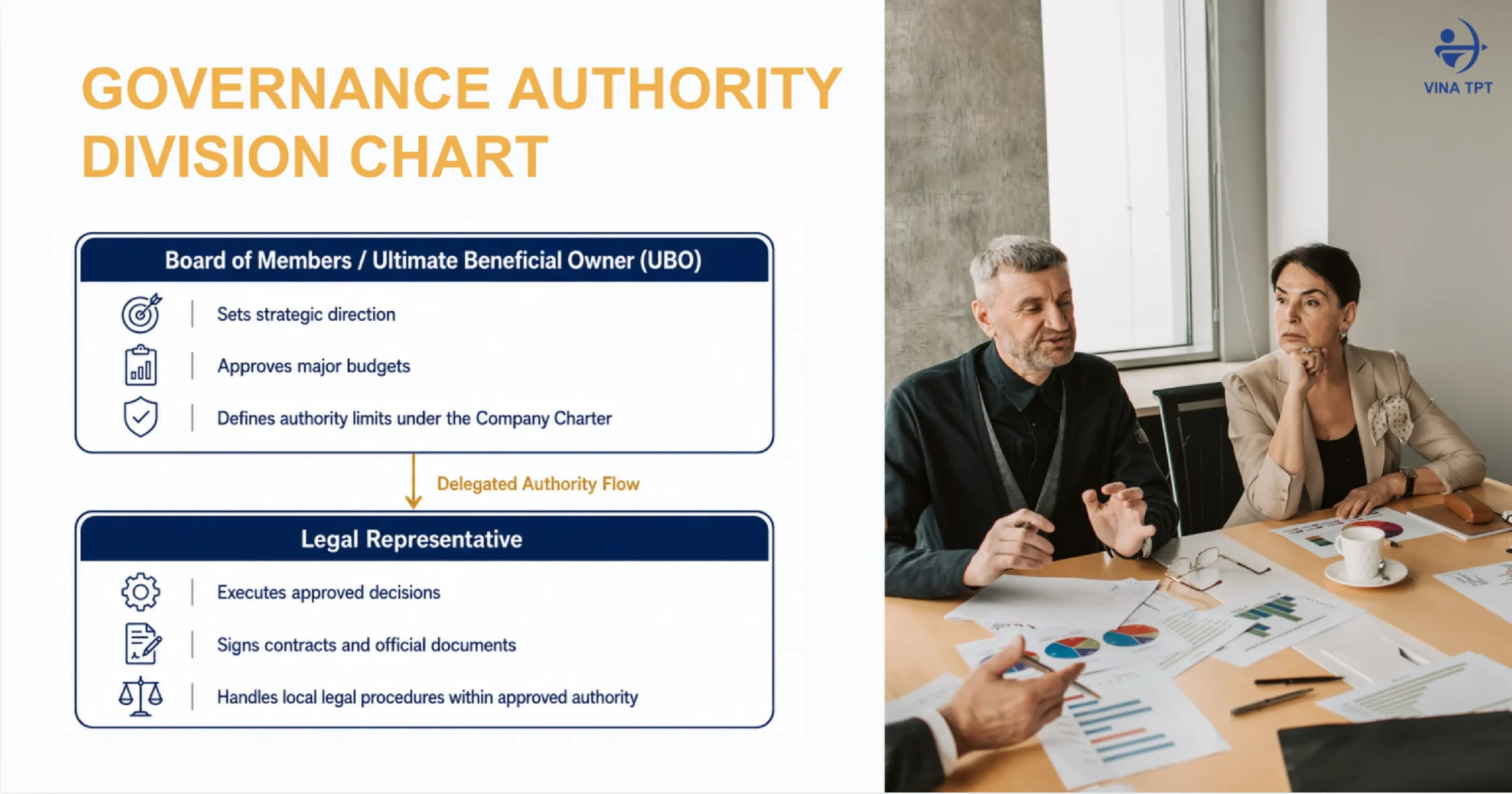
However, it is important to note that these broad powers can be strictly limited and controlled. Real investors (UBO) can fully protect their interests by designing robust internal control regulations and clearly defining financial approval limits for the Legal Representative directly in the company Charter during FDI company establishment.

3. Responsibilities and Legal Liabilities of a Legal Representative for FDI Company

A Legal Representative for FDI Company carries significant obligations and liabilities under Vietnamese law. and liabilities. A Legal Representative for an FDI company in Vietnam bears very significant legal responsibilities, both internally and before the national legal system:

  • Duty of Honesty, Care, and Diligence: Must perform assigned rights and obligations honestly and diligently to best protect the company’s legitimate interests, and must not use company information, trade secrets, or assets for personal gain.
  • Personal Joint Liability: The individual may be held personally liable and required to compensate the company for any damages caused by abuse of power, actions beyond authorized scope, or transactions that harm the company.
  • Administrative and Criminal Risks: In cases of serious violations such as tax evasion, prolonged social insurance debts, or breaches of labor safety or environmental regulations, the Legal Representative is the first person summoned by authorities. They may face exit bans, personal administrative fines, or even criminal prosecution depending on the severity of the violation.

Connect with Vina TPT today to find the most suitable Legal Representative for FDI Company solution for your business.

EXPLORE OUR SERVICES

4. Common Questions about a Legal Representative for FDI Company

  1. Can an FDI company appoint multiple Legal Representatives at the same time?

Yes. Vietnamese law allows a company to have more than one Legal Representative. The company Charter will specify the number, titles, and detailed rights and obligations of each person to optimize the governance structure.

  1. What happens if the sole Legal Representative leaves Vietnam?

When the sole Legal Representative departs Vietnam, they must issue a written power of attorney to another resident to perform their duties. If the power of attorney expires and the representative has not returned or appointed a replacement, the company may face a legal “suspension,” disrupting all business transactions.

  1. What is the difference between Legal Representative and Director?

These are two entirely different concepts. The Legal Representative is the legal authority representing the company before third parties and state agencies. The Director (or General Director) is the position responsible for day-to-day business management. One person can hold both positions simultaneously.

5. Comprehensive Solutions for Managing a Legal Representative for FDI Company

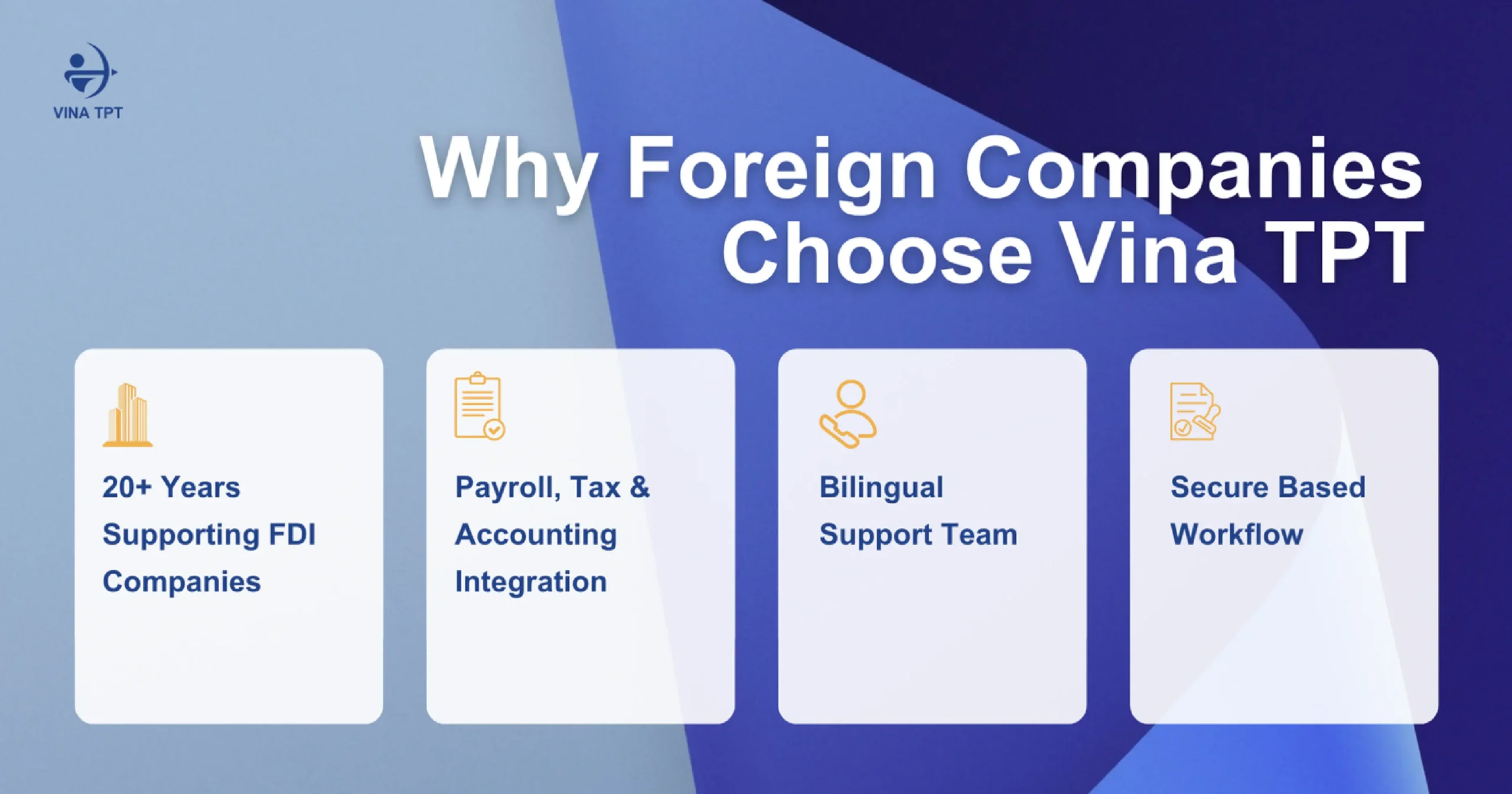
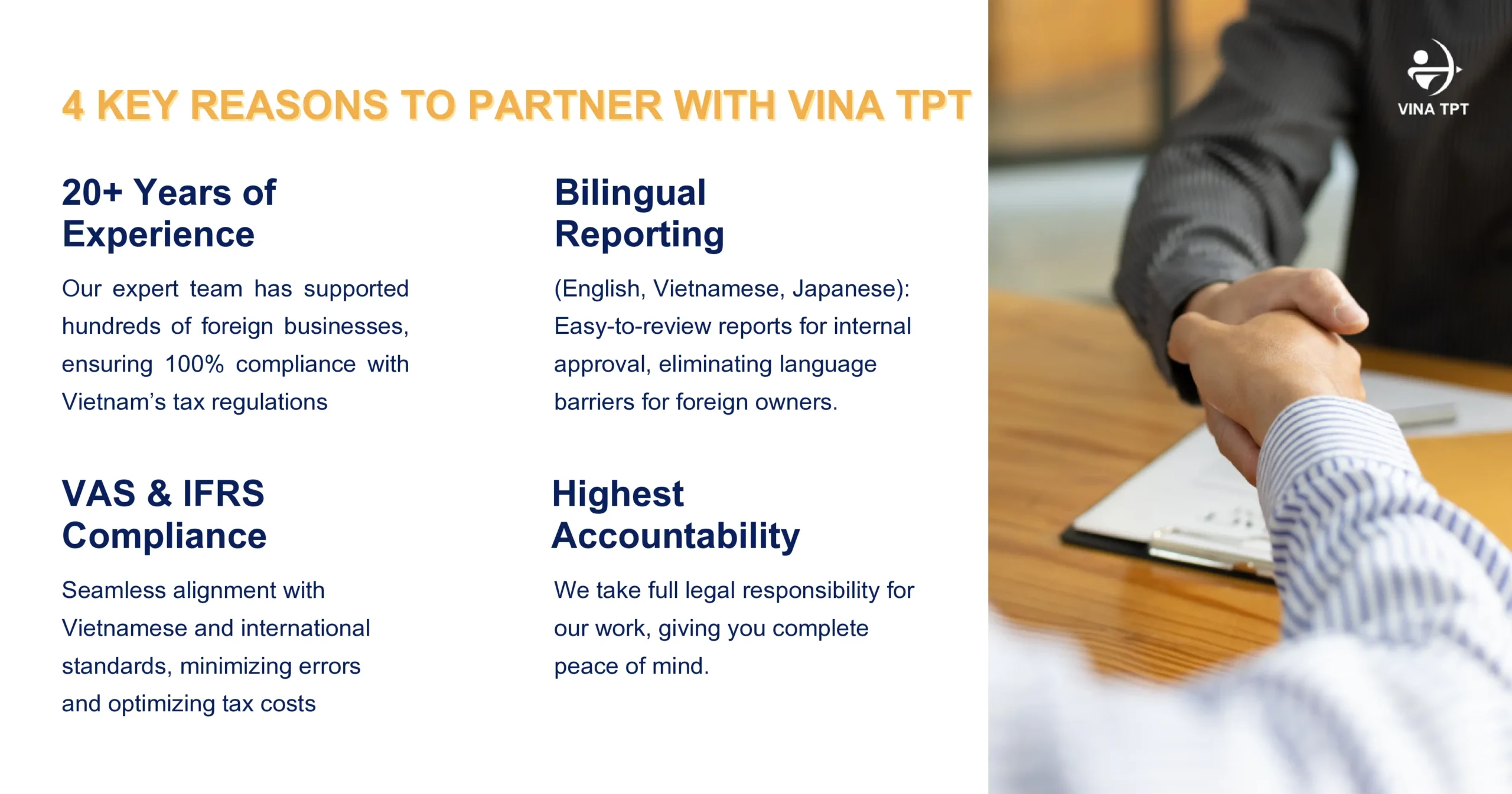
With more than 20 years of specialized experience in foreign investment consulting and corporate BPO, Vina TPT provides comprehensive solutions to help FDI companies effectively address all issues related to Legal Representatives and ensure the highest level of legal safety:

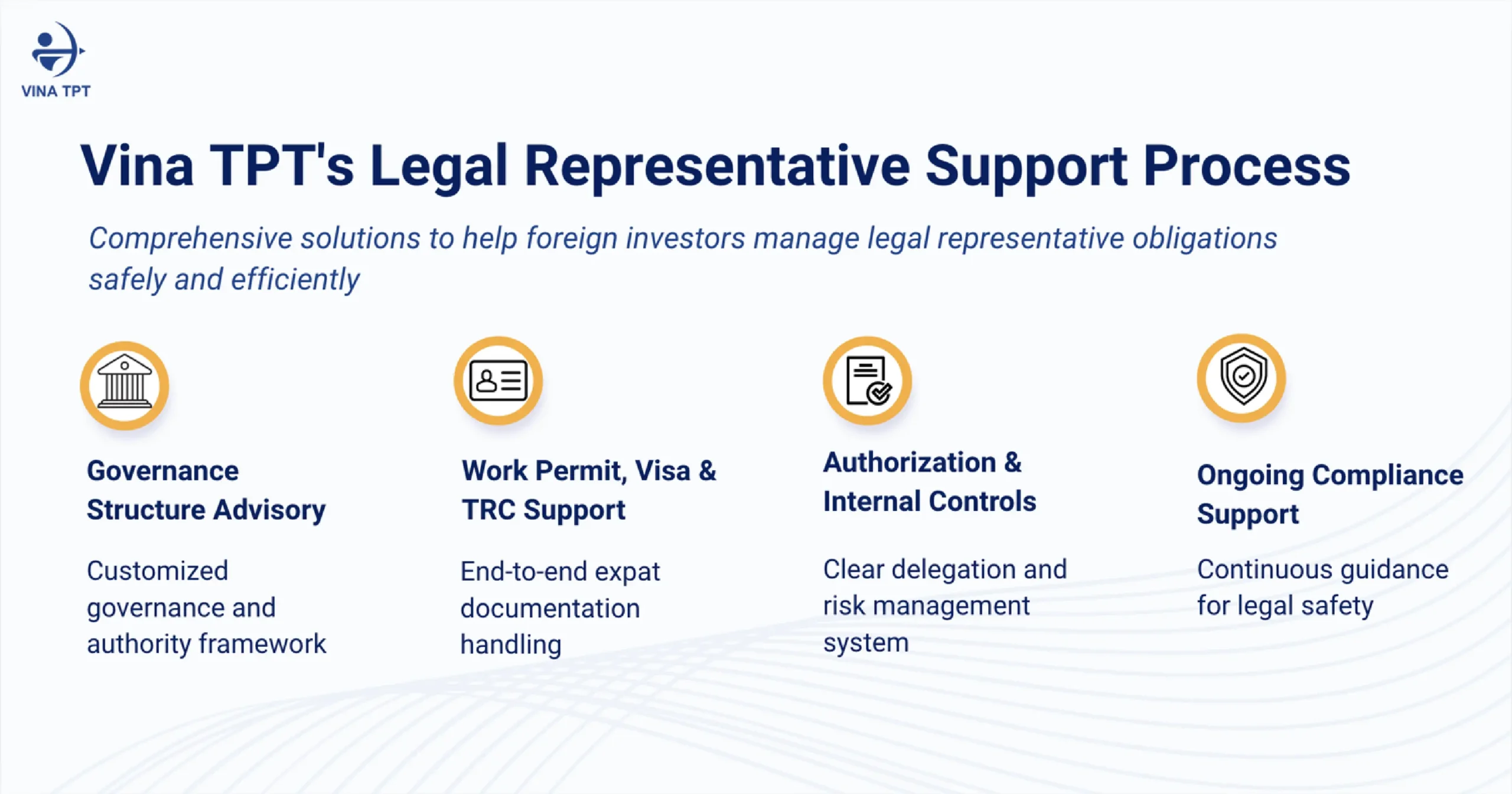
  • Optimal Internal Governance Structure Advisory: We analyze your business model to draft a customized company Charter that clearly defines authority, financial approval limits, and risk controls between management levels.
  • End-to-End Expat Documentation Handling: Fast and accurate processing of Work Permits, Visas, and Temporary Residence Cards (TRC) for foreign representatives.
  • Standard Power of Attorney and Control System: Establishment of robust authorization documents and internal control regulations to ensure smooth back-office and accounting operations even when leadership is abroad.

legal-representative-for-fdi-company-in-vietnam-requirements-rights

Conclusion

Building a clear, transparent governance mechanism around the Legal Representative for FDI Company position is a critical requirement to ensure the operational safety of any foreign investment project in Vietnam.

If your company needs in-depth consultation on appointing Legal Representatives, drafting a risk-resistant company Charter, or completing legal procedures for foreign employees, please contact Vina TPT today. Our experts are ready to provide the most optimal and secure solutions for your business.
BOOK A FREE CONSULTATION


Best City for Business Setup in Vietnam: Ho Chi Minh City, Hanoi, Da Nang or Nha Trang?

best-city-for-business-setup-in-vietnam-ho-chi-minh-city-hanoi-da-nang-or-nha-trang

best-city-for-business-setup-in-vietnam-ho-chi-minh-city-hanoi-da-nang-or-nha-trang

In 2026, Vietnam’s four largest cities – Ho Chi Minh City, Hanoi, Da Nang, and Nha Trang – continue to be the top destinations for foreign investors. Each city offers its own unique advantages in terms of economy, infrastructure, workforce, and local business culture.

This article provides a detailed comparison of the strengths and weaknesses of each location to help you decide which is the best city for business setup Vietnam based on your industry, budget, and long-term goals.

1. Ho Chi Minh City – Best City for Business Setup Vietnam for Rapid Growth

Ho Chi Minh City (HCMC) remains Vietnam’s largest economic center and the most popular choice for foreign investors seeking rapid growth.

Key Economic Strengths: It serves as the country’s financial, commercial, and logistics hub. With Tan Son Nhat International Airport, Cat Lai Port, and an extensive highway network, HCMC offers excellent connectivity across the region. Many multinational corporations choose it as their Southeast Asia headquarters.

Best-Suited Industries: Almost every sector has strong potential, especially import-export, e-commerce, FinTech, consumer goods manufacturing, professional services, technology, and F&B. It is the easiest place to find partners, suppliers, and large customer bases.

Local Business Culture & Lifestyle: Fast-paced, pragmatic, and highly entrepreneurial. Locals are open-minded, decisive, and comfortable working with foreigners. The city offers diverse cuisine, vibrant nightlife, and a dynamic atmosphere, though it also comes with heavy traffic, pollution, and higher living costs.

Advantages for Investors: Abundant business opportunities, a well-developed startup ecosystem, and strong logistics infrastructure.

Disadvantages: Higher office and labor costs, plus intense competition.

Verdict: HCMC is the best city for business setup in Vietnam if you prioritize speed, market access, and growth potential.

best-city-for-business-setup-in-vietnam-ho-chi-minh-city-hanoi-da-nang-or-nha-trang

2. Hanoi – Best City for Business Setup Vietnam for Technology & Government Access

Hanoi, Vietnam’s capital, offers a very different environment focused on politics, administration, education, and high-tech development in the North.

Key Economic Strengths: 

Hanoi is one of Vietnam’s most important economic centers, known for its role as the country’s political, administrative, and innovation hub. The city benefits from a highly educated workforce supported by leading universities and research institutes, creating strong advantages in technology, finance, and professional services. Hanoi also continues to attract significant foreign direct investment thanks to its stable business environment, improving infrastructure, and strategic location in Northern Vietnam, offering convenient access to major industrial zones and seaports. In addition, the city is actively promoting the development of the digital economy, high-tech industries, and startup ecosystems, enhancing its competitiveness and strengthening its position as an attractive destination for international investors. 

Best-Suited Industries: IT and software development, education, healthcare, financial services, government relations, high-tech manufacturing, and premium F&B.

Local Business Culture & Lifestyle:

More relationship-oriented and formal. Hanoi values long-term trust and stability. The pace is slower than in HCMC, with four distinct seasons, refined cuisine, and rich cultural heritage. It is often preferred by expat families seeking a stable, cultured environment.

Advantages for Investors: Easier access to government agencies, high-quality talent in technology and services, and lower operating costs than HCMC.

Disadvantages: Slower decision-making processes and fewer entertainment options compared to southern cities.

Verdict: Hanoi is the best city for business setup in Vietnam for companies needing strong government relations or operating in IT, education, and strategic sectors.

EXPLORE OUR SETUP BUSINESS SERVICES

3. Da Nang – Best City for Business Setup Vietnam for Work-Life Balance

Da Nang has rapidly emerged as one of Vietnam’s most attractive cities for business and living, often ranked as the most livable city in the country.

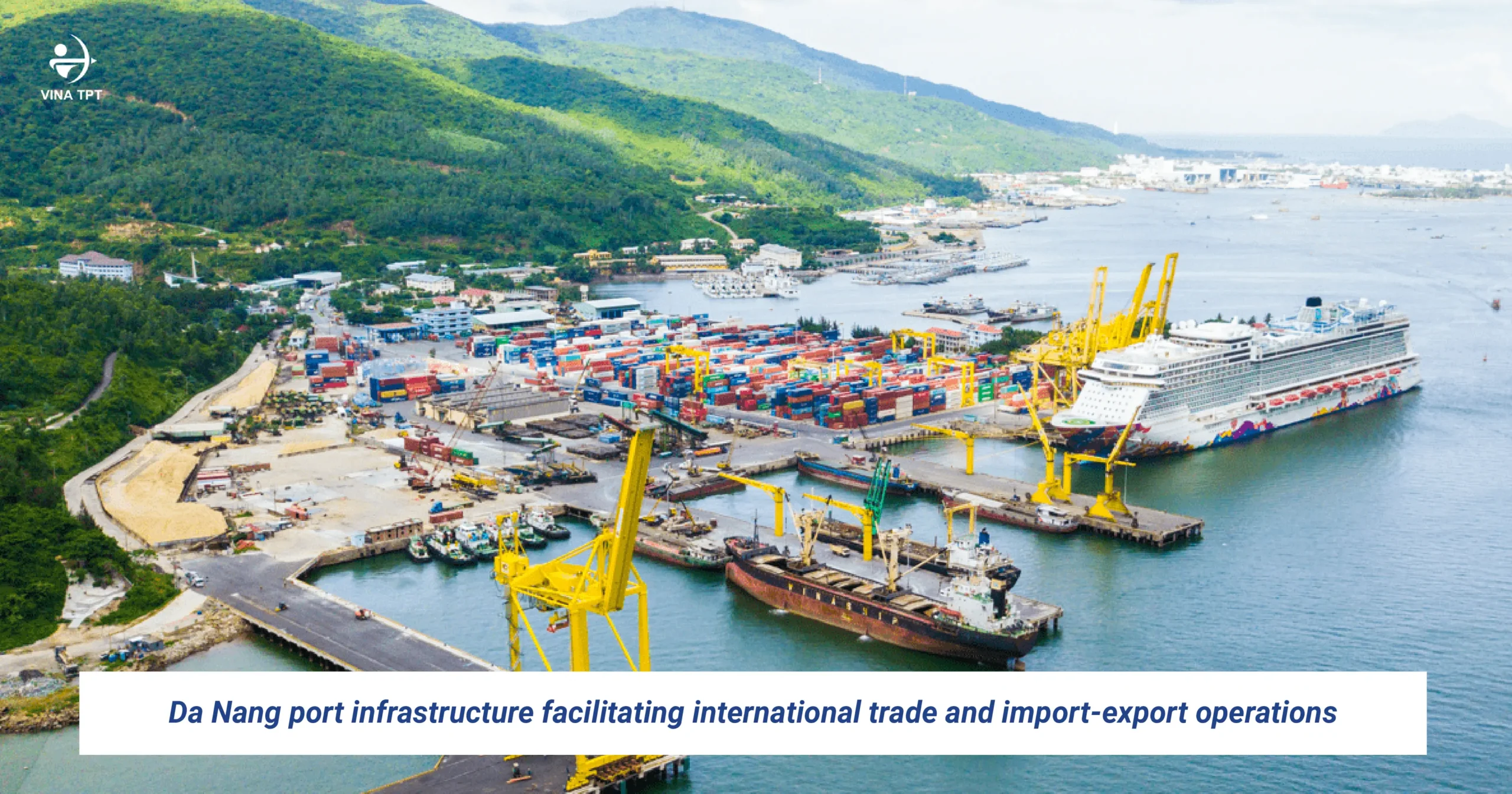
Key Economic Strengths: It serves as the logistics gateway for Central Vietnam, with a modern port and international airport. The city is aggressively developing its technology, BPO, and tourism sectors.

Best-Suited Industries: Information technology, BPO/outsourcing, tourism, logistics, clean manufacturing, and F&B.

Local Business Culture & Lifestyle: Modern yet friendly and welcoming. Da Nang offers an excellent work-life balance, beautiful beaches, clean air, and a pleasant climate year-round. Many expats choose it for its relaxed yet professional atmosphere.

Advantages for Investors: Rapidly improving infrastructure, lower costs than HCMC and Hanoi, and strong local government support.

Disadvantages: Smaller domestic market and talent pool compared to the two larger cities.

Verdict: Da Nang is the best city for business setup in Vietnam if you value work-life balance, modern infrastructure, and a high quality of life.

best-city-for-business-setup-in-vietnam-ho-chi-minh-city-hanoi-da-nang-or-nha-trang

4. Nha Trang – Best City for Business Setup Vietnam for Tourism Businesses

Nha Trang is the most lifestyle-oriented option, ideal for investors who want to combine business with a relaxed, beachside environment.

Key Economic Strengths: It is a major coastal tourism hub with growing investment in hospitality, real estate, and premium services.

Best-Suited Industries: Tourism, hotels, F&B, resort real estate, and high-end services.

Local Business Culture & Lifestyle: Relaxed, friendly, and sea-oriented. The pace of life is slower, with a strong focus on tourism and quality of life.

Advantages for Investors: 

Nha Trang also offers significantly lower operating and living costs, combined with an excellent living environment that is highly attractive for expats and their families. In addition, the city is served by the modern Cam Ranh International Airport, which provides convenient domestic and international connectivity while offering strong support for logistics and supply chain operations.

Disadvantages: Smaller business ecosystem, limited logistics infrastructure, and heavy reliance on the tourism sector.

Verdict: Nha Trang is the best city for business setup in Vietnam for tourism, hospitality, and lifestyle-driven businesses.

5. Quick Comparison: Which Is the Best City for Business Setup Vietnam?

To help investors quickly compare the top destinations for business setup in Vietnam, the table below highlights key criteria across four major cities:

Criteria

Ho Chi Minh City Hanoi Da Nang

Nha Trang

Operating Costs High Medium Medium-Low Medium-Low
Infrastructure & Logistics Excellent Good Very Good Moderate
Talent Pool Very Strong Strong (IT & Services) Growing Moderate
Best-Suited Industries Most sectors Most sectors Tech, Tourism, BPO Tourism & Hospitality
Work-Life Balance Moderate Moderate High Very High

Each city offers distinct advantages depending on your business goals and operational priorities. 

  • Ho Chi Minh City offers a dynamic, fast-paced environment filled with business opportunities. 
  • Hanoi is more elegant and relationship-oriented, with a calmer and more stable rhythm. 
  • Da Nang stands out for its balance, modern yet approachable, making it ideal for those who prioritize work-life balance. 
  • Meanwhile, Nha Trang delivers a relaxed, beach-oriented lifestyle with a slower pace, perfect for those who want to combine business with leisure and coastal living.

Ultimately, the right city depends on your industry, company size, investment strategy, and preferred lifestyle. Choosing the right location from the beginning can help optimize costs, leverage local resources, and support smoother long-term business operations in Vietnam.

6. How to Choose the Best City for Business Setup in Vietnam

To select the right city, consider these three key factors:

  • Industry and Company Scale: Both Ho Chi Minh City and Hanoi are major economic centers with diverse and comparable market demands, making them suitable for a wide range of industries. Ho Chi Minh City typically offers faster growth, greater market opportunities, and stronger commercial momentum. In contrast, Hanoi stands out for its stability, close connections with government authorities, and access to a high-quality talent pool, especially in technology, education, and professional services.
  • Lifestyle preferences for you and your expat team: If you want a fast-paced, dynamic environment, choose Ho Chi Minh City. For better work-life balance and a relaxed atmosphere, Da Nang or Nha Trang may be ideal.
  • Cultural integration: Understanding local culture will help your foreign team adapt more easily and work more effectively.

Final Tip: Before making a final decision, spend time visiting each city and consult with an experienced FDI advisor. This will help you avoid costly mistakes and choose the location that best supports your long-term business goals in Vietnam.

Still unsure which city is the best fit for your business? Contact Vina TPT for a free consultation. Our experts will provide a detailed comparison tailored to your industry and specific objectives.

BOOK A FREE CONSULTATION

Remote Payroll in Vietnam: Risks, Benefits and Is It Right for Your Business?

remote-payroll-in-vietnam-risks-benefits-and-is-it-right-for-your-business

Many foreign investors and FDI founders share the same concern when planning to establish a company in Vietnam: “If I cannot be physically present in the country on a regular basis, can I still outsource payroll services? Will I be required to go to an office to sign contracts and meet in person?”

This is one of the most frequently asked questions among remote teams and overseas businesses. The short answer is: Yes, it is entirely possible. Today, remote payroll has become a standard and widely available service in Vietnam. It is handled 100% online through modern cloud-based systems, allowing you to manage salaries, social insurance, Personal Income Tax (PIT), and all other labor obligations without ever needing to be in Vietnam.

This article will explain what remote payroll is, its practical benefits, key risks to be aware of, and how to choose a reliable provider in 2026.

1. What is Remote Payroll and How Does It Work?

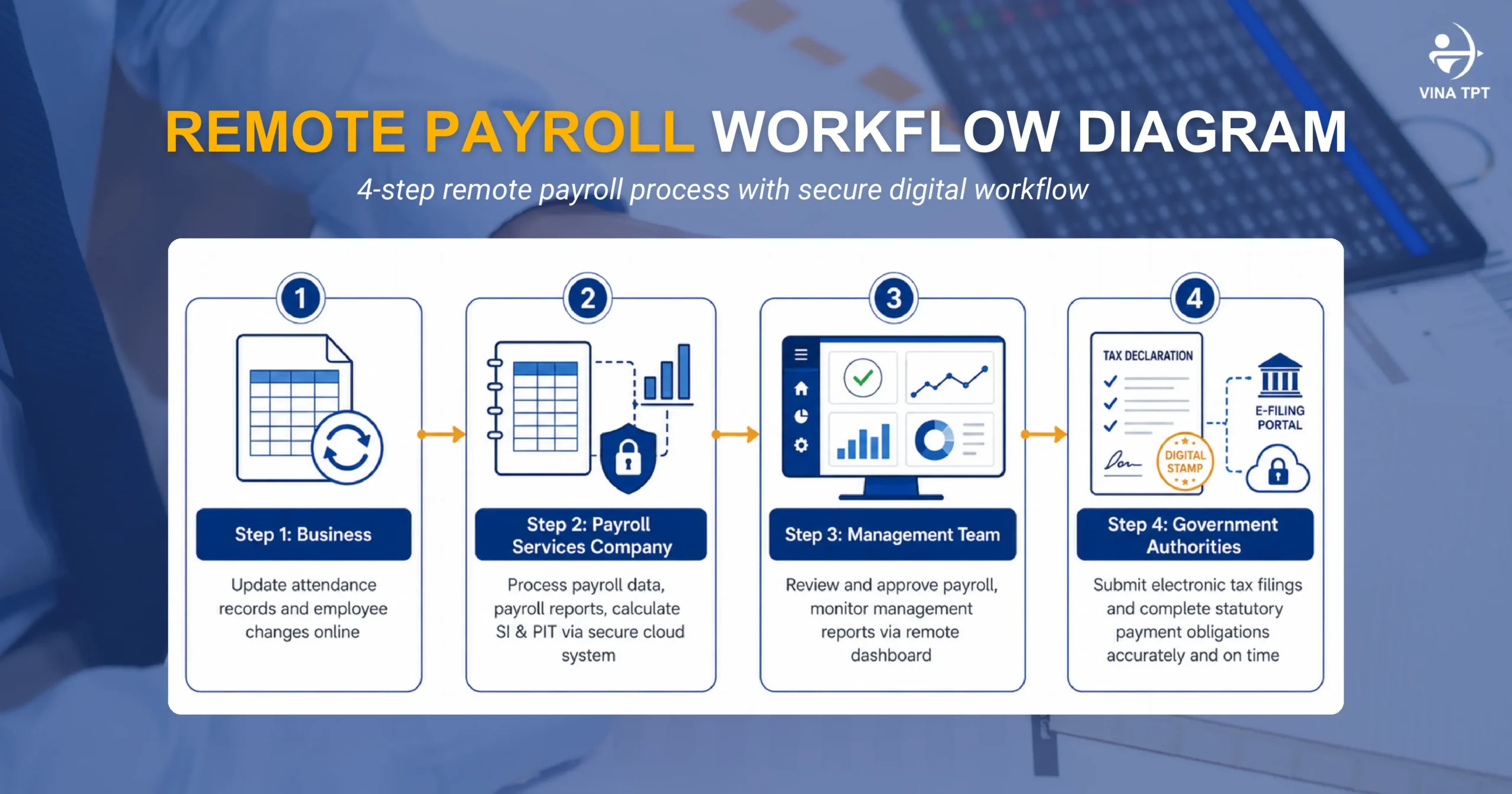
Remote payroll is a fully cloud-based service that handles salary calculation and employee management from anywhere in the world. Instead of maintaining an in-house accounting team or requiring face-to-face meetings, you simply upload employee documents through a secure online platform. The service provider then takes care of the entire payroll process – including salary processing, social insurance, health insurance, unemployment insurance, personal income tax (PIT), and labor reporting.

The remote payroll workflow is straightforward and convenient:

  • Online Contract Signing: The entire service agreement is completed securely and efficiently online through our dedicated platform. Utilizing advanced security technology, the process ensures full legal validity in accordance with Vietnamese regulations. This allows you to sign the contract remotely, without the need for any in-person meetings or office visits.
  • Monthly Payroll Review and Approval: Each month, you will receive detailed payroll reports from our service. You can easily review the information, provide feedback, and request any adjustments you require. Our dedicated team is always ready to offer professional advice on the latest regulations regarding salaries, bonuses, and labor compliance.
  • Real-time dashboard: You can monitor payroll, labor costs, social and health insurance contributions, unemployment insurance, and PIT deductions anytime through an easy-to-use online interface.
  • Secure digital payslips: Employees receive encrypted electronic payslips via email or a dedicated app, ensuring their personal information remains fully protected.

Thanks to modern cloud technology, the entire process can be completed without you ever needing to be physically present in Vietnam, saving you significant time and cost.

2. Minimum Requirements for Remote Payroll Services in Vietnam

For a remote payroll service to be truly legal, secure, and effective in Vietnam, the provider must fully comply with a comprehensive set of local regulations. Foreign investors should treat this as a critical due diligence step before signing any contract, as non-compliance can lead to heavy fines, delayed operations, or even suspension of your company’s tax code and social insurance accounts.

Here are the minimum requirements every reputable remote payroll provider in Vietnam must meet:

  • Full compliance with Vietnamese labor laws: The provider must strictly adhere to the Labor Code 2019 and all related regulations governing social insurance (BHXH), health insurance (BHYT), unemployment insurance (BHTN), and accurate contribution and deduction processes. 
  • Electronic Social Insurance Filing: The provider must possess deep expertise and complete proficiency in Vietnam’s social insurance system to accurately declare, submit reports, and make timely contributions for BHXH, BHYT, and BHTN. Manual or indirect submission processes often lead to delays, errors, and unnecessary compliance risks for your business.
  • Accurate Personal Income Tax (PIT) calculation and withholding: The provider’s team must have in-depth knowledge of the Personal Income Tax Law 2026. They need to correctly calculate and withhold PIT for both Vietnamese and foreign employees (expatriates), taking into account residency status, double tax treaties, and special allowances. Mistakes in this area are among the most common causes of tax audits and penalties.
  • Robust protection of personal data: The system must fully comply with the Law on Cybersecurity and the Law on Personal Data Protection. This includes using strong encryption, strict access controls, secure data storage, and clear policies on how employee information is handled and protected – especially important when working with sensitive expatriate data.
  • Seamless integration with Vietnamese accounting standards (VAS): The payroll system should integrate smoothly with your overall accounting setup. This ensures that payroll data flows directly into your financial records without manual re-entry, maintaining consistency and accuracy across bookkeeping, tax reporting, and financial statements.

Beyond these core technical and legal requirements, a trustworthy provider should also demonstrate proven experience working with FDI companies and remote clients, offer multilingual support (especially English), and provide a clear Service Level Agreement (SLA) that defines response times, responsibilities, and compensation in case of errors or delays.

When evaluating potential providers, always request a live system demo, review their compliance certifications, and ask for client references from other foreign-invested companies. Meeting these minimum standards is not optional – it is the foundation that ensures your remote payroll process remains fully compliant and protected from future administrative penalties or operational disruptions.

Explore Remote Payroll Services

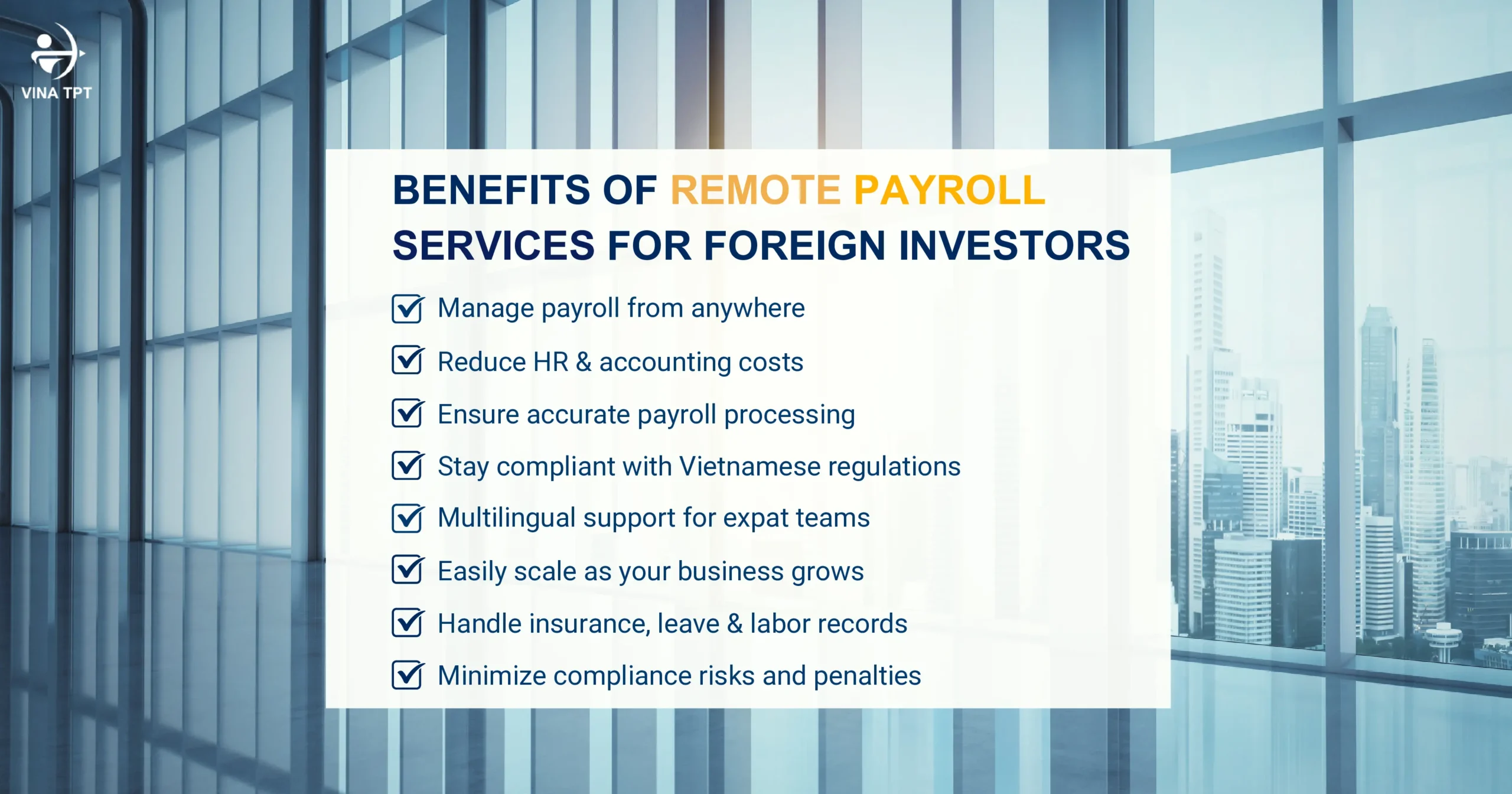
3. Benefits of Remote Payroll Services for Foreign Investors

One of the biggest advantages of remote payroll is the freedom it offers. You can manage the entire payroll process – including salary calculations, social insurance contributions, and Personal Income Tax (PIT) – from anywhere in the world, as long as you have a stable internet connection. This is particularly valuable for founders, CFOs, and leadership teams working remotely or based at headquarters overseas.

Another major benefit is significant cost reduction. Compared to building and maintaining an in-house accounting and HR team, professional remote payroll services can lower your expenses by 40–60%. This makes it an ideal solution for startups and mid-sized FDI companies that need to keep operating costs under tight control while still maintaining high standards of compliance and accuracy.

Beyond cost savings, remote payroll provides professional, accurate, and timely support. Reputable providers ensure correct salary processing, proper contributions to social, health, and unemployment insurance, and accurate PIT deductions. Most services also offer multilingual support (English, and often Japanese or Korean), making communication smooth and stress-free for expat teams.

As your company grows, remote payroll scales effortlessly with you. Whether your headcount increases from 5 to 50 or even 100 employees, you can simply expand the service scope without the need to hire additional accounting or HR staff or deal with complicated internal procedures.

Importantly, a good remote payroll service goes far beyond basic salary calculation. A reliable provider also fully manages social insurance records, processes leave requests, maternity benefits, and contract terminations, helping you maintain full compliance with Vietnamese labor laws and greatly reducing the risk of disputes or penalties.

remote-payroll-in-vietnam-risks-benefits-and-is-it-right-for-your-business

4. How to Choose a Reliable Remote Payroll Provider in Vietnam

Choosing the right remote payroll provider is critical to ensuring peace of mind and smooth operations. Here are the five most important questions you should ask before making a decision:

  1. How many years of experience do you have supporting FDI companies and remote clients? Real-world experience with foreign businesses and remote teams is essential. The provider must thoroughly understand Vietnamese labor laws, PIT regulations, and expatriate procedures.
  2. What are your commitments regarding deadlines and liability for errors or delays? The contract should include a clear Service Level Agreement (SLA) that specifies processing times for payroll and insurance contributions, along with compensation mechanisms if mistakes are made by the provider.
  3. Does your support team communicate effectively in English? Fluent English support and the ability to clearly explain complex legal requirements are crucial, especially for foreign investors and expat teams.
  4. Can your payroll service integrate with accounting services? The ideal provider should be able to connect payroll data with full accounting services (VAS bookkeeping and tax compliance) to create a seamless financial management system.
  5. How does the day-to-day workflow between the client and the service provider work? Ask specifically what documents and information your company needs to provide each month (e.g., attendance records, staff changes, salary vouchers, leave requests, etc.). The process should be transparent, straightforward, and supported by timely assistance from the provider so you don’t have to spend excessive time following up.
  6. Does the service include labor law and tax advisory support? A good provider does more than just calculate salaries. They should offer practical, ongoing advice. 

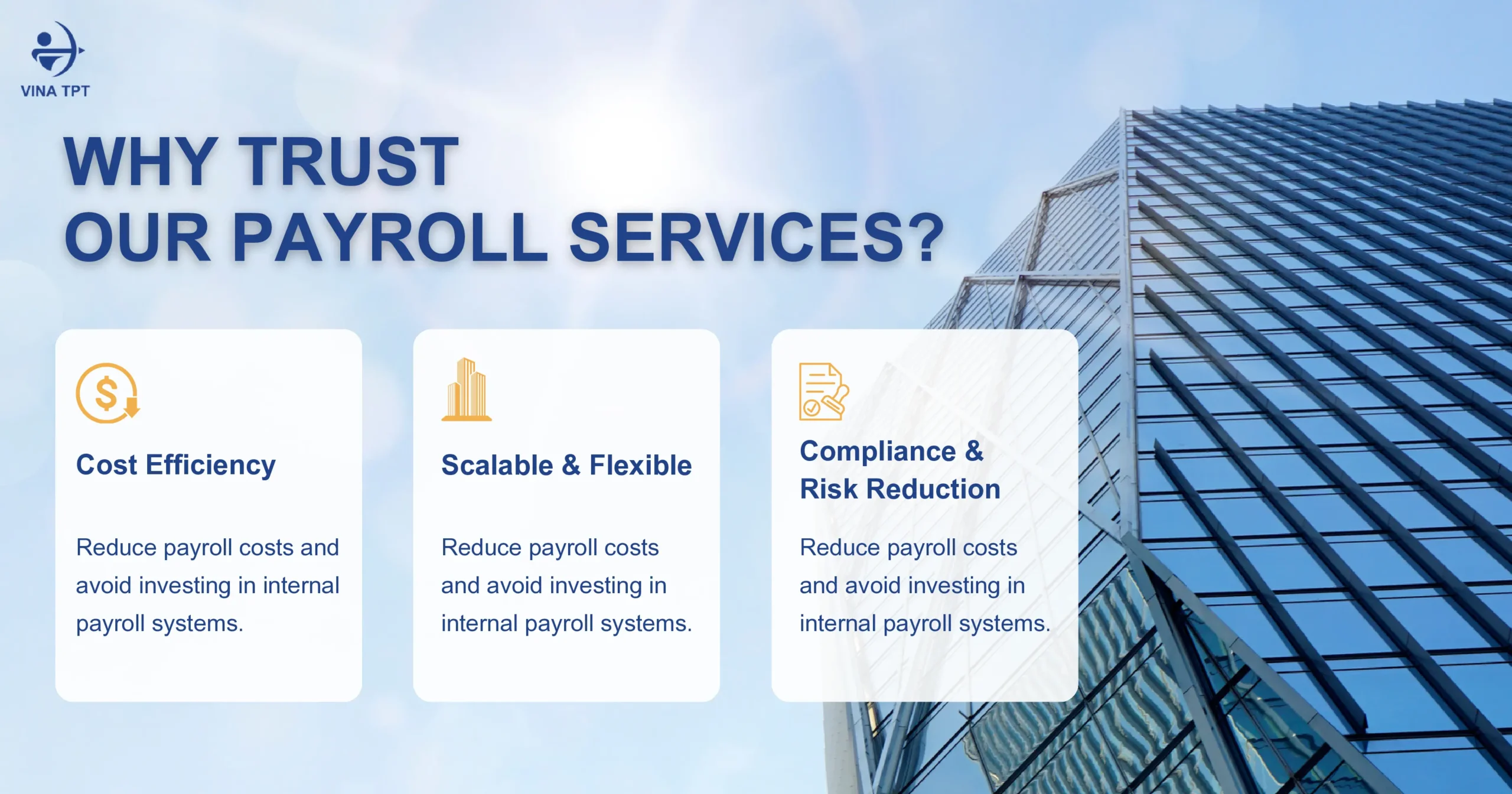
5. Why Vina TPT is the Trusted Choice for Remote Payroll in Vietnam

With over 20 years of experience supporting FDI companies and remote teams, Vina TPT offers a specialized, secure, and convenient remote payroll service.

We handle salary calculation, social and health insurance management, unemployment insurance, PIT withholding, and digital payslips entirely online with real-time dashboards. Our team provides excellent English support, uses a highly secure cloud system, and operates under a clear SLA – giving you complete confidence even when you are not physically in Vietnam.

Contact Vina TPT today for a free consultation and to experience professional remote payroll services. Let us handle your payroll and labor compliance so you can focus on growing your business.

remote-payroll-in-vietnam-risks-benefits-and-is-it-right-for-your-business

BOOK A FREE CONSULTATION


Best Payroll Services Companies for Businesses in Vietnam 2026

best-payroll-services-company-for-businesses-in-vietnam-2026

best-payroll-services-company-for-businesses-in-vietnam-2026

Finding and partnering with a professional payroll services company is one of the most important strategic management decisions that directly impacts the operational efficiency of any business in Vietnam. Whether your company is a small business in its early startup phase, a fast-growing technology firm, or a large-scale foreign-invested enterprise (FDI), a well-designed outsourced payroll solution is the key to optimizing administrative costs, minimizing local compliance risks, and freeing up internal resources to focus entirely on core revenue-generating activities.

In today’s highly dynamic business environment, Vietnam’s labor laws, mandatory social insurance regulations, and personal income tax (PIT) rules undergo frequent updates and adjustments. This reality has exposed the limitations of maintaining an in-house payroll system in terms of both cost and accuracy, driving a strong shift toward specialized outsourced payroll services.

This article provides a comprehensive analysis of the core criteria for evaluating a quality payroll services company, along with a detailed ranking of the leading players to help business leaders identify the most suitable payroll services company in Vietnam for their organization’s actual needs.

1. What Makes a Good Payroll Services Company for Businesses in Vietnam?

A truly reputable payroll services company in Vietnam must go far beyond performing routine monthly salary calculations. In practice, the right partner should deliver a comprehensive, accurate, highly secure, and locally knowledgeable human resources management solution. When screening and selecting a payroll services company, business leaders should pay close attention to the following core evaluation criteria:

  1. Absolute Compliance with Labor Laws and Tax Regulations The provider must have a team of specialists with calm, meticulous expertise who thoroughly understand the Labor Code, social insurance laws (including obligations for Social Insurance, Health Insurance, Unemployment Insurance), and the personal income tax finalization process. Every declaration and contribution submitted to state authorities must be absolutely accurate to protect the company from the risk of back taxes, administrative fines, or prolonged tax audits.
  2. Strong Remote Operation and Flexible Online Management Capabilities For foreign investors, multinational managers, or leadership teams that frequently travel, an ideal payroll solution must fully integrate user-friendly remote features. All processes – from document transfer and payroll approval to tracking staff changes and record storage, must run smoothly in an online environment, allowing business owners to maintain control without needing to be physically present in Vietnam.
  3. Advanced Cloud Technology and Maximum Information Security Payroll data, income levels, and personal employee information are among the most confidential assets of any organization. Therefore, a high-quality service provider must utilize advanced Cloud platforms with strict access controls, clear audit trails, and compliance with international security standards to completely prevent any risk of data leakage or loss.
  4. Transparent Pricing Policy and Flexible Scalability This criterion is decisive when small businesses look for payroll services for small business. The provider’s pricing structure must be transparent, free of hidden fees, and capable of scaling flexibly according to the actual monthly headcount fluctuations of the business, thereby maximizing budget efficiency at every stage of development.
  5. Multilingual Support and Deep Understanding of FDI Requirements The directly responsible team must be fluent in international languages (English, Japanese, or China) to effectively communicate, explain, and report data periodically to overseas headquarters. In addition, the provider must be fully capable of handling end-to-end legal procedures for foreign employees (expatriates) in Vietnam, such as Work Permits, Visas, and Temporary Residence Cards (TRC), to ensure complete operational synchronization.

best-payroll-services-company-for-businesses-in-vietnam-2026

Top 5 Best Payroll Services Companies in Vietnam 2026

To give you a clear overview and support your decision-making process, below is a detailed ranking and analysis of the top 5 leading payroll services company in Vietnam in 2026:

1. Talentnet 

Established in 2003 from an international HR office, Talentnet has solidified its position as one of the largest and most experienced payroll services company in the industry.

  • Key Strengths: Strong local knowledge and high-standard operational processes. The company offers a comprehensive HR service ecosystem ranging from executive recruitment and salary benchmarking to full-scale HR outsourcing.
  • Best Suited For: Large corporations and multinational enterprises with thousands of employees, complex salary structures, and the need for a provider capable of managing the entire administrative HR machinery.

2. Acclime – Acclime Vietnam

As a member of a reputable international payroll services company, Acclime Vietnam (built on a solid foundation from its predecessor operations in Vietnam) specializes in professional solutions for company establishment, accounting, and payroll for foreign investors.

  • Key Strengths: Strict international management processes, clear reporting structures, and high synchronization across the Asia-Pacific region. Acclime’s team has deep knowledge of international financial regulations and rigorous auditing standards.
  • Best Suited For: Mid-sized to large FDI companies, representative offices of international brands that require a globally recognized provider with systematic workflows and strong compatibility with complex ERP management software.

3. Vina TPT – Accounting, Tax & HR Firm

Vina TPT has emerged as one of the standout and most optimal choices in the payroll services segment (best payroll services company Vietnam), particularly for foreign-invested enterprises (FDI) and small to medium-sized businesses that require high flexibility.

  • Key Strengths: With more than 20 years of deep practical experience in FDI business consulting, Vina TPT has developed a lean and highly effective service model that skillfully combines modern Cloud technology with meticulous, careful professional expertise. Vina TPT excels in 100% remote operation capability, a bilingual team (English-Vietnamese and Japanese-Vietnamese), and a precise, detail-oriented approach that meets international standards.
  • Best Suited For: FDI companies newly entering the market, foreign businesses that need to manage HR remotely, and business owners seeking optimal payroll services for small business solutions with dedicated support and flexible tailoring to the organization’s actual scale.

4. PwC – PricewaterhouseCoopers Vietnam

As part of the globally leading Big 4 accounting and consulting group, PwC Vietnam offers a premium payroll services company in the high-end segment, complemented by in-depth strategic human resources and organizational structure consulting.

  • Key Strengths: Absolute international brand reputation and the highest level of risk control processes. PwC possesses a global network of experts capable of handling the most complex people-related issues, including global tax policies for senior executives on international assignments (Global Mobility).
  • Best Suited For: Large multinational corporations, publicly listed companies, or major financial institutions that require premium services, absolute confidentiality, and deep integration with complex independent audits.

5. HR2B – HR2B Joint Stock Company

Established in 2003, HR2B is one of the most reputable local names with a solid position in human resources management and payroll processing in the Vietnamese market.

  • Key Strengths: Highly practical payroll services company with a strong focus on core HR solutions and mid-to-senior level recruitment. HR2B offers clear, user-friendly workflows and highly competitive pricing.
  • Best Suited For: Small and medium-sized local businesses, or FDI companies in their early setup phase that are looking for a cost-effective payroll provider with stable operations and a team that understands local labor practices.

The ranking of payroll services companies presented above is intended for reference only. It is based on market popularity, client feedback, and each provider’s core strengths in Vietnam as of 2026. The order from 1 to 5 does not represent an absolute hierarchy, overall size, or superiority among the companies. It aims to provide an objective overview while respecting the unique suitability of each service model for different types of businesses.

In addition to the five prominent payroll and back-office service providers listed above, business leaders may also consider several other reputable global HR organizations currently operating in Vietnam, including: Manpower Group Vietnam, Adecco Vietnam, Randstad Vietnam, Michael Page Vietnam, and Hays Vietnam.

Explore Company Formation Services & Get Free Consultation

3. Strategic Questions to Help Leaders Choose the Right Payroll Provider

To avoid selecting an overly complicated system that wastes budget or a provider lacking sufficient support that creates legal risks, business leaders should review their internal needs using the following practical guiding questions:

  • Does your company require a fully remote/online payroll processing and approval solution? If management is often overseas, a Cloud-integrated system is essential.
  • What is your fixed monthly budget for payroll processing? Clearly defining the budget will help you quickly narrow down options between high-end Big 4 firms and more flexible solutions for SMEs.
  • Does the payroll system need to integrate and synchronize with the company’s accounting department and tax declarations? In practice, payroll and accounting systems usually operate separately. However, choosing a provider that can handle all three areas – payroll, accounting, and tax – creates a seamless flow of information. This integration reduces manual work, minimizes errors, and gives management clearer, more accurate control over labor costs throughout the year.
  • Does the head office team or foreign staff require support in specific languages (English, Japanese, etc.) for communication? Ensure the provider has specialists fluent in the required language to avoid information barriers.
  • Does your business need support with legal documentation for foreign employees (Work Permit, TRC, Visa)? A partner with end-to-end capability will save your company considerable time coordinating with third parties.

4. Why Many Businesses Choose Vina TPT for Payroll Services Company

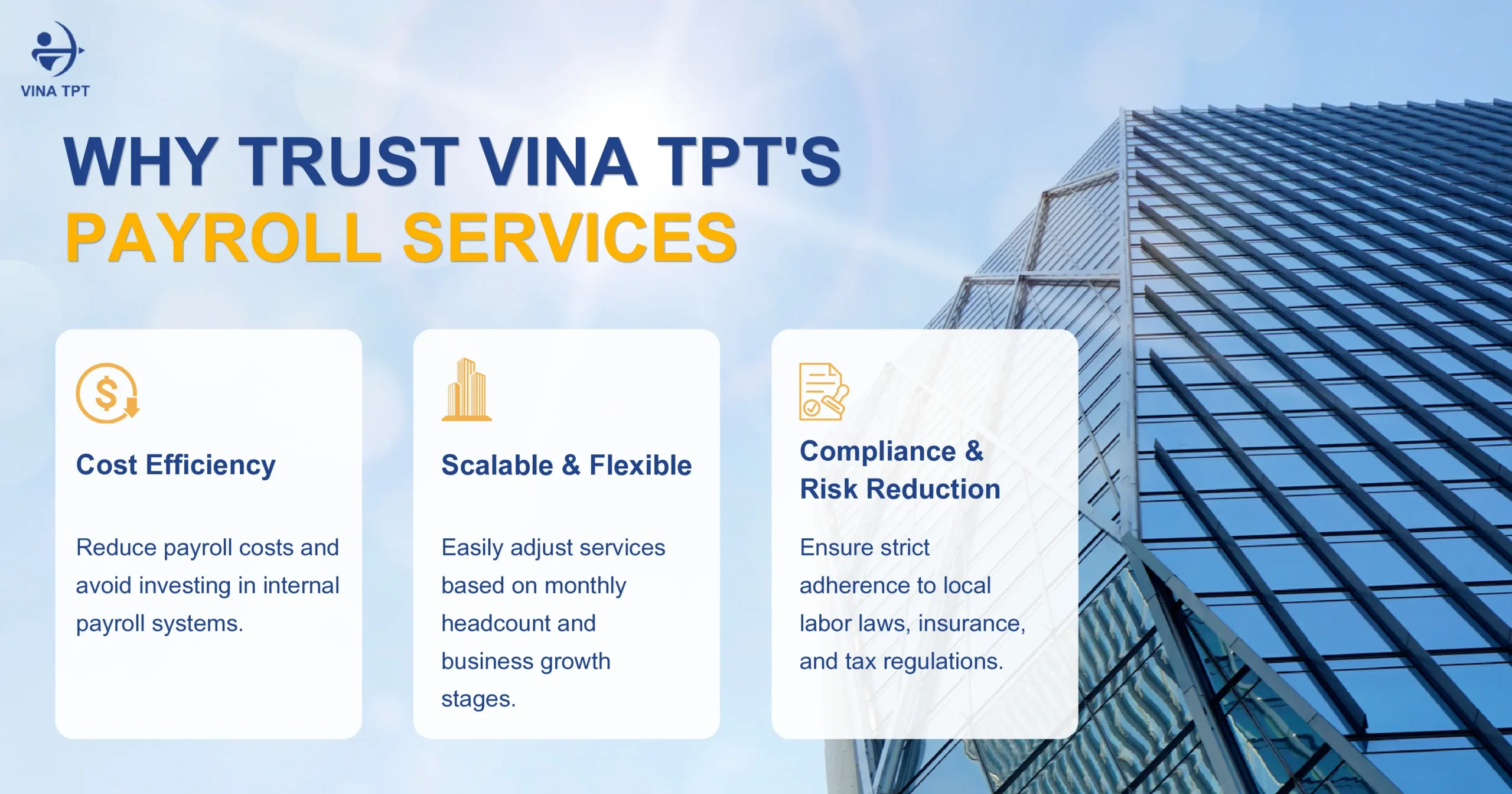
Rather than positioning itself as a mere data-entry provider, Vina TPT proudly acts as a strategic partner for businesses seeking a reliable payroll services company. Hundreds of international investors and small businesses have entrusted their payroll operations to Vina TPT thanks to its outstanding competitive advantages:

  • Deep practical experience with FDI clients: With over 20 years of specialized operations, we thoroughly understand the careful management mindset, information security requirements, and demand for absolute accuracy of foreign investors – especially Japanese companies, which currently account for more than 80% of our total client base.
  • Three-level internal quality control mechanism: To eliminate technical errors to the maximum extent, every salary calculation, social insurance declaration, and tax finalization file at Vina TPT undergoes independent review through three rigorous layers of personnel: Processing Specialist (Assistant) -> Professional Controller (Senior) -> Operations Director Approval (Manager).
  • Fully integrated solution ecosystem: A major differentiator of Vina TPT is the ability to seamlessly connect the payroll system with comprehensive accounting and corporate tax management services. This integration ensures absolute consistency in cash flow, so that actual labor cost figures in the accounting books always match the data reported in PIT and CIT declarations.
  • Flexible and secure Cloud technology platform: Our modern management technology provides automatic deadline alerts, helping businesses consistently meet their obligations on time. At the same time, our service packages are designed with high flexibility, making them extremely user-friendly and cost-optimized for the payroll services for the small business segment.

best-payroll-services-company-for-businesses-in-vietnam-2026

Conclusion

Choosing the right payroll services company is a solid foundation that helps businesses strengthen internal control, optimize administrative costs, and ensure absolute legal compliance in Vietnam.

If your company is looking for a secure, remote payroll solution that integrates perfectly with accounting and tax systems and can deliver bilingual reporting directly to headquarters, please contact Vina TPT today. Our experts will consult you on the most optimal service model and provide a tailored, visual demo designed specifically for your company’s scale.

BOOK A FREE CONSULTATION

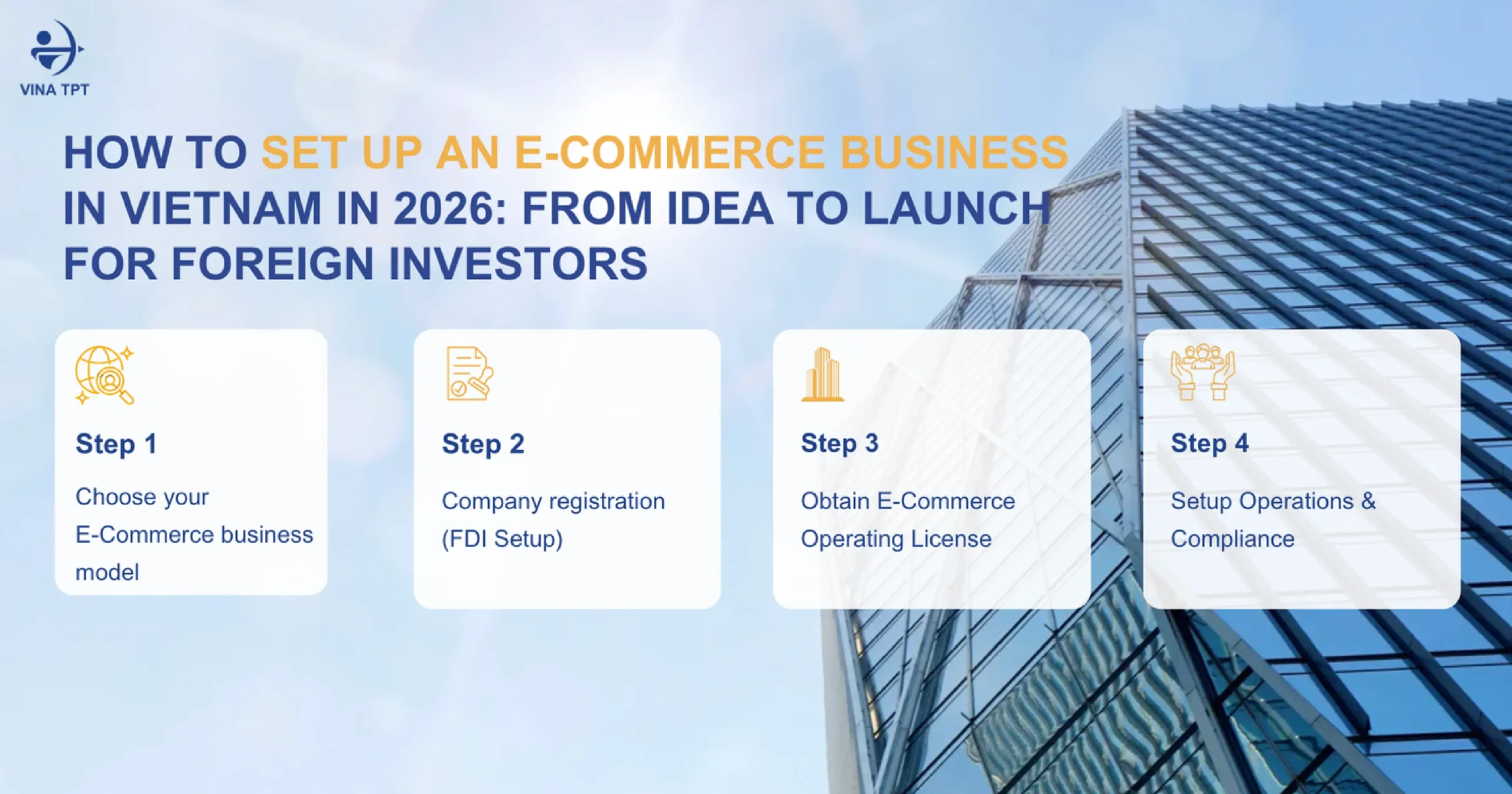
How to Set Up an E-Commerce Business in Vietnam in 2026: From Idea to Launch for Foreign Investors

how-to-get-vat-refund-in-vietnam-a-practical-guide-for-foreign-investors-2026

how-to-get-vat-refund-in-vietnam-a-practical-guide-for-foreign-investors-2026

Vietnam’s e-commerce market is growing at an impressive pace and is expected to surpass USD 30 billion by 2026. With a young, digitally native population, high internet penetration, and the explosive rise of platforms such as Shopee, Lazada, and TikTok Shop, this is an ideal time for foreign investors to establish an e-commerce business in Vietnam.

Moreover, the Law on Investment 2025 (effective March 1, 2026) and the Law on Electronic Commerce 2025 have introduced significant reforms. These changes make it much easier for foreign investors to own 100% of their company and operate fully online businesses in Vietnam.

This article offers a clear, step-by-step guide on how to set up an e-commerce business in Vietnam in 2026 – from choosing the right business model to full operational launch. It is specially designed for foreign investors interested in establishing an online trading company in Vietnam.

1. Vietnam E-Commerce market outlook 2026 & promising sectors

Vietnam’s e-commerce sector is becoming increasingly diverse, with strong potential across multiple industries – particularly attractive for FDI investors.

Key promising sectors include:

  • Fashion & Beauty: High demand, fast inventory turnover, and excellent scalability through social commerce.
  • Electronics & Technology: Strong profit margins and well-suited for cross-border models.
  • Health & Wellness: Significant post-COVID growth, especially in functional and nutritional products.
  • Home & Living: Benefiting from long-term shifts in online shopping habits.
  • Food & Beverages (especially fresh products): High potential, although it requires robust logistics.
  • Imported Products (cross-border): Leverages the appeal of international brands.
  • Eco-friendly & Sustainable Products: An emerging trend, particularly popular among younger consumers.

What these sectors share is rapidly growing demand, easy access to online customers, and strong potential for foreign companies to scale successfully.

2. Step 1: Step 1: Choose the Right Model to Set Up an E-Commerce Business in Vietnam

Before taking any concrete steps, clearly defining your overall business model is the single most important decision when learning how to start an import-export business in Vietnam.

E-commerce is merely a sales channel, not the business model itself. You must first decide how your company will operate, whether through wholesale, retail, direct export, import and distribution, or a combination of several models.

The most common business models currently used by foreign investors in Vietnam include:

  • Wholesale (B2B): Importing goods in large volumes and selling them to retailers or other businesses. This model is ideal for companies focused on supply chain efficiency and high-volume transactions.
  • Retail (B2C): Selling products directly to end consumers, either through physical stores or online channels.
  • Direct Export: Focusing on exporting Vietnamese-made products to international markets.
  • Import and Distribution: Importing goods from overseas and distributing them within Vietnam (this can combine both wholesale and retail activities).
  • Hybrid Model: Combining multiple approaches (for example, wholesale + online retail + export) to maximize revenue streams and flexibility.

E-commerce can be applied to any of the above models, whether through your own website, selling on major marketplaces such as Shopee, Lazada, or TikTok Shop, or using a combination of online and offline channels.

Practical Recommendation

Many foreign investors begin with an Import and Distribution model combined with a Hybrid approach (wholesale + online retail). This allows them to test the market and validate demand before making larger investments. Clearly defining your business model early on will help you choose the right company structure, prepare the correct licenses, and avoid costly adjustments later in the process.

3. Step 2: Company Registration (FDI Setup)

To legally set up an e-commerce business in Vietnam, foreign investors must first establish a compliant legal entity. The most common and flexible choice is a 100% foreign-owned Limited Liability Company (FDI LLC).

The standard registration process includes:

  • Obtaining the Investment Registration Certificate (IRC)
  • Obtaining the Enterprise Registration Certificate (ERC)

Under the Law on Investment 2025, in many non-restricted sectors, investors can now apply for the ERC first and complete the IRC later – significantly shortening the overall setup timeline.

Once the licenses are granted, the company must:

  • Open an investment bank account
  • Contribute charter capital within 90 days
  • Register the company seal and tax code

With complete and accurate documentation, the entire process usually takes 6 to 8 weeks.

Explore Company Formation Services & Get Free Consultation

4. Step 3: Obtain E-Commerce Operating License

After company registration, businesses must fulfill specific licensing requirements for e-commerce activities.

Companies are required to register or notify their e-commerce operations with the Ministry of Industry and Trade, depending on the chosen model. For platforms with foreign elements, appointing a Local Authorized Representative in Vietnam is often mandatory.

Additional operational requirements typically include:

  • Seller verification systems (VNeID)
  • Clear complaint handling policies
  • Robust personal data protection mechanisms

If the business sells regulated products such as food, cosmetics, or medical devices, additional specialized licenses will be required.

5. Step 4: Setup Operations & Compliance

Once all legal formalities are completed, the focus shifts to building efficient day-to-day operations. Key areas to address include:

  • Payment systems: Open corporate bank accounts and integrate local and international payment gateways.
  • Logistics & warehousing: Partner with reliable providers such as SPX or J&T, or develop your own network.
  • Human resources: Recruit staff and ensure full compliance with labor regulations, including work permits for expatriates where necessary.
  • Accounting & tax: Establish a VAS-compliant accounting system, manage VAT, and handle electronic invoicing correctly.

Setting up these elements correctly from the beginning helps avoid costly mistakes and ensures smooth, scalable operations in the long term.

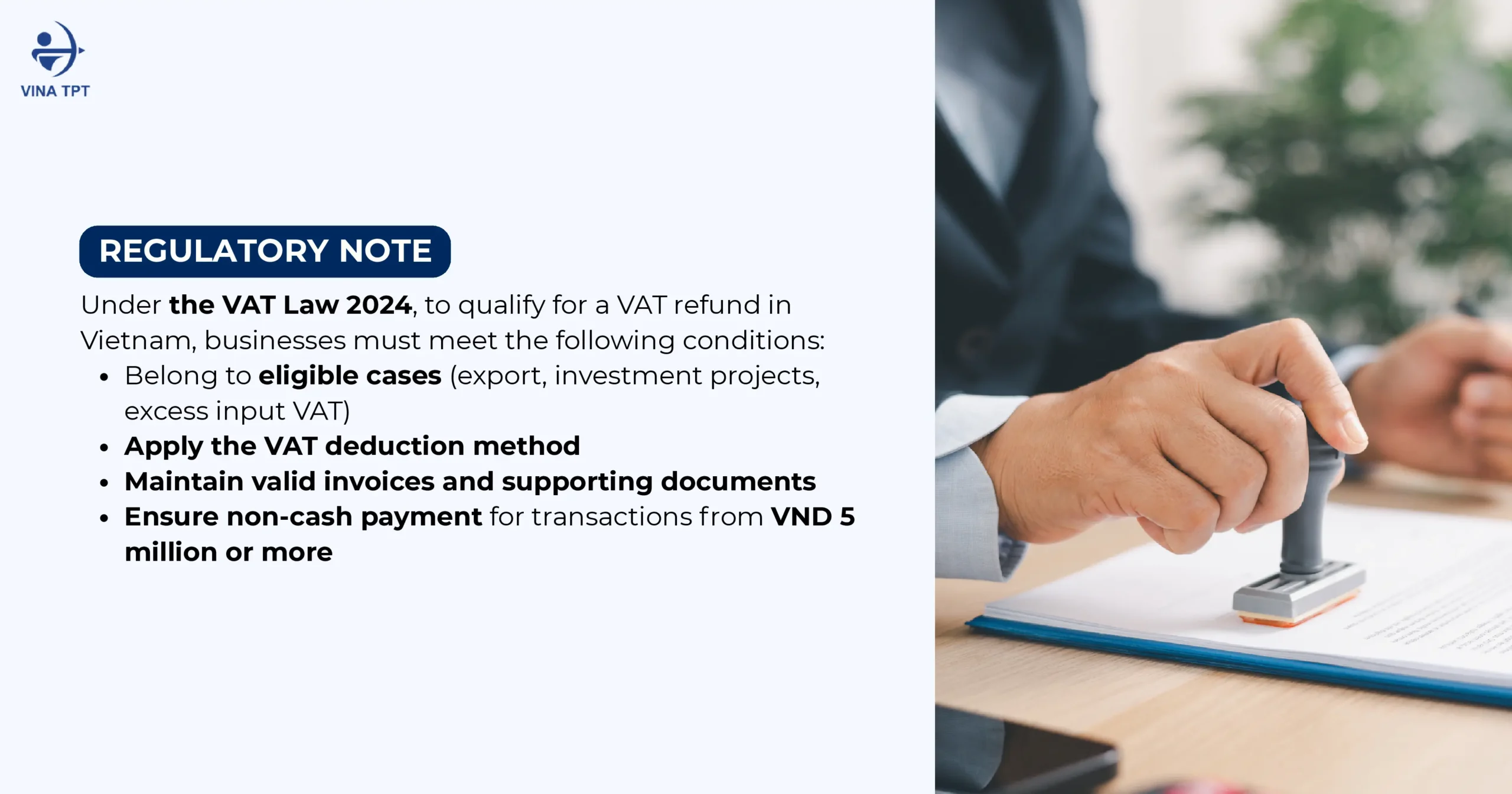
6. Common Challenges When You Set Up an E-Commerce Business in Vietnam

Although Vietnam’s e-commerce market is growing rapidly and offers tremendous potential, setting up and operating an online business in the country still presents foreign investors with a number of practical challenges. If not properly anticipated, these difficulties can delay project timelines, increase operating costs, and even undermine long-term competitiveness.

One of the biggest hurdles is the strict requirement for legal presence and regulatory compliance. Foreign investors must not only establish an FDI company but also register their e-commerce activities with the Ministry of Industry and Trade, appoint a Local Authorized Representative in Vietnam, and implement robust personal data protection mechanisms in line with the Law on Cybersecurity and the Law on Personal Data Protection. Any misstep in this process can lead to heavy administrative fines or even suspension of operations.

A second major challenge is the intense competition from dominant local platforms. Shopee, Lazada, TikTok Shop, and other established domestic marketplaces already control the majority of the market share with powerful promotional campaigns, massive user bases, and ready-made infrastructure. Building brand awareness, attracting new customers, and competing on price requires a smart marketing strategy and a substantial budget.

Third, logistics and supply chain limitations remain a significant obstacle. Although the sector has developed quickly in recent years, service quality still varies considerably across different regions. Deliveries to remote and rural areas are often slower, have lower success rates, and incur higher costs – all of which directly impact customer experience and profitability.

To successfully navigate these challenges, businesses need a clear strategy from the outset, strong partnerships with reputable local players, and professional FDI consulting support. Working with experienced advisors helps minimize risks, optimize costs, and accelerate operational readiness.
how-to-get-vat-refund-in-vietnam-a-practical-guide-for-foreign-investors-2026

7. Why Vina TPT Can Help You Set Up Your E-Commerce Business

Vina TPT offers a comprehensive, end-to-end solution to help foreign investors successfully set up an e-commerce business in Vietnam.

We provide full support from company formation and e-commerce licensing to the establishment of accounting, tax, and payroll systems. Drawing on extensive experience working with FDI companies, Vina TPT ensures you not only comply with all legal requirements but also launch operations efficiently and effectively from the very first day.

Contact Vina TPT today if you plan to set up an e-commerce business in Vietnam with full legal and operational support.

how-to-set-up-an-e-commerce-business-in-vietnam-in-2026-from-idea-to-launch-for-foreign-investors

BOOK A FREE CONSULTATION

Entering Vietnam Market Guide: A Complete Before – During – After Roadmap for Foreign Investors

how-to-get-vat-refund-in-vietnam-a-practical-guide-for-foreign-investors-2026

entering-vietnam-market-guide-2026-a-complete-before-during-after-roadmap-for-foreign-investors

If you are researching entering the Vietnam market, having a clear understanding of the entire journey, from preparation to company setup and actual operations, is the key factor for success.

Vietnam continues to be an attractive destination for foreign investors thanks to stable economic growth, competitive costs, and a wide network of free trade agreements. In particular, the Law on Investment 2025, which takes effect in 2026, has introduced many positive reforms, making the investment process more flexible and transparent.

However, in practice, many foreign investors still face difficulties not because of a lack of opportunities, but because they lack a clear roadmap – from market research and company formation to operations and compliance. A well-structured entering Vietnam market guide can help investors avoid unnecessary delays, legal risks, and operational inefficiencies.

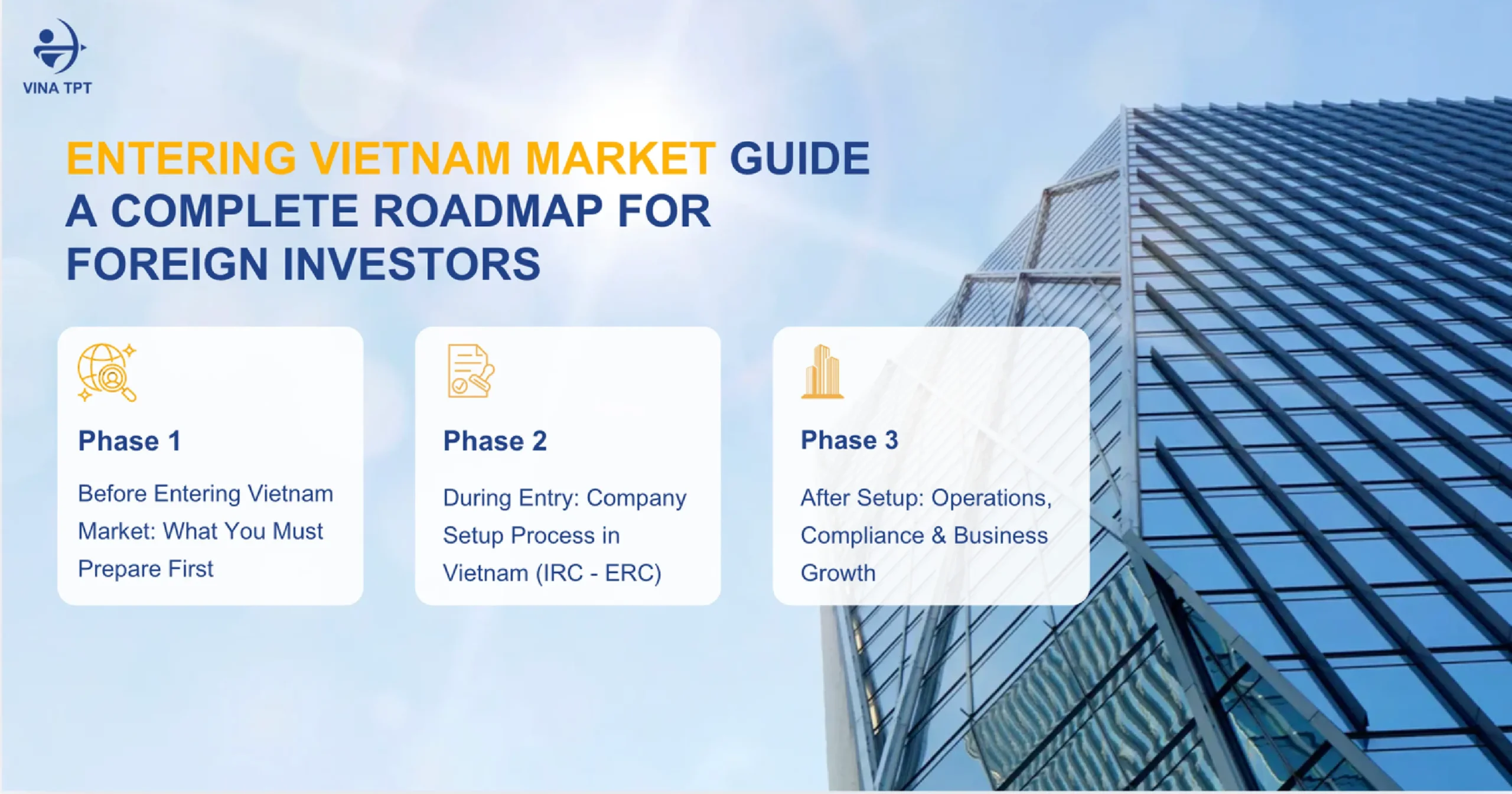
This article serves as a comprehensive entering Vietnam market guide, walking you through the full process in three phases: Before – During – After. At the end of the article, you can also download the Free Investor Handbook for more detailed information. 

Phase 1 – Before Entering Vietnam Market: What You Must Prepare First 

Before officially investing, the research and preparation phase is the most important step to minimize risks and optimize costs.

The main tasks you need to complete include Entering Vietnam Market Guide: 

  • Market research and business line selection: Study market demand, competitors, and consumption trends. It is especially important to check whether your intended business line falls under conditional or unconditional sectors according to the Law on Investment 2025 to avoid needing additional specialized licenses.

>>> You may also refer to our article: Top 20 Sectors for Business Opportunities in Vietnam for more insights.

  • Develop a detailed business plan: Create a clear business plan that includes revenue forecasts, cost estimates, capital mobilization methods, and risk assessment.
  • Risk evaluation and partner selection: Analyze legal, financial, logistics, and cultural business risks. Many investors choose to work with a local consulting firm at this stage to fully understand the actual legal requirements.
  • Financial preparation and market exploration visa: Build an initial capital plan and apply for a short-term business visa to conduct on-site surveys.

At this stage, investors should not rush to fly to Vietnam without a clear plan. Contacting a specialized FDI consulting firm early will help you save a great deal of time and cost later.

Phase 2 – During Entry: Company Setup Process in Vietnam (entering vietnam market guide)

This is the most critical and important stage in the entire FDI setup journey in Vietnam. After completing market research and planning in Phase 1, you will now officially move forward with establishing your company.

The main steps in this phase include:

  • Choosing the right business structure Most foreign investors opt for a 100% foreign-owned Limited Liability Company (FDI LLC). This structure offers simple governance, high flexibility, and full control. It is suitable for both startups and medium-sized businesses, allowing you to make decisions quickly without the complications of multiple shareholders. In most cases, choosing the right entity structure is one of the most important decisions in any entering Vietnam market guide for FDI companies.
  • Completing the IRC and ERC registration process: To legally operate in Vietnam, foreign investors are required to obtain both the Enterprise Registration Certificate (ERC), which establishes the legal entity, and the Investment Registration Certificate (IRC), which records the investment project and investment activities. Completing both licensing procedures is an essential step for foreign-invested companies to conduct business activities in compliance with Vietnamese regulations.
  • Preparing a complete and accurate application dossier Required documents typically include: a notarized and consular-legalized passport (or corporate legal documents), a detailed investment project proposal, proof of financial capacity (bank statements, financial reports, or parent company support letters), and proof of legal right to use the business premises (office lease agreement). All foreign documents must be properly translated, notarized, and consular legalized in accordance with Vietnamese regulations.
  • Completing post-licensing procedures Once the licenses are issued, you must open an investment capital account, fully contribute charter capital within 90 days, register the company seal, obtain a digital signature, and complete tax registration along with other administrative formalities

>>>Entering Vietnam market guide you may need: How to Start a Business in Vietnam: 2026 Guide for Investors 

entering-vietnam-market-guide-2026-a-complete-before-during-after-roadmap-for-foreign-investors

Phase 3 – After Setup: Operations, Compliance & Business Growth

In this stage of the entering Vietnam market guide, businesses begin transitioning from setup to long-term operations and compliance. Once you have received your official licenses, you officially enter the operational phase – the stage that ultimately determines whether your business will achieve sustainable growth or face ongoing struggles. This is where all the plans on paper turn into reality. It requires strict compliance, professional management, and careful attention to detail to avoid legal risks and maximize business efficiency.

The most critical tasks to setup after entering Vietnam market guide include:

  • Tax Compliance and Periodic Reporting You must accurately declare and pay all applicable taxes, including VAT, Corporate Income Tax (CIT), and Personal Income Tax (PIT). In addition, FDI companies are required to submit the Investment Activity Report (IAR) on a regular basis. Electronic invoicing must also be implemented and properly managed from the very first day of operations.
  • Establishing a Professional Accounting System Set up proper bookkeeping in full compliance with Vietnamese Accounting Standards (VAS) under Circular 99/2025/TT-BTC. This includes tight cash flow management, accurate internal financial reporting, and management accounts to support timely decision-making by leadership.
  • Recruitment and Human Resources Management Handle work permits and Temporary Residence Cards (TRC) for foreign investors and expatriate specialists. At the same time, build a complete payroll system and ensure timely contributions to social insurance (BHXH), health insurance (BHYT), and unemployment insurance (BHTN) for local employees. Labor law compliance is especially important in this phase to avoid disputes and administrative penalties.
  • Office and Warehouse Setup Select and secure suitable office space or warehouse facilities that align with your business model. Complete all necessary legal procedures related to the registered address and ensure the premises meet official business registration requirements.
  • Cash Flow Management and Growth Planning Closely monitor cash flow, develop long-term financial plans, optimize operating costs, and create clear strategies for business expansion – whether through opening new branches, scaling production, or growing sales channels.

This phase marks the important transition from “setup” to “real operations.” Many FDI companies face significant difficulties here because they lack local experience and have not yet built a solid internal management system. Establishing a strong operational foundation from the beginning will help you avoid legal risks, control costs effectively, and create a solid platform for sustainable growth in the years ahead.

Explore End-to-End Business Formation Services

Common Challenges in Any Entering Vietnam Market Guide

Even though the Law on Investment 2025 has brought many favorable reforms, foreign investors still often face real challenges when entering the Vietnam market. If not well prepared, these difficulties can slow progress and increase initial costs. This is why many businesses rely on a professional entering Vietnam market guide to better prepare for licensing, compliance, and operational challenges in Vietnam.

The most common challenges include:

  • Administrative procedures can still be lengthy: Although greatly simplified, some project approvals, specialized licenses, or location confirmations may take longer than expected, especially for large projects or conditional sectors.
  • Language barriers and cultural differences in business practices: Differences in communication style, contract negotiation, and working culture can cause misunderstandings or delays in the early stages.
  • Initial cost and cash flow management: The setup phase often involves many unexpected expenses (office, staff, legal procedures…), requiring tight cash flow control from the beginning.
  • Difficulty in finding high-quality talent: Demand for personnel who possess both professional skills and strong English is high, but supply remains limited in some industries.

At this stage, investors need a clear plan from Phase 1 and early cooperation with a reputable FDI consulting firm. This will help minimize risks, accelerate progress, and avoid unnecessary mistakes throughout the entire journey.

Get Your Free Investor Handbook 2026

How Vina TPT simplifies your entire Vietnam Market Entry journey

Vina TPT accompanies businesses throughout the whole entering Vietnam market journey, from the preparation phase to actual operations.

  • In Phase 1: We provide market consulting, business line selection, and planning in accordance with Vietnamese legal requirements.
  • In Phase 2: Our expert team directly supports FDI company formation, handles IRC/ERC dossiers, and manages all related procedures quickly and in full compliance.
  • In Phase 3: Vina TPT offers outsourced finance & accounting, tax compliance, and payroll services to help businesses operate stably and meet all regulatory requirements.

With over 20 years of experience, we not only help you “enter the market” but also ensure you operate efficiently and grow sustainably. 

Contact Vina TPT today for a free consultation and comprehensive A-to-Z support for your investment journey in Vietnam.

entering-vietnam-market-guide-2026-a-complete-before-during-after-roadmap-for-foreign-investors

BOOK A FREE CONSULTATION

What Foreign Investors Often Get Wrong About Tax Filing in Vietnam – Expert Advice

what-foreign-investors-often-get-wrong-about-tax-filing-in-vietnam-expert-advice

what-foreign-investors-often-get-wrong-about-tax-filing-in-vietnam-expert-advice

Many newly established FDI companies in Vietnam have had to pay fines of tens of millions of VND, or even had their tax codes suspended, simply because they misunderstood or overlooked their tax filing obligations.

In reality, from the moment a company receives its Enterprise Registration Certificate (ERC), its tax filing obligations officially come into effect. This means that even if the business has not yet generated revenue or begun full operations, tax filing in Vietnam is still a mandatory requirement.

However, many foreign investors still hold the misconception that “if there is no revenue, there is no need to file.” This common misunderstanding leads to unnecessary legal risks.

This article will help you clearly understand the most frequent mistakes in tax filing for FDI companies, while providing practical guidance to ensure proper compliance according to each filing period.

1. Common Tax Filing Mistakes That Lead to Penalties or Tax Code Suspension

Foreign investors often encounter unexpected issues when handling tax filing in Vietnam. Even experienced companies can make costly mistakes due to the complexity of local regulations. Below are the most common tax filing errors that FDI businesses frequently commit:

  • Failing to file tax returns when there is no revenue Many investors assume that “no revenue means no need to file.” In reality, according to the Law on Tax Administration 2019, once the Enterprise Registration Certificate (ERC) is issued, companies must still submit VAT returns, Personal Income Tax (PIT) declarations, and other required reports on time. Failure to do so can result in administrative fines and even suspension of the tax code.
  • Late filing or missing tax declarations Submitting a return even one day late can trigger penalties of 0.03% per day on the late-paid tax amount (as stipulated in Article 59 of the Law on Tax Administration 2019). Many FDI companies commonly forget to file monthly or quarterly VAT returns or provisional Corporate Income Tax (CIT) declarations.
  • Overlooking or incorrectly handling Foreign Contractor Tax (FCT / Withholding Tax) FCT is a withholding tax applied to payments made to foreign contractors or foreign experts (governed by Decree 81/2020/ND-CP and the Law on Corporate Income Tax). This is one of the most frequent mistakes and can lead to heavy penalties and complications when applying for future VAT refunds.
  • Failing to declare and pay License Tax (Thuế môn bài) Even with some relaxations in 2026, businesses are still required to declare and pay License Tax in accordance with Decree 139/2016/ND-CP (as amended and supplemented).
  • Neglecting to reconcile Input VAT invoices Input VAT refers to the value-added tax a business has paid to its suppliers. If invoices are not properly reconciled and supported as required under Clause 2, Article 14 of the Law on Value-Added Tax 2024, the company cannot claim input tax credits or refunds. This often results in significant “locked-up” capital.

Real-world consequences of these mistakes typically include substantial fines, prolonged tax audits, delays in visa and Temporary Residence Card (TRC) processing, and even loss of trust from partners and investors. In most cases, engaging a professional accounting service from the beginning is far more cost-effective than dealing with penalties and corrective procedures later.

what-foreign-investors-often-get-wrong-about-tax-filing-in-vietnam-expert-advice

2. Why Tax Filing Becomes a Major Challenge for New FDI Companies

Tax filing quickly becomes one of the biggest headaches for newly established FDI companies in Vietnam. Although the process has been digitized through the eTax system, significant differences in legal frameworks, administrative language, and compliance requirements still create substantial challenges for foreign investors from the very first months of operation.

The main reasons why tax filing feels so complex for new FDI companies include:

  • Lack of a local accounting team familiar with Vietnamese tax laws Most foreign investors do not have in-house staff who fully understand Vietnam’s tax system, including VAS, Circular 99/2025/TT-BTC, VAT, Corporate Income Tax (CIT), Personal Income Tax (PIT), Foreign Contractor Tax (FCT), and specialized reports such as the Investment Activity Report (IAR). Recruiting experienced local accountants with strong FDI knowledge is both difficult and expensive.
  • Unfamiliar with the electronic tax filing system (eTax) and administrative Vietnamese, all tax declarations must be submitted through the eTax platform entirely in Vietnamese, using complex legal terminology. Foreign investors often struggle to understand and accurately complete the required forms.
  • The common misconception that “no revenue means no filing is needed” This is one of the most frequent misunderstandings. In reality, once the Enterprise Registration Certificate (ERC) is issued, companies are still required to submit VAT returns, PIT declarations, and other periodic reports on time – even if they have not yet generated any revenue.
  • Lack of awareness of different filing deadlines Each type of tax has its own specific monthly, quarterly, or annual deadlines. Many new FDI companies miss submissions or file late simply because they lack a clear reminder system.
  • Difficulties in communicating and providing explanations to tax authorities When additional documents or clarifications are requested, communicating in Vietnamese and preparing materials according to the exact requirements of the tax office can be extremely time-consuming and frustrating.

These challenges often result in significant administrative fines, operational disruptions, delays in visa and Temporary Residence Card (TRC) processing, and even damage to the company’s credibility with partners and potential investors during the most critical early stage.

3. Best Practices to Ensure Accurate and Timely Tax Filing

In addition to remembering important deadlines, foreign investors should take the following concrete actions to ensure proper tax filing compliance:

Important Deadlines to Remember in 2026:

No.

Filing Period Type of Tax / Declaration

Note

1

Monthly VAT (if filing monthly) By the 20th of the following month

2

Quarterly VAT, provisional CIT, PIT, FCT By the 30th of the first month of the next quarter

This VAT requirement applies to businesses that declare VAT on a quarterly basis.

3

Annual Finalization of CIT and PIT Before March 31 of the following year

4

License Tax Within 30 days after receiving ERC (paid once per year)

Case Study: 

Company Ltd., an FDI company, received its Enterprise Registration Certificate (ERC) on January 15, 2026. Believing the common misconception that “no revenue means no need to file taxes,” the founder did not submit the Q1 VAT return or the Personal Income Tax (PIT) declaration.

As a result, the company was hit with late-filing penalties, required to submit multiple rounds of supplementary documents, and even had its tax code temporarily suspended for two weeks. The total cost – including administrative fines, lost time, and disrupted business operations.

This real-world example clearly illustrates that even if a company has not yet generated any revenue, it is still legally required to file VAT and PIT declarations on time from the very first quarter after incorporation. A seemingly small oversight in the early days can quickly escalate into significant financial losses and reputational damage.

Specific Actions Investors Should Take:

  • Set up automatic reminders for all tax filing deadlines
  • Prepare complete supporting documents and invoices from the very beginning
  • Use professional outsourced tax filing services from the first month of operation
  • Perform regular data checks and reconciliations (monthly)
  • Work with a Chief Accountant or a firm experienced in supporting FDI companies

In summary, tax filing is a process that needs careful preparation from the start and can be managed effectively with a clear checklist. If your internal team is not yet capable of handling it, investing in a professional service will help the business avoid major risks and focus on business development.

Get Your Free Investor Handbook 2026

4. Why Vina TPT is trusted by many FDI Companies for Tax Filing

With more than 20 years of experience working with FDI enterprises, Vina TPT fully understands the difficulties foreign investors face in the tax filing process in Vietnam.

We provide comprehensive services, including monthly, quarterly, and annual tax declarations, ensuring that businesses always comply with regulations and meet deadlines.

What makes Vina TPT different is our automatic deadline tracking and reminder system, which minimizes the risk of late or missed filings. In addition, our team can support three languages (English, Japanese, and Vietnamese) and work remotely, making the process convenient for foreign investors.

Thanks to our professional process and practical experience, Vina TPT helps businesses minimize the risk of fines, avoid tax code suspension, and maintain stable operations from the early stages.

Contact Vina TPT today for free consultation and professional tax filing support.

what-foreign-investors-often-get-wrong-about-tax-filing-in-vietnam-expert-advice

BOOK A FREE CONSULTATION

How to get VAT Refund in Vietnam: A Practical Guide for Foreign Investors 2026

how-to-get-vat-refund-in-vietnam-a-practical-guide-for-foreign-investors-2026

how-to-get-vat-refund-in-vietnam-a-practical-guide-for-foreign-investors-2026

Many businesses in Vietnam, especially export enterprises and FDI companies, have a large amount of capital stuck in unrefunded input Value-Added Tax (VAT). This amount can reach hundreds of millions or even billions of VND, directly affecting cash flow and operational capabilities.

Obtaining a VAT refund is not only a legitimate right but also an important financial tool that helps businesses optimize their cash flow. However, in practice, not every business clearly understands the conditions, procedures, and how to prepare documents to successfully receive a VAT refund.

This article provides a detailed guide on how to get VAT refund in Vietnam, including eligibility conditions, required documents, step-by-step procedures, processing timeline, and common mistakes to avoid in 2026. This entering Vietnam market guide is designed to give you a complete roadmap from preparation to operation.

1. Who is eligible for VAT Refund in Vietnam in 2026?

Not every business in Vietnam is eligible for a VAT refund. According to Article 15 of the Law on Value-Added Tax 2024, the most common cases that qualify for a VAT refund include: 

  • Enterprises exporting goods and services (subject to the 0% VAT rate)
  • Businesses with new or expanded investment projects, particularly FDI projects that are still in the investment phase
  • Enterprises with excess VAT paid after quarterly or annual input tax credit
  • Companies undergoing dissolution, bankruptcy, or termination of operations

To be eligible for a VAT refund, businesses must also meet several general requirements:

  • Declare and pay VAT using the deduction method
  • Maintain complete and accurate accounting records with valid supporting documents
  • Hold a bank account registered under the company’s tax code
  • For any transaction of VND 5 million or more (VAT inclusive), payment must be made via bank transfer (cash payments are not accepted)

Businesses engaged in exports and FDI investment projects are often given priority under the “refund first, audit later” mechanism. This allows them to receive VAT refunds more quickly, helping improve cash flow during the critical early stages of investment.

2. Key conditions to qualify for VAT Refund in Vietnam (What You Must Meet)

To qualify for a VAT refund in Vietnam in 2026, businesses must simultaneously meet two main conditions:

2.1. Belong to the Eligible Categories under Clauses 1, 2, 3, and 4 of Article 15 of the Law on Value-Added Tax 2024

The most common eligible cases include:

  • Enterprises exporting goods and services (subject to the 0% VAT rate)
  • Businesses undertaking new or expanded investment projects (especially FDI projects)
  • Enterprises with excess VAT paid after quarterly or annual input tax credits
  • Companies undergoing dissolution, bankruptcy, or termination of operations

2.2. Declare and Pay VAT Using the Deduction Method and Comply with Input VAT Deduction Regulations under Clause 2 of Article 14 of the Law on Value-Added Tax 2024

Specifically, businesses must:

  • Possess valid VAT invoices or equivalent supporting documents
  • Make payment via bank transfer for any transaction of VND 5 million or more (VAT inclusive) – cash payments are not accepted
  • For exported goods and services, in addition to the general conditions, the following documents are required: a contract with the foreign party (for sale, processing, or service provision), invoices, non-cash payment proof, customs declaration (for exported goods), and supporting documents such as packing list, bill of lading, and insurance certificate (if any). The Government also provides specific regulations on input VAT credit conditions for exports via overseas e-commerce platforms and other special cases. 

Only when conditions are fully satisfied can a business submit a VAT refund application.

how-to-get-vat-refund-in-vietnam-a-practical-guide-for-foreign-investors-2026

>>> You may find this article helpful: Cases Eligible for VAT Tax Refund in Vietnam in 2026 

3. Step-by-Step guide: How to get VAT Refund in Vietnam

Understanding the required documents is one of the most important steps in learning how to get VAT refund in Vietnam successfully. To carry out a VAT refund, businesses need to go through the following steps:

Below is the detailed procedure for how to get VAT refund in Vietnam in 2026. The entire process is now mainly carried out electronically, helping to shorten the time compared to before.

Step 1: Check and prepare documents

Businesses need to carefully check the eligible input VAT amount and compile all related documents (electronic VAT invoices, customs declarations, export contracts…).

Step 2: Declare VAT

Carry out VAT declaration monthly or quarterly accurately and on time as prescribed.

Step 3: Submit VAT refund application

Submit the electronic VAT refund dossier through the eTax system of the General Department of Taxation. This is an important step that determines the subsequent processing speed.

Step 4: Tax authority review and decision

The tax authority will review the dossier. If it qualifies for “refund first – audit later”, you will receive the refund decision faster.

Step 5: Receive VAT refund

After receiving the refund decision, the money will be transferred directly to the business’s bank account within the prescribed time.

Step 6: Handle additional requests (if any)

In case the dossier needs clarification, businesses must quickly explain or supplement documents as requested by the tax authority to avoid prolonging the processing time.

Explore VAT Refund Services

4. What documents are required for VAT Refund in Vietnam?

Whether the business uses the deduction method or the direct method, it is mandatory to properly store all input and output documents. These documents usually include electronic VAT invoices, contracts, payment vouchers, and related records to prove the legitimacy of declared revenue and expenses.

In addition, businesses must ensure consistency between the declared VAT data, paid tax amounts, and the accounting books. Any discrepancy or lack of valid documents may lead to tax reassessment, administrative penalties, or prolonged processing time with the tax authority.

In practice, establishing a document management and internal control system from the beginning will help minimize errors and significantly reduce pressure during periodic tax inspections or audits later.

Processing Time

  • Refund first – audit later: approximately 15 days
  • Audit first – refund later: approximately 40 days

However, in practice in 2026, the processing time may be longer if the dossier is incomplete or requires multiple explanations.

5. Common VAT Refund mistakes that delay or reject your application

Although the VAT refund process has been digitized, many businesses (especially FDI enterprises and export companies) still encounter situations where their dossiers are delayed, require multiple additional submissions, or are even rejected. One of the biggest challenges when learning how to get VAT refund in Vietnam is avoiding documentation and declaration mistakes that may delay approval.

  • Invalid or mismatched invoices and documents This is the most common error. Many businesses submit VAT invoices that do not qualify for deduction, invoices with incorrect information, or fail to fully match them with customs declarations and contracts. As a result, the dossier is suspended or removed from the refund list.
  • Late tax declaration or incorrect data Declaring incorrect input VAT data or being late by even one day can lead to penalties and delay the entire refund process.
  • Not preparing sufficient explanation documents when requested When the tax authority requests explanations, many businesses respond slowly or lack supporting documents, causing the dossier to be delayed or rejected.
  • Choosing the wrong refund method Some businesses choose the “audit first – refund later” method even though they qualify for “refund first – audit later”, significantly prolonging the time to receive the money.
  • Not completing other tax obligations Businesses with outstanding PIT, CIT, or other taxes will not be eligible for VAT refund until those obligations are settled.

Practical Advice: Before submitting the VAT refund dossier, carefully check all documents and data. Cooperating with a professional consulting firm like Vina TPT will help you avoid most of the above mistakes, increase the success rate of the refund, and significantly shorten the time to receive the money.

6. How Vina TPT Helps You Get VAT Refund Faster and Safer

With more than 20 years of experience supporting FDI enterprises and export businesses, Vina TPT deeply understands the VAT refund process and the practical requirements of the tax authorities. We help clients get VAT refunds faster, safer, and with a higher success rate.

Specifically, Vina TPT provides comprehensive support as follows:

  • Thorough checking and review of input VAT dossiers before submission
  • Full preparation and optimization of documents to increase the refund success rate
  • Representing clients in submitting electronic VAT refund applications and regularly monitoring progress
  • Timely support for explanations and supplementary documents when requested by the tax authority
  • Integration with outsourced finance & accounting services for overall tax management, avoiding arising errors

Thanks to our professional process, we help businesses significantly shorten the time to receive VAT refunds while minimizing the risk of additional requests or dossier rejection.

Most importantly, when cooperating with Vina TPT, you can focus on your core business activities instead of spending time dealing with complex administrative procedures.

If your business needs professional support on how to get VAT refund in Vietnam, Vina TPT is ready to assist from document preparation to tax authority procedures.

how-to-get-vat-refund-in-vietnam-a-practical-guide-for-foreign-investors-2026

BOOK A FREE CONSULTATION