Many newly established FDI companies in Vietnam have had to pay fines of tens of millions of VND, or even had their tax codes suspended, simply because they misunderstood or overlooked their tax filing obligations.
In reality, from the moment a company receives its Enterprise Registration Certificate (ERC), its tax filing obligations officially come into effect. This means that even if the business has not yet generated revenue or begun full operations, tax filing in Vietnam is still a mandatory requirement.
However, many foreign investors still hold the misconception that “if there is no revenue, there is no need to file.” This common misunderstanding leads to unnecessary legal risks.
This article will help you clearly understand the most frequent mistakes in tax filing for FDI companies, while providing practical guidance to ensure proper compliance according to each filing period.
1. Common Tax Filing Mistakes That Lead to Penalties or Tax Code Suspension
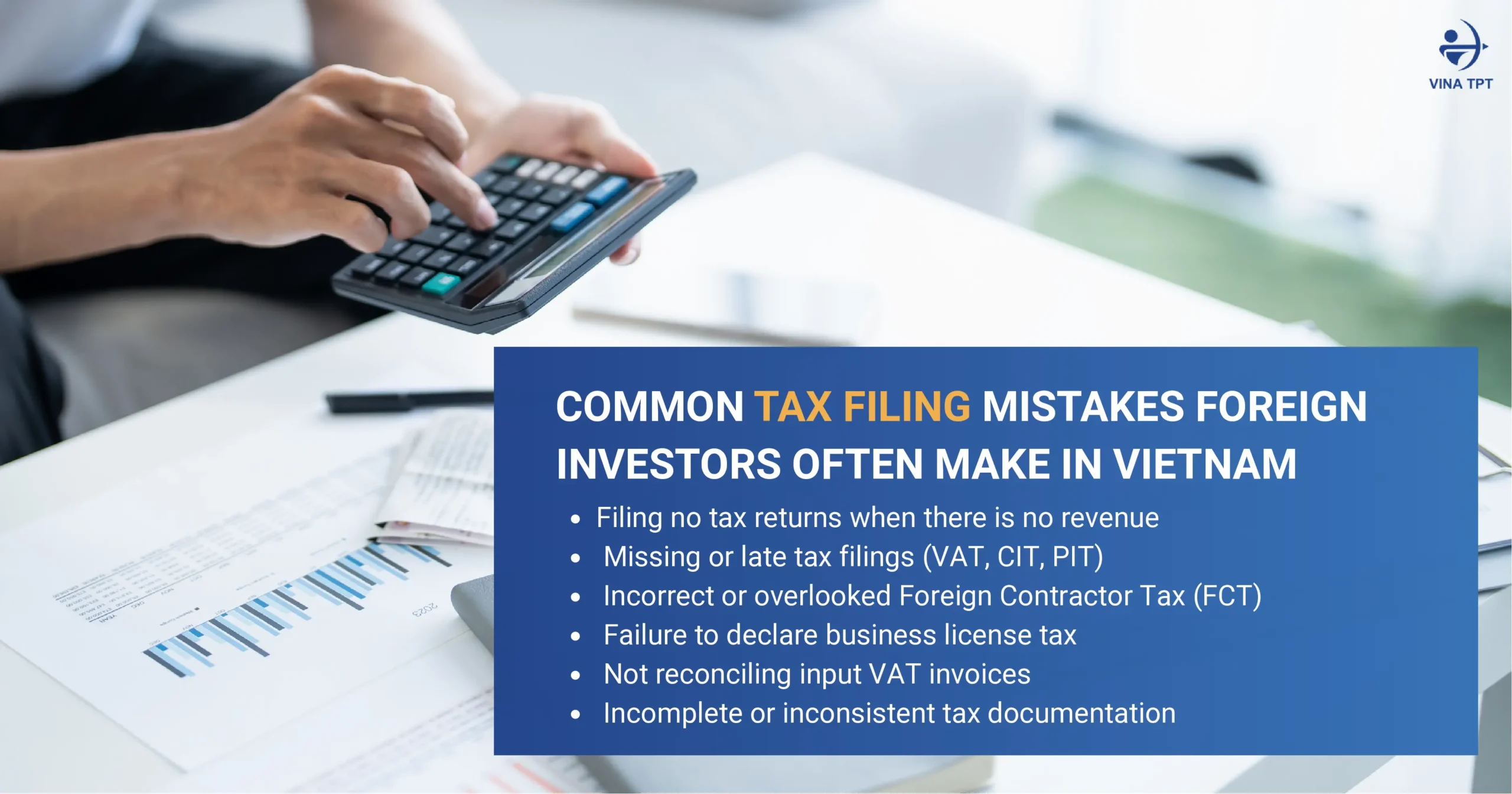
Foreign investors often encounter unexpected issues when handling tax filing in Vietnam. Even experienced companies can make costly mistakes due to the complexity of local regulations. Below are the most common tax filing errors that FDI businesses frequently commit:
- Failing to file tax returns when there is no revenue Many investors assume that “no revenue means no need to file.” In reality, according to the Law on Tax Administration 2019, once the Enterprise Registration Certificate (ERC) is issued, companies must still submit VAT returns, Personal Income Tax (PIT) declarations, and other required reports on time. Failure to do so can result in administrative fines and even suspension of the tax code.
- Late filing or missing tax declarations Submitting a return even one day late can trigger penalties of 0.03% per day on the late-paid tax amount (as stipulated in Article 59 of the Law on Tax Administration 2019). Many FDI companies commonly forget to file monthly or quarterly VAT returns or provisional Corporate Income Tax (CIT) declarations.
- Overlooking or incorrectly handling Foreign Contractor Tax (FCT / Withholding Tax) FCT is a withholding tax applied to payments made to foreign contractors or foreign experts (governed by Decree 81/2020/ND-CP and the Law on Corporate Income Tax). This is one of the most frequent mistakes and can lead to heavy penalties and complications when applying for future VAT refunds.
- Failing to declare and pay License Tax (Thuế môn bài) Even with some relaxations in 2026, businesses are still required to declare and pay License Tax in accordance with Decree 139/2016/ND-CP (as amended and supplemented).
- Neglecting to reconcile Input VAT invoices Input VAT refers to the value-added tax a business has paid to its suppliers. If invoices are not properly reconciled and supported as required under Clause 2, Article 14 of the Law on Value-Added Tax 2024, the company cannot claim input tax credits or refunds. This often results in significant “locked-up” capital.
Real-world consequences of these mistakes typically include substantial fines, prolonged tax audits, delays in visa and Temporary Residence Card (TRC) processing, and even loss of trust from partners and investors. In most cases, engaging a professional accounting service from the beginning is far more cost-effective than dealing with penalties and corrective procedures later.
2. Why Tax Filing Becomes a Major Challenge for New FDI Companies
Tax filing quickly becomes one of the biggest headaches for newly established FDI companies in Vietnam. Although the process has been digitized through the eTax system, significant differences in legal frameworks, administrative language, and compliance requirements still create substantial challenges for foreign investors from the very first months of operation.
The main reasons why tax filing feels so complex for new FDI companies include:
- Lack of a local accounting team familiar with Vietnamese tax laws Most foreign investors do not have in-house staff who fully understand Vietnam’s tax system, including VAS, Circular 99/2025/TT-BTC, VAT, Corporate Income Tax (CIT), Personal Income Tax (PIT), Foreign Contractor Tax (FCT), and specialized reports such as the Investment Activity Report (IAR). Recruiting experienced local accountants with strong FDI knowledge is both difficult and expensive.
- Unfamiliar with the electronic tax filing system (eTax) and administrative Vietnamese, all tax declarations must be submitted through the eTax platform entirely in Vietnamese, using complex legal terminology. Foreign investors often struggle to understand and accurately complete the required forms.
- The common misconception that “no revenue means no filing is needed” This is one of the most frequent misunderstandings. In reality, once the Enterprise Registration Certificate (ERC) is issued, companies are still required to submit VAT returns, PIT declarations, and other periodic reports on time – even if they have not yet generated any revenue.
- Lack of awareness of different filing deadlines Each type of tax has its own specific monthly, quarterly, or annual deadlines. Many new FDI companies miss submissions or file late simply because they lack a clear reminder system.
- Difficulties in communicating and providing explanations to tax authorities When additional documents or clarifications are requested, communicating in Vietnamese and preparing materials according to the exact requirements of the tax office can be extremely time-consuming and frustrating.
These challenges often result in significant administrative fines, operational disruptions, delays in visa and Temporary Residence Card (TRC) processing, and even damage to the company’s credibility with partners and potential investors during the most critical early stage.
3. Best Practices to Ensure Accurate and Timely Tax Filing
In addition to remembering important deadlines, foreign investors should take the following concrete actions to ensure proper tax filing compliance:
Important Deadlines to Remember in 2026:
|
No. |
Filing Period | Type of Tax / Declaration |
Note |
|
1 |
Monthly | VAT (if filing monthly) | By the 20th of the following month |
|
2 |
Quarterly | VAT, provisional CIT, PIT, FCT | By the 30th of the first month of the next quarter
This VAT requirement applies to businesses that declare VAT on a quarterly basis. |
|
3 |
Annual | Finalization of CIT and PIT | Before March 31 of the following year |
|
4 |
License Tax | Within 30 days after receiving ERC (paid once per year) |
Case Study:
Company Ltd., an FDI company, received its Enterprise Registration Certificate (ERC) on January 15, 2026. Believing the common misconception that “no revenue means no need to file taxes,” the founder did not submit the Q1 VAT return or the Personal Income Tax (PIT) declaration.
As a result, the company was hit with late-filing penalties, required to submit multiple rounds of supplementary documents, and even had its tax code temporarily suspended for two weeks. The total cost – including administrative fines, lost time, and disrupted business operations.
This real-world example clearly illustrates that even if a company has not yet generated any revenue, it is still legally required to file VAT and PIT declarations on time from the very first quarter after incorporation. A seemingly small oversight in the early days can quickly escalate into significant financial losses and reputational damage.
Specific Actions Investors Should Take:
- Set up automatic reminders for all tax filing deadlines
- Prepare complete supporting documents and invoices from the very beginning
- Use professional outsourced tax filing services from the first month of operation
- Perform regular data checks and reconciliations (monthly)
- Work with a Chief Accountant or a firm experienced in supporting FDI companies
In summary, tax filing is a process that needs careful preparation from the start and can be managed effectively with a clear checklist. If your internal team is not yet capable of handling it, investing in a professional service will help the business avoid major risks and focus on business development.
Get Your Free Investor Handbook 2026
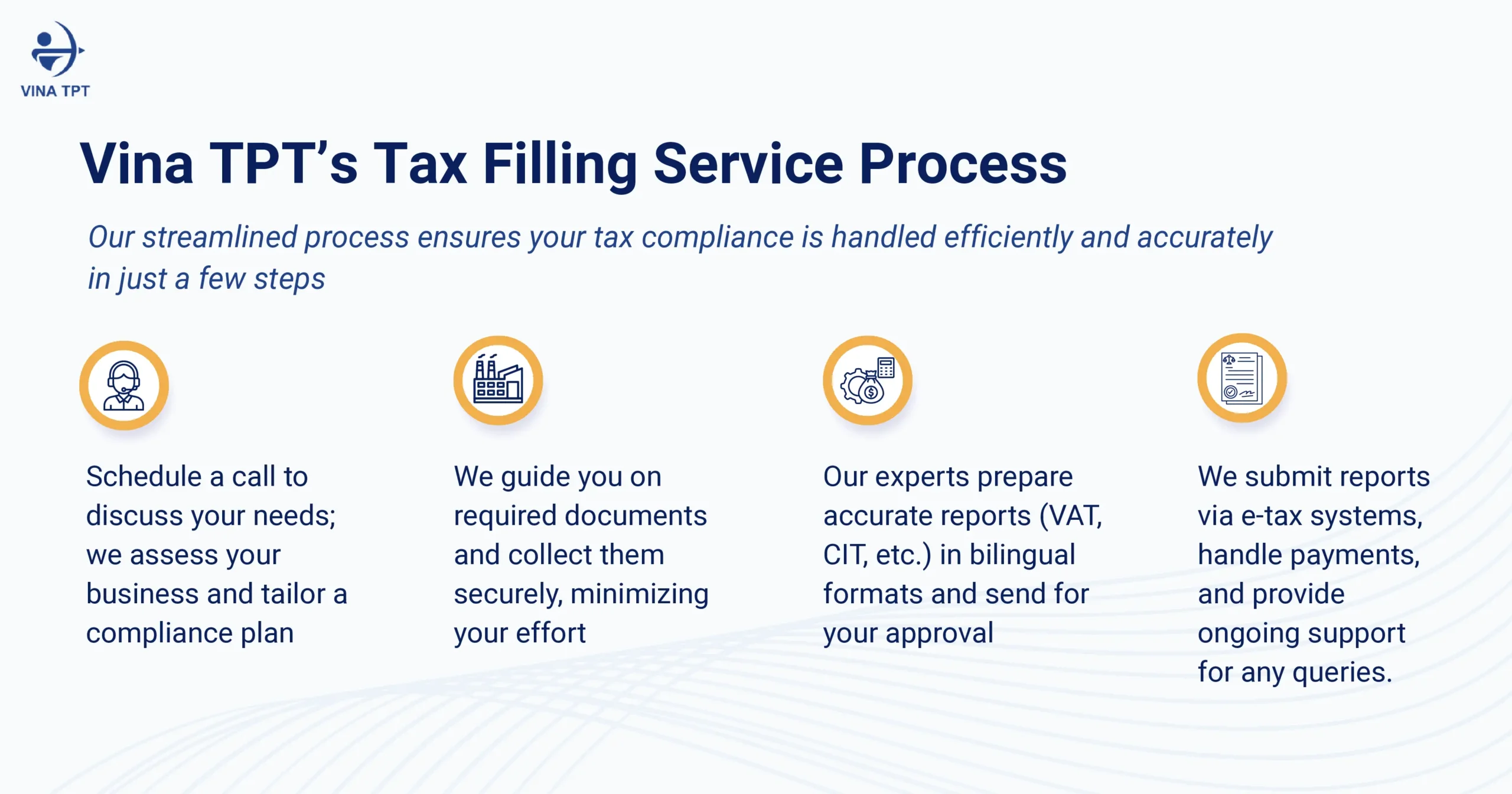
4. Why Vina TPT is trusted by many FDI Companies for Tax Filing
With more than 20 years of experience working with FDI enterprises, Vina TPT fully understands the difficulties foreign investors face in the tax filing process in Vietnam.
We provide comprehensive services, including monthly, quarterly, and annual tax declarations, ensuring that businesses always comply with regulations and meet deadlines.
What makes Vina TPT different is our automatic deadline tracking and reminder system, which minimizes the risk of late or missed filings. In addition, our team can support three languages (English, Japanese, and Vietnamese) and work remotely, making the process convenient for foreign investors.
Thanks to our professional process and practical experience, Vina TPT helps businesses minimize the risk of fines, avoid tax code suspension, and maintain stable operations from the early stages.
Contact Vina TPT today for free consultation and professional tax filing support.