If you are researching entering the Vietnam market, having a clear understanding of the entire journey, from preparation to company setup and actual operations, is the key factor for success.
Vietnam continues to be an attractive destination for foreign investors thanks to stable economic growth, competitive costs, and a wide network of free trade agreements. In particular, the Law on Investment 2025, which takes effect in 2026, has introduced many positive reforms, making the investment process more flexible and transparent.
However, in practice, many foreign investors still face difficulties not because of a lack of opportunities, but because they lack a clear roadmap – from market research and company formation to operations and compliance. A well-structured entering Vietnam market guide can help investors avoid unnecessary delays, legal risks, and operational inefficiencies.
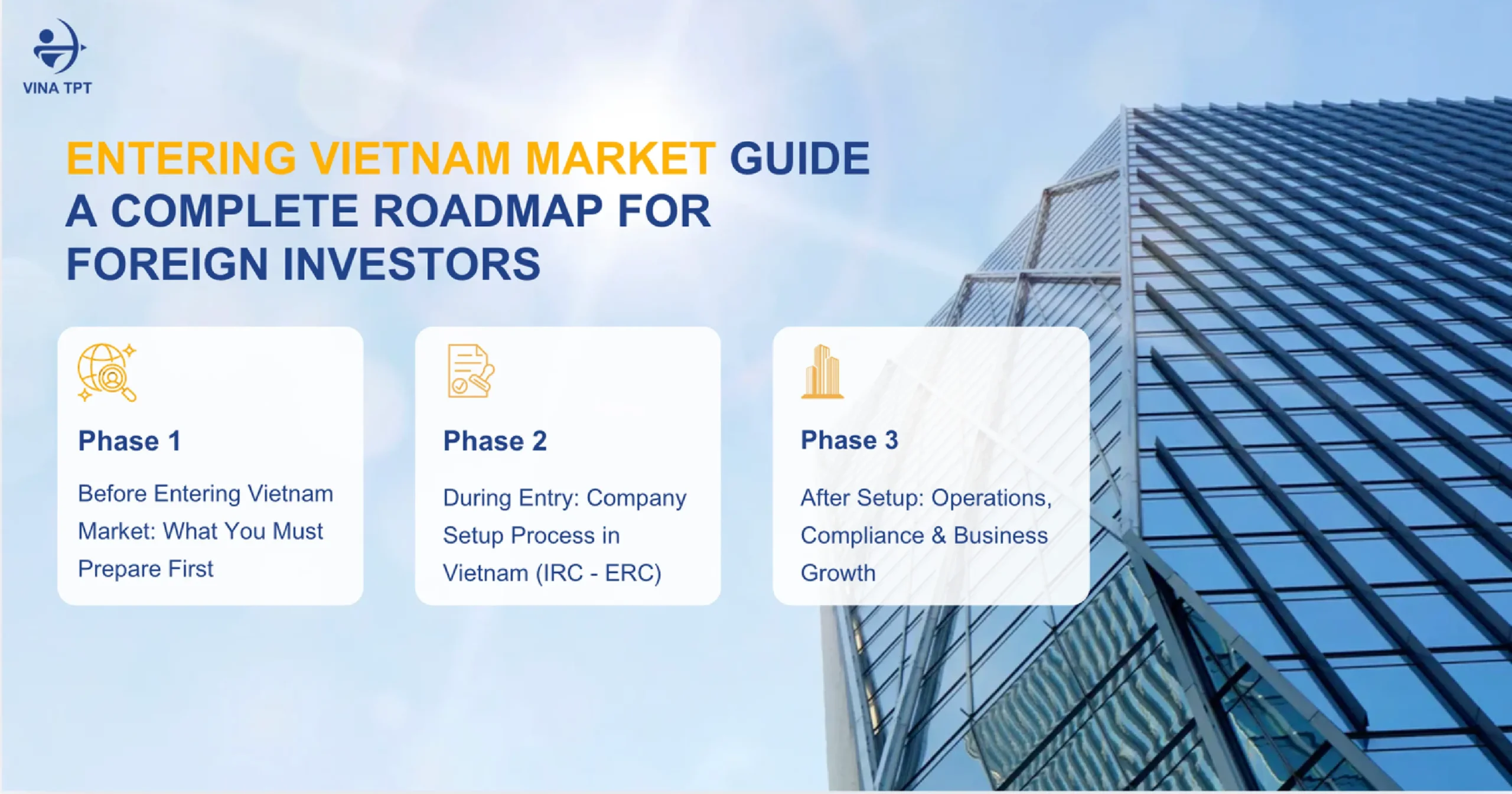
This article serves as a comprehensive entering Vietnam market guide, walking you through the full process in three phases: Before – During – After. At the end of the article, you can also download the Free Investor Handbook for more detailed information.
Phase 1 – Before Entering Vietnam Market: What You Must Prepare First
Before officially investing, the research and preparation phase is the most important step to minimize risks and optimize costs.
The main tasks you need to complete include Entering Vietnam Market Guide:
- Market research and business line selection: Study market demand, competitors, and consumption trends. It is especially important to check whether your intended business line falls under conditional or unconditional sectors according to the Law on Investment 2025 to avoid needing additional specialized licenses.
>>> You may also refer to our article: Top 20 Sectors for Business Opportunities in Vietnam for more insights.
- Develop a detailed business plan: Create a clear business plan that includes revenue forecasts, cost estimates, capital mobilization methods, and risk assessment.
- Risk evaluation and partner selection: Analyze legal, financial, logistics, and cultural business risks. Many investors choose to work with a local consulting firm at this stage to fully understand the actual legal requirements.
- Financial preparation and market exploration visa: Build an initial capital plan and apply for a short-term business visa to conduct on-site surveys.
At this stage, investors should not rush to fly to Vietnam without a clear plan. Contacting a specialized FDI consulting firm early will help you save a great deal of time and cost later.
Phase 2 – During Entry: Company Setup Process in Vietnam (entering vietnam market guide)
This is the most critical and important stage in the entire FDI setup journey in Vietnam. After completing market research and planning in Phase 1, you will now officially move forward with establishing your company.
The main steps in this phase include:
- Choosing the right business structure Most foreign investors opt for a 100% foreign-owned Limited Liability Company (FDI LLC). This structure offers simple governance, high flexibility, and full control. It is suitable for both startups and medium-sized businesses, allowing you to make decisions quickly without the complications of multiple shareholders. In most cases, choosing the right entity structure is one of the most important decisions in any entering Vietnam market guide for FDI companies.
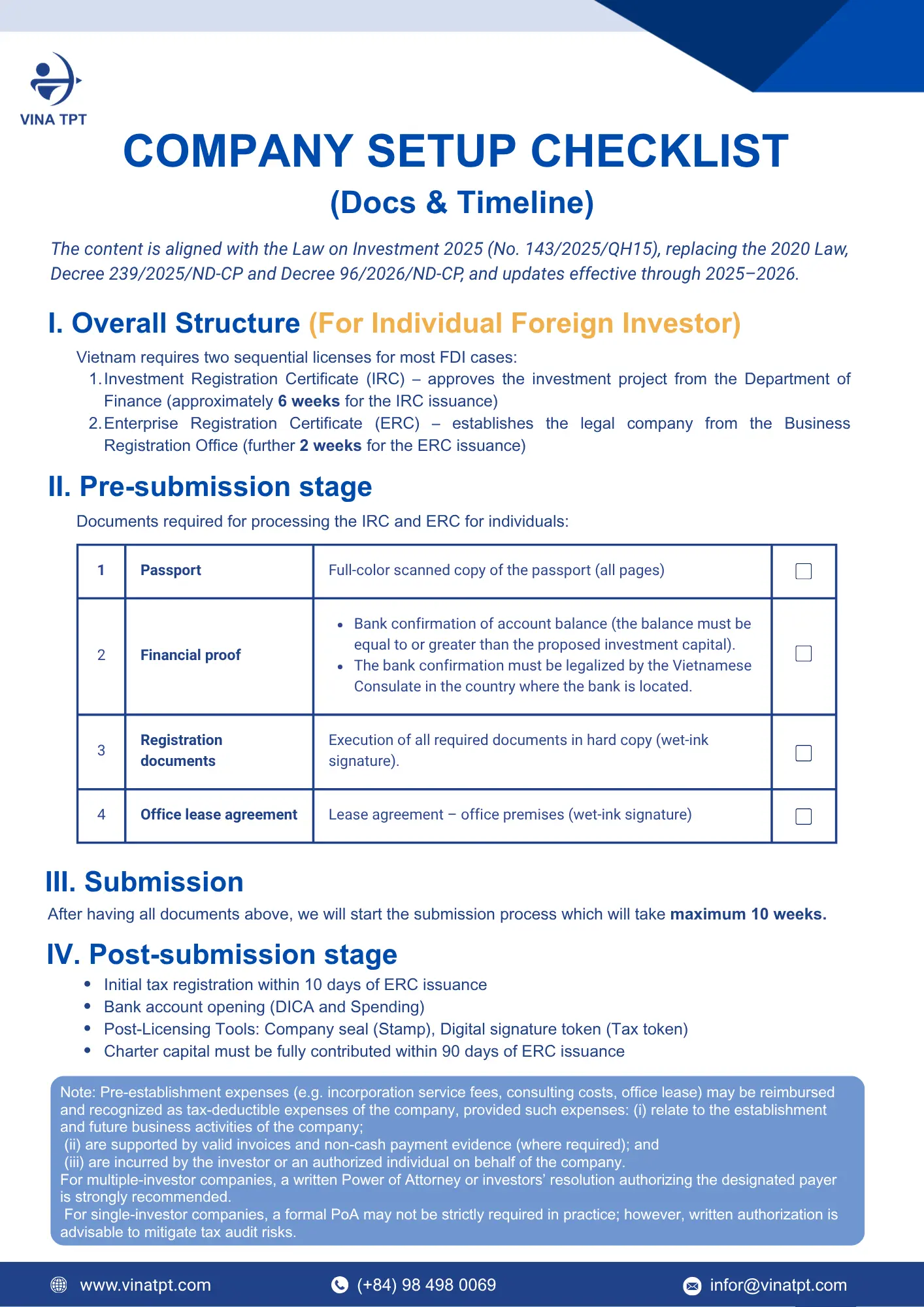
- Completing the IRC and ERC registration process: To legally operate in Vietnam, foreign investors are required to obtain both the Enterprise Registration Certificate (ERC), which establishes the legal entity, and the Investment Registration Certificate (IRC), which records the investment project and investment activities. Completing both licensing procedures is an essential step for foreign-invested companies to conduct business activities in compliance with Vietnamese regulations.
- Preparing a complete and accurate application dossier Required documents typically include: a notarized and consular-legalized passport (or corporate legal documents), a detailed investment project proposal, proof of financial capacity (bank statements, financial reports, or parent company support letters), and proof of legal right to use the business premises (office lease agreement). All foreign documents must be properly translated, notarized, and consular legalized in accordance with Vietnamese regulations.
- Completing post-licensing procedures Once the licenses are issued, you must open an investment capital account, fully contribute charter capital within 90 days, register the company seal, obtain a digital signature, and complete tax registration along with other administrative formalities
>>>Entering Vietnam market guide you may need: How to Start a Business in Vietnam: 2026 Guide for Investors
Phase 3 – After Setup: Operations, Compliance & Business Growth
In this stage of the entering Vietnam market guide, businesses begin transitioning from setup to long-term operations and compliance. Once you have received your official licenses, you officially enter the operational phase – the stage that ultimately determines whether your business will achieve sustainable growth or face ongoing struggles. This is where all the plans on paper turn into reality. It requires strict compliance, professional management, and careful attention to detail to avoid legal risks and maximize business efficiency.
The most critical tasks to setup after entering Vietnam market guide include:
- Tax Compliance and Periodic Reporting You must accurately declare and pay all applicable taxes, including VAT, Corporate Income Tax (CIT), and Personal Income Tax (PIT). In addition, FDI companies are required to submit the Investment Activity Report (IAR) on a regular basis. Electronic invoicing must also be implemented and properly managed from the very first day of operations.
- Establishing a Professional Accounting System Set up proper bookkeeping in full compliance with Vietnamese Accounting Standards (VAS) under Circular 99/2025/TT-BTC. This includes tight cash flow management, accurate internal financial reporting, and management accounts to support timely decision-making by leadership.
- Recruitment and Human Resources Management Handle work permits and Temporary Residence Cards (TRC) for foreign investors and expatriate specialists. At the same time, build a complete payroll system and ensure timely contributions to social insurance (BHXH), health insurance (BHYT), and unemployment insurance (BHTN) for local employees. Labor law compliance is especially important in this phase to avoid disputes and administrative penalties.
- Office and Warehouse Setup Select and secure suitable office space or warehouse facilities that align with your business model. Complete all necessary legal procedures related to the registered address and ensure the premises meet official business registration requirements.
- Cash Flow Management and Growth Planning Closely monitor cash flow, develop long-term financial plans, optimize operating costs, and create clear strategies for business expansion – whether through opening new branches, scaling production, or growing sales channels.
This phase marks the important transition from “setup” to “real operations.” Many FDI companies face significant difficulties here because they lack local experience and have not yet built a solid internal management system. Establishing a strong operational foundation from the beginning will help you avoid legal risks, control costs effectively, and create a solid platform for sustainable growth in the years ahead.
Explore End-to-End Business Formation Services
Common Challenges in Any Entering Vietnam Market Guide
Even though the Law on Investment 2025 has brought many favorable reforms, foreign investors still often face real challenges when entering the Vietnam market. If not well prepared, these difficulties can slow progress and increase initial costs. This is why many businesses rely on a professional entering Vietnam market guide to better prepare for licensing, compliance, and operational challenges in Vietnam.
The most common challenges include:
- Administrative procedures can still be lengthy: Although greatly simplified, some project approvals, specialized licenses, or location confirmations may take longer than expected, especially for large projects or conditional sectors.
- Language barriers and cultural differences in business practices: Differences in communication style, contract negotiation, and working culture can cause misunderstandings or delays in the early stages.
- Initial cost and cash flow management: The setup phase often involves many unexpected expenses (office, staff, legal procedures…), requiring tight cash flow control from the beginning.
- Difficulty in finding high-quality talent: Demand for personnel who possess both professional skills and strong English is high, but supply remains limited in some industries.
At this stage, investors need a clear plan from Phase 1 and early cooperation with a reputable FDI consulting firm. This will help minimize risks, accelerate progress, and avoid unnecessary mistakes throughout the entire journey.
Get Your Free Investor Handbook 2026
How Vina TPT simplifies your entire Vietnam Market Entry journey
Vina TPT accompanies businesses throughout the whole entering Vietnam market journey, from the preparation phase to actual operations.
- In Phase 1: We provide market consulting, business line selection, and planning in accordance with Vietnamese legal requirements.
- In Phase 2: Our expert team directly supports FDI company formation, handles IRC/ERC dossiers, and manages all related procedures quickly and in full compliance.
- In Phase 3: Vina TPT offers outsourced finance & accounting, tax compliance, and payroll services to help businesses operate stably and meet all regulatory requirements.
With over 20 years of experience, we not only help you “enter the market” but also ensure you operate efficiently and grow sustainably.
Contact Vina TPT today for a free consultation and comprehensive A-to-Z support for your investment journey in Vietnam.