The position of Legal Representative is often regarded as the “legal face” of any foreign-invested company in Vietnam. This individual serves as the official legal representative for the entire organization when dealing with state authorities, signing commercial contracts, working with financial institutions, and bearing the highest level of legal responsibility. Even a minor error in selecting, appointing, or managing the person in this role can trigger serious legal risks – from administrative fines and contract invalidation to complete operational disruption.
Under current Vietnamese law, every company operating in Vietnam is required to maintain at least one Legal Representative. This role is far from ceremonial; it carries significant civil and even criminal liabilities. In practice, many foreign investors face considerable challenges in fully understanding the scope of authority, associated risks, and control mechanisms needed to minimize legal exposure for this critical position.
This article from Vina TPT provides a comprehensive overview of the requirements, rights, and obligations of a legal representative Vietnam FDI investors should understand before operating a business in Vietnam.
1. The Legal Nature of a Legal Representative for FDI Company in Vietnam
According to the Law on Enterprises, a Legal Representative for FDI Company is the individual authorized to represent the company in exercising its rights and performing its obligations arising from business transactions. They represent the company in civil matters, as plaintiff or defendant in disputes before arbitration or courts, and in all other rights and obligations as prescribed by law.
For FDI companies, the Legal Representative is the person directly responsible for signing major economic contracts, approving internal personnel decisions, managing corporate bank accounts, and signing periodic tax reports. Because any action taken by this person within their authority is legally recognized as the company’s own action, this position carries decisive influence over the legal safety of the invested capital.
Vietnamese law is relatively flexible, allowing a company to appoint one or multiple Legal Representatives, depending on the governance structure specified in the company’s Charter. However, the company must always ensure that at least one Legal Representative resides in Vietnam.
2. Mandatory Requirements to Become a Legal Representative for FDI Company
To ensure legality when registering or changing management personnel, the appointed Legal Representative must fully satisfy the following strict conditions:
- Full Civil Capacity: Any individual appointed as a Legal Representative for FDI Company must be at least 18 years old have full civil capacity, and not be incapacitated or have restricted civil capacity as declared by a court.
- Clean Legal Record: Must not be prohibited from managing or establishing enterprises under the Law on Enterprises, nor be under criminal investigation or serving a sentence according to the Penal Code.
- Mandatory Residency Requirement: The Legal Representative must actually reside in Vietnam. If the company has only one Legal Representative, that person must reside in Vietnam and must issue a written power of attorney to another resident to perform their duties whenever they leave the country.
Selecting the right legal representative Vietnam FDI structure is an important governance decision that can significantly impact compliance and operational efficiency:
- Foreign Personnel (Expat): Usually senior directors seconded from the parent company. In this case, the company must complete the procedures for obtaining a Work Permit and Temporary Residence Card (TRC) in Vietnam.
- Local Vietnamese Personnel: Many foreign investors appoint a trusted Vietnamese professional as a second Legal Representative. This solution optimizes the speed of document signing and local administrative procedures, while the parent company retains core control through carefully drafted provisions in the company Charter.
2. Rights and Authority of a Legal Representative for FDI Company
A Legal Representative for FDI Company holds extensive authority to make administrative, personnel, and commercial decisions on behalf of the company. These powers are reflected in daily operations:
- Representing the company in negotiations and signing economic contracts, cooperation agreements, and documents that create financial or asset obligations with third parties.
- Establishing, managing, and executing financial transactions, and approving payment orders on the company’s bank accounts.
- Submitting licensing applications, business registration changes, and periodic tax reports on behalf of the company to state authorities (Tax Department, Planning & Investment, Labor Department).
- Representing the company in litigation, complaints, or commercial disputes before courts or arbitration to protect its legitimate rights and interests.
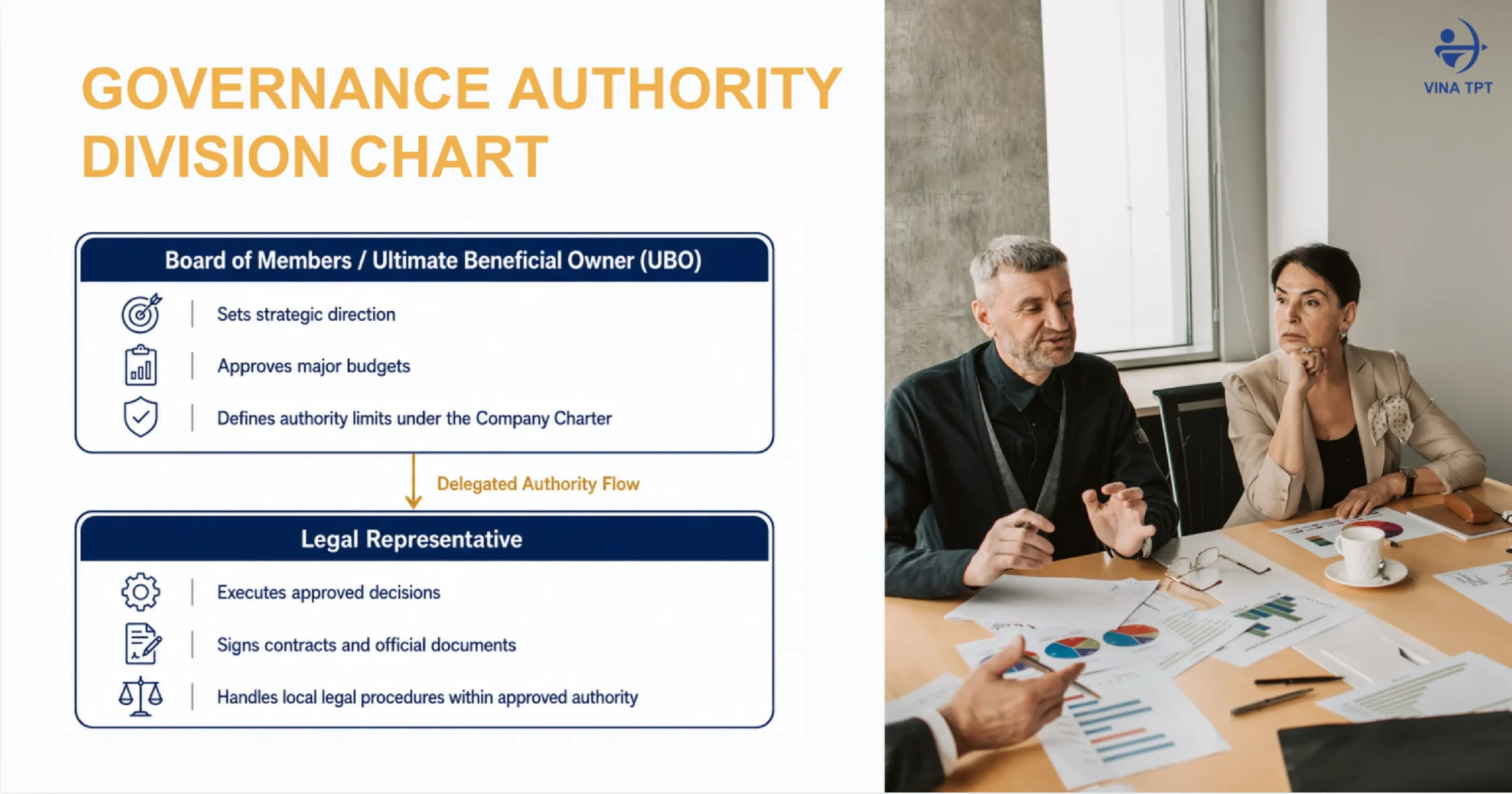
However, it is important to note that these broad powers can be strictly limited and controlled. Real investors (UBO) can fully protect their interests by designing robust internal control regulations and clearly defining financial approval limits for the Legal Representative directly in the company Charter during FDI company establishment.
3. Responsibilities and Legal Liabilities of a Legal Representative for FDI Company
A Legal Representative for FDI Company carries significant obligations and liabilities under Vietnamese law. and liabilities. A Legal Representative for an FDI company in Vietnam bears very significant legal responsibilities, both internally and before the national legal system:
- Duty of Honesty, Care, and Diligence: Must perform assigned rights and obligations honestly and diligently to best protect the company’s legitimate interests, and must not use company information, trade secrets, or assets for personal gain.
- Personal Joint Liability: The individual may be held personally liable and required to compensate the company for any damages caused by abuse of power, actions beyond authorized scope, or transactions that harm the company.
- Administrative and Criminal Risks: In cases of serious violations such as tax evasion, prolonged social insurance debts, or breaches of labor safety or environmental regulations, the Legal Representative is the first person summoned by authorities. They may face exit bans, personal administrative fines, or even criminal prosecution depending on the severity of the violation.
Connect with Vina TPT today to find the most suitable Legal Representative for FDI Company solution for your business.
4. Common Questions about a Legal Representative for FDI Company
- Can an FDI company appoint multiple Legal Representatives at the same time?
Yes. Vietnamese law allows a company to have more than one Legal Representative. The company Charter will specify the number, titles, and detailed rights and obligations of each person to optimize the governance structure.
- What happens if the sole Legal Representative leaves Vietnam?
When the sole Legal Representative departs Vietnam, they must issue a written power of attorney to another resident to perform their duties. If the power of attorney expires and the representative has not returned or appointed a replacement, the company may face a legal “suspension,” disrupting all business transactions.
- What is the difference between Legal Representative and Director?
These are two entirely different concepts. The Legal Representative is the legal authority representing the company before third parties and state agencies. The Director (or General Director) is the position responsible for day-to-day business management. One person can hold both positions simultaneously.
5. Comprehensive Solutions for Managing a Legal Representative for FDI Company
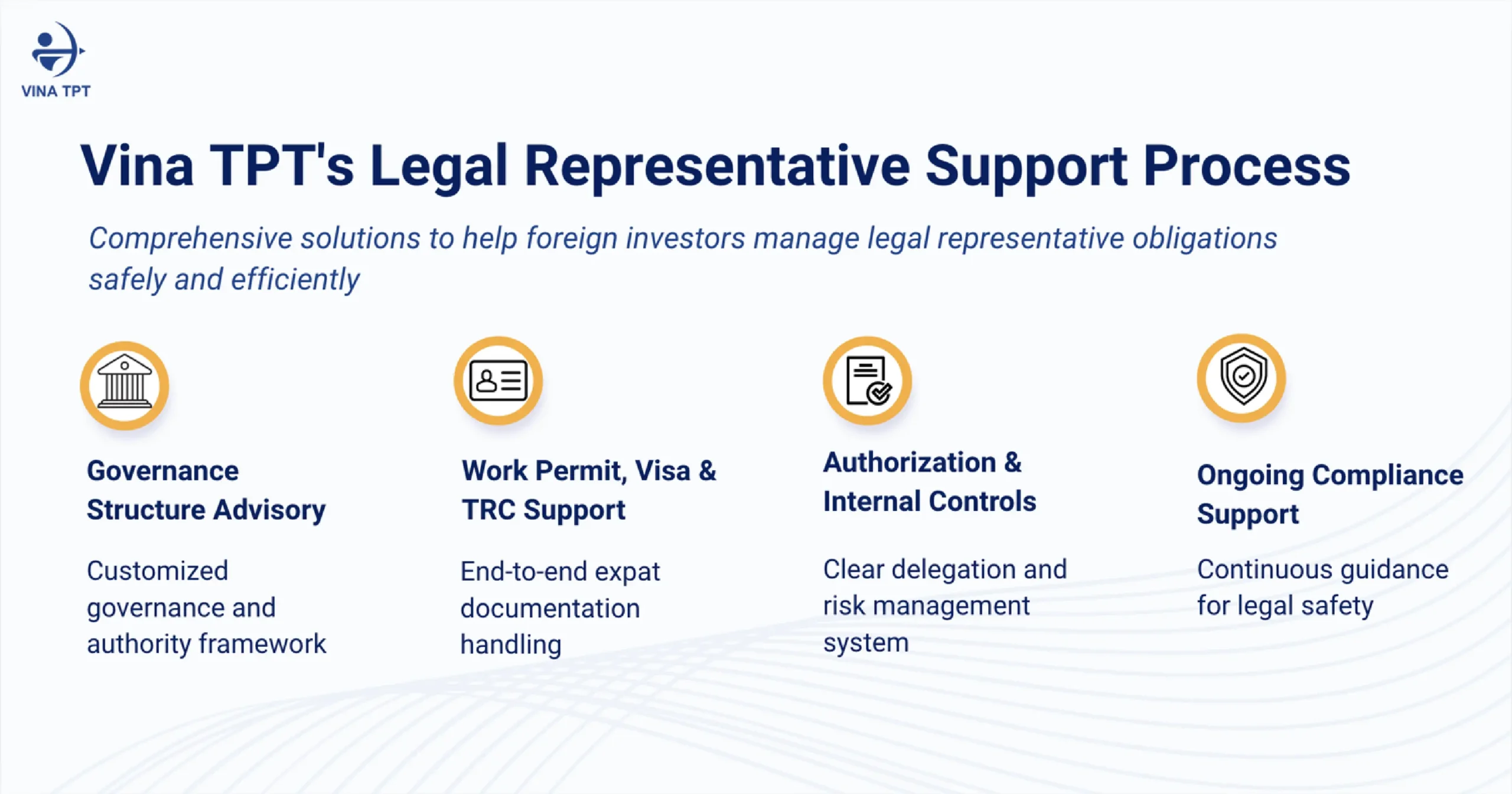
With more than 20 years of specialized experience in foreign investment consulting and corporate BPO, Vina TPT provides comprehensive solutions to help FDI companies effectively address all issues related to Legal Representatives and ensure the highest level of legal safety:
- Optimal Internal Governance Structure Advisory: We analyze your business model to draft a customized company Charter that clearly defines authority, financial approval limits, and risk controls between management levels.
- End-to-End Expat Documentation Handling: Fast and accurate processing of Work Permits, Visas, and Temporary Residence Cards (TRC) for foreign representatives.
- Standard Power of Attorney and Control System: Establishment of robust authorization documents and internal control regulations to ensure smooth back-office and accounting operations even when leadership is abroad.
Conclusion
Building a clear, transparent governance mechanism around the Legal Representative for FDI Company position is a critical requirement to ensure the operational safety of any foreign investment project in Vietnam.
If your company needs in-depth consultation on appointing Legal Representatives, drafting a risk-resistant company Charter, or completing legal procedures for foreign employees, please contact Vina TPT today. Our experts are ready to provide the most optimal and secure solutions for your business.