FDI Company Setup in Vietnam: Business License & Complete 2026 Guide

setting up company in Vietnam

setting up company in Vietnam

Why Setting up Company in Vietnam is the Strategic Choice for 2026?

The year 2026 marks a pivotal turning point for foreign investors in Vietnam. With significant reforms in the Law on Investment and a roadmap to reduce conditional business lines, the process for setting up a company in Vietnam is becoming more transparent and streamlined than ever.

However, to operate legally in specialized sectors such as retail, distribution, or logistics, investors must follow a structured path from obtaining an IRC and ERC to securing a specific business license.

1. Why Foreign Investors Need a Clear Roadmap in 2026

Starting a business in Vietnam as a foreigner offers immense potential, but understanding the 2026 regulatory landscape is crucial to avoiding delays or rejected applications.

a. FDI Opportunities in 2026

Vietnam maintains its position as Southeast Asia’s “global factory” based on four key pillars:

  • Extensive FTA Network: Leverage tariff incentives from the CPTPP, EVFTA, and RCEP.
  • New Incentive Policies: Strong focus on high-tech projects, circular economy, and renewable energy.
  • Flexible Ownership Structures: 100% foreign ownership is permitted in most sectors, including manufacturing, IT, consulting, and trading.
  • Digitalized Procedures: Significant reduction in waiting times through the National Business Registration Portal.

b. When is a Business License (Trading License) Mandatory?

While many sectors are open, a Business License (Trading License or Retail Distribution License) is still mandatory for foreign investors in “conditional” sectors under WTO commitments and Vietnamese Law.

Even with eased regulations, a separate Business License is required after company formation for:

  • Retail Sales: Directly providing goods to end consumers.
  • Distribution & Import: Applied to restricted or specialized commodity groups.
  • Specialized Services: Logistics, education, healthcare, and F&B.
  • Important Note: By July 1, 2026, sectors like accounting and insurance brokerage will see further liberalization. However, for Retail & Distribution, investors must still seek approval from the Ministry/Department of Industry and Trade.

c. Distinguishing IRC vs. ERC vs. Business License

Understanding these three acronyms is vital for any foreigner setting up a company in Vietnam:

Permit Type Issuing Authority Primary Role
IRC (Investment Registration Certificate) Department of Planning and Investment (DPI) Approves the investment project (capital, objectives, location).
ERC (Enterprise Registration Certificate) Business Registration Office Creates the legal entity and issues the Tax ID.
Business License Relevant Ministry or Department Grants permission to operate in conditional sectors (Retail, etc.).

The Standard Sequence: IRC (Project Approval) → ERC (Company Formation) → Business License (For specific sectors).

2. 5-Step Process for Setting Up Company in Vietnam in 2026

The average timeline for completion ranges from 1 to 2 months, depending on the complexity of your business lines.

Step 1: Choose a Legal Structure & Check Ownership Limits

The most common choice is a Limited Liability Company (LLC) due to its flexibility and limited liability protection. Foreigners must verify if their specific sector requires a Joint Venture (JV) with a Vietnamese partner.

Step 2: Obtain the Investment Registration Certificate (IRC)

Investors submit the application to the DPI. Key documents include:

  • Detailed Investment Project Proposal.
  • Proof of Financial Capacity (Bank statements or audited reports).
  • Office Lease Agreement or Memorandum of Understanding (MOU).
  • Timeline: 15 – 35 working days.

Step 3: Obtain the Enterprise Registration Certificate (ERC)

Once the IRC is issued, the ERC application is typically processed within 3 – 7 working days. This step officially grants your business its legal status.

Step 4: Post-Registration Procedures (Operational Compliance)

Obtaining the ERC is only the beginning. Within 90 days, investors must fulfill these mandatory obligations:

  • Open a Direct Investment Capital Account (DICA): This is the most critical step. All capital contributions, profit repatriations, and share transfers must flow through this account.
  • Capital Contribution: Ensure the total committed capital is transferred into the DICA within 90 days of ERC issuance.
  • Online Investment Reporting: Businesses must report project progress quarterly and annually on the National Investment Information System. Missing these deadlines can lead to heavy administrative fines.
  • Initial Tax & Accounting Setup: Register digital signatures, set up e-invoice templates, and pay Business License Tax (License Fees). Appointing a Chief Accountant or an outsourced accounting representative is a legal requirement for signing financial statements.

Step 5: Specialized Business License (If applicable)

For retail and distribution entities, authorities will assess the application based on local planning and socio-economic impact. Note the Economic Needs Test (ENT) requirement if you plan to open a second retail outlet or more.

setting up company in Vietnam

Get a free 30-minutes consultation

3. Required Documents & Checklist

All foreign documents must be Consularly Legalized, translated into Vietnamese, and notarized.

  • Individual Investors: Notarized passport + Bank balance confirmation.
  • Corporate Investors: Parent company’s Certificate of Incorporation + Audited financial statements (last 2 years) + Resolution appointing the authorized representative.
  • Project Documents: Detailed Business Plan and proof of right to use the business location.

4. Vina TPT: Your Trusted Partner for FDI Success in Vietnam

Establishing a legal entity is just the start. To thrive in the Vietnamese market, businesses need a solid foundation in Accounting, Tax, and HR from day one.

Vina TPT is proud to be a strategic partner, helping foreign investors remove language barriers and navigate local legal complexities:

  • Expert Consulting: From initial setup to tax structure optimization. We keep you updated on the latest regulations, including Global Minimum Tax and 2026 tax incentives.
  • Payroll & HR Management: We handle labor contracts, Social Health & Unemployment Insurance (SHUI), and Personal Income Tax (PIT) finalization for both expats and locals, ensuring absolute confidentiality.
  • Lifecycle Partnership: With over 20 years of experience, Vina TPT provides an “All-in-one” ecosystem. You focus on growth; we handle the administration.
  • No Language Barrier: Our trilingual team (English – Japanese – Vietnamese) ensures transparent communication and seamless management reporting.

Optimize your resources and minimize legal risks with Vina TPT. Contact us today for a 1-on-1 specialized consultation for your 2026 project.

Start your journey in vietnam

setting up company in Vietnam

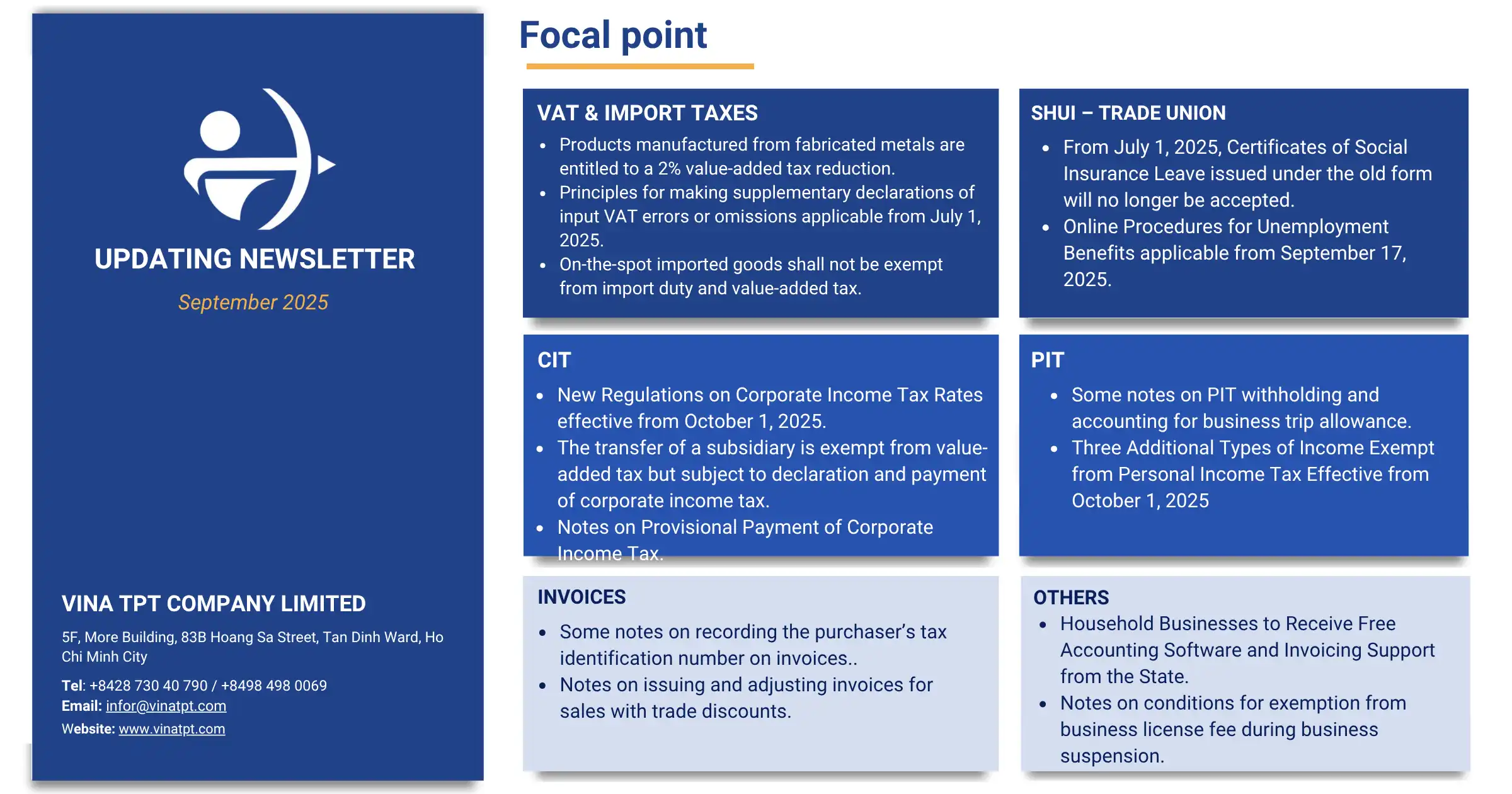
[Newsletter] Vietnam Tax Policy Updates September 2025- CIT, VAT, PIT and Social Insurance

Updates on new regulations regarding tax, e-invoices, and social insurance September 2025 (2)
As part of the Vietnam tax policy updates 2025, several new regulations related to Corporate Income Tax (CIT), Value Added Tax (VAT), Personal Income Tax (PIT), and social insurance are scheduled to take effect starting from September 2025. These changes are expected to directly impact financial reporting, payroll processes, and compliance operations across both Vietnamese and FDI enterprises.
To help businesses stay compliant and proactively adjust their internal procedures, this article provides a clear breakdown of the most important regulatory updates you need to be aware of.
In this article, we break down the most important tax regulations businesses need to prepare for in 2025.

1. Value-Added-Tax & IMPORT TAXES

1.a. Products manufactured from fabricated metals are entitled to a 2% value-added tax reduction.

Official Letter No. 6099/TCS3-QLDN2 dated September 11, 2025 of Dong Nai Tax Department regarding the case where a company manufactures and processes metal products, in which the determination of VAT reduction on sold products is made in accordance with Circular No. 174/2025/TT-BTC, specifically as follows:
  • The company shall identify its products based on the product codes, names, and descriptions provided in the Appendix issued together with Decision No. 43/2018/QD-TTg, and compare them with the List of goods and services not eligible for value-added tax (VAT) reduction issued together with Circular No. 174/2025/TT-BTC. In cases where the products fall under the List of goods attached to Circular No. 174/2025/TT-BTC, they shall not be entitled to VAT reduction.
  • For products manufactured from fabricated metals classified under Section 25, which are not included in the List of goods and services issued together with Circular No. 174/2025/TT-BTC, a VAT reduction shall apply.

1.b. Principles for making supplementary declarations of input VAT errors or omissions applicable from July 1, 2025.

Official Letter No. 3915/CT-CS dated September 18, 2025 of the Tax Department regarding VAT policies, specifically as follows:
  • The Tax Department stated that, from July 1, 2025, the Law on Value-Added Tax No. 48/2024/QH15 and Decree No. 181/2025/ND-CP have specifically provided regulations on the declaration and deduction of input VAT in cases of errors or omissions. Enterprises are therefore requested to study and comply with these provisions. Accordingly, under Point đ, Clause 1, Article 14 of Law No. 48/2024/QH15 and Clauses 5 and 6, Article 23 of Decree No. 181/2025/ND-CP, when errors or omissions in input VAT are detected, business establishments shall make supplementary declarations in accordance with the following principles:
  • A supplementary declaration shall be made in the month or quarter in which the error or omission in input VAT arises, if such error or omission results in an increase in tax payable or a reduction in refundable tax for that month or quarter.
  • A supplementary declaration shall be made in the month or quarter when the error or omission is detected, if such error or omission results in a decrease in tax payable, or only increases or decreases the amount of VAT to be carried forward to the subsequent period.

1.c. On-the-spot imported goods shall not be exempt from import duty and value-added tax.

Official Letter No. 22303/CHQ-GSQL dated September 5, 2025 of the Customs Department regarding on-the-spot imported goods, specifically as follows:
  • Clause 3 Article 3 of Law No. 90/2025/QH15 supplements Article 47a of the Customs Law, stipulating that on-the-spot import and export goods are goods delivered and received in Viet Nam under the designation of a foreign trader pursuant to sale, processing, leasing, or borrowing contracts. Cases that meet these conditions shall carry out customs procedures under Article 35 of Circular No. 08/2015/TT-BTC (as amended by Circular No. 167/2025/TT-BTC) and Article 86 of Circular No. 38/2015/TT-BTC (as amended by Circular No. 39/2018/TT-BTC).
  • According to Circular No. 134/2016/TT-BTC (as amended by Circular No. 18/2021/TT-BTC), in cases where on-the-spot imports are not registered under the processing type, the importer must declare and pay import duty based on the applicable duty rate and customs value at the time of registration. If import duty has been paid for production or business purposes and the imported products have been actually exported abroad or to a non-tariff zone, the paid duty shall be refunded in accordance with Article 36 of this Circular
  • On-the-spot import and export goods remain subject to VAT. Where goods are registered under other types (not processing), the taxpayer shall use code A11 (commercial import) or A12 (import for production and business) to declare and pay import duty and VAT.

2. Personal Income Tax (PIT)

2a. Some notes on PIT withholding and accounting for business trip allowance.

Official Letter No. 2284/CTH-QLDN1 dated September 15, 2025 of the Can Tho City Tax Department regarding taxable personal income (PIT) on business trip allowances, specifically as follows:
  • Taxable PIT income with respect to lump-sum business trip allowances: This is the portion of business trip allowances exceeding the limits prescribed by the State. Specifically: For employees working in business organizations and representative offices, the limit on business trip allowances shall be applied consistently with the level determined for corporate income tax (CIT) purposes. For employees working in international organizations or representative offices of foreign organizations, the limit on business trip allowances shall be applied in accordance with the regulations of such international organizations or representative offices of foreign organizations (see Point đ.4, Clause 2, Article 2 of Circular No. 111/2013/TT-BTC).
Travel expenses and accommodation costs for employees on business trips shall be deductible if supported by sufficient invoices and documents.
  • Where the enterprise has a financial/internal regulation stipulating allowances for travel, accommodation, and per diem for employees on business trips, and such regulation is properly implemented, these expenses shall be deductible.
  • Payment by employees’ personal bank cards for business trip expenses of VND 20 million or more (including airfares):
  • Such expenses shall be deductible if the following conditions are met:
  • Valid invoices and supporting documents are available.
  • A decision or written authorization for the employee’s business trip is issued.
  • The enterprise’s financial/internal regulation permits employees to pay using personal bank cards, with subsequent reimbursement by the enterprise.
  • Purchase of air tickets via e-commerce websites: The documents serving as the basis for deductibility include the electronic air ticket, boarding pass, and the enterprise’s non-cash payment vouchers showing the individual undertaking the transportation service.

Explore Tax Services in Viet Nam

2b. Three Additional Types of Income Exempt from Personal Income Tax Effective from October 1, 2025

According to the new provisions in the Law on Science, Technology and Innovation 2025 (No. 93/2025/QH15), effective from October 1, 2025, Clause 3, Article 71 of this Law supplements Points 18, 19, and 20 after Point 17 of Article 4 on tax-exempt income under the Law on Personal Income Tax 2007, as amended and supplemented.
Accordingly, from October 1, 2025, three additional types of income will be exempt from Personal Income Tax (PIT), including:
  • Income from salaries and wages received from performing science, technology, and innovation tasks.
  • Income from copyright related to science, technology, and innovation tasks when the results of such tasks are commercialized in accordance with the laws on science, technology, innovation, and intellectual property.
  • Income of individual investors and experts working for start-up innovation projects, founders of start-up enterprises, and individual investors contributing capital to venture capital funds.

3. Corporate Income Tax (CIT)
Corporate-income-tax-VinaTPT

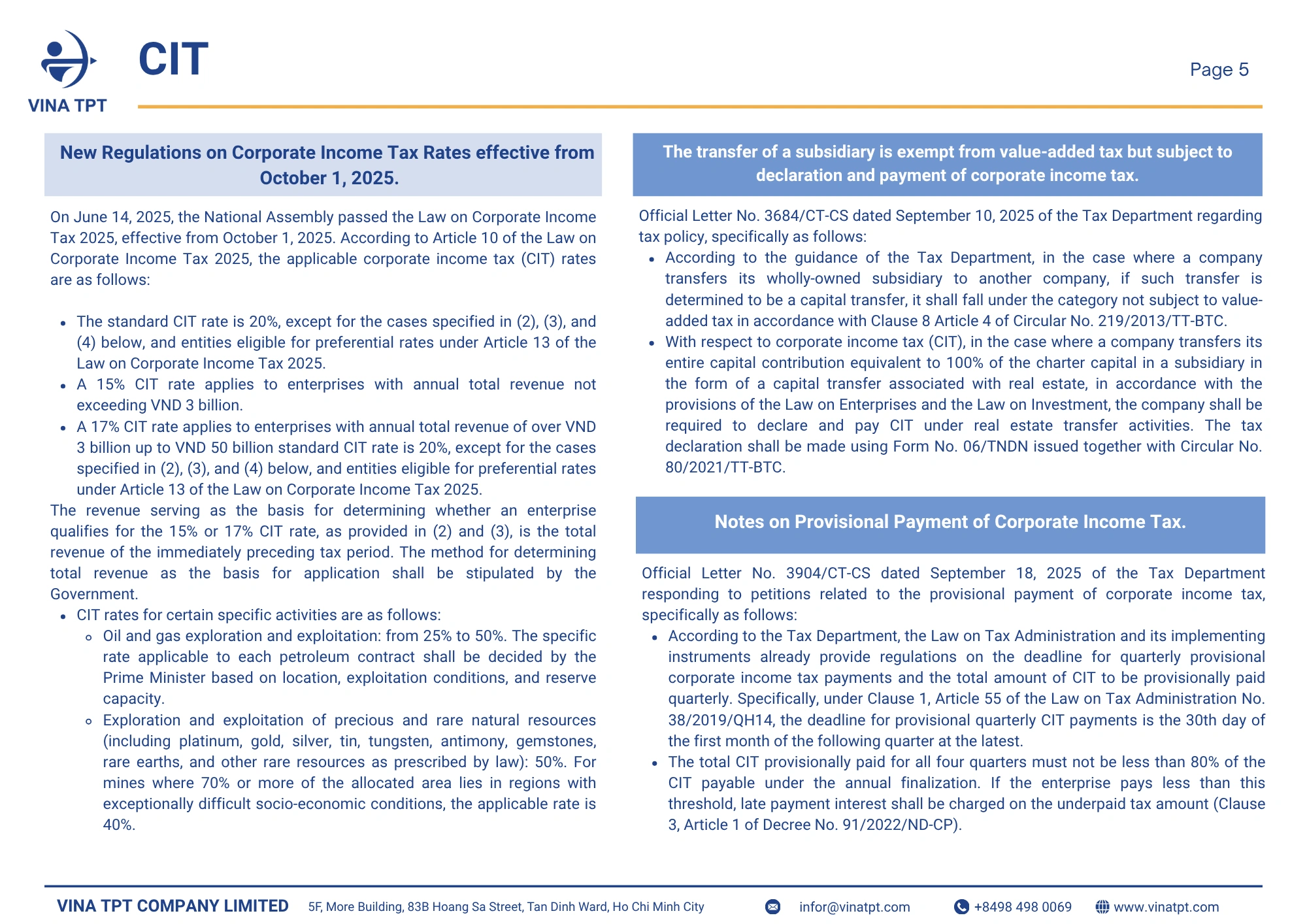
3a. New Regulations on Corporate Income Tax Rates effective from October 1, 2025.

On June 14, 2025, the National Assembly passed the Law on Corporate Income Tax 2025, effective from October 1, 2025. According to Article 10 of the Law on Corporate Income Tax 2025, the applicable corporate income tax (CIT) rates are as follows:
  • The standard CIT rate is 20%, except for the cases specified in (2), (3), and (4) below, and entities eligible for preferential rates under Article 13 of the Law on Corporate Income Tax 2025.
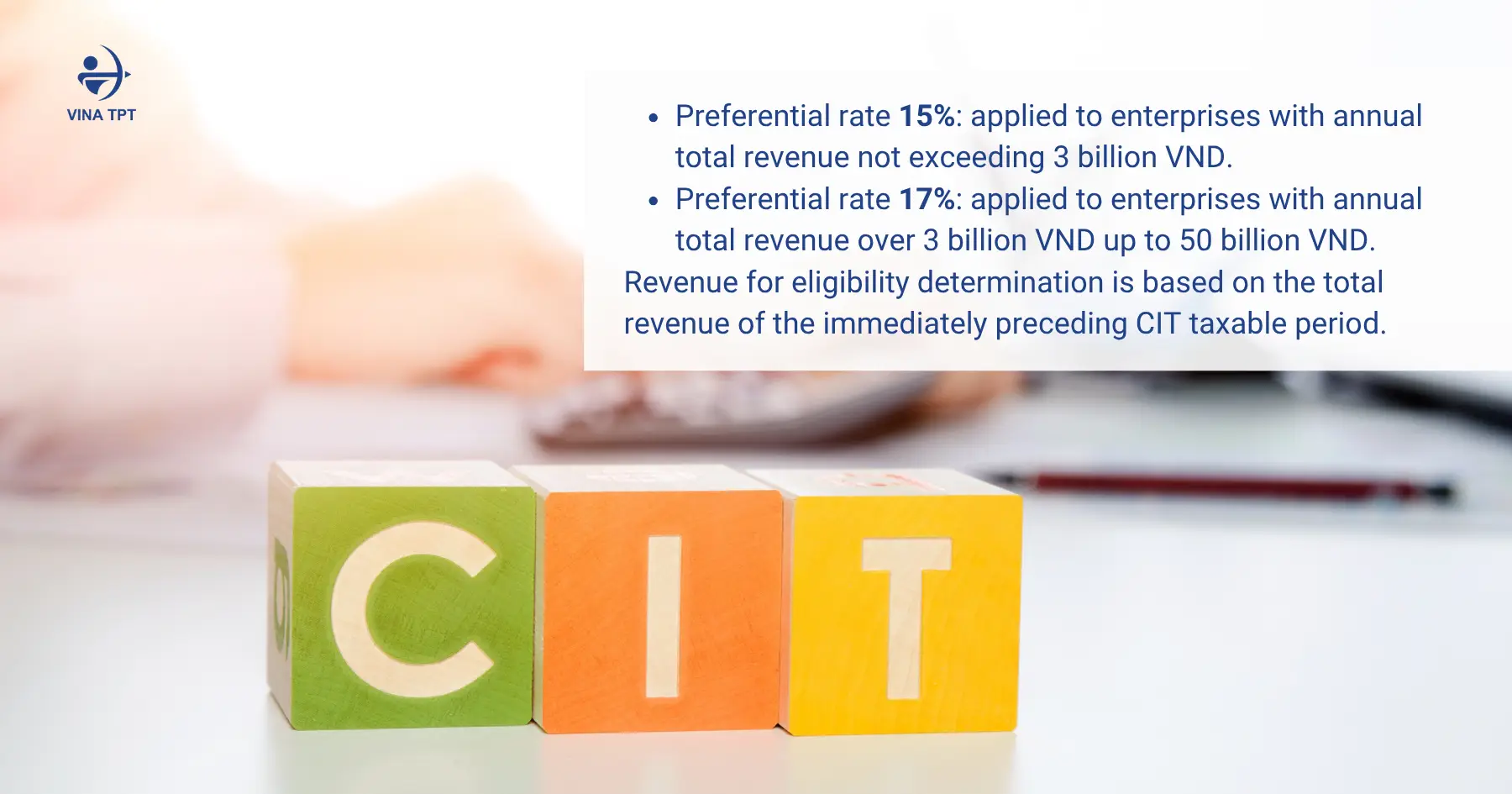
  • A 15% CIT rate applies to enterprises with annual total revenue not exceeding VND 3 billion.
  • A 17% CIT rate applies to enterprises with annual total revenue of over VND 3 billion up to VND 50 billion standard CIT rate is 20%, except for the cases specified in (2), (3), and (4) below, and entities eligible for preferential rates under Article 13 of the Law on Corporate Income Tax 2025
The revenue serving as the basis for determining whether an enterprise qualifies for the 15% or 17% CIT rate, as provided in (2) and (3), is the total revenue of the immediately preceding tax period. The method for determining total revenue as the basis for application shall be stipulated by the Government.
CIT rates for certain specific activities are as follows:
  • Oil and gas exploration and exploitation: from 25% to 50%. The specific rate applicable to each petroleum contract shall be decided by the Prime Minister based on location, exploitation conditions, and reserve capacity.
  • Exploration and exploitation of precious and rare natural resources (including platinum, gold, silver, tin, tungsten, antimony, gemstones, rare earths, and other rare resources as prescribed by law): 50%. For mines where 70% or more of the allocated area lies in regions with exceptionally difficult socio-economic conditions, the applicable rate is 40%.

3b. The transfer of a subsidiary is exempt from value-added tax but subject to declaration and payment of corporate income tax.

Official Letter No. 3684/CT-CS dated September 10, 2025 of the Tax Department regarding tax policy, specifically as follows:
  • According to the guidance of the Tax Department, in the case where a company transfers its wholly-owned subsidiary to another company, if such transfer is determined to be a capital transfer, it shall fall under the category not subject to value-added tax in accordance with Clause 8 Article 4 of Circular No. 219/2013/TT-BTC.
  • With respect to corporate income tax (CIT), in the case where a company transfers its entire capital contribution equivalent to 100% of the charter capital in a subsidiary in the form of a capital transfer associated with real estate, in accordance with the provisions of the Law on Enterprises and the Law on Investment, the company shall be required to declare and pay CIT under real estate transfer activities. The tax declaration shall be made using Form No. 06/TNDN issued together with Circular No. 80/2021/TT-BTC.

3c. Notes on Provisional Payment of Corporate Income Tax.

Official Letter No. 3904/CT-CS dated September 18, 2025 of the Tax Department responding to petitions related to the provisional payment of corporate income tax, specifically as follows:
  • According to the Tax Department, the Law on Tax Administration and its implementing instruments already provide regulations on the deadline for quarterly provisional corporate income tax payments and the total amount of CIT to be provisionally paid quarterly. Specifically, under Clause 1, Article 55 of the Law on Tax Administration No. 38/2019/QH14, the deadline for provisional quarterly CIT payments is the 30th day of the first month of the following quarter at the latest.
  • The total CIT provisionally paid for all four quarters must not be less than 80% of the CIT payable under the annual finalization. If the enterprise pays less than this threshold, late payment interest shall be charged on the underpaid tax amount (Clause 3, Article 1 of Decree No. 91/2022/ND-CP).

4. Social Insurance – Trade Union

a. From July 1, 2025, Certificates of Social Insurance Leave issued under the old form will no longer be accepted.

Official Letter No. 5761/BYT-KCB dated August 27, 2025 of the Ministry of Health regarding the settlement of difficulties in implementing social insurance regimes for employees, specifically as follows:
  • Accordingly, the Ministry of Health notes that Certificates of Social Insurance Leave issued prior to the effective date of Circular No. 25/2025/TT-BYT (July 1, 2025) shall remain valid as the basis for entitlement to social insurance benefits. For Certificates issued after July 1, 2025, it is mandatory to use the new form promulgated under Circular No. 25/2025/TT-BYT. The difference between the new form and the old form (issued under Circular No. 18/2022/TT-BYT) lies in the addition of information on the employee’s citizen identification number/identity card number/passport number/personal identification number; other contents remain unchanged from the old form.
  • During the initial implementation of Circular No. 25/2025/TT-BYT, for documents issued by hospitals still using the old form and not yet switched to the new form, in order to ensure employees’ rights and avoid inconvenience, the Ministry of Health has requested that enterprises prepare a list of employees whose documents were issued by hospitals in non-compliance with regulations, and submit an official letter to the Department of Health or the health authority of the relevant ministries/agencies managing such hospitals, requesting the supplementation of information on the documents already issued, as prescribed in Point b, Clause 4, Article 28 of Circular No. 25/2025/TT-BYT.
As for Certificates of Social Insurance Leave without the hospital’s seal due to the seal not yet being updated to the new address following a merger, the Ministry of Health has stated that, under Clause 8, Article 69 of Decree No. 188/2025/ND-CP, medical examination and treatment establishments are permitted to continue using their old seals until new seals are issued.

b. Online Procedures for Unemployment Benefits applicable from September 17, 2025.

Decision No. 1295/QD-TTPVHCC dated September 17, 2025 of the People’s Committee of Hanoi City announcing the List of administrative procedures on unemployment insurance to be piloted on the National Public Service Portal under the management competence of the Department of Home Affairs of Hanoi City, specifically as follows:
This Decision announces six procedures concerning the entitlement to and termination of unemployment benefits to be piloted by the Hanoi Department of Home Affairs on the National Public Service Portal as from September 17, 2025, including:
  • Settlement of entitlement to unemployment benefits
  • Monthly notification of job search activities.
  • Settlement of entitlement to unemployment benefits
  • Settlement of entitlement to unemployment benefits
  • Transfer of entitlement to unemployment benefits (integrated procedure for transfer-out and transfer-in).
  • Termination of entitlement to unemployment benefits.
This Decision takes effect from the date of signing.

5. OTHER

a. Household Businesses to Receive Free Accounting Software and Invoicing Support from the State.

Official Letter No. 3914/CT-CS dated September 18, 2025 of the Tax Department regarding the response to the petition of the Vietnam Banks Association:
  • With respect to the use of invoices by household businesses, the Tax Department notes that, pursuant to the provisions of Decree No. 70/2025/NĐ-CP, from June 1, 2025, when selling goods or providing services directly to consumers, household businesses under the lump-sum tax regime with annual revenue exceeding VND 1 billion must issue electronic invoices generated from cash registers connected to and transmitting data to the tax authority, and deliver such invoices to buyers. The electronic invoice data is already available on the tax authority’s system, allowing both sellers and buyers to look up invoices on the system without the need to print paper copies.
  • Under the current guidance provided in Circular No. 40/2021/TT-BTC, there is no provision requiring lump-sum household businesses to retain purchase invoices or supporting documents.
  • As stipulated at Point b, Clause 4, Article 13 of Circular No. 40/2021/TT-BTC, in cases where a lump-sum household business changes its business scale (premises size, labor use, or revenue), it must declare adjustments and supplements to the Tax Return using Form No. 01/CNKD. The tax authority, based on the household business’s tax return and the tax sector’s database, shall issue a Notice of adjustment of lump-sum tax if it determines that declared revenue has changed by 50% or more compared to the previously assessed lump-sum revenue, effective from the time of such change within the tax year.
Furthermore, pursuant to Clause 3, Article 12 of Resolution No. 198/2025/QH15, the State shall allocate funding to provide free shared digital platforms and accounting software for small and micro enterprises, household businesses, and individual business households. At present, the Ministry of Finance is drafting a Decree guiding the implementation of this Resolution, which will include provisions on the measures to support the free provision of shared digital platforms and accounting software for small and micro enterprises, household businesses, and individual businesses.

b. Notes on conditions for exemption from business license fee during business suspension.

Official Letter No. 1355/QNG-QLDN1 dated September 4, 2025, of the Quang Ngai Provincial Tax Department on guidance regarding business license fees
  • The conditions for exemption from the business license fee during business suspension are stipulated in Clause 2, Article 1 of Decree No. 22/2020/NĐ-CP and Clause 4, Article 1 of Circular No. 65/2020/TT-BTC, as follows: a written request for suspension of production and business operations must be submitted to the tax authority or the business registration authority before the deadline for payment of the business license fee (January 30 each year), and the business license fee of the year in which suspension is requested has not yet been paid.
  • Accordingly, if a Company has submitted a written request to the business registration authority to suspend production and business operations in the calendar year 2025 (from January 1 to December 31) before the license fee payment deadline (before January 30) and has not yet paid the 2025 business license fee, then the Company is not required to pay the license fee for 2025.
However, if the above conditions are not satisfied, the Company must pay the business license fee for 2025.

6. INVOICES

a. Some notes on recording the purchaser’s tax identification number on invoices.

Official Letter No. 3955/CT-CS dated September 19, 2025 of the Tax Department regarding e-invoices, specifically as follows:
  • The presentation of the buyer’s name, address, and taxpayer identification number on e-invoices shall comply with the provisions of Clause 5 and Point c, Clause 14, Article 10 of Decree No. 123/2020/ND-CP (as amended and supplemented at Points a and d, Clause 7, Article 1 of Decree No. 70/2025/ND-CP). Accordingly, in cases where the buyer is a business establishment with a TIN, the buyer’s name, address, and TIN stated on the invoice must be consistent with the information on the enterprise/branch registration certificate, household business registration certificate, tax registration certificate, or TIN notification
  • If the purchaser does not have a tax identification number, the TIN is not required to be shown on the e-invoice. In addition, in cases specified at Point c, Clause 14 , Article 10, it is not mandatory to indicate the purchaser’s name, address, or TIN on the invoice. As from June 1, 2025, where the purchaser provides a TIN or personal identification number, the invoice must also include such TIN or personal identification number.
  • For e-invoices generated from cash registers, the invoice must show the purchaser’s name, address, tax identification number/personal identification number/telephone number if so requested by the purchaser (see Clause 3, Article 11 of Decree No. 123/2020/ND-CP, as amended and supplemented under Clause 8, Article 1 of Decree No. 70/2025/ND-CP).

b. Notes on issuing and adjusting invoices for sales with trade discounts.

Official Letter No. 1802/CTH-QLDN3 dated September 3, 2025, of the Can Tho City Tax Department regarding trade discount invoices, specifically as follows:
In this document, the Can Tho City Tax Department provided guidance on determining VAT taxable prices in cases of trade discounts, how to present discount amounts on invoices, and how to handle adjustment invoices when discounts are based on quantity or sales volume. Specifically:
VAT taxable price: The VAT taxable price is the selling price after deducting the trade discount given to customers, excluding VAT (Clause 2, Article 14 of Decree No. 181/2025/NĐ-CP).
Presentation on invoices: The invoice must clearly indicate the trade discount amount (Point đ, Clause 6, Article 10 of Decree No. 123/2020/NĐ-CP.
Discounts based on quantity or sales volume:
  • Adjustment on the last purchase/next period invoice: The discount amount shall be adjusted on the sales/service invoice of the last purchase or subsequent period, ensuring the discount amount does not exceed the value of goods or services recorded on that invoice.
  • Issuing an adjustment invoice: An adjustment invoice may be issued together with a list of the invoices subject to adjustment, including amounts and tax adjustments. The list must be kept at the entity and presented upon request by the tax authority or other competent state authority (Clause 13, Article 1 of Decree No. 70/2025/NĐ-CP amending and supplementing Article 19 of Decree No. 123/2020/NĐ-CP.
  • Tax return adjustments: Based on the adjustment invoice and related records, both the buyer and the seller shall declare adjustments to sales revenue, purchase revenue, input and output VAT in the period when the adjustment invoice is issued.
  • Adjustment invoice for trade discounts: This is an adjustment invoice for previously issued invoices, used to adjust differences in amounts only; it is not used to declare sales revenue already incurred. Accordingly, in the electronic invoice system of the General Department of Taxation, the line “Total amount before tax” will display the trade discount amount, while the line “Total trade discount amount” will display as 0.

Contact us for support

📞 (+84) 984 980 069

📧 infor@vinatpt.com

🌐www.vinatpt.com

🏢 5th Floor, More Building, 83B Hoang Sa, Tan Dinh Ward, Ho Chi Minh City

accounting service Vietnam for FDI company vtpt

VAT Refund in Vietnam 2025: Updated Conditions and Eligible Cases Explained

VAT Refund in Vietnam 2025 Updated Conditions and Eligible Cases Explained-VTPT

VAT Refund in Vietnam 2025_ Updated Conditions and Eligible Cases Explained - VTPT

1.What is a VAT Refund and When is a Business Entitled to it?

Value-Added Tax (VAT) refund refers to the process by which the State reimburses the amount of VAT that a business has either paid into the State budget or has not yet been deducted. When a business meets specific VAT refund conditions, it will be entitled to receive back the paid tax amount. The purpose of this policy is to prevent double taxation and to support businesses in investment or export activities.

Businesses are eligible for VAT refunds when they fall under the cases stipulated by law and meet the specific refund conditions applicable to their business type. Detailed information will be provided by Vina TPT in this article.

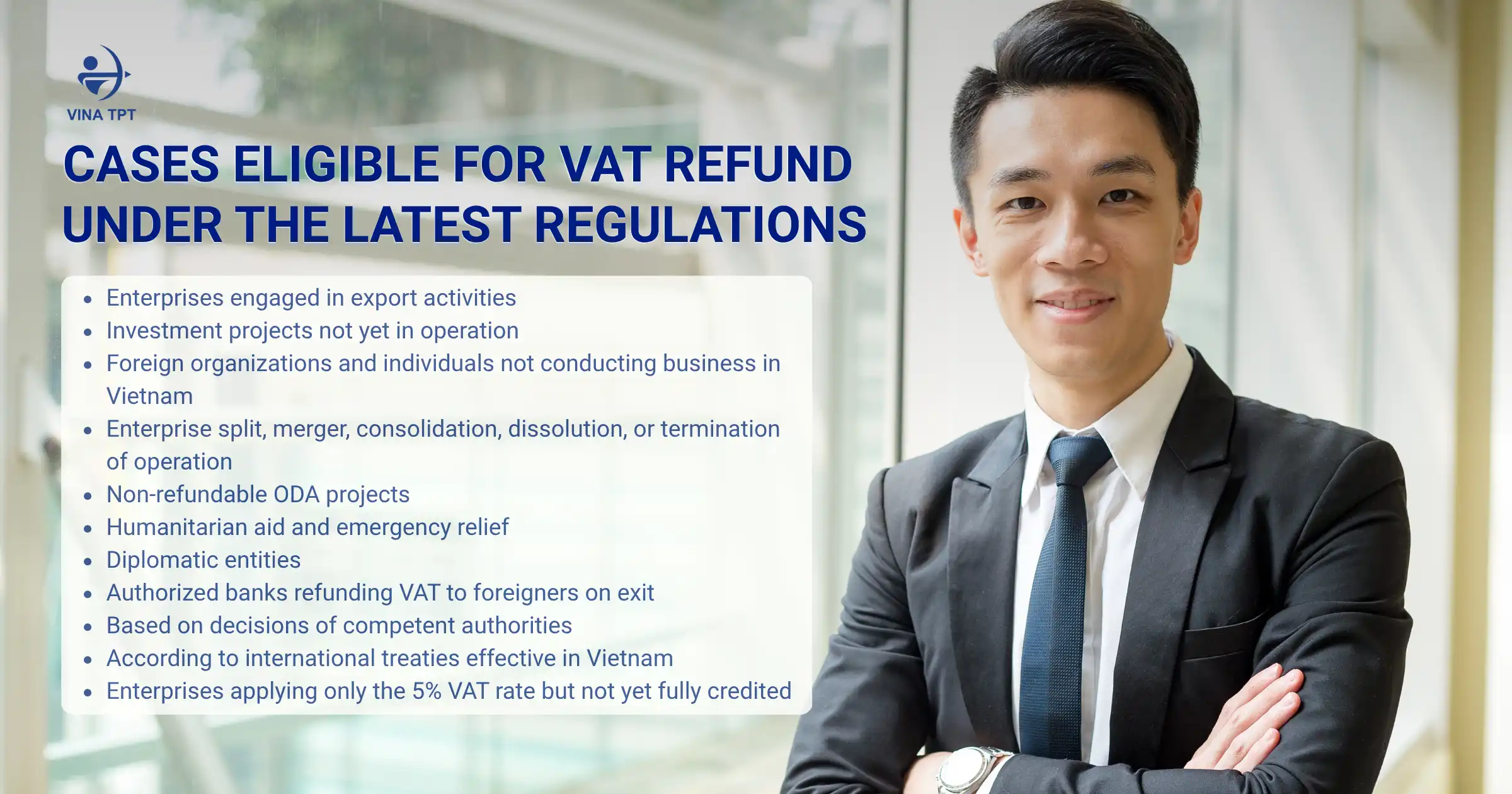
2.Cases Eligible for VAT Refund Under the Latest Regulations

VAT Refund in Vietnam 2025_ Updated Conditions and Eligible Cases Explained - VTPT

No.  Case eligible for VAT refund  Main conditions  Legal basis 
1  Enterprises engaged in export activities  Exported goods and services are subject to a 0% VAT rateInput VAT not yet credited is ≥ VND 300 million

Must have valid customs documents and bank payment records 

Article 13, VAT Law 2024 
2  Investment projects not yet in operation  The investment project has been duly registeredNo revenue has been generated

Input VAT not yet credited is ≥ VND 300 million 

Article 13, VAT Law 2024 
3  Enterprise split, merger, consolidation, dissolution, or termination of operation  The enterprise no longer operates to deduct input VATRemaining input VAT has not yet been credited  Article 13, Amended VAT Law 2008 
4  Foreign organizations and individuals not conducting business in Vietnam  Possess valid tax payment documentsDo not conduct regular business activities in Vietnam  Circular 219/2013/TT-BTC, Article 18 
5  Non-refundable ODA projects  Not using the state budget to pay VATPossess valid confirmation from the donor  VAT Law 2024, Circular 219 
6  Humanitarian aid and emergency relief  Must have a decision approving the receipt of aidMust provide valid documents related to goods and input invoices  Circular 219/2013/TT-BTC 
7  Đối tượng ngoại giao (miễn trừ)  Must have confirmation from the State Protocol DepartmentApplied under international treaties  Decree 134/2016/NĐ-CP 
8  Authorized banks refunding VAT to foreigners on exit  Must have a goods management systemMust prepare a tax refund list according to the prescribed form  Circular 92/2019/TT-BTC 
9  Based on decisions of competent authorities  Must have an official document/decision on tax refundApplied in special cases, subject to post-refund inspection  Decree 49/2022/NĐ-CP 
10  According to international treaties effective in Vietnam  Must fall under subjects clearly stated in the treatyMust provide complete dossiers and supporting documents  Law on International Treaties, Law on VAT 
11  Enterprises applying only the 5% VAT rate but not yet fully credited  Input VAT not yet credited ≥ 300 million VNDAfter 12 months or 4 consecutive quarters – applicable from 01/07/2025  Amended VAT Law 2024

 VAT 2025 Update:The 2024 Value Added Tax (VAT) Law will officially take effect from July 1, 2025.

3. Conditions for VAT refund

Depending on the type of enterprise, the conditions for VAT refund may vary

3.1. For domestic enterprises 

  • Undeducted input VAT of at least VND 300 million
  • Có Valid e-invoices andnon-cash payments for invoices from VND 20 million
  • Not under tax enforcement measures or committing tax violations
  • Proper and timely tax declaration 

3.2. For exporting enterprises 

  • Export contracts, customs declarations, and bank payment documents 
  • Continuous undeducted VAT for 3 periods or at least VND 300 million in one period
  • Exported goods must be cleared through customs
  • No fraudulent invoice transactions 

Note: From 2025, under the amended VAT Law, exporters with undeducted VAT over VND 100 million in a period may apply for refund earlier, reducing waiting time.

3.3. For investment projects 

  • Must have an Investment Registration Certificate 
  • No revenue generated, but large undeducted VAT incurred 
  • Separate bank account for the project 
  • Separate accounting for project expenses 

3.4. For foreign organizations/individuals 

  • Valid proof of VAT paid in Vietnam 
  • Non-regular business activities 
  • Full compliance with tax declaration and refund procedures 

Explore Our Tax Services

 4. Cases Not Eligible for VAT Refund

(According to Circular 219/2013/TT-BTC, amended by Circular 130/2016/TT-BTC)

  • Investment projects with insufficient charter capital contribution
    If, by the time of filing the VAT refund application (from July 1, 2016 onwards), the enterprise has not contributed the full registered charter capital it will not be eligible for refund. Instead, the uncredited input VAT will only be carried forward to the next CIT period.
  • Conditional investment sectors not meeting requirements under the Law on Investment
    This includes cases where the enterprise has not obtained the necessary license, certificate of eligibility, or written approval from the competent authority.  
  • Violation of conditions during project implementation
    If, during the implementation, the project has its license or certificate revoked, or is found no longer to meet conditional business requirements, VAT refund will be suspended from that point onward.  
  • Projects involving natural resource/mineral exploitation or production with ≥ 51% cost structure derived from natural resources
    Applicable to projects licensed from July 1, 2016. The determination of the resource ratio is guided under Clause 23, Article 4 of Circular 219.  
  • Imported goods for export but not exported through the prescribed customs area
    VAT refund is not eligible if export procedures are not carried out at the designated customs office.  
  • Exported goods not completing customs procedures at the customs-controlled area
    In this case, VAT refund is also not eligible. 

5. Key Notes on VAT Refund for Businesses

  • Do not consolidate VAT refund applications across multiple periods unless specifically guided by regulations. 
  • Carefully check the payment timeline and payment conditions of each invoice. 
  • For exporting enterprises, clearly keep records of customs declarations, bills of lading, and payment documents.
  • Always review the validity of input invoices – especially those from new suppliers. 

6. Simplify Your VAT Refund with Vina TPT’s Professional Support

Navigating the VAT refund process in Vietnam can be complex, especially with changing tax regulations and documentation requirements. Vina TPT offers professional support to help businesses simplify every step, from eligibility assessment to refund application and follow-up with tax authorities. With deep expertise in Vietnamese tax law, our team ensures accuracy, compliance, and maximum refund value for your company. Partnering with Vina TPT means saving time, avoiding costly errors, and gaining peace of mind knowing your VAT refund is handled by trusted professionals. Let Vina TPT streamline your refund process efficiently and transparently.

Contact Vina TPT today to simplify your VAT refund process!

Discuss Your Case with Our Specialists

accounting skills

Tax Breaks in Vietnam 2025 | Key CIT, VAT & PIT Updates

1/ Overview of Tax Breaks and Their Importance for FDI Businesses 

Tax breaks, also known as tax incentives, are government measures that reduce or exempt taxes to support businesses and individuals. These aim to boost investment, drive economic growth, and ease financial burdens. In Vietnam, tax breaks typically include exemptions, reduced rates, or deductible expenses. They help companies lower operating costs, boost net profits, and expand operations—especially amid post-pandemic recovery and global competition. 

For foreign direct investment (FDI) businesses, tax breaks serve as both financial tools and strategic advantages to attract capital. Under the 2025 Corporate Income Tax Law (No. 67/2025/QH15), these policies align with international commitments like the 15% global minimum tax. This creates competitive edges, encourages reinvestment, and generates jobs in Vietnam. 

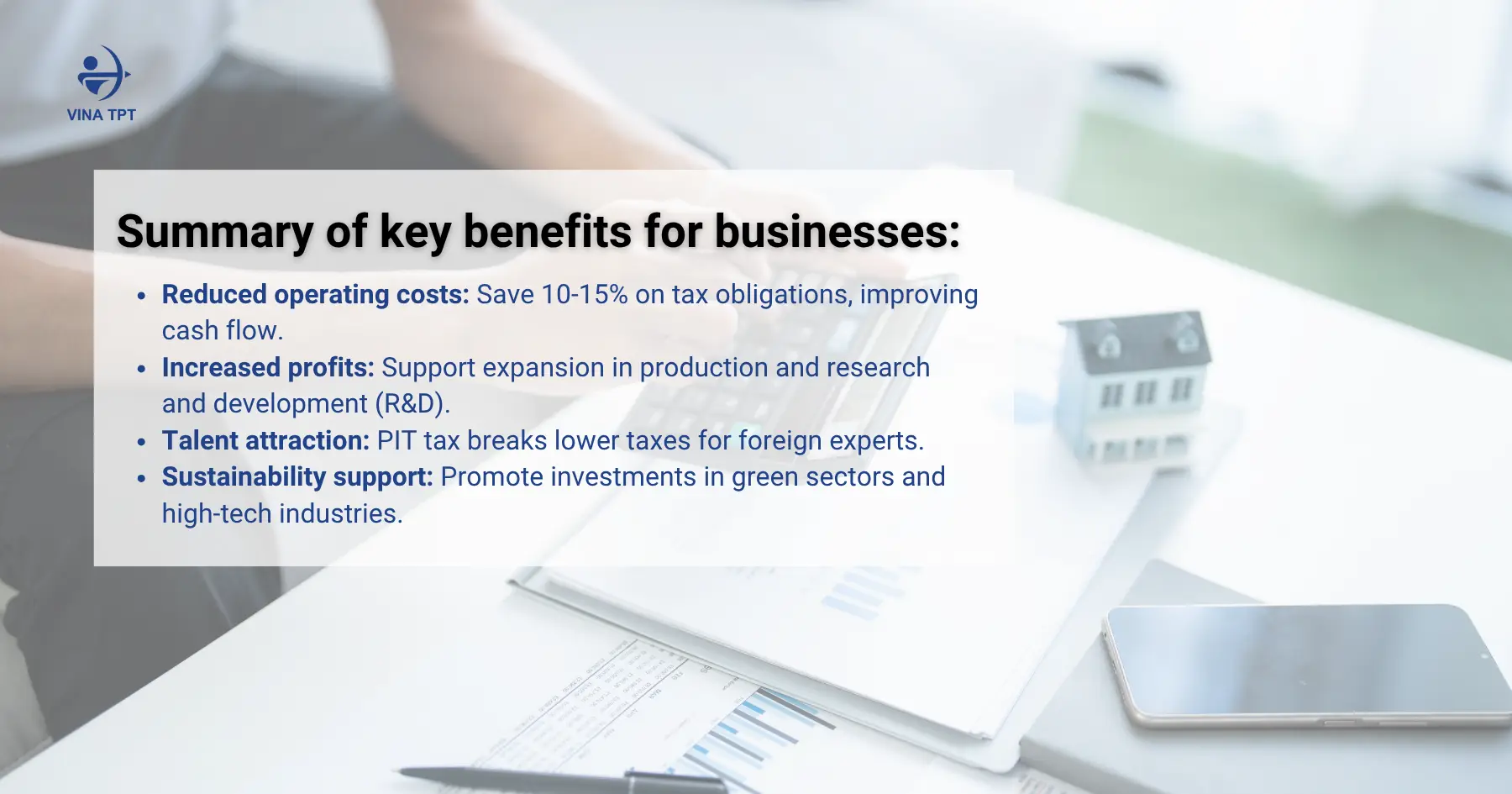
Here’s a summary of key benefits for FDI businesses: 

  • Reduced operating costs: Save 10-15% on tax obligations, improving cash flow. 
  • Increased profits: Support expansion in production and research and development (R&D). 
  • Talent attraction: PIT tax breaks lower taxes for foreign experts. 
  • Sustainability support: Promote investments in green sectors and high-tech industries. 

Explore the common tax breaks available in Vietnam to maximize benefits for your FDI enterprise. 

2/ Common Types of Tax Breaks Currently Available 

Vietnam’s government is refining tax policies to aid businesses during economic recovery, focusing on priority sectors like technology, green manufacturing, and exports. Starting in 2025, incentives apply to key taxes: Corporate Income Tax (CIT), Value-Added Tax (VAT), and Personal Income Tax (PIT). Each targets different groups and goals, helping FDI businesses cut financial loads and enhance competitiveness. Below is a comparison table: 

Tax Type  Main Incentives  Applicable Entities  Duration 
CIT  Exemption for 2-4 years, 50% reduction thereafter  FDI businesses in priority sectors  6-15 years 
VAT  Reduction from 10% to 8%  Goods and services (exclusions apply)  Until December 31, 2026 
PIT  Family deduction of VND 11 million/month (rising to VND 15.5 million/month from 2026)  Individuals and foreign experts as residents  Annual 

2.1 Corporate Income Tax (CIT) Incentives Effective from October 1, 2025 

Corporate Income Tax (CIT) directly impacts FDI business profits. From October 1, 2025, the 2025 CIT Law (No. 67/2025/QH15) expands incentives to attract high-quality investments. FDI enterprises starting new projects in high-tech fields, disadvantaged areas, or economic zones qualify for CIT exemptions for 2-4 initial years and a 50% reduction for the next 4-9 years. Preferential rates can drop to 10% for specially prioritized projects, 15% for small and medium enterprises, or 17% for investments in favored locations. 

Incentives are categorized by: 

  • Sector: High-tech, education, healthcare—exemption for 4 years, 50% reduction for 9 years. 
  • Location: Disadvantaged areas—10% rate for 15 years. 
  • Investment scale: Projects over EUR 750 million apply the 15% global minimum tax. 

Summary table: 

Incentive Type  Conditions  Duration  Reduction Level 
Exemption  High-tech projects  4 years  100% 
Rate reduction  Favored locations  15 years  10-17% 
50% reduction  New investment projects  4-9 years  50% 

Impact on FDI businesses: 

  • Cost savings up to 20-30%, boosting net profits and reinvestment. 
  • Encourages production growth and local job creation. 

Example: An FDI company investing USD 100 million in a high-tech zone could save tens of millions in taxes over the first 10 years. 

FDI enterprises should consult tax experts early to ensure proper reporting, legal workforce use, and eligibility maintenance. Compliance from the start avoids audits, penalties, and maximizes legal tax breaks. 

Maximize Your Tax Incentives Today

2.2 Value-Added Tax (VAT) Incentives Effective from July 1, 2025 

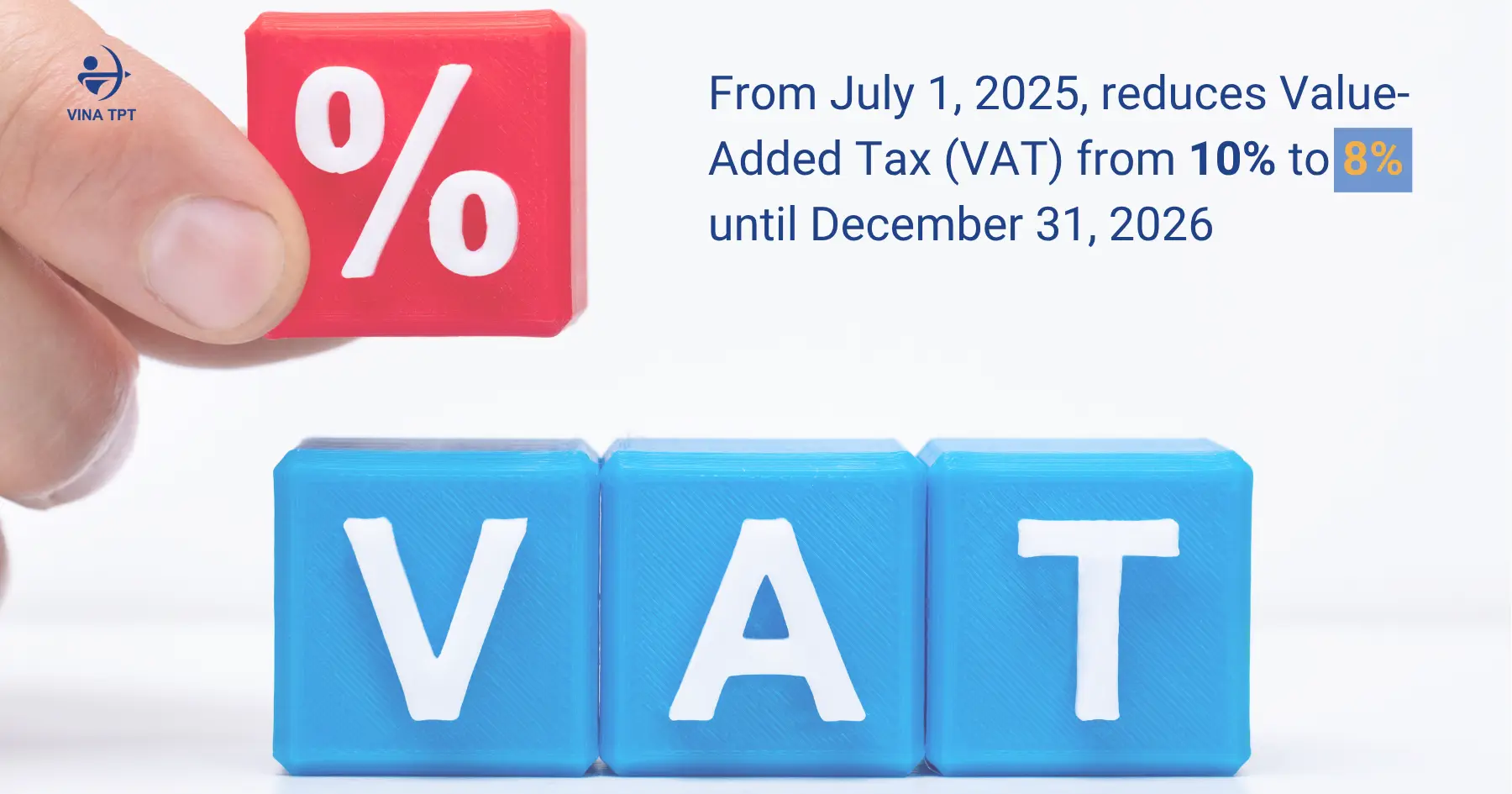
From July 1, 2025, Decree 174/2025/ND-CP reduces Value-Added Tax (VAT) from 10% to 8% until December 31, 2026, to stimulate consumption and support business recovery. This applies to most goods and services, excluding telecommunications, finance, and real estate. For FDI businesses, VAT tax breaks lower input costs, enhance cash flow, and strengthen export competitiveness. 

Specific benefits: 

  • Lower production costs: Imported materials face reduced VAT. 
  • Export support: Exported goods at 0% VAT, plus 8% reduction on related services. 

Example: An FDI firm exporting high-tech software enjoys full VAT exemption, saving 8-10% on costs. 

Key procedures: 

  • Declare VAT using new forms and electronic invoices. 
  • Collect valid documents for deductions or refunds. 
  • Note: Does not apply to specially taxed imports. 

2.3 Personal Income Tax (PIT) Incentives 

Personal Income Tax (PIT) continues to directly impact the income of workers, especially foreign experts in FDI enterprises.
From 2026, the personal allowance has been adjusted upwards to VND 15.5 million/month for the taxpayer themselves and VND 6.2 million/month for each dependent. This increase in allowances helps reduce tax obligations, improve disposable income, and enhance the attractiveness of the Vietnamese labor market.
At the same time, the PIT tax schedule has been simplified, reduced from 7 brackets to 5, with progressive tax rates.

PIT tax breaks for FDI businesses: 

  • Reduced taxes for foreign experts: Residents (present in Vietnam 183+ days/year) get deductions, cutting personnel costs. 
  • Exemptions for certain income: Stock transfers (if qualified) and foreign allowances. 

Notes: 

  • Register dependents electronically with tax authorities. 
  • Update income regularly to prevent back taxes. 

From 2026, updated policies will help FDI firms attract top global talent more easily. 

Download Vietnam Tax Handbook For Investor

3/ Key Benefits: How Tax Breaks Help Save Costs and Expand Business 

Tax breaks directly cut tax liabilities, increasing net profits and providing capital for FDI businesses to reinvest. Experts estimate savings of 10-20% on overall costs, enabling scale-up and global competition. 

Analysis from three angles: 

  • Financial: CIT and VAT reductions improve cash flow and reduce quarterly tax debts. 
  • Strategic: Encourage investments in priority areas like green technology, enhancing brand value. 
  • Human resources: PIT incentives lower salary costs, aiding recruitment of international and local experts. 

In summary, tax breaks not only save costs but also unlock business growth, allowing FDI enterprises to contribute sustainably to Vietnam’s economy. 

4/ Leveraging Tax Breaks with Vina TPT Tax Services 

To fully utilize tax breaks, FDI businesses need professional guidance from firms like Vina TPT—a Vietnam-based expert in tax and accounting. With experience supporting hundreds of FDI clients, Vina TPT identifies suitable incentives, prepares compliant files, and handles timely declarations to avoid audits. 

Standout advantages: 

  • Expertise across industries, from manufacturing to technology. 
  • Team knowledgeable in Vietnamese and international tax laws, with multilingual support. 
  • Transparent reporting and competitive fees for cost optimization. 

Support process: 

  • Assess your business and identify applicable incentives. 
  • Recommend tax plans and prepare registration documents. 
  • Implement declarations and monitor policy updates. 
  • Conduct regular reviews for ongoing compliance. 

Tax breaks are essential for FDI businesses in Vietnam to optimize costs, boost profits, and expand investments—especially with 2025 updates like the 8% VAT reduction and CIT incentives for priority sectors. These changes support economic recovery and position Vietnam as an attractive destination for foreign investment. 

Has your business maximized current tax incentives? Contact Vina TPT Tax Services today for a detailed analysis and tailored tax solutions—ensuring compliance and maximum savings! 

Talk to a Tax Specialist

Vina TPT Accounting services