FDI Company Setup in Vietnam: Business License & Complete 2026 Guide

setting up company in Vietnam

setting up company in Vietnam

Why Setting up Company in Vietnam is the Strategic Choice for 2026?

The year 2026 marks a pivotal turning point for foreign investors in Vietnam. With significant reforms in the Law on Investment and a roadmap to reduce conditional business lines, the process for setting up a company in Vietnam is becoming more transparent and streamlined than ever.

However, to operate legally in specialized sectors such as retail, distribution, or logistics, investors must follow a structured path from obtaining an IRC and ERC to securing a specific business license.

1. Why Foreign Investors Need a Clear Roadmap in 2026

Starting a business in Vietnam as a foreigner offers immense potential, but understanding the 2026 regulatory landscape is crucial to avoiding delays or rejected applications.

a. FDI Opportunities in 2026

Vietnam maintains its position as Southeast Asia’s “global factory” based on four key pillars:

  • Extensive FTA Network: Leverage tariff incentives from the CPTPP, EVFTA, and RCEP.
  • New Incentive Policies: Strong focus on high-tech projects, circular economy, and renewable energy.
  • Flexible Ownership Structures: 100% foreign ownership is permitted in most sectors, including manufacturing, IT, consulting, and trading.
  • Digitalized Procedures: Significant reduction in waiting times through the National Business Registration Portal.

b. When is a Business License (Trading License) Mandatory?

While many sectors are open, a Business License (Trading License or Retail Distribution License) is still mandatory for foreign investors in “conditional” sectors under WTO commitments and Vietnamese Law.

Even with eased regulations, a separate Business License is required after company formation for:

  • Retail Sales: Directly providing goods to end consumers.
  • Distribution & Import: Applied to restricted or specialized commodity groups.
  • Specialized Services: Logistics, education, healthcare, and F&B.
  • Important Note: By July 1, 2026, sectors like accounting and insurance brokerage will see further liberalization. However, for Retail & Distribution, investors must still seek approval from the Ministry/Department of Industry and Trade.

c. Distinguishing IRC vs. ERC vs. Business License

Understanding these three acronyms is vital for any foreigner setting up a company in Vietnam:

Permit Type Issuing Authority Primary Role
IRC (Investment Registration Certificate) Department of Planning and Investment (DPI) Approves the investment project (capital, objectives, location).
ERC (Enterprise Registration Certificate) Business Registration Office Creates the legal entity and issues the Tax ID.
Business License Relevant Ministry or Department Grants permission to operate in conditional sectors (Retail, etc.).

The Standard Sequence: IRC (Project Approval) → ERC (Company Formation) → Business License (For specific sectors).

2. 5-Step Process for Setting Up Company in Vietnam in 2026

The average timeline for completion ranges from 1 to 2 months, depending on the complexity of your business lines.

Step 1: Choose a Legal Structure & Check Ownership Limits

The most common choice is a Limited Liability Company (LLC) due to its flexibility and limited liability protection. Foreigners must verify if their specific sector requires a Joint Venture (JV) with a Vietnamese partner.

Step 2: Obtain the Investment Registration Certificate (IRC)

Investors submit the application to the DPI. Key documents include:

  • Detailed Investment Project Proposal.
  • Proof of Financial Capacity (Bank statements or audited reports).
  • Office Lease Agreement or Memorandum of Understanding (MOU).
  • Timeline: 15 – 35 working days.

Step 3: Obtain the Enterprise Registration Certificate (ERC)

Once the IRC is issued, the ERC application is typically processed within 3 – 7 working days. This step officially grants your business its legal status.

Step 4: Post-Registration Procedures (Operational Compliance)

Obtaining the ERC is only the beginning. Within 90 days, investors must fulfill these mandatory obligations:

  • Open a Direct Investment Capital Account (DICA): This is the most critical step. All capital contributions, profit repatriations, and share transfers must flow through this account.
  • Capital Contribution: Ensure the total committed capital is transferred into the DICA within 90 days of ERC issuance.
  • Online Investment Reporting: Businesses must report project progress quarterly and annually on the National Investment Information System. Missing these deadlines can lead to heavy administrative fines.
  • Initial Tax & Accounting Setup: Register digital signatures, set up e-invoice templates, and pay Business License Tax (License Fees). Appointing a Chief Accountant or an outsourced accounting representative is a legal requirement for signing financial statements.

Step 5: Specialized Business License (If applicable)

For retail and distribution entities, authorities will assess the application based on local planning and socio-economic impact. Note the Economic Needs Test (ENT) requirement if you plan to open a second retail outlet or more.

setting up company in Vietnam

Get a free 30-minutes consultation

3. Required Documents & Checklist

All foreign documents must be Consularly Legalized, translated into Vietnamese, and notarized.

  • Individual Investors: Notarized passport + Bank balance confirmation.
  • Corporate Investors: Parent company’s Certificate of Incorporation + Audited financial statements (last 2 years) + Resolution appointing the authorized representative.
  • Project Documents: Detailed Business Plan and proof of right to use the business location.

4. Vina TPT: Your Trusted Partner for FDI Success in Vietnam

Establishing a legal entity is just the start. To thrive in the Vietnamese market, businesses need a solid foundation in Accounting, Tax, and HR from day one.

Vina TPT is proud to be a strategic partner, helping foreign investors remove language barriers and navigate local legal complexities:

  • Expert Consulting: From initial setup to tax structure optimization. We keep you updated on the latest regulations, including Global Minimum Tax and 2026 tax incentives.
  • Payroll & HR Management: We handle labor contracts, Social Health & Unemployment Insurance (SHUI), and Personal Income Tax (PIT) finalization for both expats and locals, ensuring absolute confidentiality.
  • Lifecycle Partnership: With over 20 years of experience, Vina TPT provides an “All-in-one” ecosystem. You focus on growth; we handle the administration.
  • No Language Barrier: Our trilingual team (English – Japanese – Vietnamese) ensures transparent communication and seamless management reporting.

Optimize your resources and minimize legal risks with Vina TPT. Contact us today for a 1-on-1 specialized consultation for your 2026 project.

Start your journey in vietnam

setting up company in Vietnam

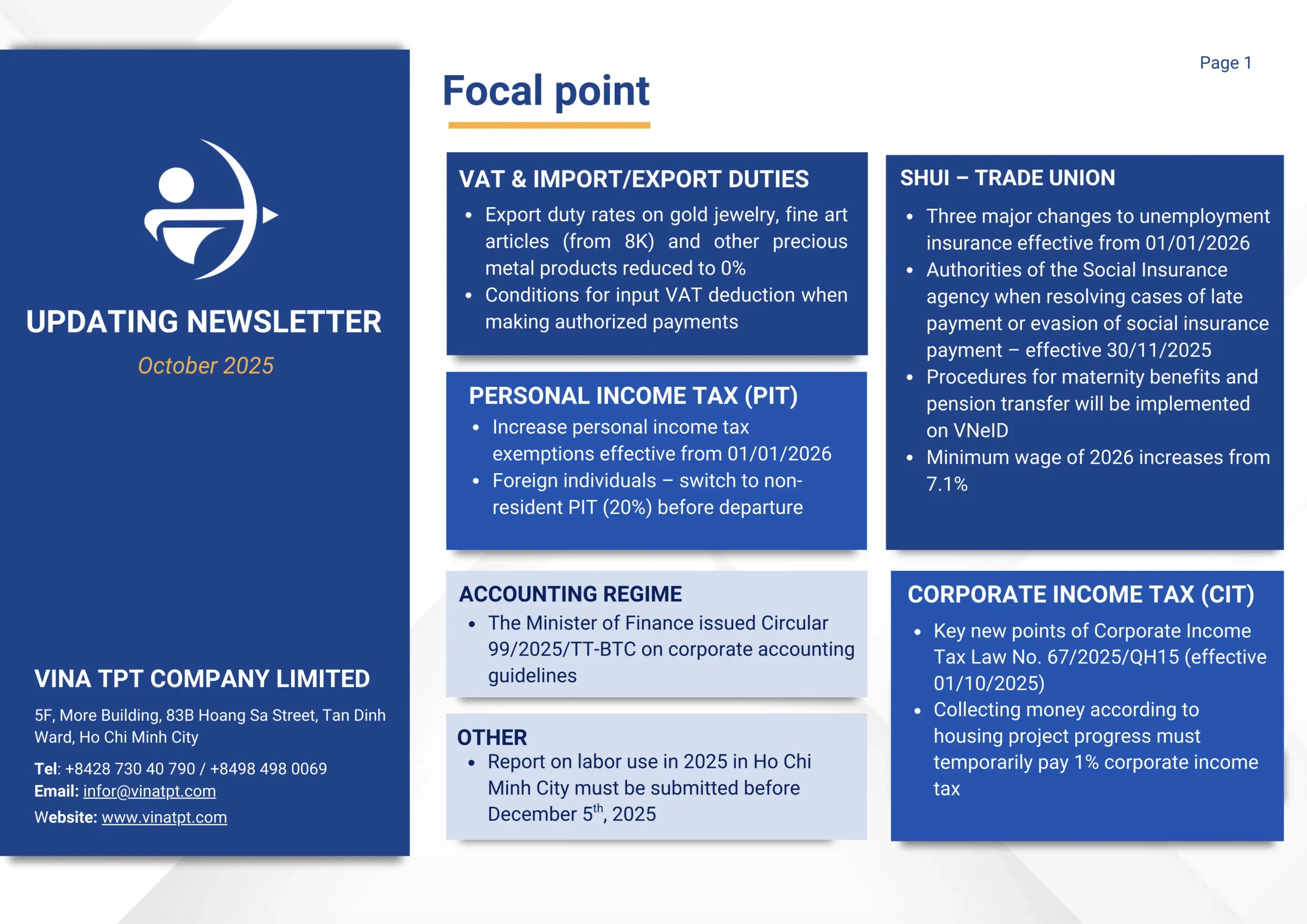
[Newsletter] Vietnam Tax Policy Updates October 2025- CIT, VAT, PIT and Social Insurance

October-2025-Newsletter-CIT-VAT-PIT-and-Social-Insurance-Vina-TPT

Newsletter-October-2025-Vina-TPT

Vietnam is implementing a series of new tax, accounting, insurance, and labour regulations effective from October 2025. Notable updates include reduced export duty rates, clarified rules for input VAT deduction, higher PIT family circumstance deductions, a shift to non-resident taxation for certain foreign individuals, new CIT rates and deductible expense rules, and stricter sanctions on late or unpaid insurance contributions. These updates will reshape compliance requirements and influence core business operations, particularly in finance, payroll, and reporting functions.

This article outlines the essential policy changes businesses need to prepare for to ensure smooth compliance and operational continuity.

1. VAT & IMPORT/EXPORT DUTIES 

1.a. Export duty on gold jewellery, fine art articles (from 8K) and other precious metal products reduced to 0%  

Decree No. 260/2025/NĐ-CP dated 10/10/2025 of the Government amends the export duty rates for certain commodity lines under groups 71.13, 71.14 and 71.15 in the Export Tariff Schedule issued together with Decree No. 26/2023/NĐ-CP dated 31/05/2023. 

The Decree reduces the export duty rate from 1% to 0% for the following items: 

  • Jewellery and parts thereof, of other precious metal, whether or not plated or clad with precious metal (HS codes 7113.19.10 and 7113.19.90); 
  • Articles of goldsmiths’ or silversmiths’ wares and parts thereof, of other precious metal, whether or not plated or clad with precious metal (HS code 7114.19.00); 
  • Other articles of gold or silver (HS code 7115.90.10). 

Products that are currently subject to the 0% export duty rate will continue to enjoy the existing 0% rate. 

1.b. Input VAT deduction when payment is made via third-party authorisation  

Official Letter No. 4850/DON-QLDN1 dated 15/10/2025 of Đồng Nai Provincial Tax Department provides guidance on the deduction of input VAT in cases where non-cash payment is made through authorisation to a third party. 

According to the regulations, for the enterprise to be eligible for input VAT deduction, it must fully satisfy the general conditions prescribed in Clause 2, Article 14 of Law No. 48/2024/QH15: 

  • Possession of a VAT invoice for the purchase of goods and services or VAT payment document. 
  • Availability of non-cash payment evidence. 
  • For exported goods and services, additional documents are required: contract, invoice, non-cash payment evidence, customs declaration, and other related documents. 

In addition, when making payment through authorisation to a third party, the enterprise must comply with the further conditions stipulated in Decree No. 181/2025/NĐ-CP: 

  • The authorisation for payment to the third party must be specifically stipulated in a written contract. 
  • The third party must be an organisation or individual lawfully operating. 

If the company fully satisfies all the above conditions and other relevant legal provisions, it will be entitled to deduct the input VAT. 

2. PERSONAL INCOME TAX (PIT)

2.a. Increase in family circumstance deductions effective from 01/01/2026  

On 17 October 2025, the Standing Committee of the National Assembly issued Resolution No. 110/2025/UBTVQH15 adjusting the family circumstance deductions for personal income tax. This Resolution takes effect from 01 January 2026 and applies to the 2026 tax period. 

  • The deduction for the taxpayer himself/herself is increased from VND 11 million to VND 15.5 million per month (VND 186 million per year) (Article 1, point a). This means the taxpayer may deduct this amount when calculating taxable income, thereby reducing the tax payable. 
  • The deduction for each dependant is increased from VND 4.4 million to VND 6.2 million per month (Article 1, point b). Accordingly, taxpayers with dependants will enjoy an additional deduction corresponding to the number of dependants, further easing the tax burden. 

2.b. Foreign individuals – switch to non-resident PIT (20%) before departure  

On 03 October 2025, the Tax Department issued Official Letter No. 4221/CT-CS providing guidance on PIT for foreign individuals working in Vietnam for less than 183 days and required to finalise their tax obligations before leaving the country. Specifically, where a foreign individual has previously been subject to resident PIT withholding and has self-declared PIT on overseas-paid income arising from work performed in Vietnam, but the actual number of days present in Vietnam is less than 183 days, such individual must re-determine their PIT obligations under the non-resident regime. 

  • PIT is calculated at 20% on total Vietnam-sourced income, irrespective of where the income is paid or received. 
  • Tax finalisation must be completed prior to departure from Vietnam.

3. CORPORATE INCOME TAX (CIT) 

3.a. Key new points of Corporate Income Tax Law No. 67/2025/QH15 (effective 01/10/2025)  

Official Letter No. 2244/QNG-NVDTPC dated 13 October 2025 of Quảng Ngãi Provincial Tax Department introduces the key new points of the Corporate Income Tax Law No. 67/2025/QH15 (effective from 01 October 2025). The main changes are as follows: 

  1. Expanded scope of taxpayers:  

Addition of foreign enterprises that do not have a permanent establishment in Vietnam (including those engaged in e-commerce and digital platforms). 

      2. Taxable income:  

Additional provision stipulating that taxable income arising in Vietnam for foreign enterprises is income derived from Vietnam, regardless of where the business activities are conducted. 

      3.New CIT rates based on revenue: 

  • Standard rate: 20% 
  • Enterprises with total annual revenue not exceeding VND 3 billion: 15% 
  • Enterprises with total annual revenue exceeding VND 3 billion but not exceeding VND 50 billion: 17% 
  • Oil and gas exploration and production activities: 25% – 50% depending on the project. 

      4.Determination of taxable income: 

  • Taxable income from business activities is the total income from all business activities. 
  • Loss carry-forward is allowed between activities, except for real estate transfer activities, investment projects, and participation rights in investment projects when the entity is enjoying tax incentives. 
  • Income from the transfer of mineral exploration, extraction, and processing projects must be accounted for separately and may not be offset against other activities. 

       5.Tax exemption and reduction: 

  • Public-service entities providing public services in socio-economically disadvantaged areas are entitled to a 50% reduction of CIT payable. 
  • Enterprises converted from household businesses are exempt from CIT for two consecutive years from the year taxable income first arises. 

       6.Science and technology development fund:  

Maximum contribution rate increased to 20%. 

       7.New tax calculation method:  

Application of CIT as a percentage of revenue for enterprises with annual revenue ≤ VND 3 billion when revenue can be determined but costs and income cannot be determined. 

      8.Additional deductible expenses: 

  • Expenses related to seconded personnel participating in management, administration, and control at credit institutions under special control or commercial banks subject to mandatory transfer. 
  • Certain expenses incurred for business and production purposes but not yet generating corresponding revenue in the period, as stipulated by the Government. 
  • Expenses for supporting the construction of public infrastructure that simultaneously serves business and production activities. 
  • Expenses related to greenhouse gas emission reduction, carbon neutrality, net-zero initiatives, and environmental pollution reduction linked to business and production activities. 
  • Certain contributions to funds established by decision of the Prime Minister or the Government.


3.b. Temporary CIT payment of 1% on progress payments received for housing projects  

Official Letter No. 5129/CT-CS dated 12 November 2025 of the Tax Department on tax policies: 

  • For housing investment projects intended for transfer/sale: If the investor collects advance payments according to progress, it must make provisional quarterly Corporate Income Tax (CIT) payments equal to 1% of the amounts collected, pursuant to Point b, Clause 6, Article 8 of Decree No. 126/2020/NĐ-CP. 
  • Regarding interest expense for enterprises with related-party transactions: Deductible interest expense is subject to the cap under Clause 3, Article 16 of Decree No. 132/2020/NĐ-CP and applies to all enterprises with related-party transactions, irrespective of whether they are domestic or foreign-invested enterprises. 


4. SOCIAL, HEALTH & UNEMPLOYMENT INSURANCE – TRADE UNION 

4.a. Three major changes to unemployment insurance effective from 01/01/2026 (Law on Employment 2025) 

On 16 June 2025, the National Assembly passed the Law on Employment 2025, which officially takes effect from 01 January 2026. Accordingly, unemployment insurance policies will undergo significant changes, with the following three key updates to unemployment insurance effective from 01/01/2026: 

(1) No entitlement to unemployment benefits upon eligibility for pension 

From 01/01/2026, under point a, clause 1, Article 39 of the Law on Employment 2025, employees who terminate employment or end their labour contract upon reaching eligibility for pension benefits will not be entitled to unemployment benefits. Thus, effective from 01/01/2026, unemployment benefits will not be payable to individuals who meet pension eligibility criteria, regardless of whether pension procedures have been initiated. 

(2) Faster receipt of unemployment benefits with reduced waiting period to 10 days 

From 2025, pursuant to clause 3, Article 39 of the Law on Employment 2025, the commencement date for unemployment benefits effective from 01/01/2026 will be the 11th working day following the submission of a complete application dossier for unemployment benefits. This represents a reduction of 5 days from the current regulation, under which benefits commence from the 16th day after dossier submission. 

(3) Maximum level of unemployment benefits 

Pursuant to clause 1, Article 39 of the Law on Employment 2025, the maximum monthly unemployment benefit for all employees shall not exceed 5 times the regional minimum wage at the time of contract termination. 

4.b. Penalties for late or evaded compulsory social/health/unemployment insurance contributions – effective 30/11/2025  

On 16 October 2025, the Government issued Decree No. 274/2025/NĐ-CP detailing certain provisions of the Social Insurance Law regarding late payment, evasion of compulsory social insurance and unemployment insurance contributions; complaints and denunciations related to social insurance. This Decree takes effect from 30 November 2025. 

  • Late payment interest rate: 0.03% per day calculated on the amount and number of days of late or evaded payment (Article 3, Clause 1, Point d; Article 7, Clause 2). 
  • Conversion period to evasion: An act of late payment shall be converted to an act of evasion after 60 days from the expiry of the latest payment deadline, provided that the Social Insurance Agency has issued a written reminder (Article 6, Clause 1, Point c). 
  • Evasion by understating salary: The act of registering a salary base for social insurance contributions lower than prescribed under the Social Insurance Law shall be deemed evasion (Article 6, Clause 1, Point b). 
  • Exemption from evasion classification (force majeure): Specific enumeration of 4 force majeure cases not to be considered as evasion (such as storms, floods, dangerous epidemics, emergency situations) as announced by competent authorities (Article 4).


5. ACCOUNTING REGIME 

5.a. Circular 99/2025/TT-BTC guiding the accounting regime for enterprises  

On 27 October 2025, the Ministry of Finance issued Circular No. 99/2025/TT-BTC regulating the accounting regime for enterprises, replacing Circular No. 200/2014/TT-BTC dated 22 December 2014. Circular No. 99/2025/TT-BTC takes effect from 01 January 2026 and applies to financial years beginning on or after 01 January 2026. Pursuant to the regulations, Circular No. 99/2025/TT-BTC simultaneously repeals and replaces the following documents: 

  • Circular No. 200/2014/TT-BTC guiding the accounting regime for enterprises; 
  • Circular No. 75/2015/TT-BTC (amending Article 128 of Circular 200); 
  • Circular No. 53/2016/TT-BTC (amending and supplementing certain provisions of Circular 200); 
  • Circular No. 195/2012/TT-BTC dated 15 November 2012 guiding accounting for main investors. 

However, certain provisions related to the accounting for the equitisation of State-owned enterprises under Circular 200 shall continue to apply until the Ministry of Finance issues a new replacement document. 

Below are some key differences between Circular No. 99/2025/TT-BTC and Circular No. 200/2014/TT-BTC regarding the accounting regime for enterprises: 

Method of converting financial statements prepared in foreign currency to Vietnamese Dong: 

  • Assets and liabilities shall be converted to Vietnamese Dong at the average transfer buying/selling exchange rate of the commercial bank where the enterprise regularly conducts transactions as at the end of the accounting period; 
  • Owner’s equity (owner’s contributed capital, capital surplus, other capital, convertible bond options) shall be converted to Vietnamese Dong at the actual transaction exchange rate on the date of capital contribution; 
  • Revaluation differences of assets shall be converted to Vietnamese Dong at the actual transaction exchange rate on the revaluation date; ….. 

Chart of accounts: Reduced to 71 level-1 accounts, abolishing 6 accounts, including 4 accounts related to non-business funding sources, capital construction investments, and 2 accounts (611 and 631). 

Addition of accounts: Renaming of accounts and addition of new accounts (e.g., Account 215 – Biological assets, etc.). Abolition of certain accounts: 621 – Purchase costs, 631 – Production costs, etc. 

Accounting forms and financial statement templates: Enterprises may also design additional or amend and supplement accounting forms and financial statement templates compared to those guided under this Circular to suit the characteristics of production and business activities and management requirements. Renaming of the “Balance Sheet” template to “Statement of Financial Position”. 


6. OTHER 

6.a. 2025 Labour Utilisation Report for Ho Chi Minh City – Must be submitted before 05 December 2025 

Official Letter No. 9002/SNV-VLATLĐ dated 13 November 2025 of the Ho Chi Minh City Department of Home Affairs on the implementation of Article 4 of Decree No. 145/2020/NĐ-CP regarding labour utilisation reporting. 

The Ho Chi Minh City Department of Home Affairs provides the following guidance on the submission of the 2025 labour utilisation report by establishments within the territory of Ho Chi Minh City: 

  1. Entities required to submit the report: 
  • Agencies, organisations, enterprises, cooperatives, households, and individuals that hire, employ, or utilise labour. 
  • Those with headquarters or places of operation within the territory of Ho Chi Minh City. 

      2. Content of the report: 

  • To be completed in accordance with Form No. 01/PLI in Appendix I issued together with Decree No. 145/2020/NĐ-CP. 

      3. Method of submission (select one of the two options): 

  • Submission via the National Public Service Portal: Perform the “Integrated procedure for registering adjustments to compulsory social insurance, health insurance, unemployment insurance contributions and labour utilisation reporting”: https://dichvucong.gov.vn/. 

      4. Submission deadline: To be completed before 05 December 2025. 

      5. Important notes: 

  • After the prescribed deadline, the Department of Home Affairs will not accept any reports. 
  • The Department of Home Affairs will compile the implementation status as a basis for confirming compliance with legal regulations upon request from relevant agencies. 
  • Failure to submit the report on time may result in administrative violations under Clause 2, Article 8 of Decree No. 12/2022/NĐ-CP. 


CONTACT US FOR SUPPORT

Expert-Vietnam-VinaTPT

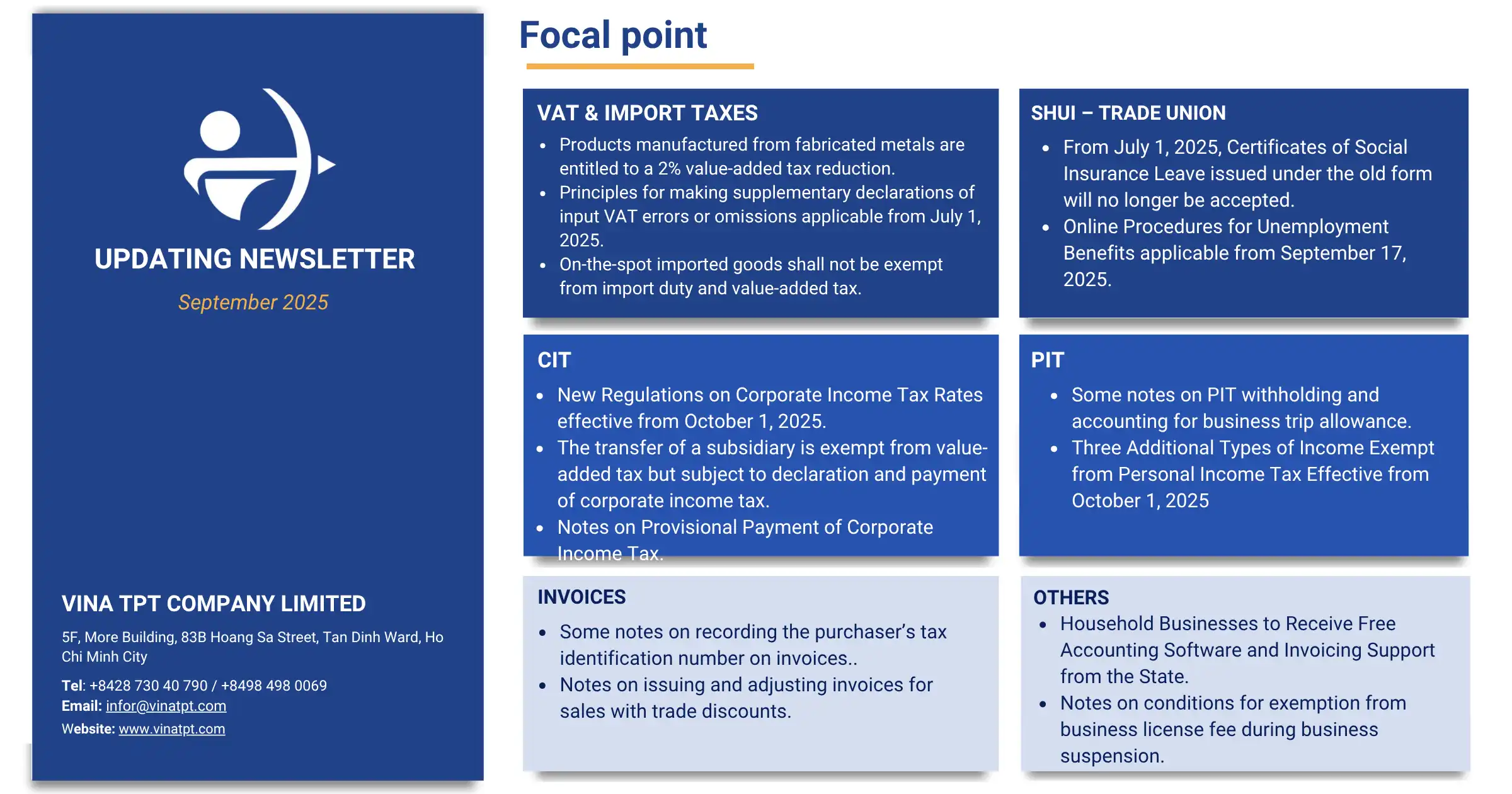
[Newsletter] Vietnam Tax Policy Updates September 2025- CIT, VAT, PIT and Social Insurance

Updates on new regulations regarding tax, e-invoices, and social insurance September 2025 (2)
As part of the Vietnam tax policy updates 2025, several new regulations related to Corporate Income Tax (CIT), Value Added Tax (VAT), Personal Income Tax (PIT), and social insurance are scheduled to take effect starting from September 2025. These changes are expected to directly impact financial reporting, payroll processes, and compliance operations across both Vietnamese and FDI enterprises.
To help businesses stay compliant and proactively adjust their internal procedures, this article provides a clear breakdown of the most important regulatory updates you need to be aware of.
In this article, we break down the most important tax regulations businesses need to prepare for in 2025.

1. Value-Added-Tax & IMPORT TAXES

1.a. Products manufactured from fabricated metals are entitled to a 2% value-added tax reduction.

Official Letter No. 6099/TCS3-QLDN2 dated September 11, 2025 of Dong Nai Tax Department regarding the case where a company manufactures and processes metal products, in which the determination of VAT reduction on sold products is made in accordance with Circular No. 174/2025/TT-BTC, specifically as follows:
  • The company shall identify its products based on the product codes, names, and descriptions provided in the Appendix issued together with Decision No. 43/2018/QD-TTg, and compare them with the List of goods and services not eligible for value-added tax (VAT) reduction issued together with Circular No. 174/2025/TT-BTC. In cases where the products fall under the List of goods attached to Circular No. 174/2025/TT-BTC, they shall not be entitled to VAT reduction.
  • For products manufactured from fabricated metals classified under Section 25, which are not included in the List of goods and services issued together with Circular No. 174/2025/TT-BTC, a VAT reduction shall apply.

1.b. Principles for making supplementary declarations of input VAT errors or omissions applicable from July 1, 2025.

Official Letter No. 3915/CT-CS dated September 18, 2025 of the Tax Department regarding VAT policies, specifically as follows:
  • The Tax Department stated that, from July 1, 2025, the Law on Value-Added Tax No. 48/2024/QH15 and Decree No. 181/2025/ND-CP have specifically provided regulations on the declaration and deduction of input VAT in cases of errors or omissions. Enterprises are therefore requested to study and comply with these provisions. Accordingly, under Point đ, Clause 1, Article 14 of Law No. 48/2024/QH15 and Clauses 5 and 6, Article 23 of Decree No. 181/2025/ND-CP, when errors or omissions in input VAT are detected, business establishments shall make supplementary declarations in accordance with the following principles:
  • A supplementary declaration shall be made in the month or quarter in which the error or omission in input VAT arises, if such error or omission results in an increase in tax payable or a reduction in refundable tax for that month or quarter.
  • A supplementary declaration shall be made in the month or quarter when the error or omission is detected, if such error or omission results in a decrease in tax payable, or only increases or decreases the amount of VAT to be carried forward to the subsequent period.

1.c. On-the-spot imported goods shall not be exempt from import duty and value-added tax.

Official Letter No. 22303/CHQ-GSQL dated September 5, 2025 of the Customs Department regarding on-the-spot imported goods, specifically as follows:
  • Clause 3 Article 3 of Law No. 90/2025/QH15 supplements Article 47a of the Customs Law, stipulating that on-the-spot import and export goods are goods delivered and received in Viet Nam under the designation of a foreign trader pursuant to sale, processing, leasing, or borrowing contracts. Cases that meet these conditions shall carry out customs procedures under Article 35 of Circular No. 08/2015/TT-BTC (as amended by Circular No. 167/2025/TT-BTC) and Article 86 of Circular No. 38/2015/TT-BTC (as amended by Circular No. 39/2018/TT-BTC).
  • According to Circular No. 134/2016/TT-BTC (as amended by Circular No. 18/2021/TT-BTC), in cases where on-the-spot imports are not registered under the processing type, the importer must declare and pay import duty based on the applicable duty rate and customs value at the time of registration. If import duty has been paid for production or business purposes and the imported products have been actually exported abroad or to a non-tariff zone, the paid duty shall be refunded in accordance with Article 36 of this Circular
  • On-the-spot import and export goods remain subject to VAT. Where goods are registered under other types (not processing), the taxpayer shall use code A11 (commercial import) or A12 (import for production and business) to declare and pay import duty and VAT.

2. Personal Income Tax (PIT)

2a. Some notes on PIT withholding and accounting for business trip allowance.

Official Letter No. 2284/CTH-QLDN1 dated September 15, 2025 of the Can Tho City Tax Department regarding taxable personal income (PIT) on business trip allowances, specifically as follows:
  • Taxable PIT income with respect to lump-sum business trip allowances: This is the portion of business trip allowances exceeding the limits prescribed by the State. Specifically: For employees working in business organizations and representative offices, the limit on business trip allowances shall be applied consistently with the level determined for corporate income tax (CIT) purposes. For employees working in international organizations or representative offices of foreign organizations, the limit on business trip allowances shall be applied in accordance with the regulations of such international organizations or representative offices of foreign organizations (see Point đ.4, Clause 2, Article 2 of Circular No. 111/2013/TT-BTC).
Travel expenses and accommodation costs for employees on business trips shall be deductible if supported by sufficient invoices and documents.
  • Where the enterprise has a financial/internal regulation stipulating allowances for travel, accommodation, and per diem for employees on business trips, and such regulation is properly implemented, these expenses shall be deductible.
  • Payment by employees’ personal bank cards for business trip expenses of VND 20 million or more (including airfares):
  • Such expenses shall be deductible if the following conditions are met:
  • Valid invoices and supporting documents are available.
  • A decision or written authorization for the employee’s business trip is issued.
  • The enterprise’s financial/internal regulation permits employees to pay using personal bank cards, with subsequent reimbursement by the enterprise.
  • Purchase of air tickets via e-commerce websites: The documents serving as the basis for deductibility include the electronic air ticket, boarding pass, and the enterprise’s non-cash payment vouchers showing the individual undertaking the transportation service.

Explore Tax Services in Viet Nam

2b. Three Additional Types of Income Exempt from Personal Income Tax Effective from October 1, 2025

According to the new provisions in the Law on Science, Technology and Innovation 2025 (No. 93/2025/QH15), effective from October 1, 2025, Clause 3, Article 71 of this Law supplements Points 18, 19, and 20 after Point 17 of Article 4 on tax-exempt income under the Law on Personal Income Tax 2007, as amended and supplemented.
Accordingly, from October 1, 2025, three additional types of income will be exempt from Personal Income Tax (PIT), including:
  • Income from salaries and wages received from performing science, technology, and innovation tasks.
  • Income from copyright related to science, technology, and innovation tasks when the results of such tasks are commercialized in accordance with the laws on science, technology, innovation, and intellectual property.
  • Income of individual investors and experts working for start-up innovation projects, founders of start-up enterprises, and individual investors contributing capital to venture capital funds.

3. Corporate Income Tax (CIT)

Corporate-income-tax-VinaTPT

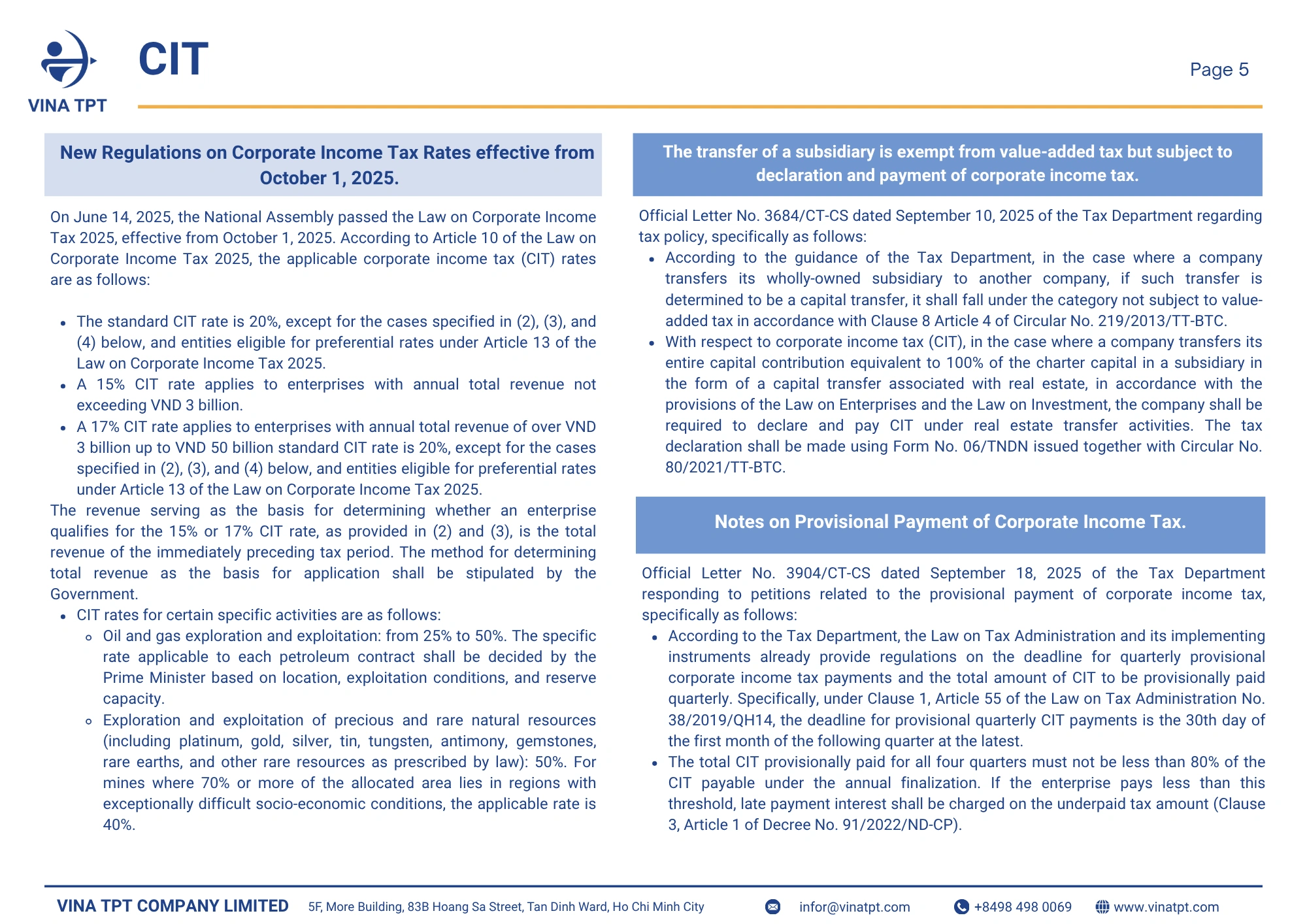
3a. New Regulations on Corporate Income Tax Rates effective from October 1, 2025.

On June 14, 2025, the National Assembly passed the Law on Corporate Income Tax 2025, effective from October 1, 2025. According to Article 10 of the Law on Corporate Income Tax 2025, the applicable corporate income tax (CIT) rates are as follows:
  • The standard CIT rate is 20%, except for the cases specified in (2), (3), and (4) below, and entities eligible for preferential rates under Article 13 of the Law on Corporate Income Tax 2025.
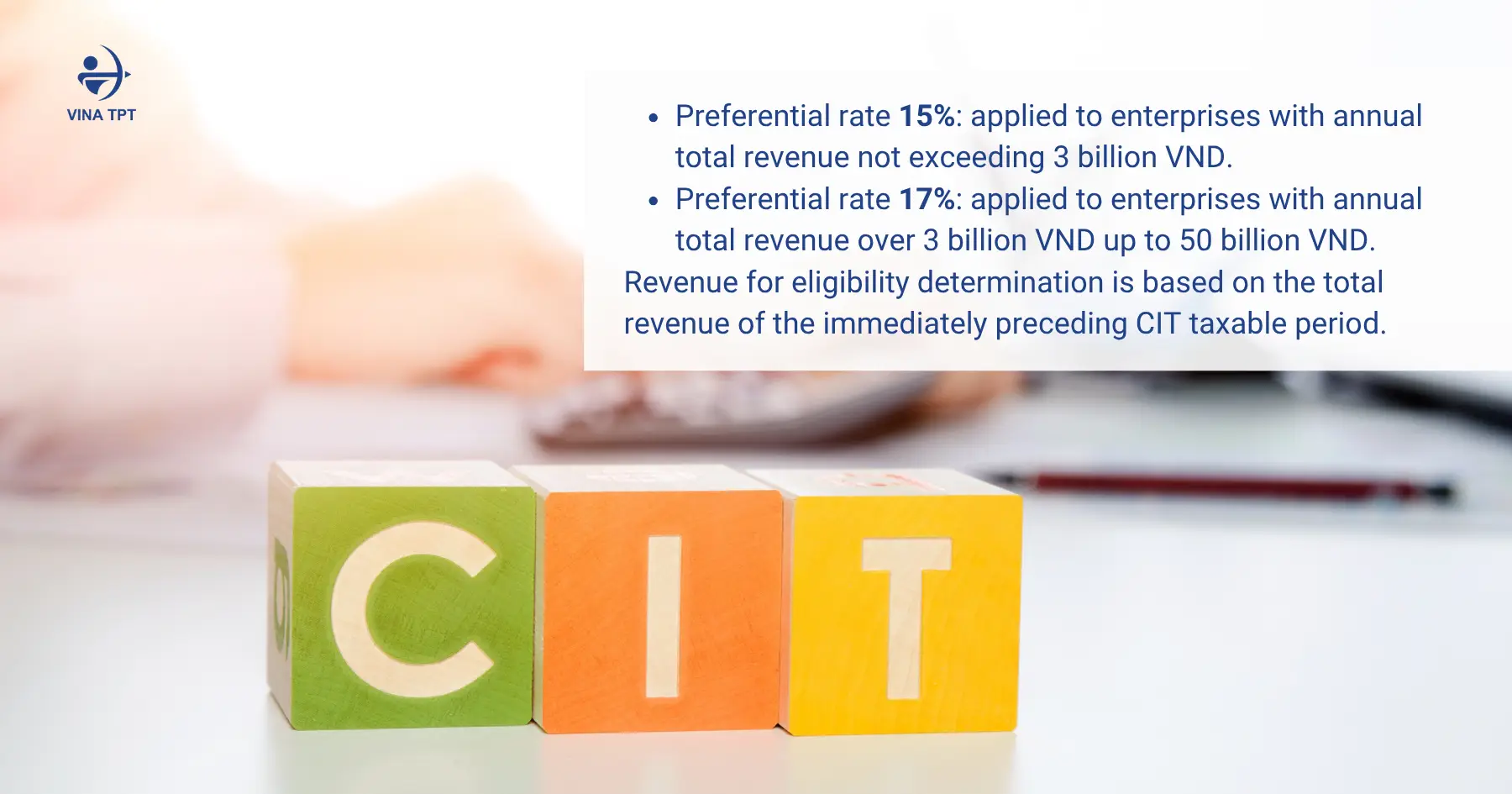
  • A 15% CIT rate applies to enterprises with annual total revenue not exceeding VND 3 billion.
  • A 17% CIT rate applies to enterprises with annual total revenue of over VND 3 billion up to VND 50 billion standard CIT rate is 20%, except for the cases specified in (2), (3), and (4) below, and entities eligible for preferential rates under Article 13 of the Law on Corporate Income Tax 2025
The revenue serving as the basis for determining whether an enterprise qualifies for the 15% or 17% CIT rate, as provided in (2) and (3), is the total revenue of the immediately preceding tax period. The method for determining total revenue as the basis for application shall be stipulated by the Government.
CIT rates for certain specific activities are as follows:
  • Oil and gas exploration and exploitation: from 25% to 50%. The specific rate applicable to each petroleum contract shall be decided by the Prime Minister based on location, exploitation conditions, and reserve capacity.
  • Exploration and exploitation of precious and rare natural resources (including platinum, gold, silver, tin, tungsten, antimony, gemstones, rare earths, and other rare resources as prescribed by law): 50%. For mines where 70% or more of the allocated area lies in regions with exceptionally difficult socio-economic conditions, the applicable rate is 40%.

3b. The transfer of a subsidiary is exempt from value-added tax but subject to declaration and payment of corporate income tax.

Official Letter No. 3684/CT-CS dated September 10, 2025 of the Tax Department regarding tax policy, specifically as follows:
  • According to the guidance of the Tax Department, in the case where a company transfers its wholly-owned subsidiary to another company, if such transfer is determined to be a capital transfer, it shall fall under the category not subject to value-added tax in accordance with Clause 8 Article 4 of Circular No. 219/2013/TT-BTC.
  • With respect to corporate income tax (CIT), in the case where a company transfers its entire capital contribution equivalent to 100% of the charter capital in a subsidiary in the form of a capital transfer associated with real estate, in accordance with the provisions of the Law on Enterprises and the Law on Investment, the company shall be required to declare and pay CIT under real estate transfer activities. The tax declaration shall be made using Form No. 06/TNDN issued together with Circular No. 80/2021/TT-BTC.

3c. Notes on Provisional Payment of Corporate Income Tax.

Official Letter No. 3904/CT-CS dated September 18, 2025 of the Tax Department responding to petitions related to the provisional payment of corporate income tax, specifically as follows:
  • According to the Tax Department, the Law on Tax Administration and its implementing instruments already provide regulations on the deadline for quarterly provisional corporate income tax payments and the total amount of CIT to be provisionally paid quarterly. Specifically, under Clause 1, Article 55 of the Law on Tax Administration No. 38/2019/QH14, the deadline for provisional quarterly CIT payments is the 30th day of the first month of the following quarter at the latest.
  • The total CIT provisionally paid for all four quarters must not be less than 80% of the CIT payable under the annual finalization. If the enterprise pays less than this threshold, late payment interest shall be charged on the underpaid tax amount (Clause 3, Article 1 of Decree No. 91/2022/ND-CP).

4. Social Insurance – Trade Union

a. From July 1, 2025, Certificates of Social Insurance Leave issued under the old form will no longer be accepted.

Official Letter No. 5761/BYT-KCB dated August 27, 2025 of the Ministry of Health regarding the settlement of difficulties in implementing social insurance regimes for employees, specifically as follows:
  • Accordingly, the Ministry of Health notes that Certificates of Social Insurance Leave issued prior to the effective date of Circular No. 25/2025/TT-BYT (July 1, 2025) shall remain valid as the basis for entitlement to social insurance benefits. For Certificates issued after July 1, 2025, it is mandatory to use the new form promulgated under Circular No. 25/2025/TT-BYT. The difference between the new form and the old form (issued under Circular No. 18/2022/TT-BYT) lies in the addition of information on the employee’s citizen identification number/identity card number/passport number/personal identification number; other contents remain unchanged from the old form.
  • During the initial implementation of Circular No. 25/2025/TT-BYT, for documents issued by hospitals still using the old form and not yet switched to the new form, in order to ensure employees’ rights and avoid inconvenience, the Ministry of Health has requested that enterprises prepare a list of employees whose documents were issued by hospitals in non-compliance with regulations, and submit an official letter to the Department of Health or the health authority of the relevant ministries/agencies managing such hospitals, requesting the supplementation of information on the documents already issued, as prescribed in Point b, Clause 4, Article 28 of Circular No. 25/2025/TT-BYT.
As for Certificates of Social Insurance Leave without the hospital’s seal due to the seal not yet being updated to the new address following a merger, the Ministry of Health has stated that, under Clause 8, Article 69 of Decree No. 188/2025/ND-CP, medical examination and treatment establishments are permitted to continue using their old seals until new seals are issued.

b. Online Procedures for Unemployment Benefits applicable from September 17, 2025.

Decision No. 1295/QD-TTPVHCC dated September 17, 2025 of the People’s Committee of Hanoi City announcing the List of administrative procedures on unemployment insurance to be piloted on the National Public Service Portal under the management competence of the Department of Home Affairs of Hanoi City, specifically as follows:
This Decision announces six procedures concerning the entitlement to and termination of unemployment benefits to be piloted by the Hanoi Department of Home Affairs on the National Public Service Portal as from September 17, 2025, including:
  • Settlement of entitlement to unemployment benefits
  • Monthly notification of job search activities.
  • Settlement of entitlement to unemployment benefits
  • Settlement of entitlement to unemployment benefits
  • Transfer of entitlement to unemployment benefits (integrated procedure for transfer-out and transfer-in).
  • Termination of entitlement to unemployment benefits.
This Decision takes effect from the date of signing.

5. OTHER

a. Household Businesses to Receive Free Accounting Software and Invoicing Support from the State.

Official Letter No. 3914/CT-CS dated September 18, 2025 of the Tax Department regarding the response to the petition of the Vietnam Banks Association:
  • With respect to the use of invoices by household businesses, the Tax Department notes that, pursuant to the provisions of Decree No. 70/2025/NĐ-CP, from June 1, 2025, when selling goods or providing services directly to consumers, household businesses under the lump-sum tax regime with annual revenue exceeding VND 1 billion must issue electronic invoices generated from cash registers connected to and transmitting data to the tax authority, and deliver such invoices to buyers. The electronic invoice data is already available on the tax authority’s system, allowing both sellers and buyers to look up invoices on the system without the need to print paper copies.
  • Under the current guidance provided in Circular No. 40/2021/TT-BTC, there is no provision requiring lump-sum household businesses to retain purchase invoices or supporting documents.
  • As stipulated at Point b, Clause 4, Article 13 of Circular No. 40/2021/TT-BTC, in cases where a lump-sum household business changes its business scale (premises size, labor use, or revenue), it must declare adjustments and supplements to the Tax Return using Form No. 01/CNKD. The tax authority, based on the household business’s tax return and the tax sector’s database, shall issue a Notice of adjustment of lump-sum tax if it determines that declared revenue has changed by 50% or more compared to the previously assessed lump-sum revenue, effective from the time of such change within the tax year.
Furthermore, pursuant to Clause 3, Article 12 of Resolution No. 198/2025/QH15, the State shall allocate funding to provide free shared digital platforms and accounting software for small and micro enterprises, household businesses, and individual business households. At present, the Ministry of Finance is drafting a Decree guiding the implementation of this Resolution, which will include provisions on the measures to support the free provision of shared digital platforms and accounting software for small and micro enterprises, household businesses, and individual businesses.

b. Notes on conditions for exemption from business license fee during business suspension.

Official Letter No. 1355/QNG-QLDN1 dated September 4, 2025, of the Quang Ngai Provincial Tax Department on guidance regarding business license fees
  • The conditions for exemption from the business license fee during business suspension are stipulated in Clause 2, Article 1 of Decree No. 22/2020/NĐ-CP and Clause 4, Article 1 of Circular No. 65/2020/TT-BTC, as follows: a written request for suspension of production and business operations must be submitted to the tax authority or the business registration authority before the deadline for payment of the business license fee (January 30 each year), and the business license fee of the year in which suspension is requested has not yet been paid.
  • Accordingly, if a Company has submitted a written request to the business registration authority to suspend production and business operations in the calendar year 2025 (from January 1 to December 31) before the license fee payment deadline (before January 30) and has not yet paid the 2025 business license fee, then the Company is not required to pay the license fee for 2025.
However, if the above conditions are not satisfied, the Company must pay the business license fee for 2025.

6. INVOICES

a. Some notes on recording the purchaser’s tax identification number on invoices.

Official Letter No. 3955/CT-CS dated September 19, 2025 of the Tax Department regarding e-invoices, specifically as follows:
  • The presentation of the buyer’s name, address, and taxpayer identification number on e-invoices shall comply with the provisions of Clause 5 and Point c, Clause 14, Article 10 of Decree No. 123/2020/ND-CP (as amended and supplemented at Points a and d, Clause 7, Article 1 of Decree No. 70/2025/ND-CP). Accordingly, in cases where the buyer is a business establishment with a TIN, the buyer’s name, address, and TIN stated on the invoice must be consistent with the information on the enterprise/branch registration certificate, household business registration certificate, tax registration certificate, or TIN notification
  • If the purchaser does not have a tax identification number, the TIN is not required to be shown on the e-invoice. In addition, in cases specified at Point c, Clause 14 , Article 10, it is not mandatory to indicate the purchaser’s name, address, or TIN on the invoice. As from June 1, 2025, where the purchaser provides a TIN or personal identification number, the invoice must also include such TIN or personal identification number.
  • For e-invoices generated from cash registers, the invoice must show the purchaser’s name, address, tax identification number/personal identification number/telephone number if so requested by the purchaser (see Clause 3, Article 11 of Decree No. 123/2020/ND-CP, as amended and supplemented under Clause 8, Article 1 of Decree No. 70/2025/ND-CP).

b. Notes on issuing and adjusting invoices for sales with trade discounts.

Official Letter No. 1802/CTH-QLDN3 dated September 3, 2025, of the Can Tho City Tax Department regarding trade discount invoices, specifically as follows:
In this document, the Can Tho City Tax Department provided guidance on determining VAT taxable prices in cases of trade discounts, how to present discount amounts on invoices, and how to handle adjustment invoices when discounts are based on quantity or sales volume. Specifically:
VAT taxable price: The VAT taxable price is the selling price after deducting the trade discount given to customers, excluding VAT (Clause 2, Article 14 of Decree No. 181/2025/NĐ-CP).
Presentation on invoices: The invoice must clearly indicate the trade discount amount (Point đ, Clause 6, Article 10 of Decree No. 123/2020/NĐ-CP.
Discounts based on quantity or sales volume:
  • Adjustment on the last purchase/next period invoice: The discount amount shall be adjusted on the sales/service invoice of the last purchase or subsequent period, ensuring the discount amount does not exceed the value of goods or services recorded on that invoice.
  • Issuing an adjustment invoice: An adjustment invoice may be issued together with a list of the invoices subject to adjustment, including amounts and tax adjustments. The list must be kept at the entity and presented upon request by the tax authority or other competent state authority (Clause 13, Article 1 of Decree No. 70/2025/NĐ-CP amending and supplementing Article 19 of Decree No. 123/2020/NĐ-CP.
  • Tax return adjustments: Based on the adjustment invoice and related records, both the buyer and the seller shall declare adjustments to sales revenue, purchase revenue, input and output VAT in the period when the adjustment invoice is issued.
  • Adjustment invoice for trade discounts: This is an adjustment invoice for previously issued invoices, used to adjust differences in amounts only; it is not used to declare sales revenue already incurred. Accordingly, in the electronic invoice system of the General Department of Taxation, the line “Total amount before tax” will display the trade discount amount, while the line “Total trade discount amount” will display as 0.

Contact us for support

📞 (+84) 984 980 069

📧 infor@vinatpt.com

🌐www.vinatpt.com

🏢 5th Floor, More Building, 83B Hoang Sa, Tan Dinh Ward, Ho Chi Minh City

accounting service Vietnam for FDI company vtpt

Bridging VAS and J-GAAP: Accounting Outsourcing Solutions for Japanese Companies in Vietnam

Accounting and financial reporting for Japanese companies in Vietnam under VAS and J-GAAP standards

accounting-outsourcing-services-for-japanese

1. Japanese Firms Face Complex Financial Localization in Vietnam

Japanese corporations are known for their strict financial and accounting processes and high standards of transparency. However, when expanding operations to Vietnam, they face significant differences between Vietnamese accounting standards (VAS) and Japanese accounting standards (J-GAAP). This difference lies not only in the way revenue and expenses are recorded, but also affects the way financial statements are presented and reconciled between the parent company in Japan and its branch in Vietnam.

Many Japanese enterprises share that ensuring compliance with VAS as required by Vietnamese tax authorities while maintaining the internal reporting format according to J-GAAP is a complex problem. To handle these challenges efficiently, many turn to accounting outsourcing services provided by a professional accounting services company in Vietnam. These services not only ensure accurate reconciliation between the two systems but also support the preparation of bilingual reports and bank statements in Japanese, helping Japanese corporations maintain compliance, transparency, and efficiency across borders.

2. Challenges in Reconciling VAS and Japanese GAAP

What makes Japanese companies difficult is not only the difference in accounting regulations, but also in the actual operation process. The way revenue is recognized between the two systems can be different: VAS is based on the time of completion of the delivery obligation, while J-GAAP can record according to the contract conditions.

Another problem is the difference in exchange rates: VAS uses actual or average exchange rates, while J-GAAP may require re-recording at the end-of-period exchange rate, leading to discrepancies in consolidated reports. In addition, preparing bank statements in Japanese or bilingual financial statements to send to the parent company is also a significant challenge, requiring accounting personnel who are both knowledgeable in the field and fluent in the language.

In many cases, Japanese companies have to maintain two separate sets of accounting systems or spend a lot of time adjusting data. This not only increases operating costs but also prolongs the auditing process, reducing the effectiveness of internal financial management.

GET JAPAN-VIETNAM ACCOUNTING SUPPORT

3. Why Accounting Outsourcing Services Is the Optimal Solution

Accounting outsourcing services is becoming an inevitable trend in the Japanese business community in Vietnam. Instead of building a large internal team, businesses can cooperate with a professional unit – both understanding Vietnamese tax regulations and the J-GAAP system.

This solution helps businesses significantly save on personnel costs, minimize the risk of errors in declarations, and maintain standard bilingual financial reports (English – Japanese – Vietnamese), meeting the requirements of both tax authorities and parent companies. In particular, professional accounting service companies can build a data standardization process, ensuring that reports can be directly integrated into the group’s management system in Japan.

Accounting outsourcing services also helps businesses be more flexible – easily expanding or reducing the scale of accounting when there are changes in the project, without affecting the continuity of financial operations.

4. How Vina TPT Simplifies Accounting for Japanese Companies

Vina TPT Accounting Service is the leading accounting services company providing accounting and financial solutions for Japanese enterprises in Vietnam. We deeply understand the differences between VAS and J-GAAP and have built a specialized process to help Japanese clients localize their financial systems while maintaining the transparency standards of the parent corporation.

Vina TPT’s team of experts includes Japanese – English bilingual accountants and tax consultants, who are intensively trained in Japanese accounting standards, Vietnamese taxes, and specialized communication skills in Japanese. 

In particular, Mr. Le Quoc Duy, the chief expert in charge of Japanese customers, has more than 2015 years of experience working with large corporations in the fields of manufacturing, finance, and logistics of Japan in Vietnam.

accounting-outsourcing-services-for-japanese

We support businesses in the entire process:

  • Standardizing data and preparing bank statements in Japanese
  • Reconciling and converting reports from VAS to J-GAAP
  • Review documents before sending to HQ
  • And provide regular advice to ensure accuracy and compliance in the long term.

5. Build Transparent, Compliant and Cross-Cultural Financial Systems

With specialized accounting outsourcing services, Japanese enterprises in Vietnam not only solve compliance issues, but also create a transparent, reliable and cross-culturally compatible financial system. Standardized and bilingual financial data helps strengthen trust between the Vietnamese branch and the Japanese parent company, and facilitates smoother group audits.

In the long term, maintaining a transparent accounting and financial system not only helps companies control costs and optimize profits, but also demonstrates a standard operating philosophy that is consistent with Japanese business culture: accuracy – discipline – reliability.

Contact Vina TPT Accounting Service today for advice on outsourcing accounting solutions and bilingual financial reporting in accordance with J-GAAP standards. We help Japanese businesses in Vietnam operate more easily – accurately, compliantly and sustainably.

BOOK A FREE CONSULTATION

Accounting-and-financial-reporting-for-Japanese-companies-in-Vietnam

Accounting service for Chinese tech firms in Vietnam

Accounting services for Chinese tech companies in Vietnam

accounting-services-for-chinese-companies

1. Fast-Growing Chinese Tech Firms Need Smarter Accounting Services in Vietnam

The wave of Chinese technology companies shifting production and investment to Vietnam is taking place strongly. From electronics, hardware, software companies to technology startups, Vietnam has become an attractive destination thanks to its competitive labor costs, preferential tax policies and strategic position in the regional supply chain.

However, along with that expansion speed are challenges in financial management. As the scale of operations increases rapidly, companies face the challenge of controlling cash flow, standardizing accounting processes, and ensuring compliance with Vietnamese regulations, which are significantly different from the Chinese system. A smart, automated and transparent accounting system is the foundation for Chinese technology companies to maintain stability during their development in Vietnam.

2. Bridging the Gap Between Tech Expansion and Accounting Readiness

Most Chinese technology companies, when first investing in Vietnam, focus on production or R&D, paying little attention to building an internal accounting team with a good understanding of local laws. This leads to a fragmented financial system that lacks standardization, making it difficult to prepare tax and financial reports according to Vietnamese regulations.

In addition, differences in language, forms, tax declaration procedures and accounting standards (VAS vs CAS) put many businesses at risk of compliance. Even small errors in declaration or late submission of reports can lead to administrative fines, affecting the reputation of the business and long-term investment projects. Clearly, to operate effectively, Chinese technology companies need a reliable accounting partner who understands both the business language and the laws of the two countries.

3. Why Accounting Outsourcing and Payroll Services Ensure Agility and Compliance

Accounting services is a popular trend among FDI companies in Vietnam, especially in the technology industry. Instead of recruiting, training and maintaining an accounting department, enterprises can use the services of a professional unit – helping to save up to 40-60% of operating costs, while eliminating human resource risks.

Units specializing in providing accounting services such as Vina TPT not only process books, prepare financial reports, declare and settle taxes, but also integrate China payroll services, ensuring that salary calculation, personal income tax and social insurance deductions are performed correctly, transparently and bilingually. This is especially important for Chinese companies with multinational staff, requiring a payroll and tax calculation system that is both accurate and easy to understand.

As a result, businesses can focus resources on core activities – product, technology and market development,  ​​while accounting, tax and human resources are guaranteed to operate smoothly and in compliance with the law.

GET ADVICE ON ACCOUNTING SERVICES IN VIETNAM

4. Modern Accounting Services for Business Growth in the Tech Industry

In the digital age, accounting is no longer a manual task, but an important part of the operational strategy. Modern accounting solutions today apply cloud computing (cloud accounting), automate reporting, and standardize financial data according to VAS – IFRS to increase processing speed and minimize errors.

For technology businesses, this is even more important when it comes to tracking R&D costs, depreciation of technology assets, or calculating cost of goods in the supply chain. Digital accounting systems help businesses access financial data in real time, make faster decisions, and coordinate easily between branches in Vietnam – China.

In addition, standardizing financial reports according to international standards also helps businesses easily mobilize capital, cooperate in investment or IPO in the future, when financial transparency becomes a key factor of market confidence.

5. From Data to Decision: Turning Accounting Insights into Business Advantage

A good accounting system not only reflects the past but also forecasts the future. When properly analyzed and presented, financial data will become a powerful tool to support leaders in making strategic decisions.

Through indicators of cash flow, personnel cost ratio, investment efficiency and gross profit, businesses can identify risks early, allocate budgets reasonably and optimize operations. This is especially important for technology businesses – where changes occur rapidly and every financial decision directly affects competitiveness.

Therefore, accounting is not just a compliance task, but a strategic foundation to help Chinese technology businesses develop sustainably in Vietnam.

6. Vina TPT Accounting Service – Trusted Partner for Chinese Tech Firms in Vietnam

With more than 10 years of experience serving FDI companies, Vina TPT Accounting Services has become a strategic partner of many Chinese, Korean and Singaporean technology companies operating in Vietnam. We have a team of bilingual English-Vietnamese, who are deeply trained in financial regulations, Vietnamese tax laws and international reporting standards.

Vina TPT experts not only perform accurate operations but also provide strategic consulting: building a standardized financial system, internal control, optimizing costs and supporting businesses in converting to a digital accounting model.

Vina TPT is committed to providing comprehensive, transparent and absolutely confidential accounting services, helping Chinese technology enterprises confidently develop in Vietnam without worrying about legal or operational barriers.

Vina TPT Accounting Service for business – a solid financial foundation for the sustainable growth of Chinese technology enterprises in Vietnam.

BOOK A FREE CONSULTATION

accounting-services-for-chinese-companies

Tax Incentive in Vietnam 2025: Comprehensive Guide to Optimize Profits under New CIT Law

Overview of corporate tax incentives in Vietnam 2025 under the new CIT Law

Overview of corporate tax incentives in Vietnam 2025 under the new CIT Law

Tax Incentive: Comprehensive Guide to Corporate Tax Incentives in Vietnam 2025 – Optimize Profits with New CIT Law

With Vietnam’s Corporate Income Tax (CIT) Law 2025 officially in force from October 1, 2025, investors and CFOs are reassessing how to leverage tax incentives to strengthen profitability and compliance.

From 10 – 17% preferential CIT rates to multi-year tax holidays, the new regime gives both domestic and foreign companies more tools to optimize profits but only if you understand the rules.

In this guide, you’ll learn:

  1. What a tax incentive is and why it matters for 2025
  2. The main types of corporate tax incentives available in Vietnam
  3. Key eligibility requirements and risk management
  4. How to prepare and apply effectively with professional support

I. What is a Tax Incentive and Why Do Businesses Need to Know in 2025?

A tax incentive is a government policy designed to reduce or exempt tax liabilities for businesses that invest in targeted sectors or locations, with the aim of encouraging sustainable growth, innovation, and foreign direct investment (FDI).

Under the CIT Law 2025, tax incentives in Vietnam have evolved to:

  • Support the digital economy and green/clean industries.
  • Attract FDI via extended tax breaks and preferential schemes.
  • Motivate companies to reinvest profits inside Vietnam rather than only extracting them.

In today’s competitive ASEAN environment, understanding tax incentives isn’t optional, it’s a survival and growth strategy.

The standard corporate income tax rate remains 20 %. However, preferential rates are flexibly applied:

  • 15 % for enterprises with annual revenue ≤ VND 3 billion
  • 17 % for enterprises with revenue over VND 3 billion up to VND 50 billion
  • In specific cases (e.g., foreign-owned enterprises, cooperatives…) where cost/expense determination is difficult, a direct tax rate on revenue may apply

II. Key 2025 Updates: Major Types of Corporate Tax Incentives in Vietnam

Key Corporate Tax Incentives in Vietnam 2025

1. Expanded deductible expenses under the 2025 CIT Law

Enterprises are now allowed to deduct additional expenses related to scientific research, digital transformation, testing new technologies, emission reduction, and community activities. This aims to create favorable conditions for businesses to pursue sustainable growth and innovation.

2. Incentives by sector, location, and investment project

Investment projects in high-tech sectors such as semiconductor production, AI, data centers, automobile manufacturing, and electronic device production are eligible for a preferential tax rate of 10% for up to 15 years.
Expansion projects applying clean technologies or contributing to environmental improvements may also qualify for tax exemptions or reductions if they meet specific requirements.

3. Clear incentive rules to avoid overlapping

If an enterprise falls under multiple incentive categories, it has the right to choose the most favorable one.
In cases where preferential provisions exist under specialized laws, the 2025 CIT Law will take precedence, except for specially regulated circumstances.

4. Loss carry-forward and Science & Technology Development Fund

Enterprises are allowed to carry forward losses continuously for up to 5 years.
They may allocate up to 20% of annual taxable income to establish a Science & Technology Development Fund, provided it is used for the correct purposes.

To explore how our consulting team can help you secure and optimize CIT incentives effectively, visit our dedicated Tax Consulting Service page for more details.

Explore Tax Consulting Services

III. Common Mistakes and How to Avoid – Plus Profit Optimization

Even with the best intentions, many businesses still miss out on their tax incentive benefits due to simple yet costly mistakes. Below are the most common pitfalls and how to fix them effectively.

  1. Late or incomplete applications: One of the most frequent issues arises from delayed or missing documentation.
    How to avoid: Ensure all required forms and supporting evidence are submitted before your project begins generating income to maintain eligibility.
  2. Ignoring Permanent Establishment (PE) rules: With the 2025 update redefining PE status, overlooking this change can lead to unexpected tax liabilities.
    How to avoid: Reassess your operational and contractual structure under the new PE definition to avoid misclassification.
  3. Overlooking Double Taxation Treaties (DTT): Many foreign investors fail to leverage DTT benefits, leading to duplicate tax payments.
    How to avoid: Coordinate early with professional consultants to utilize DTT relief and minimize cross-border tax exposure.
  4. Unclear bookkeeping and expense tracking: Incomplete financial records can weaken your eligibility for incentives and invite compliance risks.
    How to avoid: Implement digital accounting and reporting systems to ensure transparency and traceability.
  5. No profit optimization strategy: Securing an incentive is only the first step, maximizing its impact requires strategic planning.
    How to avoid: Partner with Vina TPT’s tax consultants to align your incentive structure with long-term financial goals and ROI optimization.

IV. What Should Businesses Prepare to Seize Opportunities from the 2025 CIT Law?

To stay ahead of regulatory changes and fully capitalize on new incentives, businesses must prepare proactively and strategically:

  • Review and assess impact: Conduct a detailed analysis of current financial performance, income, expenses, and business operations. Identify any necessary adjustments to comply with the new Corporate Income Tax (CIT) Law.
  • Understand eligibility criteria for incentives: Study the specific requirements for benefiting from the 2025 CIT incentives. Ensure your business meets all conditions before submitting any application.
  • Update accounting and financial systems: Make sure your accounting software and bookkeeping procedures comply with new regulations on revenue and expense recognition.
  • Train internal teams: Equip your finance and accounting personnel with updated knowledge through training sessions or specialized CIT 2025 courses.
  • Seek expert consultation: Engaging professional tax advisors is a smart move to avoid compliance risks and legally optimize your tax obligations.

Instead of navigating complex tax regulations on your own, you can connect directly with VINA TPT – trusted partner specializing in tax, accounting, and financial consulting ready to support your business in maximizing benefits under the 2025 CIT Law.

Conclusion

Tax incentives in Vietnam are more than just government policy, they’re a strategic growth lever for businesses preparing to thrive in the 2025 landscape.

Key takeaways:

  • Vietnam offers preferential CIT rates of 10 – 17% for up to 30 years.
  • Incentives now extend to green, digital, and financial sectors.
  • Compliance and timing remain critical to securing approval.

V. Why Partnering with Vina TPT Is the Most Effective Way to Leverage Tax Incentives?

The 2025 CIT incentives offer substantial opportunities to reduce tax burdens and enhance profits, but leveraging them effectively isn’t always simple. Businesses must interpret complex eligibility criteria, prepare accurate documentation, and meet strict compliance deadlines. Without expert guidance, it’s easy to miss optimal incentive schemes or face regulatory risks. That’s why partnering with a professional tax consulting firm becomes a strategic advantage.

Vina TPT Tax Service is a trusted advisor to hundreds of FDI and domestic enterprises, including manufacturing, technology, and service companies across Vietnam. Our team consists of senior tax consultants and legal experts with over 15 years of experience in tax planning, accounting compliance, and investment incentives.

We provide end-to-end support, including:

  • Assessing eligibility for tax incentives under the 2025 CIT Law
  • Structuring incentive applications for maximum tax savings
  • Preparing and submitting exemption/reduction dossiers
  • Designing long-term tax strategies aligned with business growth objectives
  • Conducting compliance audits and managing tax risks

With Vina TPT Tax Service, businesses are not only compliant but also positioned to optimize costs and secure sustainable profitability through legally maximized tax benefits.

Contact Vina TPT today and ensure your business fully capitalizes on Vietnam’s 2025 tax incentive opportunities.

Contact Vina TPT for Consultation

Expert-Vietnam-VinaTPT

Tax Breaks in Vietnam 2025 | Key CIT, VAT & PIT Updates

1/ Overview of Tax Breaks and Their Importance for FDI Businesses 

Tax breaks, also known as tax incentives, are government measures that reduce or exempt taxes to support businesses and individuals. These aim to boost investment, drive economic growth, and ease financial burdens. In Vietnam, tax breaks typically include exemptions, reduced rates, or deductible expenses. They help companies lower operating costs, boost net profits, and expand operations—especially amid post-pandemic recovery and global competition. 

For foreign direct investment (FDI) businesses, tax breaks serve as both financial tools and strategic advantages to attract capital. Under the 2025 Corporate Income Tax Law (No. 67/2025/QH15), these policies align with international commitments like the 15% global minimum tax. This creates competitive edges, encourages reinvestment, and generates jobs in Vietnam. 

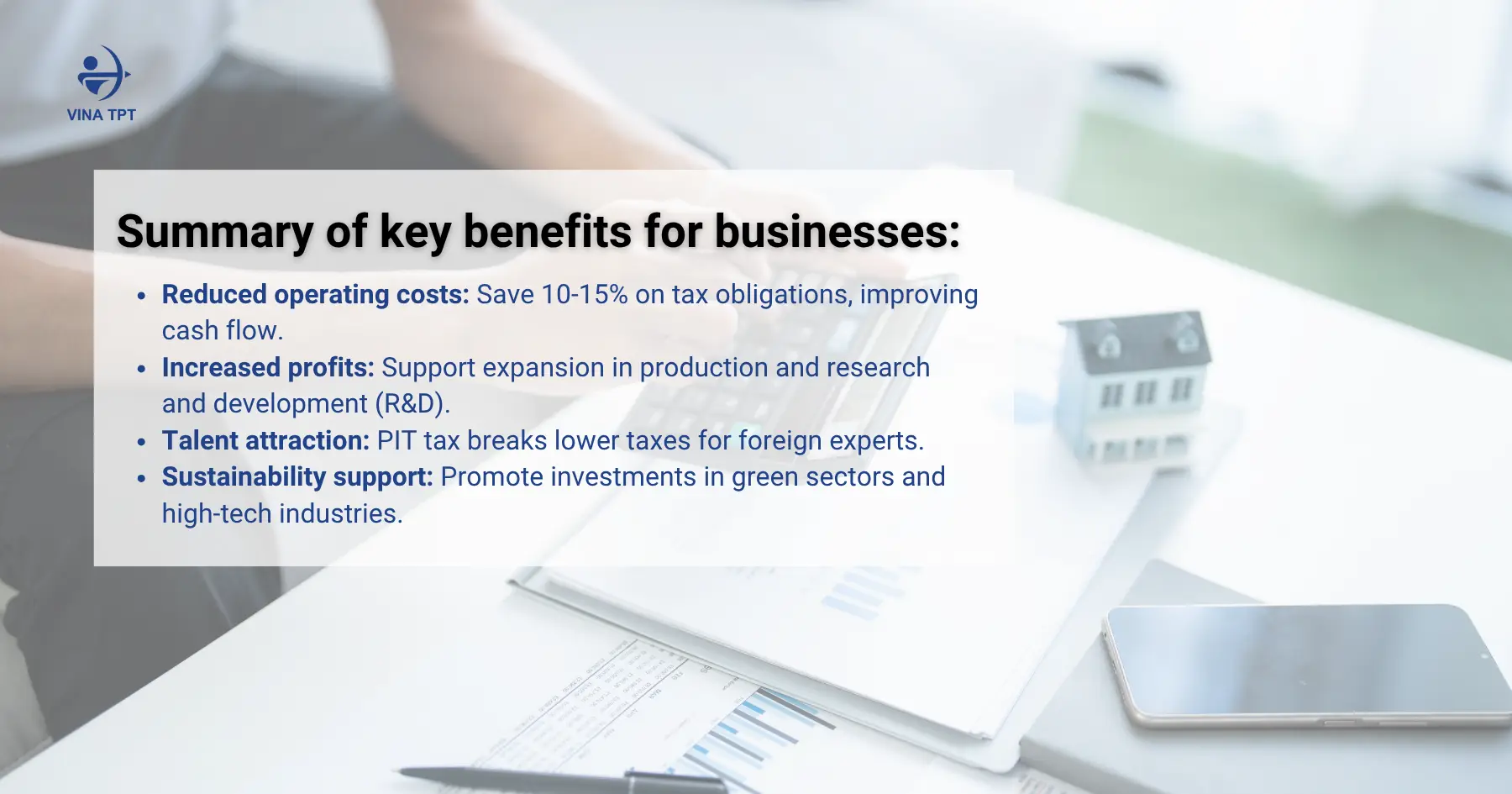
Here’s a summary of key benefits for FDI businesses: 

  • Reduced operating costs: Save 10-15% on tax obligations, improving cash flow. 
  • Increased profits: Support expansion in production and research and development (R&D). 
  • Talent attraction: PIT tax breaks lower taxes for foreign experts. 
  • Sustainability support: Promote investments in green sectors and high-tech industries. 

Explore the common tax breaks available in Vietnam to maximize benefits for your FDI enterprise. 

2/ Common Types of Tax Breaks Currently Available 

Vietnam’s government is refining tax policies to aid businesses during economic recovery, focusing on priority sectors like technology, green manufacturing, and exports. Starting in 2025, incentives apply to key taxes: Corporate Income Tax (CIT), Value-Added Tax (VAT), and Personal Income Tax (PIT). Each targets different groups and goals, helping FDI businesses cut financial loads and enhance competitiveness. Below is a comparison table: 

Tax Type  Main Incentives  Applicable Entities  Duration 
CIT  Exemption for 2-4 years, 50% reduction thereafter  FDI businesses in priority sectors  6-15 years 
VAT  Reduction from 10% to 8%  Goods and services (exclusions apply)  Until December 31, 2026 
PIT  Family deduction of VND 11 million/month (rising to VND 15.5 million/month from 2026)  Individuals and foreign experts as residents  Annual 

2.1 Corporate Income Tax (CIT) Incentives Effective from October 1, 2025 

Corporate Income Tax (CIT) directly impacts FDI business profits. From October 1, 2025, the 2025 CIT Law (No. 67/2025/QH15) expands incentives to attract high-quality investments. FDI enterprises starting new projects in high-tech fields, disadvantaged areas, or economic zones qualify for CIT exemptions for 2-4 initial years and a 50% reduction for the next 4-9 years. Preferential rates can drop to 10% for specially prioritized projects, 15% for small and medium enterprises, or 17% for investments in favored locations. 

Incentives are categorized by: 

  • Sector: High-tech, education, healthcare—exemption for 4 years, 50% reduction for 9 years. 
  • Location: Disadvantaged areas—10% rate for 15 years. 
  • Investment scale: Projects over EUR 750 million apply the 15% global minimum tax. 

Summary table: 

Incentive Type  Conditions  Duration  Reduction Level 
Exemption  High-tech projects  4 years  100% 
Rate reduction  Favored locations  15 years  10-17% 
50% reduction  New investment projects  4-9 years  50% 

Impact on FDI businesses: 

  • Cost savings up to 20-30%, boosting net profits and reinvestment. 
  • Encourages production growth and local job creation. 

Example: An FDI company investing USD 100 million in a high-tech zone could save tens of millions in taxes over the first 10 years. 

FDI enterprises should consult tax experts early to ensure proper reporting, legal workforce use, and eligibility maintenance. Compliance from the start avoids audits, penalties, and maximizes legal tax breaks. 

Maximize Your Tax Incentives Today

2.2 Value-Added Tax (VAT) Incentives Effective from July 1, 2025 

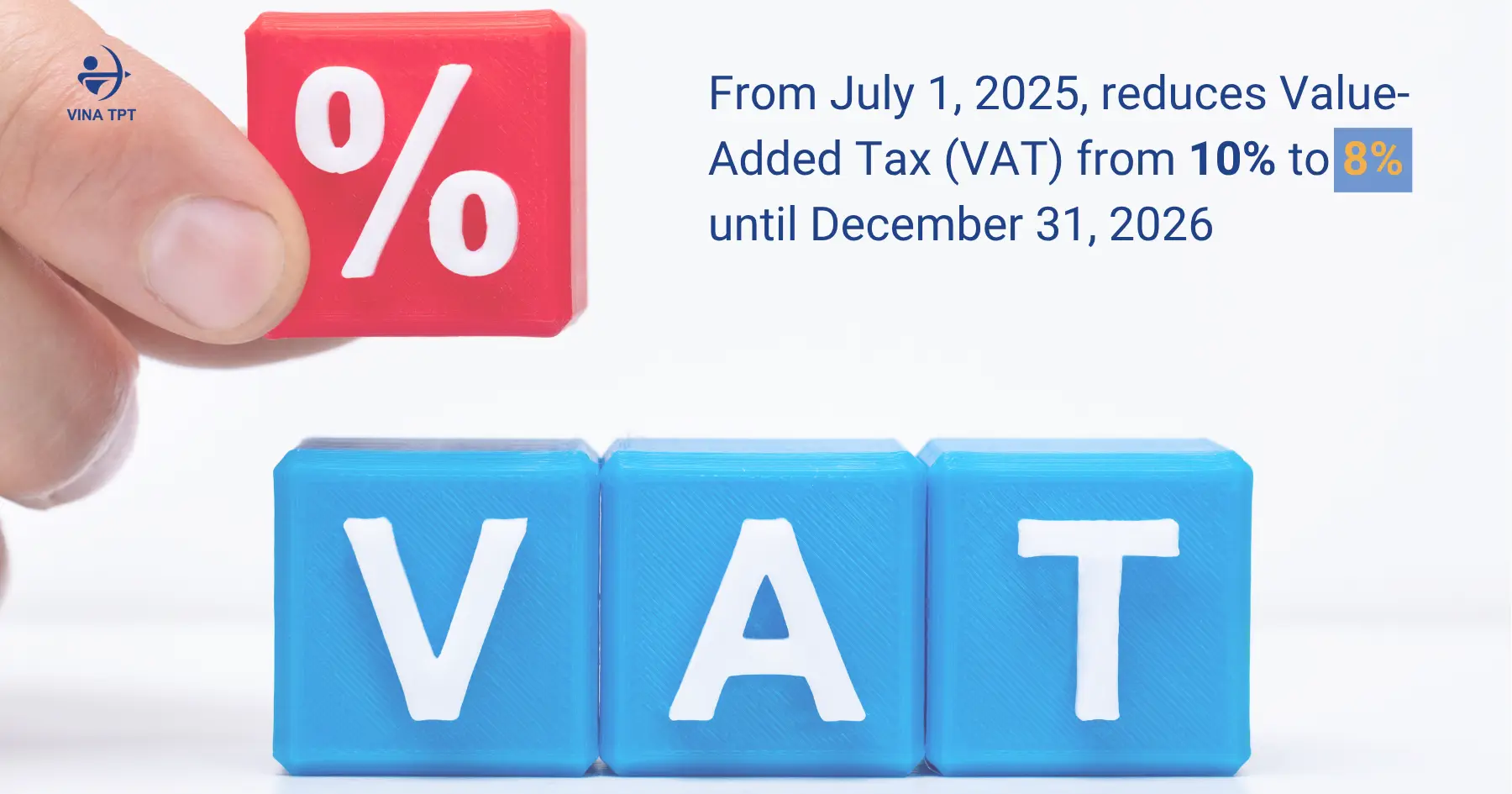
From July 1, 2025, Decree 174/2025/ND-CP reduces Value-Added Tax (VAT) from 10% to 8% until December 31, 2026, to stimulate consumption and support business recovery. This applies to most goods and services, excluding telecommunications, finance, and real estate. For FDI businesses, VAT tax breaks lower input costs, enhance cash flow, and strengthen export competitiveness. 

Specific benefits: 

  • Lower production costs: Imported materials face reduced VAT. 
  • Export support: Exported goods at 0% VAT, plus 8% reduction on related services. 

Example: An FDI firm exporting high-tech software enjoys full VAT exemption, saving 8-10% on costs. 

Key procedures: 

  • Declare VAT using new forms and electronic invoices. 
  • Collect valid documents for deductions or refunds. 
  • Note: Does not apply to specially taxed imports. 

2.3 Personal Income Tax (PIT) Incentives 

Personal Income Tax (PIT) continues to directly impact the income of workers, especially foreign experts in FDI enterprises.
From 2026, the personal allowance has been adjusted upwards to VND 15.5 million/month for the taxpayer themselves and VND 6.2 million/month for each dependent. This increase in allowances helps reduce tax obligations, improve disposable income, and enhance the attractiveness of the Vietnamese labor market.
At the same time, the PIT tax schedule has been simplified, reduced from 7 brackets to 5, with progressive tax rates.

PIT tax breaks for FDI businesses: 

  • Reduced taxes for foreign experts: Residents (present in Vietnam 183+ days/year) get deductions, cutting personnel costs. 
  • Exemptions for certain income: Stock transfers (if qualified) and foreign allowances. 

Notes: 

  • Register dependents electronically with tax authorities. 
  • Update income regularly to prevent back taxes. 

From 2026, updated policies will help FDI firms attract top global talent more easily. 

Download Vietnam Tax Handbook For Investor

3/ Key Benefits: How Tax Breaks Help Save Costs and Expand Business 

Tax breaks directly cut tax liabilities, increasing net profits and providing capital for FDI businesses to reinvest. Experts estimate savings of 10-20% on overall costs, enabling scale-up and global competition. 

Analysis from three angles: 

  • Financial: CIT and VAT reductions improve cash flow and reduce quarterly tax debts. 
  • Strategic: Encourage investments in priority areas like green technology, enhancing brand value. 
  • Human resources: PIT incentives lower salary costs, aiding recruitment of international and local experts. 

In summary, tax breaks not only save costs but also unlock business growth, allowing FDI enterprises to contribute sustainably to Vietnam’s economy. 

4/ Leveraging Tax Breaks with Vina TPT Tax Services 

To fully utilize tax breaks, FDI businesses need professional guidance from firms like Vina TPT—a Vietnam-based expert in tax and accounting. With experience supporting hundreds of FDI clients, Vina TPT identifies suitable incentives, prepares compliant files, and handles timely declarations to avoid audits. 

Standout advantages: 

  • Expertise across industries, from manufacturing to technology. 
  • Team knowledgeable in Vietnamese and international tax laws, with multilingual support. 
  • Transparent reporting and competitive fees for cost optimization. 

Support process: 

  • Assess your business and identify applicable incentives. 
  • Recommend tax plans and prepare registration documents. 
  • Implement declarations and monitor policy updates. 
  • Conduct regular reviews for ongoing compliance. 

Tax breaks are essential for FDI businesses in Vietnam to optimize costs, boost profits, and expand investments—especially with 2025 updates like the 8% VAT reduction and CIT incentives for priority sectors. These changes support economic recovery and position Vietnam as an attractive destination for foreign investment. 

Has your business maximized current tax incentives? Contact Vina TPT Tax Services today for a detailed analysis and tailored tax solutions—ensuring compliance and maximum savings! 

Talk to a Tax Specialist

Vina TPT Accounting services


Cost Comparison: In-House HR vs Outsourced Payroll for FDI in Vietnam

Vina TPT HR outsourcing Vietnam solution for foreign businesses

hr-outsourcing-vietnam-consultant-service

1. HR Management Challenges for FDI Companies in Vietnam

As FDI companies expand their operations and investments in Vietnam, HR Outsourcing Vietnam becomes an increasingly relevant solution as one of the biggest challenges is hiring employees and building an internal HR department. The labor system in Vietnam has many specific regulations such as social insurance, health insurance, personal income tax law and regulations on labor contracts. For newly established businesses in Vietnam, understanding this entire legal framework often takes a lot of time, resources and is prone to errors. 

In addition, cultural differences and language barriers also create additional pressure when businesses want to recruit the right people, manage benefits and set up Human Resources Management Challenges for FDI Companies in Vietnam

As FDI companies expand their operations and investments in Vietnam, HR Outsourcing Vietnam becomes an increasingly relevant solution as one of the biggest challenges is hiring employees and building an internal Human Resources department. The labor system in Vietnam has many specific regulations such as social insurance, health insurance, personal income tax law and regulations on labor contracts. For newly established businesses in Vietnam, understanding this entire legal framework often takes a lot of time, resources and is prone to errors. 


In addition, cultural differences and language barriers also create additional pressure when businesses want to recruit the right people, manage benefits and set up Hiring Relation systems. This is the reason why more and more FDI companies choose HR & payroll service as a safer, more economical and effective solution than building an in-house HR team from the beginning.

2. Understanding In-House HR Costs

When maintaining an in-house HR department, FDI enterprises must consider many hidden and fixed costs. First is the recruitment cost, including advertising, headhunter fees, interviews, and training. Next is the salary and benefits for the Human Resources team, which are often higher due to the demand for personnel with legal knowledge and bilingual skills. Moreover, for every in-house employee, enterprises must also pay compulsory social insurance, health insurance, and unemployment insurance, which together amount to approximately 20.5% of the employee’s monthly salary.

In addition, enterprises need to invest in HR & payroll software systems, employee records management, timekeeping, and payroll calculation. Operating costs such as office space, equipment, and the management time required from the board of directors also cannot be overlooked. Particularly for businesses in Vietnam during the early stages, this total cost structure can easily exceed the planned budget, creating financial pressure and reducing operational flexibility. 

Therefore, outsourcing or applying HR & payroll service is becoming a more effective alternative, helping FDI enterprises balance finances and focus on business development.

DISCOVER HR OUTSOURCING VIETNAM BENEFITS

3. Breakdown of Outsourced HR & Payroll Service Expenses

When choosing HR & payroll service, businesses only need to pay service fee based on the number of employees, instead of bearing the entire fixed cost of in-house HR. HR outsourcing service usually includes many items: drafting labor contracts, registering for social insurance, managing employee records, processing monthly payroll, declaring and paying personal income tax. Some advanced packages also support legal advice, updating changes in labor laws, and providing periodic human resources reports. Compared to maintaining an entire HR department, outsourcing allows businesses to predict and control costs more clearly. Especially for companies that have just opened a business in Vietnam, Vina TPT Hiring Employees Service brings advantages thanks to its flexible model, all-inclusive services, and transparent costs, ensuring that businesses only pay for what is necessary without incurring unexpected fees.

4. Key Factors Beyond Cost

Although cost is an important factor, when comparing in-house HR and outsourced service, FDI enterprises need to consider more long-term values. One of them is compliance with Vietnamese labor laws, a factor that helps avoid legal risks and protect brand reputation. Next is flexibility, allowing enterprises to easily expand or reduce the size of their staff without having to recruit or fire them complicatedly. In addition, outsourcing also brings operational efficiency, helping the management focus resources on business development strategies in Vietnam instead of handling administrative procedures. 

With HR & payroll service, enterprises have access to experts who understand the market, laws and local HR processes. This is a factor that Vina TPT Hiring Employees Service is providing outstandingly, bringing peace of mind to FDI when managing human resources in Vietnam.

5. Cost-Benefit Analysis: In-House vs Outsourcing

If analyzed as a whole, we can see a clear difference between maintaining an in-house HR department and using HR outsourcing combined with HR & payroll service:

HR in-house:

  • Enterprises have the ability to directly control their human resources and internal processes.
  • However, the costs of recruitment, training, salaries, benefits and maintaining the management system are very high.
  • The risk of errors in compliance with labor laws and tax regulations often occurs, especially for FDI enterprises that have just started doing business in Vietnam.

Outsourced HR & payroll service:

  • Provides a cost-saving solution, easily scalable according to the size of the workforce.
  • Reduces costs by 30–50% compared to maintaining in-house HR while still ensuring transparency and effective management.
  • Minimizes legal and administrative risks, while ensuring compliance with labor and tax regulations in Vietnam.
  • Creating transparent human resource data, supporting businesses in long-term development planning.

Looking at both costs and benefits, outsourcing HR is not only a short-term option but also an optimal strategy for FDI companies that want to develop sustainably in Vietnam.

6. Vina TPT Hiring Employees Service Advantage

Vina TPT Hiring Employees Service is specially designed for FDI enterprises that want to build and operate their business in Vietnam effectively. With a team of experts knowledgeable in labor, insurance and tax laws, Vina TPT provides a complete HR & payroll service solution including: recruitment, contract drafting, salary and bonus management, social insurance, and personal income tax declaration. The big difference of Vina TPT is the ability to advise on human resource strategies in parallel with legal compliance, ensuring that businesses both save costs and operate transparently. Instead of spending months building in-house HR, businesses can quickly deploy an optimal HR system in just a few days. This is the advantage that helps FDI companies confidently expand their scale, flexibly manage human resources and develop sustainably in the Vietnamese market.

Vina TPT’s HR & payroll service helps businesses save costs, reduce risks and focus on business development in Vietnam. Contact now!

BOOK A FREE CONSULTATION

Payroll-HR-Manager-Vietnam-VinaTPT

Vietnam Accounting & Tax Services for Japanese Investors

vtpt hire accounting service

vtpt hire accounting service

1. The Need to Hire Accounting Service for Japanese Investors in Vietnam

Vietnam is emerging as one of the top investment destinations in Asia, attracting more and more Japanese businesses looking for new growth opportunities. However, differences in laws, accounting standards and business environments make hiring accounting services a strategic factor to ensure success right from the start.

For Japanese companies, cooperating with a reputable Vietnamese accounting service unit not only helps with daily financial management but also ensures Vietnam accounting compliance for Japanese business, meets the reporting requirements of the parent company and complies with strict regulations in Vietnam. Hiring Vina TPT accounting service helps investors reduce administrative burden, limit errors in tax declarations, and build a transparent accounting system, supporting the long-term business expansion process.

2. Common Financial Challenges for Japanese Businesses

When operating in Vietnam, Japanese businesses often encounter some unique difficulties related to Vietnam accounting compliance for Japanese businesses, including:

  • Different accounting standards: Vietnamese Accounting Standards (VAS) differ significantly from Japanese GAAP and IFRS, requiring accurate and continuous conversion of financial statements.
  • Cash flow and foreign currency management: Exchange rate fluctuations and foreign exchange regulations can affect cash flow, especially for companies that import or transact internationally.
  • Diverse tax requirements: Businesses need to comply with many types of taxes such as Corporate Income Tax (CIT), Value Added Tax (VAT), Foreign Contractor Tax, Personal Income Tax (PIT), as well as social and health insurance.
  • Parallel reporting system: Many companies must simultaneously meet reporting requirements of Vietnam and Japan, resulting in a large amount of accounting and auditing work.

These challenges not only increase the internal workload but also require the support of a highly qualified Vina TPT accounting service partner to help businesses operate financially stably and legally.


BRIDGE JAPAN-VIETNAM ACCOUNTING STANDARDS

3. Essential Services to Hire for Smooth Operations

To overcome barriers and ensure compliance, Japanese investors should hire an accounting service that provides a comprehensive and in-depth service package. Some important services include:

  • Bookkeeping & General Accounting: Standard accounting bookkeeping, invoice management, processing daily transaction documents to ensure accuracy and transparency.
  • Financial Reporting & Conversion: Prepare financial statements according to VAS standards and convert to Japanese GAAP or IFRS for auditing, consolidate reports for parent companies in Japan.
  • Tax Filing & Compliance Service: Support periodic tax declaration, submit CIT, VAT, PIT, social insurance and other tax obligations on time, helping to avoid late payment penalties.
  • Payroll & HR Accounting: Manage payroll, personal income tax and insurance for employees, ensuring compliance with Vietnamese labor laws.
  • Audit Preparation & Internal Control: Establishing an internal control system and preparing documents for independent audits, helping businesses prepare for any financial audit or assessment.

With the above services, Vina TPT accounting service helps Japanese businesses not only comply with Vietnam accounting compliance for Japanese business, but also optimize costs and improve long-term financial management efficiency.

vtpt hire accounting service

4. Ensuring Compliance with Vietnamese Standards and Japanese Reporting Requirements

For Japanese companies operating in Vietnam, dual compliance is not only a legal requirement but also a key factor in maintaining the trust of shareholders and parent companies. Enterprises need to ensure Vietnam accounting compliance for Japanese business, while also meeting international reporting standards such as Japanese GAAP, IFRS or the group’s consolidated standards. This process includes preparing consolidated financial statements, converting reports from VAS (Vietnamese Accounting Standards) to international standards, reconciling internal data, and closely managing multidimensional financial indicators.

Performing these dual requirements yourself requires in-depth knowledge, time and experienced personnel, so hiring a professional accounting service is the optimal solution. A reputable unit like Vina TPT accounting service will provide a complete accounting service Vietnam, support the preparation of bilingual financial reports (Vietnamese – Japanese/English), control input data, and standardize the accounting system to easily serve both the Vietnamese tax authorities and the parent company in Japan.

By combining tax compliance, financial reporting, and business accounting Vietnam in one comprehensive service, Vina TPT helps businesses minimize the risk of errors, optimize the inspection process, and ensure all reports are transparent, accurate, and timely. This is the strategic solution for Japanese businesses in Vietnam to maintain sustainable growth, strengthen their reputation in both markets, and enhance their ability to expand in the future.

5. Vina TPT’s Advantage for Japanese Investors

Vina TPT stands out in the Vietnamese accounting service market thanks to its team of Japanese-Vietnamese bilingual experts and in-depth knowledge of Vietnam accounting compliance for Japanese business. The accompaniment of Lawyer Le Quoc Duy, a legal expert who can communicate directly in Japanese, helps all legal and financial procedures to be implemented quickly, accurately and in accordance with Japanese corporate culture.

Outstanding strengths of Vina TPT accounting service:

  • Bilingual Expertise: Support communication, reporting and financial analysis in both Japanese and Vietnamese.
  • Tailored Accounting Solutions: Provide flexible services from bookkeeping, tax filing to financial advisory, suitable for the needs of each type of investment.
  • Regulatory Insights: Always update Vietnamese tax regulations and accounting standards, helping Japanese enterprises maintain Vietnam accounting compliance for Japanese business in a sustainable way.
  • Strategic Financial Planning: Support financial planning, optimize capital structure and prepare for international audits.

Download Vietnam Tax Handbook - Japanese Edition

6. Steps to Engage the Right Accounting Service in Vietnam

To choose the most suitable and effective hire accounting service, Japanese investors can follow these steps:

  • Determine specific needs: Evaluate business scale, reporting requirements, accounting standard conversion needs and level of support from partners.
  • Evaluate experience and expertise: Choose a partner with professional certification and experience providing accounting services in Vietnam for Japanese businesses.
  • Compare costs and scope of services: Ensure transparent fees, suitable for budget, and include important services such as bookkeeping, tax filing and compliance.
  • Sign the contract and implement the service: Clearly define responsibilities, reporting deadlines and information exchange methods to optimize cooperation efficiency.

With extensive experience and comprehensive services, Vina TPT accounting service is the ideal choice to ensure Vietnam accounting compliance for Japanese business, helping Japanese businesses develop sustainably in Vietnam.

Hire Vina TPT accounting service today to ensure Vietnam accounting compliance for Japanese business and fully meet Japanese reporting requirements.

BOOK A FREE CONSULTATION

Vina TPT Accounting services

How Outsourced Full-Service Accounting Empowers FDI Companies in Vietnam

Full-service accounting solutions for FDI companies in Vietnam

Full-service accounting solutions for FDI companies in Vietnam

1. How Full-Service Accounting Supports FDI Companies in Vietnam

With the growth rate of Foreign-capital enterprises in Vietnam (more than 36 billion USD of registered capital in 2024 according to the Ministry of Planning and Investment), more and more multinational enterprises are facing accounting and tax complexities. A Japanese company operating in Vietnam must both prepare reports according to Vietnamese Accounting Standards (VAS) for domestic management agencies and ensure IFRS standards to send to the parent company. Without a professional full-service accounting system, the risk of data errors, late submission of reports or administrative fines is very high.

At the strategic level, full-service accounting is not only an accounting support service, but also acts as a “financial arm” to help Foreign-capital companies optimize capital management, improve internal control processes and minimize legal risks. A typical case is Samsung in Vietnam: huge transaction volume, many supply chains and factories force them to standardize reports on digital platforms. This is an example showing that outsourced accounting can bring long-term sustainability to the operations of Overseas-invested companies

2. Key Advantages of Outsourced Accounting

When choosing outsourced full-service accounting, companies can receive the following practical values:

  • Saving costs & resources: Instead of maintaining a cumbersome internal accounting department, enterprises only need to pay service fees according to demand, avoiding the burden of fixed costs.
  • Ensuring legal compliance: Professional service providers always update the latest regulations on tax and accounting, helping enterprises avoid the risk of administrative fines.
  • Transparency & international standards: Financial reports are standardized according to both Vietnamese law and IFRS, supporting reconciliation and transparency when sent to the parent corporation.
  • Optimizing financial management: Not only stopping at accounting, this service also provides in-depth financial analysis, helping the leadership have a comprehensive view to make strategic decisions.


START YOUR OUTSOURCED ACCOUNTING TODAY

3. Streamlining Financial Operations Through Full-Service Accounting

To maximize the benefits of outsourced full-service accounting, FDI enterprises need to pay attention to some important points:

  • Choose a reputable partner: Priority should be given to companies with experience working with FDI, understanding Vietnamese law and familiar with international standards.
  • Ensure data security: Accounting is directly related to sensitive financial data, so it is necessary to choose a supplier with a standard security system.
  • Define a clear scope of services: Depending on the scale, enterprises can choose a service package including payroll, tax reporting, financial statements or a full-package.
  • Periodic monitoring and evaluation: Enterprises should establish a mechanism to control and evaluate service quality to ensure long-term accuracy and suitability.

4. Enhancing Compliance and Accuracy with Professional Accounting Solutions

In Vietnam, Vina TPT has been a reliable choice for many Foreign Direct Investment companies. With a team of experts who have a deep understanding of Vietnamese accounting laws and rich experience in implementing financial reports according to international standards, Vina TPT full-service accounting solutions not only brings peace of mind in terms of compliance, but also acts as a strategic advisor.

To give Foreign Direct Investment companies a clearer view of how these solutions work in practice, here’s what Vina TPT’s full-service accounting actually delivers in each key stage of financial management.

Vina TPT’s full-service accounting service does not stop at bookkeeping or basic reporting, but covers the entire financial management process of Cross-border investment companies. First, Vina TPT collects and standardizes accounting data, compares data from many sources and ensures compliance with Vietnamese accounting and tax standards, and prepares reconciliation reports according to IFRS or US GAAP when requested by the parent company. Next, Vina TPT’s team of experts will prepare bilingual financial reports (Vietnamese – English or Japanese), including balance sheets, business performance reports, cash flow statements and report notes, satisfying both domestic management agencies and the parent group.

In addition, Vina TPT also conducts compliance reviews and adjustments before the settlement period, checks tax obligations according to investment certificates, mandatory audit requirements and related legal regulations to promptly detect and handle errors. For multinational corporations, Vina TPT supports the preparation of financial consolidation packages, synthesizing data from many subsidiaries or branches in Vietnam to send to the head office in accordance with standards and on time.

Thanks to Vina TPT’s full-service accounting service, Cross-border investment companies can completely focus on core business activities, while all financial and accounting issues are handled professionally, transparently and always in accordance with international standards.

With the support of reputable partners like Vina TPT, Foreign-capital enterprises can completely rest assured to expand their operations, seize opportunities and affirm their position in the Vietnamese market.

From compliance to growth – let Vina TPT full-service accounting solutions guide your FDI success.

BOOK A FREE CONSULTATION

Vina TPT Accounting services