FDI Company Setup in Vietnam: Business License & Complete 2026 Guide

setting up company in Vietnam

setting up company in Vietnam

Why Setting up Company in Vietnam is the Strategic Choice for 2026?

The year 2026 marks a pivotal turning point for foreign investors in Vietnam. With significant reforms in the Law on Investment and a roadmap to reduce conditional business lines, the process for setting up a company in Vietnam is becoming more transparent and streamlined than ever.

However, to operate legally in specialized sectors such as retail, distribution, or logistics, investors must follow a structured path from obtaining an IRC and ERC to securing a specific business license.

1. Why Foreign Investors Need a Clear Roadmap in 2026

Starting a business in Vietnam as a foreigner offers immense potential, but understanding the 2026 regulatory landscape is crucial to avoiding delays or rejected applications.

a. FDI Opportunities in 2026

Vietnam maintains its position as Southeast Asia’s “global factory” based on four key pillars:

  • Extensive FTA Network: Leverage tariff incentives from the CPTPP, EVFTA, and RCEP.
  • New Incentive Policies: Strong focus on high-tech projects, circular economy, and renewable energy.
  • Flexible Ownership Structures: 100% foreign ownership is permitted in most sectors, including manufacturing, IT, consulting, and trading.
  • Digitalized Procedures: Significant reduction in waiting times through the National Business Registration Portal.

b. When is a Business License (Trading License) Mandatory?

While many sectors are open, a Business License (Trading License or Retail Distribution License) is still mandatory for foreign investors in “conditional” sectors under WTO commitments and Vietnamese Law.

Even with eased regulations, a separate Business License is required after company formation for:

  • Retail Sales: Directly providing goods to end consumers.
  • Distribution & Import: Applied to restricted or specialized commodity groups.
  • Specialized Services: Logistics, education, healthcare, and F&B.
  • Important Note: By July 1, 2026, sectors like accounting and insurance brokerage will see further liberalization. However, for Retail & Distribution, investors must still seek approval from the Ministry/Department of Industry and Trade.

c. Distinguishing IRC vs. ERC vs. Business License

Understanding these three acronyms is vital for any foreigner setting up a company in Vietnam:

Permit Type Issuing Authority Primary Role
IRC (Investment Registration Certificate) Department of Planning and Investment (DPI) Approves the investment project (capital, objectives, location).
ERC (Enterprise Registration Certificate) Business Registration Office Creates the legal entity and issues the Tax ID.
Business License Relevant Ministry or Department Grants permission to operate in conditional sectors (Retail, etc.).

The Standard Sequence: IRC (Project Approval) → ERC (Company Formation) → Business License (For specific sectors).

2. 5-Step Process for Setting Up Company in Vietnam in 2026

The average timeline for completion ranges from 1 to 2 months, depending on the complexity of your business lines.

Step 1: Choose a Legal Structure & Check Ownership Limits

The most common choice is a Limited Liability Company (LLC) due to its flexibility and limited liability protection. Foreigners must verify if their specific sector requires a Joint Venture (JV) with a Vietnamese partner.

Step 2: Obtain the Investment Registration Certificate (IRC)

Investors submit the application to the DPI. Key documents include:

  • Detailed Investment Project Proposal.
  • Proof of Financial Capacity (Bank statements or audited reports).
  • Office Lease Agreement or Memorandum of Understanding (MOU).
  • Timeline: 15 – 35 working days.

Step 3: Obtain the Enterprise Registration Certificate (ERC)

Once the IRC is issued, the ERC application is typically processed within 3 – 7 working days. This step officially grants your business its legal status.

Step 4: Post-Registration Procedures (Operational Compliance)

Obtaining the ERC is only the beginning. Within 90 days, investors must fulfill these mandatory obligations:

  • Open a Direct Investment Capital Account (DICA): This is the most critical step. All capital contributions, profit repatriations, and share transfers must flow through this account.
  • Capital Contribution: Ensure the total committed capital is transferred into the DICA within 90 days of ERC issuance.
  • Online Investment Reporting: Businesses must report project progress quarterly and annually on the National Investment Information System. Missing these deadlines can lead to heavy administrative fines.
  • Initial Tax & Accounting Setup: Register digital signatures, set up e-invoice templates, and pay Business License Tax (License Fees). Appointing a Chief Accountant or an outsourced accounting representative is a legal requirement for signing financial statements.

Step 5: Specialized Business License (If applicable)

For retail and distribution entities, authorities will assess the application based on local planning and socio-economic impact. Note the Economic Needs Test (ENT) requirement if you plan to open a second retail outlet or more.

setting up company in Vietnam

Get a free 30-minutes consultation

3. Required Documents & Checklist

All foreign documents must be Consularly Legalized, translated into Vietnamese, and notarized.

  • Individual Investors: Notarized passport + Bank balance confirmation.
  • Corporate Investors: Parent company’s Certificate of Incorporation + Audited financial statements (last 2 years) + Resolution appointing the authorized representative.
  • Project Documents: Detailed Business Plan and proof of right to use the business location.

4. Vina TPT: Your Trusted Partner for FDI Success in Vietnam

Establishing a legal entity is just the start. To thrive in the Vietnamese market, businesses need a solid foundation in Accounting, Tax, and HR from day one.

Vina TPT is proud to be a strategic partner, helping foreign investors remove language barriers and navigate local legal complexities:

  • Expert Consulting: From initial setup to tax structure optimization. We keep you updated on the latest regulations, including Global Minimum Tax and 2026 tax incentives.
  • Payroll & HR Management: We handle labor contracts, Social Health & Unemployment Insurance (SHUI), and Personal Income Tax (PIT) finalization for both expats and locals, ensuring absolute confidentiality.
  • Lifecycle Partnership: With over 20 years of experience, Vina TPT provides an “All-in-one” ecosystem. You focus on growth; we handle the administration.
  • No Language Barrier: Our trilingual team (English – Japanese – Vietnamese) ensures transparent communication and seamless management reporting.

Optimize your resources and minimize legal risks with Vina TPT. Contact us today for a 1-on-1 specialized consultation for your 2026 project.

Start your journey in vietnam

setting up company in Vietnam

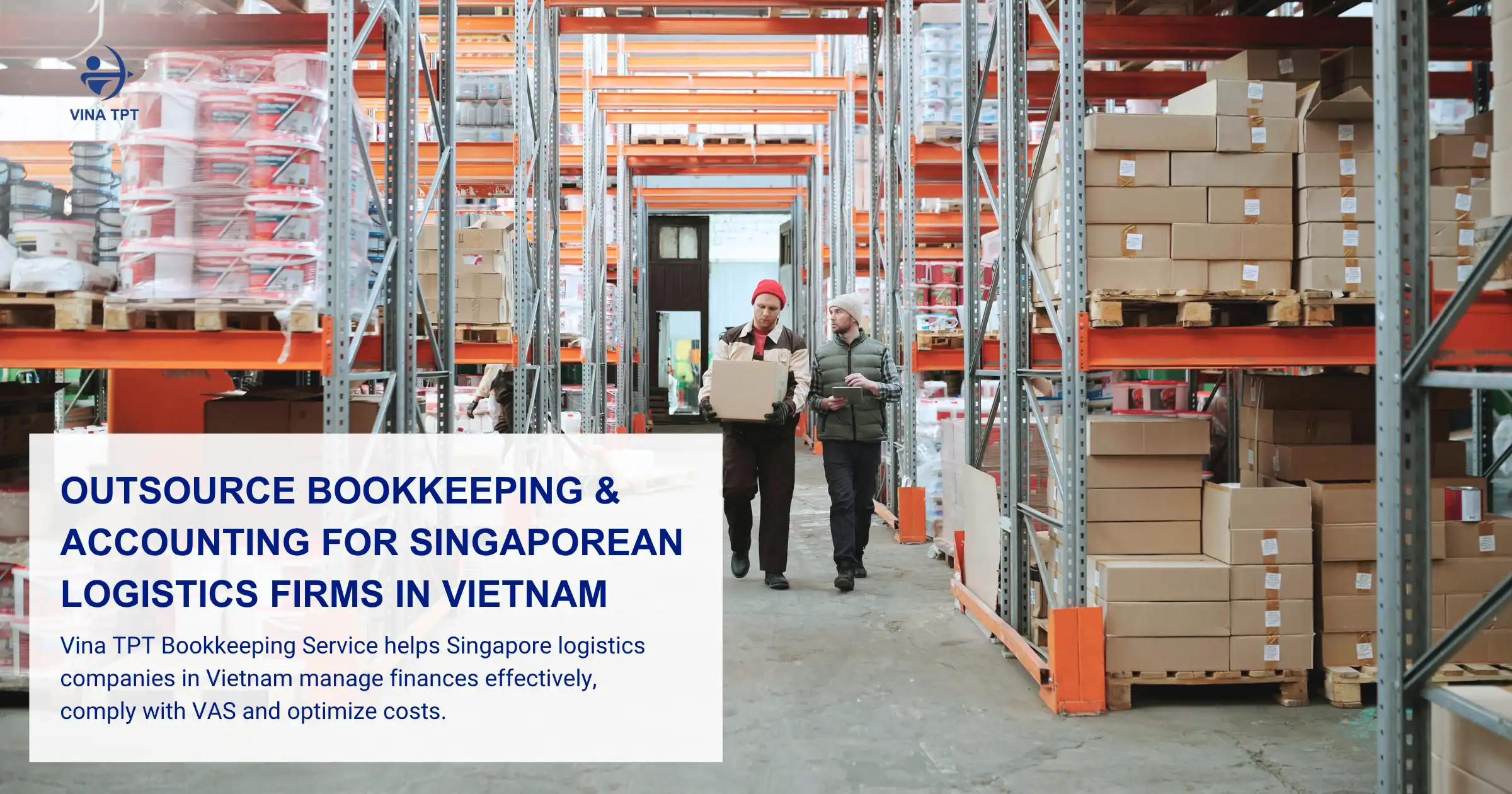
Outsource Bookkeeping & Accounting for Singaporean Logistics Firms in Vietnam

Outsource Bookkeeping & Accounting for Singaporean Logistics Firms in Vietnam-VTPT

Outsource Bookkeeping & Accounting for Singaporean Logistics Firms in Vietnam-VTPT

1. The Financial Pulse of Every Logistics Company

In the world of logistics, everything revolves around numbers – from shipping costs, fuel costs to payments to suppliers. For Singaporean companies expanding operations in Vietnam, each month is a separate “financial cycle”. If a business is like a living body, monthly accounting is the “heartbeat” that keeps the system running smoothly. 

Recording, summarizing and reporting monthly financial information helps management understand the spending, revenue, and profit situation of each transportation route or each warehouse. Thanks to this data, businesses can quickly detect problems, for example, a certain route has an unusual increase in fuel costs, or a partner is late in paying and make adjustments within the month instead of waiting until the end of the fiscal year.

2. Inside a Typical Monthly Accounting Cycle

To put this into perspective, imagine a monthly accounting cycle in the logistics industry that starts with recording each bill of lading each shipment, each delivery becomes a financial data stream. The accounting department then reconciles it with the invoice from the transport provider, fuel payments, tolls, or warehousing costs.

In addition, the business must also take inventory of the inventory in the transit warehouse, calculate the loss and depreciation of the transport vehicles. Once all the data has been updated, the final step is to compile the monthly financial report including revenue, expenses, and profits.

A professional accounting bookkeeping service will take care of this entire process, ensuring that all the numbers are accurate, transparent, and updated promptly. This is especially important for companies with operations spread between Singapore and Vietnam, where small discrepancies in data can affect the entire reporting system.

GET A CUSTOMIZED ACCOUNTING SOLUTION

3. Why Outsource Bookkeeping Is Becoming a Strategic Move

In recent years, more and more Singapore logistics businesses have chosen to outsource bookkeeping instead of maintaining an in-house accounting team. The reason lies not only in saving on personnel costs, but also in accuracy and speed.

When outsourcing accounting services, businesses are supported by experienced specialists and modern software systems, allowing access to real-time data (real-time reporting). Managers in Singapore can immediately view the financial reports of the Vietnam branch at any time, without having to wait for manual file submission.

In addition, outsourced accounting services help increase cross-border transparency. All data is managed according to the same standards, avoiding discrepancies between countries. This not only helps the board of directors make decisions faster, but also minimizes risks in auditing and tax reporting.

4. Key Data Reports That Drive Logistics Decisions

In the logistics industry, financial data is not just a record but also a “compass” for all operational decisions. When properly compiled, monthly accounting reports become an “insight hub” that helps management see the big picture.

For example, an operating cost report might show that a shipping route from Ho Chi Minh City to Singapore is consuming more fuel than usual. A revenue report by route might show that domestic shipping is generating higher profit margins than international shipping. Or a profit report by partner helps managers see which partners are contributing the most to overall revenue.

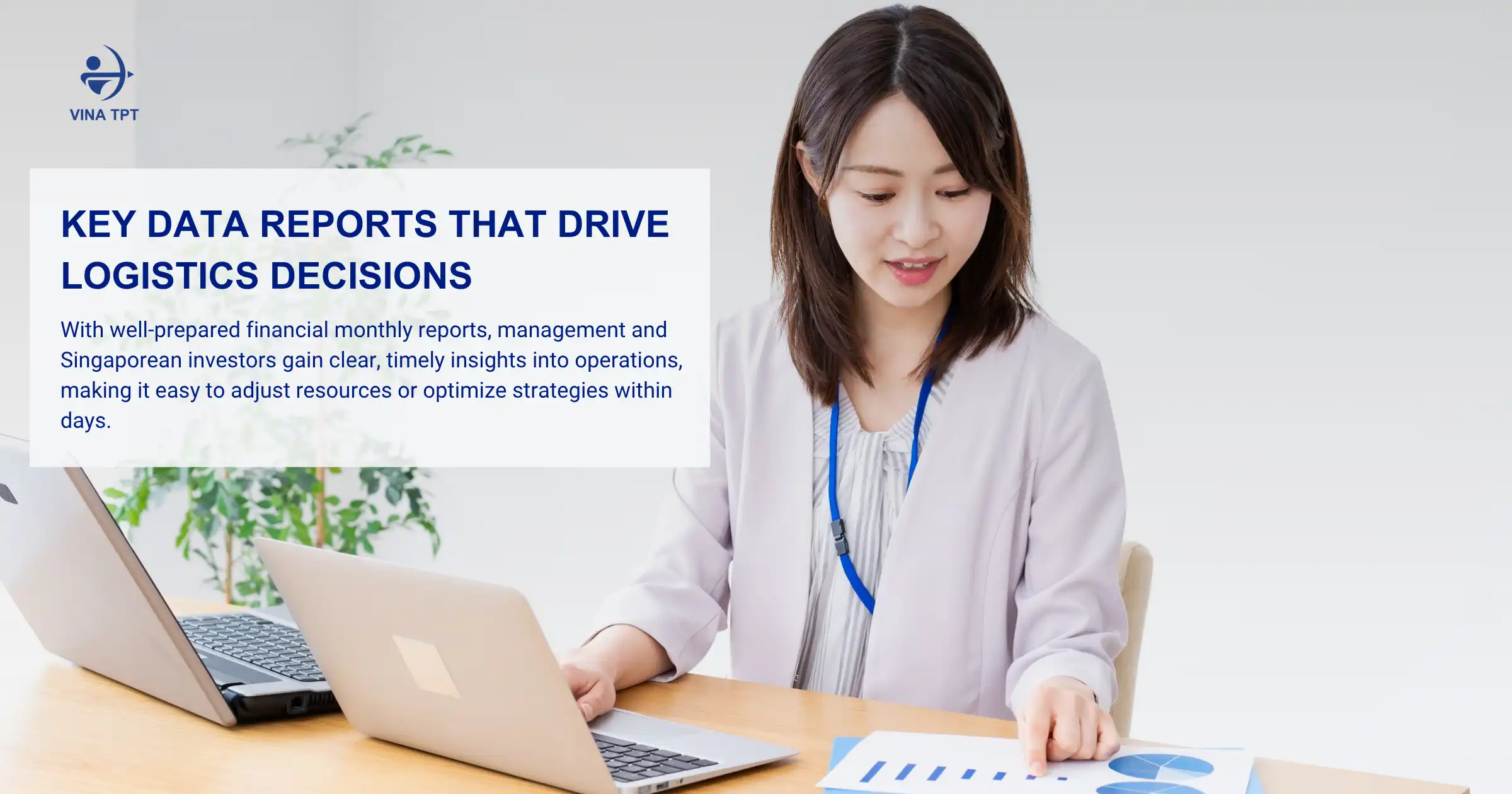
Thanks to periodic reports, Singaporean investors no longer have to wait for annual audits to know the business situation. They can make quick decisions, reallocate resources, or adjust transportation strategies in just a few days, something that used to take months.

Download Vietnam Tax Handbook For Investor

Outsource Bookkeeping & Accounting for Singaporean Logistics Firms in Vietnam-VTPT

5. Compliance with Vietnamese Accounting Standards (VAS)

For foreign-invested logistics companies, especially those from Singapore, compliance with Vietnamese Accounting Standards (VAS) is mandatory. All financial statements, value-added tax (VAT) and corporate income tax (CIT) declarations must be prepared and submitted on time.

However, this is not easy, as the Vietnamese accounting system has many detailed regulations and is regularly updated. This is where a professional accounting bookkeeping service plays an important role: they help businesses ensure legal compliance, reconcile correct data, and maintain transparency in all financial data.

As a result, businesses avoid audit and tax risks, and can focus all their efforts on core activities like operating and expanding the logistics network.

6. Vina TPT Bookkeeping Service: Turning Numbers into Insights

When it comes to reliable outsourced accounting services in Vietnam, Vina TPT Bookkeeping Service is a prominent name. Vina TPT’s difference lies not only in accurate bookkeeping, but also in the ability to turn numbers into practical business strategies.

Vina TPT understands that each logistics enterprise has its own characteristics – from fleet size, warehouse model to transportation fee calculation. Therefore, they not only prepare financial reports according to VAS but also analyze monthly data, helping enterprises understand cost trends, route profits and the efficiency of each operation.

Through regular consulting sessions, the Vina TPT Bookkeeping Service team supports Singaporean enterprises to make more accurate investment decisions, manage cash flow more effectively, and gradually build a sustainable financial system in Vietnam.

Contact Vina TPT today for a free consultation and tailored solutions for your logistics business.

BOOK A FREE CONSULTATION

Vina TPT Accounting services

Financial Statement Preparation in Vietnam for FDI: Key Differences Between Chinese and Vietnamese Accounting Standards

accounting service Vietnam for Chinese company vtpt

financial-statement-preparation-Vietnam

In recent years, Vietnam has emerged as a strategic destination for Chinese enterprises to invest in FDI, thanks to its advantages in labor costs, geographical proximity and open-door policies to attract foreign capital. However, besides the opportunities, Chinese companies face great challenges in familiarizing themselves with and complying with Vietnamese accounting standards (VAS), which are significantly different from PRC GAAP. This difference directly affects the process of financial statement preparation Vietnam, consolidated reports and tax obligations. To manage effectively and minimize risks, many enterprises choose the Vina TPT accounting system setup solution, which helps build a bilingual accounting system, ensuring transparency and compliance with both Vietnamese regulations and requirements from the parent company in China.

1. Why Chinese Investors Need to Understand Vietnamese Accounting Standards

When investing FDI in Vietnam, Chinese enterprises not only have to comply with the laws on investment and business, but also need to understand Vietnamese accounting standards (VAS). This is the basis for financial statement preparation Vietnam, declaring taxes, and demonstrating transparency to management agencies. Only applying PRC GAAP and ignoring financial statement preparation in Vietnam according to VAS can lead to audit risks, being subject to arrears or difficulties in distributing profits to the parent company. Therefore, understanding and correctly applying Vietnamese accounting standards is not only a matter of compliance, but also a foundation for enterprises to build trust with shareholders, partners and state agencies.

2. Overview of Chinese vs. Vietnamese Accounting Systems

PRC GAAP (Chinese Accounting Standards) and VAS (Vietnamese Accounting Standards) have the same goal of faithfully reflecting the financial situation, but their approaches are different:

  • PRC GAAP: Designed to serve internal management, strict supervision of the Chinese government, emphasizing capital control and compliance with domestic economic policies.
  • VAS: Built to suit the legal and tax environment of Vietnam, closely linked to tax declaration and reporting requirements to management agencies. However, VAS is in the process of integrating with IFRS to approach international standards.

For Chinese companies in Vietnam, this difference creates a gap that needs to be filled, especially when having to prepare reports for management agencies in Vietnam and meet the consolidated reporting requirements of the parent company in China.


TALK TO OUR CHINA–VIETNAM ADVISORS

3. Key Differences in Financial Statement Preparation Vietnam

When preparing financial statements in Vietnam, Chinese enterprises will encounter some major differences between PRC GAAP and VAS, specifically:

  • Revenue: Different ways of recording revenue, especially for long-term transactions or prepaid revenue.
  • Fixed assets: Different methods of asset valuation and depreciation, directly affecting profits and expenses.
  • Provisions and liabilities: VAS has its own provisions on provisioning, while PRC GAAP has a broader scope on estimating liabilities.
  • Presentation: VAS emphasizes compliance with the reporting format issued by the Ministry of Finance, while PRC GAAP is more flexible for enterprises in presentation.
  • International standards: FDI enterprises sometimes have to perform an additional step of converting from VAS to IFRS to serve global reporting.

Understanding these differences helps businesses limit errors and standardize financial data from the start.

4. Compliance Challenges for Chinese FDI Companies

In reality, many Chinese enterprises face difficulties in preparing financial statements in Vietnam. Standardizing bilingual financial statements, handling exchange rate differences, and converting from PRC GAAP to VAS or IFRS can create great pressure on the accounting department. Many enterprises face a lack of personnel who understand both systems, as well as the challenge of meeting the parent company’s expectations of transparency. This is the reason why hiring an accounting service in Vietnam for Chinese companies becomes important.

accounting service Vietnam for Chinese company vtpt

5. Setting Up a Reliable Accounting System in Vietnam

To overcome the above challenges, setting up a reliable accounting system in Vietnam is necessary. Chinese enterprises should choose software that is compatible with VAS and has the ability to export data according to PRC GAAP or IFRS. In addition, the accounting process needs to be standardized, have bilingual personnel, and have close coordination with the parent company.

Therefore, if a business wants to optimize its accounting system and ensure full compliance with Vietnamese regulations as well as requirements from the parent company, choosing a reputable partner like Vina TPT is a strategic step that cannot be ignored.

6. How Vina TPT Supports Chinese Companies Prepare Financial Statements Vietnam

We provides Vina TPT accounting system setup solutions for Chinese enterprises that want to establish business and operate accounting in Vietnam.

  • Comprehensive Accounting Service: Providing a full range of accounting services, from bookkeeping, financial reporting to tax management and bilingual reporting.
  • Dual-Language Expertise: Professional reporting, documentation and communication in both Vietnamese and Chinese, helping the parent company grasp information quickly and accurately.
  • Customized Accounting System Setup: Setting up an accounting system suitable for the scale and model of FDI, including software, processes and operational personnel.
  • Regulatory Compliance: Supporting businesses to fully comply with Vietnamese accounting standards (VAS) while meeting the reporting requirements of the parent company in China.
  • Strategic Financial Advisory: Providing financial strategy advice based on accurate data, helping businesses optimize cash flow, plan budgets and prepare for audits.

Please contact Vina TPT today for consultation on a complete accounting service solution in Vietnam, ensuring compliance and transparency for Chinese businesses in Vietnam.

BOOK A FREE CONSULTATION

financial-statement-preparation-Vietnam

Vietnam Accounting & Tax Services for Japanese Investors

vtpt hire accounting service

vtpt hire accounting service

1. The Need to Hire Accounting Service for Japanese Investors in Vietnam

Vietnam is emerging as one of the top investment destinations in Asia, attracting more and more Japanese businesses looking for new growth opportunities. However, differences in laws, accounting standards and business environments make hiring accounting services a strategic factor to ensure success right from the start.

For Japanese companies, cooperating with a reputable Vietnamese accounting service unit not only helps with daily financial management but also ensures Vietnam accounting compliance for Japanese business, meets the reporting requirements of the parent company and complies with strict regulations in Vietnam. Hiring Vina TPT accounting service helps investors reduce administrative burden, limit errors in tax declarations, and build a transparent accounting system, supporting the long-term business expansion process.

2. Common Financial Challenges for Japanese Businesses

When operating in Vietnam, Japanese businesses often encounter some unique difficulties related to Vietnam accounting compliance for Japanese businesses, including:

  • Different accounting standards: Vietnamese Accounting Standards (VAS) differ significantly from Japanese GAAP and IFRS, requiring accurate and continuous conversion of financial statements.
  • Cash flow and foreign currency management: Exchange rate fluctuations and foreign exchange regulations can affect cash flow, especially for companies that import or transact internationally.
  • Diverse tax requirements: Businesses need to comply with many types of taxes such as Corporate Income Tax (CIT), Value Added Tax (VAT), Foreign Contractor Tax, Personal Income Tax (PIT), as well as social and health insurance.
  • Parallel reporting system: Many companies must simultaneously meet reporting requirements of Vietnam and Japan, resulting in a large amount of accounting and auditing work.

These challenges not only increase the internal workload but also require the support of a highly qualified Vina TPT accounting service partner to help businesses operate financially stably and legally.


BRIDGE JAPAN-VIETNAM ACCOUNTING STANDARDS

3. Essential Services to Hire for Smooth Operations

To overcome barriers and ensure compliance, Japanese investors should hire an accounting service that provides a comprehensive and in-depth service package. Some important services include:

  • Bookkeeping & General Accounting: Standard accounting bookkeeping, invoice management, processing daily transaction documents to ensure accuracy and transparency.
  • Financial Reporting & Conversion: Prepare financial statements according to VAS standards and convert to Japanese GAAP or IFRS for auditing, consolidate reports for parent companies in Japan.
  • Tax Filing & Compliance Service: Support periodic tax declaration, submit CIT, VAT, PIT, social insurance and other tax obligations on time, helping to avoid late payment penalties.
  • Payroll & HR Accounting: Manage payroll, personal income tax and insurance for employees, ensuring compliance with Vietnamese labor laws.
  • Audit Preparation & Internal Control: Establishing an internal control system and preparing documents for independent audits, helping businesses prepare for any financial audit or assessment.

With the above services, Vina TPT accounting service helps Japanese businesses not only comply with Vietnam accounting compliance for Japanese business, but also optimize costs and improve long-term financial management efficiency.

vtpt hire accounting service

4. Ensuring Compliance with Vietnamese Standards and Japanese Reporting Requirements

For Japanese companies operating in Vietnam, dual compliance is not only a legal requirement but also a key factor in maintaining the trust of shareholders and parent companies. Enterprises need to ensure Vietnam accounting compliance for Japanese business, while also meeting international reporting standards such as Japanese GAAP, IFRS or the group’s consolidated standards. This process includes preparing consolidated financial statements, converting reports from VAS (Vietnamese Accounting Standards) to international standards, reconciling internal data, and closely managing multidimensional financial indicators.

Performing these dual requirements yourself requires in-depth knowledge, time and experienced personnel, so hiring a professional accounting service is the optimal solution. A reputable unit like Vina TPT accounting service will provide a complete accounting service Vietnam, support the preparation of bilingual financial reports (Vietnamese – Japanese/English), control input data, and standardize the accounting system to easily serve both the Vietnamese tax authorities and the parent company in Japan.

By combining tax compliance, financial reporting, and business accounting Vietnam in one comprehensive service, Vina TPT helps businesses minimize the risk of errors, optimize the inspection process, and ensure all reports are transparent, accurate, and timely. This is the strategic solution for Japanese businesses in Vietnam to maintain sustainable growth, strengthen their reputation in both markets, and enhance their ability to expand in the future.

5. Vina TPT’s Advantage for Japanese Investors

Vina TPT stands out in the Vietnamese accounting service market thanks to its team of Japanese-Vietnamese bilingual experts and in-depth knowledge of Vietnam accounting compliance for Japanese business. The accompaniment of Lawyer Le Quoc Duy, a legal expert who can communicate directly in Japanese, helps all legal and financial procedures to be implemented quickly, accurately and in accordance with Japanese corporate culture.

Outstanding strengths of Vina TPT accounting service:

  • Bilingual Expertise: Support communication, reporting and financial analysis in both Japanese and Vietnamese.
  • Tailored Accounting Solutions: Provide flexible services from bookkeeping, tax filing to financial advisory, suitable for the needs of each type of investment.
  • Regulatory Insights: Always update Vietnamese tax regulations and accounting standards, helping Japanese enterprises maintain Vietnam accounting compliance for Japanese business in a sustainable way.
  • Strategic Financial Planning: Support financial planning, optimize capital structure and prepare for international audits.

Download Vietnam Tax Handbook - Japanese Edition

6. Steps to Engage the Right Accounting Service in Vietnam

To choose the most suitable and effective hire accounting service, Japanese investors can follow these steps:

  • Determine specific needs: Evaluate business scale, reporting requirements, accounting standard conversion needs and level of support from partners.
  • Evaluate experience and expertise: Choose a partner with professional certification and experience providing accounting services in Vietnam for Japanese businesses.
  • Compare costs and scope of services: Ensure transparent fees, suitable for budget, and include important services such as bookkeeping, tax filing and compliance.
  • Sign the contract and implement the service: Clearly define responsibilities, reporting deadlines and information exchange methods to optimize cooperation efficiency.

With extensive experience and comprehensive services, Vina TPT accounting service is the ideal choice to ensure Vietnam accounting compliance for Japanese business, helping Japanese businesses develop sustainably in Vietnam.

Hire Vina TPT accounting service today to ensure Vietnam accounting compliance for Japanese business and fully meet Japanese reporting requirements.

BOOK A FREE CONSULTATION

Vina TPT Accounting services