FDI Company Setup in Vietnam: Business License & Complete 2026 Guide

setting up company in Vietnam

setting up company in Vietnam

Why Setting up Company in Vietnam is the Strategic Choice for 2026?

The year 2026 marks a pivotal turning point for foreign investors in Vietnam. With significant reforms in the Law on Investment and a roadmap to reduce conditional business lines, the process for setting up a company in Vietnam is becoming more transparent and streamlined than ever.

However, to operate legally in specialized sectors such as retail, distribution, or logistics, investors must follow a structured path from obtaining an IRC and ERC to securing a specific business license.

1. Why Foreign Investors Need a Clear Roadmap in 2026

Starting a business in Vietnam as a foreigner offers immense potential, but understanding the 2026 regulatory landscape is crucial to avoiding delays or rejected applications.

a. FDI Opportunities in 2026

Vietnam maintains its position as Southeast Asia’s “global factory” based on four key pillars:

  • Extensive FTA Network: Leverage tariff incentives from the CPTPP, EVFTA, and RCEP.
  • New Incentive Policies: Strong focus on high-tech projects, circular economy, and renewable energy.
  • Flexible Ownership Structures: 100% foreign ownership is permitted in most sectors, including manufacturing, IT, consulting, and trading.
  • Digitalized Procedures: Significant reduction in waiting times through the National Business Registration Portal.

b. When is a Business License (Trading License) Mandatory?

While many sectors are open, a Business License (Trading License or Retail Distribution License) is still mandatory for foreign investors in “conditional” sectors under WTO commitments and Vietnamese Law.

Even with eased regulations, a separate Business License is required after company formation for:

  • Retail Sales: Directly providing goods to end consumers.
  • Distribution & Import: Applied to restricted or specialized commodity groups.
  • Specialized Services: Logistics, education, healthcare, and F&B.
  • Important Note: By July 1, 2026, sectors like accounting and insurance brokerage will see further liberalization. However, for Retail & Distribution, investors must still seek approval from the Ministry/Department of Industry and Trade.

c. Distinguishing IRC vs. ERC vs. Business License

Understanding these three acronyms is vital for any foreigner setting up a company in Vietnam:

Permit Type Issuing Authority Primary Role
IRC (Investment Registration Certificate) Department of Planning and Investment (DPI) Approves the investment project (capital, objectives, location).
ERC (Enterprise Registration Certificate) Business Registration Office Creates the legal entity and issues the Tax ID.
Business License Relevant Ministry or Department Grants permission to operate in conditional sectors (Retail, etc.).

The Standard Sequence: IRC (Project Approval) → ERC (Company Formation) → Business License (For specific sectors).

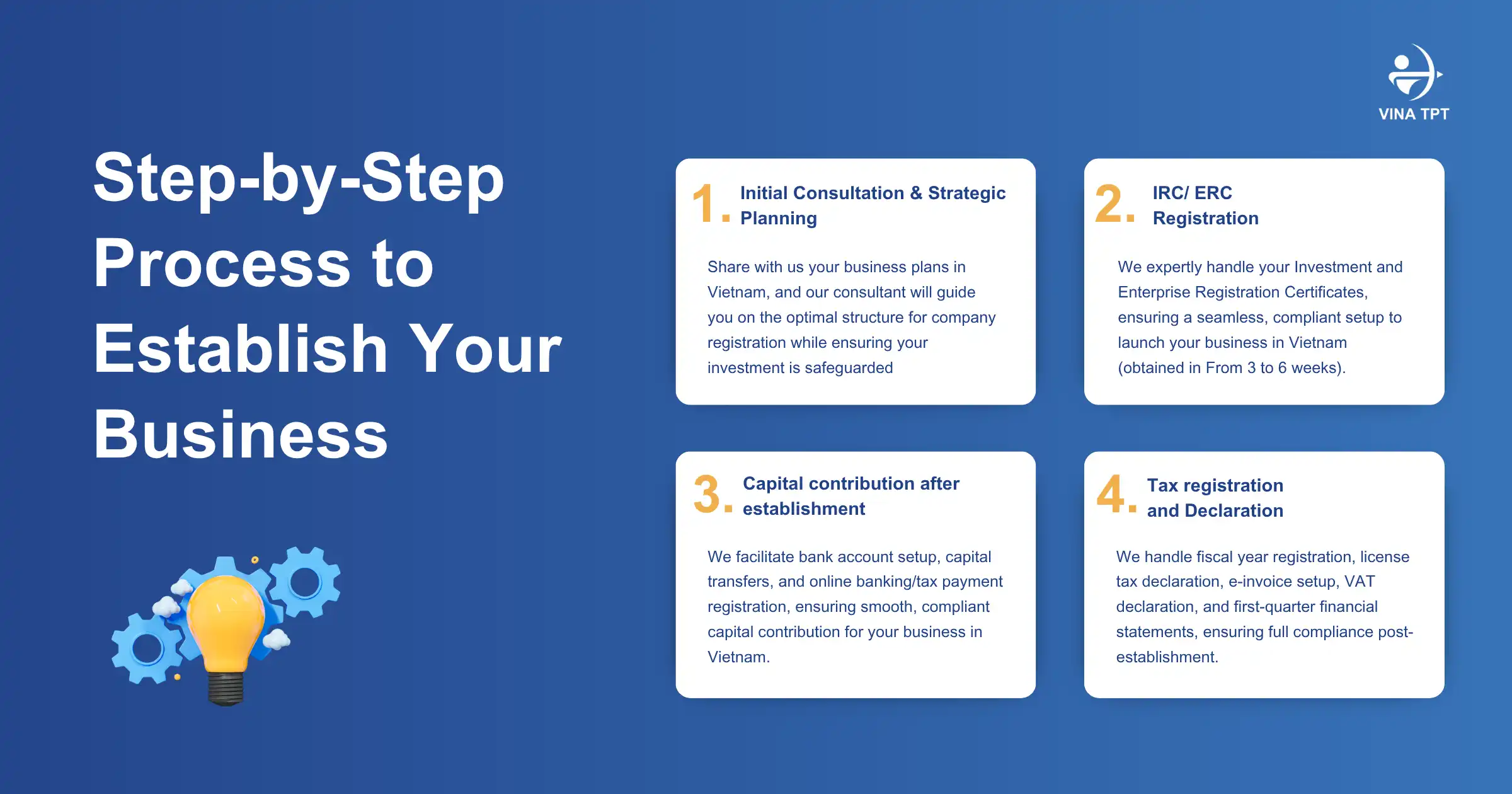
2. 5-Step Process for Setting Up Company in Vietnam in 2026

The average timeline for completion ranges from 1 to 2 months, depending on the complexity of your business lines.

Step 1: Choose a Legal Structure & Check Ownership Limits

The most common choice is a Limited Liability Company (LLC) due to its flexibility and limited liability protection. Foreigners must verify if their specific sector requires a Joint Venture (JV) with a Vietnamese partner.

Step 2: Obtain the Investment Registration Certificate (IRC)

Investors submit the application to the DPI. Key documents include:

  • Detailed Investment Project Proposal.
  • Proof of Financial Capacity (Bank statements or audited reports).
  • Office Lease Agreement or Memorandum of Understanding (MOU).
  • Timeline: 15 – 35 working days.

Step 3: Obtain the Enterprise Registration Certificate (ERC)

Once the IRC is issued, the ERC application is typically processed within 3 – 7 working days. This step officially grants your business its legal status.

Step 4: Post-Registration Procedures (Operational Compliance)

Obtaining the ERC is only the beginning. Within 90 days, investors must fulfill these mandatory obligations:

  • Open a Direct Investment Capital Account (DICA): This is the most critical step. All capital contributions, profit repatriations, and share transfers must flow through this account.
  • Capital Contribution: Ensure the total committed capital is transferred into the DICA within 90 days of ERC issuance.
  • Online Investment Reporting: Businesses must report project progress quarterly and annually on the National Investment Information System. Missing these deadlines can lead to heavy administrative fines.
  • Initial Tax & Accounting Setup: Register digital signatures, set up e-invoice templates, and pay Business License Tax (License Fees). Appointing a Chief Accountant or an outsourced accounting representative is a legal requirement for signing financial statements.

Step 5: Specialized Business License (If applicable)

For retail and distribution entities, authorities will assess the application based on local planning and socio-economic impact. Note the Economic Needs Test (ENT) requirement if you plan to open a second retail outlet or more.

setting up company in Vietnam

Get a free 30-minutes consultation

3. Required Documents & Checklist

All foreign documents must be Consularly Legalized, translated into Vietnamese, and notarized.

  • Individual Investors: Notarized passport + Bank balance confirmation.
  • Corporate Investors: Parent company’s Certificate of Incorporation + Audited financial statements (last 2 years) + Resolution appointing the authorized representative.
  • Project Documents: Detailed Business Plan and proof of right to use the business location.

4. Vina TPT: Your Trusted Partner for FDI Success in Vietnam

Establishing a legal entity is just the start. To thrive in the Vietnamese market, businesses need a solid foundation in Accounting, Tax, and HR from day one.

Vina TPT is proud to be a strategic partner, helping foreign investors remove language barriers and navigate local legal complexities:

  • Expert Consulting: From initial setup to tax structure optimization. We keep you updated on the latest regulations, including Global Minimum Tax and 2026 tax incentives.
  • Payroll & HR Management: We handle labor contracts, Social Health & Unemployment Insurance (SHUI), and Personal Income Tax (PIT) finalization for both expats and locals, ensuring absolute confidentiality.
  • Lifecycle Partnership: With over 20 years of experience, Vina TPT provides an “All-in-one” ecosystem. You focus on growth; we handle the administration.
  • No Language Barrier: Our trilingual team (English – Japanese – Vietnamese) ensures transparent communication and seamless management reporting.

Optimize your resources and minimize legal risks with Vina TPT. Contact us today for a 1-on-1 specialized consultation for your 2026 project.

Start your journey in vietnam

setting up company in Vietnam

Company registration service for Japanese mechanical manufacturing

Company-registration-service-for-Japanese-mechanical-manufacturing

register-a-company-service-for-japanese

1. Vietnam – A Strategic Base for Japanese Mechanical Manufacturers

Register a company in Vietnam has become increasingly appealing, as the country has emerged over the past decade as a new manufacturing hub in Asia, particularly attractive to Japanese mechanical engineering companies. The reasons come from reasonable operating costs, highly skilled technical human resources and a favorable geographical location for connecting the regional supply chain. In addition, the Vietnamese government has also implemented many tax incentives and infrastructure support policies to attract FDI, especially in the field of mechanical engineering and supporting industries.

For Japanese enterprises, setting up a business in Vietnam not only helps reduce costs but also expands access to the ASEAN market, while maintaining production quality according to Japanese standards. This is the reason why more and more mechanical corporations choose Vietnam as a strategic production base in Southeast Asia.

2. Legal Requirements to Register a Mechanical Manufacturing Company

To register a mechanical manufacturing company in Vietnam, businesses need to carry out some important legal procedures:

2.1 Investment Registration Certificate (IRC) if there is foreign capital.

IRC is the first license allowing the investor to implement the project in Vietnam.

The required documents usually include:

  • Application for investment project implementation and Project proposal: stating the objectives, scale, location, investment capital, progress.
  • Proof of the investor’s financial capacity: bank statement, credit contract or collateral.
  • Legal documents of the investor:
    • Individual: Notarized passport, consular legalization.
    • Organization: Business registration certificate or equivalent document, consular legalization.
  • Project location: lease contract or land/office use rights certificate.

After the IRC is granted (or for 100% domestic-owned enterprises), the investor applies for an ERC – an official license for the enterprise to operate, and also the tax code of the company.

2.2 Enterprise Registration Certificate (ERC) at the Department of Finance.

The ERC dossier usually includes:

  • Application for enterprise registration.
  • Company Charter: stipulates the organizational structure, powers of members/shareholders, capital ratio and management method.
  • List of members/shareholders and legal representatives: clearly state information, ownership ratio, voting rights.
  • Appointment decision and authorization letter (if any).
  • Capital contribution plan & financial evidence: bank statement or credit contract (especially important for large capital projects).

For the mechanical industry, some activities such as heavy metal processing, precision mechanical equipment manufacturing or industrial machinery assembly may require additional specialized licenses or technical safety certificates.

Using a professional service to register a company helps investors avoid legal errors and ensures that documents are processed in accordance with the regulations of Vietnamese authorities.

REGISTER YOUR COMPANY IN VIETNAM NOW

3. Site Selection and Industrial Licensing for Manufacturing Facilities

Choosing a factory location is one of the most important strategic decisions when Japanese mechanical enterprises register a company in Vietnam. A suitable location not only affects the initial investment cost but also determines production efficiency and future expansion.

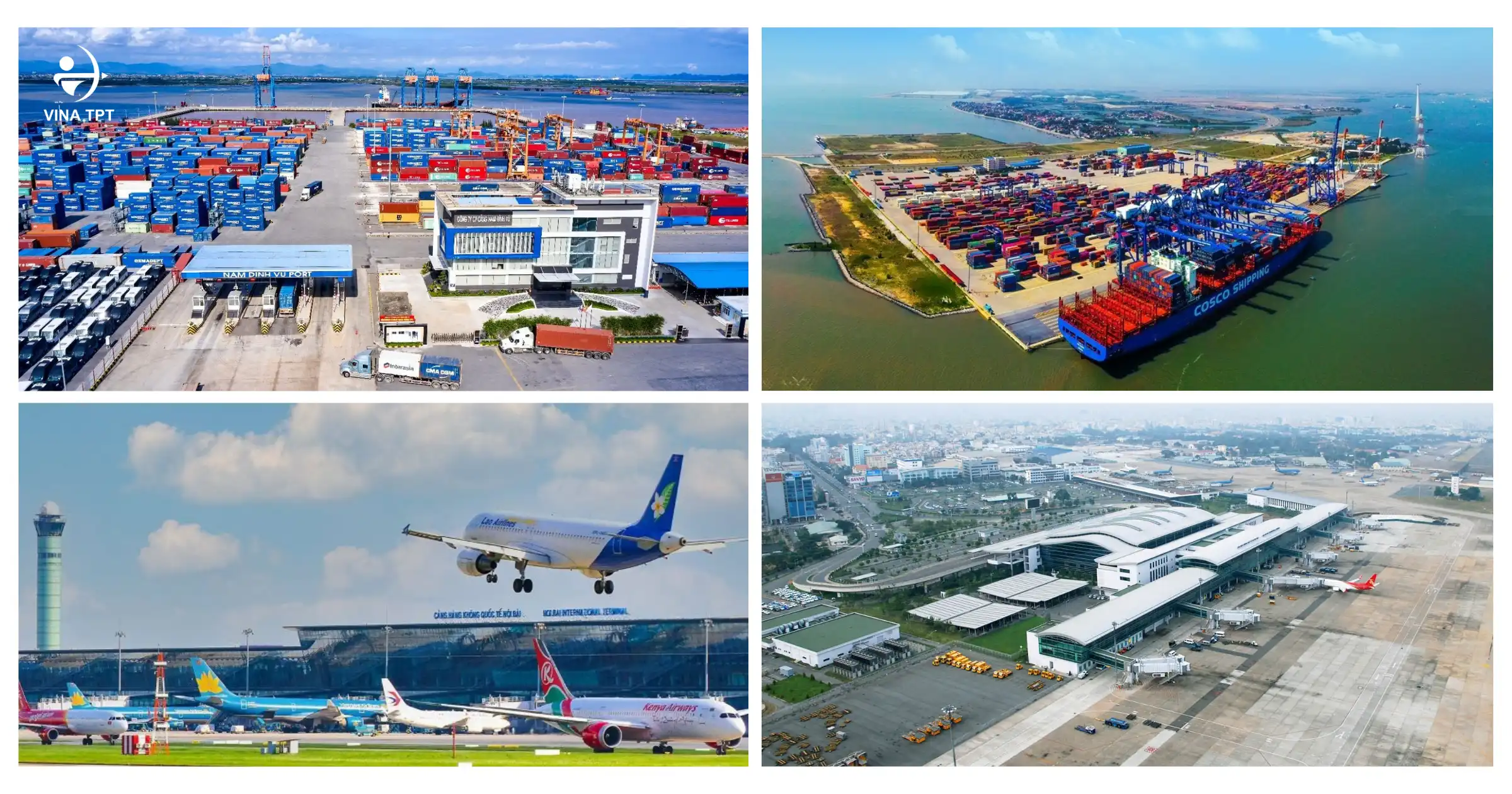
In terms of location, northern regions such as Bac Ninh, Hai Phong, Hung Yen have the advantage of being close to seaports, convenient for exporting to Japan and ASEAN. Meanwhile, southern regions such as Binh Duong, Dong Nai, Long An have good industrial infrastructure and support services, suitable for domestic supply chains. In addition to land rental costs, businesses also need to consider the ability to recruit technical workers – industrial parks near training centers in Hanoi or Ho Chi Minh City help reduce personnel costs.

register-a-company-service-for-japanese

Investment incentives are also a factor worth considering: corporate income tax exemption for the first 2-4 years, 50% reduction in the following years, support for infrastructure costs or land rental. Many localities also have their own promotion programs for Japanese investors.

After selecting a location, businesses must complete the factory operation licenses, including:

  • Construction license according to the approved industrial park planning.
  • Environmental impact assessment (EIA) report according to regulations of the Ministry of Natural Resources and Environment.
  • Certificate of safety of machinery and equipment, especially for imported mechanical lines.
  • Fire safety certification, ensuring safety systems and labor standards.

Completing all these procedures helps businesses operate legally, avoid interruptions in the production process and facilitate future expansion or investment incentives.

4. Understanding Vietnam’s Regulatory Standards for Mechanical Production to Register a Company 

For Japanese mechanical enterprises, establishing a factory in Vietnam involves not only investment and location but also compliance with local technical, safety, and quality standards, a key factor to maintain reputation and meet global requirements.

4.1. Technical Standards System

Vietnam applies two main groups of standards:

  • TCVN (Vietnam National Standards): Recommended standards based on ISO and JIS, used to control quality and production processes.
  • QCVN (Technical Regulations): Mandatory standards on safety, emissions, and energy use. Non-compliance can lead to fines or suspension.

For export-oriented firms, applying ISO 9001, ISO 14001, ISO 45001, and JIS standards ensures product quality equivalent to factories in Japan.

4.2. Equipment Inspection and Product Certification

All imported machinery are CNCs, lathes, welding, or lifting equipment, and must pass technical safety inspections before operation. Products supplied to FDI projects or exports require CR/CQ certificates, and some industries also need IATF 16949 certification.

Proactive inspection and certification reduce technical risks and enhance global competitiveness.

4.3. Environmental and Workplace Safety

Mechanical factories must install air, wastewater, and waste treatment systems meeting national standards. Enterprises also need regular safety training, inspection of lifting equipment and electrical systems, and proper protective gear.

Strict compliance not only fulfills legal requirements but reflects the Japanese values of safety, discipline, and quality.

4.4. Advantages of Japanese Enterprises

By maintaining JIS or Kaizen-5S management models, Japanese enterprises can:

  • Transfer technology easily
  • Build trust with authorities and partners
  • Access programs from JETRO, JBIC, and Vietnam-Japan cooperation projects

This foundation supports stable, long-term investment with optimized costs and minimal legal risk.

5. How Vina TPT Company Registration Service Simplifies the Setup Process

In the context of the increasingly complex Vietnamese legal system, register a company for foreign enterprises, especially in the mechanical field, requires in-depth knowledge of investment, accounting, tax and technical standards. Vina TPT company registration service was established with the mission of supporting foreign investors, especially Japanese enterprises, to set up business operations in Vietnam quickly, legally and effectively.

Vina TPT provides comprehensive solutions for the process of setting up a business in Vietnam, including:

  • Consulting on investment strategies and choosing a business model suitable for the scale of mechanical production.
  • Preparing documents and applying for an Investment Registration Certificate (IRC) and Enterprise Registration Certificate (ERC) according to the provisions of the Investment Law and the Enterprise Law.
  • Consulting on construction permits, environmental permits, equipment safety certificates and mechanical factory operation procedures.

register-a-company-service-for-japanese

Thanks to a closed service system, Vina TPT helps Japanese enterprises save maximum time, reduce legal risks and ensure the factory launch progress on schedule.

The biggest difference of Vina TPT company registration lies in the team of experts with over 20 years of practical experience in the field of corporate law, accounting, tax in Vietnam.

How Vina TPT Supports Japanese Manufacturing Enterprises: 

  • .Proven FDI Experience: Advised many Japanese projects in mechanics, electronics, and supporting industries, fully understanding local licensing and compliance.
  • Cultural Alignment: Operates with Japanese-style precision, transparency, and discipline in all documentation and processes.
  • End-to-End Support: A strategic partner from setup to operation and expansion.
  • Bilingual Team: Fluent Japanese communication ensures smooth coordination and minimized barriers.
  • Focused on Results: Ensures legal compliance, cost efficiency, and sustainable growth for every project.

Contact Vina TPT today for free consultation on the process register a company and setting up a mechanical factory in Vietnam.

CONTACT US NOW

register-a-company-service-for-japanese

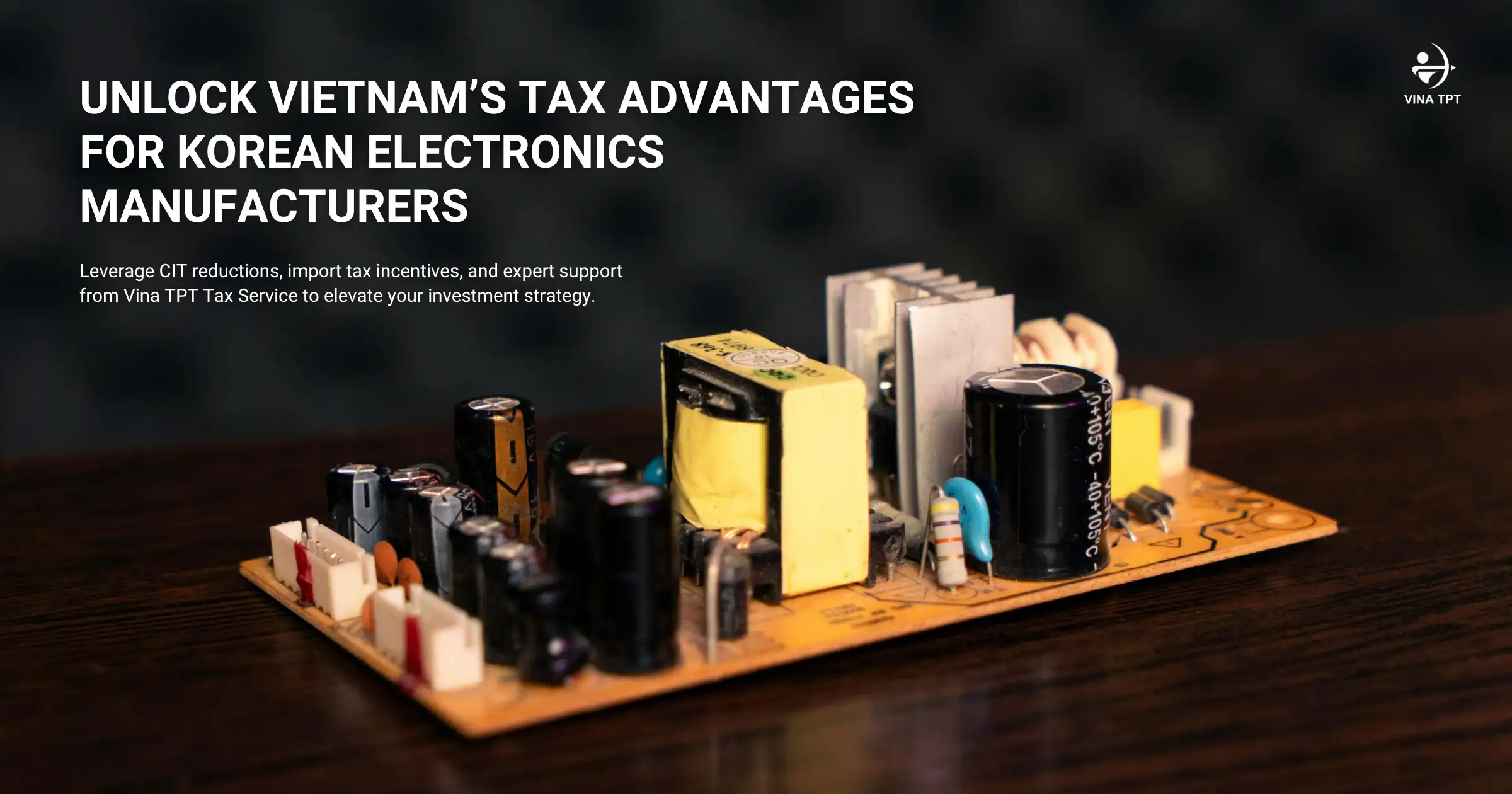
Tax incentives for Korean electronics factories in Vietnam

Korean electronics factory in Vietnam receiving tax incentives

tax-incentives-in-vietnam

1. Why Korean Electronics Manufacturers Choose Vietnam

Tax incentives in Vietnam have played a major role in making the country a top investment destination for Korean electronics corporations such as Samsung, LG, Hanwha, and SK over the past decade. Factors that make Vietnam stand out include competitive labor costs, political stability, a strategic location near the Asian supply chain, and especially the extensive Free Trade Agreements (FTA) system.

In particular, tax incentives in Vietnam for Korean investors have created a strong motivation for long-term manufacturing expansion, especially in high-tech and electronic component production. These incentives not only reduce the initial investment burden but also help Korean enterprises enhance profitability and competitiveness in the regional and global markets.

In addition, the Vietnamese government is actively attracting investment in the high-tech and electronic component manufacturing sectors – this is a great advantage for Korean factories that want to establish long-term manufacturing operations. Therefore, the tax incentives policy in Vietnam is also designed to provide maximum support to this group of businesses.

2. Overview of Tax Incentives in Vietnam for Foreign Manufacturers

Currently, Vietnam is applying many tax incentives in Vietnam for foreign investors, especially in the fields of manufacturing, high technology and industrial zones. These preferential policies are designed to encourage long-term investment and improve the competitiveness of enterprises:

  • Exemption from corporate income tax (CIT) for the first 2-4 years, 50% reduction for the next 4-9 years, depending on the scale and field of investment.
  • Exemption from import tax on machinery, equipment, components to create fixed assets or serve R&D.
  • Land lease incentives in industrial parks, high-tech parks, helping to significantly reduce initial investment costs.

In addition, Vietnam also implements a special tax holiday policy for high-tech manufacturing projects. These are important advantages that help Vietnam become an attractive destination for foreign investors looking for an efficient and stable production environment in the region.

GET TAX INCENTIVE CONSULTATION

3. Tax Incentives for Korean Factories in Vietnam: Key Benefits for Electronics Manufacturing Projects

Korean electronics factories investing in Vietnam often enjoy many outstanding incentives:

  • Corporate Income Tax (CIT): Preferential tax rate of only 10% for 15 years (compared to the standard rate of 20%), with a long tax exemption and reduction period.
  • Import Duty Exemption: Exemption from import tax on machinery, production lines, and components that cannot be produced domestically.
  • Land Rental Incentive: Exemption or reduction of land rent in industrial zones, especially in Bac Ninh, Thai Nguyen, and Hai Phong, where many Korean factories are concentrated.
  • Value Added Tax (VAT) Refund: For exporting enterprises, input VAT is quickly refunded, helping to improve cash flow.

These incentives help Korean electronics factories shorten the payback period and maximize profits during the expansion phase.

4. Compliance and Documentation Required to Access Tax Incentives in Vietnam

To enjoy tax incentives in Vietnam, businesses need to prepare complete documents according to regulations:

  • Investment Certificate (IRC) and Enterprise Registration Certificate (ERC) clearly stating the eligible business lines.
  • Documents proving that the project is in an incentive sector or area.
  • Financial statements, CIT declarations and annual investment activity reports.
  • Relevant import documents, invoices and contracts (for import tax exemptions).

Due to the strict review process, missing documents or incorrect declarations can cause businesses to lose their right to enjoy incentives or be subject to tax arrears.

5. Strategic Tax Planning with Vietnam Tax Specialists for Long-Term Profitability

To make the most of tax incentives in Vietnam, businesses need to build a long-term tax strategy that both ensures compliance with regulations and optimizes financial efficiency. Tax planning is not simply about compliance with obligations, but also a management tool that helps businesses maintain a competitive advantage and develop sustainably in the Vietnamese market.

Tax specialists play an important role in this process by helping businesses restructure their investment models to suit the locations and preferential fields, thereby maximizing tax benefits. They also support businesses in optimizing depreciation policies, transfer pricing and eligible expenses, helping to significantly reduce corporate income tax (CIT) obligations while still complying with regulations. At the same time, tax experts also periodically monitor tax compliance, detect potential risks early and limit the risk of being inspected or administratively sanctioned.

A well-thought-out tax plan not only provides short-term financial benefits, but also lays a solid foundation for future expansion and reinvestment, helping businesses maintain flexibility and stability in a rapidly changing economic landscape.

Download Vietnam Tax Handbook For Investor

6. Partnering with Vina TPT Tax Service for Comprehensive Tax Support and Incentive Application

Vina TPT Tax Service is a trusted tax consulting partner of hundreds of FDI enterprises, including many Korean electronics factories in Vietnam. Our team of experts includes tax consultants and legal experts with over 15 years of experience, with in-depth knowledge of tax regulations, accounting and investment incentives in Vietnam.

Vina TPT provides comprehensive support from:

  • Evaluating eligibility for tax incentives.
  • Preparing and submitting tax exemption/reduction applications.
  • Tax strategy consulting, risk management and periodic compliance audits.

With Vina TPT Tax Service, Korean electronics factories not only ensure compliance with regulations but also optimize costs and sustainable profits in Vietnam.

Contact Vina TPT Tax Service now to get advice from our tax experts on optimal tax incentives and costs for your business in Vietnam.

BOOK A FREE CONSULTATION

tax-incentives-in-vietnam

Business Established in Vietnam for Korean Electronics Manufacturers

Korean investor receiving business license in Vietnam

setting-up-electronics-business-in-Vietnam

1. Vietnam – The Next Hub for Korean Electronics Manufacturers

As Korean companies continue to look for new growth opportunities across Asia, Vietnam has become one of the most attractive destinations for manufacturing expansion. With a favorable investment climate and a streamlined business license in Vietnam process for foreign enterprises, Vietnam offers Korean electronics manufacturers an ideal entry point to establish long-term operations. Supported by government incentives and a robust supply chain ecosystem, the country is quickly evolving into a major production hub in the region.

Major corporations such as Samsung, LG, and Hanwha have established large-scale production complexes in Bac Ninh, Thai Nguyen, and Hai Phong, regions that are rapidly becoming Vietnam’s key electronics hubs, supported by modern logistics networks, seaports, and government investment incentives.

Moreover, Vietnam’s active participation in free trade agreements such as CPTPP and EVFTA has unlocked significant tariff advantages, enhancing its competitiveness in the global supply chain. A young, skilled workforce combined with the nation’s push for digital transformation positions Vietnam as the “new manufacturing base” for the global electronics industry, much like South Korea’s industrial rise in the 1990s.

For Korean investors, establishing a business in Vietnam not only optimizes production costs but also opens access to ASEAN, China, and India markets. By obtaining the appropriate business license in Vietnam and leveraging professional strategic consulting, Korean electronics enterprises can streamline the enterprise registration process and transform Vietnam into a sustainable hub for manufacturing and innovation in the region.

2. Strategic Considerations Before Enterprise Registration in Vietnam

Before starting the registration process, investors need to carefully consider strategic factors.

Location is key: Northern regions such as Bac Ninh, Hai Phong, Thai Nguyen currently have many Korean electronics factories, convenient for connecting and sharing the supply chain.

Legal form also directly affects the right to operate and tax obligations. Enterprises can choose to establish a 100% foreign-owned company, joint venture with a Vietnamese partner or open a representative office.

In addition, the domestic supply chain in Vietnam is expanding rapidly, providing components and logistics services suitable for electronics production. Understanding these factors helps Korean enterprises optimize costs and limit risks when entering new markets.

Book a Free Consultation on Your Business License

3. Understanding Business License in Vietnam and Compliance for Electronics Companies

After being granted the Investment Registration Certificate (IRC) and Enterprise Registration Certificate (ERC), the electronics enterprise needs to apply for a business license appropriate to the field of operation.

The electronics manufacturing industry has its own requirements on environmental safety, technology standards and fire prevention.

The estimated time for completion is:

Document preparation: 1-2 weeks, depending on the volume of documents and the level of complexity.

  • IRC appraisal: 20-45 working days.
  • ERC issuance: 10-20 working days after IRC (or similar if the enterprise is a domestic enterprise).

In fact, if the enterprise cooperates with a reputable company registration service, it will help the enterprise quickly handle the consular legalization, translation and submission of documents, shortening the time and increasing the possibility of being licensed the first time.

setting-up-electronics-business-in-Vietnam

4. How to Establish Business in Vietnam and Maintain Legal Compliance

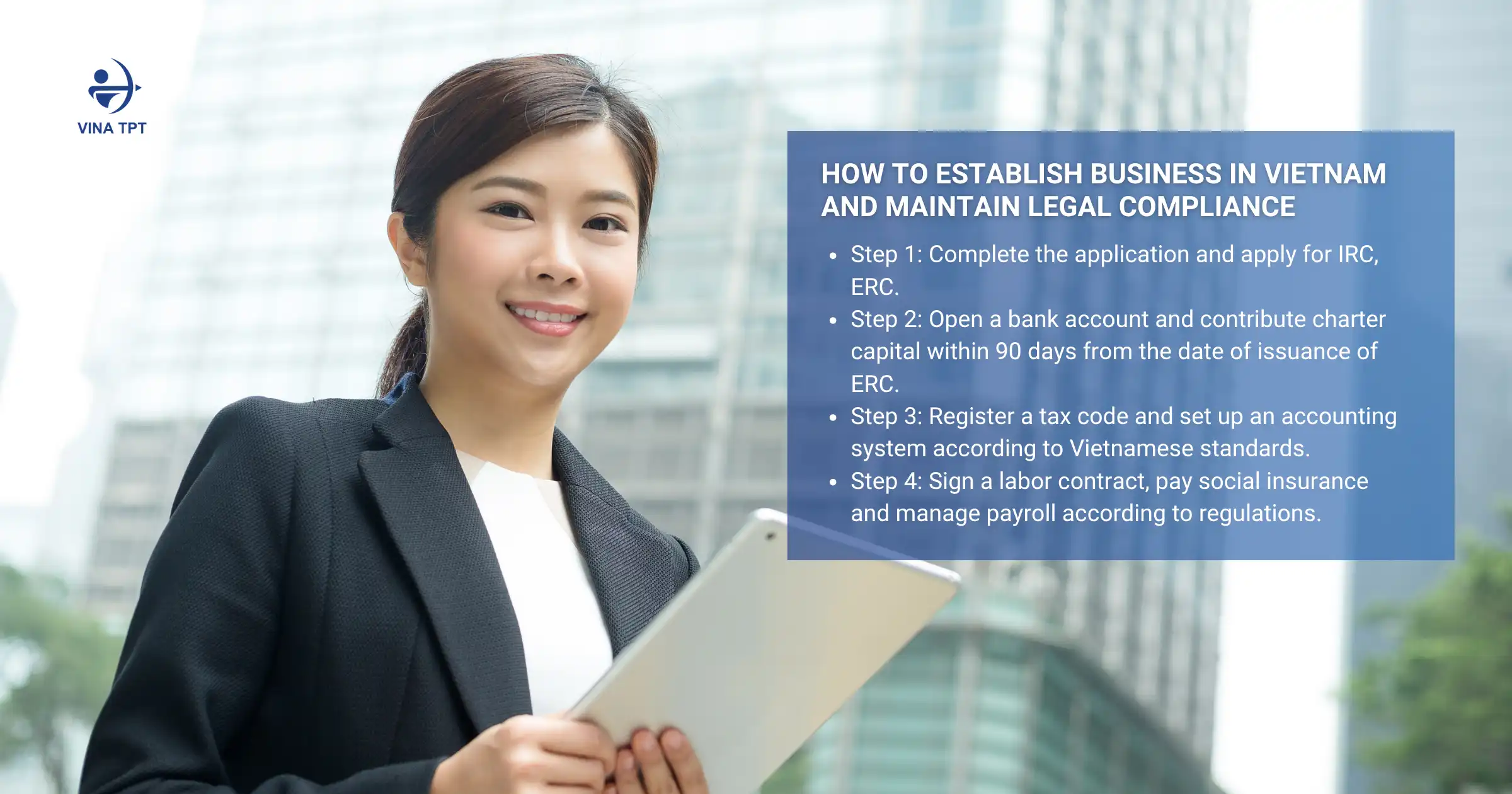
To successfully establish a business in Vietnam, investors need to take the following important steps:

Step 1: Complete the application and apply for Business License in Vietnam IRC, ERC.

If the project has FDI capital, IRC is the first license allowing the investor to implement the project in Vietnam.

The required documents usually include:

  • Application for investment project implementation and Project proposal: stating the objectives, scale, location, investment capital, progress.
  • Proof of the investor’s financial capacity: bank statement, credit contract or collateral.
  • Legal documents of the investor:
    • Individual: Notarized passport, consular legalization.
    • Organization: Business registration certificate or equivalent document, consular legalization.
  • Project location: lease contract or land/office use rights certificate.

After the IRC is granted (or for 100% domestic-owned enterprises), the investor applies for an ERC – an official license for the enterprise to operate, and also the tax code of the company.

The ERC dossier usually includes:

  • Application for enterprise registration.
  • Company Charter: stipulates the organizational structure, powers of members/shareholders, capital ratio and management method.
  • List of members/shareholders and legal representatives: clearly state information, ownership ratio, voting rights.
  • Appointment decision and authorization letter (if any).
  • Capital contribution plan & financial evidence: bank statement or credit contract (especially important for large capital projects).

Step 2: Open a bank account and contribute charter capital within 90 days from the date of issuance of ERC.

Step 3: Register a tax code and set up an accounting system according to Vietnamese standards.

Step 4: Sign a labor contract, pay social insurance and manage payroll according to regulations.

5. Vina TPT Company Registration – Partnering with Korean Electronics Manufacturers for a Sustainable Setup

With more than a decade of experience in investment consulting and business registration services, Vina TPT has successfully assisted hundreds of FDI enterprises, including a large number of Korean electronics manufacturers in establishing and expanding their operations in Vietnam.

Our comprehensive service scope covers every stage of the process — from investment model consulting and legal documentation, to business license application in Vietnam, business license renewal, and regulatory compliance. This integrated approach ensures a smooth and compliant market entry for Korean investors.

Backed by a team of seasoned professionals with in-depth knowledge of Vietnam’s business, tax, and labor laws, Vina TPT provides end-to-end business license advisory and compliance support, helping investors confidently execute their projects while focusing on production growth and long-term success.

Partnering with Vina TPT Business Advisory and Company Registration means more than saving time and costs. It’s about having a trusted local partner who truly understands how to help Korean investors establish, operate, and sustain successful ventures in Vietnam.

Contact Vina TPT for consultation and support on business registration in Vietnam quickly, legally and at optimal cost.

BOOK A FREE CONSULTATION

setting-up-electronics-business-in-Vietnam

Business Setup Consultant Vietnam: Start Your Small Foreign Business Smoothly

alt="Foreign investors establish business in Vietnam with professional setup consultant support"

alt="Foreign investors establish business in Vietnam with professional setup consultant support"

1. Why Small Foreign Investors Choose to Establish Business in Vietnam

Vietnam is becoming an ideal destination for small investors thanks to its low operating costs, young workforce and large consumer market. Compared to many other countries in the region, establishing a business in Vietnam brings clear advantages in terms of rental costs, labor and customer access. In addition, the Vietnamese Government is increasingly issuing many preferential policies to attract FDI capital, especially in the fields of technology, education, trade services and clean agriculture.

Some small business sectors that are attracting the attention of foreign investors include:

  • International style restaurants and cafes
  • Foreign language and skills training centers
  • Small-scale e-commerce startups
  • Consulting and creative design services
  • Beauty & wellness services
  • Fashion and lifestyle boutiques
  • Cosmetics and personal care retail. These sectors are particularly attractive to investors from Japan, South Korea, the United States, and China, where consumer demand and business expansion opportunities in Vietnam are seen as highly promising.

With strong growth potential, opening a small-scale company is not only suitable for market exploration but also a foundation for future business expansion.

DISCOVER HOW BUSINESS SETUP CONSULTANT VIETNAM CAN HELP YOU 

2. Legal Basics for Small-Scale Foreign Businesses

To establish a business in Vietnam, small investors need to understand the basic legal regulations. The good news is that small-scale projects often require low investment capital and simpler procedures than large enterprises.

Some important legal factors include:

  • Minimum investment capital: depending on the field, many industries do not require high statutory capital, making it easy for investors to start.
  • Registered industries: need to choose industries that are allowed according to Vietnamese law and the WTO.
  • Business license: for conditional fields such as education, logistics services, or restaurants – cafes, businesses need to apply for additional specialized licenses.
  • Business type: the most popular for small investors is a Limited Liability Company (LLC) or Representative Office.

Understanding these conditions will help the business registration process go smoothly and legally from the beginning.

3. Step-by-Step Guide to Setting Up a Small Business

When small foreign investors plan to establish business in Vietnam, understanding the step-by-step process is essential to avoid unnecessary delays and legal risks. Setting up a business may sound complex, but with the right guidance, it can be smooth and straightforward.

Step 1: Prepare the investment documents – This includes drafting the investment proposal, choosing the right business structure (LLC, joint venture, or representative office), and identifying the scope of activities. Investors need to ensure that their chosen industry is open for foreign participation under Vietnamese law.

Step 2: Apply for the Investment Registration Certificate (IRC) – For most foreign-owned companies, this is the first legal approval. It confirms the investor’s right to operate in Vietnam and outlines essential project details such as charter capital, investment scale, location, and business scope. Without the IRC, foreign investors cannot proceed to the next step of enterprise registration.

Documents typically required for IRC application include:

  • Application for investment project implementation & Project proposal: Stating objectives, scope, scale, investment capital, location, and implementation schedule.
  • Proof of investor’s financial capacity: Bank statements, audited financial reports, credit contracts, or collateral documents.
  • Legal documents of the investor:
  • For individuals: Notarized passport, consular legalization.
  • For organizations: Business Registration Certificate or equivalent, consular legalization.
  • Evidence of project location: Office/land lease agreement or land use rights certificate.
  • Power of attorney/authorization letter (if the investor appoints a third party to handle procedures).

All foreign documents must be consular legalized and officially translated into Vietnamese before submission. This step often prolongs the preparation process, so it is recommended that investors cooperate with a reliable company registration service to ensure accuracy and save time.

Step 3: Obtain the Enterprise Registration Certificate (ERC) – Once the IRC is granted, the next step is to register the business entity officially. This is comparable to a company registration service and provides the legal identity of the enterprise.

Step 4: Open a bank account and contribute charter capital. After receiving the Enterprise Registration Certificate (ERC), investors are required to open a capital account at a licensed commercial bank in Vietnam. This account will be used exclusively for injecting charter capital and handling transactions related to foreign investment.

Capital contribution timeline: The owner/members/shareholders must fully contribute the registered charter capital within 90 days from the issuance date of the ERC. Failure to meet this deadline may result in administrative penalties or forced adjustment of charter capital in the company’s registration.

Contributing capital on time is not only a compliance requirement but also strengthens the company’s credibility when applying for future business licenses, work permits, or expanding operations in Vietnam.

Step 5: Register for tax and post-licensing procedures – This includes obtaining tax codes, registering for VAT, and fulfilling labor and insurance obligations if hiring employees.

Step 6: Apply for additional sector-specific licenses (if required) – For industries such as F&B, education, or e-commerce, further permits may be necessary.

By working with a trusted business setup consultant Vietnam, small investors can streamline the above steps, reduce administrative burdens, and ensure full compliance with local regulations. Firms like Vina TPT company registration provide end-to-end assistance, helping investors save time and resources while minimizing costly mistakes.

I If you want to establish business in Vietnam without unnecessary delays, consider working with a reliable company registration service like Vina TPT. Our business setup consultant Vietnam team is ready to guide you through every step smoothly. With a team of seasoned lawyers and tax experts possessing 10–20 years of experience and having worked with more than 200 FDI enterprises, we are well-equipped to anticipate regulatory hurdles, streamline documentation, and ensure full compliance with local laws.

alt="Foreign investors establish business in Vietnam with professional setup consultant support"

4. Cost-Saving Tips for Small Investors

For small investors establishing a business in Vietnam, saving costs is an important factor in maintaining capital flow for business operations. One of the most effective ways is to choose a business type that is suitable for the scale and development goals, such as a limited liability company instead of a joint stock company. In addition, optimizing charter capital also helps reduce initial financial pressure while still ensuring compliance with legal requirements. Instead of handling all the complicated procedures themselves, investors should use a professional company registration service. This not only helps minimize the risk of errors, but also saves time and costs arising from delayed procedures or having to supplement them many times.

5. Working with a Business Setup Consultant

Working with a business setup consultant Vietnam brings great advantages to foreign investors, especially small businesses that are new to the market. With a deep understanding of the legal system, licensing conditions and administrative procedures, consultants will help the entire procedure take place quickly and legally. Moreover, they also play the role of strategic advisors, providing cost-optimized solutions, choosing feasible business lines and supporting the handling of problems arising during the business operation process. This helps investors not only shorten the time to set up a business but also focus on core business activities from the very first days.

To turn investment plans into reality quickly and economically, many small investors have chosen to accompany Vina TPT with a complete company registration service, ensuring legal and transparent procedures right from the first step.

6. Vina TPT Company Registration Service for Small Investors

With experience supporting hundreds of foreign investors, Vina TPT company registration service offers a complete solution specifically for small businesses.

Vina TPT’s strengths:

  • Advising on costs and reasonable capital structures for small startups.
  • Preparing complete and correct business registration documents.
  • Representing and monitoring the progress with state agencies.
  • Supporting post-registration procedures: seal engraving, account opening, tax declaration.

alt="Foreign investors establish business in Vietnam with professional setup consultant support"

Thanks to professional services and a team of legal experts, Vina TPT helps small investors establish businesses in Vietnam easily, quickly and legally.

Contact Vina TPT now to use the Business setup consultant Vietnam service to start your business journey in Vietnam with optimal costs and transparent procedures.

BOOK A FREE CONSULTATION

Laywer-Establish-business-Vietnam-VinaTPT


International Accounting Standards for FDI Companies in Vietnam

international accounting standards

international accounting standards IFRS compliance Vietnam

1. Why International Financial Reporting Standards (IFRS) Matter for FDI in Vietnam

International accounting standards (IFRS) are essential for FDI companies in Vietnam, helping them navigate cross-border challenges, multiple currencies, and regulatory differences. By adopting international accounting standards, Foreign-capital enterprises in Vietnam can ensure financial transparency and gain stronger investor confidence.

For FDI enterprises in Vietnam, aligning with IFRS not only enhances global credibility but also ensures smoother cooperation with local regulators under Vietnamese Accounting Standards (VAS). Many multinational corporations entering Vietnam, from manufacturing to technology, have already integrated IFRS into their reporting structures to strengthen trust with stakeholders.

2. Challenges of Implementing International Accounting Standards in Vietnam

The International Financial Reporting Standards (IFRS), issued by the International Accounting Standards Board (IASB), are designed to harmonize financial reporting worldwide. These international accounting standards are now considered the backbone of global accounting, shaping modern accounting norms across markets.

For Overseas-invested companies in Vietnam, IFRS is not just about compliance – it establishes a transparent reporting foundation that appeals to global investors while also meeting the requirements of the Ministry of Finance and Vietnamese tax authorities. According to the IFRS Foundation, more than 140 jurisdictions already require or permit IFRS, proving its growing global influence.

3. How IFRS Supports Global Accounting for FDI in Vietnam

Each IFRS requirement reflects how international accounting standards are applied in practice, ensuring that FDI Vietnam businesses maintain consistency with global reporting.

3.1 IFRS 3: Business Combinations

Mergers, acquisitions, and joint ventures are common in FDI. IFRS 3 provides guidelines on goodwill, fair value measurement, and disclosure, ensuring clarity in reporting cross-border investments.

3.2 IFRS 9: Financial Instruments

Many FDI companies in Vietnam use derivatives, foreign loans, or complex contracts. IFRS 9 ensures accurate classification and measurement, minimizing risks related to misreporting.

3.3 IFRS 16: Leases

FDI enterprises leasing factories or offices in Vietnam must record lease liabilities and right-of-use assets. This affects financial ratios and gives stakeholders a more realistic picture of obligations.

3.4 IAS 21: Effects of Foreign Exchange

Operating in Vietnam often means dealing with currency fluctuations. IAS 21 provides guidance on translating VND into the reporting currency while maintaining accuracy.

3.5 IFRS 15: Revenue Recognition

Revenue is a critical metric. IFRS 15’s five-step model ensures consistency in how FDI companies record sales, service contracts, or long-term projects in Vietnam.

EXPLORE SOLUTION

4. Challenges of Implementing IFRS in Vietnam

For many FDI Vietnam enterprises, aligning with global accounting norms is challenging due to limited resources and evolving regulations.

4.1 Diverse Regulatory Environments

Vietnam has introduced a roadmap to adopt IFRS by 2025, but many companies still balance both IFRS and VAS reporting. This dual system creates additional workload.

4.2 Resource Constraints

Smaller businesses may lack trained these standard experts. Recruiting and training staff to understand both VAS and IFRS is often costly.

4.3 Currency Volatility

Frequent changes in exchange rates complicate IAS 21 application, particularly for companies in manufacturing and export sectors.

4.4 Training and Technology Gaps

Keeping finance teams updated on evolving the standards requires ongoing investment in training and accounting technology.

These issues highlight why partnering with professional accounting services becomes essential.

international accounting standards IFRS compliance Vietnam

5. The Role of Accounting Services in IFRS Compliance

Partnering with a trusted provider like Vina TPT accounting service company makes International Financial Reporting Standards adoption smoother and more reliable for foreign investors.

Expertise and Compliance: Specialists understand both IFRS and VAS, ensuring dual compliance.

  • Cost Efficiency: Outsourcing avoids the expense of building in-house teams.
  • Scalability: Services expand alongside your operations in Vietnam.
  • Technology Integration: Using advanced accounting software ensures efficiency and accuracy.

For example, Vina TPT assists businesses in preparing consolidated financial statements, handling audits, and ensuring compliance with both international and Vietnamese standards.

6. Steps to Adopt IFRS in Vietnam

These steps help Overseas-invested companies move from basic compliance to full integration with international accounting standards, aligning with global accounting practices.

  • Assess Current Practices: Conduct a gap analysis between existing VAS practices and IFRS requirements.
  • Engage Professional Support: Work with Vina TPT Accounting Service for tailored IFRS solutions.
  • Train Finance Teams: Continuous education ensures accounting staff stay updated with IFRS changes.
  • Implement Technology Solutions: Adopt cloud-based accounting systems compatible with IFRS for greater efficiency.
  • Monitor Compliance: Regular reviews and audits strengthen long-term transparency and accuracy.

7. The Future of IFRS Adoption in Vietnam

Vietnam’s Ministry of Finance has outlined a roadmap for International Financial Reporting Standards adoption, aiming for wider use among listed and large-scale enterprises by 2025. This transition will push more Foreign Direct Investment companies to align with international practices, making professional support even more crucial.

Additionally, new global trends – such as ESG reporting and digital accounting systems – are shaping the next generation of financial transparency. Companies that prepare early will have a competitive advantage in Vietnam’s market.

As IFRS framework becomes the benchmark for Foreign Direct Investment enterprises, choosing Vina TPT accounting service company ensures compliance with international accounting standards while supporting long-term growth.

Explore Vina TPT’s comprehensive accounting and IFRS solutions designed to support FDI companies operating in Vietnam.

BOOK A FREE CONSULTATION

international accounting standards IFRS compliance Vietnam

Maximizing FDI Success in Vietnam: Tax Incentives and Financial Support Explained

tax incentives

tax incentives

1. How Tax Incentives Shape FDI Success in Vietnam

Vietnam has become one of Southeast Asia’s most attractive investment destinations, largely thanks to its tax incentives for FDI Vietnam enterprises. For many foreign investors, tax reductions are not just a way to save costs but also a signal of Vietnam’s commitment to long-term global investment growth.

Key tax incentives include preferential corporate income tax rates, tax holidays, and exemptions for industries such as high technology, renewable energy, and export manufacturing. By lowering the cost of doing business, these incentives directly improve profitability while creating a competitive environment for multinational firms.

According to the Vietnam Ministry of Finance, FDI Vietnam contributed nearly 70% of the country’s exports in 2023. This growth would not have been possible without a consistent and attractive tax policy framework aligned with international accounting standards and global trade norms.

2. Financial Support and Tax Incentives for FDI Vietnam Companies

Beyond tax reductions, Vietnam provides financial support programs for foreign investors. These include:

  • Land rent exemptions and reductions for projects in economic zones or underdeveloped areas.

  • Access to state-supported credit for infrastructure development or green technology.

  • Subsidies and grants for vocational training programs to upgrade local workforce skills.

Such measures complement tax incentives, reducing fixed costs while building sustainable operations. In practice, these support programs help FDI Vietnam enterprises balance early-stage expenses with long-term compliance under both VAS and IFRS accounting norms.

Download Vietnam Tax Handbook For Investor

3. Exploring the Main FDI Benefits Beyond Tax Reductions

While tax breaks are often the first attraction, FDI Vietnam investors also gain long-term strategic advantages. The country offers access to a consumer market of nearly 100 million people, creating opportunities for steady revenue growth. At the same time, Vietnam’s participation in strategic trade agreements such as CPTPP and EVFTA enhances its role as a reliable trade partner. A stable political environment further supports international partnerships, giving foreign investors confidence in long-term commitments.

Beyond these strengths, Vietnam’s deep integration into global supply chains enables foreign companies to use the country not only as a production hub but also as a gateway to regional markets. When combined with global accounting practices and IFRS compliance, these advantages build sustainable transparency and trust with stakeholders, positioning Vietnam as a premier destination for international investment.

4. Challenges of IFRS and Accounting Norms in Vietnam for FDI Enterprises

Despite the opportunities, FDI companies often encounter challenges in interpreting and applying Vietnam’s tax policies. Complex regulations, frequent updates, and differences between Vietnamese accounting standards and international norms can make compliance difficult.

For example, the lack of clarity around transfer pricing rules has led to disputes between tax authorities and multinational firms. Moreover, many foreign investors underestimate the time and resources needed to maintain proper financial reporting under Vietnamese standards.

These challenges can result in penalties, additional audits, and even reputational risks. This is why having a reliable accounting guide and professional local support is crucial for long-term success.

Need help navigating Vietnam’s complex tax rules?

Talk to Vina TPT’s Accounting Experts Today

5. Strategies to Maximize FDI Support Programs Effectively

To fully benefit from Vietnam’s tax incentives and financial support, FDI companies should adopt proactive strategies:

First, they need to perform regular policy reviews to stay updated with changes in tax laws. Second, companies should align their operations with priority sectors – such as high-tech or green energy – where incentives are more favorable. Third, building strong relationships with local partners and government authorities can smoothen administrative processes and reduce delays in obtaining approvals.

Equally important is the adoption of transparent financial management. By maintaining detailed records and ensuring compliance with local standards, companies can position themselves to qualify for maximum support while minimizing risks of disputes with regulators.

6. From Policy to Practice: How Vina TPT Financial Statement Service Helps FDI Companies Leverage Incentives

Turning government policies into real business advantages requires expert support. This is where Vina TPT financial statement service comes in. With deep expertise in Vietnamese accounting regulations and international reporting standards, Vina TPT helps FDI companies navigate the complexities of tax incentives and financial support programs.

Our services ensure that businesses remain compliant while maximizing the benefits available to them. Whether it is preparing accurate financial statements, advising on tax strategies, or assisting with regulatory filings, Vina TPT provides tailored solutions that help foreign investors focus on growth rather than administrative hurdles.

For companies aiming to thrive in Vietnam, partnering with a trusted service provider is not just an option but a necessity. Vina TPT empowers enterprises to move from policy awareness to policy application, turning financial support into sustainable growth.

Ready to grow your investment?Learn how Vina TPT’s tax planning and financial support services can help your FDI business thrive.

BOOK A FREE CONSULTATION

Vina TPT Accounting services