Vietnam Tax Policies and Financial Support for Korean Logistics Companies

Vietnam Tax Policies and Financial Support for Korean Logistics Companies-VTPT

tax-planning

1. Expanding Logistics Networks, Expanding Tax Challenges

In recent years, a growing number of Korean logistics companies have opened branches, transit warehouses or distribution centers in Vietnam. This is a strategic move, as Vietnam is becoming the new logistics hub of Southeast Asia, with its favorable location and rapidly developing port and airport system.

However, along with the opportunity to expand its operating network comes a series of new challenges in tax planning. When a business operates in both countries, cash flow, contracts, and operating costs all need to be carefully calculated to comply with Vietnamese law while optimizing the overall profit of the group.

Lack of appropriate tax planning can lead to double taxation, loss of investment incentives or tax arrears due to incorrect declarations. Therefore, tax planning is not just the job of the accounting department, but a core financial strategy in cross-border operations.

2. Overview of Vietnam’s Tax Policies for Logistics Companies

Vietnam’s tax system for the logistics industry is highly specific, reflecting the diversity of activities in this sector.

First, businesses must comply with corporate income tax (CIT) usually at 20%. However, if the business operates in an industrial park or an encouraged economic zone, it may enjoy a lower preferential tax rate.

Next is value-added tax (VAT) on transportation services. Depending on the type of service – domestic, international or transit, the applicable VAT rate may vary, and determining the correct rate is important to avoid audit risks.

Companies that have contracts to hire contractors or use services from abroad should pay attention to Foreign Contractor Tax, which is often applied to service fees, software or outsourcing from the Korean headquarters. In addition, import duties on transport vehicles or specialized equipment (container trucks, forklifts, refrigeration systems, etc.) are also significant costs that need to be managed in the overall tax plan.

Understanding these policies in detail is essential for Korean logistics companies to operate efficiently and compliantly in Vietnam’s regulatory landscape.

3. Available Tax Incentives and Financial Support

In addition to tax obligations, Vietnam also offers many tax incentives and financial support to encourage foreign investment.

Korean logistics companies can enjoy corporate income tax exemptions or reductions when setting up facilities in industrial parks, high-tech parks, or border economic zones. For projects focusing on digital transformation, logistics process automation, or green investments (e.g., using electric vehicles, renewable energy), businesses can receive additional incentives on accelerated depreciation and tax exemptions for a certain period of time.

In addition, the Vietnamese government is implementing many financial support programs, including preferential credit packages for businesses applying smart technology in logistics operations, and a temporary VAT reduction policy to stimulate consumption and circulation of goods.

Taking advantage of tax incentives not only helps businesses reduce short-term costs but also enhances long-term competitiveness in the regional market.

MAXIMIZE YOUR VIETNAM TAX BENEFITS

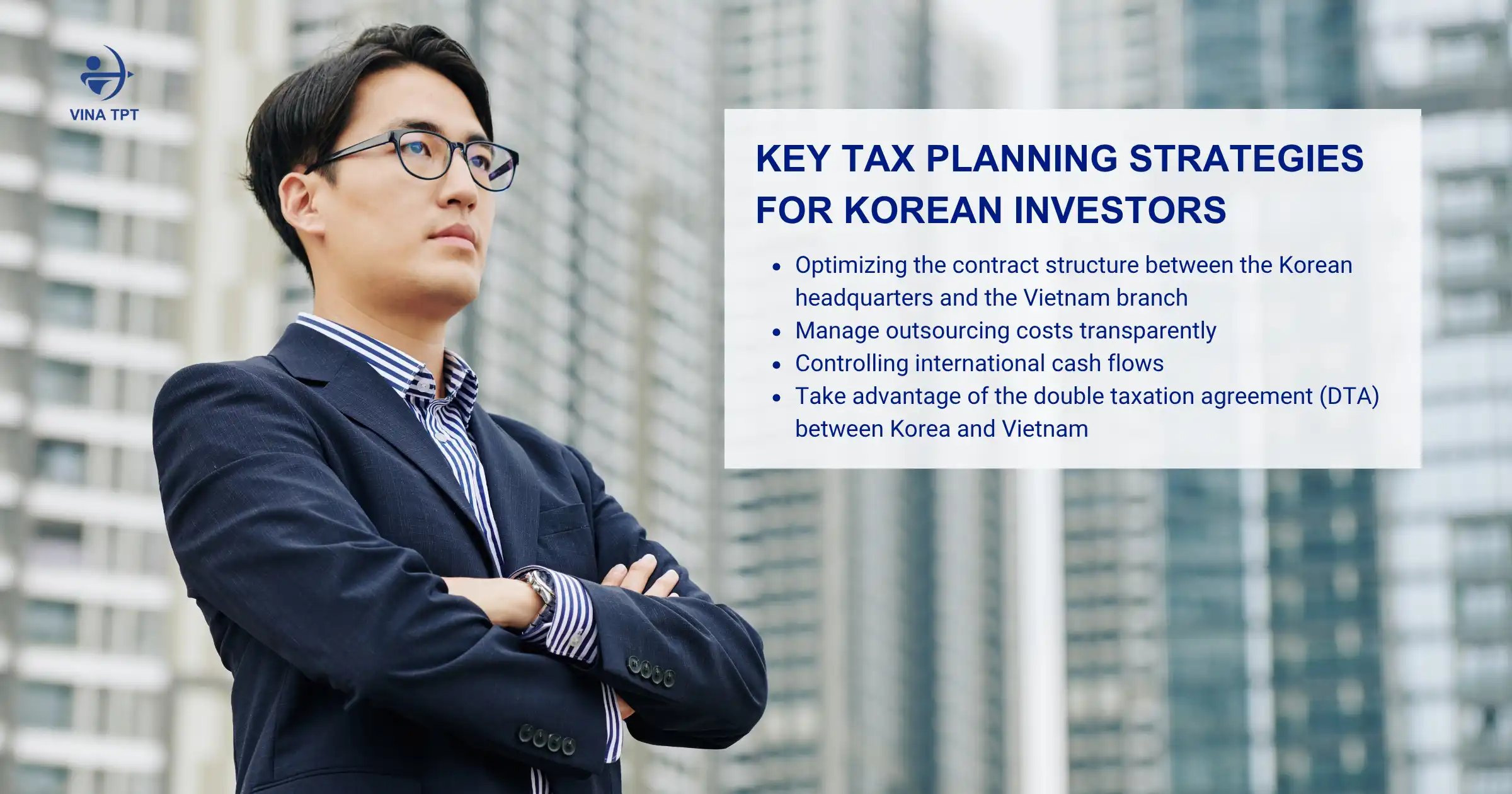
4. Key Tax Planning Strategies for Korean Investors

An effective tax planning strategy is not only based on correct declarations, but also needs to be linked to actual business operations. For Korean investors, this involves many layers of strategy.

First is optimizing the contract structure between the Korean headquarters and the Vietnam branch. Clearly defining the nature of the transaction, for example, a service contract, asset leasing or goods distribution, helps avoid the risk of being taxed in the wrong group.

Second, businesses need to manage outsourcing costs transparently. Outsourcing payments from the parent company or international suppliers must have records proving the value of the service, to avoid being adjusted under anti-transfer pricing regulations.

Third is controlling international cash flows, ensuring that payment flows between Korea and Vietnam are made at the right time, in the right currency, and with a clear legal basis.

Finally, Korean companies should take advantage of the double taxation agreement (DTA) between Korea and Vietnam. This agreement helps businesses avoid double taxation on the same income, while also providing a solid legal basis for cross-border operations.

These strategies are only effective when implemented under the guidance of tax advisory experts who understand both legal systems of Korea and Vietnam.

Download Vietnam Tax Handbook For Investor
tax-planning

5. How Vina TPT Tax Service Ensures Compliance and Optimization

In that context, Vina TPT Tax Service has become a trusted partner for Korean logistics companies operating in Vietnam. With in-depth expertise in Vietnam tax service for Korean logistics companies, Vina TPT not only helps businesses comply but also supports the optimization of tax strategies.

Vina TPT’s team of experts has practical experience in the logistics industry – from maritime transport, warehousing, to supply chain services. They not only advise on documents but also directly support businesses in the process of preparing reports, declaring taxes, working with tax authorities and conducting periodic reviews.

Vina TPT’s special feature is the “advisory and execution” model – meaning both strategic consulting and practical implementation. Thanks to that, Korean companies do not need to worry about the lack of personnel who understand Vietnamese regulations, while still ensuring the tax system operates accurately and effectively.

With the philosophy of “Transparency – Accuracy – Optimization”, Vina TPT helps foreign enterprises turn tax compliance into a sustainable competitive advantage.

Contact Vina TPT Tax Service now for free consultation on tax planning and tax incentives specifically for Korean logistics businesses in Vietnam – optimize costs, comply with the law and develop sustainably with leading experts.

BOOK A FREE CONSULTATION

tax-planning

Tax incentives for Korean electronics factories in Vietnam

Korean electronics factory in Vietnam receiving tax incentives

tax-incentives-in-vietnam

1. Why Korean Electronics Manufacturers Choose Vietnam

Tax incentives in Vietnam have played a major role in making the country a top investment destination for Korean electronics corporations such as Samsung, LG, Hanwha, and SK over the past decade. Factors that make Vietnam stand out include competitive labor costs, political stability, a strategic location near the Asian supply chain, and especially the extensive Free Trade Agreements (FTA) system.

In particular, tax incentives in Vietnam for Korean investors have created a strong motivation for long-term manufacturing expansion, especially in high-tech and electronic component production. These incentives not only reduce the initial investment burden but also help Korean enterprises enhance profitability and competitiveness in the regional and global markets.

In addition, the Vietnamese government is actively attracting investment in the high-tech and electronic component manufacturing sectors – this is a great advantage for Korean factories that want to establish long-term manufacturing operations. Therefore, the tax incentives policy in Vietnam is also designed to provide maximum support to this group of businesses.

2. Overview of Tax Incentives in Vietnam for Foreign Manufacturers

Currently, Vietnam is applying many tax incentives in Vietnam for foreign investors, especially in the fields of manufacturing, high technology and industrial zones. These preferential policies are designed to encourage long-term investment and improve the competitiveness of enterprises:

  • Exemption from corporate income tax (CIT) for the first 2-4 years, 50% reduction for the next 4-9 years, depending on the scale and field of investment.
  • Exemption from import tax on machinery, equipment, components to create fixed assets or serve R&D.
  • Land lease incentives in industrial parks, high-tech parks, helping to significantly reduce initial investment costs.

In addition, Vietnam also implements a special tax holiday policy for high-tech manufacturing projects. These are important advantages that help Vietnam become an attractive destination for foreign investors looking for an efficient and stable production environment in the region.

GET TAX INCENTIVE CONSULTATION

3. Tax Incentives for Korean Factories in Vietnam: Key Benefits for Electronics Manufacturing Projects

Korean electronics factories investing in Vietnam often enjoy many outstanding incentives:

  • Corporate Income Tax (CIT): Preferential tax rate of only 10% for 15 years (compared to the standard rate of 20%), with a long tax exemption and reduction period.
  • Import Duty Exemption: Exemption from import tax on machinery, production lines, and components that cannot be produced domestically.
  • Land Rental Incentive: Exemption or reduction of land rent in industrial zones, especially in Bac Ninh, Thai Nguyen, and Hai Phong, where many Korean factories are concentrated.
  • Value Added Tax (VAT) Refund: For exporting enterprises, input VAT is quickly refunded, helping to improve cash flow.

These incentives help Korean electronics factories shorten the payback period and maximize profits during the expansion phase.

4. Compliance and Documentation Required to Access Tax Incentives in Vietnam

To enjoy tax incentives in Vietnam, businesses need to prepare complete documents according to regulations:

  • Investment Certificate (IRC) and Enterprise Registration Certificate (ERC) clearly stating the eligible business lines.
  • Documents proving that the project is in an incentive sector or area.
  • Financial statements, CIT declarations and annual investment activity reports.
  • Relevant import documents, invoices and contracts (for import tax exemptions).

Due to the strict review process, missing documents or incorrect declarations can cause businesses to lose their right to enjoy incentives or be subject to tax arrears.

5. Strategic Tax Planning with Vietnam Tax Specialists for Long-Term Profitability

To make the most of tax incentives in Vietnam, businesses need to build a long-term tax strategy that both ensures compliance with regulations and optimizes financial efficiency. Tax planning is not simply about compliance with obligations, but also a management tool that helps businesses maintain a competitive advantage and develop sustainably in the Vietnamese market.

Tax specialists play an important role in this process by helping businesses restructure their investment models to suit the locations and preferential fields, thereby maximizing tax benefits. They also support businesses in optimizing depreciation policies, transfer pricing and eligible expenses, helping to significantly reduce corporate income tax (CIT) obligations while still complying with regulations. At the same time, tax experts also periodically monitor tax compliance, detect potential risks early and limit the risk of being inspected or administratively sanctioned.

A well-thought-out tax plan not only provides short-term financial benefits, but also lays a solid foundation for future expansion and reinvestment, helping businesses maintain flexibility and stability in a rapidly changing economic landscape.

Download Vietnam Tax Handbook For Investor

6. Partnering with Vina TPT Tax Service for Comprehensive Tax Support and Incentive Application

Vina TPT Tax Service is a trusted tax consulting partner of hundreds of FDI enterprises, including many Korean electronics factories in Vietnam. Our team of experts includes tax consultants and legal experts with over 15 years of experience, with in-depth knowledge of tax regulations, accounting and investment incentives in Vietnam.

Vina TPT provides comprehensive support from:

  • Evaluating eligibility for tax incentives.
  • Preparing and submitting tax exemption/reduction applications.
  • Tax strategy consulting, risk management and periodic compliance audits.

With Vina TPT Tax Service, Korean electronics factories not only ensure compliance with regulations but also optimize costs and sustainable profits in Vietnam.

Contact Vina TPT Tax Service now to get advice from our tax experts on optimal tax incentives and costs for your business in Vietnam.

BOOK A FREE CONSULTATION

tax-incentives-in-vietnam