5 Key functions you should include in your outsourced finance and accounting package

5 key functions you should include in your outsourced finance and accounting package

5-key-functions-you-should-include-in-your-outsourced-finance-and-accounting-package

The period 2025-2026 marks significant developments in Vietnam’s tax and accounting framework. Circular 99/2025/TT-BTC, effective from January 1, 2026, introduces updates to accounting guidance, including changes to the chart of accounts and financial reporting, contributing to Vietnam’s gradual alignment with IFRS standards.

In addition, recent amendments to Corporate Income Tax regulations and the revised Law on Personal Income Tax (effective from July 1, 2026) will have a direct impact on compliance and business operations. Furthermore, the temporary VAT reduction to 8% (subject to government extension policies) continues to affect tax planning and cost structures for businesses.

These changes create challenges for many FDI enterprises in staying compliant, especially when simultaneously handling Vietnamese Accounting Standards (VAS), reconciliation with International Financial Reporting Standards (IFRS), tax management, and payroll for foreign employees (expatriates).

In this context, many companies choose outsourced finance and accounting services as a strategic solution. These services ensure compliance, optimize costs, reduce operational burden, and allow businesses to focus on core activities.

This article provides a comprehensive overview of the 5 key functions you should look for in an outsourced finance and accounting package. It is designed to help foreign investors select a reputable and suitable service provider in Vietnam.

1. Bookkeeping Management

Bookkeeping services (in outsourced finance and accounting package) involve the collection, verification, and recording of all financial transactions according to applicable accounting standards. It forms the foundation for preparing financial statements, tax declarations, and working with auditors.

From 2026 onward, with the implementation of Circular 99/2025/TT-BTC, enterprises must comply with the new chart of accounts and regulations under Vietnamese Accounting Standards (VAS). At the same time, they often need to address differences between VAS (used for local regulatory reporting) and IFRS (required by headquarters or parent companies). Accurate recording from the very beginning is therefore essential.

A professional outsourced finance and accounting package typically includes the following bookkeeping services:

Monthly tasks:

  • Collection, verification, and secure storage of valid accounting documents (vouchers)
  • Data entry and review of accounts according to the new chart of accounts under Circular 99
  • Preparation of detailed monthly financial statements
  • Provision of ad-hoc managerial reports upon request

Year-end tasks:

  • Preparation of annual financial statements in accordance with VAS
  • Close coordination with independent auditors (liaising with auditors)
  • Support for VAS–IFRS reconciliation for headquarters reporting

Important note: A common misconception is that simply entering all documents is sufficient. In reality, transactions must be recorded correctly according to Vietnamese accounting principles (VAS). Even small deviations can lead to tax adjustments, prolonged audits, and unnecessary additional costs.

>>> You may also be interested in: Best Bookkeeping Services for Startups in Vietnam

2. Financial Reporting & Management Reports

Financial reporting is crucial not only for regulatory compliance but also as a vital tool for monitoring business performance and supporting timely decision-making.

In an outsourced finance and accounting package, financial reporting services usually include:

  • Preparation of monthly and annual financial statements in accordance with Vietnamese accounting standards
  • Consolidation of financial statements (where required)
  • Delivery of customized management reports, such as cash flow statements, budget variance analysis, KPI tracking, and cost analysis

For FDI companies, receiving timely monthly financial reports is particularly important. These reports enable leadership to closely monitor the company’s financial position and adjust business plans promptly.

3. Tax Compliance & Filing

For foreign-invested enterprises, lack of familiarity with Vietnam’s tax regulations is a frequent cause of errors and penalties. Obligations include Value-Added Tax (VAT), Corporate Income Tax (CIT), Personal Income Tax (PIT), Foreign Contractor Tax (FCT), Withholding Tax (WHT), and specialized reports such as investment activity reports.

A comprehensive Tax Compliance & Filing service within outsourced finance and accounting typically covers:

  • Monthly or quarterly VAT declaration and payment
  • Provisional CIT declaration and finalization under the Corporate Income Tax Law 
  • Monthly, quarterly, and annual PIT declaration and payment according to the new 5-bracket progressive tax schedule effective 2026
  • Handling of Foreign Contractor Tax (FCT) and Withholding Tax (WHT)
  • Support for VAT refund and transfer pricing documentation
  • Preparation of statistical reports and Investment Activity Reports (IAR) specifically required for FDI companies

Non-compliance can result in administrative fines, tax reassessments, late-payment interest, or even temporary suspension of the tax code – all of which directly impact business operations. This is why many FDI enterprises rely on professional tax compliance services to ensure full adherence from the outset.

EXPLORE OUR ACCOUNTING & TAX SERVICES

5-key-functions-you-should-include-in-your-outsourced-finance-and-accounting-package

4. Payroll & Employee Tax Handling

Payroll and employee tax handling involves the calculation of salaries, benefits administration, and management of all tax and insurance obligations related to employees. This is a critical function in business operations, as it directly affects employee welfare and the company’s legal compliance.

A professional outsourced finance and accounting package typically includes the following payroll services:

  • Monthly payroll calculation and preparation of confidential payroll reports
  • Processing of mandatory social insurance, health insurance, and unemployment insurance contributions in accordance with Vietnamese regulations
  • Withholding, declaration, and annual finalization of Personal Income Tax (PIT)
  • Specialized support for matters involving foreign employees (expatriates)

Important note for FDI companies: When a company employs expatriates, additional requirements such as visas, work permits, Temporary Residence Cards, and residency-based Personal Income Tax rules must be handled accurately and in coordination with payroll processing. Therefore, it is recommended to choose a outsourced finance and accounting provider that can support these immigration-related requirements alongside payroll services. This helps ensure consistency, optimize costs, and minimize operational risks.

In practice, effective payroll management goes far beyond simply calculating salaries. It encompasses numerous legal and tax obligations that are frequently updated in Vietnam. By outsourcing this function, many FDI enterprises can significantly reduce the workload on their internal HR teams, ensure full regulatory compliance, and maintain workforce stability – even as labor and tax regulations continue to evolve.

>>> You may also be interested in:

EXPLORE OUR PAYROLL SERVICES

5. Advisory & Ongoing Support

Outsourced finance and accounting should not be limited to execution. It must also provide proactive, strategic advisory support.

At Vina TPT, we go beyond basic services by offering:

  • Legally compliant tax optimization advice
  • Guidance on capital structuring and transfer pricing for related-party transactions
  • Support during tax audits and liaison with auditors
  • Services of a Qualified Chief Accountant (authorized to sign documents and represent the company with state authorities)
  • Assistance in setting up accounting systems and internal controls

Many of our FDI clients have successfully avoided major risks thanks to early advice on the Global Minimum Tax and changes under the 2025 CIT Law. We act not only as a service provider but as a long-term strategic partner – supporting your company from initial setup through expansion.

How to build the right outsourced finance package for your FDI company

To choose the most suitable outsourced finance and accounting package, consider the following:

  • Scale of transactions, number of employees, and expatriate requirements
  • Level of advisory support needed (from basic bookkeeping to full strategic advisory)

When selecting a service provider, FDI enterprises should also evaluate:

    • Professional expertise and clear workflows that ensure full compliance with Vietnamese Accounting Standards (VAS)
    • Responsiveness and team-based support model (rather than reliance on a single individual)
  • Risk management capabilities and clear contractual responsibilities
  • Strong data confidentiality clauses, including scope of information use, security obligations, and breach remedies

5-key-functions-you-should-include-in-your-outsourced-finance-and-accounting-package

With over 20 years of experience in company establishment consulting and financial services tailored for FDI enterprises, Vina TPT fully meets these criteria. We support clients from the initial structuring and setup phase through ongoing finance and accounting operations after incorporation.

Each client is assigned a dedicated team (Assistant – Senior – Manager levels) for multi-layer review and timely issue resolution. We commit to responding within 24-48 hours, ensuring continuous support throughout your operations in Vietnam.

Contact Vina TPT today for a free consultation and to build the most suitable outsourced finance and accounting package for your business model. 

BOOK A FREE CONSULTATION


Tax incentives for Korean electronics factories in Vietnam

Korean electronics factory in Vietnam receiving tax incentives

tax-incentives-in-vietnam

1. Why Korean Electronics Manufacturers Choose Vietnam

Tax incentives in Vietnam have played a major role in making the country a top investment destination for Korean electronics corporations such as Samsung, LG, Hanwha, and SK over the past decade. Factors that make Vietnam stand out include competitive labor costs, political stability, a strategic location near the Asian supply chain, and especially the extensive Free Trade Agreements (FTA) system.

In particular, tax incentives in Vietnam for Korean investors have created a strong motivation for long-term manufacturing expansion, especially in high-tech and electronic component production. These incentives not only reduce the initial investment burden but also help Korean enterprises enhance profitability and competitiveness in the regional and global markets.

In addition, the Vietnamese government is actively attracting investment in the high-tech and electronic component manufacturing sectors – this is a great advantage for Korean factories that want to establish long-term manufacturing operations. Therefore, the tax incentives policy in Vietnam is also designed to provide maximum support to this group of businesses.

2. Overview of Tax Incentives in Vietnam for Foreign Manufacturers

Currently, Vietnam is applying many tax incentives in Vietnam for foreign investors, especially in the fields of manufacturing, high technology and industrial zones. These preferential policies are designed to encourage long-term investment and improve the competitiveness of enterprises:

  • Exemption from corporate income tax (CIT) for the first 2-4 years, 50% reduction for the next 4-9 years, depending on the scale and field of investment.
  • Exemption from import tax on machinery, equipment, components to create fixed assets or serve R&D.
  • Land lease incentives in industrial parks, high-tech parks, helping to significantly reduce initial investment costs.

In addition, Vietnam also implements a special tax holiday policy for high-tech manufacturing projects. These are important advantages that help Vietnam become an attractive destination for foreign investors looking for an efficient and stable production environment in the region.

GET TAX INCENTIVE CONSULTATION

3. Tax Incentives for Korean Factories in Vietnam: Key Benefits for Electronics Manufacturing Projects

Korean electronics factories investing in Vietnam often enjoy many outstanding incentives:

  • Corporate Income Tax (CIT): Preferential tax rate of only 10% for 15 years (compared to the standard rate of 20%), with a long tax exemption and reduction period.
  • Import Duty Exemption: Exemption from import tax on machinery, production lines, and components that cannot be produced domestically.
  • Land Rental Incentive: Exemption or reduction of land rent in industrial zones, especially in Bac Ninh, Thai Nguyen, and Hai Phong, where many Korean factories are concentrated.
  • Value Added Tax (VAT) Refund: For exporting enterprises, input VAT is quickly refunded, helping to improve cash flow.

These incentives help Korean electronics factories shorten the payback period and maximize profits during the expansion phase.

4. Compliance and Documentation Required to Access Tax Incentives in Vietnam

To enjoy tax incentives in Vietnam, businesses need to prepare complete documents according to regulations:

  • Investment Certificate (IRC) and Enterprise Registration Certificate (ERC) clearly stating the eligible business lines.
  • Documents proving that the project is in an incentive sector or area.
  • Financial statements, CIT declarations and annual investment activity reports.
  • Relevant import documents, invoices and contracts (for import tax exemptions).

Due to the strict review process, missing documents or incorrect declarations can cause businesses to lose their right to enjoy incentives or be subject to tax arrears.

5. Strategic Tax Planning with Vietnam Tax Specialists for Long-Term Profitability

To make the most of tax incentives in Vietnam, businesses need to build a long-term tax strategy that both ensures compliance with regulations and optimizes financial efficiency. Tax planning is not simply about compliance with obligations, but also a management tool that helps businesses maintain a competitive advantage and develop sustainably in the Vietnamese market.

Tax specialists play an important role in this process by helping businesses restructure their investment models to suit the locations and preferential fields, thereby maximizing tax benefits. They also support businesses in optimizing depreciation policies, transfer pricing and eligible expenses, helping to significantly reduce corporate income tax (CIT) obligations while still complying with regulations. At the same time, tax experts also periodically monitor tax compliance, detect potential risks early and limit the risk of being inspected or administratively sanctioned.

A well-thought-out tax plan not only provides short-term financial benefits, but also lays a solid foundation for future expansion and reinvestment, helping businesses maintain flexibility and stability in a rapidly changing economic landscape.

Download Vietnam Tax Handbook For Investor

6. Partnering with Vina TPT Tax Service for Comprehensive Tax Support and Incentive Application

Vina TPT Tax Service is a trusted tax consulting partner of hundreds of FDI enterprises, including many Korean electronics factories in Vietnam. Our team of experts includes tax consultants and legal experts with over 15 years of experience, with in-depth knowledge of tax regulations, accounting and investment incentives in Vietnam.

Vina TPT provides comprehensive support from:

  • Evaluating eligibility for tax incentives.
  • Preparing and submitting tax exemption/reduction applications.
  • Tax strategy consulting, risk management and periodic compliance audits.

With Vina TPT Tax Service, Korean electronics factories not only ensure compliance with regulations but also optimize costs and sustainable profits in Vietnam.

Contact Vina TPT Tax Service now to get advice from our tax experts on optimal tax incentives and costs for your business in Vietnam.

BOOK A FREE CONSULTATION

tax-incentives-in-vietnam

Business Established in Vietnam for Korean Electronics Manufacturers

Korean investor receiving business license in Vietnam

setting-up-electronics-business-in-Vietnam

1. Vietnam – The Next Hub for Korean Electronics Manufacturers

As Korean companies continue to look for new growth opportunities across Asia, Vietnam has become one of the most attractive destinations for manufacturing expansion. With a favorable investment climate and a streamlined business license in Vietnam process for foreign enterprises, Vietnam offers Korean electronics manufacturers an ideal entry point to establish long-term operations. Supported by government incentives and a robust supply chain ecosystem, the country is quickly evolving into a major production hub in the region.

Major corporations such as Samsung, LG, and Hanwha have established large-scale production complexes in Bac Ninh, Thai Nguyen, and Hai Phong, regions that are rapidly becoming Vietnam’s key electronics hubs, supported by modern logistics networks, seaports, and government investment incentives.

Moreover, Vietnam’s active participation in free trade agreements such as CPTPP and EVFTA has unlocked significant tariff advantages, enhancing its competitiveness in the global supply chain. A young, skilled workforce combined with the nation’s push for digital transformation positions Vietnam as the “new manufacturing base” for the global electronics industry, much like South Korea’s industrial rise in the 1990s.

For Korean investors, establishing a business in Vietnam not only optimizes production costs but also opens access to ASEAN, China, and India markets. By obtaining the appropriate business license in Vietnam and leveraging professional strategic consulting, Korean electronics enterprises can streamline the enterprise registration process and transform Vietnam into a sustainable hub for manufacturing and innovation in the region.

2. Strategic Considerations Before Enterprise Registration in Vietnam

Before starting the registration process, investors need to carefully consider strategic factors.

Location is key: Northern regions such as Bac Ninh, Hai Phong, Thai Nguyen currently have many Korean electronics factories, convenient for connecting and sharing the supply chain.

Legal form also directly affects the right to operate and tax obligations. Enterprises can choose to establish a 100% foreign-owned company, joint venture with a Vietnamese partner or open a representative office.

In addition, the domestic supply chain in Vietnam is expanding rapidly, providing components and logistics services suitable for electronics production. Understanding these factors helps Korean enterprises optimize costs and limit risks when entering new markets.

Book a Free Consultation on Your Business License

3. Understanding Business License in Vietnam and Compliance for Electronics Companies

After being granted the Investment Registration Certificate (IRC) and Enterprise Registration Certificate (ERC), the electronics enterprise needs to apply for a business license appropriate to the field of operation.

The electronics manufacturing industry has its own requirements on environmental safety, technology standards and fire prevention.

The estimated time for completion is:

Document preparation: 1-2 weeks, depending on the volume of documents and the level of complexity.

  • IRC appraisal: 20-45 working days.
  • ERC issuance: 10-20 working days after IRC (or similar if the enterprise is a domestic enterprise).

In fact, if the enterprise cooperates with a reputable company registration service, it will help the enterprise quickly handle the consular legalization, translation and submission of documents, shortening the time and increasing the possibility of being licensed the first time.

setting-up-electronics-business-in-Vietnam

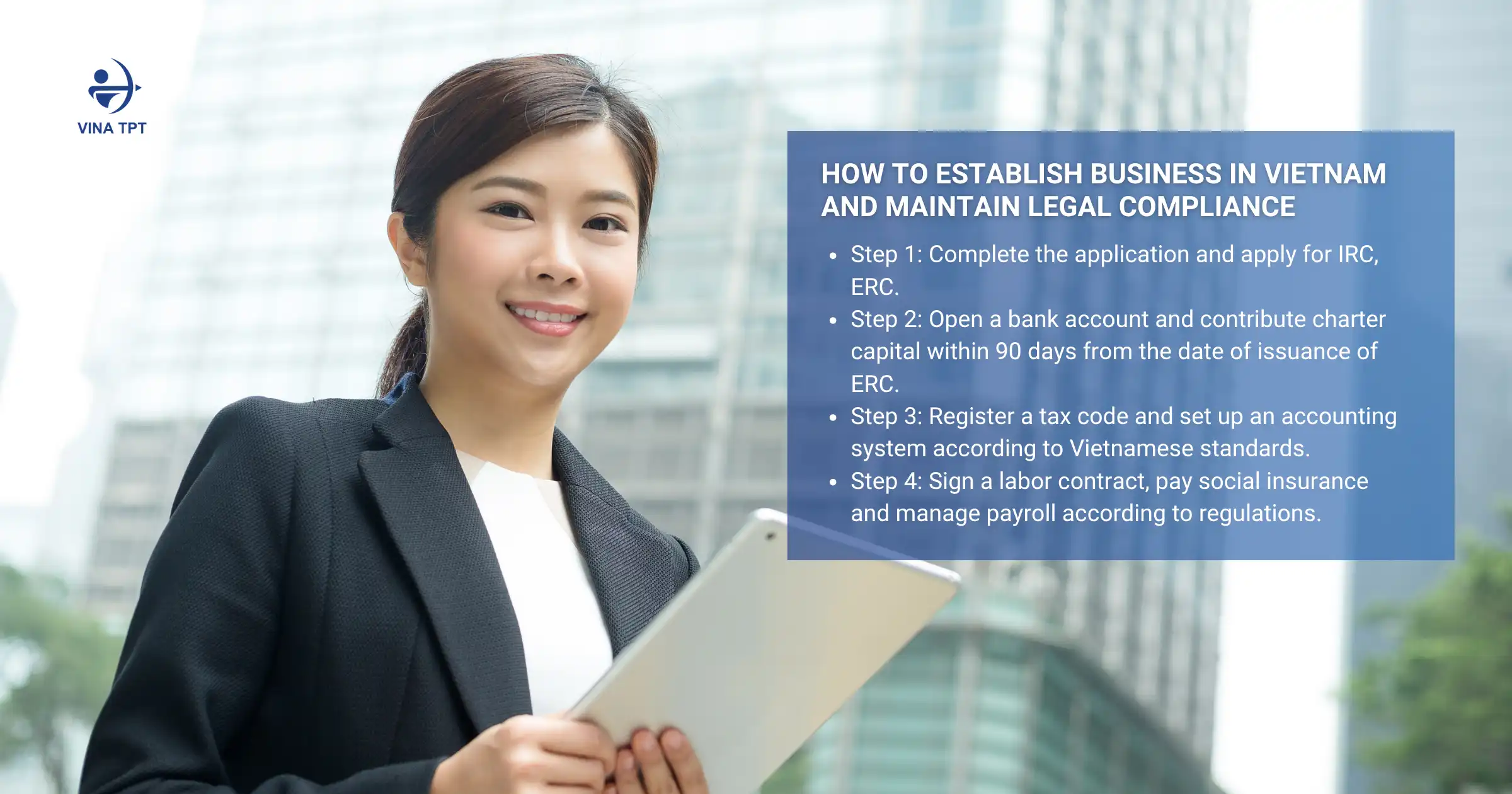
4. How to Establish Business in Vietnam and Maintain Legal Compliance

To successfully establish a business in Vietnam, investors need to take the following important steps:

Step 1: Complete the application and apply for Business License in Vietnam IRC, ERC.

If the project has FDI capital, IRC is the first license allowing the investor to implement the project in Vietnam.

The required documents usually include:

  • Application for investment project implementation and Project proposal: stating the objectives, scale, location, investment capital, progress.
  • Proof of the investor’s financial capacity: bank statement, credit contract or collateral.
  • Legal documents of the investor:
    • Individual: Notarized passport, consular legalization.
    • Organization: Business registration certificate or equivalent document, consular legalization.
  • Project location: lease contract or land/office use rights certificate.

After the IRC is granted (or for 100% domestic-owned enterprises), the investor applies for an ERC – an official license for the enterprise to operate, and also the tax code of the company.

The ERC dossier usually includes:

  • Application for enterprise registration.
  • Company Charter: stipulates the organizational structure, powers of members/shareholders, capital ratio and management method.
  • List of members/shareholders and legal representatives: clearly state information, ownership ratio, voting rights.
  • Appointment decision and authorization letter (if any).
  • Capital contribution plan & financial evidence: bank statement or credit contract (especially important for large capital projects).

Step 2: Open a bank account and contribute charter capital within 90 days from the date of issuance of ERC.

Step 3: Register a tax code and set up an accounting system according to Vietnamese standards.

Step 4: Sign a labor contract, pay social insurance and manage payroll according to regulations.

5. Vina TPT Company Registration – Partnering with Korean Electronics Manufacturers for a Sustainable Setup

With more than a decade of experience in investment consulting and business registration services, Vina TPT has successfully assisted hundreds of FDI enterprises, including a large number of Korean electronics manufacturers in establishing and expanding their operations in Vietnam.

Our comprehensive service scope covers every stage of the process — from investment model consulting and legal documentation, to business license application in Vietnam, business license renewal, and regulatory compliance. This integrated approach ensures a smooth and compliant market entry for Korean investors.

Backed by a team of seasoned professionals with in-depth knowledge of Vietnam’s business, tax, and labor laws, Vina TPT provides end-to-end business license advisory and compliance support, helping investors confidently execute their projects while focusing on production growth and long-term success.

Partnering with Vina TPT Business Advisory and Company Registration means more than saving time and costs. It’s about having a trusted local partner who truly understands how to help Korean investors establish, operate, and sustain successful ventures in Vietnam.

Contact Vina TPT for consultation and support on business registration in Vietnam quickly, legally and at optimal cost.

BOOK A FREE CONSULTATION

setting-up-electronics-business-in-Vietnam

Tax Incentive in Vietnam 2025: Comprehensive Guide to Optimize Profits under New CIT Law

Overview of corporate tax incentives in Vietnam 2025 under the new CIT Law

Overview of corporate tax incentives in Vietnam 2025 under the new CIT Law

Tax Incentive: Comprehensive Guide to Corporate Tax Incentives in Vietnam 2025 – Optimize Profits with New CIT Law

With Vietnam’s Corporate Income Tax (CIT) Law 2025 officially in force from October 1, 2025, investors and CFOs are reassessing how to leverage tax incentives to strengthen profitability and compliance.

From 10 – 17% preferential CIT rates to multi-year tax holidays, the new regime gives both domestic and foreign companies more tools to optimize profits but only if you understand the rules.

In this guide, you’ll learn:

  1. What a tax incentive is and why it matters for 2025
  2. The main types of corporate tax incentives available in Vietnam
  3. Key eligibility requirements and risk management
  4. How to prepare and apply effectively with professional support

I. What is a Tax Incentive and Why Do Businesses Need to Know in 2025?

A tax incentive is a government policy designed to reduce or exempt tax liabilities for businesses that invest in targeted sectors or locations, with the aim of encouraging sustainable growth, innovation, and foreign direct investment (FDI).

Under the CIT Law 2025, tax incentives in Vietnam have evolved to:

  • Support the digital economy and green/clean industries.
  • Attract FDI via extended tax breaks and preferential schemes.
  • Motivate companies to reinvest profits inside Vietnam rather than only extracting them.

In today’s competitive ASEAN environment, understanding tax incentives isn’t optional, it’s a survival and growth strategy.

The standard corporate income tax rate remains 20 %. However, preferential rates are flexibly applied:

  • 15 % for enterprises with annual revenue ≤ VND 3 billion
  • 17 % for enterprises with revenue over VND 3 billion up to VND 50 billion
  • In specific cases (e.g., foreign-owned enterprises, cooperatives…) where cost/expense determination is difficult, a direct tax rate on revenue may apply

II. Key 2025 Updates: Major Types of Corporate Tax Incentives in Vietnam

Key Corporate Tax Incentives in Vietnam 2025

1. Expanded deductible expenses under the 2025 CIT Law

Enterprises are now allowed to deduct additional expenses related to scientific research, digital transformation, testing new technologies, emission reduction, and community activities. This aims to create favorable conditions for businesses to pursue sustainable growth and innovation.

2. Incentives by sector, location, and investment project

Investment projects in high-tech sectors such as semiconductor production, AI, data centers, automobile manufacturing, and electronic device production are eligible for a preferential tax rate of 10% for up to 15 years.
Expansion projects applying clean technologies or contributing to environmental improvements may also qualify for tax exemptions or reductions if they meet specific requirements.

3. Clear incentive rules to avoid overlapping

If an enterprise falls under multiple incentive categories, it has the right to choose the most favorable one.
In cases where preferential provisions exist under specialized laws, the 2025 CIT Law will take precedence, except for specially regulated circumstances.

4. Loss carry-forward and Science & Technology Development Fund

Enterprises are allowed to carry forward losses continuously for up to 5 years.
They may allocate up to 20% of annual taxable income to establish a Science & Technology Development Fund, provided it is used for the correct purposes.

To explore how our consulting team can help you secure and optimize CIT incentives effectively, visit our dedicated Tax Consulting Service page for more details.

Explore Tax Consulting Services

III. Common Mistakes and How to Avoid – Plus Profit Optimization

Even with the best intentions, many businesses still miss out on their tax incentive benefits due to simple yet costly mistakes. Below are the most common pitfalls and how to fix them effectively.

  1. Late or incomplete applications: One of the most frequent issues arises from delayed or missing documentation.
    How to avoid: Ensure all required forms and supporting evidence are submitted before your project begins generating income to maintain eligibility.
  2. Ignoring Permanent Establishment (PE) rules: With the 2025 update redefining PE status, overlooking this change can lead to unexpected tax liabilities.
    How to avoid: Reassess your operational and contractual structure under the new PE definition to avoid misclassification.
  3. Overlooking Double Taxation Treaties (DTT): Many foreign investors fail to leverage DTT benefits, leading to duplicate tax payments.
    How to avoid: Coordinate early with professional consultants to utilize DTT relief and minimize cross-border tax exposure.
  4. Unclear bookkeeping and expense tracking: Incomplete financial records can weaken your eligibility for incentives and invite compliance risks.
    How to avoid: Implement digital accounting and reporting systems to ensure transparency and traceability.
  5. No profit optimization strategy: Securing an incentive is only the first step, maximizing its impact requires strategic planning.
    How to avoid: Partner with Vina TPT’s tax consultants to align your incentive structure with long-term financial goals and ROI optimization.

IV. What Should Businesses Prepare to Seize Opportunities from the 2025 CIT Law?

To stay ahead of regulatory changes and fully capitalize on new incentives, businesses must prepare proactively and strategically:

  • Review and assess impact: Conduct a detailed analysis of current financial performance, income, expenses, and business operations. Identify any necessary adjustments to comply with the new Corporate Income Tax (CIT) Law.
  • Understand eligibility criteria for incentives: Study the specific requirements for benefiting from the 2025 CIT incentives. Ensure your business meets all conditions before submitting any application.
  • Update accounting and financial systems: Make sure your accounting software and bookkeeping procedures comply with new regulations on revenue and expense recognition.
  • Train internal teams: Equip your finance and accounting personnel with updated knowledge through training sessions or specialized CIT 2025 courses.
  • Seek expert consultation: Engaging professional tax advisors is a smart move to avoid compliance risks and legally optimize your tax obligations.

Instead of navigating complex tax regulations on your own, you can connect directly with VINA TPT – trusted partner specializing in tax, accounting, and financial consulting ready to support your business in maximizing benefits under the 2025 CIT Law.

Conclusion

Tax incentives in Vietnam are more than just government policy, they’re a strategic growth lever for businesses preparing to thrive in the 2025 landscape.

Key takeaways:

  • Vietnam offers preferential CIT rates of 10 – 17% for up to 30 years.
  • Incentives now extend to green, digital, and financial sectors.
  • Compliance and timing remain critical to securing approval.

V. Why Partnering with Vina TPT Is the Most Effective Way to Leverage Tax Incentives?

The 2025 CIT incentives offer substantial opportunities to reduce tax burdens and enhance profits, but leveraging them effectively isn’t always simple. Businesses must interpret complex eligibility criteria, prepare accurate documentation, and meet strict compliance deadlines. Without expert guidance, it’s easy to miss optimal incentive schemes or face regulatory risks. That’s why partnering with a professional tax consulting firm becomes a strategic advantage.

Vina TPT Tax Service is a trusted advisor to hundreds of FDI and domestic enterprises, including manufacturing, technology, and service companies across Vietnam. Our team consists of senior tax consultants and legal experts with over 15 years of experience in tax planning, accounting compliance, and investment incentives.

We provide end-to-end support, including:

  • Assessing eligibility for tax incentives under the 2025 CIT Law
  • Structuring incentive applications for maximum tax savings
  • Preparing and submitting exemption/reduction dossiers
  • Designing long-term tax strategies aligned with business growth objectives
  • Conducting compliance audits and managing tax risks

With Vina TPT Tax Service, businesses are not only compliant but also positioned to optimize costs and secure sustainable profitability through legally maximized tax benefits.

Contact Vina TPT today and ensure your business fully capitalizes on Vietnam’s 2025 tax incentive opportunities.

Contact Vina TPT for Consultation

Expert-Vietnam-VinaTPT

Business advisory for Singaporean investors establishing real estate businesses in Vietnam

alt="Business advisory services for Singaporean investors entering Vietnam’s real estate market"

business-advisory-services

1. Vietnam Real Estate: The Next Strategic Move for Singapore Investors

Over the past decade, Vietnam has become one of the most dynamic real estate markets in Asia, with rapid urbanization, high housing demand and a boom in industrial zones. In particular, Singapore is a leading financial, investment and business advisory center in the region, is considering Vietnam as a new “profit drop point” in its strategy to expand in Southeast Asia.

Singaporean investors see in Vietnam not only high profit potential, but also an opportunity to participate in a market that is changing strongly in terms of infrastructure, urban planning and Foreign Direct Investment attraction policies. Vietnam, with its affordable land prices, youthful workforce, and fast-growing transport infrastructure including airports, seaports, and metro lines, is emerging as a promising mirror of Singapore in its early development phase.

However, to realize the opportunity, investors need to clearly understand Vietnam’s legal framework, licensing process and tax mechanism – factors that can directly impact the profitability and safety of the project.

2. Before you invest: Understanding Vietnam’s Real Estate Landscape

Real estate in Vietnam is divided into many different types, including: industrial park development, housing projects, offices, resorts, trade – services and logistics. However, not all segments are open to foreign investors.

According to current regulations, investors can:

  • Contribute capital or buy shares in Vietnamese enterprises with existing real estate projects.
  • Establish a 100% foreign-owned company to develop projects if granted appropriate investment licenses.
  • Lease or sublease land in industrial parks, export processing zones, high-tech zones.

However, direct ownership of land in Vietnam is not allowed, because land is owned by the entire people and managed by the State. Investors can only use land through leasing or joint ventures with domestic partners.

In addition, the tax and regulatory systems related to real estate (VAT, CIT, transfer tax, land fees) also have significant differences compared to Singapore. Lack of understanding or misapplication of investment structures can lead to legal risks or reduced profit efficiency.

At this stage, partnering with a professional business advisory firm becomes essential. A qualified advisory team can help Singaporean investors navigate Vietnam’s complex real estate regulations, review investment structures, and ensure full compliance with local laws. With expert guidance on legal, financial, and tax aspects, investors can make informed decisions and minimize potential risks from the very beginning. Business Advisory

Business advisory for Singaporean investors establishing real estate businesses in Vietnam

3. From Licensing to Launch: Key Steps in Establishing a Real Estate Business

The process of setting up a real estate business in Vietnam usually includes four main stages, requiring close coordination between investors, lawyers and management agencies:

Stage 1: Investment strategy consulting: Business Advisory

Investors need to clearly define their goals (developing new projects, acquiring, cooperating or operating), assess the legal feasibility of the model and choose a locality with appropriate policies.

Stage 2: Applying for an Investment Registration Certificate (IRC):

This is the first license that allows foreign-invested enterprises to carry out projects in Vietnam.

Documents typically required for IRC application include:

  • Application for investment project implementation & Project proposal: Stating objectives, scope, scale, investment capital, location, and implementation schedule.
  • Proof of investor’s financial capacity: Bank statements, audited financial reports, credit contracts, or collateral documents.
  • Legal documents of the investor:
  • For individuals: Notarized passport, consular legalization.
  • For organizations: Business Registration Certificate or equivalent, consular legalization.
  • Evidence of project location: Office/land lease agreement or land use rights certificate.
  • Power of attorney/authorization letter (if the investor appoints a third party to handle procedures).

Stage 3: Enterprise Establishment (ERC):

After having IRC, investors register to establish an enterprise, determine the type of company (LLC, joint stock or joint venture). Choosing the right model will greatly affect the capital mechanism, voting rights and profit distribution.

Stage 4: Compliance and project implementation:

Enterprises must complete tax, insurance, financial and environmental procedures before officially starting operations. This is also the stage where business advisory services become especially important to ensure that all activities are legal and effective.

All foreign documents must be consular legalized and officially translated into Vietnamese before submission. This step often prolongs the preparation process, so it is recommended that investors cooperate with a reliable company registration service to ensure accuracy and save time.

4. Tax Business Advisory: Maximizing Profitability through Smart Structuring

In real estate investment, tax optimization and smart business structure are decisive factors for net profit. Vietnam applies corporate income tax (CIT) at 20%, but there are tax incentives for investment projects in industrial parks, economic zones or investment-encouraged sectors (logistics, infrastructure, social housing, etc.).

In addition, if investors know how to structure capital flows and divide profits reasonably, they can avoid double taxation between Vietnam and Singapore thanks to the Double Taxation Avoidance Agreement (DTA) signed by the two countries. This is a great advantage, but it can only be maximized when there is a business tax advisory team that understands both tax systems.

Vina TPT experts often advise Singaporean investors about business advisory on multi-level legal entity structure strategies, cash flow allocation and legal profit transfer, to ensure optimal profits while still strictly complying with regulations in Vietnam.

OPTIMIZE YOUR TAX STRUCTURE NOW

5. Common Mistakes Foreign Real Estate Investors Should Avoid

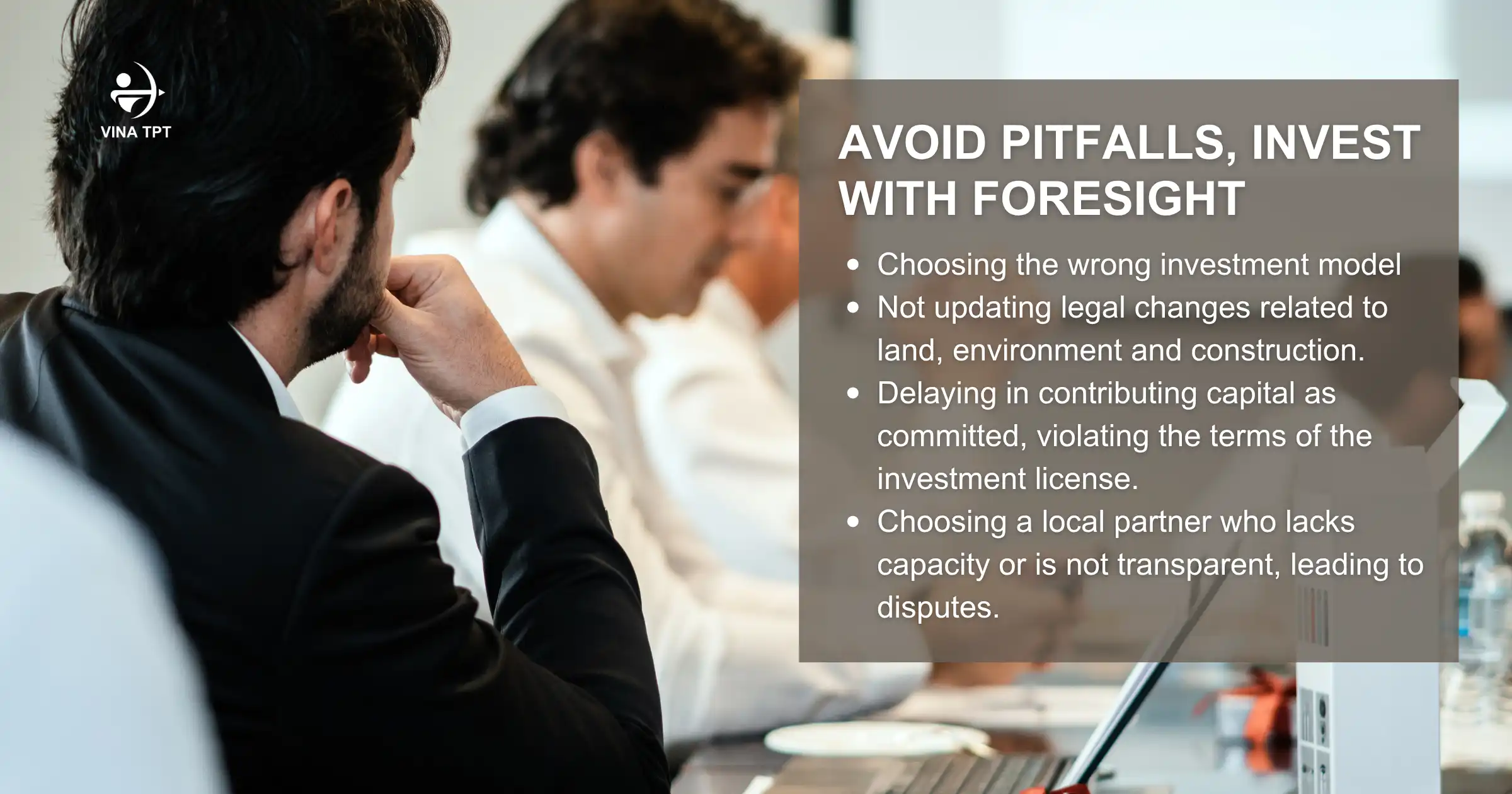
Despite the wide-open opportunities, many foreign investors including large corporations, have encountered trouble when investing in Vietnamese real estate due to common mistakes. Some typical mistakes include:

  • Choosing the wrong investment model (for example, registering a trading company instead of a project development company, leading to restrictions on land use).
  • Not updating legal changes related to land, environment and construction.
  • Delaying in contributing capital as committed, violating the terms of the investment license.
  • Choosing a local partner who lacks capacity or is not transparent, leading to disputes.

An excellent business advisory service will help investors avoid these mistakes right from the start, thanks to legal review, partner assessment and risk control throughout the investment process. 

Business advisory for Singaporean investors establishing real estate businesses in Vietnam

6. Why Partnering with Vina TPT Business Advisory Makes a Difference 

With over 15 years of experience in advising companies, Vina TPT Business Advisory Service’s team of legal, accounting and tax experts has worked with hundreds of international enterprises in the real estate, infrastructure and manufacturing sectors.

We provide end-to-end solutions, from developing investment strategies, applying for IRC/ERC licenses, advising on tax structures, to compliance management and post-investment operational accounting. Vina TPT’s strength lies in combining a deep understanding of Vietnamese law with international operational standards, helping Singaporean investors ensure compliance while optimizing profits.

If you are looking for a business consulting partner with market knowledge and the ability to handle everything from legal to tax, Vina TPT Business Advisory is the reliable bridge between Singapore and Vietnam.

BOOK A FREE CONSULTATION

business-advisory-services

Comprehensive Tax and Compliance Services for Businesses in Vietnam

Business consultant providing corporate tax service and compliance support

Business consultant providing corporate tax service and compliance support

1. Vietnam Tax & Compliance Overview

The tax environment and legal system in Vietnam are currently in a dynamic phase of updates, covering areas such as value added tax (VAT), corporate income tax (CIT), personal income tax (PIT), financial reporting standards, and electronic filing procedures. These ongoing changes make maintaining tax compliance a significant challenge for all businesses, especially FDI companies and newly established startups. Even minor mistakes in tax declaration or late payments can result in administrative fines, tax arrears, or surprise inspections by regulatory authorities.

For FDI enterprises, the documentation requirements are often more complex, as they must comply simultaneously with Vietnamese accounting standards (VAS) and international standards (IFRS), while also fulfilling regulations related to reporting foreign investment capital. Meanwhile, startups often face limited resources, lack specialized accounting teams, or have incomplete internal control processes. Managing taxes, preparing financial statements, and performing electronic tax filings without professional support can easily lead to common errors such as reporting incorrect indicators, omitting valid expenses, or calculating tax amounts incorrectly.

Using tax services, tax compliance services or full-package services such as accounting & tax services is the optimal solution to help businesses minimize risks and ensure full compliance with Vietnamese tax laws. A professional unit will support from tax code registration, monthly/quarterly tax reporting, implementing tax filing service Vietnam, to checking and periodically comparing books. In addition, tax compliance services also help businesses promptly update changes in tax policies, optimize reasonable CIT costs, prepare annual tax settlement documents and provide transparent data for audits.

2. Key Business Taxes & Compliance Requirements

2.1 Corporate & Operational Taxes

The main taxes that businesses in Vietnam must comply with include:

  • Corporate Income Tax (CIT): Corporate income tax with a common tax rate of 20%, requiring quarterly or annual declaration and payment.
  • Value- Added Tax (VAT): Value added tax applied to most goods and services, requiring electronic invoices and periodic reporting.
  • Foreign Contractor Tax (FCT): Applied to transactions with foreign contractors, requiring complex calculation and declaration processes.

And some other types of taxes depending on the industry and business activities, for example: import and export dutiestax,Natural Resources Tax resource tax, special consumption tax Land and Water Surface Rental, Transfer Pricing Taxation,…

A reputable tax compliance service will assist businesses in reviewing documents, preparing declarations and submitting them on time, avoiding the risk of being fined or collected.

2.2 Employee-Related Taxes

In addition to operating taxes, businesses must also manage:

  • Personal Income Tax (PIT): Personal income tax for employees, requiring monthly or quarterly deductions and declarations.
  • Social Insurance, Health Insurance, Unemployment Insurance: Obligation to pay compulsory social insurance and health insurance according to the provisions of the Labor Law.

Combining tax compliance service with the human resource management system – payroll helps businesses control tax and insurance deductions accurately, limiting risks of periodic inspections.

Download Vietnam Tax Handbook - Japanese Edition

3. Tax Compliance & Tax Filing Service

To operate legally and avoid the risks of late payment penalties or tax arrears, all businesses in Vietnam – from startups, SMEs to FDI companies – must fully comply with tax compliance and tax filing service Vietnam in accordance with the regulations of the tax authorities. This compliance includes many important obligations such as registering for a tax code, preparing and submitting monthly/quarterly tax declarations, annual financial statements, finalizing corporate income tax (CIT) and personal income tax (PIT), as well as paying social insurance, health insurance and union fees.

In reality, the tax declaration and payment process in Vietnam is quite complicated and requires absolute accuracy. Businesses need to clearly understand the deadlines for submitting each type of tax: VAT and PIT declarations are usually submitted monthly or quarterly, CIT reports and financial statements must be completed by the end of the fiscal year, while specific taxes such as Foreign Contractor Tax (FCT) can arise suddenly depending on business activities. Just a small error in tax calculation, reporting targets or late submission of documents can also lead to administrative fines, penalty interest or being subject to tax inspection.

Using a professional tax service or tax compliance service helps businesses significantly reduce this pressure. A reputable service provider will support from the stage of preparing documents, reviewing documents, to implementing tax filing service Vietnam on time on the electronic system of the General Department of Taxation. At the same time, accounting & tax service also acts as an internal control solution, helping businesses promptly update changes in tax laws, optimize deductions, and minimize the risk of being overcharged during settlement periods.

For FDI companies, combining tax compliance services with specialized consulting services like Vina TPT tax service is especially important because it must ensure both Vietnamese accounting standards (VAS) and international standards (IFRS). Vina TPT not only declares and pays taxes on time but also advises on long-term tax strategies, helps businesses optimize CIT, manage PIT for foreign employees, and prepare documents ready for audit or inspection. This is the foundation for businesses to maintain financial transparency and develop sustainably in Vietnam’s increasingly strict legal environment.

OPTIMIZE YOUR TAX STRATEGY

4. Integrated Accounting & Tax Service for Sustainable Growth

To achieve sustainable growth in a competitive and constantly changing business environment, businesses need an integrated accounting & tax service solution – a close combination of accounting service Vietnam and tax compliance service. This service not only ensures the preparation of financial statements according to Vietnamese Accounting Standards (VAS) or International Financial Reporting Standards (IFRS), but also includes in-depth analysis of cash flow management, cost optimization and preparation of documents for independent audit or tax inspection.

The synchronization between accounting and tax helps businesses:

  • Reduce the burden of legal compliance: All financial reports, tax declarations, corporate income tax (CIT) and personal income tax (PIT) finalizations are performed accurately and on time, avoiding the risk of late payment penalties or arrears.
  • Increase financial transparency: Consistent accounting and tax data support the management in making decisions based on actual data, thereby building long-term business plans and effective investment strategies.
  • Optimize operating costs and taxes: Experts can advise on appropriate deductions, cost control, cash flow allocation, and take advantage of tax incentives allowed by Vietnamese law.

Especially for FDI companies or startups, integrated accounting and tax solutions bring outstanding advantages when it comes to cross-border reporting for parent corporations, preparing consolidated financial statements, or handling transactions related to transfer pricing. With extensive experience, Vina TPT accounting & tax service not only performs accurate operations but also provides strategic advisory to help businesses maintain compliance, protect reputation, and develop sustainably in the Vietnamese market.

5. How Vina TPT Delivers Smarter Tax Compliance Service

Vina TPT tax service provides a comprehensive solution, helping businesses handle all procedures from tax code registration, declaration, preparation of periodic reports to representing work with tax authorities. The team of experts regularly updates the latest tax laws, advises on optimal CIT, VAT and PIT roadmaps suitable for each industry.

The strengths of Vina TPT tax compliance service lie in:

  • Experience in implementing for both domestic and FDI enterprises.
  • Multilingual service (English – Vietnamese – Japanese) suitable for international investors.
  • Transparent electronic processes, timely reporting help businesses easily control costs and risks.

Don’t let tax mistakes affect your business. 

Contact Vina TPT today for advice on a complete accounting & tax service solution and start declaring taxes in Vietnam quickly – accurately – legally.

BOOK A FREE CONSULTATION

Vina TPT Accounting services

Transfer Pricing Regulations and Guidelines for FDI Companies in Vietnam

Transfer pricing regulations and guidelines for FDI companies in Vietnam

Transfer pricing regulations and guidelines for FDI companies in Vietnam

1. Why Transfer Pricing Matters for FDI Companies in Vietnam

Transfer pricing is considered a key factor for Foreign-invested enterprises to plan tax strategies and ensure compliance with Vietnamese law. In fact, these rules greatly affects the way profits are allocated among related parties in many countries around the world. Therefore, if these companies do not strictly manage transfer pricing, this activity will lead to suspicions about profit transfer. This will lead to consequences that make businesses closely monitored by tax authorities. 

In Vietnam, pricing regulations is extremely strictly controlled because it directly affects tax revenue and economic fairness. If Overseas-invested companies do not comply, they will certainly face high risks such as administrative fines, prolonged inspections, and impacts on reputation and relationships with state agencies. Therefore, it can be seen that if those companies comply with good regulations, it will help reduce risks and build reputation and trust with investors and management agencies.

2. When do companies need to prepare

Transfer pricing documents are required when Foreign-capital enterprises conduct related transactions. Related transactions are known as transactions between companies in Vietnam and parent companies, other subsidiaries, or foreign affiliates. Typical examples for a clearer understanding are cross-border sales of goods, provision of internal services within the group, transfer of intellectual property rights, or internal lending.

According to regulations in Vietnam, operating enterprises are required to fully retain the pricing framework documents annually when exceeding the prescribed revenue and transaction value thresholds. This document is evidence proving that transactions comply with the arm’s length principle – that is, transactions are conducted at market prices, as between independent parties. The document plays an extremely important role, because if missing, enterprises will be subject to additional taxes and heavy penalties.

BOOK A TRANSFER PRICING CONSULTATION

3. Key Legal Rules that Every Company Must Know

In Vietnam, transfer pricing activities are regulated by Decree 132/2020/ND-CP and related guiding documents of the Ministry of Finance. This is the legal framework that stipulates the principles of determining related transaction prices, the requirement to prepare transfer pricing documents, and the method of comparison with market prices (arm’s length principle).

Some key points that FDI companies need to pay special attention to include:

  • Revenue & transaction value threshold: Enterprises with total revenue of VND 50 billion or total related transaction value of VND 30 billion or more are required to prepare and store transfer pricing records annually.
  • Required records: Includes 3 levels according to international standards – Local file, Master file and Country by Country Report (CbCR).
  • Submission and storage deadline: The documents must be prepared at the same time as the financial statements and tax declarations, and be ready to be provided when requested by the tax authorities.

Understanding and complying with these regulations not only helps businesses comply with the law but also avoids risks of late payment penalties, tax arrears and in-depth audits from the authorities.

4. How to Prepare for a Transfer Pricing Documents?

To create a complete and accurate transfer pricing document, FDI companies need to implement a process consisting of 4 basic steps:

4.1 Collect related transaction data for Transfer Pricing Documents

Synthesize all contracts, accounting documents, financial reports related to related transactions such as internal goods and services, technology licensing, internal loans, etc.

4.2 Analyze functions and risks 

Determine the role of each party in the transaction (service provider, distributor, R&D, brand management, etc.) to demonstrate reasonable profit margins.

4.3 Compare market prices 

Apply accepted methods (CUP, TNMM, RPM, CPM) to demonstrate that the transaction complies with the arm’s length principle.

4.4 Draft and archive documents 

The documents must clearly show business information, pricing methods, analysis results and reference documents. The storage must be made available upon request from tax authorities or during tax audits.

5. Practical Tips to Stay Compliant Without Penalties

To minimize risks and avoid being overcharged, enterprises need to proactively review internal transactions periodically, ideally quarterly or semi-annually, in order to make timely adjustments before the reporting period. At the same time, data synchronization between departments such as accounting, finance and legal plays a key role in ensuring that all information and related-party transaction contracts are updated accurately and consistently. 

In addition, cooperating with consulting units with knowledge of Vietnamese law and international standards such as Vina TPT helps enterprises prepare complete documents and receive in-depth consultation before determining the transfer price. 

This proactive approach not only helps enterprises maintain compliance, avoid administrative fines but also strengthens the image of transparency and reputation with management agencies.

6. Partnering with Vina TPT for Smooth Management

With more than 10 years of experience supporting Foreign Direct Investment Companies in Vietnam, Vina TPT tax audit support provides consulting services and prepares documents according to international standards, and supports businesses during tax audits.

Outstanding benefits when cooperating with Vina TPT:

  • Consulting on optimal transfer pricing strategies, minimizing tax risks.
  • Preparing a complete set of transfer pricing documents (Local file, Master file, CbCR) in accordance with regulations and on time.
  • Representing businesses in meetings with tax authorities, helping the inspection and examination process take place quickly and transparently.

Accompanying Vina TPT, every company can focus on business activities with peace of mind, while ensuring compliance with legal regulations in Vietnam.

BOOK A FREE CONSULTATION

Vina TPT Accounting services