Vietnam Transfer Pricing: Essential Overview under Decree 132/2020

transfer pricing vietnam

Foreign direct investment (FDI) enterprises and multinational corporations operating in Vietnam operate under strict regulatory scrutiny regarding Transfer Pricing Vietnam compliance. The General Department of Taxation actively identifies profit shifting, scrutinizes cross-border transactions, and targets artificial margin compression. 

At the center of this enforcement architecture stands Decree 132/2020/ND-CP, which establishes rigorous documentation standards aligned with the OECD’s Base Erosion and Profit Shifting (BEPS) Action 13 framework. Navigating these requirements demands meticulous preparation: failure to maintain compliant contemporaneous files exposes taxpayers to severe tax reassessments, aggressive expense disallowance, and statutory penalties. 

Key Takeaways for Taxpayers: 

  • Decree 132 applies to all domestic and cross-border related-party transactions (RPTs). 
  • Net interest expense deductions are capped at 30% of EBITDA across all debt instruments once RPTs exist. 
  • Compliance mandates both annual disclosure forms and a contemporaneous three-tiered documentation package. 
  • Missing filing deadlines or presenting unverified benchmarks allows tax authorities to adjust profits directly to the median range.

1. Regulatory Framework & Key Triggers Under Decree 132

Vietnam’s transfer pricing regime operates strictly under the principle of substance-over-form. Decree 132/2020/ND-CP regulates how associated enterprises determine transaction prices, allocate operating costs, and establish taxable income for Corporate Income Tax (CIT) purposes. The framework hinges on identifying associated relationships and controlling allowable deductions. 

1.1 How Related-Party Relationships Are Defined 

Under Article 5 of Decree 132, two entities are classified as related parties when one party participates directly or indirectly in the management, control, capital contribution, or financing of the other. Critical legal triggers include: 

  • Equity Ownership Threshold: One enterprise directly or indirectly holds at least 25% of the owner’s equity in the second enterprise. 
  • Financing & Guarantee Exposure: One enterprise guarantees or extends loans to another, provided the loan capital represents at least 25% of the borrowing entity’s equity and constitutes more than 50% of its total medium- and long-term debts. 
  • Management & Control: An enterprise appoints more than 50% of the board of directors or controls key executive decisions of another. 
  • Commercial Dependency: One entity accounts for more than 50% of the total sales or purchase turnover of the other entity under exclusive commercial arrangements. 

Common Audit Trap: Many independent foreign enterprises mistakenly trigger related-party status simply by securing a large commercial bank loan backed by a parent company guarantee, unaware that passing the 25% equity and 50% debt threshold subjects their entire cost structure to Decree 132. 

1.2 The 30% EBITDA Cap on Net Interest Expense 

Under Clause 3, Article 16 of Decree 132/2020/ND-CP, the cap on deductible loan interest expenses is stipulated as follows: 

  • Interest Cap: Total net interest expense (interest expense incurred during the period minus interest income from deposits and loans) deductible for Corporate Income Tax (CIT) purposes shall not exceed 30% of the total net operating profit plus net interest expense and depreciation/amortization expenses (EBITDA). 
  • Negative EBITDA: If the taxpayer’s EBITDA is negative or zero, the entire net interest expense incurred in the period is non-deductible. 
  • Carry-Forward of Disallowed Interest: Any net interest expense exceeding the 30% cap can be carried forward to subsequent tax periods when determining total deductible interest expense. The continuous carry-forward period must not exceed 05 consecutive years, starting from the year following the incurred year. 
  • Excluded Entities: This cap does not apply to credit institutions, insurance enterprises, securities companies, and certain ODA-funded projects or concessional government loans as prescribed by law.

2. Who Must Prepare Documentation? Exemptions and Safe Harbors

Enterprises engaging in related-party transactions must assess their eligibility under the safe harbor provisions of Decree 132 before committing resources to full documentation packages
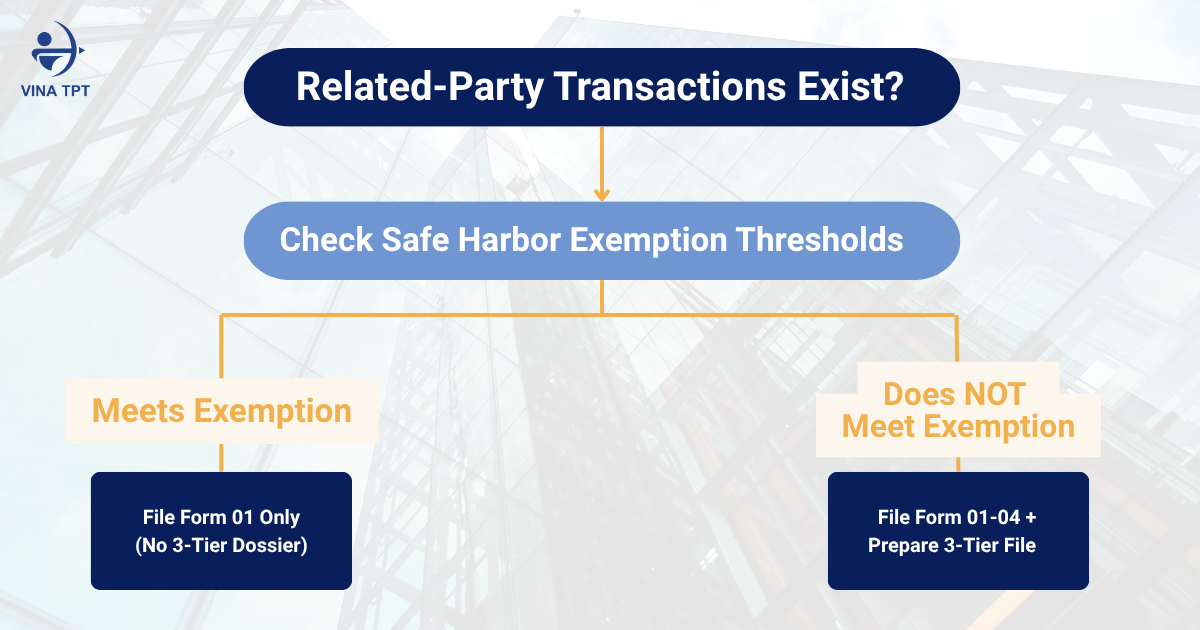
Related-Party Transactions Exist

2.1 Full Exemption Thresholds 

Under Clause 2, Article 19 of Decree 132/2020/ND-CP, taxpayers are exempt from preparing Transfer Pricing Documentation (Local File, Master File, and CbCR) if they qualify under any of the following cases: 

  • Revenue and Transaction Threshold: Total revenue in the tax period is under VND 50 billion and the total value of related-party transactions is under VND 30 billion. 
  • Advance Pricing Agreement (APA): The taxpayer has entered into an APA and submits the required annual APA reports in compliance with applicable regulations. 
  • Simple Business Operations Meeting Margin Thresholds: The taxpayer performs routine functions, incurs no revenue or expenses from intangibles, generates revenue under VND 200 billion, and achieves an operating margin (EBIT to net revenue) of at least:

» 5% for distribution. 

» 10% for manufacturing. 

» 15% for toll processing/contract manufacturing.  

Note: Taxpayers exempt from TP documentation are still required to submit the prescribed TP disclosure forms with their annual CIT return. 

2.2 Form Disclosure vs. Contemporary Documentation 

Taxpayers frequently confuse filing exemptions with complete reporting waivers: 

  • Exempt Taxpayers (Form-Only): Qualifying for a documentation safe harbor waives only the burden of drafting the Local File, Master File, and CbCR. The taxpayer remains legally obligated to declare its related parties and transactions on Form 01 attached to the annual CIT finalization dossier. 
  • Non-Exempt Taxpayers (Full Dossier): Must file the required statutory appendices (Forms 01, 02, 03, and 04) and compile contemporaneous three-tier files prior to the CIT filing date, storing them locally for immediate tax authority audit requests.

3. The Three-Tier Documentation Structure Explained

Decree 132 aligns Vietnam’s compliance rules directly with the OECD BEPS Action 13 three-tiered documentation standard. This integrated structure provides tax authorities with a clear overview from local operations up to global value chains. 

3.1 Local File vs. Master File Requirements 

The Local File and Master File address different operational dimensions of an enterprise: 

Criterion  Local File (Hồ sơ quốc gia)  Master File (Hồ sơ tập đoàn toàn cầu) 
Primary Scope  Entity-level activities within Vietnam.  Global operations of the multinational group (MNE). 
Core Content  • Detailed Functional, Asset, and Risk (FAR) analysis. 


• Local management structure and business strategy. 


• Intercompany pricing agreements and material transaction values. 


• Financial reconciliations and local economic benchmarking studies. 


• Global organizational structure and geographical presence. 


• Five primary drivers of group profitability. 


• Intangible asset (IP) development and ownership strategies. 


• Intercompany financial arrangements and treasury policies. 


• Consolidated financial statements. 


Source of Preparation  Formulated directly by the Vietnamese subsidiary and local tax advisors.  Drafted by the global ultimate parent entity and localized for submission in Vietnam. 

3.2 Country-by-Country Reporting (CbCR) 

Country-by-Country Reporting (Báo cáo lợi nhuận liên quốc gia) maps where value, employees, assets, and tax liabilities sit across worldwide tax jurisdictions. 

  • Reporting Threshold: Mandated for multinational groups with consolidated global revenue of at least VND 18,000 billion (approx. EUR 750 million) in the preceding tax period. 
  • Filing Obligations for Vietnamese Subsidiaries: If the Ultimate Parent Entity (UPE) is located in a foreign jurisdiction that has an effective Automatic Exchange of Information (AEOI) treaty with Vietnam, the local subsidiary only needs to file a formal notification letter. If no functional exchange agreement exists, or if the UPE fails to file, the Vietnamese entity must submit the CbCR copy directly to the local tax department. 

BOOK A FREE CONSULTATION

4. Benchmarking Methodology: Establishing the Arm’s Length Range

A transfer pricing study relies on an Economic Analysis that proves all intercompany pricing reflects independent market outcomes (the Arm’s Length Principle). 

4.1 Common Transfer Pricing Methods in Vietnam 

Decree 132 outlines five formal pricing methods: 

  • Comparable Uncontrolled Price (CUP) Method: Directly compares transaction prices to external or internal market prices; standard for commodities and plain vanilla financing. 
  • Resale Price Method (RPM): Evaluates gross margins earned in related purchases against resale to independent parties; best for routine distributors. 
  • Cost Plus Method (CPM): Adds an appropriate gross markup to direct and indirect production costs; ideal for contract manufacturers and routine service providers. 
  • Transactional Net Margin Method (TNMM): Examines operating profit relative to an appropriate base (costs, sales, or assets). TNMM is the most common method in Vietnam because local contract manufacturers and toll processors rarely possess reliable public gross-margin data or exact product-level comparables. 
  • Profit Split Method (PSM): Allocates combined operating profit from complex, integrated transactions where both parties contribute unique intangibles. 

4.2 Database Screening & Interquartile Range 

In accordance with Articles 17 and 18 of Decree 132/2020/ND-CP, the three-step screening and calculation process to determine the arm’s length range is conducted as follows: 

  • Quantitative Screening: Automatic filtering via commercial databases based on industry classification codes (SIC/NACE), comparable geographic markets, active operational status (at least 3 consecutive operating years), minimum revenue thresholds, availability of sufficient financial data, and verified independence (related-party ownership below 25%). 
  • Qualitative Screening: Manual review of annual reports, financial statements, company websites, and business descriptions to assess comparability in Functions, Assets, and Risks (FAR analysis). Companies engaged in diversified operations without segmented data or possessing unique, valuable intangibles are rejected. 
  • Calculation of the Arm’s Length Range: Profit Level Indicators (such as OP/OR, Berry Ratio, or OP/TC) of the accepted comparable companies are compiled, excluding entities with extreme or persistent losses. Under Decree 132, the standard arm’s length range is determined using the interquartile method, spanning from the 25th percentile ($Q_1$) to the 75th percentile ($Q_3$), with the median value serving as the primary benchmark. 

Common Transfer Pricing Methods in Vietnam

 5. Compliance Timelines, Penalties, and Audit Red Flags

Transfer pricing compliance requires strict adherence to statutory deadlines and proactive risk management to avoid audits. 

5.1 Submission Deadlines and Inspection Timelines 

  • Statutory Filing Deadline: Transfer pricing disclosure forms (Forms 01 to 04) must be submitted along with the annual Corporate Income Tax finalization return no later than the last day of the 3rd month following the close of the calendar/financial year (typically March 31). 
  • Documentation Availability: Three-tier transfer pricing files must be completed and stored contemporaneously prior to the tax filing date. 
  • Inspection Response Window: Upon receiving a formal written demand from tax authorities: 
  • Taxpayers have 30 business days to deliver the complete transfer pricing documentation during standard audits. 
  • The timeline drops to 15 business days during pre-audit consultation proceedings. 
  • Language Requirement: Documentation must be provided in Vietnamese. Master files or transaction agreements drawn up in foreign languages must include verified Vietnamese translations when requested. 

5.2 Audit Triggers and Consequences of Non-Compliance 

Tax bureaus use data-driven algorithms to flag high-risk taxpayers. Common audit triggers include: 

  • Reporting consecutive multi-year operating losses while continuing to expand local production footprints or report surging revenues. 
  • Maintaining profit margins significantly lower than the benchmarked industry average in the same province. 
  • Making substantial royalty, software license, or management fee payments to offshore affiliates in low-tax jurisdictions. 
  • Unbalanced functional and asset profiles (e.g., operating as an asset-heavy toll manufacturer while absorbing all inventory risks). 

6. Comprehensive Transfer Pricing Advisory Services by Vina TPT

Navigating Decree 132 requires local tax insight, economic modeling expertise, and defendable empirical benchmarks. Vina TPT provides specialized transfer pricing solutions that protect multinational enterprises from tax adjustments while ensuring operational compliance across Vietnam. 

End-to-End Transfer Pricing Compliance Solutions by Vina TPT 

  • Diagnostic TP Risk Reviews (Health Check): Auditing existing related-party structures, intercompany contracts, and commercial terms to highlight adjustment exposures before authorities launch an audit. 
  • Three-Tier Dossier Preparation: Drafting compliant, localized Local Files, Master Files, and statutory disclosures (Forms 01 through 04) tailored to your operational realities in Vietnam.
  • Defensible Economic Benchmarking: Accessing certified global financial databases to develop verifiable, robust peer groups that withstand rigorous scrutiny from local tax offices.
  • Supply Chain Restructuring & APAs: Structuring intercompany transaction flows, intangibles licensing, and negotiating Advance Pricing Agreements (APAs) with the General Department of Taxation. 

Audit Defense Support & Consultation Process 

When tax authorities challenge your documentation, having the right team beside you makes all the difference. Vina TPT works alongside your internal finance teams during transfer pricing audits by: 

  • Reconciling technical differences directly with tax audit teams. 
  • Defending functional characterizations and screening criteria. 
  • Preventing arbitrary adjustments to the median range. 

Mitigating tax exposure through early transfer pricing compliance is vastly superior to managing retrospective tax adjustments. Partner with Vina TPT today to evaluate your risk profile and secure a customized compliance roadmap for your enterprise. 

BOOK A FREE CONSULTATION

Transfer Pricing Regulations and Guidelines for FDI Companies in Vietnam

Transfer pricing regulations and guidelines for FDI companies in Vietnam

Transfer pricing regulations and guidelines for FDI companies in Vietnam

1. Why Transfer Pricing Matters for FDI Companies in Vietnam

Transfer pricing is considered a key factor for Foreign-invested enterprises to plan tax strategies and ensure compliance with Vietnamese law. In fact, these rules greatly affects the way profits are allocated among related parties in many countries around the world. Therefore, if these companies do not strictly manage transfer pricing, this activity will lead to suspicions about profit transfer. This will lead to consequences that make businesses closely monitored by tax authorities. 

In Vietnam, pricing regulations is extremely strictly controlled because it directly affects tax revenue and economic fairness. If Overseas-invested companies do not comply, they will certainly face high risks such as administrative fines, prolonged inspections, and impacts on reputation and relationships with state agencies. Therefore, it can be seen that if those companies comply with good regulations, it will help reduce risks and build reputation and trust with investors and management agencies.

2. When do companies need to prepare

Transfer pricing documents are required when Foreign-capital enterprises conduct related transactions. Related transactions are known as transactions between companies in Vietnam and parent companies, other subsidiaries, or foreign affiliates. Typical examples for a clearer understanding are cross-border sales of goods, provision of internal services within the group, transfer of intellectual property rights, or internal lending.

According to regulations in Vietnam, operating enterprises are required to fully retain the pricing framework documents annually when exceeding the prescribed revenue and transaction value thresholds. This document is evidence proving that transactions comply with the arm’s length principle – that is, transactions are conducted at market prices, as between independent parties. The document plays an extremely important role, because if missing, enterprises will be subject to additional taxes and heavy penalties.

BOOK A TRANSFER PRICING CONSULTATION

3. Key Legal Rules that Every Company Must Know

In Vietnam, transfer pricing activities are regulated by Decree 132/2020/ND-CP and related guiding documents of the Ministry of Finance. This is the legal framework that stipulates the principles of determining related transaction prices, the requirement to prepare transfer pricing documents, and the method of comparison with market prices (arm’s length principle).

Some key points that FDI companies need to pay special attention to include:

  • Revenue & transaction value threshold: Enterprises with total revenue of VND 50 billion or total related transaction value of VND 30 billion or more are required to prepare and store transfer pricing records annually.
  • Required records: Includes 3 levels according to international standards – Local file, Master file and Country by Country Report (CbCR).
  • Submission and storage deadline: The documents must be prepared at the same time as the financial statements and tax declarations, and be ready to be provided when requested by the tax authorities.

Understanding and complying with these regulations not only helps businesses comply with the law but also avoids risks of late payment penalties, tax arrears and in-depth audits from the authorities.

4. How to Prepare for a Transfer Pricing Documents?

To create a complete and accurate transfer pricing document, FDI companies need to implement a process consisting of 4 basic steps:

4.1 Collect related transaction data for Transfer Pricing Documents

Synthesize all contracts, accounting documents, financial reports related to related transactions such as internal goods and services, technology licensing, internal loans, etc.

4.2 Analyze functions and risks 

Determine the role of each party in the transaction (service provider, distributor, R&D, brand management, etc.) to demonstrate reasonable profit margins.

4.3 Compare market prices 

Apply accepted methods (CUP, TNMM, RPM, CPM) to demonstrate that the transaction complies with the arm’s length principle.

4.4 Draft and archive documents 

The documents must clearly show business information, pricing methods, analysis results and reference documents. The storage must be made available upon request from tax authorities or during tax audits.

5. Practical Tips to Stay Compliant Without Penalties

To minimize risks and avoid being overcharged, enterprises need to proactively review internal transactions periodically, ideally quarterly or semi-annually, in order to make timely adjustments before the reporting period. At the same time, data synchronization between departments such as accounting, finance and legal plays a key role in ensuring that all information and related-party transaction contracts are updated accurately and consistently. 

In addition, cooperating with consulting units with knowledge of Vietnamese law and international standards such as Vina TPT helps enterprises prepare complete documents and receive in-depth consultation before determining the transfer price. 

This proactive approach not only helps enterprises maintain compliance, avoid administrative fines but also strengthens the image of transparency and reputation with management agencies.

6. Partnering with Vina TPT for Smooth Management

With more than 10 years of experience supporting Foreign Direct Investment Companies in Vietnam, Vina TPT tax audit support provides consulting services and prepares documents according to international standards, and supports businesses during tax audits.

Outstanding benefits when cooperating with Vina TPT:

  • Consulting on optimal transfer pricing strategies, minimizing tax risks.
  • Preparing a complete set of transfer pricing documents (Local file, Master file, CbCR) in accordance with regulations and on time.
  • Representing businesses in meetings with tax authorities, helping the inspection and examination process take place quickly and transparently.

Accompanying Vina TPT, every company can focus on business activities with peace of mind, while ensuring compliance with legal regulations in Vietnam.

BOOK A FREE CONSULTATION

Vina TPT Accounting services

Mastering Internal Accounting Skills for FDI Companies in Vietnam

accounting skills

accounting skills

1. Why FDI Companies Struggle with Internal Accounting in Vietnam

Foreign Direct Investment (FDI) companies bring international expertise, modern technologies, and capital into Vietnam. However, when it comes to internal accounting and the accounting skills required to meet both local and international standards, many enterprises find themselves navigating an unfamiliar landscape. The root causes of these struggles can be categorized into three main areas.

1.1 Differences in Accounting Standards

One of the biggest challenges is the gap between Vietnamese Accounting Standards (VAS) and International Financial Reporting Standards (IFRS). While IFRS emphasizes transparency and fair value measurement, VAS is more rules-based and focuses on historical cost. This difference often creates confusion for multinational finance teams that are accustomed to global practices. Companies operating across multiple jurisdictions often need dual reporting systems, which increases complexity and cost.

1.2 Regulatory Complexity and Compliance Burden

Vietnamese tax regulations are subject to frequent updates. Circulars and decrees from the Ministry of Finance may significantly alter reporting requirements. For Foreign-invested enterprises, keeping up with these changes while ensuring compliance is resource-intensive. This is particularly critical since any misstep in compliance can lead to financial penalties and reputational risks.

1.3 Talent Gaps in Internal Accounting Teams

Despite Vietnam’s growing talent pool, there remains a shortage of accountants who are equally proficient in both local standards and international practices. Many internal teams lack the experience to handle cross-border transactions, intercompany reconciliations, and transfer pricing documentation. This talent gap makes it difficult for Foreign-invested enterprises firms to establish strong internal accounting functions.

Optimize Your Accounting Today

2. Building a Solid Foundation of Local Accounting Knowledge

For FDI businesses, success begins with a deep understanding of local accounting practices. Internal teams must not only learn the technical aspects of VAS but also grasp the cultural and operational nuances of doing business in Vietnam.

2.1 Mastering Vietnamese Accounting Standards

FDI companies should prioritize training sessions for their accounting staff to build expertise in VAS. This includes familiarity with chart of accounts, revenue recognition methods, and local expense allocation rules. By mastering VAS, internal teams can reduce reporting errors and create a solid bridge to IFRS-based reporting.

2.2 Understanding Local Taxation Principles

Knowledge of Vietnam’s tax system is equally essential. From corporate income tax (CIT) and value-added tax (VAT) to personal income tax (PIT), each element requires careful management. Internal accountants who are well-versed in these principles can optimize tax planning strategies while ensuring compliance with regulations published by the General Department of Taxation.

3. Essential Skills to Manage Complex FDI Transactions

The complexity of Foreign Direct Investment operations demands specialized skills in managing cross-border and multi-currency transactions. Internal accounting teams must go beyond bookkeeping and become strategic partners in financial management.

3.1 Transfer Pricing Management

Transfer pricing is one of the most sensitive areas in Foreign Direct Investment accounting. Internal teams must be capable of preparing proper transfer pricing documentation and benchmarking studies, ensuring compliance with Decree 132/2020/ND-CP. Failure to meet requirements could result in significant fines or tax adjustments.

3.2 Multi-Currency and Intercompany Transactions

Enterprises often deal with transactions in multiple currencies, requiring skills in foreign exchange management and consolidation. Internal accountants need to understand how currency fluctuations impact both profit margins and tax liabilities. Case studies from companies like Intel Vietnam highlight how effective foreign currency management safeguards profits in volatile markets.

3.3 Advanced Financial Reporting

Internal accounting teams should also be trained to prepare consolidated financial statements that align both with VAS and IFRS. This skill enables management to make informed decisions while also meeting reporting obligations in home countries.

accounting skills

4. Strengthening Internal Controls While Ensuring Compliance

Strong internal controls are the backbone of reliable financial management. For Foreign Direct Investment companies, this means establishing processes that prevent fraud, reduce errors, and guarantee compliance.

4.1 Risk-Based Internal Audits

An effective internal audit function ensures that accounting records are accurate and compliant. Internal teams must develop auditing skills that go beyond formality, focusing on risk-based audits that highlight vulnerabilities in financial processes.

4.2 Compliance with Local and International Regulations

Internal accountants must be trained to monitor compliance with both Vietnamese laws and international frameworks such as the OECD transfer pricing guidelines. According to the OECD, aligning local practices with global standards helps multinational corporations mitigate risks and maintain investor confidence.

4.3 Technology-Enabled Controls

Implementing enterprise resource planning (ERP) systems strengthens internal controls by automating reconciliations and approvals. Companies like Samsung Vietnam have successfully deployed SAP ERP to streamline compliance reporting and reduce manual errors.

Book Expert Guidance

5. Preparing Accounting Teams for Future Growth

As Vietnam continues to attract large-scale FDI projects, internal accounting skills must evolve to meet future demands.

5.1 Continuous Professional Development

Foreign-invested enterprises should encourage their internal accounting staff to pursue certifications such as CPA Vietnam, ACCA, or CMA. These qualifications equip accountants with the knowledge to manage increasingly complex operations.

5.2 Building Multidisciplinary Teams

The future of FDI accounting will require collaboration between finance, legal, and operational experts. Internal accountants must be capable of working cross-functionally, ensuring financial decisions align with overall business strategies.

5.3 Anticipating Regulatory Shifts

Vietnam is preparing for gradual convergence with IFRS, expected to become mandatory in coming years. Internal teams that prepare early for this transition will ensure smoother adaptation and minimize disruption.

6. Turning Internal Accounting Skills into Value with Vina TPT

While building internal accounting skills is essential, many companies still need external guidance to accelerate the process. This is where Vina TPT’s internal accounting services provide a competitive advantage.

With decades of experience serving Foreign Direct Investment enterprises, Vina TPT offers:

  • Training programs that strengthen internal accounting capabilities.
  • Advisory on VAS-IFRS convergence and compliance.
  • Tailored solutions for transfer pricing, internal audits, and financial reporting.

By partnering with Vina TPT, Foreign Direct Investment companies transform internal accounting from a compliance burden into a strategic driver of growth. This partnership ensures that internal teams are not only capable of managing current challenges but are also prepared for the evolving financial landscape in Vietnam.

accounting skills